NBSE Class 12 Question Paper 2022 Chemistry
Finished viewing? Save it for later —
Download NBSE Class 12 Question Paper 2022 Chemistry (PDF · 4 pages)About NBSE Class 12 Question Paper 2022 Chemistry
NBSE Class 12 Question Paper 2022 Chemistry is available here for free download. Published by Nagaland Board for Class 12, this question paper can be viewed online or downloaded as a PDF (4 pages). Candidates preparing for Class 12 can use NBSE Class 12 Question Paper 2022 Chemistry to understand the exam pattern, the type of questions asked, and the overall difficulty level.
Frequently Asked Questions
How can I download NBSE Class 12 Question Paper 2022 Chemistry?
Open this page and click the Download button to save NBSE Class 12 Question Paper 2022 Chemistry as a PDF. It is completely free on AglaSem Docs.
Is NBSE Class 12 Question Paper 2022 Chemistry free to download?
Yes. NBSE Class 12 Question Paper 2022 Chemistry can be viewed online and downloaded as a PDF free of cost on AglaSem Docs.
How many pages does NBSE Class 12 Question Paper 2022 Chemistry have?
NBSE Class 12 Question Paper 2022 Chemistry contains 4 pages, which you can read online or download together as a single PDF.
Where can I find more Class 12 study material?
You can find more Class 12 question papers, sample papers, syllabus, and answer keys on AglaSem Docs.
NBSE Class 12 Question Paper 2022 Chemistry – Text
Read the full text of this question paper below — useful to quickly search, copy and reference the content online without downloading the PDF.
📄 View text version (4 pages)
Page 1
2022
CHEMISTRY
Total marks : 70 Time : 3 hours
General instructions:
i) Approximately 15 minutes is allotted to read the question paper and revise the
answers.
ii) The question paper consists of 30 questions. All questions are compulsory.
iii) Marks are indicated against each question.
iv) Internal choice has been provided in some questions.
N.B: Check to ensure that all pages of the question paper is complete as indicated on the top
left side.
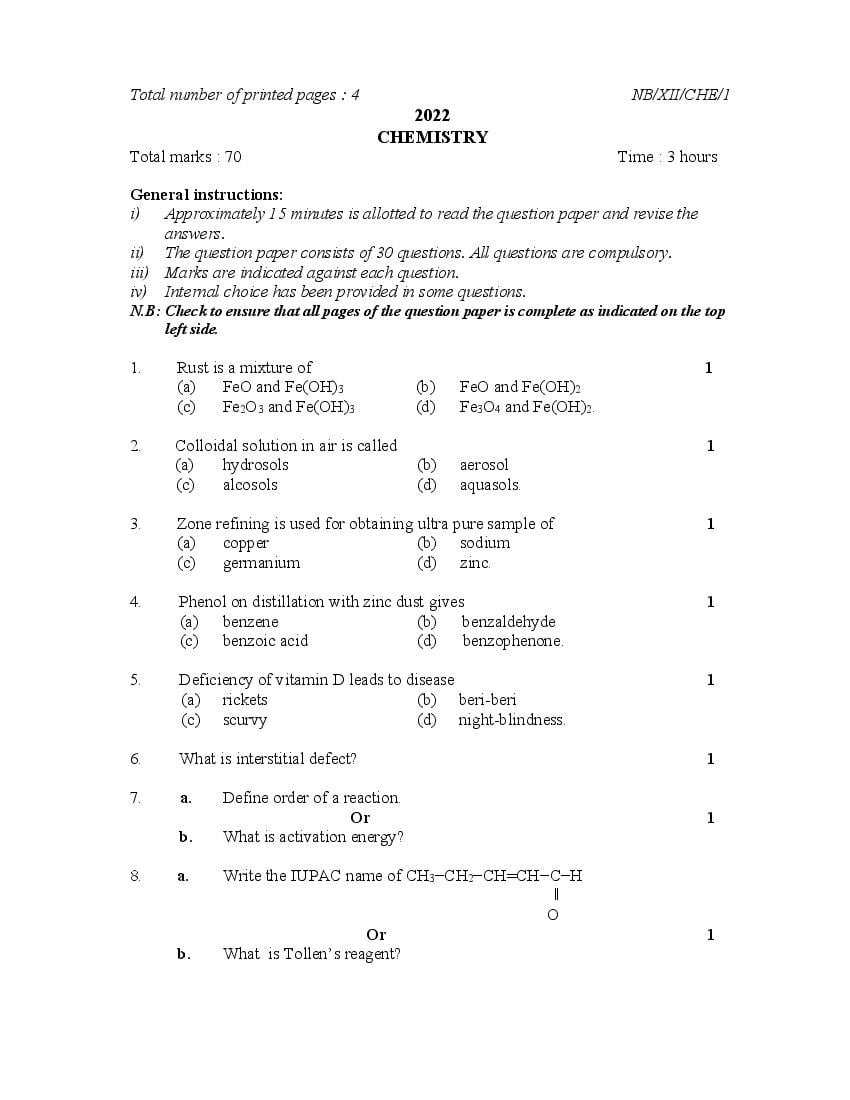
1. Rust is a mixture of 1
(a) FeO and Fe(OH)3 (b) FeO and Fe(OH)2
(c) Fe2O3 and Fe(OH)3 (d) Fe3O4 and Fe(OH)2.
2. Colloidal solution in air is called 1
(a) hydrosols (b) aerosol
(c) alcosols (d) aquasols.
3. Zone refining is used for obtaining ultra pure sample of 1
(a) copper (b) sodium
(c) germanium (d) zinc.
4. Phenol on distillation with zinc dust gives 1
(a) benzene (b) benzaldehyde
(c) benzoic acid (d) benzophenone.
5. Deficiency of vitamin D leads to disease 1
(a) rickets (b) beri-beri
(c) scurvy (d) night-blindness.
6. What is interstitial defect? 1
7. a. Define order of a reaction.
Or 1
b. What is activation energy?
8. a. Write the IUPAC name of CH3−CH2−CH=CH−C−H
‖
O
Or 1
b. What is Tollen’s reagent?
Page 2
9. What is diazotisation? 1
10. Why do soaps not work in hard water? 1
11. a. What is Van’t Hoff factor? Under what condition Van’t Hoff factor
“i” is equal to unity?
Or 2
b. Calculate molality of 2.5g of ethanoic acid (CH3COOH) in 75g of
benzene.
12. a. Differentiate between calcination and roasting.
Or 2
b. Explain the electrolysis of aluminium by Hall-Heroult process.
13. a. Explain why do the transition metals generally formed coloured
compounds?
Or 2
b. Why does transition metals act as a good catalyst?
14. a. Complete the following reaction:
(i) H3C−Br + AgF →
CH 2−CH=CH2 + HBr →
(ii)
Or 2
b. What is DDT? Draw the structure of DDT.
15. a. Why are antioxidants added in the food?
Or 2
b. What are narcotic analgesics and non-narcotic analgesics?
16. a. What is Fittig reaction? Give reaction.
Or 2
b. Explain chirality with an example.
17. a. Niobium crystalises in body-centered cubic structure, if its density
is 8.55gcm-3. Calculate the atomic radius of Niobium using its atomic
mass 93u.
b. Calculate the packing efficiency in hexagonal closed packing.
Page 3
18. a. 200cm3 of an aqueous solution of a protein contains 1.26g of the
protein. The osmotic pressure of such a solution at 300K is found
to be 2.57×10⁻³ bar. Calculate the molar mass of the protein.
( R= 0.083Lbar mol−1K−1).
b. The boiling point of benzene is 353.23K when 1.80g of a
non-volatile solute was dissolved in 90g of benzene, the boiling
point is raised to 354.11K. Calculate the molar mass of the
solute. Kb for benzene is 2.53K kg mol−1.
19. a. Show that in a first order reaction, time required for the completion
of 99.9 is 10 times of half-life (t½) of the reaction.
Or 3
b. The rate constants of a reaction at 500K and 700K are 0.02S −1 and
0.07S−1 respectively. Calculate the values of Ea. ( Given R=8.314
JK−1mol−1, log 0.02= −1.698, log 0.07= −1.1549).
20. a. Write the comparison between physisorption and chemisorption.
Or 3
b. What is peptisation? Explain Schulze and Hardy rule with an example.
21. a. Write the preparation of H2SO4 by Contact process. Give one of its
uses.
Or 3
b. Give reasons why:
i) H2S is less acidic than H2Te.
ii) Noble gases have very low boiling points.
22. a. How is potassium permanganate prepared from pyrolusite ore? Give
one of its uses.
b. La(OH)3 is more basic than Lu(OH)3. Give reason.
23. a. Explain the structural isomerism of coordination compounds.
b. Draw the figure to show the crystal field splitting of d-orbital in
tetrahedral coordination. Write the IUPAC name of K3[Cr(C2O4)3].
24. a. How do primary, secondary and tertiary alcohol differ towards
oxidation reaction.
b. What is Reimer-Tiemann reaction? Write the reaction involved in it.
Page 4
25. a. Why is aniline less basic than ethylamine?
b. What is meant by Hoffmann bromamide degradation reaction?
26. a. Differentiate between DNA and RNA.
b. Explain the terms:
i) Zwitter ion
ii) Glycosidic linkage.
27. a. How is Nylon-6,6 prepared? Give one of its uses.
b. Explain the two types of polythene.
28. a. State Kohlrauch law. Write its application. λ⸰m for NaCl, HCl and
NaAc are 126.4, 425.9 and 91.0 S cm2 mol−1 respectively.
Calculate λ⸰ for HAc.
Or 5
b. State Faraday’s law of electrolysis. The conductivity of 0.001028
mol L−1 acetic acid is 4.95 ×10⁻⁵ S cm−1. Calculate its dissociation
constant if λ⸰m for acetic acid is 390.5 S cm2 mol−1.
29. a. (i) Give the oxidation state and structure of any three oxoacids
of phosphorus.
(ii) Which form of sulphur shows paramagnetic behavior?
Or 5
b. (i) Write the preparation and structure of PCl5.
(ii) Explain the ionization enthalpy, electronegativity and
oxidation state of group-17.
30. a. (i) Explain Wolf-Kishner reduction with reaction.
(ii) Why is the boiling point of carboxylic acid higher than the
corresponding alcohols?
Or 5
b. Explain the following reactions and give the reaction involved in it:
(i) Gatterman-Koch reaction
(ii) Decarboxylation
(iii) Hell-Volhard Zelinsky reaction.
**********************