CBSE Class 10 Question Paper 2025 Design Thinking Innovation
Finished viewing? Save it for later —
Download CBSE Class 10 Question Paper 2025 Design Thinking Innovation (PDF · 32 pages)About CBSE Class 10 Question Paper 2025 Design Thinking Innovation
CBSE Class 10 Question Paper 2025 Design Thinking Innovation is available here for free download. Published by CBSE for Class 10, this question paper can be viewed online or downloaded as a PDF (32 pages). Candidates preparing for Class 10 can use CBSE Class 10 Question Paper 2025 Design Thinking Innovation to understand the exam pattern, the type of questions asked, and the overall difficulty level.
Frequently Asked Questions
How can I download CBSE Class 10 Question Paper 2025 Design Thinking Innovation?
Open this page and click the Download button to save CBSE Class 10 Question Paper 2025 Design Thinking Innovation as a PDF. It is completely free on AglaSem Docs.
Is CBSE Class 10 Question Paper 2025 Design Thinking Innovation free to download?
Yes. CBSE Class 10 Question Paper 2025 Design Thinking Innovation can be viewed online and downloaded as a PDF free of cost on AglaSem Docs.
How many pages does CBSE Class 10 Question Paper 2025 Design Thinking Innovation have?
CBSE Class 10 Question Paper 2025 Design Thinking Innovation contains 32 pages, which you can read online or download together as a single PDF.
Where can I find more Class 10 study material?
You can find more Class 10 question papers, sample papers, syllabus, and answer keys on AglaSem Docs.
CBSE Class 10 Question Paper 2025 Design Thinking Innovation – Text
Read the full text of this question paper below — useful to quickly search, copy and reference the content online without downloading the PDF.
📄 View text version (32 pages)
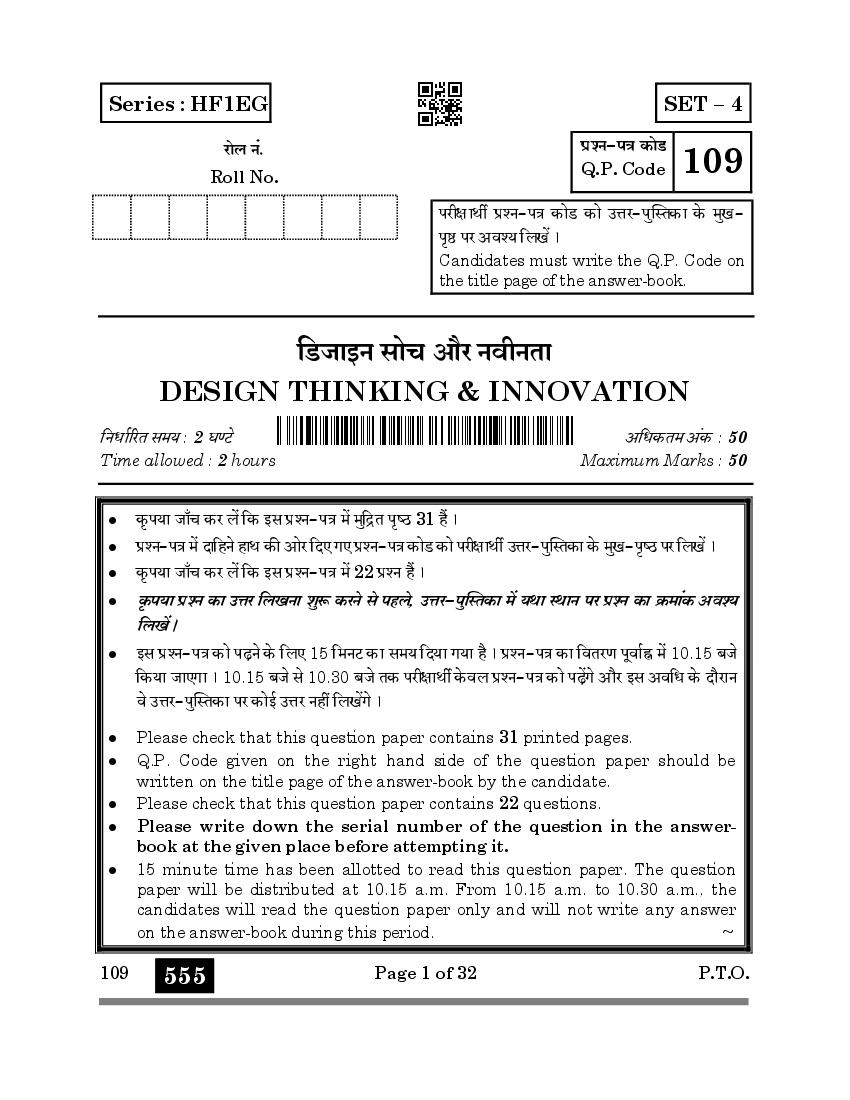
Page 1
. -
Roll No.
Q.P. Code 109
- - -
Candidates must write the Q.P. Code on
the title page of the answer-book.
DESIGN THINKING & INNOVATION
: 2 : 50
Time allowed : 2 hours Maximum Marks : 50
● - 31
● - - - -
● - 22
● , -
● - 15 - 10.15
10.15 10.30 -
-
● Please check that this question paper contains 31 printed pages.
● Q.P. Code given on the right hand side of the question paper should be
written on the title page of the answer-book by the candidate.
● Please check that this question paper contains 22 questions.
● Please write down the serial number of the question in the answer-
book at the given place before attempting it.
● 15 minute time has been allotted to read this question paper. The question
paper will be distributed at 10.15 a.m. From 10.15 a.m. to 10.30 a.m., the
candidates will read the question paper only and will not write any answer
on the answer-book during this period. ~
109 555 Page 1 of 32 P.T.O.
Page 2
(1)
(2) - 22 : - -
(3) - -
(4) (5 + 17 =) 22 () 2
(5 + 10 =) 15
(5)
(6) - : (24 )
(i) 05
(ii)
(iii)
(iv) /
(7) - : (26 )
(i) 17
(ii) 10
(iii)
(iv) /
109 Page 2 of 32 ~
Page 3
(1) Please read the instructions carefully.
(2) This Question Paper consists of 22 questions in two sections : Section – A
& Section – B.
(3) Section – A has Objective type questions whereas Section – B contains
Subjective type questions.
(4) Out of the given (5 + 17 =) 22 questions, a candidate has to answer
(5 + 10 =) 15 questions in the allotted (maximum) time of 2 hours.
(5) All questions of a particular section must be attempted in the correct
order.
(6) Section – A : Objective Type Questions (24 Marks)
(i) This section has 05 questions.
(ii) There is no negative marking.
(iii) Do as per the instructions given.
(iv) Marks allotted are mentioned against each question/part.
(7) Section – B : Subjective Type Questions (26 Marks)
(i) This section has 17 questions.
(ii) A candidate has to do 10 questions.
(iii) Do as per the instructions given.
(iv) Marks allotted are mentioned against each question/part.
109 Page 3 of 32 ~ P.T.O.
Page 4
( )
1. 6 4 : 41=4
(i)
? 1
(A)
(B)
(C)
(D)
(ii) “Caps Lock” (key) ? 1
(A) (Command key)
(B) (Control key)
(C) (Navigation key)
(D) (Punctuation key)
(iii) ` 1,000/-
` 12,000/- 1
SMART goals
?
(A) (Measurable)
(B) (Realistic)
(C) (Relevant)
(D) (Timely)
109 Page 4 of 32 ~
Page 5
(Objective Type Questions)
1. Answer any 4 out of the given 6 questions on employability skills. 41=4
(i) A person who is hard of hearing struggles to understand verbal
instructions in a noisy environment. This situation is an example of 1
(A) Interpersonal Barrier
(B) Cultural Barrier
(C) Physical Barrier
(D) Technological Barrier
(ii) The “Caps Lock” key on your computer keyboard is an example of 1
(A) Command key
(B) Control key
(C) Navigation key
(D) Punctuation key
(iii) Ankita decides to increase her savings by setting aside ` 1,000/-
every month for the next year. She calculates that this will help her
save ` 12,000/- by the end of the year. 1
Questions : Which aspect of SMART goals is most clearly
demonstrated in Ankita’s plan ?
(A) Measurable
(B) Realistic
(C) Relevant
(D) Timely
109 Page 5 of 32 ~ P.T.O.
Page 6
,
,
(Marine Protected Area)
1
(Sustainable Development
goal) ?
(A) (Zero Hunger)
(B) (Life below water)
(C) (Decent work and Economic Growth)
(D) (Responsible Consumption and Production)
(v)
, -
1
(A)
(B)
(C) -
(D)
(vi) ,
,
1
(A) (B)
(C) (D)
109 Page 6 of 32 ~
Page 7
income. However, overfishing has led to a significant decline in the
local fish population. To address this, the community decides to
establish a Marine Protected Area (MPA) where fishing is restricted,
to allow fish population to recover. 1
Question : Which Sustainable Development Goal (SDG) does this
action primarily support ?
(A) Zero hunger
(B) Life below water
(C) Decent work and Economic growth
(D) Responsible Consumption and Production
(v) If a person is aware that they tend to procrastinate when faced with
difficult tasks but if he takes steps to improve their time
management, this self-awareness is best described as 1
(A) A strength in emotional intelligence.
(B) A weakness in decision-making.
(C) A weakness in time-management.
(D) A strength in recognizing weakness and taking action.
(vi) An entrepreneur allocates profits between reinvesting in the
business, paying dividends to shareholders, and compensating
employees. This activity is an example of 1
(A) Making decision
(B) Dividing income
(C) Managing the business
(D) Creating a product
109 Page 7 of 32 ~ P.T.O.
Page 8
(i) (Pixilation in animation)
1
(A) -
(B) -
(C)
(D)
(ii)
(UI)
(states) (transitions)
(interact)
1
: (low-fidelity prototype
technique) ?
(A) (Paper Prototype)
(B) (Scenario as Prototype)
(C) (Animatics as Prototype)
(D) 3D (3D form Prototype)
109 Page 8 of 32 ~
Page 9
(i) Identify the statement most correctly representing pixilation in
animation. 1
(A) A technique where individual pixels are animated to create a
digital effect.
(B) A stop-motion technique using live actors as frame by frame
subjects.
(C) A method where images are pixilated to obscure details.
(D) An effect that blurs motion in traditional animation.
(ii) A development term is working on a new smartwatch interface.
Before diving into coding, they create a sequence of drawings that
represent the different states and transitions of the smart watch’s
UI. These drawings are then photographed and assembled into a
short video that simulates the experience of interacting with the
smartwatch. The term uses this video to gather feedback from
potential users. 1
Questions : Which low-fidelity prototype technique is being used in
this scenario ?
(A) Paper prototype
(B) Scenario as prototype
(C) Animatics as prototype
(D) 3D form prototype
109 Page 9 of 32 ~ P.T.O.
Page 10
,
1
: ,
?
(A)
(B)
(C)
(D)
(iv) “” _______ 1
(A) / (Protagonist) (B) / (Antagonist)
(C) - (Confidant) (D) / (Affection)
(v) (Cognitive)
: 1
(A)
(B)
(C) ,
(structured patterns)
(D)
109 Page 10 of 32 ~
Page 11
has evolved over the decades. To gather insights, he decides to
interview an older relative. In addition to asking about their modes
of entertainment, the student asks about the type of clothing worn
during their youth and the kind of transportation available at the
time. 1
Questions : Which of the following topics would be most relevant to
further explore how entertainment has changed over time ?
(A) The evolution of technology in the household.
(B) The types of traditional festivals celebrated.
(C) The role of education in personal development.
(D) The influence of religious practices on daily life.
(iv) In the epic of Mahabharata, a character named “Arjun” played the
role of 1
(A) Protagonist (B) Antagonist
(C) Confidant (D) Affection
(v) Identify the most accurate statement about the cognitive benefits
and applications of creative doodling : 1
(A) Creative doodling is most effective when vibrant colours are
used throughout the process.
(B) Creative doodling is generally inappropriate for professional
environment and settings.
(C) To achieve the best results, creative doodling should adhere to
strict guidelines and structured patterns.
(D) Creative doodling can enhance memory retention and improve
focus during learning activities.
109 Page 11 of 32 ~ P.T.O.
Page 12
(A) -
(B)
(C)
(D)
3. 6 5 : 51=5
(i) (SCAMPER’s) (Combine action)
? 1
(A)
(B)
(C)
(D)
(ii) / ______ 1
(A)
(B)
(C)
(D)
109 Page 12 of 32 ~
Page 13
(A) increase the use of non-renewable energy sources.
(B) install energy-efficient appliances and reduce water
consumption.
(C) replace reusable items with single use products for convenience.
(D) maximize waste production to stimulate economic activity.
3. Answer any 5 out of given 6 questions. 51=5
(i) When considering SCAMPER’s ‘combine action’, which approach
would most effectively generate novel ideas for a products’
development ? 1
(A) Combining multiple similar products to increase efficiency.
(B) Integrating features from different product categories to
address diverse needs.
(C) Replacing one component with another to see if it improves
performance.
(D) Removing unnecessary elements to simplify the product.
(ii) The ‘Durability / Life’ strategy in sustainable product design aims to
achieve __________ 1
(A) The products’ ability to be shared among multiple users.
(B) The products’ capacity to be produced with minimal waste.
(C) The products’ longevity and improvement with age.
(D) The products’ use of renewable energy sources.
109 Page 13 of 32 ~ P.T.O.
Page 14
communication) 1
(A)
(B)
(C) (text)
(D)
(iv) : “ ”
,
(sly)
(sly) ? 1
(A)
(B) ,
(C)
(D)
109 Page 14 of 32 ~
Page 15
communication while using software like MS PowerPoint. 1
(A) Utilizing colour contrast to enhance readability.
(B) Ensuring that visual elements are aligned and balanced.
(C) Overloading slides with excessive text.
(D) Using simple and clear graphics to convey information.
(iv) Fable : “The Fox and the Grapes”.
In the Fable, a hungry fox comes across a vine with a bunch of ripe
grapes hanging high. Despite his best efforts to reach them, the fox
cannot get the grapes. He eventually walks away, muttering that the
grapes are probably sour anyway. This story highlights the theme of
rationalizing failure.
Here, the fox is best described as a sly. Which statement best
explains why the fox is considered a sly ? 1
(A) The fox contrasts with the grapes to highlight his inability to
reach them. Showing how people rationalize their failure.
(B) The fox provides assistance to the grapes, helping them grow.
(C) The fox is the main character who directly seeks to obtain the
grapes for his benefits.
(D) The fox supports the grapes by enhancing their visibility to
others.
109 Page 15 of 32 ~ P.T.O.
Page 16
? 1
(A) (Pixilation) (B) (Motion Graphics)
(C) (Stop Motion) (D) 3 (3D animation)
(vi)
? 1
(A) (Ideation) (B) (Implementation)
(C) (Evaluation) (D) (Prototyping)
4. 6 5 : 51=5
(i) , ? 1
(A)
(B)
(C)
(D)
(ii)
,
? 1
(A) (B)
(C) (D)
109 Page 16 of 32 ~
Page 17
the scenes moments from various events in your school, which
animation method is ideal for creating smooth and realistic animated
sequences ? 1
(A) Pixilation (B) Motion graphics
(C) Stop motion (D) 3D animation
(vi) During which stage of the design process would you use animatics to
visualize the sequence and timing of animations before full
production begins ? 1
(A) Ideation (B) Implementation
(C) Evaluation (D) Prototyping
4. Answer any 5 out of given 6 questions. 51=5
(i) During the Gupta period, what was a significant feature of food
production and consumption ? 1
(A) Heavy reliance on hunting and gathering.
(B) Development of complex food preservation techniques.
(C) Cultivation of cereals and spice cultivation in the south.
(D) Extensive use of mechanized food production.
(ii) Which type of creativity would be most characteristic of someone who
experiences a sudden flash of insight leading to a creative
breakthrough in science, similar to Newton’s discovery of gravity ? 1
(A) Deliberate cognitive creativity
(B) Deliberate emotional creativity
(C) Spontaneous cognitive creativity
(D) Spontaneous emotional creativity
109 Page 17 of 32 ~ P.T.O.
Page 18
, ,
? 1
(A)
(B)
(C)
(D)
(iv) :
1
:
(A) ,
(B) , ,
(C) ,
(D) ,
(v) - (Observation)
? 1
(A)
(B) – –
(C)
(D) -
109 Page 18 of 32 ~
Page 19
a peer-reviewed journal article. However, she does not cite the article
because she believes the ideas were already well-known and do not
require attribution.
Which of the following best describes the risk Maya is taking by not
citing the journal article ? 1
(A) Her work may be regarded as original and insightful.
(B) She might be accused of plagiarism and loose credibility.
(C) Her group members will receive all the credit for the work.
(D) She will be praised for being efficient in gathering information.
(iv) Assertion : Stories are used to preserve and carry forward culture
and information. 1
Reason : Observation is key to writing relatable stories.
(A) Both Assertion and Reason are true and Reason is the correct
explanation of Assertion.
(B) Both Assertion and Reason are true, but Reason is not the
correct explanation of Assertion.
(C) Assertion is true, but Reason is false.
(D) Assertion is false, but Reason is true.
(v) What is the recommended approach for creating a character based on
real life observation ? 1
(A) Copying characters from popular movies.
(B) Drawing characters from personal observation, like people at a
bus stop or street market.
(C) Replicating characters from a textbook exactly as they appear.
(D) Using only imagination without any real-life reference.
109 Page 19 of 32 ~ P.T.O.
Page 20
(A)
(B)
(C)
(D)
5. 6 5 : 51=5
(i) “ ” (Squash and stretch)
? 1
(A)
(B)
(C)
(D)
(ii)
,
? 1
(A)
(B)
(C)
(D) ,
109 Page 20 of 32 ~
Page 21
animatics ? 1
(A) Drawing sequential image or key frames.
(B) Scanning or photographing the images.
(C) Playing the images sequentially on a screen.
(D) Adding complex visual effects.
5. Answer any 5 out of given 6 questions. 51=5
(i) Which of the following tasks would best help students understand
the concept of “Squash and Stretch” ? 1
(A) Animating a bouncing ball
(B) Creating a pendulum swing animation
(C) Designing character facial expression
(D) Drawing still life sketches
(ii) A group of students has created a cardboard prototype of a vender
cart for their project. After presenting it to the class, they received
feedback suggesting that the design lacks details and some sections
are not fitting well. What should the group do to address this
feedback ? 1
(A) Ignore the feedback and continue with their current design.
(B) Discard the current prototype and use clay instead of
cardboard.
(C) Completely redesign the prototype from scratch.
(D) Make adjustments to the cardboard pieces, including fitting
them together better and adding colour and sketches for details.
109 Page 21 of 32 ~ P.T.O.
Page 22
? 1
(A) (Reuse)
(recycle)
(B)
(C)
(D) - (non-recyclable)
(iv) , ,
,
, 1
(A)
(B)
(C)
(D)
(v) ? 1
(A) ,
(B) , (Climax) (Conclusion)
(C) ,
(D) ,
109 Page 22 of 32 ~
Page 23
reusability be applied to packaging ? 1
(A) By designing packaging that cannot be reused or recycled.
(B) By creating packaging that is only used once before disposal.
(C) By redesigning packaging to be easily reusable for other
purposes.
(D) By using packaging material that are expensive and non-
recyclable.
(iv) During a field trip organized by her school, Priya collected various
natural objects from a nearby park, including leaves, seeds and
twigs. After returning, she wanted to find creative ways to use these
items rather than just storing them. Which of the following is an
example of a creative use for the collected natural items, as Priya
intended ? 1
(A) Using leaves as bookmarks or coasters.
(B) Simply storing the collected items without modification.
(C) Discarding the items after collection.
(D) Using the items only for scientific analysis.
(v) What are the three components of the end or outcome in a story ? 1
(A) Objective, obstacles and outcome
(B) Crisis, climax and conclusion
(C) Beginning, middle and end
(D) Exposition, rising action and resolution
109 Page 23 of 32 ~ P.T.O.
Page 24
? 1
(A)
(B)
(C)
(D)
–
( )
5 3 20
30 32=6
6.
? 2
7. (gym)
? 2
8. ICT spam () , (users)
? 2
9. 2
10. 2
109 Page 24 of 32 ~
Page 25
hand gestures ? 1
(A) Avoid using gestures altogether.
(B) Use gestures only if the audience requests them.
(C) Use gestures that are unrelated to the topic.
(D) Use hand gestures to emphasize important aspects of the issue.
SECTION – B
(Subjective Type Questions)
Answer any 3 out of the given 5 questions on Employability Skills.
Answer each question in 20-30 words : 32=6
6. How is the pollution of rivers and ponds expected to impact the
availability of clean water in the future ? 2
7. How does the example of a gym introducing wellness programs like yoga
and meditation challenge the misconception that every business idea
must be unique ? 2
8. What is spam in the context of ICT, and why is it considered a problem for
users ? 2
9. Share some tips for practicing the four steps for effective time
management. 2
10. List the qualities of good feedback. 2
109 Page 25 of 32 ~ P.T.O.
Page 26
11. , (sustainability)
? 2
12. - (task guidelines) , -
(criss crossing lines) ,
? 2
13. “ ”
? 2
14.
2
15. (Animatics) , ,
?
, 2
16. 2
109 Page 26 of 32 ~
Page 27
11. How can studying the preparation procurement and disposal of breakfast
ingredients help in understanding sustainability ? 2
12. How do criss-crossing lines and shapes differ from horizontal lines and
flat shapes in terms of the emotions they evoke, according to the task
guidelines ? 2
13. For your civics project on “Public transportation and its efficiency in your
city”, what steps would you need to take to gather and present your
findings ? 2
14. How can a learner ensure that the process to telling their story is
enjoyable both for themselves and their audience ? 2
15. In the context of creating animatics for a short film project, how would
adding voiceover, music and sound effects improve the effectiveness of
your animatics ? Provide an example of how each element might enhance
the project. 2
16. Explain why it is important to draw a character in multiple poses and
expressions. 2
109 Page 27 of 32 ~ P.T.O.
Page 28
17.
4
18. (visual)
? 4
19. - ,
, ,
-
-
? -
4
20. (vendor cart) ,
(functions) ?
?
(portability) (functionality)
4
109 Page 28 of 32 ~
Page 29
17. Compare and contrast the chronological and fractured narrative
structures. Provide examples to illustrate how each structure influences
the storytelling and reader’s experience. 4
18. Discuss the role of visual design principles, such as grids and minimal use
of fonts and colours in creating an effective presentation. How do these
principles contribute to audience engagement and comprehension ? 4
19. Eco-concrete is an innovative construction material designed to be more
environmentally friendly than traditional concrete. It incorporates
recycled materials, such as glass, industrial by products, and other waste
products, into its mixture. This approach reduces the need for raw
materials and lowers the environmental impact associated with concrete
production. The manufacturing process of Eco-concrete often requires less
energy and emits fewer greenhouse gases compared to conventional
concrete.
Analyze the sustainability aspects of Eco-concrete, how does this product
differ from traditional concrete in terms of environmental impact and
resource use ? Discuss the motivations for developing Eco-concrete and
the sustainability issues it aims to address. 4
20. In the process of redesigning a vendor cart, explain how you would
approach the study of the cart’s existing functions and features. What
factors would you consider to extend its usefulness and convenience ?
Provide an example of a redesign that improves portability or functionality. 4
109 Page 29 of 32 ~ P.T.O.
Page 30
-
-
4
22. - , (low-fidelity proto-
typing) ,
,
4
(a)
?
(b) -
__________
109 Page 30 of 32 ~
Page 31
dinosaur and a paper spaceship. She wants to create a scene where the
dinosaur encounters the spaceship in a prehistoric setting.
Explain how Komal can use clay-motion technique to animate her clay
dinosaur and cutout animation techniques for the paper spaceship.
Discuss the potential challenges she might face and how she can overcome
them to ensure smooth animation. 4
22. In a high-school design course, students are introduced to low-fidelity
proto-typing methods. One student, Sachin, is tasked with designing a
new type of ergonomic chair. To communicate his initial ideas, Sachin
decides to use simple materials such as cardboard, foam and markers to
create his prototype. 4
(a) Describe how Sachin can effectively use low fidelity prototyping
method to refine his ergonomic chair design. What are the
advantages of using cardboard and foam in this context ?
(b) Discuss how Sachin’s use of these low-fidelity methods can help him
gather feedback and make iterative improvements to his design.
____________
109 Page 31 of 32 ~ P.T.O.
Page 32
Document Details
| Board / Org | CBSE |
| Exam | Class 10 |
| Type | Question Paper |
| Pages | 32 |
| Updated | 24 Sep 2026 |