CBSE Class 10 Mathematics Basics Question Paper 2020 Set 430-5-1
Finished viewing? Save it for later —
Download CBSE Class 10 Mathematics Basics Question Paper 2020 Set 430-5-1 (PDF · 19 pages)About CBSE Class 10 Mathematics Basics Question Paper 2020 Set 430-5-1
CBSE Class 10 Mathematics Basics Question Paper 2020 Set 430-5-1 is available here for free download. Published by CBSE for Class 10, this question paper can be viewed online or downloaded as a PDF (19 pages). Candidates preparing for Class 10 can use CBSE Class 10 Mathematics Basics Question Paper 2020 Set 430-5-1 to understand the exam pattern, the type of questions asked, and the overall difficulty level.
Frequently Asked Questions
How can I download CBSE Class 10 Mathematics Basics Question Paper 2020 Set 430-5-1?
Open this page and click the Download button to save CBSE Class 10 Mathematics Basics Question Paper 2020 Set 430-5-1 as a PDF. It is completely free on AglaSem Docs.
Is CBSE Class 10 Mathematics Basics Question Paper 2020 Set 430-5-1 free to download?
Yes. CBSE Class 10 Mathematics Basics Question Paper 2020 Set 430-5-1 can be viewed online and downloaded as a PDF free of cost on AglaSem Docs.
How many pages does CBSE Class 10 Mathematics Basics Question Paper 2020 Set 430-5-1 have?
CBSE Class 10 Mathematics Basics Question Paper 2020 Set 430-5-1 contains 19 pages, which you can read online or download together as a single PDF.
Where can I find more Class 10 study material?
You can find more Class 10 question papers, sample papers, syllabus, and answer keys on AglaSem Docs.
CBSE Class 10 Mathematics Basics Question Paper 2020 Set 430-5-1 – Text
Read the full text of this question paper below — useful to quickly search, copy and reference the content online without downloading the PDF.
📄 View text version (19 pages)
Page 1
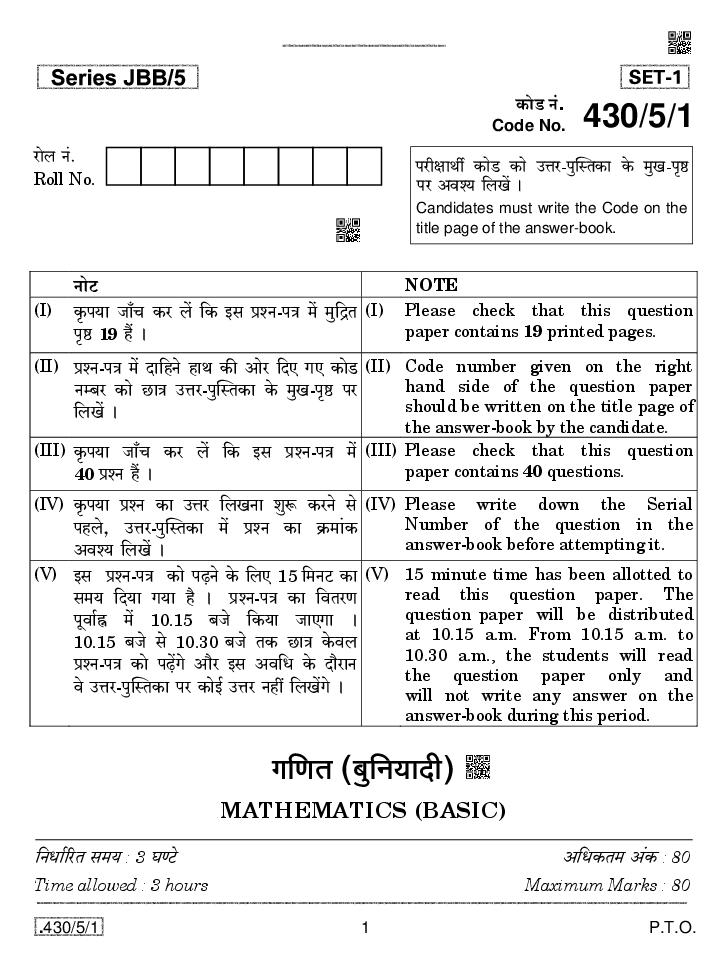
Code No. 430/5/1
amob Z§. narjmWu H$moS >H$mo CÎma-nwpñVH$m Ho$ _wI-n¥ð
Roll No. >na Adí` {bIo§ &
Candidates must write the Code on the
title page of the answer-book.
ZmoQ> NOTE
(I) H¥$n`m Om±M H$a b| {H$ Bg àíZ-nÌ _o§ _w{ÐV (I) Please check that this question
n¥ð> 19 h¢ & paper contains 19 printed pages.
(II) àíZ-nÌ _| Xm{hZo hmW H$s Amoa {XE JE H$moS (II) Code number given on the right
>Zå~a H$mo N>mÌ CÎma-nwpñVH$m Ho$ _wI-n¥ð> na hand side of the question paper
{bI| & should be written on the title page of
the answer-book by the candidate.
(III) H¥$n`m Om±M H$a b| {H$ Bg àíZ-nÌ _| (III) Please check that this question
>40 àíZ h¢ & paper contains 40 questions.
(IV) H¥$n`m àíZ H$m CÎma {bIZm ewê$ H$aZo go (IV) Please write down the Serial
nhbo, CÎma-nwpñVH$m _| àíZ H$m H«$_m§H$ Number of the question in the
Adí` {bI| & answer-book before attempting it.
(V) Bg àíZ-nÌ H$mo n‹T>Zo Ho$ {bE 15 {_ZQ >H$m (V) 15 minute time has been allotted to
g_` {X`m J`m h¡ & àíZ-nÌ H$m {dVaU read this question paper. The
nydm©• _| 10.15 ~Oo {H$`m OmEJm & question paper will be distributed
10.15 ~Oo go 10.30 ~Oo VH$ N>mÌ Ho$db at 10.15 a.m. From 10.15 a.m. to
10.30 a.m., the students will read
àíZ-nÌ H$mo n‹T>|Jo Am¡a Bg Ad{Y Ho$ Xm¡amZ the question paper only and
do CÎma-nwpñVH$m na H$moB© CÎma Zht {bI|Jo & will not write any answer on the
answer-book during this period.
J{UV (~w{Z`mXr)
MATHEMATICS (BASIC)
{ZYm©[aV g_` : 3 KÊQ>o A{YH$V_ A§H$ : 80
Time allowed : 3 hours Maximum Marks : 80
.430/5/1 1 P.T.O.
Page 2
{ZåZ{b{IV {ZX}em| H$mo ~hþV gmdYmZr go n{‹T>E Am¡a CZH$m g»Vr go nmbZ H$s{OE :
(i) àíZ-nÌ Mma IÊS>m| _| {d^m{OV {H$`m J`m h¡ – H$, I, J Ed§ K & Bg àíZ-nÌ _|
40 àíZ h¢ & g^r àíZ A{Zdm`© h¢ &
(ii) IÊS> H$ _| àíZ g§»`m 1 go 20 VH$ 20 àíZ h¢ Ed§ àË`oH$ àíZ EH$ A§H$ H$m h¡ &
(iii) IÊS> I _| àíZ g§»`m 21 go 26 VH$ 6 àíZ h¢ Ed§ àË`oH$ àíZ Xmo A§H$m| H$m h¡ &
(iv) IÊS> J _| àíZ g§»`m 27 go 34 VH$ 8 àíZ h¢ Ed§ àË`oH$ àíZ VrZ A§H$m| H$m h¡ &
(v) IÊS> K _| àíZ g§»`m 35 go 40 VH$ 6 àíZ h¢ Ed§ àË`oH$ àíZ Mma A§H$m| H$m h¡ &
(vi) àíZ-nÌ _| g_J« na H$moB© {dH$ën Zht h¡ & VWm{n EH$ -EH$ A§H$ dmbo Xmo àíZm| _|, Xmo-Xmo
A§H$m| dmbo Xmo àíZm| _|, VrZ-VrZ A§H$m| dmbo VrZ àíZm| _|, Mma-Mma A§H$m| dmbo VrZ àíZm|
_| Am§V[aH$ {dH$ën {XE JE h¢ & Eogo àíZm| _| Ho$db EH$ hr {dH$ën H$m CÎma {b{IE &
(vii) BgHo$ A{V[aº$, Amdí`H$VmZwgma, àË`oH$ IÊS> Am¡a àíZ Ho$ gmW `Wmo{MV {ZX}e {XE JE
h¢ &
(viii) H¡$bHw$boQ>a Ho$ à`moJ H$s AZw_{V Zht h¡ &
IÊS> H$
àíZ g§»`m 1 go 20 VH$ àË`oH$ àíZ 1 A§H$ H$m h¡ &
àíZ g§»`m 1 go 10 _| ghr {dH$ën Mw{ZE &
1. `{X a¡{IH$ g_rH$aUm| H$m EH$ `w½_ g§JV h¡, Vmo {Zê${nV aoImE±
(A) g_mÝVa h¢
(B) à{VÀN>oXr `m g§nmVr h¢
(C) h_oem g§nmVr hmoVr h¢
(D) h_oem à{VÀN>oXr hmoVr h¢
2. q~XþAm| (3, – 2) VWm (– 3, 2) Ho$ ~rM H$s Xÿar h¡
(A) 52 BH$mB©
(B) 4 10 BH$mB©
(C) 2 10 BH$mB©
(D) 40 BH$mB©
.430/5/1 2
Page 3
Read the following instructions very carefully and strictly follow them :
(i) This question paper comprises four sections – A, B, C and D. This question
paper carries 40 questions. All questions are compulsory.
(ii) Section A : Question Numbers 1 to 20 comprises of 20 questions of one mark
each.
(iii) Section B : Question Numbers 21 to 26 comprises of 6 questions of two marks
each.
(iv) Section C : Question Numbers 27 to 34 comprises of 8 questions of three marks
each.
(v) Section D : Question Numbers 35 to 40 comprises of 6 questions of four marks
each.
(vi) There is no overall choice in the question paper. However, an internal choice
has been provided in 2 questions of one mark, 2 questions of two marks,
3 questions of three marks and 3 questions of four marks. You have to attempt
only one of the choices in such questions.
(vii) In addition to this, separate instructions are given with each section and
question, wherever necessary.
(viii) Use of calculators is not permitted.
SECTION A
Question numbers 1 to 20 carry 1 mark each.
Choose the correct option in question numbers 1 to 10.
1. If a pair of linear equations is consistent, then the lines represented by
them are
(A) parallel
(B) intersecting or coincident
(C) always coincident
(D) always intersecting
2. The distance between the points (3, – 2) and (– 3, 2) is
(A) 52 units
(B) 4 10 units
(C) 2 10 units
(D) 40 units
.430/5/1 3 P.T.O.
Page 4
(A) 8
1
(B)
8
(C) –8
1
(D) –
8
4. e§Hw$ Ho$ {N>ÞH$ Ho$ AmH$ma Ho$ EH$ {Jbmg H$m gånyU© n¥ð>r` joÌ\$b h¡ (r1 > r2)
(A) r1 l + r2 l
(B) l (r1 + r2) + r22
1
(C) h ( r12 + r22 + r1r2)
3
(D) h 2 (r1 – r2 )2
5. g§»`m 120 H$mo A^mÁ` JwUZI§S>m| Ho$ JwUZ\$b Ho$ ê$n _| ì`º$ H$aZo na {ZåZ àmßV hmoVm h¡ :
(A) 583
(B) 15 23
(C) 10 22 3
(D) 5 23 3
6. {ÛKmVr g_rH$aU 4x2 – 6x + 3 = 0 H$m {d{dº$H$a (discriminant) h¡
(A) 12
(B) 84
(C) 2 3
(D) – 12
7. `{X q~Xþ (3, – 6) q~XþAm| (0, 0) VWm (x, y) H$mo Omo‹S>Zo dmbo aoImI§S> H$m _Ü`-q~Xþ h¡, Vmo
q~Xþ (x, y) hmoJm
(A) (– 3, 6)
(B) (6, – 6)
(C) (6, – 12)
3
(D) ( , – 3)
2
.430/5/1 4
Page 5
(A) 8
1
(B)
8
(C) –8
1
(D) –
8
4. The total surface area of a frustum-shaped glass tumbler is (r1 > r2)
(A) r1 l + r2 l
(B) l (r1 + r2) + r22
1
(C) h ( r12 + r22 + r1r2)
3
(D) h 2 (r1 – r2 )2
5. 120 can be expressed as a product of its prime factors as
(A) 583
(B) 15 23
(C) 10 22 3
(D) 5 23 3
6. The discriminant of the quadratic equation 4x2 – 6x + 3 = 0 is
(A) 12
(B) 84
(C) 2 3
(D) – 12
7. If (3, – 6) is the mid-point of the line segment joining (0, 0) and (x, y),
then the point (x, y) is
(A) (– 3, 6)
(B) (6, – 6)
(C) (6, – 12)
3
(D) ( , – 3)
2
.430/5/1 5 P.T.O.
Page 6
g§»`m h¡
AmH¥${V-1
(A) 0
(B) AZoH$
(C) 2
(D) 1
9. {ZåZ{b{IV ~ma§~maVm ~§Q>Z Ho$ {bE :
dJ© : 0–5 5 – 10 10 – 15 15 – 20 20 – 25
~ma§~maVm : 8 10 19 25 8
_mÜ`H$ dJ© H$s Cƒ gr_m h¡
(A) 15
(B) 10
(C) 20
(D) 25
10. {H$gr Ag§^d KQ>Zm Ho$ hmoZo H$s àm{`H$Vm h¡
(A) 1
1
(B)
2
(C) n[a^m{fV Zht
(D) 0
àíZ g§»`m 11 go 15 _| [aº$ ñWmZ ^[aE &
11. {H$gr d¥Îm H$mo Xmo q~XþAm| na à{VÀN>o{XV H$aZo dmbr aoIm H$mo __________ H$hVo h¢ &
12. `{X ~hþnX ax2 – 2x H$m EH$ eyÝ`H$ 2 h¡, Vmo ‘a’ H$m _mZ ___________ h¡ &
13. g^r dJ© ____________ hmoVo h¢ & (gdmªJg_/g_ê$n)
14. `{X Xmo Jmobm| H$s {ÌÁ`mAm| H$m AZwnmV 2 : 3 h¡, Vmo BZ Jmobm| Ho$ Am`VZm| H$m AZwnmV
_________ hmoJm &
15. `{X PQR H$m joÌ\$b eyÝ` h¡, Vmo q~Xþ P, Q VWm R ______________ h¢ &
.430/5/1 6
Page 7
Figure-1
(A) 0
(B) many
(C) 2
(D) 1
9. For the following frequency distribution :
Class : 0–5 5 – 10 10 – 15 15 – 20 20 – 25
Frequency : 8 10 19 25 8
The upper limit of median class is
(A) 15
(B) 10
(C) 20
(D) 25
10. The probability of an impossible event is
(A) 1
1
(B)
2
(C) not defined
(D) 0
Fill in the blanks in question numbers 11 to 15.
11. A line intersecting a circle in two points is called a ___________ .
12. If 2 is a zero of the polynomial ax2 – 2x, then the value of ‘a’ is ________ .
13. All squares are __________ . (congruent/similar)
14. If the radii of two spheres are in the ratio 2 : 3, then the ratio of their
respective volumes is __________ .
15. If ar ( PQR) is zero, then the points P, Q and R are ____________ .
.430/5/1 7 P.T.O.
Page 8
16. AmH¥${V-2 _|, ^y{_ Ho$ EH$ q~Xþ B go _rZma AC Ho$ {eIa H$m CÞ`Z H$moU 60 h¡ & `{X
_rZma H$s D±$MmB© 20 _r. hmo, Vmo _rZma Ho$ nmX-q~Xþ go Bg q~Xþ H$s Xÿar kmV H$s{OE &
AmH¥${V-2
17. _mZ kmV H$s{OE :
tan 40 tan 50
AWdm
`{X cos A = sin 42 h¡, Vmo A H$m _mZ kmV H$s{OE &
18. EH$ {g¸o$ H$mo Xmo ~ma CN>mbm OmVm h¡ & XmoZm| ~ma {MV AmZo H$s àm{`H$Vm kmV H$s{OE &
19. Cg e§Hw$ H$s D±$MmB© kmV H$s{OE {OgH$s {ÌÁ`m 5 go_r VWm {V`©H$ D±$MmB© 13 go_r h¡ &
20. `{X – 6, x, 8 EH$ g_m§Va loT>r Ho$ H«${_V nX h¢, Vmo x H$m _mZ kmV H$s{OE &
AWdm
g_m§Va loT>r – 27, – 22, – 17, – 12,... H$m 11dm± nX kmV H$s{OE &
IÊS> I$
àíZ g§»`m 21 go 26 _| àË`oH$ àíZ 2 A§H$m| H$m h¡ &
21. {ÛKmV g_rH$aU 3x2 – 4 3 x + 4 = 0 Ho$ _yb kmV H$s{OE &
22. Om±M H$s{OE {H$ Š`m {H$gr àmH¥$V g§»`m n Ho$ {bE g§»`m 6n A§H$ ‘0’ (eyÝ`) na g_mßV
hmo gH$Vr h¡ &
AWdm
150 VWm 200 H$m b.g. (LCM) kmV H$s{OE &
1
23. `{X tan (A + B) = 3 VWm tan (A – B) = h¡, 0 < A + B 90, A > B, Vmo
3
A VWm B Ho$ _mZ kmV H$s{OE &
.430/5/1 8
Page 9
16. In Figure-2, the angle of elevation of the top of a tower AC from a point B
on the ground is 60. If the height of the tower is 20 m, find the distance
of the point from the foot of the tower.
Figure-2
17. Evaluate :
tan 40 tan 50
OR
If cos A = sin 42, then find the value of A.
18. A coin is tossed twice. Find the probability of getting head both the times.
19. Find the height of a cone of radius 5 cm and slant height 13 cm.
20. Find the value of x so that – 6, x, 8 are in A.P.
OR
Find the 11th term of the A.P. – 27, – 22, – 17, – 12, ... .
SECTION B
Question numbers 21 to 26 carry 2 marks each.
21. Find the roots of the quadratic equation
3x2 – 4 3 x + 4 = 0.
22. Check whether 6n can end with the digit ‘0’ (zero) for any natural
number n.
OR
Find the LCM of 150 and 200.
1
23. If tan (A + B) = 3 and tan (A – B) = , 0 < A + B 90, A > B, then
3
find the values of A and B.
.430/5/1 9 P.T.O.
Page 10
AC = 2 3 go_r, A = 80, B = 60, XY = 4 3 go_r, YZ = 12 go_r VWm
XZ = 6 go_r h¡, Vmo Y H$m _mZ kmV H$s{OE &
2 3 go_r 4 3 go_r
AmH¥${V-3
25. {H$gr H$maUde 14 ˜am~ ~ë~, 98 AÀN>o ~ë~m| _| {_b JE h¢ & Ho$db `h XoIH$a Zht
~Vm`m Om gH$Vm h¡ {H$ H$moB© ~ë~ ˜am~ h¡ `m Zht & Bg {_lU _| go EH$ ~ë~ `mÑÀN>`m
{ZH$mbm OmVm h¡ & {ZH$mbo JE ~ë~ Ho$ AÀN>m hmoZo H$s àm{`H$Vm kmV H$s{OE &
26. {ZåZ{b{IV ~§Q>Z H$m _mÜ` kmV H$s{OE :
dJ© : 5 – 15 15 – 25 25 – 35 35 – 45
~ma§~maVm : 2 4 3 1
AWdm
{ZåZ{b{IV ~§Q>Z 100 H$_©Mm[a`m| Ho$ AmZo-OmZo Ho$ IMm] H$mo Xem©Vm h¡ :
ì`` (< _|) : 200 – 400 400 – 600 600 – 800 800 – 1000 1000 – 1200
H$_©Mm[a`m| H$s
21 25 19 23 12
g§»`m :
Bg ~§Q>Z H$m ~hþbH$ kmV H$s{OE &
IÊS> J$
àíZ g§»`m 27 go 34 _| àË`oH$ àíZ 3 A§H$m| H$m h¡ &
27. EH$ d¥Îm Ho$ n[aJV MVw^w©O ABCD ItMm J`m h¡ & {gÕ H$s{OE {H$
AB + CD = AD + BC.
.430/5/1 10
Page 11
AC = 2 3 cm, A = 80, B = 60, XY = 4 3 cm, YZ = 12 cm and
XZ = 6 cm, then find the value of Y.
2 3 cm 4 3 cm
Figure-3
25. 14 defective bulbs are accidentally mixed with 98 good ones. It is not
possible to just look at the bulb and tell whether it is defective or not.
One bulb is taken out at random from this lot. Determine the probability
that the bulb taken out is a good one.
26. Find the mean for the following distribution :
Classes : 5 – 15 15 – 25 25 – 35 35 – 45
Frequency : 2 4 3 1
OR
The following distribution shows the transport expenditure of
100 employees :
Expenditure
200 – 400 400 – 600 600 – 800 800 – 1000 1000 – 1200
(in <) :
Number of
21 25 19 23 12
employees :
Find the mode of the distribution.
SECTION C
Question numbers 27 to 34 carry 3 marks each.
27. A quadrilateral ABCD is drawn to circumscribe a circle. Prove that
AB + CD = AD + BC.
.430/5/1 11 P.T.O.
Page 12
g§»`mE± kmV H$s{OE &
AWdm
x VWm y Ho$ {bE hb H$s{OE :
2 3 5 4
= 13 VWm – =–2
x y x y
29. {gÕ H$s{OE {H$ 3 EH$ An[a_o` g§»`m h¡ &
30. H¥$îUm Ho$ nmg EH$ go~m| H$m ~mJ h¡ {OgHo$ gmW EH$ 10 _r. 10 _r. gmBµO H$m EH$
{H$MZ JmS>©Z h¡ & CgZo Cgo EH$ 10 10 {J«S> _| ~m±Q>H$a Cg_| {_Å>r VWm ImX S>mbr h¡ &
CgZo q~Xþ A na EH$ Zt~y H$m nm¡Ym, q~Xþ B na Y{ZE H$m nm¡Ym, q~Xþ C na ß`mO H$m nm¡Ym
VWm q~Xþ D na EH$ Q>_mQ>a H$m nm¡Ym bJm`m h¡ & CgH$m n{V am_ {H$MZ JmS>©Z H$mo XoIH$a
Vmarµ\$ H$aVm h¡ VWm H$hVm h¡ {H$ A, B, C VWm D H$mo {_bmZo na dh em`X EH$ g_m§Va
MVw^w©O ~Z OmE & ZrMo {XE JE {MÌ H$mo Ü`mZnyd©H$ XoIH$a {ZåZ{b{IV Ho$ CÎma Xr{OE :
(i) {ZX}em§H$ Aj Ho$ ê$n _| 10 10 {J«S> H$m Cn`moJ H$aVo hþE q~XþAm| A, B, C VWm
D Ho$ {ZX}em§H$ kmV H$s{OE &
(ii) kmV H$s{OE {H$ Š`m ABCD EH$ g_m§Va MVw^w©O h¡ `m Zht &
.430/5/1 12
Page 13
thrice of the smaller number by 4. Find the numbers.
OR
Solve for x and y :
2 3 5 4
= 13 and – =–2
x y x y
29. Prove that 3 is an irrational number.
30. Krishna has an apple orchard which has a 10 m 10 m sized kitchen
garden attached to it. She divides it into a 10 10 grid and puts soil and
manure into it. She grows a lemon plant at A, a coriander plant at B, an
onion plant at C and a tomato plant at D. Her husband Ram praised her
kitchen garden and points out that on joining A, B, C and D they may
form a parallelogram. Look at the below figure carefully and answer the
following questions :
(i) Write the coordinates of the points A, B, C and D, using the
10 10 grid as coordinate axes.
(ii) Find whether ABCD is a parallelogram or not.
.430/5/1 13 P.T.O.
Page 14
Vmo Bg g_m§Va loT>r H$m 21dm± nX kmV H$s{OE &
32. 4 go_r, 5 go_r VWm 6 go_r ^wOmAm| dmbo EH$ {Ì^wO H$s aMZm H$s{OE & {\$a BgHo$ g_ê$n
EH$ Am¡a {Ì^wO H$s aMZm H$s{OE {OgH$s ^wOmE± nhbo {Ì^wO H$s g§JV ^wOmAm| H$s 2 JwZr
3
hm| &
AWdm
2.5 go_r {ÌÁ`m H$m EH$ d¥Îm It{ME & BgHo$ Ho$ÝÐ go 8 go_r Xÿa pñWV EH$ q~Xþ P
br{OE & d¥Îm na q~Xþ P go ñne©-aoIm `w½_ H$s aMZm H$s{OE &
33. {gÕ H$s{OE {H$ :
1
(cosec A – sin A) (sec A – cos A) =
tan A cot A
34. AmH¥${V-4 _|, AB Am¡a CD Ho$ÝÐ O dmbo d¥Îm Ho$ Xmo nañna bå~ ì`mg h¢ VWm OD N>moQ>o
d¥Îm H$m ì`mg h¡ & `{X OA = 7 go_r h¡, Vmo N>m`m§{H$V ^mJ H$m joÌ\$b kmV H$s{OE &
AmH¥${V-4
AWdm
.430/5/1 14
Page 15
then find the 21st term of the A.P.
32. Construct a triangle with its sides 4 cm, 5 cm and 6 cm. Then construct a
2
triangle similar to it whose sides are of the corresponding sides of the
3
first triangle.
OR
Draw a circle of radius 2.5 cm. Take a point P at a distance of 8 cm from
its centre. Construct a pair of tangents from the point P to the circle.
33. Prove that :
1
(cosec A – sin A) (sec A – cos A) =
tan A cot A
34. In Figure-4, AB and CD are two diameters of a circle (with centre O)
perpendicular to each other and OD is the diameter of the smaller circle.
If OA = 7 cm, then find the area of the shaded region.
Figure-4
OR
.430/5/1 15 P.T.O.
Page 16
^mJ H$m joÌ\$b kmV H$s{OE &
AmH¥${V-5
IÊS> K$
àíZ g§»`m 35 go 40 VH$ àË`oH$ àíZ 4 A§H$m| H$m h¡ &
35. ~hþnX p(x) = 3x4 – 4x3 – 10x2 + 8x + 8 Ho$ AÝ` eyÝ`H$ kmV H$s{OE, `{X 2 VWm
– 2 , BgHo$ Xmo eyÝ`H$ {XE JE h¢ &
AWdm
~hþnX g(x) = x3 – 3x2 + x + 2 H$mo ~hþnX x2 – 2x + 1 go {d^m{OV H$s{OE VWm
{d^mOZ EoëJmo[aÏ_ H$s gË`Vm H$s Om±M H$s{OE &
36. g_wÐ Vb go 75 _r. D±$Mo bmBQ>hmCg Ho$ {eIa go XoIZo na Xmo g_wÐr OhmµOm| Ho$ AdZ_Z
H$moU 30 VWm 45 h¢ & `{X XmoZm| OhmµO bmBQ>hmCg H$s {dnarV {XemAm| _| hm|, Vmo XmoZm|
OhmµOm| Ho$ ~rM H$s Xÿar kmV H$s{OE &
37. `{X {H$gr {Ì^wO H$s EH$ ^wOm Ho$ g_m§Va AÝ` Xmo ^wOmAm| H$mo {^Þ-{^Þ q~XþAm| na
à{VÀN>oX H$aZo Ho$ {bE EH$ aoIm ItMr OmE, Vmo {gÕ H$s{OE {H$ `o AÝ` Xmo ^wOmE± EH$ hr
AZwnmV _| {d^m{OV hmoVr h¢ &
AWdm
.430/5/1 16
Page 17
circumscribing the square. Find the area of the shaded region.
Figure-5
SECTION D
Question numbers 35 to 40 carry 4 marks each.
35. Find other zeroes of the polynomial
p(x) = 3x4 – 4x3 – 10x2 + 8x + 8,
if two of its zeroes are 2 and – 2 .
OR
Divide the polynomial g(x) = x3 – 3x2 + x + 2 by the polynomial
x2 – 2x + 1 and verify the division algorithm.
36. From the top of a 75 m high lighthouse from the sea level, the angles of
depression of two ships are 30 and 45. If the ships are on the opposite
sides of the lighthouse, then find the distance between the two ships.
37. If a line is drawn parallel to one side of a triangle to intersect the other
two sides in distinct points, prove that the other two sides are divided in
the same ratio.
OR
.430/5/1 17 P.T.O.
Page 18
H$s{OE {H$ 4 (AD2 + BE2 + CF2) = 9 AB2.
AmH¥${V-6
38. YmVw H$s MmXa go ~Zm Am¡a D$na go Iwbm EH$ ~V©Z e§Hw$ Ho$ {N>ÞH$ Ho$ AmH$ma H$m h¡,
{OgH$s D±$MmB© 14 go_r h¡ VWm {ZMbo Am¡a D$nar d¥Îmr` {gam| H$s {ÌÁ`mE± H«$_e: 8 go_r
VWm 20 go_r h¡ & ~V©Z H$s Ym[aVm kmV H$s{OE &
39. Xmo nmZr Ho$ Zb EH$ gmW EH$ hm¡µO H$mo 9 3 K§Q>m| _| ^a gH$Vo h¢ & ~‹S>o ì`mg dmbm Zb
8
hm¡µO H$mo ^aZo _|, H$_ ì`mg dmbo Zb go 10 K§Q>o H$_ g_` boVm h¡ & àË`oH$ Zb Ûmam
AbJ-AbJ hm¡µO H$mo ^aZo H$m g_` kmV H$s{OE &
AWdm
EH$ Eogo Am`VmH$ma nmH©$ H$mo ~ZmZm h¡ {OgH$s Mm¡‹S>mB© CgH$s bå~mB© go 3 _r. H$_ hmo &
BgH$m joÌ\$b nhbo go {Z{_©V g_{Û~mhþ {Ì^wOmH$ma nmH©$ {OgH$m AmYma Am`VmH$ma nmH©$
H$s Mm¡‹S>mB© Ho$ ~am~a VWm D±$MmB© 12 _r. h¡, go 4 dJ© _rQ>a A{YH$ hmo & Bg nmH©$ H$s
bå~mB© Am¡a Mm¡‹S>mB© kmV H$s{OE &
40. {ZåZ{b{IV ~ma§~maVm ~§Q>Z Ho$ {bE ‘go H$_ àH$ma’ H$m VmoaU It{ME :
dJ© : 0 – 10 10 – 20 20 – 30 30 – 40 40 – 50 50 – 60 60 – 70 70 – 80
~ma§~maVm : 7 14 13 12 20 11 15 8
.430/5/1 18
Page 19
CF AB. Prove that 4 (AD2 + BE2 + CF2) = 9 AB2.
Figure-6
38. A container open at the top and made up of a metal sheet, is in the form
of a frustum of a cone of height 14 cm with radii of its lower and upper
circular ends as 8 cm and 20 cm, respectively. Find the capacity of the
container.
3
39. Two water taps together can fill a tank in 9
hours. The tap of larger
8
diameter takes 10 hours less than the smaller one to fill the tank
separately. Find the time in which each tap can separately fill the tank.
OR
A rectangular park is to be designed whose breadth is 3 m less than its
length. Its area is to be 4 square metres more than the area of a park
that has already been made in the shape of an isosceles triangle with its
base as the breadth of the rectangular park and of altitude 12 m. Find
the length and breadth of the park.
40. Draw a ‘less than’ ogive for the following frequency distribution :
Classes : 0 – 10 10 – 20 20 – 30 30 – 40 40 – 50 50 – 60 60 – 70 70 – 80
Frequency : 7 14 13 12 20 11 15 8
.430/5/1 19 P.T.O.
Document Details
| Board / Org | CBSE |
| Exam | Class 10 |
| Type | Question Paper |
| Pages | 19 |
| Updated | 22 Jul 2026 |