CBSE Class 12 Sample Paper 2023 Political Science
Finished viewing? Save it for later —
Download CBSE Class 12 Sample Paper 2023 Political Science (PDF · 8 pages)About CBSE Class 12 Sample Paper 2023 Political Science
CBSE Class 12 Sample Paper 2023 Political Science is available here for free download. Published by CBSE for Class 12, this sample paper can be viewed online or downloaded as a PDF (8 pages). Candidates preparing for Class 12 can use CBSE Class 12 Sample Paper 2023 Political Science to understand the exam pattern, the type of questions asked, and the overall difficulty level.
Frequently Asked Questions
How can I download CBSE Class 12 Sample Paper 2023 Political Science?
Open this page and click the Download button to save CBSE Class 12 Sample Paper 2023 Political Science as a PDF. It is completely free on AglaSem Docs.
Is CBSE Class 12 Sample Paper 2023 Political Science free to download?
Yes. CBSE Class 12 Sample Paper 2023 Political Science can be viewed online and downloaded as a PDF free of cost on AglaSem Docs.
How many pages does CBSE Class 12 Sample Paper 2023 Political Science have?
CBSE Class 12 Sample Paper 2023 Political Science contains 8 pages, which you can read online or download together as a single PDF.
Where can I find more Class 12 study material?
You can find more Class 12 question papers, sample papers, syllabus, and answer keys on AglaSem Docs.
CBSE Class 12 Sample Paper 2023 Political Science – Text
Read the full text of this sample paper below — useful to quickly search, copy and reference the content online without downloading the PDF.
📄 View text version (8 pages)
Page 1
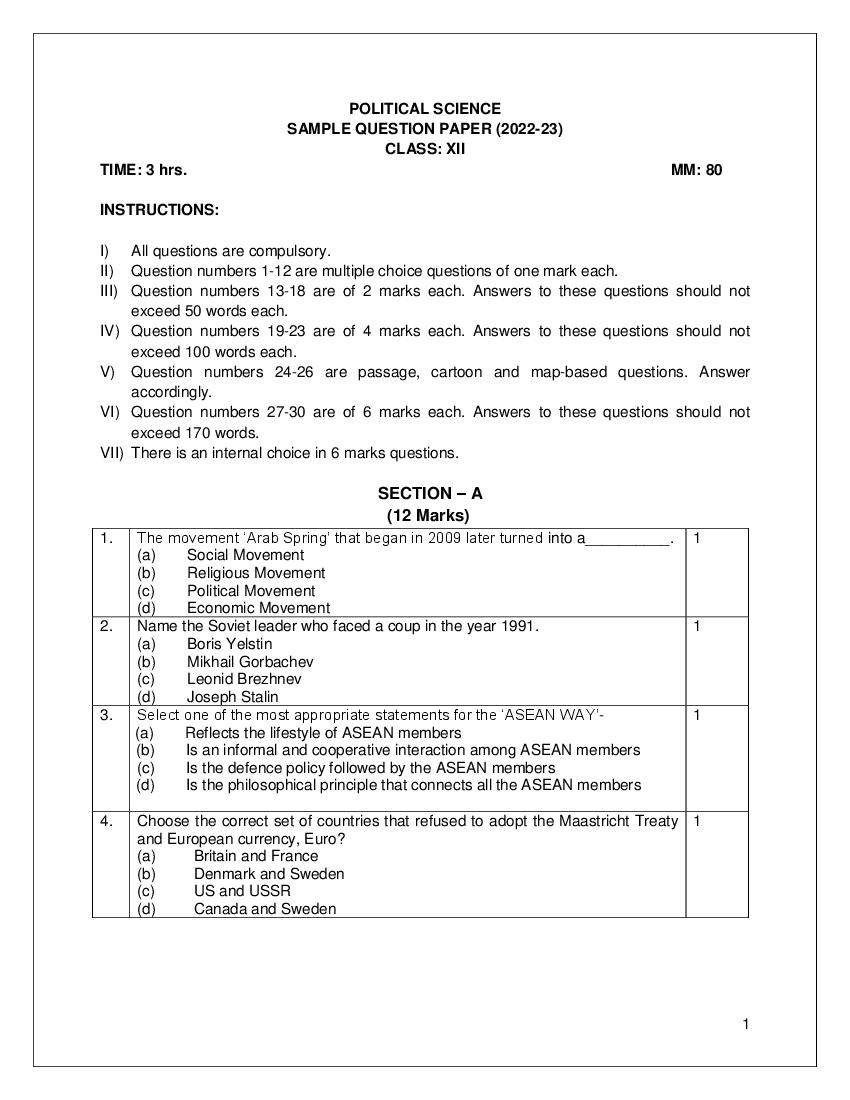
SAMPLE QUESTION PAPER (2022-23)
CLASS: XII
TIME: 3 hrs. MM: 80
INSTRUCTIONS:
I) All questions are compulsory.
II) Question numbers 1-12 are multiple choice questions of one mark each.
III) Question numbers 13-18 are of 2 marks each. Answers to these questions should not
exceed 50 words each.
IV) Question numbers 19-23 are of 4 marks each. Answers to these questions should not
exceed 100 words each.
V) Question numbers 24-26 are passage, cartoon and map-based questions. Answer
accordingly.
VI) Question numbers 27-30 are of 6 marks each. Answers to these questions should not
exceed 170 words.
VII) There is an internal choice in 6 marks questions.
SECTION – A
(12 Marks)
1. The movement ‘Arab Spring’ that began in 2009 later turned into a__________. 1
(a) Social Movement
(b) Religious Movement
(c) Political Movement
(d) Economic Movement
2. Name the Soviet leader who faced a coup in the year 1991. 1
(a) Boris Yelstin
(b) Mikhail Gorbachev
(c) Leonid Brezhnev
(d) Joseph Stalin
3. Select one of the most appropriate statements for the ‘ASEAN WAY’- 1
(a) Reflects the lifestyle of ASEAN members
(b) Is an informal and cooperative interaction among ASEAN members
(c) Is the defence policy followed by the ASEAN members
(d) Is the philosophical principle that connects all the ASEAN members
4. Choose the correct set of countries that refused to adopt the Maastricht Treaty 1
and European currency, Euro?
(a) Britain and France
(b) Denmark and Sweden
(c) US and USSR
(d) Canada and Sweden
1
Page 2
Directions for Q.Nos. 5 and 6
In the question given below, there are two statements marked as Assertion (A) and
Reason (R). Read these statements and choose one correct answer from the given
options-
(a) Both A and R are true and R is the correct explanation of A
(b) Both A and R are true and R is not the correct explanation of A
(c) A is true but R is false
(d) A is false, but R is true
5. 1
Assertion (A) Traditional Security accepts confidence building as a means of
avoiding violence.
Reason (R) Confidence building is a process in which countries share ideas and
information with their rivals.
6. Assertion (A) The real challenge to Indira Gandhi came not from the opposition but 1
from within her own party.
Reason (R) She had to deal with the ‘Syndicate’, a group of powerful and influential
leaders from within the Congress.
7. Terrorism refers to - 1
a) A bomb blast in a market place or train etc.
b) Systematic creation of atmosphere of fear in society using brutal violence
c) An external attack by any military group
d) Violence created by a group of people or an individual
8. Which of the following statements about NITI Aayog are true? 1
(i) NITI Aayog acts as a “think tank” of the Union
Government
(ii) NITI Aayog acts against terrorism
(iii) NITI Aayog acts in the spirit of cooperative
federalism
(iv) NITI Aayog decides more role for bigger states
and smaller role for smaller states
Codes
a) (i), (ii) and (iv)
b) (iii) and (iv)
c) (i), (iii) and (iv)
d) (i) and (iii)
9. Name the personality who drafted Second Five Year Plan. 1
(a) K. C. Negoy
(b) T.T. Krishnamachari
(c) Smt. Durgabai Deshmukh
(d) P. C. Mahalnobis
10. Arrange the following in chronological order- 1
(a) Second General Elections
(b) V.V. Giri elected as the President of India
(C) Fourth General Elections
2
Page 3
Codes
(a) i), iii) ,ii), iv)
(b) iii), ii), iv), i)
(c) ii), iv), i), iii)
(d) iv), iii),i), ii)
11. Name the judge of the Allahabad High Court who declared Mrs. Indira Gandhi’s 1
election as invalid---
(a) Om Prakash Trivedi
(b) Jagmohan Lal Sinha
(c) Narain Dutt Ojha
(d) Kunj Bihari Srivastava
12. Find the odd one out in the context of proclamation of emergency - 1
(a) Call for ‘Total Revolution’.
(b) the Railway Strike of 1974
(c) Naxalite Movement
(d) Gujarat Movement
SECTION – B
(12 Marks)
13. Highlight any one feature of the multi-polar world as visualized by both Russia and 2
India.
14. Name the countries included in South Asia and suggest one way to enhance peace 1+1=2
and cooperation in this region.
15. Highlight any two issues that dominate the politics of North–East India. 1+1=2
16. While throwing some light on the Mandal Issue, give one reason for anti-Mandal 1+1=2
protests in India.
17. Evaluate balance of power as a significant component of traditional security 1+1=2
policy.
18. How far did the Rajiv Gandhi – Longowal Accord succeed in bringing normalcy in 2
Punjab?
SECTION – C
(20 Marks)
19. ‘Some of the most significant responses to the challenge of environmental 2+2=4
degradation have come from the environmental movements’. Justify the
statement with special reference to movements against extraction of earth and
against mega- dams.
20. Explain the areas of cooperation and disagreement between India and Bangladesh. 2+2=4
21. Do you agree with the statement that the foreign policy of independent India has 1+3=4
pursued the dream of a peaceful world”? Support your answer with three suitable
arguments.
22. Analyze two reasons for the imposition of national emergency in India on June 25, 2+2=4
1975.
23. ”The Soviet Union became a great power after the Second World War. However in 1+3=4
no time the Soviet system became bureaucratic and authoritarian making life difficult
for its citizens.” Do you agree with the given statement? Give arguments to prove
your answer.
Section – D
(12 Marks)
24. Read the passage given below and answer the questions that follow: 1+1+1
3
Page 4
After the end of the bipolar structure of world politics in the early 1990s, it became
clear that alternative centres of political and economic power could limit America’s
dominance. Thus, European Union and ASEAN emerged as forces to reckon with.
BRICS has also emerged as a new centre of power on the world stage. The term
BRICS refers to Brazil, Russia, India and South Africa. The key objectives of BRICS
are primarily to cooperate and distribute mutual economic benefits among its
members besides non- interference in the internal policies of each nation and mutual
equality. The 11th Conference of BRICS concluded in Brazil in 2019.
(1) Name the political leader who chaired the 11th Conference of BRICS.
a) Leonid Brezhnev
b) Jair Bolsonaro
c) Deodoro da Fonseca
d) Jacob Zuma
(2) Which among the following statements about BRICS is correct?
a) BRICS was founded to promote the welfare of the people of South Asia
and to improve their quality of life.
b) BRICS countries respect mutual equality.
c) BRICS was established to create a free Trade Agreement (FTA) for
investment, labour and services.
d) The headquarters of the BRICS are at Kathmandu (Nepal).
(3) BRIC turned into BRICS after the inclusion of South Africa in its first meeting in
the year _________.
a) 2019
b) 2009
c) 2010
d) 2011
(4) BRICS was founded in 2006 in _________.
a) Brazil
b) India
c) Russia
d) China
25. In the given outline political map of India, four states have been marked as (A), (B), 1+1+1
(C) and (D). Identify these states on the basis of the information given below and +1=4
write their correct names in your answer book along with the respective serial
numbers of the information used and the concerned alphabets as per the format that
follows:
(i) The state where a coalition led by the CPI formed the government in the
year 1957.
(ii) The state related to leader Shyama Prasad Mukherjee.
(iii) The state related to Karpuri Thakur, who implemented reservation for
backward class.
(iv) The state related to K. Kamraj, who started the Mid Day Meal program
4
Page 5
Sr. Number for the Alphabet Concerned Name of the states
information used
(i)
(ii)
(iii)
(iv)
Note: Following questions are for the Visually Impaired Candidates in lieu of 1+1+1
question number 25. +1=4
1. What was the reason of split in Congress?
5
Page 6
3. Name the party that dominated the first three general elections?
4. Name the leader who gave the strategy of ‘Non-Congressism’.
26. Study the given Cartoon and answer the questions that follow: 1+1+1
+1=4
1) Border disputes between India and China erupted in 1960. Pandit Nehru was
having talks with his counterpart____________ in China which proved futile.
(a) Mao Tsetung
(b) Presidnt Jinping
(c) Zhou Enlai
(d) Dalai Lama
2) Name the place in Indian territory which was occupied by China in the year
1962?
(a) Chagai hills
(b) Aksai Chin
(c) Balochistan
(d) Nagaland
3) _____________ was the defence minister of India during the Indo-china war?
(a) Kailash Nath Katju
(b) V.K. Krishna Menon
(c) Baldev Singh
(d) Jawaharlal Nehru
6
Page 7
(a Peace Agreement
(b) Panchsheel Agreement
(c) Standstill Agreement
(d) Tashkent Agreement
Following questions are for the Visually Impaired candidates in lieu of question 1+1+1
number 26. +1
1. In January,1966, Prime Minister, Sh.Lal Bahadur Shastri signed the Tashkent
Agreement with__________.
a. General Ayub Khan
b. General Yahya Khan
c. Mohammad Zia UI Haq
d. Musa Khan
2. The first meeting of Non-Aligned Movement was held at __________.
a. Belgrade
b. Uzbekistan
c. Baku
d. New Delhi
3. Which of the following statements related to Indo-China War (1962) is correct?
a. China could not cross the Line of Control
b. The Soviet Union remained neutral during the conflict
c. The Soviets helped China against India
d. The Chinese forces did not withdraw their troops back to their earlier position
4. On what ground did India grant political asylum to Dalai Lama and thousands of
Tibetan refugees? Choose the correct statement-
a. Dalai Lama was a known Tibetan leader
b. India granted political asylum on humanitarian grounds
c. Dalai Lama had a political influence over India
d. People of India supported Dalai Lama
SECTION – E
(24 Marks)
27. Give an analysis of the cultural and political consequences of globalization. 3+3=6
OR
Analyze any three reasons for resistance to globalization. 2+2+2
=6
28. In this changing world, a strengthened and revitalized UN is desirable. Highlight the 1+1+1
necessary reforms for an empowered United Nations. +1+1+
OR 1=6
Analyze the composition of the United Nations Security Council. What according to 2+4=6
your opinion is the major difference in the privileges given to its permanent and non-
permanent members?
29. Enlist the main considerations for bringing the Princely States with the Indian Union. 3+1+2
Name the leader who played the historic role in this direction. What was his =6
contribution?
OR
Discuss three reasons for setting up of the States Reorganization Commission after 2+2+2
India’s independence. =6
7
Page 8
statement with three relevant arguments. =6
OR
Analyze three major developments towards the end of 1980s that made a long- 2+2+2
lasting impact on the politics of India =6
8
Document Details
| Board / Org | CBSE |
| Exam | Class 12 |
| Type | Sample Paper |
| Pages | 8 |
| Updated | 22 Jul 2026 |