NBSE Class 12 Question Paper 2022 Sociology – Text
Read the full text of this question paper below — useful to quickly search, copy and reference the content online without downloading the PDF.
📄 View text version (2 pages)
Page 1
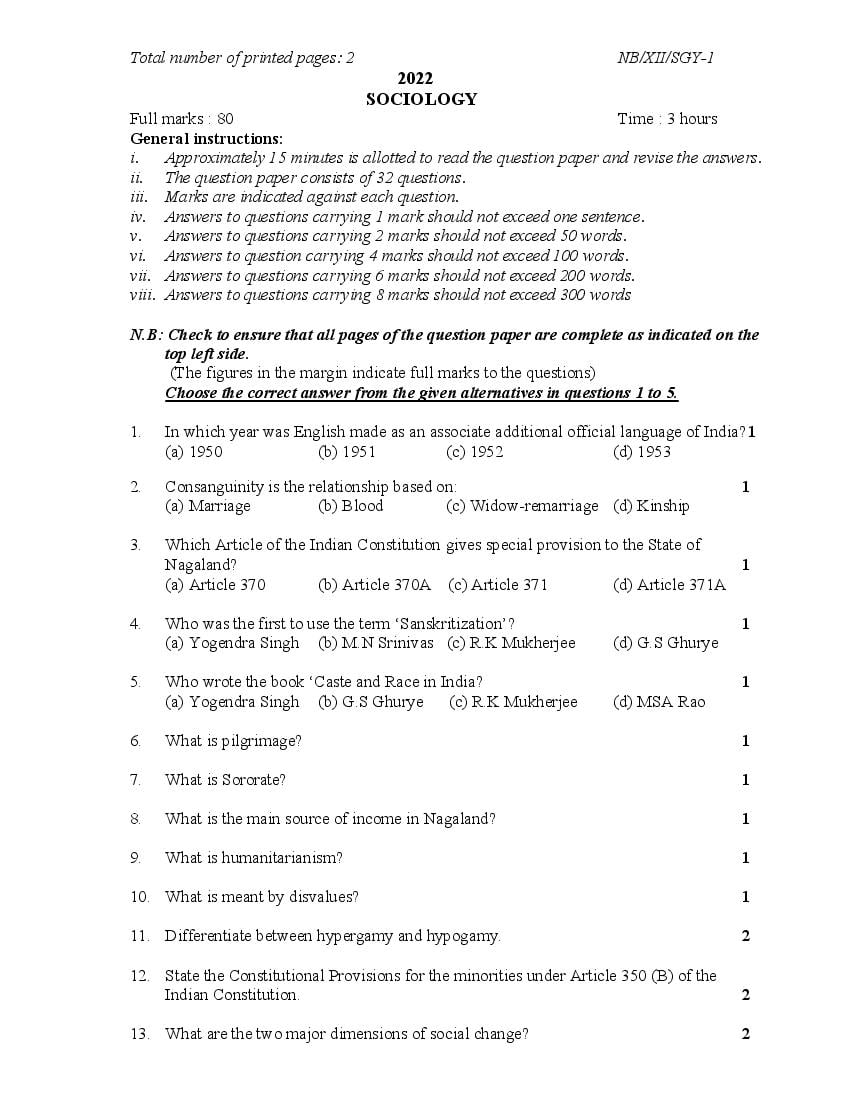
Total number of printed pages: 2 NB/XII/SGY-1 2022 SOCIOLOGY Full marks : 80 Time : 3 hours General instructions: i. Approximately 15 minutes is allotted to read the question paper and revise the answers. ii. The question paper consists of 32 questions. iii. Marks are indicated against each question. iv. Answers to questions carrying 1 mark should not exceed one sentence. v. Answers to questions carrying 2 marks should not exceed 50 words. vi. Answers to question carrying 4 marks should not exceed 100 words. vii. Answers to questions carrying 6 marks should not exceed 200 words. viii. Answers to questions carrying 8 marks should not exceed 300 words N.B: Check to ensure that all pages of the question paper are complete as indicated on the top left side. (The figures in the margin indicate full marks to the questions) Choose the correct answer from the given alternatives in questions 1 to 5. 1. In which year was English made as an associate additional official language of India?1 (a) 1950 (b) 1951 (c) 1952 (d) 1953 2. Consanguinity is the relationship based on: 1 (a) Marriage (b) Blood (c) Widow-remarriage (d) Kinship 3. Which Article of the Indian Constitution gives special provision to the State of Nagaland? 1 (a) Article 370 (b) Article 370A (c) Article 371 (d) Article 371A 4. Who was the first to use the term ‘Sanskritization’? 1 (a) Yogendra Singh (b) M.N Srinivas (c) R.K Mukherjee (d) G.S Ghurye 5. Who wrote the book ‘Caste and Race in India? 1 (a) Yogendra Singh (b) G.S Ghurye (c) R.K Mukherjee (d) MSA Rao 6. What is pilgrimage? 1 7. What is Sororate? 1 8. What is the main source of income in Nagaland? 1 9. What is humanitarianism? 1 10. What is meant by disvalues? 1 11. Differentiate between hypergamy and hypogamy. 2 12. State the Constitutional Provisions for the minorities under Article 350 (B) of the Indian Constitution. 2 13. What are the two major dimensions of social change? 2
Page 2
-2- NB/XII/SGY/1 14. Distinguish between benevolent and malevolent spirits. 2 15. State the two major objectives of land reforms after independence. 2 16. Give Ghurye’s concept of purity and pollution in the context of Caste system. 2 17. Briefly explain the structural changes of a joint family in modern times. 4 18. Write in brief an account on the emergence of Nagaland as a State. 4 19. How does Yogendra Singh analyse the modernization of Indian tradition? 4 20. (a) Mention four factors that promoted secularization in India. 4 Or (b) Explain one social movement with examples. 4 Answer any three (3) from Q.21 to Q.26 3x6=18 21. What is communalism? How is it a challenge to National integration? (1+5=6) 22. State the Constitutional Provisions for the Scheduled Tribes in India. 23. What are the factors responsible for the process of westernisation? 24. What is liberalisation? Highlight its implications. (2+4=6) 25. Explain the origin and development of Sociology in India. 26. Discuss the cultural factors of Unity in India. Answer any three (3) from Q.27 to Q.32 3x8=24 27. Highlight eight features of National Population policy 2000. 28. Discuss the importance of Morung in traditional Naga society. 29. Mention four social and political pre-requisites of modernisation and briefly explain the two phases of modernisation in India. (4+4=8) 30. Explain any four implications of globalization. (2x4=8) 31. Highlight the changes that have taken place in culture in the context of globalization. 32. Discuss the functions of kinship in Indian society. *********************************