Page 1
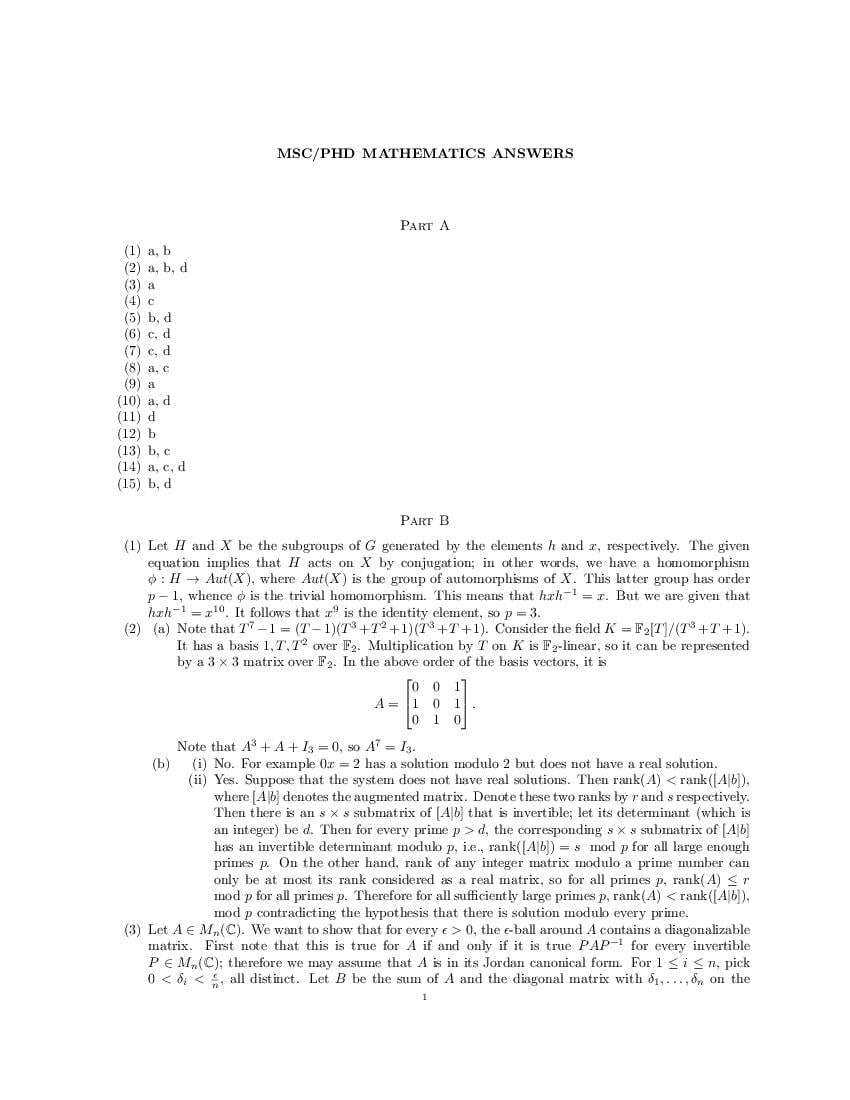
MSC/PHD MATHEMATICS ANSWERS Part A (1) a, b (2) a, b, d (3) a (4) c (5) b, d (6) c, d (7) c, d (8) a, c (9) a (10) a, d (11) d (12) b (13) b, c (14) a, c, d (15) b, d Part B (1) Let H and X be the subgroups of G generated by the elements h and x, respectively. The given equation implies that H acts on X by conjugation; in other words, we have a homomorphism φ : H → Aut(X), where Aut(X) is the group of automorphisms of X. This latter group has order p − 1, whence φ is the trivial homomorphism. This means that hxh−1 = x. But we are given that hxh−1 = x10 . It follows that x9 is the identity element, so p = 3. (2) (a) Note that T 7 − 1 = (T − 1)(T 3 + T 2 + 1)(T 3 + T + 1). Consider the field K = F2 [T ]/(T 3 + T + 1). It has a basis 1, T, T 2 over F2 . Multiplication by T on K is F2 -linear, so it can be represented by a 3 × 3 matrix over F2 . In the above order of the basis vectors, it is 0 0 1 A = 1 0 1 . 0 1 0 Note that A3 + A + I3 = 0, so A7 = I3 . (b) (i) No. For example 0x = 2 has a solution modulo 2 but does not have a real solution. (ii) Yes. Suppose that the system does not have real solutions. Then rank(A) < rank([A|b]), where [A|b] denotes the augmented matrix. Denote these two ranks by r and s respectively. Then there is an s × s submatrix of [A|b] that is invertible; let its determinant (which is an integer) be d. Then for every prime p > d, the corresponding s × s submatrix of [A|b] has an invertible determinant modulo p, i.e., rank([A|b]) = s mod p for all large enough primes p. On the other hand, rank of any integer matrix modulo a prime number can only be at most its rank considered as a real matrix, so for all primes p, rank(A) ≤ r mod p for all primes p. Therefore for all sufficiently large primes p, rank(A) < rank([A|b]), mod p contradicting the hypothesis that there is solution modulo every prime. (3) Let A ∈ Mn (C). We want to show that for every � > 0, the �-ball around A contains a diagonalizable matrix. First note that this is true for A if and only if it is true P AP −1 for every invertible P ∈ Mn (C); therefore we may assume that A is in its Jordan canonical form. For 1 ≤ i ≤ n, pick 0 < δi < n� , all distinct. Let B be the sum of A and the diagonal matrix with δ1 , . . . , δn on the 1
Page 2
diagonal. We claim that B is diagonalizable. Indeed, the eigen-values of B are ai,i + δi , 1 ≤ i ≤ n. We may choose the δi to further satisfy that these are distinct, thus making B diagonalizable. (4) The integrand extended to a function on the complex plane has simple poles at ±2i, and −1 ± i. We shall compute the integral by contour integration. Let Cn be the contour given by the square with vertices (−n, 0), (n, 0), (n, n), (n, −n), and denote by In the value of the contour integral about Cn (traversed counterclockwise). On one hand, for n 0, In = In+1 = 2πi{sum of the residues in Cn }. On the other hand, limn→∞ In converges to the value of the required integral on the real line as the integrand goes to zero on the three sides of Cn not on the real line, as n → ∞. (5) By way of contradiction, suppose that there exists such an analytic function f . Then f has an P∞ (n) expansion as a convergent power series around 0. It is of the form f (z) = n=0 f n!(0) z n . From the given information, we can, however, conclude that f (n) (0) = 0 for all n ≥ 0; therefore, f ≡ 0, contradiction. (6) The function satisfies the hypotheses of Lagrange’s Mean Value Theorem over [0,1] and [1,2], using which we’ll prove that the difference quotient ∆(h) = [f (1 + h) − f (1)]/h has a limit as h → 0. Let � > 0 be given. Then, ∃δ > 0 such that |f 0 (x) − 2013| < � whenever 0 < 1 − x < δ. For −1 < h < 0, the MVT says that ∃c ∈ (0, 1) such that ∆(h) = f 0 (c). But then |∆(h) − 2013| < � whenever 0 < −h < δ. This says that limh→0− ∆(h) = 2013. One similarly shows that limh→0+ ∆(h) = 2013. (7) (a) By way of contradiction, suppose that f and f −1 are differentiable. Then Df ◦D(f −1 ) : R3 → R3 is D(idR3 ) = I3 at every point in R3 . However, rank(Df ) ≤ 2 at every point in R2 , contradiction. (b) No. Consider f : R → R, t 7→ et . Then (Df )(x) = ex for all x ∈ R. Therefore (Df )(x) induces an isomorphism of of tangent spaces for all x. (8) (a) For a prime p, set S(p) := {a ∈ Z : a ≥ 1 and there exist b ∈ Z, b ≥ a and n ∈ Z such that pa | f (pb n)}. By hypothesis S(p) is empty except for finitely many p, so for some p, S(p) is infinite. Choose such a p. Then for all a ∈ S(p), there exist b, n such that pa | f (pb n) so pa | f (0) since f (0) = f (x) − xg(x) for some g(x) ∈ Z[x]. Therefore f (0) = 0, a contradiction since q | f (q) for all primes q. (b) Let F be a finite field; denote its group of units by F × . Let n = |F × |. Let d > 0 be a divisor of n. We want to show that there exists at most one subgroup of F × of order d. By way of contradiction, suppose that there are two distinct subgroups G and H of F × of order d. Note that for all x ∈ G ∪ H, xd = 1, so in F , there at least d + 1 elements that satisfy the polynomial T d − 1 = 0, a contradiction. (9) Suppose, by way of contradiction, that K admits a disconnection, that is open subsets U, V ⊂ R2 such that K ⊂ U ∪ V , U ∩ K 6= ∅, V ∩ K 6= ∅, but U ∩ V ∩ K = ∅. Let Ki0 = Ki \ (U ∩ V ), i ≥ 1. If Ki0 6= ∅ ∀i, then by the Finite Intersection Property, ∩∞ 0 i=1 Ki 6= ∅, contradicting the fact that K ⊂ U ∪ V . So, ∃n such that Kn ⊂ U ∪ V . Similarly, working with Ki00 = Ki \ (U ∪ V ) we can show that ∃m such that U ∩ V ∩ Km = ∅. If we set N = max{m, n}, then U, V form a disconnection of KN , contradicting the hypothesis that the Ki are connected. (10) It suffices to show that A is bounded and closed. The projection maps (x, y) 7→ x and (x, y) 7→ y are continuous. Therefore A is bounded. Since every continuous R-valued function on A attains its maximum, it also attains its minimum. Let p be any limit point of A. The continuous function A → R, q 7→ d(q, p), where d is the usual metric on R2 attains its minimum, so p ∈ A. Hence A is closed. 2