NCERT Book Class 11 Chemistry Chapter 5 Thermodynamics
Finished viewing? Save it for later —
Download NCERT Book Class 11 Chemistry Chapter 5 Thermodynamics (PDF · 32 pages)About NCERT Book Class 11 Chemistry Chapter 5 Thermodynamics
NCERT Book Class 11 Chemistry Chapter 5 Thermodynamics is available here for free download. Published by NCERT for Class 11, this books can be viewed online or downloaded as a PDF (32 pages). Candidates preparing for Class 11 can use NCERT Book Class 11 Chemistry Chapter 5 Thermodynamics to understand the exam pattern, the type of questions asked, and the overall difficulty level.
Frequently Asked Questions
How can I download NCERT Book Class 11 Chemistry Chapter 5 Thermodynamics?
Open this page and click the Download button to save NCERT Book Class 11 Chemistry Chapter 5 Thermodynamics as a PDF. It is completely free on AglaSem Docs.
Is NCERT Book Class 11 Chemistry Chapter 5 Thermodynamics free to download?
Yes. NCERT Book Class 11 Chemistry Chapter 5 Thermodynamics can be viewed online and downloaded as a PDF free of cost on AglaSem Docs.
How many pages does NCERT Book Class 11 Chemistry Chapter 5 Thermodynamics have?
NCERT Book Class 11 Chemistry Chapter 5 Thermodynamics contains 32 pages, which you can read online or download together as a single PDF.
Where can I find more Class 11 study material?
You can find more Class 11 question papers, sample papers, syllabus, and answer keys on AglaSem Docs.
NCERT Book Class 11 Chemistry Chapter 5 Thermodynamics – Text
Read the full text of this books below — useful to quickly search, copy and reference the content online without downloading the PDF.
📄 View text version (1 page)
Page 1
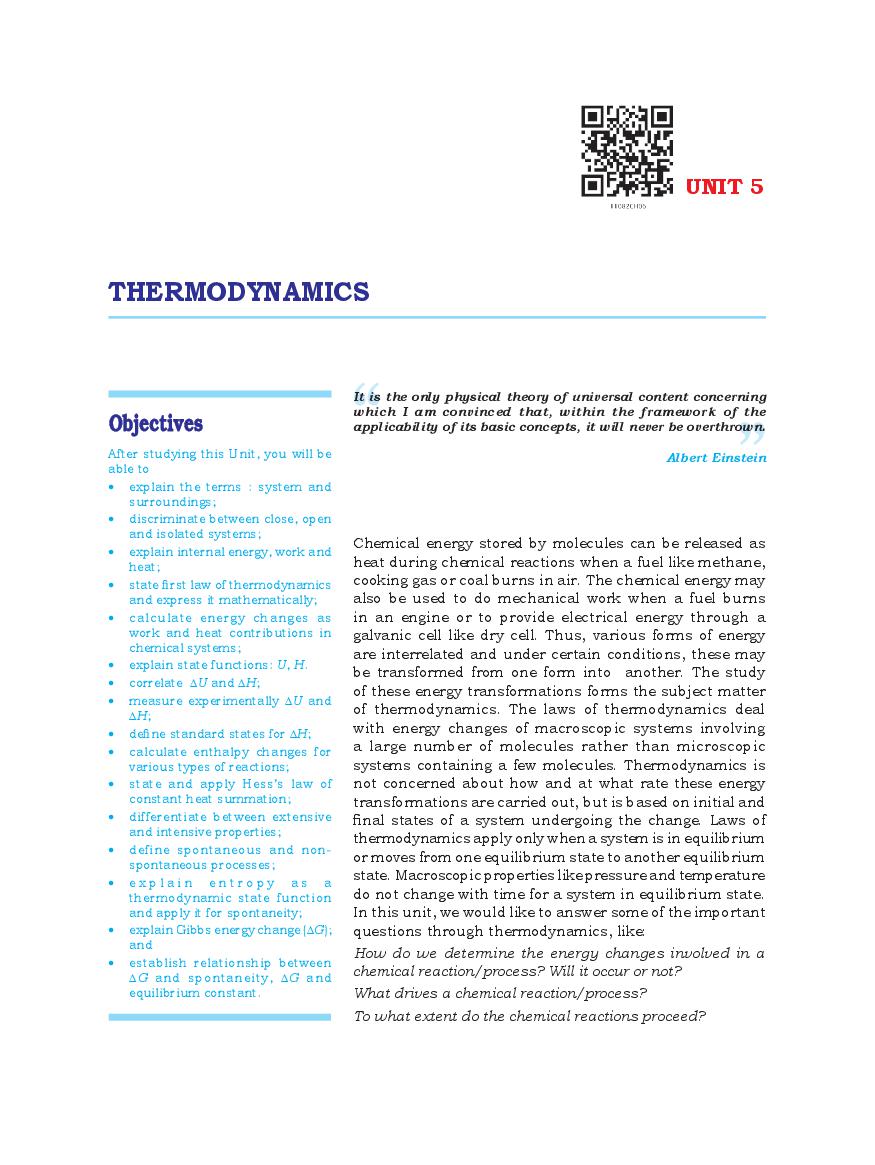
Thermodynamics
It is the only physical theory of universal content concerning
which I am convinced that, within the framework of the
applicability of its basic concepts, it will never be overthrown.
After studying this Unit, you will be Albert Einstein
able to
• explain the terms : system and
surroundings;
• discriminate between close, open
and isolated systems;
Chemical energy stored by molecules can be released as
• explain internal energy, work and
heat; heat during chemical reactions when a fuel like methane,
• state first law of thermodynamics cooking gas or coal burns in air. The chemical energy may
and express it mathematically; also be used to do mechanical work when a fuel burns
• calculate energy changes as in an engine or to provide electrical energy through a
work and heat contributions in galvanic cell like dry cell. Thus, various forms of energy
chemical systems;
are interrelated and under certain conditions, these may
• explain state functions: U, H.
be transformed from one form into another. The study
• correlate ∆U and ∆H;
of these energy transformations forms the subject matter
• measure experimentally ∆U and
∆H; of thermodynamics. The laws of thermodynamics deal
• define standard states for ∆H; with energy changes of macroscopic systems involving
• calculate enthalpy changes for a large number of molecules rather than microscopic
various types of reactions; systems containing a few molecules. Thermodynamics is
• state and apply Hess’s law of not concerned about how and at what rate these energy
constant heat summation; transformations are carried out, but is based on initial and
• differentiate between extensive final states of a system undergoing the change. Laws of
and intensive properties;
thermodynamics apply only when a system is in equilibrium
• define spontaneous and non-
spontaneous processes;
or moves from one equilibrium state to another equilibrium
• explain entropy as a
state. Macroscopic properties like pressure and temperature
thermodynamic state function do not change with time for a system in equilibrium state.
and apply it for spontaneity; In this unit, we would like to answer some of the important
• explain Gibbs energy change (∆G); questions through thermodynamics, like:
and
How do we determine the energy changes involved in a
• establish relationship between
∆G and spontaneity, ∆G and chemical reaction/process? Will it occur or not?
equilibrium constant. What drives a chemical reaction/process?
To what extent do the chemical reactions proceed?
t
Showing the first page only. Download the PDF above for the complete document.
Document Details
| Board / Org | NCERT |
| Exam | Class 11 |
| Type | Books |
| Pages | 32 |
| Updated | 29 Aug 2026 |