Finished viewing? Save it for later —
Download NCERT Book Class 11 Chemistry Chapter 3 Classification of Elements and Periodicity in Properties (PDF · 26 pages)About NCERT Book Class 11 Chemistry Chapter 3 Classification of Elements and Periodicity in Properties
NCERT Book Class 11 Chemistry Chapter 3 Classification of Elements and Periodicity in Properties is available here for free download. Published by NCERT for Class 11, this books can be viewed online or downloaded as a PDF (26 pages). Candidates preparing for Class 11 can use NCERT Book Class 11 Chemistry Chapter 3 Classification of Elements and Periodicity in Properties to understand the exam pattern, the type of questions asked, and the overall difficulty level.
Frequently Asked Questions
How can I download NCERT Book Class 11 Chemistry Chapter 3 Classification of Elements and Periodicity in Properties?
Open this page and click the Download button to save NCERT Book Class 11 Chemistry Chapter 3 Classification of Elements and Periodicity in Properties as a PDF. It is completely free on AglaSem Docs.
Is NCERT Book Class 11 Chemistry Chapter 3 Classification of Elements and Periodicity in Properties free to download?
Yes. NCERT Book Class 11 Chemistry Chapter 3 Classification of Elements and Periodicity in Properties can be viewed online and downloaded as a PDF free of cost on AglaSem Docs.
How many pages does NCERT Book Class 11 Chemistry Chapter 3 Classification of Elements and Periodicity in Properties have?
NCERT Book Class 11 Chemistry Chapter 3 Classification of Elements and Periodicity in Properties contains 26 pages, which you can read online or download together as a single PDF.
Where can I find more Class 11 study material?
You can find more Class 11 question papers, sample papers, syllabus, and answer keys on AglaSem Docs.
NCERT Book Class 11 Chemistry Chapter 3 Classification of Elements and Periodicity in Properties – Text
Read the full text of this books below — useful to quickly search, copy and reference the content online without downloading the PDF.
📄 View text version (1 page)
Page 1
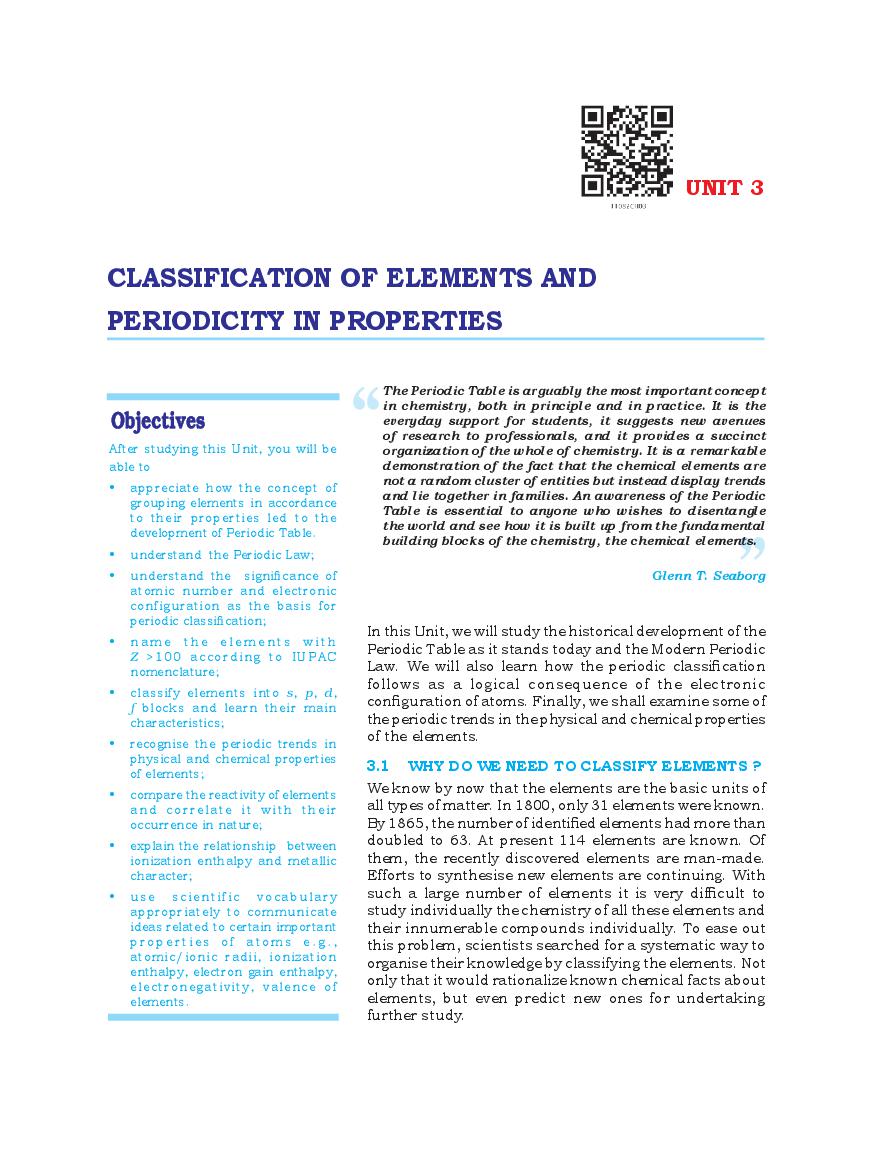
Classification of Elements and
Periodicity in Properties
The Periodic Table is arguably the most important concept
in chemistry, both in principle and in practice. It is the
everyday support for students, it suggests new avenues
of research to professionals, and it provides a succinct
After studying this Unit, you will be organization of the whole of chemistry. It is a remarkable
able to demonstration of the fact that the chemical elements are
not a random cluster of entities but instead display trends
• appreciate how the concept of
and lie together in families. An awareness of the Periodic
grouping elements in accordance
Table is essential to anyone who wishes to disentangle
to their properties led to the
the world and see how it is built up from the fundamental
development of Periodic Table.
building blocks of the chemistry, the chemical elements.
• understand the Periodic Law;
• understand the significance of Glenn T. Seaborg
atomic number and electronic
configuration as the basis for
periodic classification;
In this Unit, we will study the historical development of the
• name the elements with
Z >100 according to IUPAC
Periodic Table as it stands today and the Modern Periodic
nomenclature; Law. We will also learn how the periodic classification
follows as a logical consequence of the electronic
• classify elements into s, p, d,
f blocks and learn their main configuration of atoms. Finally, we shall examine some of
characteristics; the periodic trends in the physical and chemical properties
• recognise the periodic trends in of the elements.
physical and chemical properties
of elements;
3.1 WHY DO WE NEED TO CLASSIFY ELEMENTS ?
• compare the reactivity of elements We know by now that the elements are the basic units of
and correlate it with their all types of matter. In 1800, only 31 elements were known.
occurrence in nature; By 1865, the number of identified elements had more than
• explain the relationship between doubled to 63. At present 114 elements are known. Of
ionization enthalpy and metallic them, the recently discovered elements are man-made.
character; Efforts to synthesise new elements are continuing. With
• use scientific vocabulary such a large number of elements it is very difficult to
appropriately to communicate study individually the chemistry of all these elements and
ideas related to certain important their innumerable compounds individually. To ease out
properties of atoms e.g., this problem, scientists searched for a systematic way to
atomic/ionic radii, ionization
organise their knowledge by classifying the elements. Not
enthalpy, electron gain enthalpy,
electronegativity, valence of only that it would rationalize known chemical facts about
elements. elements, but even predict new ones for undertaking
further study.
Unit 3.indd 74 9/9/2022 4:36:12 PM
Showing the first page only. Download the PDF above for the complete document.
Document Details
| Board / Org | NCERT |
| Exam | Class 11 |
| Type | Books |
| Pages | 26 |
| Updated | 29 Aug 2026 |