HP Board Class 11 Model Question Paper 2022 Chemistry Term 2
Finished viewing? Save it for later —
Download HP Board Class 11 Model Question Paper 2022 Chemistry Term 2 (PDF · 4 pages)About HP Board Class 11 Model Question Paper 2022 Chemistry Term 2
HP Board Class 11 Model Question Paper 2022 Chemistry Term 2 is available here for free download. Published by Himachal Pradesh Board for Class 11, this sample paper can be viewed online or downloaded as a PDF (4 pages). Candidates preparing for Class 11 can use HP Board Class 11 Model Question Paper 2022 Chemistry Term 2 to understand the exam pattern, the type of questions asked, and the overall difficulty level.
Frequently Asked Questions
How can I download HP Board Class 11 Model Question Paper 2022 Chemistry Term 2?
Open this page and click the Download button to save HP Board Class 11 Model Question Paper 2022 Chemistry Term 2 as a PDF. It is completely free on AglaSem Docs.
Is HP Board Class 11 Model Question Paper 2022 Chemistry Term 2 free to download?
Yes. HP Board Class 11 Model Question Paper 2022 Chemistry Term 2 can be viewed online and downloaded as a PDF free of cost on AglaSem Docs.
How many pages does HP Board Class 11 Model Question Paper 2022 Chemistry Term 2 have?
HP Board Class 11 Model Question Paper 2022 Chemistry Term 2 contains 4 pages, which you can read online or download together as a single PDF.
Where can I find more Class 11 study material?
You can find more Class 11 question papers, sample papers, syllabus, and answer keys on AglaSem Docs.
HP Board Class 11 Model Question Paper 2022 Chemistry Term 2 – Text
Read the full text of this sample paper below — useful to quickly search, copy and reference the content online without downloading the PDF.
📄 View text version (4 pages)
Page 1
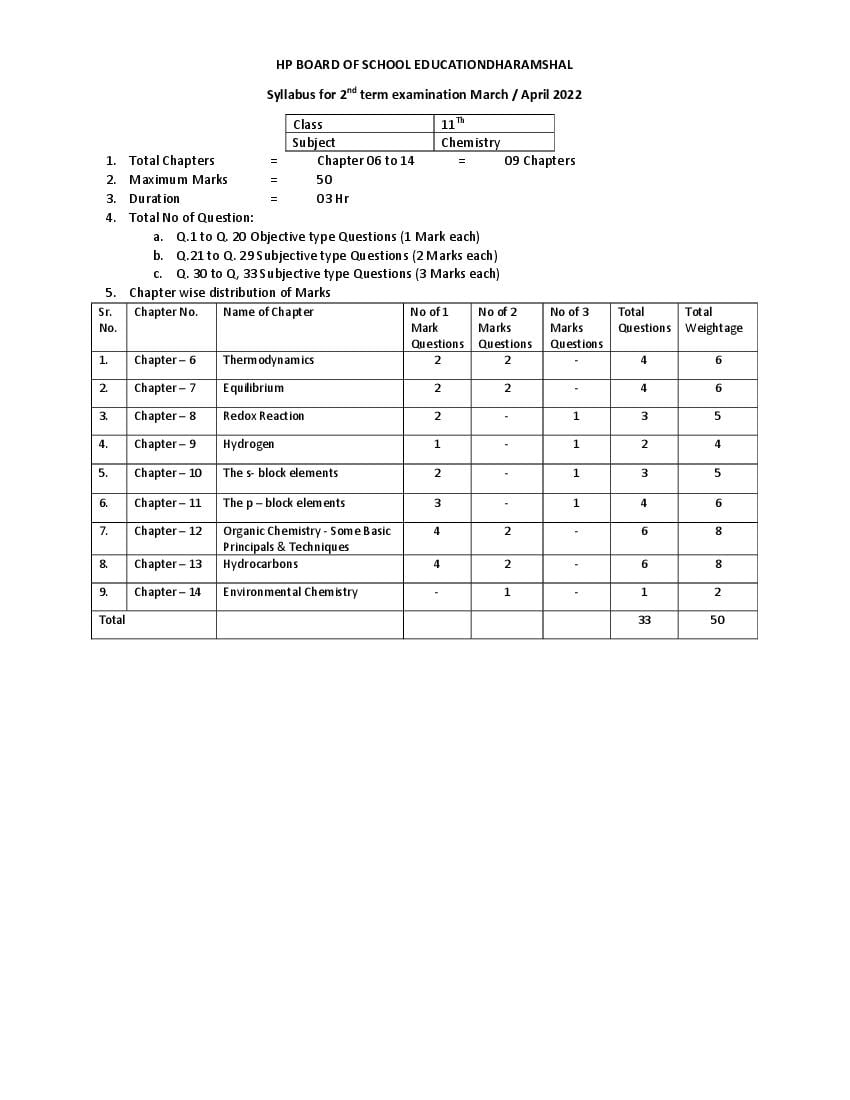
Syllabus for 2nd term examination March / April 2022
Class 11Th
Subject Chemistry
1. Total Chapters = Chapter 06 to 14 = 09 Chapters
2. Maximum Marks = 50
3. Duration = 03 Hr
4. Total No of Question:
a. Q.1 to Q. 20 Objective type Questions (1 Mark each)
b. Q.21 to Q. 29 Subjective type Questions (2 Marks each)
c. Q. 30 to Q, 33 Subjective type Questions (3 Marks each)
5. Chapter wise distribution of Marks
Sr. Chapter No. Name of Chapter No of 1 No of 2 No of 3 Total Total
No. Mark Marks Marks Questions Weightage
Questions Questions Questions
1. Chapter – 6 Thermodynamics 2 2 - 4 6
2. Chapter – 7 Equilibrium 2 2 - 4 6
3. Chapter – 8 Redox Reaction 2 - 1 3 5
4. Chapter – 9 Hydrogen 1 - 1 2 4
5. Chapter – 10 The s- block elements 2 - 1 3 5
6. Chapter – 11 The p – block elements 3 - 1 4 6
7. Chapter – 12 Organic Chemistry - Some Basic 4 2 - 6 8
Principals & Techniques
8. Chapter – 13 Hydrocarbons 4 2 - 6 8
9. Chapter – 14 Environmental Chemistry - 1 - 1 2
Total 33 50
Page 2
Model Question Paper
Second Term Examination, March / April 2022
Class – 11
Duration – 03:00 Hr Chemistry M.M.: 50
Instructions: i) All questions are compulsory.
ii) While answering your Questions, you must indicate on your Answer-book the same Question
No. as appearing in your Question Paper.
iii) Internal choices are given in some questions.
iv) Question No. 1 to 20 carry 1mark each, Question No. 21 to 29 carry 2 marks each and
Question No. 30 to 33 carry 3 marks each.
v) Make neat and clean diagrams where required.
Q.1 When system does not exchange heat with surrounding the process is called
a) Isothermal b) adiabatic
c) thermal d) Isochoric
Q.2 Which of the following is not Lewis acid
a) BF3 b) AlCl3
c) FeCl3 d) PH3
Q.3 Which of the following can act as an oxidising as well as reducing agent
a) H2O2 b) SO3
c) H2SO4 d) HNO3
Q.4 How many hydrogen bonded water molecules are associated with CuSO4.5H2O
a) Five b) One
c) One d) Three
Q.5 When Sodium reacts with excess of oxygen the oxidation number of oxygen changes from
a) 0 to – 1 b) 0 to – 2
c) – 1 to – 2 d) Does not change
Q.6 Group 13 elements shows
a) only + 1 oxidation state b) only + 3 oxidation state
c) + 1 and +3 oxidation state d) +1, +2 and +3 Oxidation States
Q.7 Inductive effect involves
a) displacement of electrons resulting polarisation
b) displacement of electrons resulting polarisation
c) delocalisation of electrons
d) delocalisation of electrons
Q.8 The IUPAC name of given structure is
a) Hexane b) Isopentane
c) 3 - Ethylbutane d) 3 - Methylpentane
Page 3
a) Two alkyhalides b) Two aryl halides
c) One alkyl and One aryl halide d) None of these
Q.10 The ease of dehydrohalogenation for different halogen is in the order
a) Iodide > Bromide > Chloride b) Bromide > Iodide > Chloride
c) Chloride > Bromide > Iodide d) Iodide > Chloride > Bromide
Q.11 All carbon atom in benzene are………………… hybridized.
Q.12 If G is – ive ( G< 0) then the process is …………………
Q.13 In the relation Kp = Kc (RT)n, n represents …………………
Q.14 Loss of electrons by any species is called as ……………………
Q.15 ………………… is the only alkali metal which when burnt in air forms a mixture of oxides as well nitride.
Q.16 Thermodynamically the most stable form of carbon is ………………
Q.17 The general electronic configuration of Group – 13 elements is ……………………
Q.18 If a covalent bond breaks in such a fashion that the shared pair of electrons remains with one of the
fragments the cleavage is called ……………….
Q.19 Two successive members of a homologous series differ from each other in their molecular formula
by …………………
Q.20 The process of elimination of Carbon dioxide from a Carboxylic acid is known as ……………
Q.21 Calculate the heat of combustion of ethylene (gas) to from CO2 (gas) and H2O (gas) at 298k and 1
atmospheric pressure. The heats of formation of CO2, H2O and C2H4 are – 393.7, - 241.8, + 52.3 kJ per
mole respectively
OR
Derive relation between Cp and Cv for an ideal gas.
Q.22 Differentiate between classical and photochemical smog.
Q.23 Explain the term electrophile and nucleophile with example.
Q.24 Explain the relative stability of conformations of n-butane.
Q.25 a) State Le chatelier’s principle.
b) State the Law of Chemical equilibrium
Q.26 a) Define Specific Heat.
b) State the first Law of Thermodynamics.
Q.27 Explain why tertiary carbocation is more stable then secondary and primary carbocations?
OR
Page 4
Q. 28 a) What is peroxide effect?
b) State Huckel’s rule of aromaticity.
OR
Write short note on the following:
a) Wurtz Reaction
b) Friedel Craft Reaction
Q.29 Calculate the pOH value of the solution if its pH is 7.
OR
At equilibrium the concentration of N2 = 3.0 x 10⁻³M, O2 = 4.2 x 10⁻³M and NO = 2.8 x 10⁻³M in a
sealed vessel at 800K. What will be Kc for the reaction
N2 (g) + O2 (g) ⇌ 2NO (g)
Q.30 a) What is the cause of hardness of water?
b) Why ice floats over water?
Q.31 a) Define oxidation and reduction in terms of electrons transfer.
b) Can we store copper sulphate in an iron vessel?
c) Define electrode potential.
OR
a) What do you mean by Electrochemical Series?
b) Define disproportionation reaction.
c) Write the functions of Salt bridge in electrochemical cell.
Q.32 a) Why Be and Mg do not impart colour to the flame?
b) Why do the alkali metals give blue solution, when treated with liquid NH3?
c) Why is the oxidation state of Na and K always + 1?
OR
a) Why is Na metal always kept in Kerosine Oil or Paraffine wax?
b) Why Li is strongest reducing agent?
c) Why Alkaline earth metals are harder than alkali metals?
Q.33 a) Define inert pair effect.
b) Give reactions to justify amphoteric nature of Aluminium.
OR
a) Define catenation.
b) Explain why there is phenomenal decrease in ionisation enthalpy from Carbon to Silicon?
Document Details
| Board / Org | Himachal Pradesh Board |
| Exam | Class 11 |
| Type | Sample Paper |
| Pages | 4 |
| Updated | 30 Apr 2026 |