NCERT Book Class 11 Chemistry Chapter 7 Redox Reactions
Finished viewing? Save it for later —
Download NCERT Book Class 11 Chemistry Chapter 7 Redox Reactions (PDF · 21 pages)About NCERT Book Class 11 Chemistry Chapter 7 Redox Reactions
NCERT Book Class 11 Chemistry Chapter 7 Redox Reactions is available here for free download. Published by NCERT for Class 11, this books can be viewed online or downloaded as a PDF (21 pages). Candidates preparing for Class 11 can use NCERT Book Class 11 Chemistry Chapter 7 Redox Reactions to understand the exam pattern, the type of questions asked, and the overall difficulty level.
Frequently Asked Questions
How can I download NCERT Book Class 11 Chemistry Chapter 7 Redox Reactions?
Open this page and click the Download button to save NCERT Book Class 11 Chemistry Chapter 7 Redox Reactions as a PDF. It is completely free on AglaSem Docs.
Is NCERT Book Class 11 Chemistry Chapter 7 Redox Reactions free to download?
Yes. NCERT Book Class 11 Chemistry Chapter 7 Redox Reactions can be viewed online and downloaded as a PDF free of cost on AglaSem Docs.
How many pages does NCERT Book Class 11 Chemistry Chapter 7 Redox Reactions have?
NCERT Book Class 11 Chemistry Chapter 7 Redox Reactions contains 21 pages, which you can read online or download together as a single PDF.
Where can I find more Class 11 study material?
You can find more Class 11 question papers, sample papers, syllabus, and answer keys on AglaSem Docs.
NCERT Book Class 11 Chemistry Chapter 7 Redox Reactions – Text
Read the full text of this books below — useful to quickly search, copy and reference the content online without downloading the PDF.
📄 View text version (1 page)
Page 1
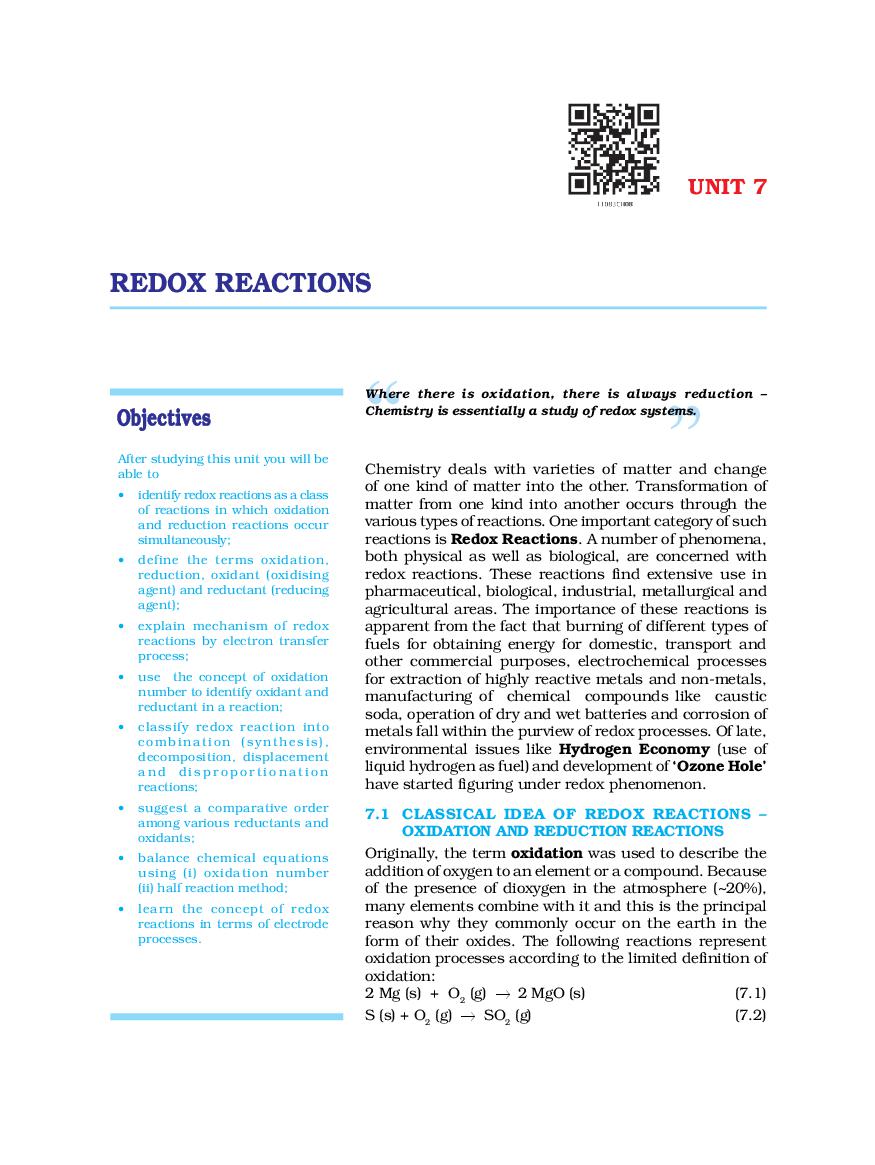
UNIT 7
REDOX REACTIONS
Where there is oxidation, there is always reduction –
Chemistry is essentially a study of redox systems.
After studying this unit you will be
able to Chemistry deals with varieties of matter and change
of one kind of matter into the other. Transformation of
identify redox reactions as a class
of reactions in which oxidation matter from one kind into another occurs through the
and reduction reactions occur various types of reactions. One important category of such
simultaneously; reactions is Redox Reactions. A number of phenomena,
define the terms oxidation, both physical as well as biological, are concerned with
reduction, oxidant (oxidising redox reactions. These reactions find extensive use in
agent) and reductant (reducing pharmaceutical, biological, industrial, metallurgical and
agent); agricultural areas. The importance of these reactions is
explain mechanism of redox apparent from the fact that burning of different types of
reactions by electron transfer fuels for obtaining energy for domestic, transport and
process;
other commercial purposes, electrochemical processes
use the concept of oxidation for extraction of highly reactive metals and non-metals,
number to identify oxidant and manufacturing of chemical compounds like caustic
reductant in a reaction;
soda, operation of dry and wet batteries and corrosion of
classify redox reaction into metals fall within the purview of redox processes. Of late,
combination (synthesis),
decomposition, displacement
environmental issues like Hydrogen Economy (use of
and disproportionation liquid hydrogen as fuel) and development of ‘Ozone Hole’
reactions; have started figuring under redox phenomenon.
suggest a comparative order
7.1 CLASSICAL IDEA OF REDOX REACTIONS –
among various reductants and
oxidants; OXIDATION AND REDUCTION REACTIONS
balance chemical equations Originally, the term oxidation was used to describe the
using (i) oxidation number addition of oxygen to an element or a compound. Because
(ii) half reaction method; of the presence of dioxygen in the atmosphere (~20%),
lear n the concept of redox many elements combine with it and this is the principal
reactions in terms of electrode reason why they commonly occur on the earth in the
processes. form of their oxides. The following reactions represent
oxidation processes according to the limited definition of
oxidation:
2 Mg (s) + O2 (g) → 2 MgO (s) (7.1)
S (s) + O2 (g) → SO2 (g) (7.2)
Unit 7.indd 235 10/10/2022 10:37:02 AM
Showing the first page only. Download the PDF above for the complete document.
Document Details
| Board / Org | NCERT |
| Exam | Class 11 |
| Type | Books |
| Pages | 21 |
| Updated | 29 Aug 2026 |