NCERT Book Class 11 Chemistry Chapter 6 Equilibrium
Finished viewing? Save it for later —
Download NCERT Book Class 11 Chemistry Chapter 6 Equilibrium (PDF · 53 pages)About NCERT Book Class 11 Chemistry Chapter 6 Equilibrium
NCERT Book Class 11 Chemistry Chapter 6 Equilibrium is available here for free download. Published by NCERT for Class 11, this books can be viewed online or downloaded as a PDF (53 pages). Candidates preparing for Class 11 can use NCERT Book Class 11 Chemistry Chapter 6 Equilibrium to understand the exam pattern, the type of questions asked, and the overall difficulty level.
Frequently Asked Questions
How can I download NCERT Book Class 11 Chemistry Chapter 6 Equilibrium?
Open this page and click the Download button to save NCERT Book Class 11 Chemistry Chapter 6 Equilibrium as a PDF. It is completely free on AglaSem Docs.
Is NCERT Book Class 11 Chemistry Chapter 6 Equilibrium free to download?
Yes. NCERT Book Class 11 Chemistry Chapter 6 Equilibrium can be viewed online and downloaded as a PDF free of cost on AglaSem Docs.
How many pages does NCERT Book Class 11 Chemistry Chapter 6 Equilibrium have?
NCERT Book Class 11 Chemistry Chapter 6 Equilibrium contains 53 pages, which you can read online or download together as a single PDF.
Where can I find more Class 11 study material?
You can find more Class 11 question papers, sample papers, syllabus, and answer keys on AglaSem Docs.
NCERT Book Class 11 Chemistry Chapter 6 Equilibrium – Text
Read the full text of this books below — useful to quickly search, copy and reference the content online without downloading the PDF.
📄 View text version (1 page)
Page 1
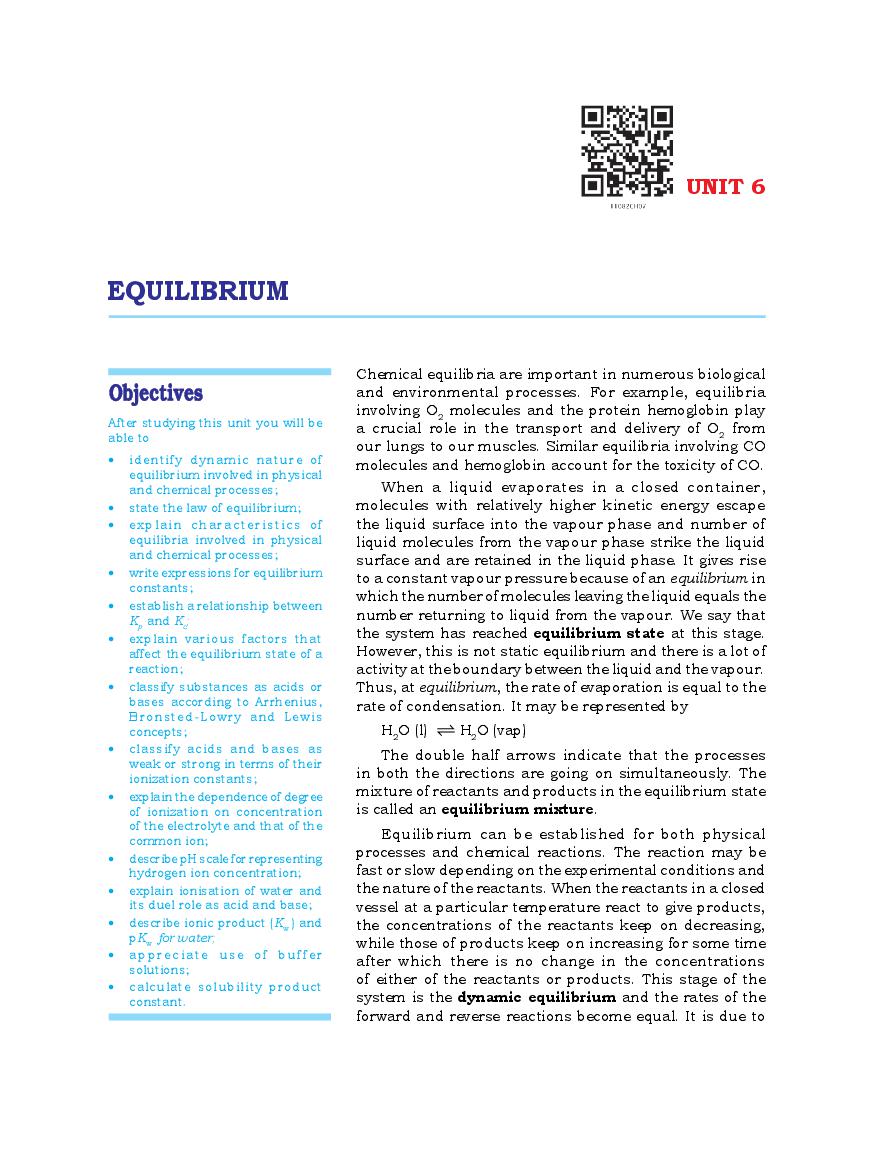
Equilibrium
Chemical equilibria are important in numerous biological
and environmental processes. For example, equilibria
involving O2 molecules and the protein hemoglobin play
After studying this unit you will be
a crucial role in the transport and delivery of O2 from
able to
our lungs to our muscles. Similar equilibria involving CO
• identify dynamic nature of molecules and hemoglobin account for the toxicity of CO.
equilibrium involved in physical
and chemical processes; When a liquid evaporates in a closed container,
• state the law of equilibrium; molecules with relatively higher kinetic energy escape
• explain characteristics of the liquid surface into the vapour phase and number of
equilibria involved in physical liquid molecules from the vapour phase strike the liquid
and chemical processes; surface and are retained in the liquid phase. It gives rise
• write expressions for equilibrium to a constant vapour pressure because of an equilibrium in
constants;
which the number of molecules leaving the liquid equals the
• establish a relationship between
Kp and Kc; number returning to liquid from the vapour. We say that
• explain various factors that the system has reached equilibrium state at this stage.
affect the equilibrium state of a However, this is not static equilibrium and there is a lot of
reaction; activity at the boundary between the liquid and the vapour.
• classify substances as acids or Thus, at equilibrium, the rate of evaporation is equal to the
bases according to Arrhenius, rate of condensation. It may be represented by
Bronsted-Lowry and Lewis
concepts; H2O (l) H2O (vap)
• classify acids and bases as
The double half arrows indicate that the processes
weak or strong in terms of their
ionization constants; in both the directions are going on simultaneously. The
• explain the dependence of degree mixture of reactants and products in the equilibrium state
of ionization on concentration is called an equilibrium mixture.
of the electrolyte and that of the
common ion; Equilibrium can be established for both physical
• describe pH scale for representing processes and chemical reactions. The reaction may be
hydrogen ion concentration; fast or slow depending on the experimental conditions and
• explain ionisation of water and the nature of the reactants. When the reactants in a closed
its duel role as acid and base; vessel at a particular temperature react to give products,
• describe ionic product (Kw ) and the concentrations of the reactants keep on decreasing,
pKw for water;
while those of products keep on increasing for some time
• appreciate use of buffer
after which there is no change in the concentrations
solutions;
• calculate solubility product
of either of the reactants or products. This stage of the
constant. system is the dynamic equilibrium and the rates of the
forward and reverse reactions become equal. It is due to
Unit 6.indd 168 9/12/2022 11:58:20 AM
Showing the first page only. Download the PDF above for the complete document.
Document Details
| Board / Org | NCERT |
| Exam | Class 11 |
| Type | Books |
| Pages | 53 |
| Updated | 29 Aug 2026 |