HBSE Class 10 Sample Paper 2027 Mathematics Basic Stepwise Marking Scheme
Finished viewing? Save it for later —
Download HBSE Class 10 Sample Paper 2027 Mathematics Basic Stepwise Marking Scheme (PDF · 21 pages)About HBSE Class 10 Sample Paper 2027 Mathematics Basic Stepwise Marking Scheme
HBSE Class 10 Sample Paper 2027 Mathematics Basic Stepwise Marking Scheme is available here for free download. Published by Haryana Board for Class 10, this answer key can be viewed online or downloaded as a PDF (21 pages). Candidates preparing for Class 10 can use HBSE Class 10 Sample Paper 2027 Mathematics Basic Stepwise Marking Scheme to understand the exam pattern, the type of questions asked, and the overall difficulty level.
Frequently Asked Questions
How can I download HBSE Class 10 Sample Paper 2027 Mathematics Basic Stepwise Marking Scheme?
Open this page and click the Download button to save HBSE Class 10 Sample Paper 2027 Mathematics Basic Stepwise Marking Scheme as a PDF. It is completely free on AglaSem Docs.
Is HBSE Class 10 Sample Paper 2027 Mathematics Basic Stepwise Marking Scheme free to download?
Yes. HBSE Class 10 Sample Paper 2027 Mathematics Basic Stepwise Marking Scheme can be viewed online and downloaded as a PDF free of cost on AglaSem Docs.
How many pages does HBSE Class 10 Sample Paper 2027 Mathematics Basic Stepwise Marking Scheme have?
HBSE Class 10 Sample Paper 2027 Mathematics Basic Stepwise Marking Scheme contains 21 pages, which you can read online or download together as a single PDF.
Where can I find more Class 10 study material?
You can find more Class 10 question papers, sample papers, syllabus, and answer keys on AglaSem Docs.
HBSE Class 10 Sample Paper 2027 Mathematics Basic Stepwise Marking Scheme – Text
Read the full text of this answer key below — useful to quickly search, copy and reference the content online without downloading the PDF.
📄 View text version (22 pages)
Page 1
HBSE Class 10 Sample
Paper 2027 Mathematics
Basic Stepwise Marking
Scheme
EXAM YEAR TYPE SUBJECT
Haryana Class 10 2027 Answer Key Maths
Notes · Sample Papers · Previous Year Papers · Mock Tests
Page 2
m .co
m .co s em
se g la
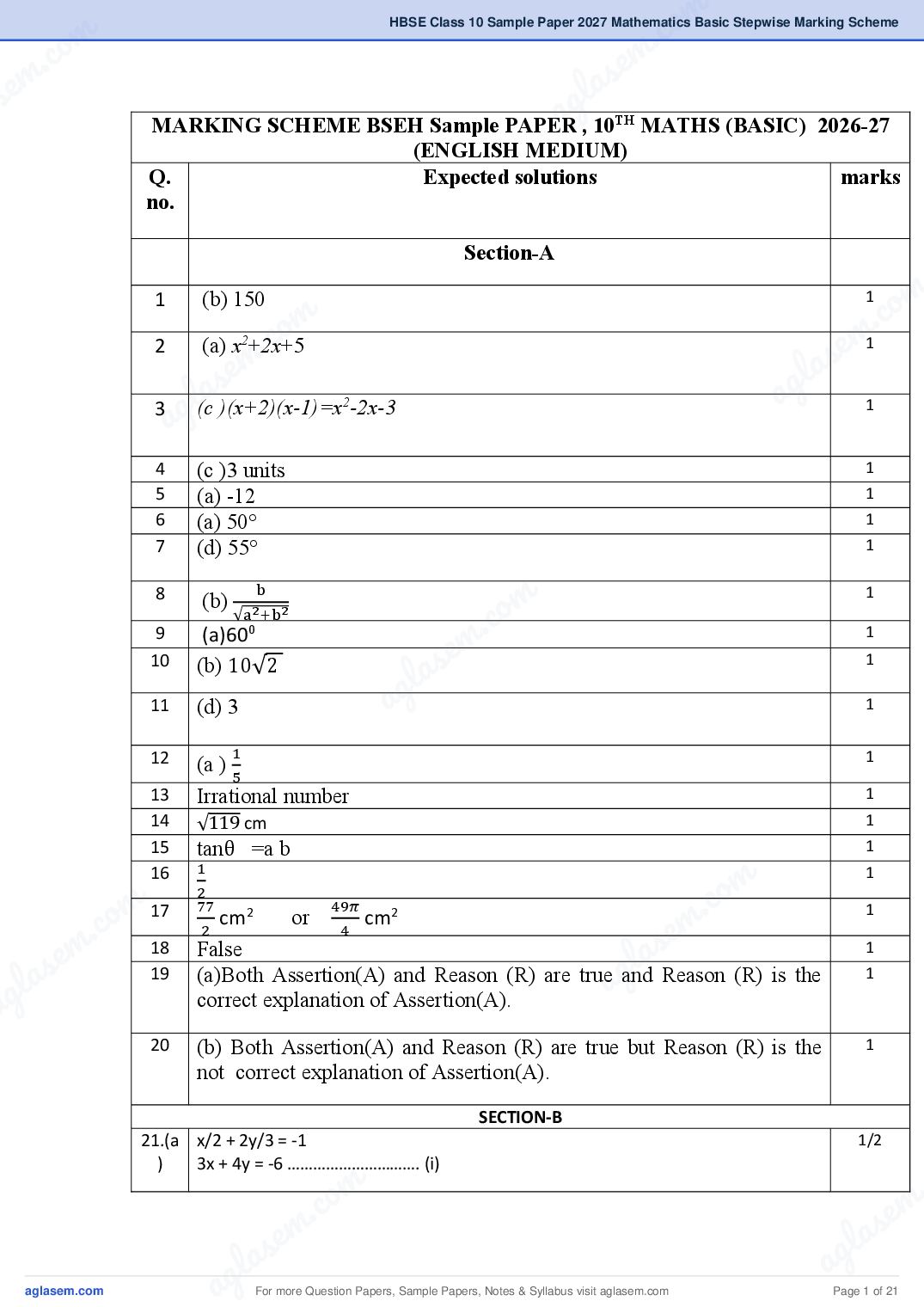
a , 10 MATHS (BASIC) 2026-27
MARKING SCHEME BSEH Sample PAPER TH
(ENGLISH MEDIUM)
Q. Expected solutions marks
no.
Section-A
m
.co
1 (b) 150 1
m
(a) x2+2x+5.co s e m1
em
2
s l a
a
3 gl(c )(x+2)(x-1)=x -2x-3 2 ag
a
1
4 (c )3 units 1
5 (a) -12 1
6 (a) 50° 1
7 (d) 55° 1
om
8 b 1
(b)
√a2 +b2
. c
9 (a)600
e m 1
10 (b) 10√2
las 1
11 (d) 3 ag 1
12 1 1
(a )
5
13 Irrational number 1
14 √119 cm 1
15 tanθ =a b 1
om
16 1 1
m 17
2
. c
c. o
77 49𝜋
m
1
cm2 cm2
e
or
em 18
2
False
4
l as 1
las 19 (a)Both Assertion(A) and Reason (R) are true and Reason (R) is the
ag 1
ag correct explanation of Assertion(A).
20 (b) Both Assertion(A) and Reason (R) are true but Reason (R) is the 1
not correct explanation of Assertion(A).
SECTION-B
21.(a x/2 + 2y/3 = -1 1/2
) 3x + 4y = -6 …………………………. (i)
m .
.co s e m
s em l a
g la ag
a For more Question Papers, Sample Papers, Notes & Syllabus visit Page 1 of 21
Page 3
.. 1/2
x-y/3 = 3
3x – y = 9 ……………………………. (ii)
….……………………………………………………………………………………………………………………………
..
1/2
When the equation (ii) is subtracted from equation (i) we get,
5y = -15
y = -3 ………………………………….(iii)
….……………………………………………………………………………………………………………………………
..
1/2
When the equation (iii) is substituted in (i) we get,
3x – 12 = -6
3x = 6
x=2
Hence, x = 2 , y = -3
21.(b Using the property of a rectangle,
) We know that, 1/2
Lengths are equal,
i.e., CD = AB
Hence, x + 3y = 13 …(i)
….……………………………………………………………………………………………………………………………
..
Breadths are equal, 1/2
i.e., AD = BC
Hence, 3x + y = 7 …(ii)
….……………………………………………………………………………………………………………………………
..
1/2
On multiplying Eq. (ii) by 3 and then subtracting Eq. (i),
We get,
8x = 8
So, x = 1
….……………………………………………………………………………………………………………………………
.. 1/2
On substituting x = 1 in Eq. (i),
We get,
y=4
Therefore, the required values of x and y are 1 and 4, respectively.
22. Let (– 4, 6) divide AB internally in the ratio k : 1.
For more Question Papers, Sample Papers, Notes & Syllabus visit Page 2 of 21
Page 4
m .co
m .co s e m
se g l a
Using the section formula, we get a
3𝑘−6 −8𝑘+10
(– 4, 6) = ( , 𝑘+1 ) 1
𝑘+1
….…………………………………………………………………………………………………………………………
3𝑘−6
So, – 4 =
𝑘+1
.….…………………………………………………………………………………………………………………………
m
.co
1/2
m
m .co
⇒ – 4k – 4 = 3k – 6
s e m
⇒ 7k =2
s e l a
a ag 1/2
⇒, k : 1 = 2 : 7
g lWe can check for the y-coordinate also.
a So, the point (– 4, 6) divides the line segment joining the points A(– 6, 10) and
B(3, – 8) in the ratio 2 : 7.
23.
m
m .co
s e
In ∆PBC and ∆PDE, g la
a
∠BPC = ∠EPD [vertically opposite angles]
PB/PD = 5/10 = ½ … (i) 1
PC/PE = 6/12 = ½ … (ii)
.….…………………………………………………………………………………………………………………………
m
m .co
m .co s e m
s e From equation (i) and (ii),
g l a
g la a
a We get,
PB/PD = PC/PE
Since, ∠BPC of ∆PBC = ∠EPD of ∆PDE and the sides including these. 1/2
.….…………………………………………………………………………………………………………………………
m .
.co s e m
s em l a
g la ag
a For more Question Papers, Sample Papers, Notes & Syllabus visit Page 3 of 21
Page 5
1/2
∆PBC ∼ ∆PDE
24.(b We know that,
)
cos 60° = 1/2
sec 30° = 2/√3
1/2
tan 45° = 1
sin 30° = 1/2
cos 30° = √3/2
….…………………………………………………………………………………………………………………………
Now, substitute the values in the given problem, we get
(5cos260° + 4sec230° – tan245°)/(sin2 30° + cos2 30°) 1/2
= {5(1/2)2+4(2/√3)2-1}/(1/2)2+(√3/2)2
….…………………………………………………………………………………………………………………………
= (5/4+16/3-1)/(1/4+3/4) 1/2
={ (15+64-12)/12}/(4/4)
….…………………………………………………………………………………………………………………………
1/2
= 67/12
24.(a
1+sinA
) LHS = √ By rationalization
1−sinA
1+𝑠𝑖𝑛𝐴 1+𝑠𝑖𝑛𝐴 1/2
= √ × 1+𝑠𝑖𝑛𝐴
1−𝑠𝑖𝑛𝐴
….…………………………………………………………………………………………………………………………
1/2
For more Question Papers, Sample Papers, Notes & Syllabus visit Page 4 of 21
Page 6
m .co
m .co s e m
se g l a
1+sinA a
=
√1−sin2 A
….…………………………………………………………………………………………………………………………
1+sinA 1/2
=
√cos2 A
m
.co
….…………………………………………………………………………………………………………………………
m
m .co e m
s 1/2
s e l a
ag
1+sinA
l=a cosA
ag = secA +tanA = RHS
25.
Area swept by the minute hand in 60 minutes = Area of the circle with
om
1/2
radius equal to the length of the minute hand = πr2
. c
m
….…………………………………………………………………………………………………………………………
e
las
ag
Area swept by minute hand in 1 minute = πr2/60
….………………………………………………………………………………………………………………………… 1/2
Thus, area swept by minute hand in 5 minutes = (πr2/60) × 5 = πr2/12
o m
m c
. (r) = 14 cm]
c. o
1/2
m
[∵Length of the minute hand
e
e m l as
las g
….…………………………………………………………………………………………………………………………
a
ag
= 1/12 × 22/7 × 14 × 14 cm2
= 154/3 cm2 1/2
SECTION-C
m .
.co s e m
s em l a
g la ag
a For more Question Papers, Sample Papers, Notes & Syllabus visit Page 5 of 21
Page 7
.............................................................................………………………………...
a
अतः इसे रूप में लिखा जा सकता है
b
जहााँ a और b सह-अभा्ቋ हैं और b≠ 0
a
अत: 3−2 √5 =
b
.......................................................................……………………………………….
a 3b−a
⇒ 2√5 = 3 − =
b b
..................................................................................………………………….
3b−a
⇒ √5 =
2b
..............................................................................………………………….
3b−a
िहााँ √5 अपरिमेय है तथा परिमेय है l
2b
क्योंकि अपरिमेय संख्या≠ परिमेय संख्या
...................................................................…………………………………...
अतः उपिोक्त एि वििोधाभास है ।
इसललए हमािी िल्पना ग़लत है .
अतः 3−2 √5 अपररमेय है ।
27. 6x2−3−7x=6x2−7x−3=0
⇒6x2+2x−9x−3=0
⇒2x(3x+1)−3(3x+1)=0 1
⇒(2x−3)(3x+1)=0
Zeros = 3/2,−1/3
….…………………………………………………………………………………………………………………………
α+β=−b/a⇒(3/2)+ (−1/3)=7/6=-(−7)6=−b/a 1
For more Question Papers, Sample Papers, Notes & Syllabus visit Page 6 of 21
Page 8
m .co
m .co s em
se g la
a
….…………………………………………………………………………………………………………………………
1
αβ=c/a⇒(3/2)(−1/3)=−1/2=−3/6=c/a
Hence proved.
28.(a Let Rahul’s age be x years and his son’s age be y years.
) 1/2
m
.co
….…………………………………………………………………………………………………………………………
o m m
c
. hence(later), s e
m
Five years
e l a
a s
lx+ 5 = 3 (y + 5) ag
ag
⇒x+ 5 = 3 y + 15 1/2
⇒x - 3 y = 10.......(1)
….…………………………………………………………………………………………………………………………
m
Also, five years ago(before),
m .co
s e
x-5 = 7 (y – 5)
g la 1/2
⇒ x-5 = 7y – 35
a
⇒x-7y = -30........(2)
….…………………………………………………………………………………………………………………………
Subtracting equation (2) from (1),
m
m .co
.co
x - 3 y -x +7y = 10+ 30
m
(∵eq.(2) changes its sign)
s em 1/2
s e g la
g la 4y = 40 a
a
⇒y = 10
….…………………………………………………………………………………………………………………………
Put y = 10 in eq. (1),
1/2
m .
.co s e m
s em l a
g la ag
a For more Question Papers, Sample Papers, Notes & Syllabus visit Page 7 of 21
Page 9
⇒x - 30 = 10
⇒x = 40
….…………………………………………………………………………………………………………………………
Thus, present age of Rahul=x=40 years and 1/2
present age of Rahul's son=y=10 years.
28.(b Let the larger angle = x
) Smaller angle = y
As both angles are supplementary, 1
x + y = 180
⇒ x = 180 - y .... (i)
….…………………………………………………………………………………………………………………………
Difference is 18 degrees.
So, x - y = 18 1/2
⇒ x = 18 + y .... (i)
….…………………………………………………………………………………………………………………………
Substituting the value of x in equation (i) we get,
⇒ 18 + y = 180 - y
⇒ - y - y = 18 - 180
⇒ - 2y = -162
⇒ y=−162/−2
⇒ y = 81 1/2
….…………………………………………………………………………………………………………………………
Substituting the value of y in equation (i), we get,
⇒ x = 180 - 81 = 99 1/2
….…………………………………………………………………………………………………………………………
Hence, the angles are 99° and 81°.
1/2
29. We know that the distance between the two points is given
by the Distance Formula = √(x2 − x1 )2 + (y2 − y1 )2 By 1/2
substituting the values of points P (2, - 3) and Q (10, y) in the distance
formula, we get
….…………………………………………………………………………………………………………………………
For more Question Papers, Sample Papers, Notes & Syllabus visit Page 8 of 21
Page 10
m .co
m .co s e m
se g l a
a
PQ = √(2 − 10)² + (− 3 − 𝑦)² = 10
1/2
PQ = √(− 8)² + (3 + 𝑦)² = 10
….…………………………………………………………………………………………………………………………
m
m .co
.co
Squaring on both sides, we get
s e m1/2
s em
64 + (y + 3)2 = 100
g l a
l a a
….…………………………………………………………………………………………………………………………
ag
(y + 3)2 = 36
1/2
y + 3 = √36
y+3=±6
….…………………………………………………………………………………………………………………………
m
y + 3 = 6 or y + 3 = - 6
m .co 1
e
Therefore, y = 3 or - 9 are the possible values for y.
s
g la
a
30.(a Given, cos A + cos² A = 1
)
⇒ cos A = 1 - cos² A 1
⇒cos A = sin² A [ ∵ sin² A = 1 - cos² A ]
………………………(i)
….…………………………………………………………………………………………………………………………
m
m .co
m .co LHS=(sin² A + sin⁴ A) = em
(sin²A + (sin²A)²)
s
1/2
s e la
….…………………………………………………………………………………………………………………………
g
g la a
a
= (sin²A + (cos A)²) [using (i)] 1
….…………………………………………………………………………………………………………………………
= sin²A + cos²A
m .
1/2
.co s e m
s em l a
g la ag
a For more Question Papers, Sample Papers, Notes & Syllabus visit Page 9 of 21
Page 11
30.(b LHS=(sinA+cosecA)²+(cosA+secA)²
)
1/2
=sin²A+cosec²A+2sinAcosecA+cos²A+sec²A+2cosAsecA
….…………………………………………………………………………………………………………………………
=sin²A+cos²A+cosec²A+sec²A+2sinA×1/sinA+2cosA×1/cosA 1
[∵cosecA=1/sinA and secA=1/cosA ]
….…………………………………………………………………………………………………………………………
=1+cosec²A+sec²A+2+2
[∵sin²A+cos²A=1] 1/2
….…………………………………………………………………………………………………………………………
=5+(1+cot²A)+(1+tan²A)
[∵1+tan²A=sec²A and 1+cot²A=cosec²A ] 1
=7+tan²A+cot²A= RHS
….…………………………………………………………………………………………………………………………
For more Question Papers, Sample Papers, Notes & Syllabus visit Page 10 of 21
Page 12
m .co
m .co s e m
se g l a
31. a
m
m .co
m .co e m
s 1/2
s e l a
g l a ag
a
….…………………………………………………………………………………………………………………………
Given the height of the observer be DE = 1.5 m
m
.co
That is AB = 1.5 m
Let BC = h is the height of the chimney
e m
Hence AC = (h – 1.5) m
las 1/2
is AD = BE = 28.5 m ag
Given the distance between the observer and the chimney
….…………………………………………………………………………………………………………………………
In right △CAD,θ=45o
1
tan 45o=AC/AD
⇒1=(h−1.5)/28.5
….………………………………………………………………………………………………………………………… m
m .co
.co ⇒28.5=h−1.5
s e m
em a
1
as ⇒h=28.5+1.5= 30 m
g l
l a
ag Thus the height of the chimney is 30 m.
SECTION-D
32.( Given, 2nd term, a₂ = 14 3rd term, a₃= 18 1
a) Common difference, d = a₃ - a₂ = 18 - 14 = 4
...............................................................................................................................
m .
.co s e m
s em l a
g la ag
a For more Question Papers, Sample Papers, Notes & Syllabus visit Page 11 of 21
Page 13
a₂ = a + d
14 = a + 4 1
a = 10
...............................................................................................................................
1
Sum of n terms of AP is given by Sₙ = n/2 [2a + (n - 1) d]
...............................................................................................................................
1
S₅₁ = 51/2 [2 × 10 + (51 - 1) 4]
...............................................................................................................................
= 51/2 [20 + 50 × 4]
= 51/2 × 220
= 51 × 110
= 5610 1
32.(
b) nth term of an AP aₙ = a + (n - 1)d 1/2
Let a be the first term and d the common difference.
.............................................................................................................................
According to the question, a₃ = 16 and a₇ - a₅ = 12
a + (3 - 1)d = 16 1
a + 2d = 16 ........ (1)
.............................................................................................................................
Using a₇ - a₅ = 12
[a + (7 - 1) d] - [a + (5 - 1) d] = 12
1
[a + 6d] - [a + 4d] = 12 1
2
2d = 12
d=6
.............................................................................................................................
By substituting this in equation (1), we obtain
a + 2 × 6 = 16
a + 12 = 16
a=4 1
.............................................................................................................................
For more Question Papers, Sample Papers, Notes & Syllabus visit Page 12 of 21
Page 14
m .co
m .co s e m
se g l a
a
Therefore, A.P. will be 4, 4 + 6, 4 + 2 × 6, 4 + 3 × 6, ... 1
Hence, the sequence will be 4, 10, 16, 22, ...
33.(a
)
m
m .co
.co s e m
em
Statement:Basic
s
Proportionality Theorem
g l a
l a that if a line is drawn parallel to one side of a triangle ,the otheratwo
ag sides are divided in the same ratio.
Prove
1
….………………………………………………………………………..
m
.co
1/2
Given: In ΔABC, DE||BC
s em
g la
.........................................................
. a
1/2
m
m .co
m .co s e m
s e g l a
g la a
a
.........................................................
1/2
........................................
𝐀𝐃 𝐀𝐄
To prove: =
𝐃𝐁 𝐄𝐂
m
---------------------------------------------------------
.
.co s e m
s em l a
g la ag
a For more Question Papers, Sample Papers, Notes & Syllabus visit Page 13 of 21
Page 15
1/2
Construction : Draw EM⊥AB and DN⊥AC. Join B to E and C to D
---------------------------------------------------------------------------
Proof: In ΔADE and ΔBD 1/2
𝟏
𝐀𝐫𝐞𝐚 𝐨𝐟𝚫𝐀𝐃𝐄 𝟐×𝐀𝐃×𝐄𝐌 𝐀𝐃
= 𝟏 = 𝐃𝐁 --------------(i)
𝐀𝐫𝐞𝐚 𝐨𝐟 𝚫𝐁𝐃𝐄 𝟐
×𝐃𝐁×𝐄𝐌
--------------------------------------------------------------------------
In ΔADE and ΔCDE
1/2
𝟏
𝐀𝐫𝐞𝐚 𝐨𝐟𝚫𝐀𝐃𝐄 𝟐×𝐀𝐄×𝐃𝐍 𝐀𝐄
= 𝟏 = --------------(ii)
𝐀𝐫𝐞𝐚 𝐨𝐟 𝚫𝐂𝐃𝐄 𝟐×𝐄𝐂×𝐃𝐍
𝐄𝐂
---------------------------------------------------------------------------
Since, DE||BC [Given]
1/2
∴ ar(ΔBDE) = ar(ΔCDE) ------------------------------------ (iii)
[Δs on the same base and between the same parallel sides are equal in
area]
---------------------------------------------------------------------------
From eq. (i), (ii) and (iii)
1/2
𝐀𝐃 𝐀𝐄
: = Hence proved.
𝐃𝐁 𝐄𝐂
For more Question Papers, Sample Papers, Notes & Syllabus visit Page 14 of 21
Page 16
m .co
m .co s e m
se g l a
a
33.(b
)
1/2
m
c o m m .co
m . s e
e
...........................................................................................................................................
s l a
g l a ag
a
Given, ΔABC ∼ ΔPQR
⇒ ∠ABC = ∠PQR (corresponding angles) --------- (1) 1
⇒ AB/PQ = BC/QR (corresponding sides)
.....................................................................................................................................
.
om
1
⇒ AB/PQ = (BC/2) / (QR/2)
.
⇒ AB/PQ = BD/QM (D and M are mid-points of BC and QR) ------------ (2)c
e m
.....................................................................................................................................
..
las
In ΔABD and ΔPQM,
ag 1
12
∠ABD = ∠PQM (from 1)
AB/PQ = BD/QM (from 2)
⇒ ΔABD ∼ ΔPQM (SAS criterion)
.....................................................................................................................................
1
...
⇒ AB/PQ = BD/QM = AD/PM (corresponding sides)
m
.co
⇒ AB/PQ = AD/PM
m
.co m
Hence proved.
m s e
s e g l a
g la a
a
m .
.co s e m
s em l a
g la ag
a For more Question Papers, Sample Papers, Notes & Syllabus visit Page 15 of 21
Page 17
)
Depth of each conical depression, h₁ = 1.4 cm
Radius of each conical depression, r = 0.5 cm 1
Dimensions of the cuboid are 15 cm × 10 cm × 3.5 cm
….…………………………………………………………………………………………………………
.
Volume of wood in the entire pen stand = volume of the wooden 1
cuboid - 4 × volume of the conical depression
….…………………………………………………………………………………………………………
.
1
= l × b × h - 4 × 1/3 πr2h₁
….…………………………………………………………………………………………………………
.
1
= (15 cm × 10 cm × 3.5 cm) - (4 × 1/3 × 22/7 × 0.5 cm × 0.5 cm × 1.4
cm)
1
….…………………………………………………………………………………………………………
.
= 525 cm3 - 1.47 cm3
For more Question Papers, Sample Papers, Notes & Syllabus visit Page 16 of 21
Page 18
m .co
m .co s e m
se g l a
= 523.53 cm3
a
The volume of wood in the entire stand is 523.53 cm3.
34.(b The total surface area of the cube
) 2 2 2
=6×(edge) =6×5×5 cm =150 cm .
1
m
.co
….………………………………………………………………………………………………………….…………………………
m
.co m1
The surface area of the block = Total Surface Area of cube - base area
s e
em
of hemisphere + Curved Surface Area of hemisphere
s g l a
l a a
ag =150−πr2+2πr2
….………………………………………………………………………………………………………….…………………………
1
=(150+πr2) cm2,
….………………………………………………………………………………………………………….…………………………
2 2
=150 cm +(22/7×4.2/2×4.2/2) cm 1
2
=(150+13.86) cm
….………………………………………………………………………………………………………….…………………………
m
.co
2
=163.86 cm 1
e m
35.(a
class interval s
la (x )
class-mark Number of fi x i
g
) i
a children (fi )
11-13 12 7 84
13-15 14 6 84
15-17 16 9 144
17-19 18 13 234
1+1
19-21 20 f 20f
110m
c. 96o
21-23 22 5
m
.co e∑mf x =752+20f
23-25 24 4
em ∑ fi =44+f
las
s
i i
la a g
ag ..................................................................................................……………………………………….
∑f x
Mean = x̅ = ∑ i i
fi 1/2
...........................................................................................………………………………………...
752+20f
⇒ 18 =
44+f
m .
1/2
.co s e m
s em l a
g la ag
a For more Question Papers, Sample Papers, Notes & Syllabus visit Page 17 of 21
Page 19
⇒ 18(44+f) =752+20f
1/2
⇒ 792 +18f = 752+ 20f
1/2
.......................................................................................................................
⇒792-752 = 20f -18 f
................................................................................................................
⇒40 = 2f
⇒ f = 20 1
Hence, missing frequency f =20
35.(b
)
Number of Cars Frequency
0-10 7
10-20 14
20-30 13
30-40 12
40-50 20
50-60 11
60-70 15
70-80 8
From the table, it can be observed that the maximum class frequency is 20,
1
belonging to class interval 40 − 50
Therefore, modal class = 40 − 50
….………………………………………………………………………………………………………….…………………………
Class size, h = 10
Lower limit of modal class, l = 40
Frequency of modal class, f₁ = 20 1
Frequency of class preceding modal class, f₀ = 12
Frequency of class succeeding the modal class, f₂ = 11
….………………………………………………………………………………………………………….…………………………
Mode = l + [(f₁ - f₀)/(2f₁ - f₀ - f₂) ]× h
….………………………………………………………………………………………………………….…………………………
1
= 40 + [(20 - 12)/(2 × 20 - 12 - 11)] × 10 1/2
….………………………………………………………………………………………………………….…………………………
For more Question Papers, Sample Papers, Notes & Syllabus visit Page 18 of 21
Page 20
m .co
m .co s e m
se g l a
= 40 + [8/(40 - 23)] × 10 a
= 40 + (8/17) × 10 1
= 40 + 4.705
….………………………………………………………………………………………………………….…………………………
= 44.705
≈ 44.7
m
.co
1/2
m
Hence, the mode is 44.7
.co
m Distance e
s 1
m
a
Section - E
s e l
(i)a Time =
ag
36.
g l Speed
a (ii)Let the usual speed of plane be x km/h
New increased speed of plane= (x + 250)km/h
Total distance=1500 km
According to question
1500 1500 1
− = 1/2
𝑥 𝑥 + 250 2
….……………………………………………………………………………………………………………..
m
.co
1500(𝑥 + 250) − 1500𝑥 1
=
𝑥(𝑥 + 250) 2
e m
1500x + 375000 − 1500x 1
las
x(x + 250)
=
2
ag
2
X +250 x = 750000
X2 +250 x - 750000=0
1/2
m
m .co
.co
(iii)(a) X2 +250 x - 750000=0
e m
e m
X2 +1000x - 750x- 750000=0
l as
las X(x+1000)-750(x +1000)=0
(x+1000)(x-750)=0 ag
ag 1
….……………………………………………………………………………………………………………..
X=-1000 or x = 750
Reject x=-1000, because speed cannot be negative.
1
Hence,usual speed of plane is 750km/h.
(iii)(b) X2 +250 x - 750000=0
m .
.co s e m
s em l a
g la ag
a For more Question Papers, Sample Papers, Notes & Syllabus visit Page 19 of 21
Page 21
X(x+1000)-750(x +1000)=0
(x+1000)(x-750)=0 1
….……………………………………………………………………………………………………………..
X=-1000 or x = 750
Reject x=-1000, because speed cannot be negative.
Hence,new speed of plane is x+250= 750+250=1000km/h. 1
37. (i) Since,radius at a point of contact is perpendicular to tangent.
∴ By Pythagoras theorem, we have
PA = √𝑃𝑆 2 + 𝐴𝑆 2 =√122 + 52 =√169 = 13 cm 1
….……………………………………………………………………………………………………………..
(ii)one common tangent can be drawn when two circles touch 1
externally.
….……………………………………………………………………………………………………………..
(iii)(a) By Pythagoras theorem, we have
BQ = √TQ2 + TQ2 =√32 + 42 =√25 = 5 cm 1
….……………………………………………………………………………………………………………..
QY= BQ- BY = 5-4 =1 cm 1
….……………………………………………………………………………………………………………..
(iii) (b) PK= PA + AK = 13 + 5 = 18 cm 1
….……………………………………………………………………………………………………………..
1
XY = XK + KY= 10 +8 = 18 cm
38. (i) Total no. of fish in the aquarium = 13+18+12+11= 54 1
Number of male fish in the aquarium = 36
∴Number of female fish in the aquarium =54- 36 =18
So,probability of selecting a female fish=
For more Question Papers, Sample Papers, Notes & Syllabus visit Page 20 of 21
Page 22
m .co
m .co s e m
se g l a
no.of favourable outcomes 18 1a 1
total no.of possible outcomes
= =
54 3
….……………………………………………………………………………………………………………..
1
(ii) The probability of selecting a
no.of favourable outcomes 18 1
m
.co
flowerhorn fish= = =
m total no.of possible outcomes 54 3
.co e
s 1
m
em
….……………………………………………………………………………………………………………..
s g l a
l a a
ag (iii) (a) The probability of selecting a koi fish
no.of favourable outcomes 12 2
= = 54 = 9
total no.of possible outcomes
….……………………………………………………………………………………………………………..
no.of favourable outcomes 13
P(selecting a guppy fish) =
o m possible outcomes = 54
c
1
.
total no.of
s em flowerhorn fish= 18 +11 =29
g la
(iii) (b)Total no. of angel fish and
29
a fish or flowerhorn fish)= 54
P (selecting either angel
….……………………………………………………………………………………………………………..
1
P (selecting neither angel fish nor flowerhorn fish) =
=1- P (selecting either angel fish or flowerhorn fish)
29 25
= 1-
54
= 54
m
m .co
m .co s e m
s e g l a
g la a
a
m .
.co s e m
s em l a
g la ag
a For more Question Papers, Sample Papers, Notes & Syllabus visit Page 21 of 21
Document Details
| Board / Org | Haryana Board |
| Exam | Class 10 |
| Type | Answer Key |
| Pages | 21 |
| Updated | 03 Nov 2026 |