aglasem.com
Schools Admission Mock Test Playground
ClassChoose class
StateSelect state

CMI Entrance Exam 2018 Question Paper Solution M.Sc Maths
Download the CMI Entrance Exam 2018 Question Paper Solution M.Sc Maths PDF for free at AglaSem. Get accurate, step-by-step solutions to every question so you can check your answers, learn the correct method and see how to score full marks. More Detail
CMI Entrance Exam 2018 Question Paper Solution M.Sc Maths - Page 1 of 2

Finished viewing? Save it for later —

Download CMI Entrance Exam 2018 Question Paper Solution M.Sc Maths (PDF · 2 pages)
Downloaded 13 times

About CMI Entrance Exam 2018 Question Paper Solution M.Sc Maths

CMI Entrance Exam 2018 Question Paper Solution M.Sc Maths is available here for free download. Published by Default for CMI Entrance Exam, this solution can be viewed online or downloaded as a PDF (2 pages). Candidates preparing for CMI Entrance Exam can use CMI Entrance Exam 2018 Question Paper Solution M.Sc Maths to understand the exam pattern, the type of questions asked, and the overall difficulty level.

Frequently Asked Questions

How can I download CMI Entrance Exam 2018 Question Paper Solution M.Sc Maths?

Open this page and click the Download button to save CMI Entrance Exam 2018 Question Paper Solution M.Sc Maths as a PDF. It is completely free on AglaSem Docs.

Is CMI Entrance Exam 2018 Question Paper Solution M.Sc Maths free to download?

Yes. CMI Entrance Exam 2018 Question Paper Solution M.Sc Maths can be viewed online and downloaded as a PDF free of cost on AglaSem Docs.

How many pages does CMI Entrance Exam 2018 Question Paper Solution M.Sc Maths have?

CMI Entrance Exam 2018 Question Paper Solution M.Sc Maths contains 2 pages, which you can read online or download together as a single PDF.

Where can I find more CMI Entrance Exam study material?

You can find more CMI Entrance Exam question papers, sample papers, syllabus, and answer keys on AglaSem Docs.

CMI Entrance Exam 2018 Question Paper Solution M.Sc Maths – Text

Read the full text of this solution below — useful to quickly search, copy and reference the content online without downloading the PDF.

📄 View text version (2 pages)

Page 1

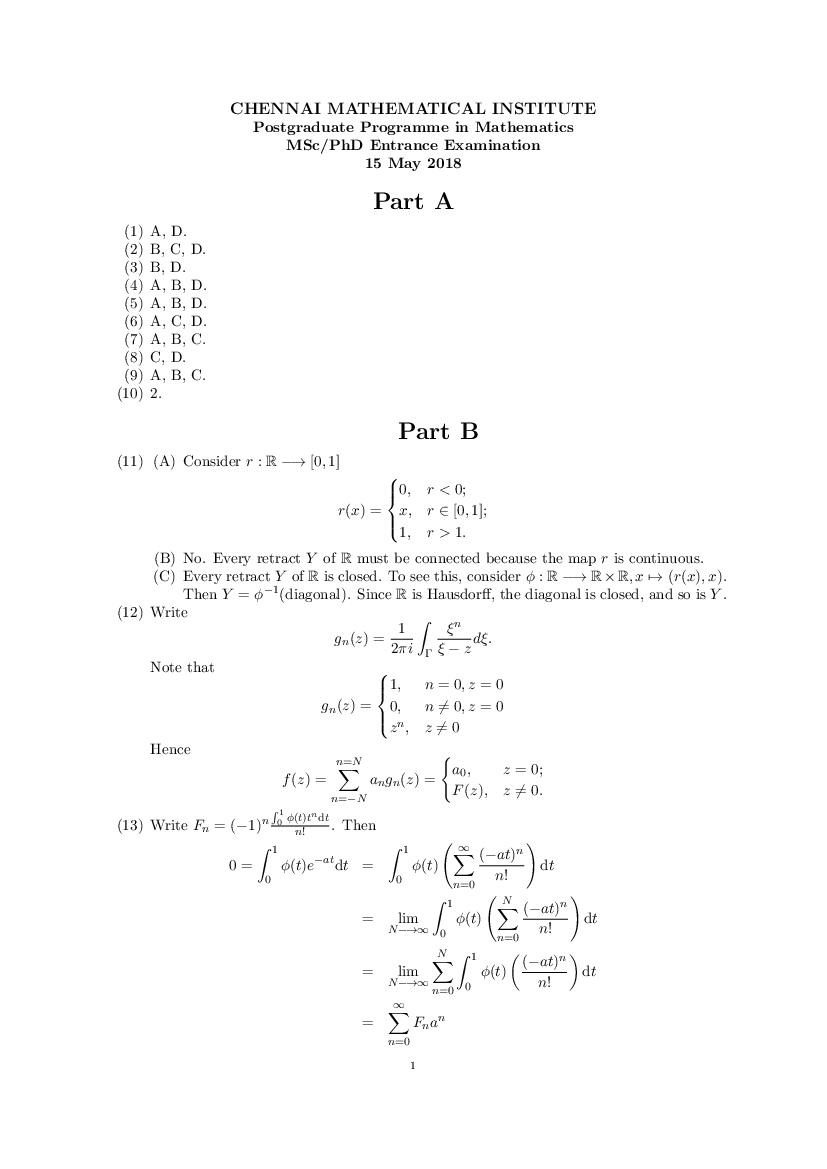
CHENNAI MATHEMATICAL INSTITUTE Postgraduate Programme in Mathematics MSc/PhD Entrance Examination 15 May 2018 Part A (1) A, D. (2) B, C, D. (3) B, D. (4) A, B, D. (5) A, B, D. (6) A, C, D. (7) A, B, C. (8) C, D. (9) A, B, C. (10) 2. Part B (11) (A) Consider r : R −→ [0, 1]  0, r < 0;  r(x) = x, r ∈ [0, 1];  1, r > 1.  (B) No. Every retract Y of R must be connected because the map r is continuous. (C) Every retract Y of R is closed. To see this, consider φ : R −→ R × R, x 7→ (r(x), x). Then Y = φ−1 (diagonal). Since R is Hausdorff, the diagonal is closed, and so is Y . (12) Write ξn Z 1 gn (z) = dξ. 2πi Γ ξ − z Note that  1,  n = 0, z = 0 gn (z) = 0, n 6= 0, z = 0  n  z , z 6= 0 Hence n=N ( X a0 , z = 0; f (z) = an gn (z) = n=−N F (z), z 6= 0. R1 φ(t)tn dt (13) Write Fn = (−1)n 0 n! . Then ∞ Z 1 Z 1 ! X (−at) n 0= φ(t)e−at dt = φ(t) dt 0 0 n! n=0 N Z 1 ! X (−at)n = lim φ(t) dt N −→∞ 0 n! n=0 N Z 1 (−at)n X   = lim φ(t) dt N −→∞ 0 n! n=0 ∞ X = Fn an n=0 1

Page 2

Since ∞ n P n=0 Fn a = 0 for every a ∈ R+ , we see that Fn = 0 for every n ≥ 0. (14) By way of contradiction assume that U ( R. Then, since U is open, U ( U . Pick x ∈ U r U and a sequence {xn } ⊆ U converging to x. Since h is uniformly continuous, {h(xn )} is a Cauchy sequence in R, it converges to y ∈ R. Hence {xn } converges go h−1 (y) ∈ U , a contradiction. (15) Since det A = −1, the characteristic polynomial of A is of the form X 2 + bX − 1 for some b ∈ R, so A has real eigenvalues, λ1 , λ2 . Let vi be an eigenvector for λi , i = 1, 2. For i = 1, 2, λ2i vit vi = λi vit λi vi = vit At Avi = vit vi , so λi is 1 or −1. Without loss of generality, λ1 = 1 and λ2 = −1. Then A gives a reflection about the line spanned by v1 sending v2 to −v2 . (16) (A) For any G, 0 is a characteristic subgroup. Let 0 6= H ⊆ Q be a characteristic subgroup. Let 0 6= x ∈ H and y ∈ Q. Then the map r 7→ ry/x is an automorphism of Q, and it takes x to y. Hence y ∈ H, so H = Q. Hence 0 and Q are the only characteristic subgroups of Q. (B) For any g ∈ G, the map G −→ G, g1 7→ gg1 g −1 is an isomprphism, so, for every characteristic subgroup H of G, gHg −1 = H. Hence H is normal. The converse is false: take H = Z inside G = Q. (17∗ ) (A) (At M A)t = At M t A = −At M A. (B) Check directly with v = e1 , e2 , e3 after noting tha the action of SOE (R) and Φ are k-linear. Also use the fact that the entries At = A−1 are the signed minors of A, coming from the adjoint of A. (C) Using (B) it is enough to show that there does not exist a nonzero v ∈ R3 whose span is stable under the action of SO3 . This is true: if v, w ∈ R3 are non-zero vectors of the same length, there exists A ∈ SO3 such that Av = w. (18∗ ) For positive integers n, write Un = {z ∈ C r {0} : |z| < n}. These form an open cover of C r {0}. Note that for every z1 ∼ z2 , |z1 | = |z2 |, so for every n, π −1 (π(Un )) = Un . Hence π(Un ), n ≥ 1 is an open cover of X. This does not have a finite sub-cover since the open cover Un , n ≥ 1 does not have a finite sub-cover. (19∗ ) First note that the minimal polynomial of g divides X |G| − 1. (A) If char k = 0 then for every g, g has distinct eigenvalues and hence is diagonalizable, so g = 1, contradicting the hypothesis that |G| > 1. (B) Let p = char k. Let g ∈ G and write its order as pe m e with m = 1 or m > 1 and p - m. The the minimal polynomial of g p is X m − 1 which e has distinct roots, so, again, by the above argument, g p = 1, so m = 1. (C) Hence G is a p-group. Use class equation. (20∗ ) The limit is f (1). This is true for xk , k ≥ 0, and hence also for polynomials. By Weierstrass’ theorem, it is true for all continuous functions. 2

Document Details

Board / OrgDefault
ExamCMI Entrance Exam
TypeSolution
Pages2
Updated22 Jul 2026

More for CMI Entrance Exam

📄Brochure 📄Question Paper 📄Solution