NCERT Book Class 11 Chemistry Chapter 1 Some Basic Concepts of Chemistry
Finished viewing? Save it for later —
Download NCERT Book Class 11 Chemistry Chapter 1 Some Basic Concepts of Chemistry (PDF · 28 pages)About NCERT Book Class 11 Chemistry Chapter 1 Some Basic Concepts of Chemistry
NCERT Book Class 11 Chemistry Chapter 1 Some Basic Concepts of Chemistry is available here for free download. Published by NCERT for Class 11, this books can be viewed online or downloaded as a PDF (28 pages). Candidates preparing for Class 11 can use NCERT Book Class 11 Chemistry Chapter 1 Some Basic Concepts of Chemistry to understand the exam pattern, the type of questions asked, and the overall difficulty level.
Frequently Asked Questions
How can I download NCERT Book Class 11 Chemistry Chapter 1 Some Basic Concepts of Chemistry?
Open this page and click the Download button to save NCERT Book Class 11 Chemistry Chapter 1 Some Basic Concepts of Chemistry as a PDF. It is completely free on AglaSem Docs.
Is NCERT Book Class 11 Chemistry Chapter 1 Some Basic Concepts of Chemistry free to download?
Yes. NCERT Book Class 11 Chemistry Chapter 1 Some Basic Concepts of Chemistry can be viewed online and downloaded as a PDF free of cost on AglaSem Docs.
How many pages does NCERT Book Class 11 Chemistry Chapter 1 Some Basic Concepts of Chemistry have?
NCERT Book Class 11 Chemistry Chapter 1 Some Basic Concepts of Chemistry contains 28 pages, which you can read online or download together as a single PDF.
Where can I find more Class 11 study material?
You can find more Class 11 question papers, sample papers, syllabus, and answer keys on AglaSem Docs.
NCERT Book Class 11 Chemistry Chapter 1 Some Basic Concepts of Chemistry – Text
Read the full text of this books below — useful to quickly search, copy and reference the content online without downloading the PDF.
📄 View text version (1 page)
Page 1
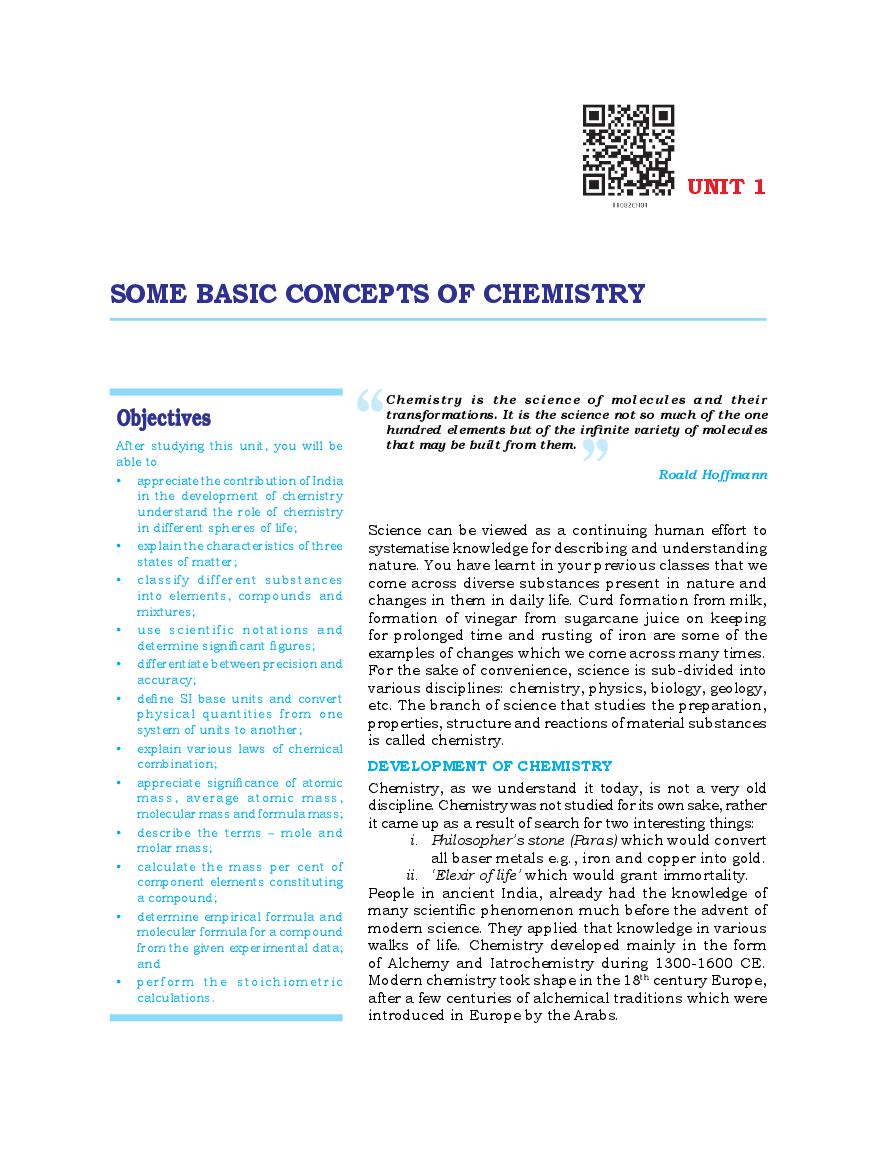
SOME BASIC CONCEPTS OF CHEMISTRY
Chemistry is the science of molecules and their
transformations. It is the science not so much of the one
hundred elements but of the infinite variety of molecules
After studying this unit, you will be that may be built from them.
able to
• appreciate the contribution of India Roald Hoffmann
in the development of chemistry
understand the role of chemistry
in different spheres of life; Science can be viewed as a continuing human effort to
• explain the characteristics of three systematise knowledge for describing and understanding
states of matter; nature. You have learnt in your previous classes that we
• classify different substances come across diverse substances present in nature and
into elements, compounds and changes in them in daily life. Curd formation from milk,
mixtures;
formation of vinegar from sugarcane juice on keeping
• use scientific notations and for prolonged time and rusting of iron are some of the
determine significant figures;
examples of changes which we come across many times.
• differentiate between precision and
For the sake of convenience, science is sub-divided into
accuracy;
various disciplines: chemistry, physics, biology, geology,
• define SI base units and convert
etc. The branch of science that studies the preparation,
physical quantities from one
system of units to another;
properties, structure and reactions of material substances
• explain various laws of chemical
is called chemistry.
combination; DEVELOPMENT OF CHEMISTRY
• appreciate significance of atomic Chemistry, as we understand it today, is not a very old
mass, average atomic mass,
discipline. Chemistry was not studied for its own sake, rather
molecular mass and formula mass;
it came up as a result of search for two interesting things:
• describe the terms – mole and
molar mass;
i. Philosopher’s stone (Paras) which would convert
all baser metals e.g., iron and copper into gold.
• calculate the mass per cent of
component elements constituting
ii. ‘Elixir of life’ which would grant immortality.
a compound; People in ancient India, already had the knowledge of
• determine empirical formula and many scientific phenomenon much before the advent of
molecular formula for a compound modern science. They applied that knowledge in various
from the given experimental data; walks of life. Chemistry developed mainly in the form
and of Alchemy and Iatrochemistry during 1300-1600 CE.
• perform the stoichiometric Modern chemistry took shape in the 18th century Europe,
calculations. after a few centuries of alchemical traditions which were
introduced in Europe by the Arabs.
Showing the first page only. Download the PDF above for the complete document.
Document Details
| Board / Org | NCERT |
| Exam | Class 11 |
| Type | Books |
| Pages | 28 |
| Updated | 29 Aug 2026 |