CTET 2021 (Jan) Question Paper 2
Finished viewing? Save it for later —
Download CTET 2021 (Jan) Question Paper 2 (PDF · 64 pages)About CTET 2021 (Jan) Question Paper 2
CTET 2021 (Jan) Question Paper 2 is available here for free download. Published by CBSE for CTET, this question paper can be viewed online or downloaded as a PDF (64 pages). Candidates preparing for CTET can use CTET 2021 (Jan) Question Paper 2 to understand the exam pattern, the type of questions asked, and the overall difficulty level.
Frequently Asked Questions
How can I download CTET 2021 (Jan) Question Paper 2?
Open this page and click the Download button to save CTET 2021 (Jan) Question Paper 2 as a PDF. It is completely free on AglaSem Docs.
Is CTET 2021 (Jan) Question Paper 2 free to download?
Yes. CTET 2021 (Jan) Question Paper 2 can be viewed online and downloaded as a PDF free of cost on AglaSem Docs.
How many pages does CTET 2021 (Jan) Question Paper 2 have?
CTET 2021 (Jan) Question Paper 2 contains 64 pages, which you can read online or download together as a single PDF.
Where can I find more CTET study material?
You can find more CTET question papers, sample papers, syllabus, and answer keys on AglaSem Docs.
CTET 2021 (Jan) Question Paper 2 – Text
Read the full text of this question paper below — useful to quickly search, copy and reference the content online without downloading the PDF.
📄 View text version (64 pages)
Page 1
64
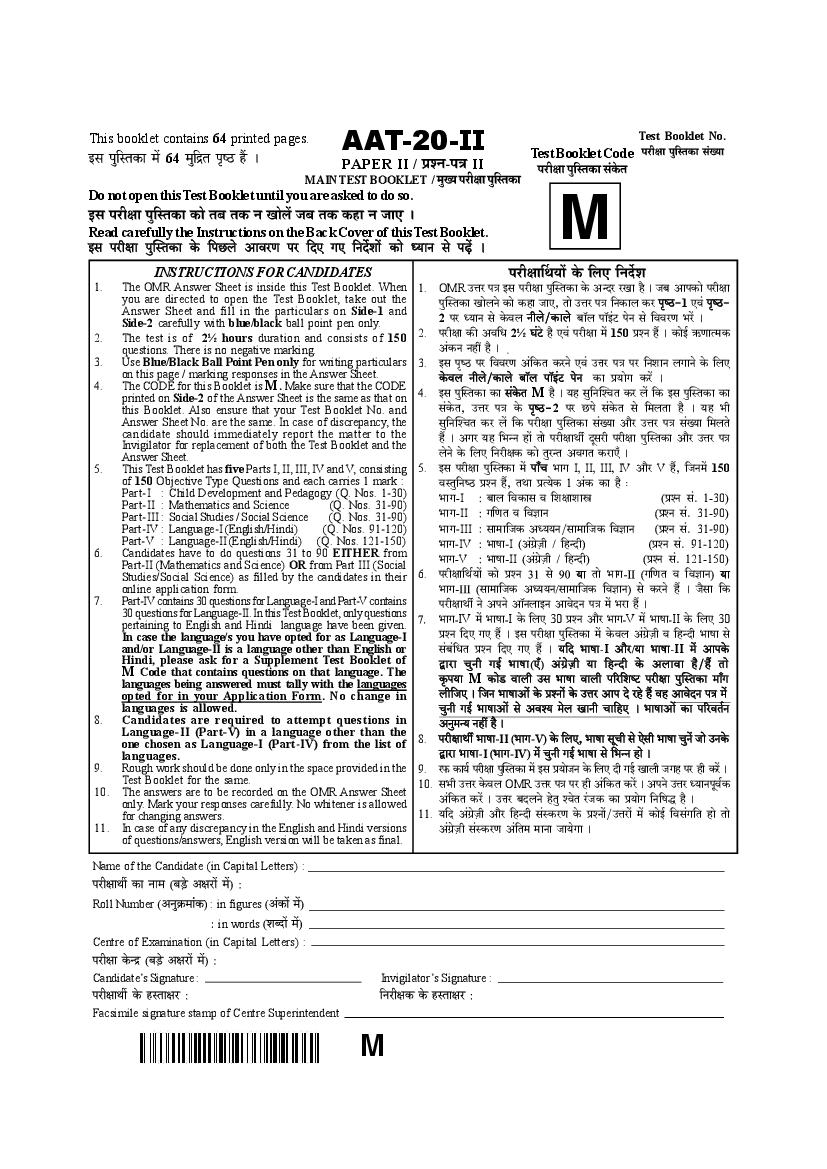
AAT-20-II Test Booklet Code
Test Booklet No.
PAPER II / II
MAIN TEST BOOKLET
M
Do not open this Test Booklet until you are asked to do so.
Read carefully the Instructions on the Back Cover of this Test Booklet.
Bg narjm nwpñVH$m Ho$ {nN>bo AmdaU na {XE JE {ZX}em| H$mo ܶmZ go n‹‹T>| &
INSTRUCTIONS FOR CANDIDATES
1. The OMR Answer Sheet is inside this Test Booklet. When 1. OMR CÎma nÌ Bg narjm nwpñVH$m Ho$ AÝXa aIm h¡ & O~ AmnH$mo narjm
you are directed to open the Test Booklet, take out the nwpñVH$m ImobZo H$mo H$hm OmE, Vmo CÎma nÌ {ZH$mb H$a n¥îR>-1 Ed§ n¥îR>-
Answer Sheet and fill in the particulars on Side-1 and
Side-2 carefully with blue/black ball point pen only. 2 na ܶmZ go Ho$db Zrbo/H$mbo ~m°b nm°B§Q> noZ go {ddaU ^a| &
2. The test is of 2½ hours duration and consists of 150 2. narjm H$s Ad{Y 2½ K§Q>o h¡ Ed§ narjm ‘| 150 àíZ h¢ & H$moB© F$UmË‘H$
questions. There is no negative marking. A§H$Z Zht h¡ & ‹
3. Use Blue/Black Ball Point Pen only for writing particulars 3. Bg n¥îR> na {ddaU A§{H$V H$aZo Ed§ CÎma nÌ na {ZemZ bJmZo Ho$ {bE
on this page / marking responses in the Answer Sheet. Ho$db Zrbo/H$mbo ~m°b nm°B§Q> noZ H$m à¶moJ H$a| &
4. The CODE for this Booklet is M. Make sure that the CODE
printed on Side-2 of the Answer Sheet is the same as that on 4. Bg nwpñVH$m H$m g§Ho$V M h¡ & ¶h gw{ZpíMV H$a b| {H$ Bg nwpñVH$m H$m
this Booklet. Also ensure that your Test Booklet No. and g§Ho$V, CÎma nÌ Ho$ n¥îR>- 2 na N>no g§Ho$V go {‘bVm h¡ & ¶h ^r
Answer Sheet No. are the same. In case of discrepancy, the gw{ZpíMV H$a b| {H$ narjm nwpñVH$m g§»¶m Am¡a CÎma nÌ g§»¶m {‘bVo
candidate should immediately report the matter to the h¢ & AJa ¶h {^ÝZ hm| Vmo narjmWu Xÿgar narjm nwpñVH$m Am¡a CÎma nÌ
Invigilator for replacement of both the Test Booklet and the
Answer Sheet. boZo Ho$ {bE {ZarjH$ H$mo VwaÝV AdJV H$amE± &
5. This Test Booklet has five Parts I, II, III, IV and V, consisting 5. Bg narjm nwpñVH$m ‘| nm±M ^mJ I II III IV Am¡a V h¢, {OZ‘| 150
of 150 Objective Type Questions and each carries 1 mark : dñVw{ZîR>> àíZ h¢, VWm à˶oH$ 1 A§H$ H$m h¡ …
Part-I : Child Development and Pedagogy (Q. Nos. 1-30) ^mJ I ~mb {dH$mg d {ejmemó àíZ g§. 1 30
Part-II : Mathematics and Science (Q. Nos. 31-90)
Part-III : Social Studies / Social Science (Q. Nos. 31-90) ^mJ II J{UV d {dkmZ àíZ g§. 31 90
Part-IV : Language-I (English/Hindi) (Q. Nos. 91-120) ^mJ III gm‘m{OH$ Aܶ¶Z/gm‘m{OH$ {dkmZ àíZ g§. 31 90
Part-V : Language-II (English/Hindi) (Q. Nos. 121-150) ^mJ IV ^mfm I A§J«oµOr {hÝXr àíZ g§. 91 120
6. Candidates have to do questions 31 to 90 EITHER from
Part-II (Mathematics and Science) OR from Part III (Social ^mJ V ^mfm II A§J«oµOr {hÝXr àíZ g§. 121 150
Studies/Social Science) as filled by the candidates in their 6. narjm{W©¶m| H$mo àíZ go ¶m Vmo ^mJ J{UV d {dkmZ ¶m
online application form. ^mJ gm‘m{OH$ Aܶ¶Z gm‘m{OH$ {dkmZ go H$aZo h¢ & O¡gm {H$
7. Part-IV contains 30 questions for Language-I and Part-V contains narjmWu Zo AnZo Am°ZbmBZ AmdoXZ nÌ ‘| ^am h¢ &
30 questions for Language-II. In this Test Booklet, only questions
pertaining to English and Hindi language have been given. ^mJ IV ‘| ^mfm I Ho$ {bE 30 àíZ Am¡a ^mJ V ‘| ^mfm II Ho$ {bE 30
In case the language/s you have opted for as Language-I àíZ {XE JE h¢ & Bg narjm nwpñVH$m ‘| Ho$db A§J«oµOr d {hÝXr ^mfm go
and/or Language-II is a language other than English or g§~§{YV àíZ {XE JE h¢ & ¶{X ^mfm I Am¡a ¶m ^mfm II ‘| AmnHo$
Hindi, please ask for a Supplement Test Booklet of Ûmam MwZ r JB© ^mfm E± A§J «oµO r ¶m {hÝXr Ho$ Abmdm h¡/h¢ Vmo
M Code that contains questions on that language. The H¥$n¶m M H$moS> dmbr Cg ^mfm dmbr n[a{eîQ> narjm nwpñVH$m ‘m±J
languages being answered must tally with the languages
opted for in your Application Form. No change in br{OE & {OZ ^mfmAm| Ho$ àíZm| Ho$ CÎma Amn Xo aho h¢ dh AmdoXZ nÌ ‘|
languages is allowed. MwZr JB© ^mfmAm| go Adí¶ ‘ob ImZr Mm{hE & ^mfmAm| H$m n[adV©Z
8. Candidates are required to attempt questions in AZw‘ݶ Zht h¡ &
Language-II (Part-V) in a language other than the
one chosen as Language-I (Part-IV) from the list of 8. narjmWu ^mfm II ^mJ V Ho$ {bE, ^mfm gyMr go Eogr ^mfm MwZ| Omo CZHo$
languages. Ûmam ^mfm I ^mJ IV ‘| MwZr JB© ^mfm go {^ÝZ hmo &
9. Rough work should be done only in the space provided in the 9. a’$ H$m¶© narjm nwpñVH$m ‘| Bg à¶moOZ Ho$ {bE Xr JB© Imbr OJh na hr H$a| &
Test Booklet for the same. 10. g^r CÎma Ho$db OMR CÎma nÌ na hr A§{H$V H$a| & AnZo CÎma ܶmZnyd©H$
10. The answers are to be recorded on the OMR Answer Sheet
only. Mark your responses carefully. No whitener is allowed A§{H$V H$a| & CÎma ~XbZo hoVw ídoV a§OH$ H$m à¶moJ {Z{fÕ h¡ &
for changing answers. 11. ¶{X A§J«oµOr Am¡a {hÝXr g§ñH$aU Ho$ àíZm|/CÎmam| ‘| H$moB© {dg§J{V hmo Vmo
11. In case of any discrepancy in the English and Hindi versions A§J«oµOr g§ñH$aU A§{V‘ ‘mZm Om¶oJm &
of questions/answers, English version will be taken as final.
Name of the Candidate (in Capital Letters) :
Roll Number : in figures
in words
Centre of Examination (in Capital Letters) :
Candidate’s Signature : Invigilator’s Signature :
Facsimile signature stamp of Centre Superintendent
M
Page 2
PART – I / –I
CHILD DEVELOPMENT AND PEDAGOGY /
Directions : Answer the following questions : (. 1 30)
(Q. Nos. 1 to 30) by selecting the correct/most
appropriate options. / :
1. During the period of childhood, 1. -
development – (1)
(1) is slow and cannot be measured.
(2) is multi-layered and complex. (2)
(3) consists only of quantitative changes. (3)
(4) is disorderly and disjointed. (4)
2. ‘Zone of proximal development’ is
(1) the area between a child’s current 2. ‘ ’ ?
level of independent performance (1)
and the level of performance that the
child could achieve with the help of
adults and more skilled peers.
(2) a range of tasks that the child
should be able to do as per her age (2)
but cannot.
(3) the process where two individuals
who begin with different (3)
understandings arrive at a shared
understanding. (4) ,
(4) the process in which children learn
to perform tasks as set by the elder
members in a society.
3. According to Jean Piaget, children in 3.
formal operational stage -
(1) are capable of hypothetico-
(1)
deductive reasoning and
propositional thought.
(2) are bound by centration and (2)
irreversibly of thought.
(3) cannot conserve, classify and seriate. (3) ,
(4) begin to engage in make-believe
and symbolic play.
(4)
4. At which stage of Lawrence Kohlberg’s
theory of moral development do
individuals believe that actively 4.
maintaining the current social system
ensures positive human relationships
and societal order ?
(1) The punishment and obedience
orientation ?
(2) The social-order maintaining orientation (1)
(3) The instrumental purpose (2) -
orientation (3)
(4) The universal ethical principle
(4)
orientation
Page 3
5. Which of the following is a correctly 5. -
matched pair of type of intelligence and
end-state performance possibilities as -
per Howard Gardner’s theory of ?
multiple intelligences ?
Types of End-state
-
Intelligence performance
possibility
(1) Spatial – Therapist (1) –
(2) Intra-personal – Salesperson
(2) –
(3) Linguistic – Sculptor
(4) Bodily-kinesthetic – Athlete
(3) –
(4) - –
6. According to Lev Vygotsky –
(1) language plays an important role 6. -
in cognitive development of (1)
children.
(2) children learn language through a
(2) ‘ ’
‘language acquisition device’.
(3) children’s cognitive development
occurs in stages. (3)
(4) maturation of schemas leads to
cognitive development in children. (4)
7. In a progressive classroom, assessment
of learners during the process of
7. –
teaching-learning – -
(1) is not at all helpful in children’s (1)
learning. (2)
(2) creates a hindrance in the process
of children’s learning.
(3)
(3) is helpful in identifying ‘high’, ‘ ’, ‘ ’
‘low’ and ‘non’ achievers for the ‘’
purposes of giving feedback to the
parents.
(4) ,
(4) is very important since it gives
insights into children’s
-
understanding and helps the teacher
to reflects on her pedagogy.
Page 4
8. An effective classroom strategy to 8.
reduce gender stereotyping and
broadening developmental possibilities ?
for all sexes is
(1)
(1) to ignore and dismiss biological
differences among the sexes.
(2)
(2) to reinforce gender roles as
portrayed in the society.
(3) forming same-sex ability (3)
groupings. (4)
(4) forming mixed-sex activity groups -
and promote discussion.
9. Multilingualism in a classroom needs to 9. ____
be understood as _________ by the
teachers.
(1)
(1) an asset and resource
(2)
(2) a hindrance
(3)
(3) a problem
(4)
(4) a systemic issue
10. A child-centered classroom is one in 10. - , -
which (1)
(1) the teacher uses the textbook as
the only source of knowledge. (2) ,
(2) the teacher segregates the children
based on their abilities. (3)
(3) the teacher uses rewards and
punishments to direct children’s
behaviour. (4)
(4) the teacher is flexible and caters to
needs of individual children.
11. According to which theorist ‘cultural 11.
tools’ play an important role in cognitive ‘ ’
development of children ? ?
(1) Lev Vygotsky (1)
(2) Jean Piaget (2)
(3) Albert Bandura (3)
(4) B.F. Skinner (4) ..
Page 5
12. Which of the following is NOT a suitable 12.
learning material for students who are
partially sighted ?
(1) Large-print books
?
(2) Three dimensional maps and (1)
charts (2) -
(3) Talking books, felt bulletin boards (3) ,
(4) Small-print worksheets (4)
13. The underlying belief behind ‘inclusive 13. ‘ ’ -
education’ is
(1)
(1) segregation of children on the
basis of their abilities and
provisioning of vocational training
accordingly. (2) ,
(2) diagnostic labelling of children ,
based on their handicaps for
identification of their limitations.
(3) -
(3) provisioning of special education
institutions for children with
different handicaps.
(4) the philosophy that all children
(4)
have a right to get equal education
in a regular school.
14. Needs of gifted and creative children can 14.
be addressed by
(1) giving challenging tasks and ?
activities to prevent boredom. (1)
(2) giving questions that require
convergent thinking. (2)
(3) providing specific instructions to
solve problems. (3)
(4) administrating memory based
tests.
(4)
15. Children with ‘dyslexia’ can be 15.
identified by ?
(1) finding out their social and (1)
cultural context.
(2) a thorough physical health check- (2)
up. (3)
(3) analyzing their reading and
writing skills. (4) -
(4) assessing their ability to solve
complex higher-order problems.
Page 6
16. Which of the following is NOT an 16.
effective strategy to address learners
from disadvantaged and deprived
backgrounds ? ?
(1) Talk to the learners to understand (1)
their needs and challenges faced
by them.
(2) Asking the learners to enroll for (2)
tuition outside of school so that ,
the teacher does not have to pay
much attention to them.
(3) Motivate the students to set (3)
moderately challenging goals and
provide appropriate instructional
support.
(4) Form collaborative groups to work (4)
on activities and encourage
students to support each other.
17.
17. Physical and emotional health of
children _________ their learning.
____
(1)
(1) does not have any influence on
(2)
(2) plays an important role in
(3)
(3) is not related to
(4)
(4) has an insignificant role in
18.
18. To promote meaningful learning in the ____
classrooms, a teacher should –
(i)
(i) help students to regulate their
own emotions and motivation.
(ii) categorize and label students (ii)
according to their performance
and make ability-grouping.
-
(iii) promote dialogue and discussion
(iii)
among children to build
multiple perspectives.
(iv) ignore diversity in the classroom
and follow standard methods of (iv)
instruction.
(1) (i), (iii)
(1) (i), (iii)
(2) (ii), (iii) (2) (ii), (iii)
(3) (i), (iii), (iv) (3) (i), (iii), (iv)
(4) (i), (ii), (iii), (iv)
(4) (i), (ii), (iii), (iv)
Page 7
19. Learning is a _________ and _________ 19. , ____ ____
process.
(1) ;
(1) complex; active
(2) simple; linear (2) ;
(3) simple; individual (3) ;
(4) complex; passive (4) ;
20. A teacher should _________ the social, 20.
cultural, religious and linguistic ,
diversity in her classroom to facilitate , , ____
meaningful learning.
(1) dismiss (1)
(2) ignore (2)
(3) understand (3)
(4) neglect (4)
21. It is important to create _________ 21. ____
learning environment in the classroom ____
rather than _________ one.
(1) collaborative; competitive (1) ;
(2) competitive; collaborative (2) ;
(3) fearful; facilitative (3) ;
(4) competitive; facilitative (4) ;
22. Which of the following is an example of 22.
effective motivational strategy to
encourage students to learn ? ?
(1) Providing scaffolding especially (1)
when students learn a new skill.
(2) Emphasis on completion of work
(2)
rather than learning.
(3) Giving tasks that are very easy.
(3)
(4) Creating a lot of opportunities for
(4)
competition.
23. Which of the following statements about 23.
children’s thinking is NOT correct ? ?
(1) Children construct their own (1) -
theories about various
phenomenon around them.
(2) Children cannot think of concepts
(2)
on their own and the primary role
of teachers is to provide
information.
(3) Children actively think about (3) -
various phenomenon around them
and have an urge to explore. (-)
(4) Children are born with curiosity to
learn about the world around (4)
them.
Page 8
24. Children’s failure in school 24. -
(1) suggests that children from (1)
deprived backgrounds are not
capable of learning.
(2) indicates that school has not been (2)
able to cater to the needs and
interests of these children.
(3) proves that these children have (3)
genetic birth defects and hence
should be pulled out from school.
(4) signifies that parents have not (4)
been able to support their children
to learn.
25. By working in groups, teaching and 25. -
helping each other, children -
(1)
(1) are able to reflect on their own
thought processes and shift to a
higher level of cognitive activity.
(2) can develop misconceptions which (2) ,
interferes with their learning.
(3)
(3) get distracted and hence it is an
ineffective pedagogical strategy.
(4)
(4) develop competitive tendencies , /
that hinder learning.
26. In a _________ classroom teachers 26. ____ -
adapt their pedagogy and vary
assessment to cater to individual
students.
(1) teacher-centric (1) -
(2) progressive (2)
(3) textbook-centric
(3) -
(4) behaviouristic
(4)
Page 9
27. Which of the following statements about 27.
development is correct ?
?
(1) There is a lot of cultural diversity
(1) -
in the development of children.
(2) Children across the world follow
the same sequence and exact time (2)
of development.
(3) Development occurs in a neat, (3) ,
orderly set of stages
predetermined by genetic factors.
(4) Development is simple and uni-
(4) -
dimensional.
28. Which of the following is a major 28.
hallmark of the period of middle
childhood ? ?
(1) Emergence of make-believe play. (1) -
(2) Development of logical thought (2)
that is concrete in nature.
(3) Rapid development of motor skills (3)
and overall physical growth.
(4) Development of scientific
reasoning and ability to think (4)
abstractly.
29. School _________ socialization of
children.
29. ____
(1) does not play any role in (1)
(2) plays very little role in (2)
(3) is a primary agency of (3)
(4) is a secondary agency of (4)
30. Which of the following theorists
proposed that children’s thinking is
30.
qualitatively different from that of
adults ? ?
(1) Jean Piaget (1)
(2) Lev Vygotsky (2)
(3) Howard Gardner (3)
(4) Lawrence Kohlberg (4)
Page 10
IMPORTANT : Candidates have to do questions 31 90 II
31 to 90 EITHER from Part - II (Mathematics III
and Science) OR from Part - III (Social Studies /
Social Science).
PART - II / - II
MATHEMATICS AND SCIENCE /
Directions : Answer the following questions by :
selecting the correct/most appropriate options.
/ :
31. If 0.139 + 0.75 + 2.105 – (1.001) 31. 0.139 + 0.75 + 2.105 – (1.001)
1.1 = 2 – k, then the value of k is 1.1 = 2 – k , k
(1) 0.8925 (1) 0.8925
(2) 0.982 (2) 0.982
(3) 0.1071 (3) 0.1071
(4) 0.1075 (4) 0.1075
3 5
32. If a = – and b = , then which of the 3 5
4 6 32. a = – 4 b = 6 ,
following does not lie between a and b ?
a b ?
(1) 0
(1) 0
1
(2) – 1
2 (2) –
2
2 2
(3) – (3) –
5 5
7 7
(4) – (4) –
9 9
33. The product of 1.7 104 and 33. 1.7 104 12.5 10–6
12.5 10–6 is expressed in the k 10n
standard form as k 10n. The value of (2k + n)
(2k + n) is
(1) 2.125 (1) 2.125
(2) 1.125 (2) 1.125
(3) 2.25 (3) 2.25
(4) 3.25 (4) 3.25
SPACE FOR ROUGH WORK /
Page 11
34. Two numbers are in the ratio 3:5. If 34. 3:5
12 is added to both the numbers, then 12 , 5:7
the ratio becomes 5:7. The sum of the
given two numbers is
(1) 32
(1) 32
(2) 40
(2) 40
(3) 48
(3) 48
(4) 56
(4) 56
35. The marked price of an article is
35. ` 840
` 840. A shopkeeper gives a discount
15%
of 15% on the marked price and still
, 19%
makes a profit of 19%. What is the ?
cost price of the article ?
(1) ` 540
(1) ` 540
(2) ` 580
(2) ` 580
(3) ` 600 (3) ` 600
(4) ` 640 (4) ` 640
5x – 7 4x – 3
36. If + 2 = + 4x, then the 5x – 7 4x – 3
3 4 36. 3
+ 2 =
4
+ 4x ,
value of (8x + 5) is (8x + 5)
(1) 6
(1) 6
(2) 7
(2) 7
(3) 9
(3) 9
(4) 13
(4) 13
SPACE FOR ROUGH WORK /
Page 12
37. Let 37.
P = 12xy – 10y2 – 18x2, P = 12xy – 10y2 – 18x2,
Q = 14x2 + 12y2 + 9xy, and Q = 14x2 + 12y2 + 9xy,
R = 5y2 – x2 + xy
R = 5y2 – x2 + xy
then (P + Q) – R =
(P + Q) – R =
(1) 22xy – 3x2 + 3y2
(1) 22xy – 3x2 + 3y2
(2) 22xy + 3x2 – 3y2
(2) 22xy + 3x2 – 3y2
(3) 20xy – 7x2 – 3y2
(3) 20xy – 7x2 – 3y2
(4) 20xy – 3x2 – 3y2
(4) 20xy – 3x2 – 3y2
1 1 1
38. If x4 + 4 = 322, x 0, then one of the
x 38. x4 + 4 = 322, x 0 , x – x
x
1
values of x – is
x
(1) 2
(1) 2
(2) 4
(2) 4
(3) 6
(3) 6
(4) 8
(4) 8
39. If 15x2 – 26x + 8 = (Ax + B) (Cx + D), 39. 15x2 – 26x + 8 = (Ax + B) (Cx + D)
where A and C are positive integers,
then what is the value of (2A + B – C –
, , A C ,
2D) ? (2A + B – C – 2D) ?
(1) 0 (1) 0
(2) 1 (2) 1
(3) 2 (3) 2
(4) 3 (4) 3
SPACE FOR ROUGH WORK /
Page 13
40. In ABC and DEF, if AB = EF, 40. ABC DEF AB = EF,
BC = DE and CA = FD, then BC = DE CA = FD ,
(1) ABC ≅ DEF
(1) ABC ≅ DEF
(2) ABC ≅ FED
(2) ABC ≅ FED
(3) ABC ≅ EFD
(3) ABC ≅ EFD
(4) ABC ≅ DFE (4) ABC ≅ DFE
41. Which of the following can be the 41.
sides of a right angled triangle ?
?
(1) 20 cm, 21 cm and 31 cm
(1) 20 cm, 21 cm 31 cm
(2) 35 cm, 77 cm and 88 cm
(2) 35 cm, 77 cm 88 cm
(3) 15 cm, 32 cm and 57 cm
(3) 15 cm, 32 cm 57 cm
(4) 65 cm, 72 cm and 97 cm
(4) 65 cm, 72 cm 97 cm
42. The number of edges of a polyhedron,
which has 7 faces and 10 vertices, is
42. 7 10
(1) 13
(1) 13
(2) 14
(2) 14
(3) 15
(3) 15
(4) 17
(4) 17
43. In ABC, the side AB is produced to
E and side CA is produced to D. 43. ABC , AB E
If BAD = 125 and EBC = CA D
100then which of the following is BAD = 125 EBC = 100 ,
true ?
?
(1) ABC is an isosceles triangle.
(1) ABC
(2) AB > BC
(2) AB > BC
(3) Difference between ABC and
ACB is 35 (3) ABC ACB 35
(4) Difference between BAC and (4) BAC ACB 20
ACB is 20
SPACE FOR ROUGH WORK /
Page 14
44. In trapezium PQRS, PQ || SR and the 44. PQRS , PQ || SR PQ
ratio of PQ to SR is 3:2. If the area of SR 3:2
the trapezium is 480 cm2 and the 480 cm2 PQ SR
distance between PQ and SR is 12 cm,
then the length of SR is 12 cm , SR
(1) 24 cm (1) 24 cm
(2) 32 cm (2) 32 cm
(3) 36 cm (3) 36 cm
(4) 48 cm (4) 48 cm
45. A rectangular sheet of paper 88 cm 10 cm 45. 88 cm 10 cm
is folded without overlapping to make a ,
cylinder of height 10 cm. What is the
10 cm
capacity (in litres) of the cylinder ?
22 ( )
(Take = ) 22
7
? ( = 7 )
(1) 5.54
(2) 6.16 (1) 5.54
(3) 7.392 (2) 6.16
(3) 7.392
(4) 8.624
(4) 8.624
46. The volume of a cube is 2197 cm3.
What is its lateral surface area
46. 2197 cm3
(in cm2)? (cm2 ) ?
(1) 676 (1) 676
(2) 576 (2) 576
(3) 845
(3) 845
(4) 1014
(4) 1014
47. What is the mean of the range, mode 47. , ,
and median of the data given below ? ?
5, 10, 3, 6, 4, 8, 9, 3, 15, 2, 9, 4, 19, 11, 4 5, 10, 3, 6, 4, 8, 9, 3, 15, 2, 9, 4, 19, 11, 4
(1) 8 (1) 8
(2) 9 (2) 9
(3) 10 (3) 10
(4) 12 (4) 12
SPACE FOR ROUGH WORK /
Page 15
48. Which of the following is most 48.
appropriate strategy for introducing
the concept of multiplication of two
decimal numbers in the middle school ? ?
(1) The algorithm should be used to (1) -
introduce the concept.
(2) The process should be visually (2)
represented.
(3) Multiplication as repeated (3) ,
addition should be emphasized. -
(4) Multiplication as inverse of (4) ,
division should be emphasized.
49. Which of the following is a narrow 49.
aim of teaching mathematics ? ?
(1) To encourage systematic (1)
reasoning among students.
(2) To develop students’ ability to (2)
argue the truth and falsity of
statements.
(3) To make students proficient in (3)
handling numbers and number
operations.
(4) To develop students’ (4)
generalization abilities.
SPACE FOR ROUGH WORK /
Page 16
50. Which of the following is most 50.
appropriate strategy for teaching
students to solve mathematical
?
problems ?
(1)
(1) Guess and verify approach should
be strictly discouraged.
(2) The list of formulae required for
solving the given set of problems (2)
should be provided in the
beginning.
(3) Teacher should begin by (3)
explaining the steps required for
obtaining the solutions of the
problems.
(4)
(4) Students should be encouraged to
view a problem from many
perspectives.
51. Identify the incorrect statement from 51.
among the following :
(1) Hypothesis have a role in
(1)
construction of mathematical
knowledge.
(2)
(2) The notion of argumentation is
central to mathematics. (3)
(3) Mathematical communication
involves precise use of language.
(4) Conjectures do not have utility in (4)
constructing mathematical
knowledge.
SPACE FOR ROUGH WORK /
Page 17
52. Which of the following is a desirable 52.
strategy for assessing students’
learning in mathematics ?
(1) Same tasks should be given to all ?
students for parity. (1)
(2) Students’ incorrect answers
should be ignored. (2)
(3) Students’ justification of their
responses should be an important
basis of assessment. (3)
(4) Development of mathematical
vocabulary should not be a basis
of assessment.
(4)
53. For a given figure to be a triangle, the
condition that it is a union of three
segments is 53.
(1) a necessary but not a sufficient
condition.
(2) a sufficient but not a necessary (1)
condition.
(3) both necessary and sufficient
(2) ,
condition. (3)
(4) neither necessary nor sufficient
condition. (4)
54. Consider the following statements : 54. :
A = If n is even, then n2 is even. A = n , n2
B = If n2 is not even, n is not even. B = n2 , n
C = If n2 is even, then n is even. C = n2 , n
D = If n is not even, then n2 is not even. D = n , n2
Which of the following statements is ?
true ? (1) C, A
(1) C is converse of A. (2) D, A
(2) D is converse of A.
(3) B, A
(3) B is inverse of A.
(4) D, A
(4) D is contraposition of A.
SPACE FOR ROUGH WORK /
Page 18
55. Which of the following teaching- 55.
learning resources in mathematics
cannot be used for visually challenged
students ? ?
(1) GeoGebra (1)
(2) Taylor’s abacus (2)
(3) Tiles (3)
(4) GeoBoard (4)
56. Which of the following statements is 56. ?
true ?
(1) Mathematics consists of all the (1)
theorems proved in mathematics
books. (2)
(2) A person good in arithmetical
computation is also good in
Mathematics and vice-versa.
:
(3) Intuition has no role in generating (3)
mathematical knowledge.
(4) Mathematical statements can be (4)
conditional.
57. Which of the following statements is 57.
NOT correct regarding differently
abled children of dyslexia in
mathematics learning in an inclusive
?
classroom ? (1)
(1) Dyslexia has an impact in a
person’s co-ordination of verbal
and spatial aspects of numbers. (2)
(2) Visual patterns in mathematics
help in overcoming difficulties
experienced by dyslexic children.
(3)
(3) Dyslexic children may have
difficulty in writing down their
ideas in systematic and organized
manner. (4)
(4) Dyslexia impacts only language
learning not mathematics learning.
SPACE FOR ROUGH WORK /
Page 19
58. The number of distinct prime factors 58. 6-
of the largest 6-digit number is
(1) 3
(1) 3
(2) 4
(2) 4
(3) 5
(3) 5
(4) 6
(4) 6
59. If the 8-digit number 179x091y is
divisible by 88, then what is the value 59. 8- 179x091y, 88
of (x – y) ? , (x – y) ?
(1) 1
(1) 1
(2) 2
(2) 2
(3) 3
(3) 3
(4) 4
(4) 4
11 13 15
60. Let a = ,b= and c = be three 11 13 15
13 14 17
60. a = 13, b = 14 c = 17
fractions. Which of the following is
true ? ?
13 11 15 13 11 15
(1) < < (1) < <
14 13 17 14 13 17
15 13 11
(2) < < 15 13 11
17 14 13 (2) < <
17 14 13
11 15 13
(3) < < 11 15 13
13 17 14 (3) < <
13 17 14
11 13 15
(4) < < 11 13 15
13 14 17 (4) < <
13 14 17
SPACE FOR ROUGH WORK /
Page 20
Directions : Answer the following questions by :
selecting the correct/most appropriate options.
/ :
61. Which of the following represents 61.
correct matching set ? ?
(a) helps in the (i) Cartilage (a) (i)
movement of body
by contraction
and relaxation.
(b) Hard structure (ii) Muscles (b) (ii)
which forms the
skeleton
(c) (iii) -
(c) Part of skeleton (iii) Rib-cage
which can be bent
(d) (iv)
(d) Joins the chest (iv) Bones
bone and back
bone together to
form an enclosure
(1) (a) (i), (b) (iii), (c) (ii), (d) (iv)
(1) (a) (i), (b) (iii), (c) (ii), (d) (iv)
(2) (a) (ii), (b) (iv), (c) (i), (d) (iii)
(2) (a) (ii), (b) (iv), (c) (i), (d) (iii)
(3) (a) (iii), (b) (ii), (c) (i), (d) (iv)
(3) (a) (iii), (b) (ii), (c) (i), (d) (iv)
(4) (a) (iv), (b) (iii), (c) (ii), (d) (i)
(4) (a) (iv), (b) (iii), (c) (ii), (d) (i)
62. Which of the following glands in
human beings secretes more than two 62.
hormones ? ?
(1) Adrenal (1)
(2) Pituitary (2)
(3) Pancreas (3)
(4) Thyroid (4)
63. Which of the following statements is 63. ?
true ?
(1)
(1) All metals are solids.
(2)
(2) All metals are hard.
(3) All non-metals are gases. (3)
(4) All non-metals are non-ductile. (4) ( )
64. ‘Y’ is a man-made fibre obtained 64. ‘Y’ - ()
from a natural source. What could be ‘Y’
‘Y’ ?
?
(1) Rayon
(1)
(2) Nylon (2)
(3) Acrylic (3)
(4) Jute (4)
Page 21
65. Study the following table : 65. :
Fuel Calorific State Ignition -
value temp. A
A High solid high B
B Moderate gas high C
C Moderate gas moderate D
D Low liquid low
Which is best suited as domestic fuel ? ?
(1) A (1) A
(2) B (2) B
(3) C (3) C
(4) D (4) D
66. Species restricted to a particular area 66.
are referred to as -
(1) Endangered species (1)
(2) Extinct species (2)
(3) Endemic species (3)
(4) Migratory species (4)
67. Metal ‘X’ displaces metal ‘Y’ from its 67. ‘X’, ‘Y’ -
salt solution but is not able to displace Z
metal ‘Z’ from its salt solution.
Identify the most reactive metal.
(1) X ?
(2) Y (1) X
(2) Y
(3) Z
(3) Z
(4) Cannot be determined. (4)
68. Light rays from an object fall on a 68.
surface and get reflected in a :
completely diffused manner. What
can you say about the nature of image ?
of the object ?
(1)
(1) It will be virtual and of same size.
(2) It will be real and enlarged. (2)
(3) It will be virtual and enlarged. (3)
(4) No image will be formed. (4)
Page 22
69. In order to slide a huge box lying on 69.
the ground in her room, Reshma
should apply a force which is greater ?
than which of the following forces ? (1)
(1) Static friction
(2)
(2) Gravitational force
(3) Normal force (3)
(4) Muscular force (4)
70. Identify the correct statement from 70. _____
among the following :
(1) The lower the frequency of the (1) ,
vibration, higher is the pitch.
(2) The loudness of sound is
(2)
determined by the frequency of
vibration.
(3) Sound cannot travel through (3)
vacuum. (4)
(4) Pitch of sound is determined by its
amplitude.
71.
71. Which of the following sets comprises ?
liquids which are poor conductors of (1) , ,
electricity ?
(2) , ,
(1) tap water, shampoo, honey
(2) salt solution, lemon juice, vinegar (3) , ,
(3) shampoo, vegetable oil, distilled (4) , ,
water 72.
(4) sugar solution, vinegar, lemon juice ?
72. Which of the following sets comprises (1) , ,
chemical changes ?
(1) Boiling of water, breaking of (2) , ,
glass, rusting of iron -
(2) Dissolving salt in water, digestion (3) , ,
of food, shredding of paper.
(3) Cooking of food, boiling of water, (4) , ,
dissolving sugar in water.
(4) Rusting of iron, burning of paper,
digestion of food 73.
73. Neena was cycling to the market to
buy some grocery items. The market 4 km 10 12
is 4 km away from her home. She km/h
travels at a speed of 12 km/h for first
10 minutes. On her way she meets her 15
friend Nikhat and stops to chat with 8 km/h
her for 15 minutes. She resumes her
journey at a speed of 8 km/h. What is ?
her average speed for the journey ?
(1) 6 km/h
(1) 6 km/h
(2) 8 km/h (2) 8 km/h
(3) 10 km/h (3) 10 km/h
(4) 4 km/h (4) 4 km/h
Page 23
74. Which of the following will not be 74.
helpful in the process of separating a
mixture of salt and water ? ?
(1) Decantation (1)
(2) Filteration (2)
(3) Distillation (3)
(4) Boiling (4)
75. Which of the following properties of 75.
light can be used to explain the
phenomenon of shadow formation ? ?
A. Light travels in a straight line.
B. Light travels at a high speed. A.
C. Light is composed of seven colours. B.
D. Light does not pass through C. ()
opaque objects. D.
(1) A and B (1) A B
(2) B and C
(2) B C
(3) C and D
(3) C D
(4) D and A
(4) D A
76. Identify the correct statement from
among the following : 76. :
(1) The proportion of fine particles in (1)
sandy soil is relatively higher than
in the clayey soil.
(2)
(2) The amount of large and fine
particles is about the same in
clayey soil. (3)
(3) The proportion of large particles
in loamy soil is relatively higher (4)
than in the sandy soil.
(4) The proportion of fine particles in
clayey soil is relatively higher 77. ‘X’ ()
than in the loamy soil.
77. Deficiency of vitamin ‘X’ causes ‘Y’
bleeding of gums. This vitamin is
essential for absorption of mineral ‘Y’
‘X’ ‘Z’ ‘X’,
and ‘X’ is found in food ‘Z’. Identify ‘Y’ ‘Z’ :
X, Y and Z. (1) X- D, Y-, Z-
(1) X-vitamin D, Y- calcium, Z-milk
product (2) X- C, Y-, Z-
(2) X-vitamin C, Y-iron, Z-citrus
fruits
(3) X- B, Y-, Z-
(3) X-vitamin B, Y-calcium, Z-green
leafy vegetables
(4) X- A, Y-, Z-
(4) X-vitamin A, Y-phosphorus,
Z-poultry products
Page 24
78. Which of the following statement best 78.
describes the nature of science ? ?
(1) science is a system of beliefs. (1)
(2) science is social in nature. (2)
(3) scientists are totally objective in (3)
their work.
(4) the scientific method is the only (4)
guide for conducting research.
79. Cognitive validity in science 79.
curriculum means -
(1) inclusion of how concepts of (1)
science evolve over time.
(2) adaptation of content as per the (2)
cognitive level of learners.
(3) dilution of content (3) -
(4) inclusion of appropriate fun (4)
elements of science.
80. According to N.C.F. 2005 in the upper 80. ... 2005 ,
primary stage science curriculum,
which of the following is
recommended ? ?
a. Concepts should be linked to a.
making sense of everyday
experience. b. /
b. Concepts should be arrived at from
activities/experiments.
c.
c. Concepts should be taught through
disciplinary approach.
d.
d. Along with concepts, laws and
theories need to be introduced
(1) a, b c
(1) a, b and c
(2) a b
(2) a and b
(3) a, b d
(3) a, b and d
(4) a d
(4) a and d
Page 25
81. From the following, identify the 81.
statement that is true about science.
(1) Scientists rely heavily on (1)
imagination to carry out their
work.
(2)
(2) All scientific ideas are discovered
and tested by controlled
experiments. (3)
(3) When a theory has been supported
by a great deal of scientific
evidence, it becomes law. (4) ,
(4) In time, science will be able to solve
most of society’s problems.
82. Ishu was given an individual task of 82.
collecting weather reports for a week.
Identify where Ishu went wrong from
the assessment indicators given below :
(1) She tabulates data from a website
(1)
everyday.
(2) She arrives at conclusion that rain
may or may not take place in the (2)
coming week.
(3) She concludes that decreased (3)
humidity increases the likelihood
of rainfall.
(4)
(4) She understands that range of
maximum and minimum
temperature varies everyday.
83. Which of the following is a useful 83.
strategy to understand conceptual
gaps in learners ? ?
(1) organizing quiz sessions (1)
(2)
(2) observing practical skills
(3) using concept maps
(3)
(4) giving homework regularly (4)
Page 26
84. To encourage more girls to take up 84.
sciences, you may adopt all of the ,
following strategies, except ,
(1) use gender sensitive language and (1)
encourage your students to do so.
(2) be mindful that girls always
dominate discussion in science
(2)
classroom.
(3) invite women scientists to visit
your classroom. (3)
(4) engage students in examining (4)
myths and stereotypes about
science.
85.
85. Science teachers need to ask more –
divergent questions because a.
a. it stimulates and develops critical
thinking. b.
b. it directs students to correct
answers.
c. it helps develop thinking strategies c.
d. it helps in assessing creative d.
behaviour in a learner.
(1) a, b, c (1) a, b, c
(2) a, c, d (2) a, c, d
(3) only b
(4) only a
(3) b
(4) a
86. Using demonstrations in classroom 86.
predominantly involves learners in
(1) visual and auditory learning
(2) visual learning only (1)
(3) visual, auditory and kinesthetic (2)
learning (3) ,
(4) auditory and kinesthetic learning (4)
87.
87. Give the sequence of planning for
your science classroom using inquiry
approach in teaching concept of
density. a.
a. allow students to determine
relationship between objects that b.
float and sink.
b. allow students to play with water c.
in a tub with different objects.
c. ask students to design a small boat
1
that can carry 1 kg of weight.
(1) a b c (1) abc
(2) c b a (2) cba
(3) b c a (3) bca
(4) b a c (4) bac
Page 27
88. ‘Y’ is a plant which does not have 88. ‘Y’
Chlorophyll. What could ‘Y’ be ? () ‘Y’
?
(1) Cuscuta
(1) ()
(2) Algae
(2)
(3) Pitcher plant (3) ( )
(4) Maple tree (4)
89. Which of the following statements is 89. ?
correct ? (1)
(1) Large intestine is wider and
shorter than small intestine.
(2)
(2) Absorption of digested food takes
place in large intestine.
(3) Assimilation of food takes place
(3)
in large intestine.
(4)
(4) Large intestine has finger like
projection called villi.
90. Which of the following statements is 90.
NOT true regarding life cycle of silk ?
worm and production of silk fibres ?
(1)
(1) The larvae of silk moths are called
as caterpillars.
(2) /
(2) The pupa develops into
caterpillar.
(3)
(3) Silk fibres are proteins secreted by
caterpillars.
(4)
(4) The silk yarn is obtained from the
cocoon of the silk moth.
Page 28
IMPORTANT : Candidates have to do 31 90
Question Nos. 31 to 90 EITHER from Part -
II (Mathematics and Science) OR from II III
Part - III (Social Studies / Social Science).
PART - III / - III
SOCIAL STUDIES / SOCIAL SCIENCE
Directions : Answer the following questions by
selecting the correct/most appropriate options. :
31. Consider the statements A, B, C about
/
Autumn season in India and choose 31. A, B
the correct answer : C
A. This season is also known as the
south-west monsoon season. A. -
B. Winds blow from the Bay of
Bengal and Arabian sea towards B. ,
the land in this season.
C. This season is marked by the
onset and advance of monsoon. C.
(1) A and B are true, C is false.
(2) A and C are true, B is false. (1) A B , C
(3) B and C are true, A is false. (2) A C , B
(4) A, B, C all are false. (3) B C , A
(4) A, B C
32. Which of the following rivers form the 32. ‘
‘Sunderban Delta’ ? ’ ?
(1) Ganga and Brahmaputra
(1)
(2) Narmada and Tapi
(2)
(3) Mahanadi and Godavari
(3)
(4) Krishna and Kaveri
(4)
33. Identify the atmospheric layer from 33. A B
the given features A and B : :
A. Meteorites burn up in this layer A. -
on entering from the space.
B. Temperature declines with B.
increasing height in this layer.
(1) Troposphere
(1) (2)
(2) Stratosphere
(3) (4)
(3) Mesosphere
(4) Thermosphere
34.
34. Insolation is associated with (1)
(1) Air pressure (2)
(2) Seasonal winds (3)
(3) Solar energy (4)
(4) Exosphere and its gases
Page 29
35. Match the following with appropriate 35.
choices : :
a. Coniferous i. Eastern
a. i.
forests margin of the
continents
b. Mediterranean ii. Hardwood b. ii.
vegetation trees
c. Tropical iii. Softwood c. iii.
evergreen evergreen
forests trees
d. Temperate iv. West and d. iv.
evergreen south-west
forests margin of the -
continents
(1) a-i, b-ii, c-iii, d-iv (1) a-i, b-ii, c-iii, d-iv
(2) a-iii, b-iv, c-ii, d-i (2) a-iii, b-iv, c-ii, d-i
(3) a-iii, b-ii, c-iv, d-i (3) a-iii, b-ii, c-iv, d-i
(4) a-i, b-iv, c–ii, d-iii (4) a-i, b-iv, c–ii, d-iii
36. Consider the two statements and 36.
choose the correct option : :
Statement (A) : Sahara once used to
(A) :
be a lush green plain.
Statement (B) : Cave painting in -
sahara depicts rivers, crocodiles, (B) :
elephants, lions, cattle and goats. , , , ,
(1) (A) is false, but (B) is true.
(2) (A) is true, but (B) is false. (1) (A) , (B)
(3) Both (A) and (B) are true.
(2) (A) , (B)
(4) Both (A) and (B) are false.
(3) (A) (B)
37. Consider the statements A, B, C on (4) (A) (B)
dolphin and choose the correct
answer : 37. A, B C
A. Dolphins are found in the fresh
water of river Ganga and :
Brahmaputra.
B. Dolphin sanctuary is located in
A.
the state of Bihar.
C. The presence of dolphin is an B.
indicator of the health of the
river.
(1) A, B, C all are correct.
C.
(2) A and C are correct but B is
incorrect. (1) A, B C
(3) B and C are correct but A is (2) A C , B
incorrect.
(4) A and B are correct but C is (3) B C , A
incorrect. (4) A B , C
Page 30
38. Biogas is essentially a mixture of 38.
(1) Methane and Carbon dioxide ?
(2) Methane and Nitrogen
(1)
(3) Methane and Hydrogen
(4) Methane and Helium (2)
(3)
39. Consider the statements A and B (4)
about resources and choose the
correct answer. 39. A B
A. All resources have economic
value.
B. Time and technology are two A.
important factors that can B.
change substance into resource.
(1) A is false, but B is true.
(2) A is true, but B is false. (1) A , B
(3) Both A & B are true and B is the
correct explanation of A. (2) A , B
(4) Both A & B are true but B is not a (3) A B B
correct explanation of A. A
(4) A B B
40. Choose the correct group of A
conventional sources of energy from
the following :
(1) Oil, natural gas, firewood
40.
(2) Coal, firewood, biogas :
(3) Hydel power, geothermal energy, (1) , ,
tidal energy (2) , ,
(4) Nuclear energy, solar energy, (3) -, - ,
hydel power
41. Match the types of natural resources (4) , , -
(B) with their classification (A) :
A B 41.
(Classification (Resource Type) :
Basis) A B
a. Level of i. Actual & ( ) ( )
development & Potential a. i.
use
b. Origin ii. Biotic &
Abiotic b. ii.
c. Distribution iii. Ubiquitous c. iii.
and localised
d. Stock iv. Renewable d. iv.
and Non-
renewable
(1) a-i, b-ii, c-iii, d-iv
(1) a-i, b-ii, c-iii, d-iv
(2) a-ii, b-i, c-iv, d-iii
(2) a-ii, b-i, c-iv, d-iii
(3) a-iii, b-iv, c-i, d-ii
(3) a-iii, b-iv, c-i, d-ii
(4) a-iv, b-iii, c-ii, d-i
(4) a-iv, b-iii, c-ii, d-i
Page 31
42. Statement (A) : Around 12,000 years 42. (A) : 12,000
ago, a shift to relatively warmer ,
conditions led to development of
grasslands in many areas in India. (B) : , , ,
Statement (B) : There was an increase in
the number of deer, antelopes, goat,
sheep and cattle. (1) (A) , (B)
(1) (A) is true but (B) is false. (2) (A) , (B)
(2) (A) is false but (B) is true. (3) (A) (B) (A)
(3) Both (A) and (B) are true and (B) (B)
is the reason for (A). (4) (A) (B) , (A)
(4) Both (A) and (B) are true but (B) (B)
is not the reason for (A).
43. ‘’
43. Which of the following is true in the
context of ‘sites’ ?
?
A. These are places where remains A.
of past were found. B.
B. These are found only on earth’s C.
surface. D.
C. These are found only buried
under the earth. (1) A
D. They are never found under sea (2) A B
or a river.
(3) A, B C
(1) A only
(2) A and B only (4) D
(3) A, B and C only
(4) D only 44. :
44. The Harappans made A.
A. Seals out of stone B.
B. Pots with yellow designs C.
C. Spindle whorls made of iron D.
D. Gold vessels (1) A C
(1) A and C only (2) A D
(2) A and D only (3) A, B C
(3) A, B and C only
(4) B, C D
(4) B, C and D only
45. A megalithic burial had remains of 45.
two skeletons. An appropriate way for
figuring out a female’s skeleton from
among the two would be to look at :
A. the bone structures A.
B. the ornaments on the skeletons B.
C. size of the skeletons C.
D. utensils for cooking food found D.
with skeletons.
(1) only A (1) A
(2) only A and B
(2) A B
(3) only A and C
(4) only D (3) A C
(4) D
Page 32
46. Arrange the following in ascending 46.
order starting from the earliest period :
A. Beginning of the composition of
the Vedas
A.
B. Beginning of the building of B.
megaliths. C.
C. Settlements of Farmers at Inamgaon
D.
D. Charaka
(1) A, B, C, D
(1) A, B, C, D
(2) B, C, D, A
(2) B, C, D, A
(3) C, D, B, A
(3) C, D, B, A (4) D, C, B, A
(4) D, C, B, A
47.
47. Arrange the following in descending
order (backward) starting from the () :
recent period :
A. , ,
A. Increase in the use of iron,
cities, punch marked coins.
B. Beginning of the use of iron in B.
the subcontinent.
C. Settlement in Arikamedu port C.
D. Beginning of the composition of D.
Sangam literature.
(1) A, C, B, D
(1) A, C, B, D
(2) A, B, C, D (2) A, B, C, D
(3) C, D, A, B (3) C, D, A, B
(4) C, D, B, A (4) C, D, B, A
48. Statement (A) : Chola temples were 48. (A) : ,
the hub of religious, social and
cultural life.
(B) :
Statement (B) : Chola bronze images
were of deities but sometimes also
of devotees.
(1) (A) is true, but (B) is false. (1) (A) , (B)
(2) (A) is false, but (B) is true. (2) (A) , (B)
(3) Both (A) and (B) are true and (B) (3) (A) (B) (A)
is the correct explanation of (A).
(B)
(4) Both (A) and (B) are true, but (B)
is not the correct explanation of (4) (A) (B) , (A)
(A). (B)
Page 33
49. Statement (A) : The authors of 49. (A) :
‘tawarikhs’ during the Delhi
Sultans advised on preserving an
‘’ ‘
ideal social order based on ’ ‘’
‘birthright’ and ‘gender
distinctions’.
Statement (B) : Their ideas were
shared by everybody. (B) :
(1) (A) is true but (B) is false.
(2) (A) is false but (B) is true. (1) (A) , (B)
(3) Both (A) and (B) are true and (B) (2) (A) , (B)
is the correct explanation of (A). (3) (A) (B) (A)
(4) Both (A) and (B) are true, but (B) (B)
is not the correct explanation of (4) (A) (B) , (A)
(A).
(B)
50. Statement (A) : Raziya changed her 50. (A) :
name on her inscriptions and
pretended she was a man.
Statement (B) : Authors of tawarikhs (B) :
used social and gender differences
to argue that men are superior to
women.
(1) (A) is true, but (B) is false. (1) (A) , (B)
(2) (A) is false, but (B) is true. (2) (A) , (B)
(3) Both (A) and (B) are true and (B) (3) (A) (B) (A)
is the correct explanation of (A). (B)
(4) Both (A) and (B) are true but (B) (4) (A) (B) , (A)
is not the correct explanation of (B)
(A).
51. (A) : ,
51. Statement (A) : Akbar, Jahangir and -- ( )
Shahjahan followed the idea of
Sulh-i-Kul (universal peace) as
principles of governance. (B) :
Statement (B) : Akbar’s interactions -
with people connected with faiths,
made him realise that religious ,
scholars who emphasised rituals
and dogmas were often bigots.
(1) (A) , (B)
(1) (A) is true, but (B) is false.
(2) (A) , (B)
(2) (A) is false, but (B) is true.
(3) (A) (B) (A)
(3) Both (A) and (B) are true and (B)
is the reason for (A). (B)
(4) (A) (B) (A)
(4) Both (A) and (B) are true but (B)
is not the reason for (A). (B)
Page 34
52. Statement (A) : Under the Delhi 52. (A) :
Sultans and the Mughals, the
hierarchy between social classes
decreased.
Statement (B) : The tribal societies (B) :
were not divided into numerous
unequal classes.
(1) (A) , (B)
(1) (A) is true, but (B) is false.
(2) (A) , (B)
(2) (A) is false, but (B) is true.
(3) Both (A) and (B) are true and (B) (3) (A) (B) (A)
is the correct explanation of (A). (B)
(4) Both (A) and (B) are true, but (B) (4) (A) (B) , (A)
is not the correct explanation of (B)
(A).
53. (A) :
53. Statement (A) : Bahadur Shah Zafar
wrote letters to all the chiefs and
rulers to organise a confederacy of
Indian states to fight the British.
Statement (B) : Bahadur Shah Zafar’s (B) : 1857
decision to bless the rebellion of
1857 changed the entire situation
dramatically.
(1) (A) is true but (B) is false.
(1) (A) , (B)
(2) (A) is false, but (B) is true.
(2) (A) , (B)
(3) Both (A) and (B) are true and (B)
(3) (A) (B) (A)
was ensured because of (A).
(B)
(4) Both (A) and (B) are true but (A)
has no relationship with (B). (4) (A) (B) , (A)
(B)
54. Which of the following is FALSE in 54. ,
the context of women, caste and
reform during the colonial period ?
?
(1) Pandita Ramabai founded a
(1)
widow’s home at Poona.
(2) The knowledge of ancient texts
helped the reformers promote new (2)
laws.
(3) Vidyasagar suggested that widows (3) -
could remarry.
(4) Prarthana Samaj drew only upon (4)
Hindu texts. -
Page 35
55. The state of Telangana was earlier 55.
part of which state of India ? ?
(1) Madhya Pradesh (1)
(2) Karnataka (2)
(3) Maharashtra (3)
(4) Andhra Pradesh (4)
56. Consider the following statements and 56.
select the option that indicates the :
correct role of media in a democracy :
A.
A. It should provide information to
citizens through news.
B. It should provide the point of B.
view of the advertiser, through
its news programmes.
C.
C. It must discuss the views of all
sections.
(1) A B
(1) Only A and B (2) B C
(2) Only B and C (3) A C
(3) Only A and C
(4) A, B C
(4) A, B and C
57. Which of the following advertisements 57.
is not an example of gender stereotype ? (-)
(1) A girl playing football in an ?
advertisement for a sports shoe. (1)
(2) A mother making tea in an
advertisement for a tea brand. (2)
(3) A woman doing makeup in an
advertisement for a lipstick. (3)
(4) A woman being dropped by her -
husband to office in an (4)
advertisement for a car. ()
Page 36
58. Identify the continent from the given 58. A B
features A and B : :
A. It is the smallest continent that
A.
lies entirely in the Southern
Hemisphere.
B. It is also called an ‘Island B. ‘ ’
continent’.
(1)
(1) Antarctica
(2)
(2) Australia
(3)
(3) South America
(4) Africa (4)
59. - ,
59. As we move away from the sun in the
solar system, (1)
(1) time taken by planets to complete
one orbit around the sun increases.
(2)
(2) time taken by planets to complete
one orbit around the sun
decreases. (3) :
(3) size of the planets decreases
gradually. (4)
(4) planets very close to the sun are
made up of gases and liquids and
the planets far away from the sun
are made up of rocks.
60.
60. Imagine if the earth is not inclined ,
towards the plane of its orbit, then A.
A. the circle of illumination will
match with longitudinal lines. B.
B. the circle of illumination will
match with latitudinal lines.
C.
C. there will be no seasonal
variation in a particular region.
D.
D. there will be more seasonal
variation in a particular region.
Choose the correct option.
(1) A C
(1) A and C
(2) A D
(2) A and D
(3) B C
(3) B and C
(4) B D
(4) B and D
Page 37
61. A Gram Panchayat is elected for a 61. ,
term of how many years in India ?
?
(1) 5
(1)
(2) 6
(2)
(3) 4
(4) 3 (3)
(4)
62. What is the designation of the person
in-charge of a police station ? 62. ?
(1) Station House Officer (1)
(2) Police Superintendent (2)
(3) Officer on Special Duty (3)
(4) Home Inspector (4)
63. The Amendment brought about in 63. 2005
2005 to the Hindu Succession Act
provided for which of the following ? ?
(1) Right of minority communities to (1)
open religious schools.
(2) Right of women to have an equal
share in family property. (2)
(3) Right of Hindu community to
have special laws governing (3)
marriage.
(4) Right of men to protect (4)
themselves from paying
compensation after divorce. 64.
64. Who is considered as the final ?
interpreter of the Indian Constitution ? (1)
(1) President of India
(2)
(2) Parliament
(3)
(3) Judiciary
(4)
(4) Attorney General
65. ( ) , 1989
65. The (Prevention of Atrocities) Act,
1989 was enacted to provide justice to ?
which of the following communities ?
(1)
(1) Dalits and Minorities
(2)
(2) Minorities and Tribals
(3)
(3) Tribals and Dalits
(4)
(4) Only Minorities
66.
66. A political system having more than
one level of government can be
_____
described as ________.
(1) Secular (1)
(2) Liberal (2)
(3) Republican (3)
(4) Federal (4)
Page 38
67. Which of the following policies 67.
promotes social justice ? ?
A. Reservation of seats in A.
government employment for
listed dalit candidate.
B. Enacting Minimum Wages Act B.
(1) Only A (1) A
(2) Only B (2) B
(3) Both A and B (3) A B
(4) Neither A nor B (4) A B
68. In a discussion on architecture of New 68.
Delhi, a teacher should focus on :
discussing : (1)
(1) how tourists look at the buildings.
(2)
(2) how to view the buildings from a
distance. (3)
(3) superiority of its style over Old
Delhi (4)
(4) how it asserted British importance
and created sense of awe
69. The teaching of History must be done 69. :
with the focussed objective of (1) ,
(1) transmitting what happened in the (2) ,
pasts.
(2) memorising how it happened in (3)
the pasts.
(3) identifying issues which are
(4)
relevant in the present.
(4) developing performing abilities of
the learners.
70.
70. What can be the purpose of ?
introducing current affairs in social
science classroom ? A.
A. Promote interest in the issues of B.
the country.
B. Develop skills of analysis and C.
critical evaluation.
C. Build interest in the subject by D.
providing sensational news.
D. Help the learner relate school
learning to life outside of school.
Choose the correct option : :
(1) A, B, C are true. (1) A, B, C
(2) A, B, D are true. (2) A, B, D
(3) A, C, D are true. (3) A, C, D
(4) B, C, D are true. (4) B, C, D
Page 39
71. The objective of discussing ‘equality’ 71. ‘’
in a social science classroom is to :
A. address issues of dignity with the A.
learners.
B. sensitize learners towards B.
respecting everyone.
C. build upon values enshrined in the C.
Constitution.
D.
D. explain that all differences leads
to inequality.
:
Choose the correct option : (1) A, B, C
(1) A, B, C are true. (2) A, B, D
(2) A, B, D are true. (3) A, C, D
(3) A, C, D are true. (4) B, C, D
(4) B, C, D are true. 72.
72. In order to address the diversity that :
exists in the class and in society, a
social science teacher needs to A.
A. include examples of multiple
cultures in the class discussions. B.
B. take up only examples that are
relevant to the majority. C.
C. encourage students to share
their personal experiences in the
class. :
Choose the correct option : (1) A C
(1) A and C are true. (2) B C
(2) B and C are true. (3) B
(3) Only B is true. (4) A B
(4) A and B are true. 73.
:
73. Assessment in social science should
(1)
emphasise :
(1) identification of learners who are
(2)
failing.
(2) testing learners writing abilities in
(3)
the class.
(3) measuring retention of
(4)
information by learners.
(4) evaluation of learners ability to
extrapolate their learning to
various life situations.
Page 40
74. An example of secondary source is 74. :
(1) C.A. Bayly’s An Illustrated (1) ..
History of Modern India
(2) James Mill’s A History of British (2)
India
(3) Constitution of India
(3)
(4) Painting by Abanindranath Tagore
(4)
75. To discuss on women’s education in 75.
colonial India, students could refer to
the following autobiography :
?
(1) Tarabai Shinde’s Stripurushtulna
(1) -
(2) Rashsundari Devi’s Amar Jiban
(2)
(3) Rokeya Sakhawat Hossain’s
Sultana’s Dream (3)
(4)
(4) Sattanar’s Manimekalai
76. The teaching of Geography should 76.
develop perspectives related to issues :
concerning
A. Resources and Conservation
A.
B. Development and Displacement
B.
C. Challenges to Unity in Diversity
C.
D. Human Development
D.
Choose the correct option :
:
(1) only A and B (1) A B
(2) only A and D (2) A D
(3) A, B and C (3) A, B C
(4) A, B and D (4) A, B D
77. An active social science classroom 77.
would encourage learners to :
(1) keep discussions minimal (1)
(2) be focussed on reading the (2) -
textbook
(3)
(3) listen to the lectures and rely on
what is being shared.
(4)
(4) participate in challenging projects.
Page 41
78. Which of the following are true about 78.
End-Text questions ? ?
A. Encourage learners to explain A.
concepts in their own words and -
debating on issues.
B. Project work, compare and
B. ,
contrast are types of end-text
questions.
C. Expands on the learners’
understanding of concepts and C.
relate with what has been taught
earlier.
Choose the correct option : :
(1) A, B C
(1) A, B and C are true.
(2) A B
(2) A and B are true.
(3) A C
(3) A and C are true. (4) B C
(4) B and C are true.
79.
79. The social and political life textooks : :
A. Include definitions and A.
descriptions of socio-political
issues.
B.
B. Portray institutions and
processes as if they functioned
as envisioned in the Constitution
C. Provide diverse concrete
examples of people and regions. C.
Choose the correct option :
:
(1) A and B
(1) A B
(2) A and C
(2) A C
(3) B and C (3) B C
(4) A, B and C (4) A, B C
80. After narrating Dr. Ambedkar’s
80. .
experience on the way to Koregaon, a , ,
teacher asks, ‘Do you think people at “ .
the station discriminated against Dr.
Ambedkar and his brothers ?’ ?”
In this question, which skill is the
teacher emphasising ? ?
(1) comparing experiences (1)
(2) infer from situations (2)
(3) cause and effect (3)
(4) hypothesizing situation (4)
Page 42
81. To introduce the theme ‘Markets’, 81. ‘’
which would be the best pedagogical ?
method ?
(1)
(1) textbook reading and discussion.
(2)
(2) inviting a shopkeeper for an
interview to the class.
(3)
(3) showing pictures of various
markets.
(4) -
(4) locating major markets around the
school on a map.
82. ‘
82. ‘This is the glory of God,
Defilement exists within.
The body is polluted from within,
Be sure of it says the Mahari Chokha’
’
As a teacher, how would you interpret
,
this poem and discuss with your
learners ?
?
(1) Human purity is fixed at birth.
(1)
(2) Human purity is determined by
(2) ,
the work we do.
(3) Human purity is determined by
(3)
our thoughts and beliefs.
(4) Human purity can be achieved by
(4)
seeking God’s blessing.
83. Social Science curriculum at the 83.
upper primary stage focuses on :
:
A. Understanding earth as the
A.
habitat of life forms
B. Studying own region, state and
B. ,
country
C. Studying India’s past and current C.
development
Choose the correct option : :
(1) only A (1) A
(2) only A and B (2) A B
(3) A, B and C (3) A, B C
(4) only A and C (4) A C
Page 43
84. Using a globe and a source of light, 84.
teacher can demonstrate the following
concepts :
?
A. Rotation
A.
B. Day – Night
B. -
C. Seasonal Variations
D. Distribution of Rainfall
C.
Choose the correct option;
D.
(1) A, B and C :
(2) A, B and D (1) A, B C
(3) A, C and D (2) A, B D
(4) B, C and D (3) A, C D
(4) B, C D
85. As a teacher, you can make
interlinkages while discussing ‘Iron
85. ‘
smelters and factory owners’, a theme ’
in History with which one of the
following chapters of geography
textbook ? ?
A. Mineral Resources A.
B. Industries B.
C. Power Resources C.
D. Inside our earth D.
Choose the correct option : :
(1) A, B and C (1) A, B C
(2) A, B and D (2) A, B D
(3) A, C D
(3) A, C and D
(4) B, C D
(4) B, C and D
86. , ‘
86. In a city school, the best method to ’
introduce ‘Types of Forests’ in a :
geography class would be to (1)
(1) organize a field visit to a forest
near to the school. (2) -
(2) make a PowerPoint presentation
on forests in the region. (3)
(3) screen a documentary on different
types of forests. (4)
(4) divide learners into small groups
to work on types of forests.
Page 44
87. To develop practical skills among 87. ‘
’
learners while discussing
‘earthquakes’ teacher should focus
upon :
(1) Types of earthquakes (1)
(2) Precautions during earthquake (2)
(3) Present cases of earthquakes
(4) An activity on earth’s movement (3)
(4)
88. The local people of the Tawa reservoir 88. 1990
area organised to demand which right
related to their livelihood in the 1990s ?
(1) Cultivation rights
?
(2) Fishing rights (1)
(3) Horticulture rights (2)
(4) Commercial Forestry rights (3)
(4)
89. Choose the description that best
represents diversity from among the 89.
following. ?
(1) It leads to discrimination among
people.
(1)
(2) It leads to similarity of people. (2)
(3) It accepts differences among (3)
people.
(4)
(4) It accepts inequality among
people.
90. In the context of democracy in India, 90.
which of the following statements is ?
false ?
(1)
(1) A small section of Indian
population could vote even before
independence of India.
(2) India adopted representative (2)
democracy after independence.
(3) In India people participate (3)
indirectly in the working of the
government.
(4) The first general election after (4) 1950
independence was held in 1950.
Page 45
PART – IV
LANGUAGE – I
ENGLISH
IMPORTANT : Candidates should attempt questions from Part – IV (Q. No. 91-120),
if they have opted for ENGLISH as LANGUAGE – I only.
Directions : Read the passage given below 91. Thoughts affect us when our
and answer the questions (Q. Nos. 91 – 99)
(1) job is affected.
that follow by selecting the correct/most
appropriate options : (2) sleep is disturbed.
(3) learning is affected.
The very nature of the mind is (4) pride is hurt.
restlessness. It cannot stay at one place or hold
one thought for long. For every thought that
92. Read the following statements :
appears, there are comments, judgements and
A. Our reading decides the filter in
associations. Thinking is a continuous activity
our minds.
with the mind jumping from one thought to
another from morning till night. Like clouds in B. The filter in our mind controls
the sky or waves in the ocean, thoughts appear our likes but not dislikes.
and disappear as if in ceaseless activity. (1) Both A and B are correct.
(2) Both A and B are incorrect.
However, all thoughts that pass through
our mind do not affect us. But we get affected (3) A is correct and B is incorrect.
when our ego is hit. Then the mind whirls and (4) A is incorrect and B is correct.
creates a tornado of restlessness within. A
variety of probable scenarios crop up ‘how 93. Which of the following statements is
dare he insult me; what does she think of incorrect ?
herself ? Where I am not respected, I will not (1) Each one of us has an inborn filter
go; if he speaks thus, I will reply so’. And so it
in our mind.
goes on and on.
(2) We like to be respected when we
We have an inbuilt filter in our mind go somewhere.
which chooses the types of thoughts or subjects
(3) The filter in our minds influences
that we like to brood upon. We are not born
with this filter but we acquire it over the years our actions.
with the kind of books we read, the company (4) Our thoughts do not remain stuck
we keep and the subjects we are interested in. at one point.
That is why some people are obsessed 94. Which part of speech is the underlined
with football, cricket or fashion while others
word in the following expression ?
could not care less for such things. This filter is
‘But we get affected’
built day by day by our actions, suggestions,
teachings and influence of others. We can (1) Verb
ultimately choose our own filter. So let us learn (2) Adjective
to build our filter wisely and strengthen it (3) Adverb
daily. (4) Particle
Page 46
95. Which part of speech is the underlined Directions : Read the poem given below and
word in the following expression ? answer the questions (Q. Nos. 100 –
105) that follow by selecting the
‘It cannot stay at one place.’
correct/most appropriate options :
(1) Determiner
(2) Pronoun That time of year thou mayst in me behold,
(3) Particle When yellow leaves, or none, or few do hang
Upon those boughs which shake against the cold
(4) Adverb
Bare ruined choirs, where late the sweet birds sang.
96. ‘as if in ceaseless activity’ In me thou seest the twilight of such day,
The word ‘ceaseless’ means As after sunset fadeth in the west,
Which by and by black night doth take away,
(1) permanent
Death’s second self that seals up all in rest.
(2) continuous
(3) temporary In me thou seest the glowing of such fire,
(4) flawless That on the ashes of his youth doth lie,
As the death-bed, whereon it must expire,
Consumed with that which it was nourished by.
97. ‘creates a tornado of restlessness’
The word ‘tornado’ here means This thou perceiv’st, which makes thy love
more strong,
(1) waterfall To love that well, which thou must leave ere
(2) confusion long.
(3) storm
(4) mixture 100. The poet’s life, today, is like ______
season.
(1) spring
98. Thoughts are compared to (2) autumn
(1) comments (3) winter
(2) judgements (4) summer
(3) associations
(4) clouds 101. In this season the branches have
_______ leaves.
99. The process of thinking continues (i) few
from (ii) no
(1) day to day (1) only (i)
(2) week to week (2) only (ii)
(3) morning to night (3) either (i) or (ii)
(4) year to year (4) neither (i) nor (ii)
Page 47
102. What did the branches of the trees Directions : Answer the following questions
enjoy earlier ? by selecting the most
appropriate options.
(1) a ruined group of singers
(2) sweet songs of birds 106. What are the three components of
PPP model of teaching ?
(3) bright light of the sun
(1) Present – Practice – Produce
(4) darkness after the sunset (2) Product – Practice – Present
(3) Pre-teaching – Practice teaching –
Produce result
103. What does ‘Death’s second self’ stand (4) Pre – conception – Practice by
teacher – Post conception
for ?
(1) sleep that gives rest 107. A teacher of class VIII discussed
‘determiners’ in her classroom
(2) a dying fire
through a short text in which
determiners occur many times and
(3) ashes of one’s youth
learners were made to notice them in
use. This was followed by learners
(4) setting sun
using the same in their own language
for particular purposes. Teacher then
brought to the notice of the learners,
104. ‘That on the ashes of his youth doth the uses of determiners in contexts.
What strategy did the teacher employ
lie’, in her classroom ?
Which figure of speech has been used (1) Structured teaching
in the underlined phrase ? (2) Consciousness raising
(3) Task based language teaching
(1) Simile
(4) Communical language teaching
(2) Metaphor
(3) Personification 108. A teacher found some of the aspects of
language learning e.g. reading with
(4) Alliteration
understanding a text on scientific
concepts. She decided to pick students
who find it difficult on the particular
105. The theme of the poem is aspects. She took separate session for
them to support them read and
(1) the idea of death understand such text. What is she
trying to do here ?
(2) the change of seasons (1) Remedial teaching
(3) love (2) Higher Order skills
(3) Thinking skills
(4) songs of the birds
(4) Feedback teaching
Page 48
109. A teacher wanted her students to 112. What is the following activity known
learn vocabulary effectively. Which of as in vocabulary learning ?
the following ways should she adopt to
Find words which can befriend the
teach vocabulary in her classroom ?
word ‘rain’. e.g. heavy rain.
(1) Write all the new words on the
blackboard and write their (1) Collocation
meanings in the language of
(2) Phrase
teaching.
(3) Word groups
(2) Ask her learners to underline the
difficult words in a lesson and (4) Word web
find their meanings in their
language,
(3) Ask them to find the meanings of 113. A teacher asks her learners to join
the words in the dictionary. sentences to make a short paragraph,
(4) Ask them to group the words into inserting supplied connectors and
meaningful categories and use coherence markers like (but, and,
them in real life purposes. however, because, although, etc.)
What is this approach to writing
110. A reader gets the hints based on
known as ?
sound-symbol correspondences to
decode and comprehend the text. (1) Control composition
What is this known as ? (2) Controlled-to-free writing approach
(1) Graphic cues
(3) Free-writing approach
(2) Graphophonic cues
(4) Communicative approach
(3) Metalinguistic cues
(4) Syntactic cues
114. An assessment done at the end of six
111. India’s language-in-education policy is months of one term is ________.
known as ________.
(1) Summative assessment
(1) National language formula
(2) Formative assessment
(2) Three language formula
(3) Semester assessment
(3) Language in education
(4) Official language policy (4) Remedial assessment
Page 49
115. A teacher asks her learners of 118. Denotative meaning of a word is
class VIII to read a novel by an Indian _________.
author and asks them to write an
(1) factual meaning or basic meaning
essay giving their views on the novel.
What is this known as a reading
(2) much more than what a word
activity ?
actually means
(1) Intensive reading
(2) Extensive reading (3) figurative meaning
(3) Reading for information
(4) grammatical meaning
(4) Scanning
116. A teacher selected a text from a
119. ‘We acquire … language by
newspaper and dropped every fifth
word and asked her learners to supply understanding input that is a little
the missing words. What is a test beyond our current level of (acquired)
known as ?
competence.’ What is this pedagogical
(1) A cloze test
concept known as ?
(2) Fill in the blanks
(3) Complete the comprehensible (1) Output hypothesis
paragraph
(4) Writing test (2) Interaction hypothesis
(3) Input hypothesis
117. Multilingualism as a strategy is
(4) Thinking hypothesis
(1) using the languages of learners for
teaching-learning of languages
and content subjects.
(2) teaching-learning of at least three 120. What is the status given to English by
languages and content in mother
the Indian Constitution ?
tongue.
(3) teaching of all subjects in English (1) Official Language
medium and teaching Indian
languages as a language. (2) Associate Official Language
(4) teaching of a foreign language (3) National Language
along with Indian languages
through the medium of the state (4) Link Language
language.
Page 50
– IV
– I
: – IV .. 91 120) – I
( 91 91.
99 ) -
- (1)
(2)
(3)
, ‘ (4)
? ,
? - 92. ,
’
(1)
, ‘ (2)
?’
, ‘ (3)
’ (4)
, 93. _____
, ‘,
, , (1)
’ (2)
(3)
, , (4)
,
-
94. ‘-’ -
1960 (1)
100 , 200 4 100 (2)
(3)
(4)
Page 51
( .
95. ‘ ’ - 100 105 )
(1) :
(2) ,
(3)
,
(4)
96. ‘ ’ , : ,
(1) – -
,
(2) –
(3) –
,
(4) –
97. ‘ - …….’
-
,
(1)
(2)
(3) 100. ?
(4) (1)
(2)
(3)
98. , (4)
-
(1) 101.
?
(2)
(1)
(3) (2)
(4) (3) -
(4)
99.
? 102.
?
(1)
(1)
(2) (2)
(3) (3)
(4) (4)
Page 52
103. ‘’ - 107. -
-
(1)
(1)
(2)
(3) (2)
(4)
(3)
104. (4)
-
(1)
108.
(2) -
(3) (1)
(4)
(2)
(3)
105. -
(1) (4)
(2)
109. , , , _____
(3)
(4) (1)
(2)
– (3)
: (4)
110.
106. –
_____
(1)
(2) (1)
(2) -
(3)
(3)
(4)
(4) -
Page 53
111. - 116.
? _____
(1) - (1)
(2) (2)
(3)
(3)
(4)
(4)
117. ?
112. (1)
-
? (2)
(1)
(2) - (3) -
(4)
(3) :
(4)
118.
113.
____ ____
_____
(1) , (1)
(2) , (2)
(3) , (3)
(4) , (4)
114. _____ 119.
‘ ’
(1)
(2)
(1)
(3) (2)
(4) (3)
(4)
115.
120. -
_____ -
(1) (1)
(2)
(2)
(3)
(3)
(4)
(4)
Page 54
PART – V
LANGUAGE – II
ENGLISH
IMPORTANT : Candidates should attempt questions from Part – V (Q. No. 121-150),
if they have opted for ENGLISH as LANGUAGE – II only.
Directions : Read the passage given below Kamaladevi went with her mother to
and answer the questions (Q. Nos. 121 – 128)
that follow by selecting the correct/most Seva Sadan and saw her exhorting women even
appropriate options : older than her to become literate. She heard her
read to them from the newspapers, magazines
The richness of her childhood and extracts from books by social reformers
experience came from living a life, which and nationalists, followed by discussions and
embraced tradition on one hand and exposure saw their attitudes changing. Girjabai’s love for
to the world of change, of questioning and music was shared by Kamaladevi and she was
questing on the other. Her father’s progressive encouraged to learn North Indian and Carnatic
music. This love of music was a great source of
ideas, his involvement in bringing about
peace for Kamaladevi in her later years.
change in the restricted Brahminical society,
his encouragement of Kamaladevi to follow
121. Her father did not believe in
her own inclinations and yet give her an
(1) removing brahminical restrictions
opportunity to study in a school and participate
(2) giving freedom to children
in all the social functions with which he was (3) allowing children to join the
involved, as a Senior Revenue Official, gave adults in their activities
her confidence. The example of her (4) female education
grandmother, who lived the life of a scholar
and fearless woman, who travelled alone 122. Which of the following statements is
without any fear of any social disapproval or NOT correct of her grandmother ?
adverse consequences, was a fitting example to (1) She believed that women should
lead a secure life.
Kamaladevi, who later travelled all over the
(2) She loved to read books.
world, often risking her life.
(3) She was not afraid of social
Girjabai, her mother was a dominant criticism.
influence throughout her childhood and youth (4) She travelled unescorted.
who set an example by overcoming all
difficulties without a murmur. She discarded 123. Which of the following statements is
meaningless social customs and observances. correct about her mother ?
She championed the cause of women. Her (1) She struggled through life
conviction was that a woman must educate smilingly.
(2) She observed faithfully all the
herself, so that she could be independent and
social customs.
her insistence that Kamaladevi should not only
(3) She preferred studies to sports.
study, but also participate in cultural activities
(4) She did not believe in adult
and sports, enriched her daughter’s life.
literacy.
Page 55
124. Study the following statements : 128. Which two contradictory kinds of
A. Kamaladevi’s mother read to experience did Kamaladevi have in
her childhood ?
her from newspapers and
magazines. (1) Questioning and Questing
(2) Tradition and Change
B. Music was a source of great
(3) Childlike and Adult
comfort to her.
(4) Social and Individual
(1) A is right and B is wrong.
(2) A is wrong and B is right. Directions : Read the passage given below
(3) Both A and B are right. and answer the questions (Q. Nos. 129-135)
that follow by selecting the correct / most
(4) Both A and B are wrong. appropriate options.
The goal of independence was achieved in
125. ‘which embraced tradition’ India through a prolonged struggle, during which,
The word ‘embraced’ here means the far-sightedness of the leaders of the freedom
movement resulted in giving a final shape to our
(1) disused
social and economic goals to be achieved after
(2) performed freedom. This vision imagined to build a self-
(3) pleased reliant nation through maximum utilization of the
resources in men and materials, and the
(4) followed
establishment of a noble and liberal society. It has
been an article of faith amongst the policy
126. ‘an example by overcoming all planners in India that while economic strength
difficulties’ determined the scope and quality of political
freedom for millions, the quality of freedom
The word ‘overcoming’ means
depends on increased work and production in
(1) reaching factories. It leads to just and equal distribution of
(2) not coming wealth among the people so that the poor can also
enjoy the benefit of freedom. This, it is
(3) conquering
recognized, is possible only through increased
(4) over bearing employment opportunities in the society.
In human terms, democracy means
127. ‘living a life, which embraced availability of equal opportunities to all the
tradition, people irrespective of caste, creed, sex and
Which part of speech is the underlined religion to develop their personalities. It means
word ? access to education in Arts, Science and
Humanities and also awareness of our age old
(1) Adjective
values and traditions. It needs to be emphasized
(2) Adverb that the Indian policy has been based on a
(3) Pronoun concern for the individual not only as a worker
(4) Determiner working for the economic development of the
society but also as an end in itself.
Page 56
In the Indian context, the concept of 132. ‘while economic strength determined
national development goes far beyond the scope’
economic growth; it is concerned with the The word ‘determined’ means
creation of a nation united in one purpose, of
(1) established
people speaking different languages, professing
(2) decried
different religions and rooted in a variety of
cultures. (3) preferred
(4) rejected
129. Our leaders’ vision of independent
India was based on 133. ‘our social and economic goal’
(1) boycott of foreign goods
Part of speech of the underlined word
(2) development of defence forces is
(3) economic self-reliance
(1) Pronoun
(4) diversification of employment
(2) Determiner
(3) Interjection
130. In addition to economic growth our
society, as a consequence, also needs (4) Conjunction
(1) development of countryside.
(2) to give importance to cultural 134. ‘In the Indian context, the concept of’
variety. The word ‘concept’ means
(3) to pay attention to climatic (1) Curiosity
changes.
(2) Idea
(4) just and equitable distribution of
wealth. (3) Care
(4) Inception
131. Study the following statements :
A. Along with economic growth, we
135. The Independence was achieved in
also want to develop a united
nation with one aim. India
B. A noble and liberal society (1) through a long struggle
depends entirely on economic
wealth. (2) by self-reliant leadership
(1) A is right and B is wrong. (3) through violent means
(2) A is wrong and B is right.
(3) Both A and B are right. (4) by making use of every resource
(4) Both A and B are wrong. available
Page 57
Directions : Answer the following questions 139. A teacher arranges her learners into
by selecting the most appropriate pairs and give them a text of two
options. paragraphs. One learner in the pair
reads out the text to the other and the
partner takes the dictation. Then the
136. ‘Habit formation through repetition’ process is reversed. What is this
is a component of which method ? known as ?
(1) Communicative approach (1) Jig-saw dictation
(2) Audio lingualism (2) Partial dictation
(3) Task based language teaching (3) Running dictation
(4) Composition dictation
(4) Constructivism
140. ‘Mechanics’ of language in speaking
137. A teacher of class VII asks her skills includes ________.
learners to bring at least two or three (1) pronunciation, grammar and
objects from home and she asks them vocabulary
to exchange the objects among (2) clarity of message
themselves. She now asks them to (3) social and cultural rules of using
describe the objects in their hands in language
at least ten sentences. What are the (4) script, words and sentences
objects known as in language
teaching-learning materials ? 141. Jatin Ragav is reading fast, looking
for specific information in a
(1) Realia machinery manual. What is this
reading sub skill known as ?
(2) Home objects
(1) Skimming
(3) Teachers materials
(2) Scanning
(4) Inputs for language learning (3) Bottom up reading
(4) Critical reading
138. Which one of following components is
a process in the Top Down approach 142. Here are some sets of words in some
pattern. Find what are these known as
to teaching-learning of listening ? in teaching-learning of pronunciation ?
(1) Discriminating between intonation bit-bet, did-dead, hid-head, lid-lead,
miss-mess, pin-pen, lock-luck
compounds
(1) Contrastive pairs
(2) Discriminating between phonemes
(2) Comparable pairs
(3) Recognising prominent details (3) Vowels
(4) Recognising the topic (4) Stress and intonation
Page 58
143. Words which one recognizes when one 147. A teacher asked her learners to watch
hears or sees them are ________. a movie two days ago and now she
asks them to have a discussion on
(1) Productive vocabulary what would they do, if they were the
hero/heroine of the movie ? What is
(2) Receptive vocabulary this assessment task known as ?
(1) Extrapolative task
(3) Explicit vocabulary
(2) Critical pedagogy
(4) Implicit vocabulary (3) Speaking task
(4) Thinking task
144. What does ‘free-writing approach’ to
148. What does fluency in reading mean ?
writing promote ?
(1) Ability to read a text at ease with
(1) Understanding of form and expression.
accuracy (2) Ability to read a text without any
mistake at all.
(2) Grammatical accuracy (3) Ability to interpret the text.
(3) Understanding of the content and (4) Ability to read without any
fluency grammatical errors.
(4) Syntax and language use 149. Which of the following statements are
true of languages in India ?
a. English is the official language
145. ‘Pedagogical Grammar’ means that of India.
________. b. Hindi is the national language of
India.
(1) All grammar teaching should be
c. Hindi is the official language of
rule focussed. India.
(2) Teaching grammar in context d. English is the associate official
language of India.
(3) Begin from form and move on to (1) ‘a’ and ‘b’ are true.
use. (2) ‘c’ and ‘d’ are true.
(4) Teaching through immersion (3) ‘a’ and ‘d’ are true.
(4) ‘b’ and ‘c’ are true.
146. Which one of the following is not 150. ‘Declarative Knowledge’ in learning
advocated as an element for grammar refers to ________.
assessment in a poem ? (1) knowing the rules of a grammatical
item.
(1) Poetic devices
(2) knowing how to do a grammatical
(2) Theme of the poem item.
(3) knowing the ideas and concepts in
(3) Grammar learning.
(4) Vocabulary (4) knowing to use a dictionary
Page 59
– V
– II
: – V .. 121 150) – II
(..
121 128 )
–
“ !
,
-
,
–
“ – !
,
”
- , 121. “ ……”
, –
,
(1) ,
, (2) ,
- ,
(3) ,
, - (4) ,
122.
,
- ? :
, ,
- (i)
?” (ii)
(iii)
(1) (i)
(2) (i) (ii)
, ,
(3) (ii) (iii)
(4) (iii)
Page 60
123. , “ ……” (
– 129 135 )
(1) :
(2) -
(3)
(4)
,
124. , -
(1) -
(2)
,
(3)
(4) ,
,
-
125. “ ” : -
(1) ,
(2) ,
(3) , ,
(4) ,
126. ‘ !’ , ‘
’
(1)
(2)
(3)
(4)
127. ‘’
?
(1)
(2)
(3) ‘’
(4)
128. , -
(1)
(2)
(3)
(4)
Page 61
129. ? 135. ‘ -
(1) ’ –
(2) -
(1) :
(3) - (2)
(4) (3)
(4)
130.
- –
(1) –
:
(2)
(3) 136.
(4)
-
131. - (1)
(1) (2) -
(2)
(3) (3)
(4) (4)
132. 137. 2005
- _____
(1) - (1)
(2) (2)
(3) – (3)
(4) (4)
138. -
133. ‘’ ?
– (1)
(1)
(2)
(2)
(3)
(3)
(4)
(4)
134. 139. - _____
-
(1) (1) -
(2) -: (2) -
(3) (3) -
(4) (4) -
Page 62
140. _____ 146. -
(1) –
(2) (1)
(3)
(4) (2)
141. -
(3)
–
(1)
(4)
(2)
(3)
147.
(4)
-
142. (1) ,
/
? (2)
(1) -
(2) - (3)
(3) - (4)
(4) - 148. - “
143. , !
- ?”
_____
(1) -
(2)
(1) (2)
(3)
(3) (4)
(4)
149.
144. - -
?
(1) (1)
(2) - ?
(3) , (2) - ?
(3)
(4) ..
?
145. ‘ (4)
150.
?’ - -
(1) (1)
(2) (2)
(3)
(3)
(4)
(4)
Page 63
SPACE FOR ROUGH WORK
Page 64
READ THE FOLLOWING INSTRUCTIONS
CAREFULLY: 1.
1. The manner in which the different questions are to
be answered has been explained in the Test Booklet
which you should read carefully before actually
answering the questions.
2.
2. Out of the four alternatives for each question, only
one circle for the correct answer is to be darkened OMR 2
completely with Blue/Black Ball Point Pen on
Side-2 of the OMR Answer Sheet. The answer once
marked is not liable to be changed.
3. The candidates should ensure that the Answer Sheet 3.
is not folded. Do not make any stray marks on the
Answer Sheet. Do not write your Roll No. anywhere
else except in the specified space in the Answer Sheet.
4.
4. Handle the Test Booklet and Answer Sheet with care,
as under no circumstances (except for discrepancy
in Test Booklet Code or Number and Answer Sheet
Code or Number), another set will be provided.
5. The candidates will write the correct Test Booklet 5.
Code and Number as given in the Test Booklet /
Answer Sheet in the Attendance Sheet.
6. A machine will read the coded information in the OMR
Answer Sheet. Hence, no information should be left
incomplete and it should not be different from the
information given in the Admit Card.
7. Candidates are not allowed to carry any textual 7.
material, printed or written, bits of papers, pager,
mobile phone, electronic device or any other material
except the Admit Card inside the examination hall/
room.
8. Mobile phones, wireless communication devices
(even in switched off mode) and the other banned
items should not be brought in the examination halls/
rooms. Failing to comply with this instruction, it will
be considered as using unfair means in the
examination and action will be taken against them
including cancellation of examination. 9.
9. Each candidate must show on demand his / her Admit
Card to the Invigilator. 10.
10. No candidate, without special permission of the Centre
Superintendent or Invigilator, should leave his / her seat.
11. The candidates should not leave the Examination Hall/ 11.
Room without handing over their Answer Sheet to the
Invigilator on duty and sign the Attendance Sheet
twice. Cases where candidate has not signed the
Attendance Sheet second time will be deemed not to
have handed over the Answer Sheet and dealt with as
an unfair means case. The candidates are also
required to put their left hand THUMB impression in
the space provided in the Attendance Sheet.
12.
12. Use of Electronic / Manual Calculator is prohibited.
13. The candidates are governed by all Rules and 13.
Regulations of the Examining Body with regard to
their conduct in the Examination Hall/Room. All cases
of unfair means will be dealt with as per Rules and
Regulations of the Examining Body. 14.
14. No part of the Test Booklet and Answer Sheet shall
be detached under any circumstances.
15. On completion of the test, the candidate must hand 15.
over the Answer Sheet to the Invigilator in the
Hall / Room. The candidates are allowed to take
away this Test Booklet with them.
M
Document Details
| Board / Org | CBSE |
| Exam | CTET |
| Type | Question Paper |
| Pages | 64 |
| Updated | 22 Jul 2026 |