HP Board Class 11 Model Question Paper 2022 Physics Term 2
Finished viewing? Save it for later —
Download HP Board Class 11 Model Question Paper 2022 Physics Term 2 (PDF · 4 pages)About HP Board Class 11 Model Question Paper 2022 Physics Term 2
HP Board Class 11 Model Question Paper 2022 Physics Term 2 is available here for free download. Published by Himachal Pradesh Board for Class 11, this sample paper can be viewed online or downloaded as a PDF (4 pages). Candidates preparing for Class 11 can use HP Board Class 11 Model Question Paper 2022 Physics Term 2 to understand the exam pattern, the type of questions asked, and the overall difficulty level.
Frequently Asked Questions
How can I download HP Board Class 11 Model Question Paper 2022 Physics Term 2?
Open this page and click the Download button to save HP Board Class 11 Model Question Paper 2022 Physics Term 2 as a PDF. It is completely free on AglaSem Docs.
Is HP Board Class 11 Model Question Paper 2022 Physics Term 2 free to download?
Yes. HP Board Class 11 Model Question Paper 2022 Physics Term 2 can be viewed online and downloaded as a PDF free of cost on AglaSem Docs.
How many pages does HP Board Class 11 Model Question Paper 2022 Physics Term 2 have?
HP Board Class 11 Model Question Paper 2022 Physics Term 2 contains 4 pages, which you can read online or download together as a single PDF.
Where can I find more Class 11 study material?
You can find more Class 11 question papers, sample papers, syllabus, and answer keys on AglaSem Docs.
HP Board Class 11 Model Question Paper 2022 Physics Term 2 – Text
Read the full text of this sample paper below — useful to quickly search, copy and reference the content online without downloading the PDF.
📄 View text version (4 pages)
Page 1
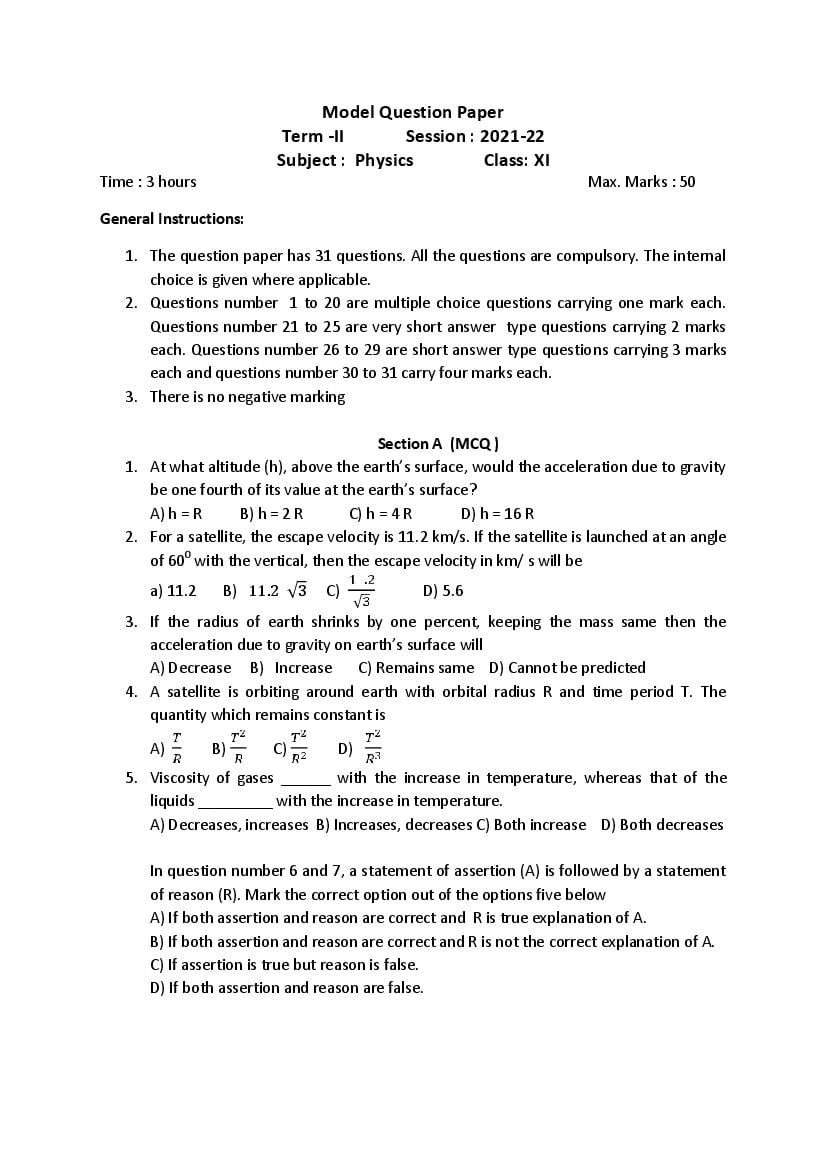
Term -II Session : 2021-22
Subject : Physics Class: XI
Time : 3 hours Max. Marks : 50
General Instructions:
1. The question paper has 31 questions. All the questions are compulsory. The internal
choice is given where applicable.
2. Questions number 1 to 20 are multiple choice questions carrying one mark each.
Questions number 21 to 25 are very short answer type questions carrying 2 marks
each. Questions number 26 to 29 are short answer type questions carrying 3 marks
each and questions number 30 to 31 carry four marks each.
3. There is no negative marking
Section A (MCQ )
1. At what altitude (h), above the earth’s surface, would the acceleration due to gravity
be one fourth of its value at the earth’s surface?
A) h = R B) h = 2 R C) h = 4 R D) h = 16 R
2. For a satellite, the escape velocity is 11.2 km/s. If the satellite is launched at an angle
of 600 with the vertical, then the escape velocity in km/ s will be
.
a) 11.2 B) 11.2 √3 C) D) 5.6
√
3. If the radius of earth shrinks by one percent, keeping the mass same then the
acceleration due to gravity on earth’s surface will
A) Decrease B) Increase C) Remains same D) Cannot be predicted
4. A satellite is orbiting around earth with orbital radius R and time period T. The
quantity which remains constant is
A) B) C) D)
5. Viscosity of gases ______ with the increase in temperature, whereas that of the
liquids _________ with the increase in temperature.
A) Decreases, increases B) Increases, decreases C) Both increase D) Both decreases
In question number 6 and 7, a statement of assertion (A) is followed by a statement
of reason (R). Mark the correct option out of the options five below
A) If both assertion and reason are correct and R is true explanation of A.
B) If both assertion and reason are correct and R is not the correct explanation of A.
C) If assertion is true but reason is false.
D) If both assertion and reason are false.
Page 2
experiences weightlessness.
Reason: An object orbits around earth under the influence of earth’s gravitational
field is in a state of free fall.
7. Assertion: Water waves in a river are not polarised.
Reason: Water waves are longitudinal as well as transverse in nature.
8. Bulk modulus is relevant for
A ) Solids B) Liquids C) Gases D) All of the above
9. What is the pressure on a swimmer 10 m below the surface of lake?
A) 1 atm B) 2 atm 3) 3 atm 4) 1.5 atm
Answer question 10 and 11 based on this case study.
Your mother places hot milk on your study table which if not consumed immediately
will begin to cool gradually. Finally it attains the temperature of the surrounding.
Place a thermometer in the milk cup and stir it constantly using a wooden stick.
Meanwhile take a stopwatch and note the thermometer readings after a fixed time
intervals say after one minute. Continue till you get the temperature reading nearly
50 C above the room temperature. A graph is plotted between the change in
temperature and time.
10. Which law best describes this experiment?
A) Wien’s displacement law B) Stefan- Boltzman law
C) Newton’s law of cooling D) All of the above laws
11. Which of the following statements is false?
A) Rate of loss of heat depends upon the difference in temperature of body and its
surrounding.
B) Initially the rate of cooling is less which gradually increases as the temperature of
the body falls.
C) Initially the rate of cooling is higher which gradually decreases as the temperature
of the body falls.
D) The graph between change in temperature between two successive intervals and
time is parabolic.
Page 3
1. Isothermal expansion a) Δ W = 0
2. Isobaric expansion b) Δ U = - ve
3. Adiabatic expansion c) Δ U = +ve
4. Isochoric expansion d) Δ U = 0
A) 1-d, 2-c, 3-b, 4-a B) 1-c, 2-d, 3-b, 4-a
C) 1-d, 2-c, 3-a, 4-b D) 1-c, 2-b, 3-a, 4-d
13. The equation of state for an adiabatic process is
A) P V = K B) P γ = K C) T V γ – 1 = K D) P T γ = K
14. No process is possible whose sole result is the transfer of heat from a colder object
to a hotter object. This is the statement by
A) Kelvin - Planck B) Clausius C) First law of thermodynamics D) Zeroth law of
thermodynamics
15. For a linear triatomic gas, the value of γ is
A) 1.28 B) 1.33 C) 1. 4 D) 1.67
16. The ratio of vapour densities of two gases at the same temperature is 8 : 9. The rms
velocity of these molecules will be
A) 2:3 B) 3: 2√2 C) 2√2 : 2 D) 3 : 2
17. On an average a human heart is found to beat 75 times in a minute. The heart beat
frequency is
A) 75 Hz B) 1.25 Hz C) 72 Hz D) 98.4 Hz
18. A body oscillates with SHM according to the equation
x = (5.0 m) cos [ ( 2π rad /s) t + π/4 ] . At t = 1.5 s, speed of the body in m/s is
A) 22.22 B) 3.535 C) 2.22 D) 35.35
19. If the incident wave is represented by y (x,t) = A sin (ω t – k x). For reflection at rigid
boundary the reflected wave is represented as
A) - A sin (ω t – k x) B) - A sin (ω t + k x) C) A sin (ω t – k x) D) A sin (ω t + k x)
20. When sound wave travels from air to water, which parameter does not change?
A) Wavelength B) Frequency C) Velocity D) All of these
Page 4
21. What are the conditions for a satellite to be geostationary?
22. State zeroth law of thermodynamics.
23. What is isothermal process? What are the essential conditions for a process to be
isothermal?
24. The length of a simple pendulum executing SHM is increased by 21%, what is the
percentage increase in time period of the pendulum of increased length?
OR
At what temperature will the speed of sound be double of its value at 273 K?
25. Differentiate between transverse and longitudinal waves.
26. State briefly Kepler’s laws of planetary motion with the help of labelled diagrams.
27. On the basis of kinetic theory, derive an expression for the pressure exerted by an
ideal gas.
28. Load on a metal wire suspended from a rigid support is gradually increased. Plot the
stress – strain curve and hence define elastic limit and permanent set.
29. Applying first law of thermodynamics derive relation between Cp and Cv.
OR
Explain four steps involved in the operation of a Carnot’s engine.
30. What is SHM? Show that for small oscillations, the motion of a simple pendulum is
simple harmonic. Hence obtain an expression for its time period. How the time
period varies when mass is doubled?
31. What is velocity head? Prove that the sum of pressure head, velocity head and
gravitational head remains constant in the streamline flow of an ideal fluid.
OR
Derive an expression for the rise of liquid in a capillary tube and show that the height
of the liquid column supported is inversely proportional to the radius of the tube.
State one example of capillarity from daily life.
Document Details
| Board / Org | Himachal Pradesh Board |
| Exam | Class 11 |
| Type | Sample Paper |
| Pages | 4 |
| Updated | 30 Apr 2026 |