HP Board Class 11 Model Question Paper 2022 Psychology Term 2
Finished viewing? Save it for later —
Download HP Board Class 11 Model Question Paper 2022 Psychology Term 2 (PDF · 12 pages)About HP Board Class 11 Model Question Paper 2022 Psychology Term 2
HP Board Class 11 Model Question Paper 2022 Psychology Term 2 is available here for free download. Published by Himachal Pradesh Board for Class 11, this sample paper can be viewed online or downloaded as a PDF (12 pages). Candidates preparing for Class 11 can use HP Board Class 11 Model Question Paper 2022 Psychology Term 2 to understand the exam pattern, the type of questions asked, and the overall difficulty level.
Frequently Asked Questions
How can I download HP Board Class 11 Model Question Paper 2022 Psychology Term 2?
Open this page and click the Download button to save HP Board Class 11 Model Question Paper 2022 Psychology Term 2 as a PDF. It is completely free on AglaSem Docs.
Is HP Board Class 11 Model Question Paper 2022 Psychology Term 2 free to download?
Yes. HP Board Class 11 Model Question Paper 2022 Psychology Term 2 can be viewed online and downloaded as a PDF free of cost on AglaSem Docs.
How many pages does HP Board Class 11 Model Question Paper 2022 Psychology Term 2 have?
HP Board Class 11 Model Question Paper 2022 Psychology Term 2 contains 12 pages, which you can read online or download together as a single PDF.
Where can I find more Class 11 study material?
You can find more Class 11 question papers, sample papers, syllabus, and answer keys on AglaSem Docs.
HP Board Class 11 Model Question Paper 2022 Psychology Term 2 – Text
Read the full text of this sample paper below — useful to quickly search, copy and reference the content online without downloading the PDF.
📄 View text version (12 pages)
Page 1
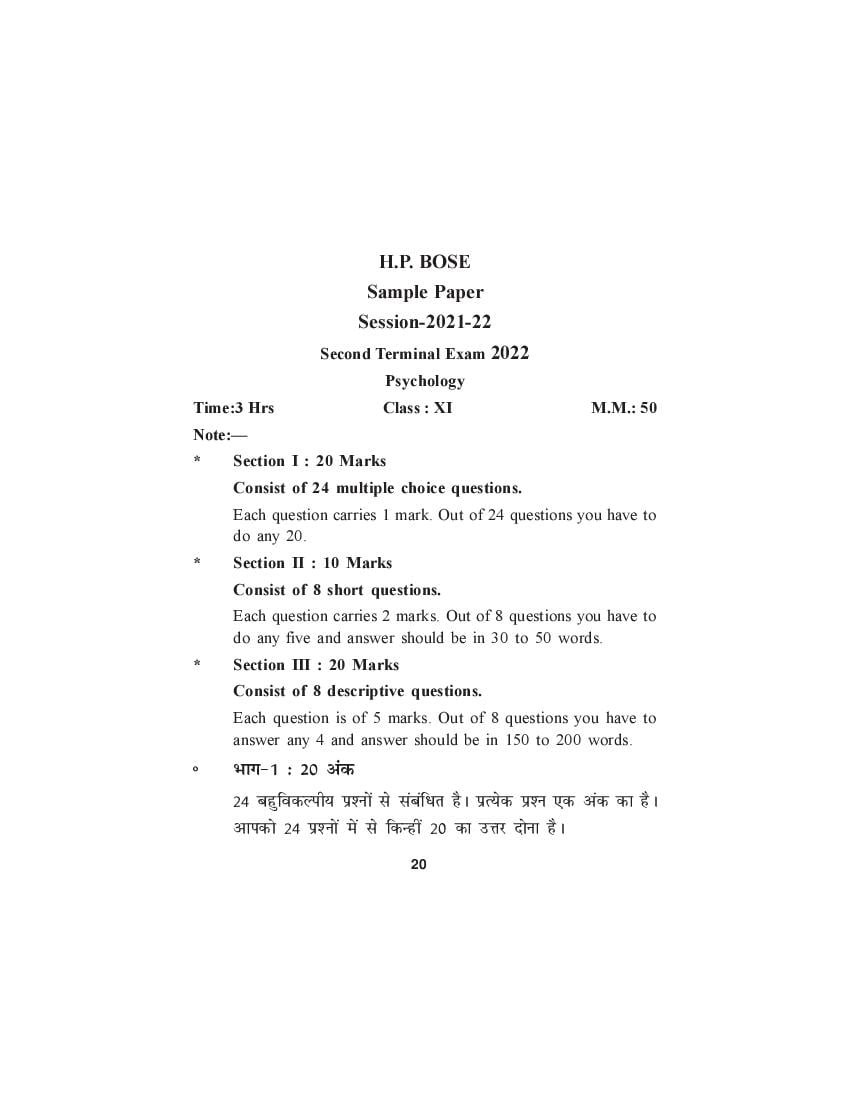
Sample Paper
Session-2021-22
Second Terminal Exam 2022
Psychology
Time:3 Hrs Class : XI M.M.: 50
Note:
* Section I : 20 Marks
Consist of 24 multiple choice questions.
Each question carries 1 mark. Out of 24 questions you have to
do any 20.
* Section II : 10 Marks
Consist of 8 short questions.
Each question carries 2 marks. Out of 8 questions you have to
do any five and answer should be in 30 to 50 words.
* Section III : 20 Marks
Consist of 8 descriptive questions.
Each question is of 5 marks. Out of 8 questions you have to
answer any 4 and answer should be in 150 to 200 words.
ø Öæ»-v Ñ w® ¥¢·¤
wy ÕãéUçß·¤ËÂèØ ÂýàÙô´ âð â¢Õ¢çÏÌ ãñUÐ ÂýØð·¤ ÂýàÙ °·¤ ¥¢·¤ ·¤æ ãñUÐ
¥æ·¤ô wy ÂýàÙô´ ×ð´ âð ç·¤ãUè´ w® ·¤æ ©UæÚU ÎôÙæ ãñUÐ
20
Page 2
¥æÆU Üæé-©UæÚU ÂýàÙô´ âð â¢Õ¢çÏÌ ãñUÐ ÂýØð·¤ ÂýàÙ Îô ¥¢·¤ô´ ·¤æ ãñUÐ
¥æ·¤ô ç·¤ãUè´ Âæ¡¿ ÂýàÙô´ ·¤æ ©UæÚU ÎðÙæ ãñUÐ ©UæÚU x®-z® àæÎô´ ×ð´ ãUôÙæ
¿æçãU°Ð
ø Öæ»-x Ñ w® ¥¢·¤
} ßæüÙæ×·¤ ÂýàÙ ©UæÚU âð â¢Õ¢çÏÌ ãñUÐ ÂýØð·¤ ÂýàÙ Âæ¡¿ ¥¢·¤ô´ ·¤æ ãñUÐ
¥æ·¤ô ç·¤ãUè´ ¿æÚU ÂýàÙô´ ·¤æ ©UæÚU vz®-w®® àæÎô´ ×ð´ ÎðÙæ ãñUÐ
Section-I
1. Gestalt means :
a) As a whole b) As a change
c) As a machine d) As a behaviour
»ðSÅUæËÅU ·¤æ ¥Íü ãñU-
·¤) â×»ý ·ð¤ M¤Â ×ð´ ¹) ÂçÚUßÌüÙ ·ð¤ M¤Â ×ð´
») ×àæèÙ ·ð¤ M¤Â ×ð´ æ) ÃØßãUæÚU ·ð¤ M¤Â ×ð´
2. Who among the following is associated with Gestalt theory of
perception?
a) PAVLOV b) SKINNER
c) THORNDIKE d) KOHLER
çÙÙçÜç¹Ì ×ð´ âð ·¤õÙ ÂýØÿæè·¤ÚUæ ·ð¤ »ðSÅUæËÅU çâhæ¢Ì âð â¢Õ¢çÏÌ ãñU?
·¤) ÂæòßÜæòß ¹) çS·¤ÙÚU
») ÍæÙüÇU槷¤ æ) ·¤ôãUÜÚU
21
Page 3
organisation?
a) The law of Proximity b) The law of Similarity
c) The law of Symmetry d) The law of Contrast
çÙÙçÜç¹Ì ×ð´ âð ·¤õÙâæ ÂýØÿæè·¤ÚUæ ·¤æ ⢻ÆUÙ ·¤æ çÙØ× ÙãUè´ ãñU?
·¤) çÙ·¤ÅUÌæ ·¤æ çÙØ× ¹) â×æÙÌæ ·¤æ çÙØ×
») â×ç×Ìè ·¤æ çÙØ× æ) çßá×Ìæ ·¤æ çÙØ×
4. The most important school of Psychology. Which has contributed
a lot towards perception is ...................
a) Psychoanalysis b) Gestaltism
c) Behaviourism d) Structuralism
×ÙôçßææÙ ·¤æ âÕâð ×ãUßÂêæü âÂýÎæØ çÁâ·¤æ ÂýØÿæè·¤ÚUæ ×ð´ ÕãéUÌ
¥çÏ·¤ Øô»ÎæÙ ãñU?
·¤) ×ÙôçßàÜðáæßæÎ ¹) »ðSÅUæËÅUßæÎ
») ÃØßãUæÚUßæÎ æ) â¢ÚU¿ÙæßæÎ
5. Who was the pioneer of Classical Conditioning?
a) Skinner b) Pavlov
c) Thorndike d) Kohler
Âýæ¿èÙ ¥ÙéÕ¢ÏÙ çâhæ¢Ì ·ð¤ ¥ßðá·¤ ·¤õÙ Íð?
·¤) çS·¤ÙÚU ¹) ÂæòßÜæòß
») ÍæÙüÇU槷¤ æ) ·¤ôãUÜÚU
22
Page 4
a) Albert Bandura b) J.B. Watson
c) Sigmund Freud d) Vygotsky
×æòÇUçÜ¢» ·¤æ â¢ÂýØØ çÎØæ »Øæ ãñU-
·¤) ¥ËßÅüU Õ¢ÇêUÚUæ mæÚUæ ¹) Áð0Õè0 ÕæòÅUâÙ mæÚUæ
») çâ×´ÇU Èý¤æØÇU mæÚUæ æ) ß槻ôâ·¤è mæÚUæ
7. Which of the following pair is not correctly matches.
a) Classical conditioning Thorndike
b) Instrumental conditioning Skinner
c) Observational Learning Bandura
d) Cognitive Learning Kohler
çÙÙçÜç¹Ì ×ð´ âð ç·¤â Øé× ·¤æ ç×ÜæÙ âãUè ÙãUè´ ãñU?
·¤) Âýæ¿èÙ ¥ÙéÕ¢ÏÙ- ÍæÙüÇU槷¤
¹) Ùõç×çæ·¤ ¥ÙéÕ¢ÏÙ- çS·¤ÙÚU
») Âýðÿææ ¥çÏ»×- Õ¢ÇêUÚUæ
æ) â¢ÁæÙæ×·¤ ¥çÏ»×- ·¤ôãUÜÚU
8. Kohlers learning theory is also known as
a) Trial and Error theory
b) Reinforcement theory
c) Theory of Insight
d) Classical conditioning
23
Page 5
·¤) ÂýØæ⠰ߢ æéçÅU ·¤æ çâhæ¢Ì
¹) ÂéÙÕüÜÙ ·¤æ çâhæ¢Ì
») ¥¢ÌÎüëçcÅU ·¤æ çâhæ¢Ì
æ) Âýæ¿èÙ ¥ÙéÕ¢ÏÙ ·¤æ çâhæ¢Ì
9. Which of the following factors affect learning?
a) Interest of the student
b) Emotional health of the student
c) Social and cultural content of the student
d) All of the above
çÙÙçÜç¹Ì ×ð´ âð ·¤õÙ âð ·¤æÚU·¤ ¥çÏ»× ·¤ô ÂýÖæçßÌ ·¤ÚUÌð ãñ´U?
·¤) çßlæÍèü ·¤è ¥çÖL¤ç¿
¹) çßlæÍèü ·¤æ âæ¢ßðç»·¤ SßæSØ
») çßlæÍèü ·¤æ âæ×æçÁ·¤ °ß¢ âæ¢S·ë¤çÌ·¤ â¢ÎÖü
æ) ©UÂÚUôÌ âÖè
10. Which of the following is related to creative thinking?
a) Divergent thinking b) Covergent thinking
c) Emotional thinking d) Egoistic thinking
çÙÙçÜç¹Ì ×ð´ âð ·¤õÙ âÁüÙæ×·¤ ç¿¢ÌÙ âð â¢Õ¢çÏÌ ãñU?
·¤) ¥ÂâæÚUè ç¿¢ÌÙ ¹) ¥çÖâæÚUè ç¿¢ÌÙ
») âæ¢ßðç»·¤ ç¿¢ÌÙ æ) ¥ã¢UßæÎè ç¿¢ÌÙ
24
Page 6
of which are origional solutions. Aman is displaying
characteristics of a/an.......
a) Creative thinker b) Covergent thinking
c) Rigid thinking d) Ego centre thinker
¥×Ù ãU×àð ææ â×SØæ ·ð¤ °·¤æçÏ·¤ â×æÏæÙô´ ·ð¤ ÕæÚÔU ×ð´ âô¿Ìæ ãñU §Ù×ð´ âð
¥çÏ·¤ÌÚU â×æÏæÙ ×õçÜ·¤ ãUôÌð ãñÚ? ¥×Ù ç·¤Ù »éæô´ ·¤æ ÂýÎàæüÙ ·¤ÚU ÚUãUæ ãñU?
·¤) âÁüÙæ×·¤ ç¿¢ÌÙ ¹) ¥çÖâæÚUè ç¿¢ÌÙ
») ¥ÙØ ç¿¢ÌÙ¤ æ) ¥ã¢U·ð´¤çÎýÌ ç¿¢ÌÙ
12. Out of the box thinking is related to....
a) Consistent thinking b) Memory based thinking
c) Divergent thinking d) Covergent thinking
ÒÒ¥æ©UÅU-¥æòȤ Î Õæòâ/ãUÅU·ð¤ âô¿ôÓÓ ç¿¢ÌÙ ç·¤ââð â¢Õ¢çÏÌ ãñU?
·¤) ¥Ùé·ê¤ÜÙ ç¿¢ÌÙ ¹) S×ëçÌ ¥æÏæçÚUÌ ç¿¢ÌÙ
») ¥ÂâæÚUè ç¿¢ÌÙ æ) ¥çÖâæÚUè ç¿¢ÌÙ
13. Thinking is essentially
a) a cognitive activity b) a psychomotor activity
c) a psychological activity d) an affective behaviour
ç¿¢ÌÙ ¥çÙßæØüÌ ãñ´U-
·¤) â¢ææÙæ×·¤ Âýç·ý¤Øæ ¹) ×ÙôÂýðÚU·¤ Âýç·ý¤Øæ
») ×ÙôßñææçÙ·¤ Âýç·ý¤Øæ æ) ÖæßÙæ×·¤ Âýç·ý¤Øæ
25
Page 7
process.
a) Preparation b) Attention
c) Incubation d) Illumination
çÙÙçÜç¹Ì ×ð´ âð ·¤õÙ âÁüÙæ×·¤ ç¿¢ÌÙ Âýç·ý¤Øæ ·¤è ¥ßSÍæ ÙãUè´ ãñU?
·¤) ÌñØæÚUè ¹) ¥ßÏæÙ
») ©UÎ÷ÖßÙ æ) ÂýÎèçÌ
15. The first systematic attempt to understand the nature of forgetting
was made by..
a) Maslow b) Skinner
c) Ebbinghaus d) Bartlet
çßS×ÚUæ ·¤è Âý·ë¤çÌ ·ð¤ ÂãUÜð ·ý¤ç×·¤ ¥ØØÙ ·¤æ ÂýØÙ ............ mæÚUæ
ç·¤Øæ »ØæÐ
·¤) ×ñSÜô¤ ¹) çS·¤ÙÚU
») °çÕ¢»ãUæòâ æ) ÕæÅüUÜðÅU
16. Sensory memory has a large capacity, how ever. It is of very
short duration i.e. less than a second.
a) True b) false
â¢ßðÎè S×ëçÌ ·¤è ⢿Øè ÿæ×Ìæ Ìô ÕãéUÌ ãUôÌè ãñU ç·¢¤Ìé §â·¤è ¥ßçÏ
ÕãéUÌ ·¤× ãUôÌè ãñU, °·¤ âð·ð´¤ÇU âð Öè ·¤×Ð
·¤) âãUè ¹) »ÜÌ
26
Page 8
learning.
a) William James b) Skinner
c) Bartlet d) Ebbinghaus
ç·¤â ×ÙôßñææçÙ·¤ Ùð çÙÚUÍüÙ àæÎô´ ·¤ô ¥çÏ»× âæ×»ýè ·¤è ÌÚUãU ÂýØô»
ç·¤Øæ?
·¤) çßçÜØ× Áðâ ¹) çS·¤ÙÚU
») ßæÅüUÜðÅU¤ æ) °çÕ¢»ãUæòâ
18. The first systematic exploration of memory is credited to___
a) William James b) Ebbinghaus
c) Skinner d) Bartlet
S×ëçÌ ·ð¤ ÂãUÜð ·ý¤ç×·¤ ¥ØØÙ ·¤æ æðØ ........ ·¤ô ÁæÌæ ãñUÐ
·¤) çßçÜØ× Áðâ ¹) °çÕ¢»ãUæòâ
») çS·¤ÙÚU æ) ÕæÅüUÜðÅU
19. The stage model of memory compares memory process with
the working of a ______
a) Machine b) Telephone
c) Computer d) Screen
S×ëçÌ ·¤æ ¥ßSÍæ ×æòÇUÜ S×ëçÌ Âýç·ý¤Øæ¥ô´ ·¤è ÌéÜÙæ ............. âð
·¤ÚUÌæ ãñUÐ
·¤) ×àæèÙ ¹) ÅðUÜèȤôÙ
») ·¢¤ØêÅUÚU æ) S·ý¤èÙ
27
Page 9
a) Attitude b) Curiosity
c) Interest d) Hunger
çÙÙçÜç¹Ì ×ð´ âð ·¤õÙ âæ ¥çÁüÌ ÂýðÚU·¤ ·¤æ ©UÎæãUÚUæ ÙãUè´ ãñU?
·¤) ¥çÖßëçæ ¹) çÁææâæ¤
») L¤ç¿ æ) Öê¹
21. ................ is the process of arousing, sustaining and regulating
activity.
a) Motivation b) Emotion
c) Learning d) Perception
................... ·¤æØü ·ð¤ ¥æÚ¢UÖ ·¤ÚUÙð, ÁæÚUè ÚU¹Ùð ¥õÚU çÙØç×Ì ·¤ÚUÙð ·¤è
Âýç·ý¤Øæ ãñUÐ
·¤) ¥çÖÂýðÚUææ ¹) â¢ßð»
») ¥çÏ»× æ) ÂýØÿæè·¤ÚUæ
22. Maslows motivation theory is also known as__
a) Theory of Physiology b) Theory of needs
c) Theory of will power d) Theory of arousal
×ñSÜô ·ð¤ ¥çÖÂýðÚUææ çâhæ¢Ì ·¤ô ØãU Öè ·¤ãUæ ÁæÌæ ãñUÐ
·¤) àæÚUèÚU-ç·ý¤Øæ çâhæ¢Ì ¹) ¥æßàØ·¤Ìæ ·¤æ çâhæ¢Ì
») ÎëɸU §ÀUæ àæçÌ ·¤æ çâhæ¢Ì æ) ¥¢ÌÙôüÎ ·¤æ çâhæ¢Ì¤
28
Page 10
a) Physical needs b) Self esteem needs
c) Self actualization d) Safety needs
çÙÙ ×ð´ âð ·¤õÙ âè ¥æßàØ·¤Ìæ ©Uæ SÌÚU Øæ ·ý¤× ·¤è ¥æßàØ·¤Ìæ ãñU?
·¤) àææÚUèçÚU·¤ ¥æßàØ·¤Ìæ
¹) ¥æ×-â×æÙ ·¤è ¥æßàØ·¤Ìæ
») ¥æ×-ßæSÌßè·¤ÚUæ ·¤è ¥æßàØ·¤Ìæ
æ) âéÚUÿææ ·¤è ¥æßàØ·¤Ìæ
24. Which of the following is a biological or natural motive.
a) Hunger b) Thirst
c) Sleep d) All of the above
çÙÙçÜç¹Ì ×ð´ âð ·¤õÙ âæ Áñçß·¤ Á×ÁæÌ ÂýðÚU·¤ ãñU?
·¤) Öê¹ ¹) Øæâ
») çÙÎýæ/Ùè´Î æ) ©UÂÚUôÌ âÖè
Section-II
Do any five 2×5=10
wz. ¿ØÙæ×·¤ ¥ßÏæÙ Øæ ãñU?
What is selective attention?
w{. ¥çÏ»× ·¤ô ÂçÚUÖæçáÌ ·¤èçÁ°?
Define Learning.
29
Page 11
What do you mean by modelling?
w}. S×ëçÌ ·¤è ¥ßSÍæ¥ô´ ·ð¤ Ùæ× çÜç¹°Ð
Write names of stages of memory.
w~. ¥Ë·¤æçÜ·¤ S×ëçÌ ÂÚU Üæé çÅUÂæè çܹð´Ð
Write short note on short term memory.
x®. ¥çÖâæÚUè ç¿¢ÌÙâð ¥æ Øæ â×ÛæÌð ãñ´U?
What do you mean by covergent thinking?
xv. â×SØæ â×æÏæÙ ·ð¤ Âý×é¹ ¥ßÚUôÏ Øæ ãñ´U?
What are the major obstacles of problem solving?
xw. â¢ßð» ·¤ô ÂçÚUÖæçáÌ ·¤ÚÔ´UФ
Define Emotion.
Section-III
Do any five 4×5=20
xx. ¥ßÏæÙ ·¤ô ÂçÚUÖæçáÌ ·¤èçÁ°Ð §â·ð¤ »éæô´ ·¤è ÃØæØæ ·¤èçÁ°Ð
Define attention. Explain its properties.
xy. Öý× ·¤ô ÂçÚUÖæçáÌ ·¤èçÁ° ¥õÚU ©Uâ·ð¤ Âý·¤æÚUô´ ·¤è ÃØæØæ ·¤èçÁ°Ð
Define illusion and explain its types.
xz. ¥çÏ»× ·ð¤ Âýæ¿èÙ ¥ÙéÕ¢ÏÙ çâhæ¢Ì ·¤è ÃØæØæ ·¤ÚÔ´UÐ
Explain classical conditioning theory of learning.
30
Page 12
Write note on learning disability.
x|. çßS×ÚUæ ·¤ô ÂçÚUÖæçáÌ ·¤èçÁ°Ð çßS×ÚUæ ·¤ô ÂýÖæçßÌ ·¤ÚUÙð ßæÜð
·¤æÚU·¤ô´ ·¤è ÃØæØæ ·¤èçÁ°Ð
Define forgetting. Describe factors of affecting forgetting.
x}. âÁüÙæ×·¤ ç¿¢ÌÙ ·¤ô ·ñ¤âð ÕɸUæØæ Áæ â·¤Ìæ ãñU?
How can creative thinking be enhanced?
x~. ×ñSÜô ·¤ô ¥æßàØ·¤Ìæ ÂÎæÙé·ý¤× çâhæ¢Ì ·¤è ÃØæØæ ·¤èçÁ°Ð
Explain Maslows Hierarchy of needs.
y®. â¢ßð» ·ð¤ Áðâ-Üñ´Áð çâhæ¢Ì ·¤è ÃØæØæ ·¤ÚÔ´UÐ
Explain James-Lange theory of emotions.
31
Document Details
| Board / Org | Himachal Pradesh Board |
| Exam | Class 11 |
| Type | Sample Paper |
| Pages | 12 |
| Updated | 30 Apr 2026 |