WBJEE 2023 Sample Paper Maths
Finished viewing? Save it for later —
Download WBJEE 2023 Sample Paper Maths (PDF · 9 pages)About WBJEE 2023 Sample Paper Maths
WBJEE 2023 Sample Paper Maths is available here for free download. Published by WBJEEB for West Bengal Joint Entrance Examination, this sample paper can be viewed online or downloaded as a PDF (9 pages). Candidates preparing for West Bengal Joint Entrance Examination can use WBJEE 2023 Sample Paper Maths to understand the exam pattern, the type of questions asked, and the overall difficulty level.
Frequently Asked Questions
How can I download WBJEE 2023 Sample Paper Maths?
Open this page and click the Download button to save WBJEE 2023 Sample Paper Maths as a PDF. It is completely free on AglaSem Docs.
Is WBJEE 2023 Sample Paper Maths free to download?
Yes. WBJEE 2023 Sample Paper Maths can be viewed online and downloaded as a PDF free of cost on AglaSem Docs.
How many pages does WBJEE 2023 Sample Paper Maths have?
WBJEE 2023 Sample Paper Maths contains 9 pages, which you can read online or download together as a single PDF.
Where can I find more West Bengal Joint Entrance Examination study material?
You can find more West Bengal Joint Entrance Examination question papers, sample papers, syllabus, and answer keys on AglaSem Docs.
WBJEE 2023 Sample Paper Maths – Text
Read the full text of this sample paper below — useful to quickly search, copy and reference the content online without downloading the PDF.
📄 View text version (9 pages)
Page 1
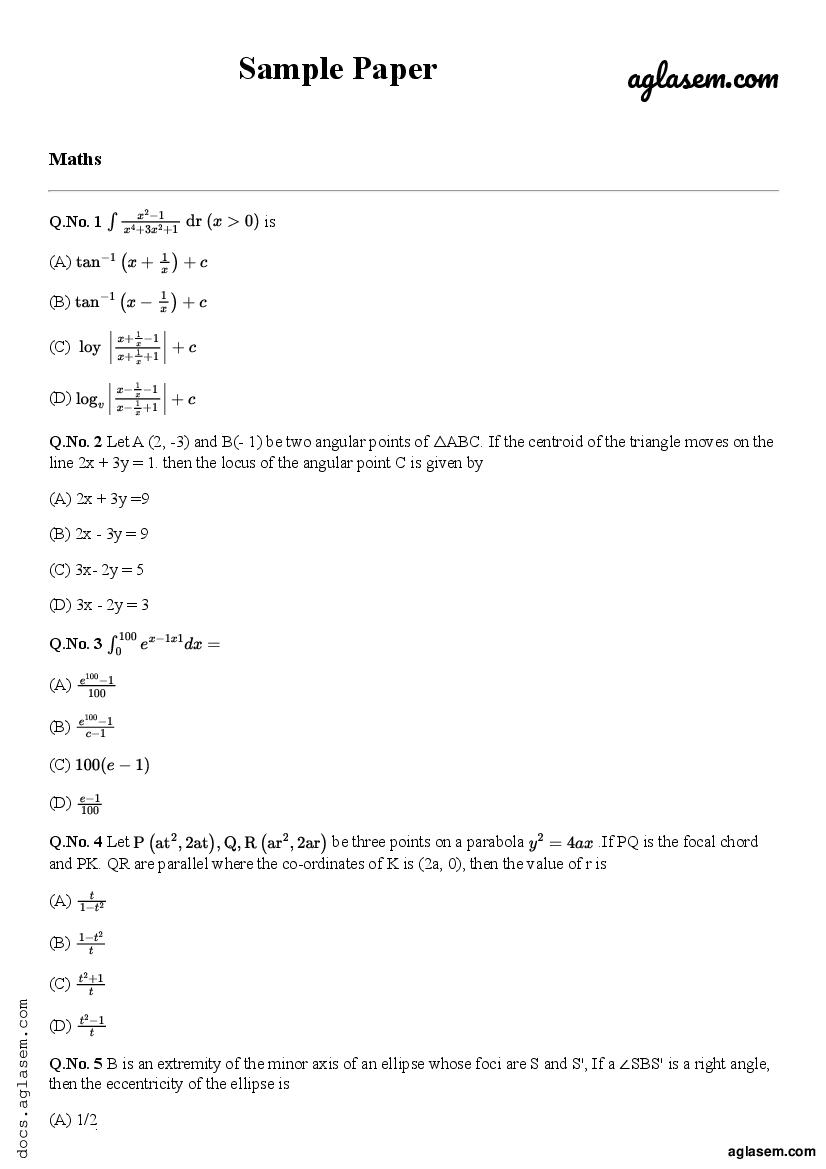
Q.No. 1 ∫
(A) tan
(B) tan
(C) loy
(D) log
(C) 3x- 2y = 5
(D) 3x - 2y = 3
Q.No. 3 ∫
(A)
(B)
(A)
(B)
(C)
(D)
e
e
1−t
1−t
2
t +1
t −1
100
100
100
c−1
(C) 100(e − 1)
(D) e−1
100
2
t
t
t
t
−1
−1
v
−1
−1
2
2
∣(x +
(x −
x+
x+
x−
x−
100
0
4
x −1
x +3x +1
1
x
1
x
1
x
1
x
2
−1
+1
−1
+1
e
2
1
x
1
x
x−1x1
) + c
) + c
+ c
+ c
dx =
Sample Paper
dr (x > 0) is
Q.No. 2 Let A (2, -3) and B(- 1) be two angular points of △ABC. If the centroid of the triangle moves on the
line 2x + 3y = 1. then the locus of the angular point C is given by
(A) 2x + 3y =9
(B) 2x - 3y = 9
Q.No. 4 Let P (at , 2at), Q, R (ar , 2ar) be three points on a parabola y = 4ax .If PQ is the focal chord
2 2 2
and PK. QR are parallel where the co-ordinates of K is (2a, 0), then the value of r is
Q.No. 5 B is an extremity of the minor axis of an ellipse whose foci are S and S', If a ∠SBS' is a right angle,
then the eccentricity of the ellipse is
(A) 1/2
√
Page 2
(C) 2/3
(D) 1/3
Q.No. 6 Three lines are drawn from the origin O with direction cosines proportional to (1,-1.1). (2, -3, 0) and
(1, 0, 3). The three lines are
(A) not coplanar
(B) coplanar
(C) perpendicular to each other
(D) coincident
Q.No. 7 In a GP. series consisting of positive terms, cach term is equal to the sum of next two terms. Then
the common ratio of this G.P series is
(A) √5
(B) √5
2
(C) √ 5−1
2
(D) √ 5+1
2
Q.No. 8 ∫ cos(log x)dx = F (x) + c where c is an arbitrary constant .Here F(x) =
(A) x[cos(log x) + sin(log x)]
(B) x[cos(log x) − sin(log x)]
(C) x
2
[cos(log x) + sin(log x)]
(D) x
2
[cos(log x) − sin(log x)]
Q.No. 9 ∫ cos(log x)dv = F(x) + c where c is an arbitrary constant, Here F(x) =
(A) x[cos(log x) + sin(log x)]
(B) x[(cos(log x) - sin(log x)]
(C) x[(cos(log x) + sin(log x)]
(D) x/2[(cos(log x) - sin(log x)]
Q.No. 10 If the sum of two unit vectors is a unit vector, then the magnitude of their difference is
(A) √2 units
(B) 2 units
(C) √3 units
(D) √5 units
Q.No. 11 The approximate value of sin 31 is∘
Page 3
(B) > 0.6
(C) < 0.5
(D) < 0.4
Q.No. 12 The integrating factor of the first order differential equation
+ x (x + 1)y = x − 1 is
2 2 dy 2 2
x (x − 1)
dx
(A) ex
(B) x - 1/x
(C) x + 1/x
(D) 1
x
2
Q.No. 13 The probability that a non leap year selected at random will have 53 Sundays is
(A) 0
(B) 1/7
(C) 2/7
(D) 3/7
Q.No. 14 The area of the region lying above x-axis. and included between the circle x + y 2 2
= 2ax & the
parabola y = ax, a > 0 is
2
(A) 8πa 2
(B) a (
2 π
4
−
2
3
)
2
(C) 16πa
9
(D) π ( 27
8
+ 3a )
2
Q.No. 15 Let f: [: |a, b| → R be differentiable on [a, b]&k ∈ R .Let f (a) = 0 = f (b) Also let
J(x) = f (x) + kf (x) Then
′
(A) J(x) > 0 f or all x ∈ [a, b]
(B) J(x) < 0 f or all x ∈ [a, b]
(C) J(x) − 0 for all x ∈ [a, b]
(D) J(x) = 0 through (a, b)
Q.No. 16 Let α → γ→ be three unit vectors such that α
→ , β, → ⋅ β→ = α
→ ⋅ γ→ = 0 and the angle between β→ and γ→ is 30 ∘
→ is ________________
.Then α
(A) 2(β→ × γ→)
(B) −2(β→ × γ→)
Page 4
(D) (β→ × γ→)
Q.No. 17 If z and z be two non zero complex numbers such that then,the origin and the
z1 z2
1 2 + = 1
z2 z1
points represented by z and z
1 2
(A) lie on a straight line
(B) form an right angled triangle
(C) form an equilateral triangle
(D) form an isosceles triangle
Q.No. 18 The locus of the mid-points of the chords of the circle x2+ y2 +2x -2y -2 = 0 which make an angle
of 90° at the centre is
(A) x2 + y2 -2x - 2y = 0
(B) x2 + y2 -2x + 2y = 0
(C) x2 +y2 + 2x - 2y = 0
(D) x2 + y2 + 2x -2y -1 = 6
Q.No. 19 If f : R → R be defined by f (x) = e and g : R → R defined by g(x) = x . The mapping
x 2
g ∘ f : R → B be defined by (g ∘ f )(x) = g[f (x)]∀x ∈ R . Then
(A) g ∘ f is bijective but f is not injective
(B) g ∘ f is injective and g is injective
(C) g ∘ f is injective but g is not bijective
(D) g ∘ f is surjective and g is surjective
Q.No. 20 Let f(x) = x13 + x11 + x9 + x7 +x5 + x3 +x + Then f(x) = 0 has
(A) 13 real roots
(B) only one positive and only two negative real roots
(C) not more than one real root
(D) has two positive and one negative real root
Q.No. 21 The normals to the curve y = x − x + 1 ,drawn at the points with the abscissa x
2
1
= 0, x 2 = −1
and x −
3
5
2
(A) are parallel to each Other
(B) are pairwise perpendicular
(C) are concurrent
(D) are not concurrent
Page 5
(A) p!
(B) q!
(C) p
(D) q
Q.No. 23 The point Q is the image of the P(1,5) about the line y x and R is the image of the point Q about
the line y = −x The circumcenter of the ΔP QR is
(A) (5, 1)
(B) (−5, 1)
(C) (1, −5)
(D) (0, 0)
Q.No. 24 The number of selection of n objects from 2n objects of which n are identical and the rest are
different is
(A) 2 n
(B) 2 n−1
(C) 2 n
− 1
(D) 2 n−1
+ 1
Q.No. 25 Without changing the direction of the the origin is to the point (2. 3). Then the equation
x + y − 4x − 6y + 9 = 0 changes to
2 2
(A) x + y + 4 = 0
2 2
(B) x + y
2 2
= 4
(C) x + y − 8x − 12y + 48 = 0
2 2
(D) x + y
2 2
= 9
Q.No. 26 Consider the function y = log (x + √x + 1), a > 0, a ≠ 1 .The inverse of the function
a
2
(A) does not exist
(B) is x = log 1/2
(y + √ y
2
+ 1)
(C) is x = sinh(y/n a )
(D) is x = cosh (−y ln 1
)
a
Q.No. 27 The value of the integral ∫
1 2
x
e dx
0
(A) is less than 1
(B) is greater than 1
Page 6
(D) lies in the closed interval [1, e]
Q.No. 28 Transforming to parallel axes through a point (p,q), the equation 2x2 + 3xy + 4y2 + x + 18y + 25 =
0 becomes 2x2 + 3xy + 4y2 = Then
(A) p = -2, q= 3
(B) p = 2, q= -3
(C) p = 3, q= -4
(D) p= -4, q= 3
^ →
Q.No. 29 Let α→ = ^i + ^j + k, β =^ → = ^i + ^ȷ − k
j − k and y
i −^
^ ^
be three vectors A vector δ→ in the plane of α
→
→
and β projections on γ→ Is 1
given by
√3
(A) −^i − 3^j − 3k
^
(B) ^i − 3^j − 3k
^
(C) −^i + 3^j + 3k
^
(D) ^i + 3^j − 3k
^
Q.No. 30 Out of 7 consonants and 4 vowels. words are formed each having 3 consonants and 2 vowels. The
number of such words that can be formed is
(A) 210
(B) 25200
(C) 2520
(D) 302400
Q.No. 31 Number of common tangents of y = x and -x2+4x-4 is
2
(A) 1
(B) 2
(C) 3
(D) 4
Q.No. 32 The value of K in order that f(x) = sin x - cos x - Kx + 5 decreases for all positive real values of x
is given by
(A) K < I
(B) K ≥ I
(C) K > √2
(D) K < √2
Page 7
C r + 2.
n
C r+1 +
n
C r12 is equal to
(A) 2. C n
r+2
(B) n+1
C r+1
(C) n −2
C r+2
(D) n+1
Cr
Q.No. 34 Let P be the set of all non-singular matrices of order 3 over R and Q be the set of all orthogonal
matrices of order 3 over R. Then
(A) P is proper subset of Q
(B) Q is proper subset of P
(C) Neither P is proper subset of Q nor Q is proper subset of P
(D) P∩Q = Φ. the void set
Q.No. 35 Let ρ be a relation defined on N the set of the natural numbers as
ρ = {(x, y) ∈ N × N : 2x + y = 41} then
(A) ρ is an equivalence relation
(B) ρ is only reflexive relation
(C) ρ is only symmetric relation
(D) ρ is not transitive
Q.No. 36 If p, q are odd integers. then the roots of the equation 2px2 + (2p + q) x + q = 0 are
(A) rational
(B) irrational
(C) non-real
(D) equal
Q.No. 37 Let A, B be two distinct points on the parabola y = 4x If the axis of the parabola touches a circle
2
Of radius r having AB as diameter, the slope Of the line AB is
(A) 1
r
(B) 1
r
(C) 2
r
(D) − 2
r
Q.No. 38 If one of the diameters Of the given by the equation x + y + 4x + 6y − 12 = 0 is a chord of a
2 2
circle S, whose centre is (2,-3) the radius of S is
(A) √41 units
(B) 3√5 units
Page 8
(D) 2√5 units
are in G.P. then x, y, z are in
(A) A.P always
(B) GP always
(C) AP depending on the value of x.y, z
(D) G.P depending on the value of x. y, z
Q.No. 40 The value of det A. where A =
(A) in the closed interval [1, 2]
(B) in the closed interval [0, 1]
(C) in the open interval (0, 1)
(D) in the open interval (1, 2)
Answer Sheet
Q.No. 1
Q.No. 2
Q.No. 3
Q.No. 4
Q.No. 5
Q.No. 6
Q.No. 7
Q.No. 8
Q.No. 9
Q.No. 10
Q.No. 11
Q.No. 12
Q.No. 13
Q.No. 14
Q.No. 15
Q.No. 16
Q.No. 17
Q.No
(C)
(A)
(C)
(D)
(B)
(B)
(B)
(C)
(C)
(C)
(A)
(B)
(B)
(B)
(C)
(C)
(C)
⎜⎟
Q.No. 39 Let f: KR —> R be such that f is injective and f(x) f(y) = f(x+ y) for all x, y ∈ R. If f(x), f(y), f(z)
⎛
⎝
Answer
1
− cos θ
−1
cos θ
1
− cos θ
0
cos θ
1
⎞
⎠
lies
Page 9
Q.No. 19 (C)
Q.No. 20 (C)
Q.No. 21 (C)
Q.No. 22 (B)
Q.No. 23 (D)
Q.No. 24 (A)
Q.No. 25 (B)
Q.No. 26 (C)
Q.No. 27 (B)
Q.No. 28 (B)
Q.No. 29 (C)
Q.No. 30 (B)
Q.No. 31 (B)
Q.No. 32 (C)
Q.No. 33 (C)
Q.No. 34 (B)
Q.No. 35 (D)
Q.No. 36 (A)
Q.No. 37 (C)
Q.No. 38 (A)
Q.No. 39 (A)
Q.No. 40 (A)
Document Details
| Board / Org | WBJEEB |
| Exam | West Bengal Joint Entrance Examination |
| Type | Sample Paper |
| Pages | 9 |
| Updated | 09 Jun 2026 |