HPCET 2025 Syllabus
Finished viewing? Save it for later —
Download HPCET 2025 Syllabus (PDF · 24 pages)About HPCET 2025 Syllabus
HPCET 2025 Syllabus is available here for free download. Published by Himachal Pradesh Exams for Himachal Pradesh Common Entrance Test, this syllabus can be viewed online or downloaded as a PDF (24 pages). Candidates preparing for Himachal Pradesh Common Entrance Test can use HPCET 2025 Syllabus to understand the exam pattern, the type of questions asked, and the overall difficulty level.
Frequently Asked Questions
How can I download HPCET 2025 Syllabus?
Open this page and click the Download button to save HPCET 2025 Syllabus as a PDF. It is completely free on AglaSem Docs.
Is HPCET 2025 Syllabus free to download?
Yes. HPCET 2025 Syllabus can be viewed online and downloaded as a PDF free of cost on AglaSem Docs.
How many pages does HPCET 2025 Syllabus have?
HPCET 2025 Syllabus contains 24 pages, which you can read online or download together as a single PDF.
Where can I find more Himachal Pradesh Common Entrance Test study material?
You can find more Himachal Pradesh Common Entrance Test question papers, sample papers, syllabus, and answer keys on AglaSem Docs.
HPCET 2025 Syllabus – Text
Read the full text of this syllabus below — useful to quickly search, copy and reference the content online without downloading the PDF.
📄 View text version (24 pages)
Page 1
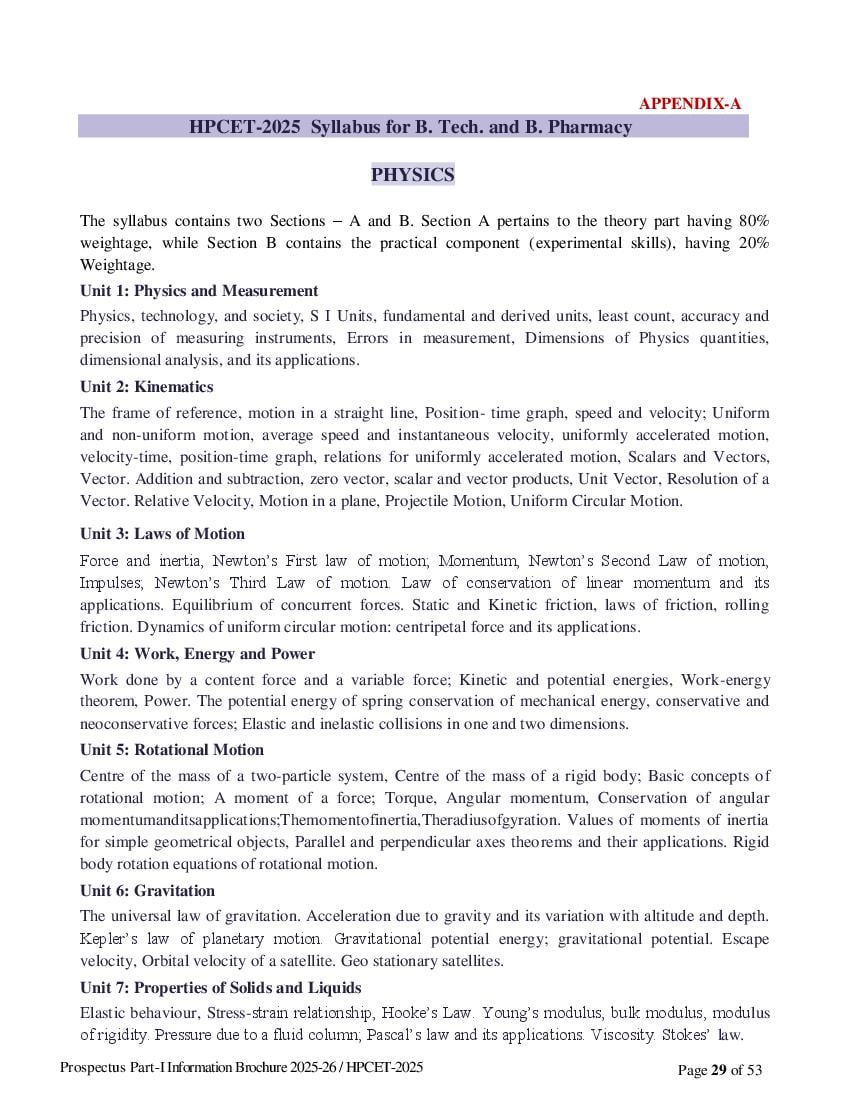
HPCET-2025 Syllabus for B. Tech. and B. Pharmacy
PHYSICS
The syllabus contains two Sections – A and B. Section A pertains to the theory part having 80%
weightage, while Section B contains the practical component (experimental skills), having 20%
Weightage.
Unit 1: Physics and Measurement
Physics, technology, and society, S I Units, fundamental and derived units, least count, accuracy and
precision of measuring instruments, Errors in measurement, Dimensions of Physics quantities,
dimensional analysis, and its applications.
Unit 2: Kinematics
The frame of reference, motion in a straight line, Position- time graph, speed and velocity; Uniform
and non-uniform motion, average speed and instantaneous velocity, uniformly accelerated motion,
velocity-time, position-time graph, relations for uniformly accelerated motion, Scalars and Vectors,
Vector. Addition and subtraction, zero vector, scalar and vector products, Unit Vector, Resolution of a
Vector. Relative Velocity, Motion in a plane, Projectile Motion, Uniform Circular Motion.
Unit 3: Laws of Motion
Force and inertia, Newton’s First law of motion; Momentum, Newton’s Second Law of motion,
Impulses; Newton’s Third Law of motion. Law of conservation of linear momentum and its
applications. Equilibrium of concurrent forces. Static and Kinetic friction, laws of friction, rolling
friction. Dynamics of uniform circular motion: centripetal force and its applications.
Unit 4: Work, Energy and Power
Work done by a content force and a variable force; Kinetic and potential energies, Work-energy
theorem, Power. The potential energy of spring conservation of mechanical energy, conservative and
neoconservative forces; Elastic and inelastic collisions in one and two dimensions.
Unit 5: Rotational Motion
Centre of the mass of a two-particle system, Centre of the mass of a rigid body; Basic concepts of
rotational motion; A moment of a force; Torque, Angular momentum, Conservation of angular
momentumanditsapplications;Themomentofinertia,Theradiusofgyration. Values of moments of inertia
for simple geometrical objects, Parallel and perpendicular axes theorems and their applications. Rigid
body rotation equations of rotational motion.
Unit 6: Gravitation
The universal law of gravitation. Acceleration due to gravity and its variation with altitude and depth.
Kepler’s law of planetary motion. Gravitational potential energy; gravitational potential. Escape
velocity, Orbital velocity of a satellite. Geo stationary satellites.
Unit 7: Properties of Solids and Liquids
Elastic behaviour, Stress-strain relationship, Hooke’s Law. Young’s modulus, bulk modulus, modulus
of rigidity. Pressure due to a fluid column; Pascal’s law and its applications. Viscosity. Stokes’ law.
Prospectus Part-I Information Brochure 2025-26 / HPCET-2025 Page 29 of 53
Page 2
applications. Surface energy and surface tension, angle of contact, application of surface tension –
drops, bubbles and capillary rise. Heat, temperature, thermal expansion; Specific heat capacity,
calorimetry; Change of state, latent heat. Heat transfer-conduction, convection and radiation. Newton’s
law of cooling.
Unit 8: Thermodynamics
Thermal equilibrium, Zeroth law of thermodynamics, The concept of temperature. Heat, work and
internal energy. The first law of thermodynamics. The second law of thermodynamics: reversible and
irreversible processes. Carnot engine and its efficiency.
Unit 9: Kinetic Theory of Gases
Equation of state of a perfect gas, work done on compressing a gas, Kinetic theory of gases –
assumptions, the concept of pressure. Kinetic energy and temperature: RMS speed of gas molecules:
Degrees of freedom. Law of equipartition of energy, Applications to specific heat capacities of gases;
Mean free path. Avogadro’s number.
Unit 10: Oscillations and Waves
Periodic motion – period, frequency, displacement as a function of time. Periodic functions. Simple
harmonic motion (S.H.M.) and its equation; Phase: oscillations of a spring -restoring force and force
constant: energy in S.H.M. – Kinetic and potential energies; Simple pendulum – derivation of
expression for its time period: Free, forced and damped oscillations, resonance.
Wave motion. Longitudinal and transverse waves, speed of a wave. Displacement relation for a
progressive wave. Principle of superposition of waves, a reflection of waves. Standing waves in
strings and organ pipes, Fundamental mode and harmonics. Beats. Doppler Effect in sound.
Unit 11: Electrostatics
Electric charges: Conservation of charge. Coulomb’s law-forces between two point charges, Forces
between multiple charges: superposition principle and continuous charge distribution.
Electric field: Electric field due to a point charge, Electric field lines. Electric dipole, Electric field due
to a dipole. Torque on a dipole in a uniform electric field.
Electric flux. Gauss’s law and its applications to find field due to infinitely long uniformly charged
straight wire, uniformly charged infinite plane sheet and uniformly charged thin spherical shell.
Electric potential and its calculation for a point charge, electric dipole and system of charges;
Equipotential surfaces, Electrical potential energy of a system of two point charges in an electrostatic
field.
Conductors and insulators. Dielectrics and electric polarization, Capacitor, The combination of
capacitors in series and parallel, Capacitance of a parallel plate capacitor with and without dielectric
medium between the plates. Energy stored in a capacitor.
Unit 12: Current Electricity
Electric current. Drift velocity. Ohm’s law. Electrical resistance. Resistances of different materials. V-l
characteristics of Ohmic and non-ohmic conductors. Electrical energy and power. Electrical resistivity.
Colour code for resistors; Series and parallel combinations of resistors; Temperature dependence of
resistance.
Prospectus Part-I Information Brochure 2025-26 / HPCET-2025 Page 30 of 53
Page 3
in series and parallel. Kirchhoff’s laws and their applications. Wheatstone bridge. Metre Bridge.
Potentiometer – principle and its applications.
Unit 13: Magnetic Effects of Current and Magnetism
Biot–Savart law and its application to current carrying circular loop. Ampere’s law and its
applications to infinitely long current carrying straight wire and solenoid. Force on a moving charge in
uniform magnetic and electric fields. Cyclotron.
Force on a current-carrying conductor in a uniform magnetic field. The force between two parallel
current carrying conductors- definition of ampere. Torque experienced by a current loop in a uniform
magnetic field: Moving coil galvanometer, its current sensitivity and conversion to ammeter and
voltmeter.
Current loop as a magnetic dipole and its magnetic dipole moment. Bar magnet as an equivalent
solenoid, Magnetic field lines; Earth’s magnetic field and magnetic elements. Para-, dia- and
ferromagnetic substances. Magnetic susceptibility and permeability. Hysteresis. Electromagnets and
permanent magnets.
Unit 14: Electromagnetic Induction and Alternating Currents
Electromagnetic induction: Faraday’s law. Induced emf and current: Lenz’s Law, Eddy currents. Self
and mutual inductance. Alternating currents, peak and RMS value of alternating current/voltage:
Reactance and impedance: LCR series circuit, resonance: Quality factor, power in AC circuits,
wattless current. AC generator and transformer.
Unit 15: Electromagnetic Waves
Electromagnetic waves and their characteristics, Transverse nature of electromagnetic waves,
Electromagnetic spectrum (radio waves, microwaves, infrared, visible, ultraviolet. X-rays. Gamma
rays), Applications of e. m. waves.
Unit 16: Optics
Reflection and refraction of light at plane and spherical surfaces, mirror formula. Total internal
reflection and its applications. Deviation and dispersion of light by a; prism; Lens formula.
Magnification. Power of a lens. Combination of thin lenses in contact. Microscope and astronomical
telescope (reflecting and refracting) and their magnifying powers.
Unit 17: Dual Nature of Matter and Radiation
Photoelectric effect, Hertz and Lenard’s observations; Einstein’s photoelectric equation- particle
nature of light. Matter waves- wave nature of particles, de Broglie relation. Davisson-Germer
experiment (experimental details should be omitted; only conclusion should be explained).
UNIT 18: Atoms and Nuclei
Alpha- particle scattering experiments; Rutherford’s model of atom; Bohr model, energy levels,
hydrogen spectrum. Composition and size of nucleus, atomic masses, isotopes, isobars; isotones.
Radioactivity- alpha, beta and gamma particles/ rays and their properties decay law. Mass-energy
relation, mass defect; binding energy per nucleon and its variation with mass number, nuclear fission
and fusion.
UNIT 19: Electronic Devices
Prospectus Part-I Information Brochure 2025-26 / HPCET-2025 Page 31 of 53
Page 4
semiconductor diode- I-V characteristics in forward and reverse bias, diode as a rectifier; I-V
characteristics of LED, photodiode, solar cell, and Zener diode; Zener diode as a voltage regulator.
Junction transistor, transistor action, characteristics of a transistor; transistor as an amplifier (common
emitter configuration) and oscillator. Logic gates(OR,AND,NOT,NAND and NOR). Transistor as a
switch.
UNIT 20: Communication Systems
Propagation of electromagnetic waves in the atmosphere: Sky and space wave propagation, Need for
modulation. Amplitude and Frequency Transmission medium, Basic Elements of a Communication
System (Block Diagram only).
UNIT 21: Experimental Skill
1. Vernier calliper, its use to measure external and internal diameter and depth of a given vessel.
2. Screw gauge and its use to determine the diameter/thickness of thin sheet/wire.
3. Simple Pendulum-All the dissipation of energy by plotting a graph between square of
amplitude versus time.
4. Metre Scale: Calculate the mass of the given object by principle of moments.
5. Young's modulus of elasticity of the material used in the metallic wire.
6. The surface tension of water by using capillary rise and effect of detergents on it.
7. Calculation of Coefficient of the viscosity of a given viscous liquid by measuring the terminal
velocity of a spherical body.
8. Plotting a cooling curve between the temperatures of a hot body versus time.
9. Calculate the speed of sound in air at room temperature using a resonance tube.
10. Specific heat capacity of a given (i) solid and (ii) liquid by method of mixtures.
11. Find the resistivity of the material of a given wire using metre bridge.
12. Calculate the resistance of a given wire using Ohm's law.
13. Potentiometer-
a) Comparison between emf of two primary cells.
b) Determination of the internal resistance of the given cell.
14. Calculate the resistance and figure of merit of a galvanometer by half deflection method,
15. The focal length of the optical equipment by using the parallax method:
a) Convex mirror
b) Concave mirror, and
c) Convex lens
16. Plot the graph between angle of deviation vs angle of incidence for a given triangular
prism.
17. Calculate the refractive index of a glass slab using a traveling microscope.
18. Characteristic curves of a p-n junction diode in reverse and forward bias.
19. Characteristic curves of Zener diode and finding reverse break-down voltage.
20. Characteristic curves of the transistor and finding current gain and voltage gain.
2I. Identification of Diodes, Transistor, LED, IC, Capacitor, Resistor from mixed collection of
such items.
22. Using a millimeter to:
(i) Identify the base of a transistor.
(ii) Distinguish between n-p-n and p-n-p type transistor
(iii) See the unidirectional flow of current in case of a LED and a Diode.
(iv) Check the correctness or otherwise of a given electronic component (Transistor, Diode
or IC)
Prospectus Part-I Information Brochure 2025-26 / HPCET-2025 Page 32 of 53
Page 5
Section-A: Physical Chemistry
Unit 1 Some Basic Concepts of Chemistry:
Matter and its nature, Dalton’s atomic theory, the concept of the atom, molecule, element, and
compound.
Physical quantities and their measurements in Chemistry, precision, and accuracy, significant
figures, S.I. Units, dimensional analysis.
Laws of chemical combination.
Atomic and molecular masses, mole concept, molar mass, percentage composition, empirical
and molecular formulae.
Chemical equations and stoichiometry.
Unit 2 States of Matter:
Classification of matter into solid, liquid and gaseous states.
Gaseous State: Measurable properties of gases; Gas laws–Boyle’s law, Charles’s law,
Graham’s law of diffusion, Avogadro’s law, Dalton’s law of partial pressure.
The concept of the absolute scale of temperature; Ideal gas equation, kinetic theory of gases
(only postulates).
The concept of average, root mean square and most probable velocities.
Real gases, deviation from Ideal behaviour, compressibility factor, van der Waals equation,
liquefaction of gases, critical constants.
Liquid State: Properties of liquids –vapour pressure, viscosity and surface tension and effect of
temperature on them (qualitative treatment only).
Solid State: Classification of solids-molecular, ionic, covalent and metallic solids, amorphous
and crystalline solids (elementary idea).
Bragg’s Law and its applications.
Unit cell and lattices, packing in solids (fcc, bcc and hcp lattices), voids, calculations involving
unit cell parameters, imperfections in solids.
Electrical, magnetic and dielectric properties.
Unit 3 Atomic Structure:
Thomson and Rutherford atomic models and their limitations.
Nature of electromagnetic radiation, photoelectric effect.
The spectrum of the hydrogen atom, Bohr model of hydrogen atom – its postulates, derivation
of the relations for the energy of the electron and radii of the different orbits, limitations of
Bohr’s model.
Dual nature of matter,de-Broglie relationship, Heisenberg uncertainty principle.
Elementary ideas of quantum mechanics, the quantum mechanical model of an atom, its
important features, the concept of atomic orbitals as one-electron wave functions.
Variation of Ψ1 and Ψ2 with r for1s and 2s orbitals; various quantum numbers (principal,
Angular momentum, and magnetic quantum numbers),and their significance.
Shapes of s,p and d–orbitals, electron spin and spin quantum number.
Rules for filling electrons in orbitals – Aufbau principle, Pauli exclusion principle and Hund’s
rule, electronic configuration of elements, the extra stability of half-filled and completely filled
orbitals.
Prospectus Part-I Information Brochure 2025-26 / HPCET-2025 Page 33 of 53
Page 6
Kossel– Lewis approach to chemical bond formation, the concept of ionic and covalent bonds.
Ionic Bonding: Formation of ionic bonds, factors affecting the formation of ionic bonds;
calculation of lattice enthalpy.
Covalent Bonding: Concept of electronegativity, Fajan’s rule, dipole moment; Valence Shell
Electron Pair Repulsion (VSEPR) theory and shapes of simple molecules.
Quantum mechanical approach to covalent bonding: Valence bond theory, Its important
features, the concept of hybridization involving s, p, and d orbitals; Resonance.
Molecular Orbital Theory: Its important features, LCAOs, types of molecular orbitals (bonding,
anti bonding), sigma and pi-bonds, molecular orbital electronic configurations of homonuclear
diatomic molecules, the concept of bond order, bond length and bond energy.
Elementary idea of metallic bonding, Hydrogen bonding, and its applications.
Unit 5 Chemical Thermodynamics:
Fundamentals of thermodynamics: System and surroundings, extensive and intensive
properties, state functions, types of processes.
First law of thermodynamics: Concept of work, heat internal energy, and enthalpy, heat
capacity, molar heat capacity
Hess’s law of constant heat summation.
Enthalpies of bond dissociation, combustion, formation, atomization, sublimation, phase
transition, hydration, ionization, and solution.
The second law of thermodynamics: Spontaneity of processes; Delta S of the universe and
Delta G of the system as criteria for spontaneity, Delta Go (Standard Gibbs energy change) and
equilibrium constant.
Unit 6 Solutions:
Different methods for expressing the concentration of a solution: molality, molarity, mole
fraction, percentage (by volume and mass both), the vapour pressure of solutions and Raoult’s
Law.
Ideal and non-ideal solutions, vapour pressure – composition, plots for ideal and non-ideal
solutions.
Colligative properties of dilute solutions, relative lowering of vapour pressure, depression of
freezing point, elevation of boiling point and osmotic pressure.
Determination of molecular mass using colligative properties.
Abnormal value of molar mass, Hoff factor, and its significance.
Unit 7 Equilibrium:
Meaning of equilibrium, the concept of dynamic equilibrium.
Equilibria involving physical processes: Solid-liquid, liquid – gas and solid-gas equilibria,
Henry’s law, a general characteristic of equilibrium involving physical processes.
Equilibria involving chemical processes: Law of chemical equilibrium, equilibrium constants
(Kp and Kc) and their significance, the significance of Delta G and Delta Go in chemical
equilibria, factors affecting equilibrium concentration, pressure, temperature, the effect of the
catalyst.
Le Chatelier’s principle.
Ionic equilibrium: Weak and strong electrolytes, ionization of electrolytes, various concepts
Prospectus Part-I Information Brochure 2025-26 / HPCET-2025 Page 34 of 53
Page 7
equilibria (including multistage ionization) and ionization constants, ionization of water, pH
scale, common ion effect, hydrolysis of salts and pH of their solutions, solubility of sparingly
soluble salts and solubility products, buffer solutions.
Unit 8 Redox Reactions and Electrochemistry:
Electronic concepts of oxidation and reduction, redox reactions, oxidation number, rules for
assigning oxidation number, balancing of redox reactions.
Electrolytic and metallic conduction, conductance in electrolytic solutions, specific and molar
conductivities and their variation with concentration.
Kohlrausch’s law and its applications.
Electrochemical cells: Electrolytic and Galvanic cells, different types of electrodes, electrode
potentials including standard electrode potential, half-cell and cell reactions, emf of a Galvanic
cell and its measurement.
Nernst equation and its applications; Relationship between cell potential and Gibbs’ energy
change.
Dry cell and lead accumulator, fuel cells.
Unit 9 Chemical Kinetics:
The rate of a chemical reaction, factors affecting the rate of reactions: concentration,
temperature, pressure, and catalyst.
Elementary and complex reactions, order and molecularity of reactions, rate law, rate constant
and its units, differential and integral forms of zero and first-order reactions, their
characteristics and half-lives, the effect of temperature on the rate of reactions.
Arrhenius theory, activation energy and its calculation, collision theory of bimolecular gaseous
reactions (no derivation).
Unit 10 Surface Chemistry:
Adsorption: Physisorption and chemisorption and their characteristics, factors affecting the
adsorption of gases on solids: Freundlich and Langmuir adsorption isotherms, adsorption from
solutions.
Catalysis: Homogeneous and heterogeneous, activity and selectivity of solid catalysts, enzyme
catalysis, and its mechanism.
Colloidal state: Distinction among true solutions, colloids, and suspensions, classification of
colloids: lyophilic, lyophobic.
Multimolecular, macromolecular and associated colloids (micelles), preparation and properties
of colloids: Tyndall effect, Brownian movement, electrophoresis, dialysis, coagulation, and
flocculation.
Emulsions and their characteristics.
Section-B: Organic Chemistry
Unit 11 Classification of Elements and Periodicity in Properties:
Modern periodic law and present form of the periodic table.
s, p, d and f block elements.
Periodic trends in properties of elements atomic and ionic radii, ionization enthalpy.
Electron gain enthalpy, valence, oxidation states and chemical reactivity.
Prospectus Part-I Information Brochure 2025-26 / HPCET-2025 Page 35 of 53
Page 8
Modes of occurrence of elements in nature, minerals, ores.
Steps involved in the extraction of metals: concentration, reduction (chemical and electrolytic
methods) and refining with special reference to the extraction of Al, Cu, Zn, and Fe.
Thermodynamic and electrochemical principles involved in the extraction of metals.
Unit 13 Hydrogen:
The position of hydrogen in periodic table, isotopes, preparation, properties, and uses of
hydrogen.
Physical and chemical properties of water and heavy water.
Structure, preparation, reactions, and uses of hydrogen peroxide.
Classification of hydrides :ionic ,covalent and interstitial.
Hydrogen as a fuel.
Unit 14 S Block Elements (Alkali and Alkaline Earth Metals):
Group 1 and Group 2 Elements: General introduction, electronic configuration and general
trends in physical and chemical properties of elements, anomalous properties of the first
element of each group, diagonal relationships.
Preparation and properties of some important compounds: Sodium carbonate, sodium
chloride, sodium hydroxide and sodium hydrogen carbonate.
Industrial uses of lime, limestone, Plaster of Paris and cement.
The biological significance of Na, K, Mg and Ca.
Unit 15 P Block Elements:
Group 13 to Group 18 Elements: General introduction, electronic configuration, and general
trends in physical and chemical properties of elements across the periods and down the groups;
unique behaviour of the first element in each group. Groupwise study of the p block elements.
Group 13: Preparation, properties, and uses of boron and aluminium; Structure, properties and
uses of borax, boric acid, diborane, boron trifluoride, aluminium chloride, and alums.
Group 14: Tendency for catenation; Structure, properties, and uses of allotropes and oxides of
carbon, silicon tetrachloride, silicates, zeolites, and silicones.
Group 15: Properties and uses of nitrogen and phosphorus; Allotropic forms of phosphorus;
Preparation, properties, structure, and uses of ammonia, nitric acid, phosphine and phosphorus
halides, (PCl3, PCl5); Structures of oxides and oxoacids of nitrogen and phosphorus.
Group 16: Preparation, properties, structures and uses of dioxygen and ozone;
Allotropicformsofsulphur;Preparation,properties,structures,andusesofsulphurdioxide,sulphurica
cid (including its industrial preparation); Structures of oxoacids of sulphur.
Group 17: Preparation, properties, and uses of chlorine and hydrochloric acid; Trends in the
acidic nature of hydrogen halides; Structures of Interhalogen compounds and oxides and
oxyacids of halogens.
Group 18: Occurrence and uses of noble gases; Structures of fluorides and oxides of xenon.
Unit 16 D and F Block Elements:
Transition Elements: General introduction, electronic configuration, occurrence and
characteristics, general trends in properties of the first-row transition elements: physical
properties, ionization enthalpy, oxidation states, atomic radii, colour, catalytic behaviour,
magnetic properties, complex formation, interstitial compounds, alloy formation.
Prospectus Part-I Information Brochure 2025-26 / HPCET-2025 Page 36 of 53
Page 9
Inner Transition Elements: Lanthanides, Electronic configuration, oxidation states, chemical
reactivity and lanthanoid contraction, and Actinoids: Electronic configuration and oxidation
states
Unit 17 Coordination Compounds:
Introduction to coordination compounds, Werner’s theory.
ligands, coordination number, denticity, chelation.
IUPAC nomenclature of mononuclear coordination compounds, isomerism.
Bonding-Valence bond approach and basic ideas of Crystal field theory, colour and magnetic
properties.
Importance of coordination compounds (in qualitative analysis, extraction of metals and in
biological systems).
Unit 18 Environmental Chemistry:
Environmental pollution: Atmospheric, water, and soil.
Atmospheric pollution: Tropospheric and stratospheric.
Gaseous pollutants: Oxides of carbon, nitrogen, and sulphur, hydrocarbons; their sources,
harmful effects, and prevention.
Greenhouse effect and Global warming, acid rain.
Particulate pollutants: Smoke, dust, smog, fumes, mist; their sources, harmful effects, and
prevention.
Stratospheric pollution: Formation and breakdown of ozone, depletion of ozone layer its
mechanism and effects.
Water Pollution: Major pollutants such as pathogens, organic wastes, and chemical
pollutants; their harmful effects and prevention.
Soil pollution: Major pollutants such as pesticides (insecticides, herbicides and fungicides)
their harmful effects and prevention.
Strategies to control environmental pollution.
Section-C: Organic Chemistry
Unit 19: Purification and Characterisation of Organic Compounds
Purification: Crystallization, sublimation, distillation, differential extraction, and
chromatography principles and their applications.
Qualitative analysis: Detection of nitrogen, sulphur, phosphorus, and halogens.
Quantitative analysis (basic principles only): Estimation of carbon, hydrogen, nitrogen,
halogens, sulphur, phosphorus.
Calculations of empirical formula and molecular formulae; Numerical problems in organic
quantitative analysis.
Unit 20: Some Basic Principles of Organic Chemistry
Tetravalency of carbon; Shapes of simple molecules–hybridization (s and p).
Classification of organic compounds based on functional groups: -C= C-and those containing
halogens, oxygen, nitrogen, and sulphur; Homologous series.
Isomerism: structural and stereoisomerism.
Nomenclature (Trivial and IUPAC): Covalent bond fission Homolytic and heterolytic: free
Prospectus Part-I Information Brochure 2025-26 / HPCET-2025 Page 37 of 53
Page 10
and nucleophiles.
Electronic displacement in a covalent bond: Inductive effect, electromeric effect, resonance,
and hyperconjugation.
Common types of organic reactions: Substitution, addition, elimination, and rearrangement.
Unit 21: Hydrocarbons
Classification, isomerism, IUPAC nomenclature, general methods of preparation, properties
and reactions.
Alkanes: Conformations; Sawhorse and Newman projections (of ethane); Mechanism of
halogenation of alkanes.
Alkenes: Geometrical isomerism.
Mechanism of electrophilic addition: addition of hydrogen, halogens, water, hydrogen halides
(Markownikoff’s and peroxide effect); Ozonolysis, oxidation, and polymerization.
Alkynes: Acidic character; Addition of hydrogen, halogens, water and hydrogenhalides;
Polymerization.
Aromatic hydrocarbons: Nomenclature, benzene structure and aromaticity.
Mechanism of electrophilic substitution: halogenation, nitration, Friedel-Crafts alkylation and
acylation, directive influence of the functional group in monosubstituted benzene.
Unit 22: Organic Compounds Containing Halogens
General methods of preparation, properties, and reactions.
Nature of C-X bond.
Mechanisms of substitution reactions.
Uses, Environmental effects of chloroform, iodoform, freons, and DDT.
Unit 23: Organic Compounds Containing Oxygen
General methods of preparation, properties, reactions and uses.
Alcohols : Identification of primary, secondary and tertiary alcohols; mechanism of
dehydration.
Phenols: Acidic nature, electrophilic substitution reactions: halogenation, nitration, and
sulphonation, Reimer Tiemann reaction.
Ethers: Structure.
Aldehyde and Ketones: Nature of carbonyl group; Nucleophilic addition to >C=O group,
relative reactivities of aldehydes and ketones.
Important reactions such as nucleophilic addition reactions (addition of HCN, NH3 and its
derivatives), Grignard reagent; oxidation; reduction (Wolff Kishner and Clemmensen); the
acidity of hydrogen, aldol condensation, Cannizzaro reaction, Haloform reaction.
Chemical tests to distinguish between aldehydesand ketones.
Carboxylic Acids: Acidic strength and factors affecting it.
Unit 24: Organic Compounds Containing Nitrogen
General methods of preparation, properties, reactions, and uses.
Amines: Nomenclature, classification, structure, basic character and identification of primary,
secondary and tertiary amines and their basic character.
Prospectus Part-I Information Brochure 2025-26 / HPCET-2025 Page 38 of 53
Page 11
Unit 25: Polymers
General introduction and classification of polymers, general methods of polymerization
addition and condensation, co-polymerization.
Natural and synthetic rubber and vulcanization.
Some important polymers with emphasis on their monomers and uses, polyethene, nylon,
polyester, and bakelite.
Unit 26: Biomolecules
General introduction and importance of biomolecules.
Carbohydrates: Classification: aldoses and ketoses; monosaccharides (glucose and fructose),
constituent monosaccharides or oligosaccharides (sucrose, lactose, maltose) and
polysaccharides (starch, cellulose, glycogen).
Proteins: Elementary Idea of amino acids, peptide bond, polypeptides; Proteins: primary,
secondary, tertiary and quaternary structure (qualitative idea only), denaturation of proteins,
enzymes.
Vitamins: Classification and functions.
Nucleic Acids – Chemical constitution of DNA and RNA. Biological functions of nucleic
acids.
Unit 27: Chemistry in Everyday Life
Chemicals in medicines: Analgesics, tranquillizers, antiseptics, disinfectants, antimicrobials,
antifertility drugs, antibiotics, antacids, antihistamines their meaning and common examples.
Chemicals in food: Preservatives, artificial sweetening agents–common examples.
Cleansing agents: Soaps and detergents, cleansing action.
Unit 28: Principles Related to Practical Chemistry
Detection of extra elements (Nitrogen, Sulphur, halogens) inorganic compounds.
Detection of the following functional groups: hydroxyl (alcoholic and phenolic), carbonyl
(aldehyde and ketone), carboxyl and amino groups in organic compounds.
The chemistry involved in the preparation of the following: Inorganic compounds: Mohr’s
salt, potash alum, and organic compounds: Acetanilide, p-nitro acetanilide, aniline yellow,
iodoform.
The chemistry involved in the titrimetric exercises: Acids bases and the use of indicators,
oxalic-acid vs KMnO4, Mohr’s salt vs KMnO4.
Chemical principles involved in the qualitative salt analysis: Cations: Pb2+, Cu2+, AI3+,
Fe3+, Zn2+, Ni2+, Ca2+, Ba2+, Mg2+, NH4+, and Anions: CO32-, S2-, SO2-4, NO2-, NO3–, CI–, Br–,
I–(Insoluble salt sexcluded).
Chemical principles involved in the following experiments: Enthalpy of solution of CuSO4,
Enthalpy of neutralisation of strong acid and strong base, Preparation of lyophilic and
lyophobic sols, and Kinetic study of the reaction of iodide ion with hydrogen peroxide at room
temperature.
Prospectus Part-I Information Brochure 2025-26 / HPCET-2025 Page 39 of 53
Page 12
1. Sets, Relations and Functions:
Sets and their representation; Union, intersection and complement of sets and their algebraic
properties; Power set; Relation, Types of relations, equivalence relations, functions; one-one,
into and onto functions, composition of functions,
2. Complex Numbers and Quadratic Equations:
Complex numbers as ordered pairs of reals, Representation of complex numbers in the form
a+b and their representation in aplane, Argand diagram, algebra of complex numbers, modulus
and argument (or amplitude) of a complex number, square root of a complex number, triangle
inequality, Quadratic equations in real and complex number system and their solutions.
Relation between roots and co-efficients, nature of roots, formation of quadratic equations with
given roots.
3. Matrices and Determinants:
Matrices, algebra of matrices, types of matrices, determinants and matrices of order two and
three. Properties of determinants, evaluation of determinants, area of triangles using
determinants. Adjoint and evaluation of inverse of a square matrix using determinants and
elementary transformations, Test of consistency and solution of simultaneous linear equations
in two or three variables using determinants and matrices.
4. Permutations And Combinations:
Fundamental principle of counting, permutation as an arrangement and combination as
selection, Meaning of P (n,r) and C (n,r), simple applications.
5. Mathematical Induction:
Principle of Mathematical Induction and its simple applications.
6. Binomial Theorem and its Simple Applications:
Binomial theorem for a positive integral index, general term and middle term, properties of
Binomial coefficients and simple applications.
7. Sequences and Series:
Arithmetic and Geometric progressions, insertion of arithmetic, geometric means between two
given numbers. Relation between A.M. and G.M. Sum upto n terms of special series: S n, S n2,
Sn3. Arithmetico-Geometric progression.
8. Limit, Continuity and Differentiability:
Real - valued functions, algebra of functions, polynomials, rational, trigonometric, logarithmic
and exponential functions, inverse functions. Graphs of simple functions. Limits, continuityand
differentiability. Differentiation of the sum, difference, product and quotient of two functions.
Differentiation of trigonometric, inverse trigonometric, logarithmic, exponential, composite and
implicit functions; derivatives of order up to two. Rolle's and Lagrange's Mean Value
Theorems. Applications of derivatives: Rate of change of quantities, monotonic - increasing
and decreasing functions, Maxima and minima of functions of one variable, tangents, and
normals.
9. Integral Calculus:
Integral as an anti-derivative, Fundamental integrals involving algebraic, trigonometric,
exponential and logarithmic functions. Integration by substitution, by parts, and by partial
fractions. Integration using trigonometric identities.
Prospectus Part-I Information Brochure 2025-26 / HPCET-2025 Page 40 of 53
Page 13
Evaluation of definite integrals, determining areas of the regions bounded by simple curves in
standard form.
10 Differential Equations:
Ordinary differential equations, their order and degree. Formation of differential equations.
Solution of differential equations by the method of separation of variables, solution of
homogeneous and linear differential equations.
11 Co-ordinate Geometry:
Cartesian system of rectangular co-ordinates 10 in a plane, distance formula, section formula,
locus and its equation, translation of axes, slope of a line, parallel and perpendicular lines,
intercepts of a line on the coordinate axes.
Straight lines
Various forms of equations of a line, intersection of lines, angles between two lines, conditions
for concurrence of three lines, distance of a point from a line, equations of internal and external
bisectors of angles between two lines, coordinates of centroid, orthocentre and circumcentre of
a triangle, equation of family of lines passing through the point of intersection of two lines.
Circles, conic sections
Standard form of equation of a circle, general form of the equation of a circle, its radius and
centre, equation of a circle when the end points of a diameter are given, points of intersection of
a line and a circle with the centre at the origin and condition for a line to be tangent to a circle,
equation of the tangent. Sections of cones, equations of conic sections (parabola, ellipse and
hyperbola) in standard forms, condition for y = mx + c to be a tangent and point (s) of tangency.
12 Three Dimensional Geometry:
Coordinates of a point in space, distance between two points, section formula, direction ratios
and direction cosines, angle between two intersecting lines. Skew lines, the shortest distance
between them and its equation. Equations of a line and a plane in different forms, inter section
of a line and a plane, coplanar lines.
13 Vector Algebra:
Vectors and scalars, addition of vectors, components of a vector in two dimensions and three-
dimensional space, scalar and vector products, scalar and vector triple product.
14 Statistics and Probability:
Measures of Dispersion: Calculation of mean, median, mode of grouped and ungrouped data
calculation of standard deviation, variance and mean deviation for grouped and ungrouped data.
Probability: Probability of an event, addition and multiplication theorems of probability, Baye's
theorem, probability distribution of a random variate, Bernoulli trials and Binomial distribution.
15 Trigonometry:
Trigonometrical identities and equations. Trigonometrical functions. Inverse trigonometrical
functions and their properties. Heights and Distances.
16 Mathematical Reasoning:
Statements, logical operations and/or implies, implied by, if and only if. Understanding of
tautology, contradiction, converse and contrapositive.
Prospectus Part-I Information Brochure 2025-26 / HPCET-2025 Page 41 of 53
Page 14
CONTENTS OF CLASS XI SYLLABUS
UNIT I: DIVERSITY IN LIVING WORLD:
What is living?; Biodiversity; Need for classification; Three domains of life; Taxonomy &
Systematics; Concept of species and taxonomical hierarchy; Binomial nomenclature; Tools for
study of Taxonomy – Museums, Zoos, Herbaria, Botanical gardens.
Five kingdom classification; salient features and classification of Monera; Protista and Fungi into
major groups; Lichens; Viruses and Viroids.
Salient features and classification of plants into major groups-Algae, Bryophytes, Pteridophytes,
Gymnosperms and Angiosperms (three to five salient and distinguishing features and at least two
examples of each category); Angiosperms- classification up to class, characteristic features and
examples).
Salient features and classification of animals- nonchordate up to phyla level and chordate up to
classes level (three to five salient features and at least two examples).
UNIT II: STRUCTURAL ORGANISATION IN ANIMALS AND PLANTS:
Morphology and modifications; Tissues; Anatomy and functions of different parts of flowering
plants: Root, stem, leaf, inflorescence- cymose and racemose, flower, fruit and seed (To be dealt
along with the relevant practical of the Practical Syllabus).
Animal tissues; Morphology, anatomy and functions of different systems (digestive, circulatory,
respiratory, nervous and reproductive) of an insect (cockroach). (Brief account only)
UNIT III: CELL STRUCTURE AND FUNCTION:
Cell theory and cell as the basic unit of life; Structure of prokaryotic and eukaryotic cell; Plant cell
and animal cell; Cell envelope, cell membrane, cell wall; Cell organelles-structure and function;
Endomembrane system-endoplasmic reticulum, Golgi bodies, lysosomes, vacuoles; mitochondria,
ribosomes, plastids, micro bodies; Cytoskeleton, cilia, flagella, centrioles (ultra structure and
function); Nucleus-nuclear membrane, chromatin, nucleolus.
Chemical constituents of living cells: Biomolecules- structure and function of proteins,
carbodydrates, lipids, nucleic acids; Enzymes-types, properties, enzyme action.
B Cell division: Cell cycle, mitosis meiosis and their significance.
UNIT IV: PLANT PHYSIOLOGY:
Transport in plants: Movement of water, gases and nutrients; Cell to cell transport-Diffusion,
facilitated diffusion, active transport; Plant–water relations–Imbibition, waterpotential, osmosis,
plasmolysis; Long distance transport of water – Absorption, apoplast, symplast, transpiration pull,
root pressure and guttation; Transpiration-Opening and closing of stomata; Uptake and translocation
Of mineral nutrients-Transport of food, phloem transport, Mass flow hypothesis; Diffusion of gases
(brief mention).
Mineral nutrition: Essential minerals, macro and micronutrients and their role; Deficiency
symptoms; Mineral toxicity; Elementary idea of Hydroponics as a method to study mineral
nutrition;
Nitrogen metabolism-Nitrogen cycle, bio logical nitrogen fixation.
Photosynthesis: Photosynthesis as a means of Autotrophic nutrition; Site of photosynthesis take
place; pigments involved in Photosynthesis (Elementary idea); Photochemical and biosynthetic
phases of photosynthesis; Cyclic and non cyclic and photophosphorylation; Chemiosmotic
hypothesis; Photorespiration C3 and C4 pathways; Factors affecting photosynthesis.
Prospectus Part-I Information Brochure 2025-26 / HPCET-2025 Page 42 of 53
Page 15
and electron transport system (aerobic); Energy relations- Number of ATP molecules generated;
Amphibolic pathways; Respiratory quotient.
Plant growth and development: Seed germination; Phases of Plant growth and plant growth rate;
Conditions of growth; Differentiation, dedifferentiation and re differentiation; Sequence of
developmentalprocessinaplantcell;Growthregulators-auxin,gibberellin,cytokinin,ethylene, ABA;
Seed dormancy; Vernalisation; Photoperiodism.
UNIT V: HUMAN PHYSIOLOGY:
Digestion and absorption; Alimentary canal and digestive glands; Role of digestive enzymes and
gastrointestinal hormones; Peristalsis, digestion, absorption and assimilation of proteins,
carbohydrates and fats; Caloric value of proteins, carbohydrates and fats; Egestion; Nutritional and
digestive disorders – PEM, indigestion, constipation, vomiting, jaundice, diarrhea.
Breathing and Respiration: Respiratory organs in animals (recall only); Respiratory system in
humans; Mechanism of breathing and its regulation in humans-Exchange of gases, transport of gases
and regulation of respiration Respiratory volumes; Disorders related to respiration-Asthma,
Emphysema, Occupational respiratory disorders.
Body fluids and circulation: Composition of blood, blood groups, coagulation of blood;
Composition of lymph and its function; Human circulatory system-Structure of human heart and
blood vessels; Cardiac cycle, cardiac output, ECG, Double circulation; Regulation of cardiac
activity; Disorders of circulatory system -Hypertension, Coronary artery disease, Angina pectoris,
Heart failure.
Excretory products and their elimination: Modes of excretion- Ammonotelism, ureotelism,
uricotelism; Human excretory system-structure and fuction; Urine formation, Osmoregulation;
Regulationofkidneyfunction-Renin-angiotensin,AtrialNatriureticFactor,ADHandDiabetes
insipidus; Role of other organs in excretion; Disorders; Uraemia, Renal failure, Renal calculi,
Nephritis; Dialysis and artificial kidney.
Locomotion and Movement: Types of movement- ciliary, fiagellar, muscular; Skeletal
musclecontractile proteins and muscle contraction; Skeletal system and its functions (To be dealt
with the relevant practical of Practical syllabus); Joints; Disorders of muscular and skeletal
system- Myasthenia gravis, Tetany, Muscular dystrophy, Arthritis, Osteoporosis, Gout.
Neural control and coordination: Neuron and nerves; Nervous system in humans- central nervous
system,peripheralnervoussystemandvisceralnervoussystem;Generationandconductionof nerve impulse;
Reflex action; Sense organs; Elementary structure and function of eye and ear.
Chemical coordination and regulation: Endocrine glands and hormones; Human endocrine
system-Hypothalamus, Pituitary, Pineal, Thyroid, Parathyroid, Adrenal, Pancreas, Gonads;
Mechanism of hormone action (Elementary Idea); Role of hormones as messengers and
regulators, Hypo-and hyperactivity and related disorders (Common disorders e.g. Dwarfism,
Acromegaly, Cretinism, goiter, exopthalmic goiter, diabetes, Addison’s disease).
(Important: Diseases and disorders mentioned above to be dealt in brief.)
CONENTS OF CLASS XII SYLLABUS
UNIT I: REPRODUCTION:
Reproduction in organisms: Reproduction, a characteristic feature of all organisms for
continuation of species; Modes of reproduction – Asexual and sexual; Asexual reproduction;
Modes-Binary fission, sporulation, budding, gemmule, fragmentation; vegetative propagation in
plants.
Sexual reproduction in flowering plants: Flower structure; Development of male and female
Prospectus Part-I Information Brochure 2025-26 / HPCET-2025 Page 43 of 53
Page 16
interaction; Double fertilization; Post fertilization events- Development of endosperm and
embryo, Development of seed and formation of fruit; Special modes-apomixis, parthenocarpy,
polyembryony; Significance of seed and fruit formation.
Human Reproduction: Male and female reproductive systems; Microscopic anatomy of testis and
ovary; Gametogenesis-spermatogenesis & oogenesis; Menstrual cycle; Fertilization, embryo
development upto blastocyst formation, implantation; Pregnancy and placenta formation
(Elementary idea); Parturition (Elementary idea); Lactation (Elementary idea).
Reproductive health: Need for reproductive health and prevention of sexually transmitted diseases
(STD); Birth control-Need and Methods, Contraception and Medical Termination of Pregnancy
(MTP); Amniocentesis; Infertility and assisted reproductive technologies – IVF, ZIFT, GIFT
(Elementary idea for general awareness).
UNIT II: GENETICS AND EVOLUTION:
Heredity and variation: Mendelian Inheritance; Deviations from Mendelism- Incomplete
dominance, Co-dominance, Multiple alleles and Inheritance of blood groups, Pleiotropy;
Elementary idea of polygenic inheritance; Chromosome theory of inheritance; Chromosomes and
genes; Sex determination-In humans, birds, honey bee; Linkage and crossing over; Sex linked
inheritance- Haemophilia, Colour blindness; Mendelian disorders in humans- Thalassemia;
Chromosomal disorders in humans; Down’s syndrome, Turner’s and Klinefelter’s syndromes.
Molecular basis of Inheritance: Search for genetic material and DNA as genetic material;
Structure of DNA and RNA; DNA packaging; DNA replication; Central dogma; Transcription,
genetic code, translation; Gene expression and regulation- Lac Operon; Genome and human
genome project; DNA finger printing.
Evolution: Origin of life; Biological evolution and evidences for biological evolution from
Paleontology,comparativeanatomy,embryologyandmolecularevidence);Darwin’scontribution,
Modern Synthetic theory of Evolution; Mechanism of evolution-Variation (Mutation and
Recombination) and Natural Selection with examples, types of natural selection; Gene flow and
genetic drift; Hardy-Weinberg’s principle; Adaptive Radiation; Human evolution.
UNIT III: BIOLOGY AND HUMAN WELFARE:
Health and Disease; Pathogens; parasites causing human diseases (Malaria, Filariasis, Ascariasis.
Typhoid, Pneumonia, common cold, amoebiasis, ring worm); Basic concepts o immunology
vaccines; Cancer, HIV and AIDS; Adolescence, drug and alcohol abuse. Improvement in food
production; Plant breeding, tissue culture, single cell protein, Biofortification; Apiculture and
Animal husbandry.
Microbes in human welfare: In household food processing, industrial production, sewag treatment,
energy generation and as biocontrol agents and biofertilizers.
UNIT IV: BIOTECHNOLOGY AND ITS APPLICATIONS:
Principles and process of Biotechnology: Genetic engineering (Recombinant DNA technology).
Application of Biotechnology in health and agriculture: Human insulin and vaccine production,
gene therapy; Genetically modified organisms-Bt crops; Transgenic Animals; Biosafety issues-
Biopiracy and patents.
UNIT V: ECOLOGY AND ENVIRONMENT:
Organisms and environment: Habitat and niche; Population and ecological adaptations; Population
interactions-mutualism, competition, predation, parasitism; Population attributes-growth, birth rate
and death rate, age distribution. Ecosystem: Patterns, components; productivity an decomposition;
Prospectus Part-I Information Brochure 2025-26 / HPCET-2025 Page 44 of 53
Page 17
Ecological succession; Ecological Services-Carbon fixation, pollination, oxygen release.
Biodiversity and its conservation :Concept of Biodiversity ;Patterns of Biodiversity; Importance of
Biodiversity; Loss of Biodiversity; Biodiversity conservation; Hotspots, endangered organisms,
extinction, Red Data Book, biosphere reserves, National parks and sanctuaries.
Environmental issues: Air pollution and its control; Water pollution and its control;
Agrochemicals and their effects; Solid waste management; Radioactive waste management;
Greenhouse effect and global warning; Ozone depletion; Deforestation; Any three case studies a
success stories address in environmental issues.
Prospectus Part-I Information Brochure 2025-26 / HPCET-2025 Page 45 of 53
Page 18
Syllabus of BHMCT/B.Sc. (HM & CT)
Section A: General English
Comprehension of Passage, Verbal Reasoning, Syllogisms, Antonyms, Fill in the Blanks, Jumbled Paragraphs
with 4 or 5 sentences, Sentence Correction, Sentence completion, Sentence Correction, odd man out, idioms,
one-word substitution, Different usage of same word etc.
Section B: General Knowledge
Current National and International Affairs, Business, Punch line of companies, Top officials of big companies,
Major corporate events, Trade and Commerce, Famous award and prizes Science, Scientific Inventions, Social
Science, Geography, International organizations History, Social issues, Culture, Entertainment, Polities etc.
Sports, Finance, Automobiles, Travel and Tourism.
Section C: Reasoning
Critical reasoning, Visual reasoning, Assumption- Premise- Conclusion, Assertion and reasons, Statements
and assumptions, identifying valid inferences, identifying Strong arguments and Weak arguments, Statements
and Conclusions, Cause and Effect, Identifying Probably true, Probably false, definitely true, definitely false
kind of statement, Linear arrangements, Matrix arrangements.
Puzzles, Syllogisms, Functions, Family tree- identifying relationship among group of people, Symbol Based
Problems, Coding and Decoding, Sequencing, identifying next number in series, etc.
Section D:
Data Interpretation: There will be questions of data interpretation which will be mostly based of various
graphs.
Graphs: Column graphs, Bar Graphs, Line charts, Pie Chart, Graphs representing Area, Venn diagram etc.
Prospectus Part-I Information Brochure 2025-26 / HPCET-2025 Page 46 of 53
Page 19
HPCET-2025 Syllabus for MCA, MBA, MBA (T&HM)
Section A: HPCET syllabus for VARC (Verbal Ability & Reading Comprehension- 25 questions, 100 marks).
The VARC section will be the first section of HPCET question paper, comprising two sub
parts: Verbal Ability & Reading Comprehension (VARC)
(Q. No.: 1 to 25)
HPCET VARC SYLLABUS
Fill in the blanks Para completion and inference Verbal logic
Verbal reasoning Subject-verb agreement Parajumbles
Sentence completion Foreign language words used in English Different usage of same word
Grammar Reading comprehension Idioms
Syllogisms Analogies Antonyms
Jumble paragraphs Sentence correction One word substitution
Parts of speech Preposition Type of clauses
Phrases modifiers Error in tenses Articles usage
Section B: HPECT syllabus for DILR (Data Interpretation & Logical Reasoning-25 questions, 100 marks)
Data Interpretation & Logical Reasoning (DILR) comprises the second section of this
question paper and is to be solved after the VARC section. It consists of two sub parts:
Data Interpretation and Logical Reasoning (DILR)
(Q. No.: 26 to 50)
HPCET DILR SYLLABUS
Blood Relations Clock sand Calendars Syllogism
Series Statements Venn Diagram
Propositions Data Arrangement Data Structures
Direction Sense Family Tree Tables
Coding-Decoding Binary Logic Pie Charts
Assumptions Seating Arrangement Data Sufficiency
Puzzles Sets & Caselets Bars & Line Graphs
Section C: HPCET syllabus for QA (Quantitative Aptitude - 25 questions, 100 marks)
Quantitative Aptitude will be the third & last section of this question paper.
(Q. No.: 51 to 75)
HPCET QA SYLLABUS
Geometry Ratios and Proportion Inequalities
Trigonometry In-equations Quadratic and linear equations Work and Time
Algebra Surds and Indices Percentages
Mensuration Time-Speed-Distances Logarithms
Partnership(Accounts) Number System Square root and Cube root
Profit &Loss Geometric Progression Probability
Mean, mode, median Binomial theorem Simple interest and
Compound interest
Prospectus Part-I Information Brochure 2025-26 / HPCET-2025 Page 47 of 53
Page 20
Syllabus of M.Sc. Physics
Section-A
Mathematical methods
Infinite sequences and series- convergence and divergence, conditional and absolute convergence, ration test
for convergence. Calculus of single and multiple variable, partial derivatives, Jacobian, Imperfect and perfect
differentials. Taylor Expansion, Vector algebra, Vector Calculus, Multiple integrals, Divergence theorem,
Green’s theorems, Stokes’ theorem, Orthogonal coordinate systems. First order equations and linear second
order differential equations with constant coefficients. Linear vector spaces, linear independence, basis.
Matrices and determinants, Hermitian adjoint and inverse of a matrix; Hermitian, orthogonal and unitary
matrices; Eigenvalue and eigenvectors. Fourier expansion- statement of Dirichlet’s condition, analysis of
simple waveforms and Fourier series. Probability distributions and error analysis.
Classical mechanics and general properties of matter
Newton’s laws of motion and applications, Velocity and acceleration in Cartesian, Polar and cylindrical
coordinate systems. Uniformly rotating frame, Centrifugal and Coriolis forces, System of particles. Center of
mass, Equation of motion of the CM, Conservation of linear and angular momentum, Conservation of energy,
Variable mass systems Motion under a central force, Kepler’s laws Gravitational Law and field, Conservative
and nonconservative forces Elastic and inelastic collisions. Differential equation for simple harmonic
oscillator and its general solution, Superposition of two or more simple harmonic oscillators, Lissajous figures,
Damped and forced oscillators, resonance, Wave equation, travelling and standing waves in one dimension,
Energy density and energy transmission in waves, Group velocity and phase velocity, Sound waves in media,
Doppler Effect. Rigid body motion, Euler angles, Fixed axis rotations. Moments of Inertia and products of
Inertia, Parallel and perpendicular axes theorem, Principal moments and axes. Kinematics of moving fluids,
Equation of continuity, Euler’s equation, Bernulli’s theorem.
Section-B
Optics
Fermat’s principle, General theory of image formation, Thick lens, Thin Lens and lens combinations.
Huygen’s Principle, Interference of light, Optical path retardation, interferometers. Fraunhofer diffraction,
Rayleigh criterion and resolving power, Diffraction gratings. Linear, Circular and elliptic polarization, Double
refraction and optical rotation. Lasers, principle and working.
Electricity and magnetism
Electricity and Magnetism: Coulomb’s law, Gauss’s law, Electric field and potential Electrostatic boundary
conditions, Solution of Laplace’s equation for sample cases. Conductors, Capacitors, Dielectrics, Dielectric
polarization Volume and surface charges, energy stored in Electromagnetic field Biot-Savart law, Ampere’s
law, Faraday’s law of electromagnetic induction, Self and mutual inductance. Alternating currents, Simple DC
and AC circuits with R, L and C components. Displacement current, Maxwell’s equations and plane
electromagnetic waves, poynting’s theorem. Lorentz Force and motion of charged particles in electric and
magnetic fields. Reflection and refraction at a dielectric interface, Transmission and reflection coefficients.
Prospectus Part-I Information Brochure 2025-26 / HPCET-2025 Page 48 of 53
Page 21
Modern Physics
Inertial frames and Galilean invariance, Postulates of special relativity, Lorentz transformations, length
contraction, Time dilation, Relativistic velocity addition theorem, Mass energy equivalence. Blackbody
radiation, Planck’s law, Rayleigh-Jeans and Wein’s Law, Photoelectric effect, Compton Effect. Bohr’s atomic
model, Sommerfeld’s correction, X-rays. Wave-particle duality, Uncertainty principle. Wave function and it’s
interpretation, wave packets, Dynamical variables as operators, measurement of observables, expectation
values. Commutation relations between operators and compatibility, observables and simultaneous
measurements, Ehrefest’s theorem. Schrodinger equation and its solution for one, two and three dimensional
boxes, Solution of Schrodinger equation for the one dimensional harmonic oscillator, Reflection and
transmission at a step potential.
Nuclear and Particle Physics
General properties of Nuclei, Nuclear Models: liquid drop model, condition of nuclear stability. Experimental
evidence for nuclear magic numbers, elementary accounts of nuclear shell model and its predictions,
Radioactivity, qualitative account of the theory of alpha decay and beta decay, Interaction of Nuclear
Radiation with matter; Energy loss due to ionization energy loss of electrons, Cerenkov radiation, Rutherford
scattering, Multiple coulomb scattering, passage of gamma-rays through matter. Compton scattering, pair
production radiation loss by fast electrons, Radiation length and electrongamma showers, position a
annihilation, Relativistic Kinematics. Particles Accelerators and Detectors, classification of elementary
particles, Types of interactions and its features, Mass spectra and major decays of elementary particle; leptons,
mesons, baryons, Weak and electromagnetic Decays of Strange mesons and Hyperons. Classification of weak
decays and selection rules.
Section-D
Atomic and Molecular Physics
Spectroscopy Good quantum numbers and selection rules. Stern-Gerlach experiment, Fine structure, Magnetic
moment of the electron, Lande g factor, Vector model-Space quantization. Zeeman effect. Explanation from
vector atom model. Pauli exclusion principle, shell structure. Hund’s rule, spectroscopic terms of many
electron atoms in the ground state, Spectra of alkali and alkaline earth atoms. Rotational and vibrational
spectra, Raman effect, Stokes and anti-stokes lines, complimentary character of Raman and Infrared spectra,
experimental arrangements for Raman spectroscopy.
Kinetic Theory of Gases and Thermodynamics
Elements of Kinetic theory of gases. Velocity distribution and Equipartition of energy. Specific hear of Mono-
, di-and tri-atomic gases. Ideal gas, van-der-Waals gas and equation of state. Mean free path. Laws of
thermodynamics. Zeroth law and concept of thermal equilibrium. First law and its consequences. Isothermal
and adiabatic processes. Reversible, irreversible and quasi-static processes. Second law and entropy. Carnot
cycle. Maxwell’s thermodynamic relations and simple applications. Ideas of ensembles, Maxwell-Baltzmann,
Fermi-Dirac and Bose-Einstein distributions.
Solid State Physics and Electronics
Basics of Crystal Structure: Lattice and basis, primitive and unit cell, Wigner Seitz cell, symmetry operations,
lattice types, paeking fraction, Miller indices, simple structures NaCL, diamond. Diffraction Methods: Bragg’s
Law, experimental arrangements. Laue equation, reciprocal lattice, atomic scattering factor, geometrical
structure factors. Crystal bonding: potential between a pair of atoms, LennardJones potential, Ionic, Covalent,
Vander- Wall’s cohesive energy, Lattice Vibration, specific heat Einstein and Debye’s models of specific heat.
Free electron theory of metals, Band Theory of Metals: Kronig Penny model, Brillouin zones, electrons in
Prospectus Part-I Information Brochure 2025-26 / HPCET-2025 Page 49 of 53
Page 22
semiconductors, Magnetism, Curie-Weiss law, Langevin theory, basics of superconductivity. Junction Diodes,
Transistors their characteristics and simple circuit design: Thevnim’s Theorem, Norton Theorem, Constant
Voltage and current generator, idea of equivalent circuits, low frequency equivalent circuits, low frequency
equivalent circuits, h-parameters, bias stability, thermal runaway, BIJ, FET’ s and MOSFETS: Structure and
working FET amplifier. Oscillators: Tuned Collector, Hartley and Colpitts oscillators, phase shift oscillators.
Operational Amplifier, Inverting noninverting amplifier, OP-Amp as adder subtractor, comparator, integrator
and differentiator. Modulation and detection, Digital electronic fundamentals, various number systems, Basic
logic gates, de-Morgan’s law.
APPENDIX-E
Prospectus Part-I Information Brochure 2025-26 / HPCET-2025 Page 50 of 53
Page 23
Section A
Earth Sciences: Structure and composition of Environment- Atmosphere, Hydrosphere and Lithosphere,
Earth Processes, Mineral and Power Resources in India, Biogeochemical Cycles, Meteorology, Climate
Change, Origin and evolution of earth, Mineral and Power Resources in India.
Section B
Physical and Chemical Sciences: Fundamentals, Atmospheric Chemistry, Water Chemistry, Geochemistry,
Green Chemistry, Water-Physics characterstics, buffering capacity, Essential and trace elements in living
systems, Bio-molecules-chemical components of cell, Bio-geochemical cycles-carbon, nitrogen and
phosphorus, Hydrological cycle and global water balance, Toxicity of Heavy metals.
Section C :
Life Sciences
Origin of life: Theories of evolution, genetic drift, speciation , cell organelles, cell division, modes of
reproduction, principles of inheritance, epistasis, mutations, chromosomal aberrations, extra-chromosomal
inheritance.
Genetic Material: DNA structure and replication, transcription and translation, chromosome structure,
protein structure, mutability and repair of DNA, reverse genetics.
Photosynthesis, Plant growth hormones, Dormancy and seed germination, Respiration.
Plant and Animal Systematics: Bryophytes, Tracheophytes, Gymnosperms, Angiosperms. Membrane
structure and Ion transport, ATPase- structure and function, Photosynthesis, Photoperiodism, Vernalization,
RUBISCO.
Animal systematic, physiology and diseases: Cnidaria, Echinodermata, Chordata, Protostomia; Anatomy
and physiology of humans; major classes of bacterial and viral pathogens, Apoptosisand cancer, inherited
diseases, animal cell culture.
Eclology and Environment: Biosphere, Organizational level of biosphere, Ecosystem: Structure and Types,
Food Chain and Energy Flow, Population and community Ecology, Biodiversity andits Conservation.
Microbiology and Biotechnology: Principles of Microbiology, Microbiology of Air, Water, Soil, Sewage,
Recombinant DNA technology, principles of gene cloning, transposition, applications of biotechnology in
medicine, industry, agriculture and environment.
Natural resources and Management: Natural Resources-Forest, Water, Minerals Marine, Energy
(Renewable and Nonrenewable)- Sources, Threats, Conservation and Management.
Global Environmental issues: Ozone depletion and Global warming, Acid rain and Smog, Sustainable
Development.
Environmental Pollution: Air, Water, Soil, Noise Pollution- Sources, Causes, Effects, Consequences.
Waste Management: Solid waste- Disposal, Management; Waste of energy conservation.
Instrumentation: Principles and applications of microscopy, spectrophotometer, centrifugation, radioisotope
techniques, electrophoresis and chromatographic separation techniques, Blotting and hybridization techniques.
APPENDIX-F
Prospectus Part-I Information Brochure 2025-26 / HPCET-2025 Page 51 of 53
Page 24
SN Major Disciplines Mandatory courses Other relevant course(s) for
At 10+2 Level This discipline
1 Civil Engineering Phy, Chem, Maths NA
2 Computer Science & Engineering / Phy, Maths #
For remaining single course,
Computer Science &Engineering select any courses out of 14
(Artificial Intelligence & Machine
Learning) / Computer Science &
Engineering(Artificial Intelligence
& Data Science)
3 Electrical Engineering/Electrical & Phy, Maths #
For remaining single course,
Electronics Engineering / select any courses out of 14
Electronics and communication
Engineering
4 Mechanical Engineering Phy, Chem, Maths NA
5 Architecture As per Norms of Council of Architecture (CoA)
#
Physics/ Mathematics / Chemistry/ Computer Science/Electronics/Information Technology/ Biology/
Informatics Practices/Biotechnology/Technical Vocational subject/Agriculture/Engineering Graphics/
Business Studies/Entrepreneurship.
Prospectus Part-I Information Brochure 2025-26 / HPCET-2025 Page 52 of 53
Document Details
| Board / Org | Himachal Pradesh Exams |
| Exam | Himachal Pradesh Common Entrance Test |
| Type | Syllabus |
| Pages | 24 |
| Updated | 24 Sep 2026 |