WBBSE Class 10 Syllabus for Maths
Finished viewing? Save it for later —
Download WBBSE Class 10 Syllabus for Maths (PDF · 31 pages)About WBBSE Class 10 Syllabus for Maths
WBBSE Class 10 Syllabus for Maths is available here for free download. Published by West Bengal Board for Class 10, this syllabus can be viewed online or downloaded as a PDF (31 pages). Candidates preparing for Class 10 can use WBBSE Class 10 Syllabus for Maths to understand the exam pattern, the type of questions asked, and the overall difficulty level.
Frequently Asked Questions
How can I download WBBSE Class 10 Syllabus for Maths?
Open this page and click the Download button to save WBBSE Class 10 Syllabus for Maths as a PDF. It is completely free on AglaSem Docs.
Is WBBSE Class 10 Syllabus for Maths free to download?
Yes. WBBSE Class 10 Syllabus for Maths can be viewed online and downloaded as a PDF free of cost on AglaSem Docs.
How many pages does WBBSE Class 10 Syllabus for Maths have?
WBBSE Class 10 Syllabus for Maths contains 31 pages, which you can read online or download together as a single PDF.
Where can I find more Class 10 study material?
You can find more Class 10 question papers, sample papers, syllabus, and answer keys on AglaSem Docs.
WBBSE Class 10 Syllabus for Maths – Text
Read the full text of this syllabus below — useful to quickly search, copy and reference the content online without downloading the PDF.
📄 View text version (31 pages)
Page 1
òÓõ ˆ◊!í
˛ôy‡˛ƒ¢)!â˛
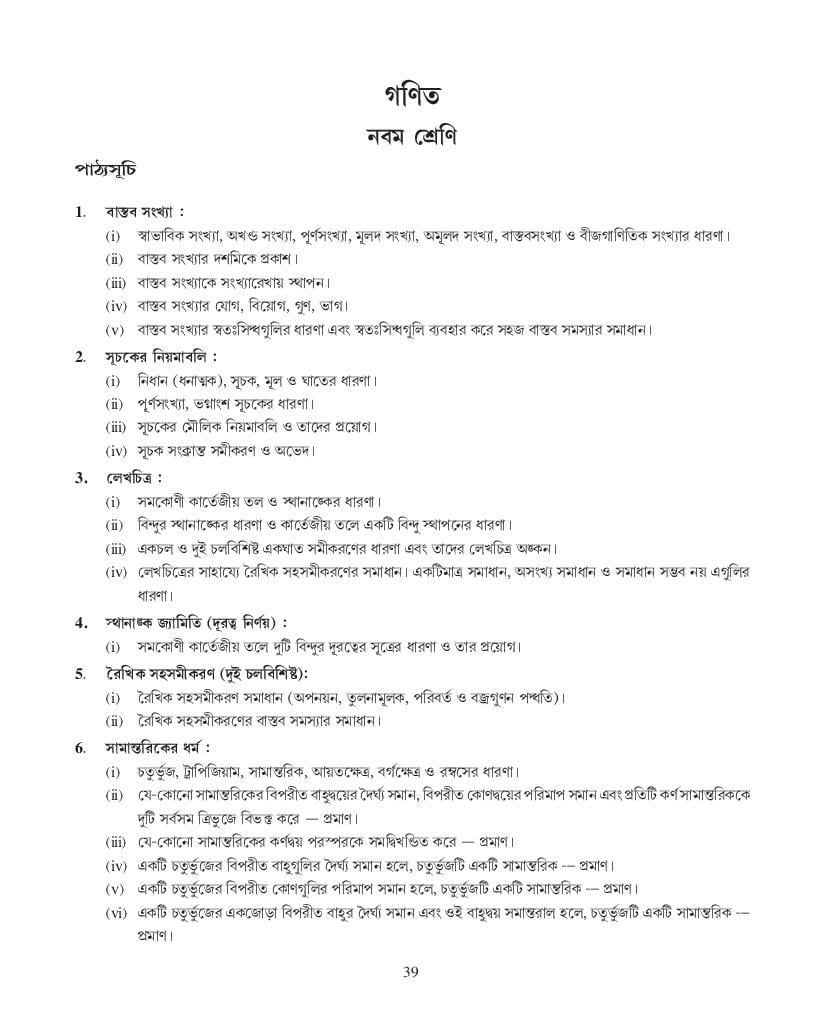
1. Óyhfl˛Ó ¢ÇÖƒy Èı
SiV fl˛∫y¶˛y!ÓÑ˛ ¢ÇÖƒyñ xÖ[˛ ¢ÇÖƒyñ ˛ô)í≈¢ÇÖƒyñ õ)úî ¢ÇÖƒyñ xõ)úî ¢ÇÖƒyñ Óyhfl˛Ó¢ÇÖƒy Á Ó#ãÜy!í!ì˛Ñ˛ ¢ÇÖƒyÓ˚ ïyÓ˚íy–
SiiV Óyhfl˛Ó ¢ÇÖƒyÓ˚ îü!õˆÏÑ˛ ≤ÃÑ˛yü–
SiiiV Óyhfl˛Ó ¢ÇÖƒyˆÏÑ˛ ¢ÇÖƒyˆÏÓ˚ÖyÎ˚ fiÌy˛ôò–
SivV Óyhfl˛Ó ¢ÇÖƒyÓ˚ ˆÎyÜñ !ÓˆÏÎ˚yÜñ Ü%íñ ¶˛yÜ–
SvV Óyhfl˛Ó ¢ÇÖƒyÓ˚ fl˛∫ì˛É!¢ÂïÜ%!úÓ˚ ïyÓ˚íy ~ÓÇ fl˛∫ì˛É!¢ÂïÜ%!ú ÓƒÓ£yÓ˚ Ñ˛ˆÏÓ˚ ¢£ã Óyhfl˛Ó ¢õ¢ƒyÓ˚ ¢õyïyò–
2. ¢)â˛ˆÏÑ˛Ó˚ !òÎ˚õyÓ!ú ı
SiV !òïyò SïòydÑ˛Vñ ¢)â˛Ñ˛ñ õ)ú Á áyˆÏì˛Ó˚ ïyÓ˚íy–
SiiV ˛ô)í≈¢ÇÖƒyñ ¶˛@¿yÇü ¢)â˛ˆÏÑ˛Ó˚ ïyÓ˚íy–
SiiiV ¢)â˛ˆÏÑ˛Ó˚ ˆõÔ!úÑ˛ !òÎ˚õyÓ!ú Á ì˛yˆÏîÓ˚ ≤ÈÏÎ˚yÜ–
SivV ¢)â˛Ñ˛ ¢ÇÑ˛yhs˛ ¢õ#Ñ˛Ó˚í Á xˆÏ¶˛î–
3. ˆúÖ!â˛e ı
SiV ¢õˆÏÑ˛yí# Ñ˛yˆÏì≈˛ã#Î˚ ì˛ú Á fiÌyòyˆÏAÑ˛Ó˚ ïyÓ˚íy–
SiiV !Ó®%Ó˚ fiÌyòyˆÏAÑ˛Ó˚ ïyÓ˚íy Á Ñ˛yˆÏì≈˛ã#Î˚ ì˛ˆÏú ~Ñ˛!›˛ !Ó®% fiÌy˛ôˆÏòÓ˚ ïyÓ˚íy–
SiiiV ~Ñ˛â˛ú Á î%£z â˛ú!Ó!üT˛ ~Ñ˛áyì˛ ¢õ#Ñ˛Ó˚ˆÏíÓ˚ ïyÓ˚íy ~ÓÇ ì˛yˆÏîÓ˚ ˆúÖ!â˛e xAÑ˛ò–
SivV ˆúÖ!â˛ˆÏeÓ˚ ¢y£yˆÏ΃ ˜Ó˚!ÖÑ˛ ¢£¢õ#Ñ˛Ó˚ˆÏíÓ˚ ¢õyïyò– ~Ñ˛!›˛õye ¢õyïyòñ x¢ÇÖƒ ¢õyïyò Á ¢õyïyò ¢Ω˛Ó òÎ˚ ~Ü%!úÓ˚
ïyÓ˚íy–
4. fiÌyòyAÑ˛ ãƒy!õ!ì˛ Sî)Ó˚c !òí≈Î˚V ı
SiV ¢õˆÏÑ˛yí# Ñ˛yˆÏì≈˛ã#Î˚ ì˛ˆÏú î%!›˛ !Ó®%Ó˚ î)Ó˚ˆÏcÓ˚ ¢)ˆÏeÓ˚ ïyÓ˚íy Á ì˛yÓ˚ ≤ÈÏÎ˚yÜ–
5. ˜Ó˚!ÖÑ˛ ¢£¢õ#Ñ˛Ó˚í Sî%£z â˛ú!Ó!üT˛Vı
SiV ˜Ó˚!ÖÑ˛ ¢£¢õ#Ñ˛Ó˚í ¢õyïyò Sx˛ôòÎ˚òñ ì%˛úòyõ)úÑ˛ñ ˛ô!Ó˚Óì≈˛ Á ÓLÜ%íò ˛ôÂï!ì˛V–
SiiV ˜Ó˚!ÖÑ˛ ¢£¢õ#Ñ˛Ó˚ˆÏíÓ˚ Óyhfl˛Ó ¢õ¢ƒyÓ˚ ¢õyïyò–
6. ¢yõyhs˛!Ó˚ˆÏÑ˛Ó˚ ïõ≈ ı
SiV â˛ì%˛¶%≈˛ãñ ›˛Δy!˛ô!ãÎ˚yõñ ¢yõyhs˛!Ó˚Ñ˛ñ xyÎ˚ì˛ˆÏ«˛eñ ÓÜ≈ˆÏ«˛e Á Ó˚¡∫ˆÏ¢Ó˚ ïyÓ˚íy–
SiiV ˆÎÈÙÈˆÑ˛yˆÏòy ¢yõyhs˛!Ó˚ˆÏÑ˛Ó˚ !Ó˛ôÓ˚#ì˛ Óy£%mˆÏÎ˚Ó˚ ˜îá≈ƒ ¢õyòñ !Ó˛ôÓ˚#ì˛ ˆÑ˛yímˆÏÎ˚Ó˚ ˛ô!Ó˚õy˛ô ¢õyò ~ÓÇ ≤Ã!ì˛!›˛ Ñ˛í≈ ¢yõyhs˛!Ó˚Ñ˛ˆÏÑ˛
î%!›˛ ¢Ó≈¢õ !e¶%˛ˆÏã !Ó¶˛=˛ Ñ˛ˆÏÓ˚ ÈÙÙÙÈ ≤Ãõyí–
SiiiV ˆÎÈÙÈˆÑ˛yˆÏòy ¢yõyhs˛!Ó˚ˆÏÑ˛Ó˚ Ñ˛í≈mÎ˚ ˛ôÓ˚fl˛ôÓ˚ˆÏÑ˛ ¢õ!mÖ![˛ì˛ Ñ˛ˆÏÓ˚ ÈÙÙÙÈ ≤Ãõyí–
SivV ~Ñ˛!›˛ â˛ì%˛¶≈%˛ˆÏãÓ˚ !Ó˛ôÓ˚#ì˛ Óy£%Ü%!úÓ˚ ˜îá≈ƒ ¢õyò £ˆÏúñ â˛ì%˛¶%≈˛ã!›˛ ~Ñ˛!›˛ ¢yõyhs˛!Ó˚Ñ˛ ÈÙÙÙÈ ≤Ãõyí–
SvV ~Ñ˛!›˛ â˛ì%˛¶≈%˛ˆÏãÓ˚ !Ó˛ôÓ˚#ì˛ ˆÑ˛yíÜ%!úÓ˚ ˛ô!Ó˚õy˛ô ¢õyò £ˆÏúñ â˛ì%˛¶%≈˛ã!›˛ ~Ñ˛!›˛ ¢yõyhs˛!Ó˚Ñ˛ ÈÙÙÙÈ ≤Ãõyí–
SviV ~Ñ˛!›˛ â˛ì%˛¶%≈˛ˆÏãÓ˚ ~Ñ˛ˆÏãyv˛¸y !Ó˛ôÓ˚#ì˛ Óy£%Ó˚ ˜îá≈ƒ ¢õyò ~ÓÇ Á£z Óy£%mÎ˚ ¢õyhs˛Ó˚yú £ˆÏúñ â˛ì%˛¶%≈˛ã!›˛ ~Ñ˛!›˛ ¢yõyhs˛!Ó˚Ñ˛ ÈÙÙÙÈ
≤Ãõyí–
39
Page 2
SviiiV v˛z˛ôˆÏÓ˚Ó˚ !ÓÓ,!ì˛Ü%!úÓ˚ ≤ÈÏÎ˚yÜ–
7. Ó£%˛ôî# ¢ÇÖƒyõyúy ı
SiV ~Ñ˛ Óy ~ˆÏÑ˛Ó˚ ˆÓ!ü â˛ú!Ó!üT˛ Ó£%˛ôî# ¢ÇÖƒyõyúyÓ˚ ïyÓ˚íy–
SiiV Ó£%˛ôî# ¢ÇÖƒyõyúyÓ˚ ˆÎyÜñ !ÓˆÏÎ˚yÜñ Ü%í Á ¶˛yˆÏÜÓ˚ ïyÓ˚íy–
SiiiV Ó£%˛ôî# ¢ÇÖƒyõyúy ˆÌˆÏÑ˛ xˆÏ˛ô«˛ˆÏÑ˛Ó˚ ïyÓ˚íy–
SivV Ó£%˛ôî# ¢ÇÖƒyõyúyÓ˚ ü)ˆÏòƒÓ˚ ïyÓ˚íy–
SvV ¶˛y܈Ïü°Ï v˛z˛ô˛ôy
SviV Ü%íò#Î˚Ñ˛ v˛z˛ô˛ôy
SviiV ü)òƒ Ó£%˛ôî#Ó˚˚ ïyÓ˚íy–
SviiiV v˛z˛ôˆÏÓ˚Ó˚ ≤ÈÏì˛ƒÑ˛!›˛Ó˚ ≤ÈÏÎ˚yÜ–
8. v˛zͲôyîˆÏÑ˛ !ӈϟ’°Ïí ı a2 – b2, a3 + b3, a3 – b3, a3+b3+c3–3abc, õïƒ˛ôî !ӈϟ’°Ïíñ ü)òƒ ˛ôÂï!ì˛–
9. ˆ¶˛îÑ˛ Á õïƒ!Ó®% ¢ÇÑ˛yhs˛ v˛z˛ô˛ôyîƒ ı
SiV ~Ñ˛!›˛ !e¶%˛ˆÏãÓ˚ ˆÎÈÙÈˆÑ˛yˆÏòy î%!›˛ Óy£%Ó˚ õïƒ!Ó®%Ó˚ ¢ÇˆÏÎyÜÑ˛yÓ˚# ¢Ó˚úˆÏÓ˚ÖyÇü ì,˛ì˛#Î˚ Óy£%Ó˚ ¢õyhs˛Ó˚yú Á xˆÏï≈Ñ˛ ÈÙÙÙÈ ≤Ãõyí–
SiiV ~Ñ˛!›˛ !e¶%˛ˆÏãÓ˚ ˆÎÈÙÈˆÑ˛yˆÏòy ~Ñ˛!›˛ Óy£%Ó˚ õïƒ!Ó®% !îˆÏÎ˚ x˛ôÓ˚ ~Ñ˛!›˛ Óy£%Ó˚ ¢õyhs˛Ó˚yú ¢Ó˚úˆÏÓ˚Öyñ ì,˛ì˛#Î˚ Óy£%!›˛ˆÏÑ˛ ¢õ!mÖ![˛ì˛
Ñ˛ˆÏÓ˚ ~ÓÇ î%!›˛ Óy£%mˆÏÎ˚Ó˚ !äÈߨ ¢Ó˚úˆÏÓ˚ÖyÇü !mì˛#Î˚ Óy£%Ó˚ xˆÏï≈Ñ˛ÈÈÙÙÙÈÈ≤Ãõyí–
SiiiV !ì˛ò Óy !ì˛ˆÏòÓ˚ ˆÓ!ü ¢õyhs˛Ó˚yú ¢Ó˚úˆÏÓÖ ˚ y Î!î ˆÑ˛yˆÏòy ˆ¶˛îÑ˛ ˆÌˆÏÑ˛ ¢õyò ¢õyò xÇü !äÈߨ Ñ˛ˆÏÓ˚ ì˛y£ˆÏú x˛ôÓ˚ ˆÎÈÙÈˆÑ˛yˆÏòy ˆ¶˛îÑ˛
ˆÌˆÏÑ˛Á ¢õyò ¢õyò xÇü !äÈߨ Ñ˛Ó˚ˆÓÏ – ≤ÃõyˆÏíÓ˚ ≤ÈÎÏ y˚ ãò ˆò£z– ˆÑ˛Óúõye Îyâ˛y£z–
SivV v˛z˛ôˆÏÓ˚Ó˚ !ÓÓ,!ì˛Ü%!úÓ˚ ≤ÈÏÎ˚yÜ–
10. úy¶˛ Á «˛!ì˛ ı Ñ˛Î˚õ)úƒñ !ÓÑ˛Î˚õ)úƒñ úy¶˛ñ «˛!ì˛ñ ïyÎ≈õ)úƒñ Ñ˛Î˚õ)ˆÏúƒÓ˚ v˛z˛ôÓ˚ üì˛Ñ˛Ó˚y úy¶˛ Óy «˛!ì˛ñ !ÓÑ˛Î˚õ)ˆÏúƒÓ˚ v˛z˛ôÓ˚ üì˛Ñ˛Ó˚y
úy¶˛ Óy «˛!ì˛ñ äÈyv˛¸ñ ¢õì%˛úƒ äÈyv˛¸ £zì˛ƒy!îÓ˚ ïyÓ˚íy ~ÓÇ ≤ÈÏÎ˚yÜ–
11. Ó˚y!ü!ÓK˛yò ı
SiV ì˛ˆÏ̃Ó˚ ì˛y!úÑ˛y !òí≈ˆÏÎ˚Ó˚ ïyÓ˚íy–
SiiV ˛ô!Ó˚¢ÇÖƒy !Ó¶˛yãò äÈÑ˛ ˜ì˛!Ó˚Ó˚ ïyÓ˚íy–
SiiiV Ñ˛õˆÏÎÔ!ÜÑ˛ ˛ô!Ó˚¢ÇÖƒyÓ˚ ïyÓ˚íy–
SivV xyÎ˚ì˛ˆÏúÖ xAÑ˛ò–
SvV ˛ô!Ó˚¢ÇÖƒy Ó£¶%˛ã xAÑ˛ò–
12. ˆ«˛eö˛ú ¢ÇÑ˛yhs˛ v˛z˛ô˛ôyîƒ ı
fl˛∫ì˛É!¢Âï ı xyÎ˚ì˛ˆÏ«˛ˆÏeÓ˚ ˆ«˛eö˛ú = ˜îá≈ƒ × ≤ÃfiÌ ÈÙÈ~Ó˚ ïyÓ˚íy–
SiV ˆÎ ¢Ñ˛ú ¢yõyhs˛!Ó˚Ñ˛ ~Ñ˛£z ¶)˛!õ Á ~Ñ˛£z ¢õyhs˛Ó˚yú ¢Ó˚úˆÏÓ˚Öy Î%܈ÏúÓ˚ õˆÏïƒ xÓ!fiÌì˛ ì˛yˆÏîÓ˚ ˆ«˛eö˛ú ¢õyò ÈÙÙÙÈ ≤Ãõyí–
SiiV ˆÎ ¢Ñ˛ú ¢yõyhs˛!Ó˚Ñ˛ ¢õyò ¢õyò ¶)˛!õ Á ~Ñ˛£z ¢õyhs˛Ó˚yú ¢Ó˚úˆÏÓ˚Öy Î%܈ÏúÓ˚ õˆÏïƒ xÓ!fiÌì˛ ì˛yˆÏîÓ˚ ˆ«˛eö˛ú ¢õyò
Sxò%!¢Âïyhs˛V–
SiiiV ¢yõyhs˛!Ó˚ˆÏÑ˛Ó˚ ˆ«˛eö˛ú " ¢yõyhs˛!Ó˚Ñ˛!›˛Ó˚ ¶)˛!õ ' v˛zFâ˛ì˛y Sxò%!¢Âïyhs˛V–
SivV ~Ñ˛!›˛ !e¶%˛ã Á ~Ñ˛!›˛ ¢yõyhs˛!Ó˚Ñ˛ ~Ñ˛£z ¶)˛!õÓ˚ v˛z˛ôÓ˚ ~ÓÇ ~Ñ˛£z ¢õyhs˛Ó˚yú ¢Ó˚úˆÏÓ˚Öy Î%܈ÏúÓ˚ õˆÏïƒ xÓ!fiÌì˛ £ˆÏúñ
!e¶%˛ã!›˛Ó˚ ˆ«˛eö˛ú ¢yõyhs˛!Ó˚Ñ˛!›˛Ó˚ ˆ«˛eö˛ˆÏúÓ˚ xˆÏï≈Ñ˛ ÈÙÙÙÈ ≤Ãõyí–
SvV !e¶%˛ˆÏãÓ˚ ˆ«˛eö˛ú " ' ¶)˛!õ ' v˛zFâ˛ì˛y Sxò%!¢Âïyhs˛V–
SviV ˆÎ ¢Ñ˛ú !e¶%˛ã ~Ñ˛£z ¶)˛!õÓ˚ v˛z˛ôÓ˚ ~ÓÇ ~Ñ˛£z ¢õyhs˛Ó˚yú ¢Ó˚úˆÏÓ˚Öy Î%܈ÏúÓ˚ õˆÏïƒ xÓ!fiÌì˛ ì˛yˆÏîÓ˚ ˆ«˛eö˛ú ¢õyò ÈÙÙÙÈ
≤Ãõyí–
SviiV ˆÎ ¢Ñ˛ú !e¶%˛ã ¢õyò ¢õyò ¶)˛!õÓ˚ v˛z˛ôÓ˚ ~ÓÇ ~Ñ˛£z ¢õyhs˛Ó˚yú ¢Ó˚úˆÏÓ˚Öy Î%܈ÏúÓ˚ õˆÏïƒ xÓ!fiÌì˛ ì˛yˆÏîÓ˚ ˆ«˛eö˛ú
¢õyò Sxò%!¢Âïyhs˛V–
40
Page 3
¢Ó˚úˆÏÓ˚Öy Î%܈ÏúÓ˚ õˆÏïƒ xÓ!fiÌì˛ ÈÙÙÙÈ ≤Ãõyí–
SixV v˛z˛ôˆÏÓ˚Ó˚ !ÓÓ,!ì˛Ü%!úÓ˚ ≤ÈÏÎ˚yÜ–
13. ¢¡ôyîƒ ı ~Ñ˛!›˛ !e¶%˛ãyÑ˛yÓ˚ ˆ«˛ˆÏeÓ˚ ¢õyò ˆ«˛eö˛ú!Ó!üT˛ ~Ñ˛!›˛ ¢yõyhs˛!Ó˚Ñ˛ xyÑ˛yˆÏÓ˚Ó˚ ˆ«˛e xAÑ˛ò ÎyÓ˚ ~Ñ˛!›˛ ˆÑ˛yˆÏíÓ˚ ˛ô!Ó˚õy˛ô
!ò!î≈T˛ ~ÓÇ ≤ÈÎÏ y˚ Ü–
14. ¢¡ôyîƒ ı ~Ñ˛!›˛ â˛ì%˛¶≈%˛ãyÑ˛yÓ˚ ˆ«˛ˆÏeÓ˚ ¢õyò ˆ«˛eö˛ú!Ó!üT˛ ~Ñ˛!›˛ !e¶%˛ãyÑ˛yÓ˚ ˆ«˛e xAÑ˛ò ~ÓÇ ≤ÈÏÎ˚yÜ–
15. !e¶%˛ã ~ÓÇ â˛ì%˛¶%≈˛ˆÏãÓ˚ ˛ô!Ó˚¢#õy Á ˆ«˛eö˛ú !òí≈Î˚ ı
SiV !e¶%˛ˆÏãÓ˚ ˛ô!Ó˚¢#õy Á ˆ«˛eö˛ú !òí≈Î˚– ˆ£Ó˚ˆÏòÓ˚ ¢)ˆÏeÓ˚ ïyÓ˚íy– Óyhfl˛Ó ¢õ¢ƒyÎ˚ ≤ÈÏÎ˚yÜ–
SiiV xyÎ˚ì˛ˆÏ«˛eñ ÓÜ≈ˆ« Ï ˛eñ ¢yõyhs˛!Ó˚Ñ˛ñ Ó˚¡¢∫ ñ ›˛Δy!˛ô!ãÎ˚yˆÏõÓ˚ ˛ô!Ó˚¢#õy Á ˆ«˛eö˛ú !òí≈Î˚ ~ÓÇ Óyhfl˛Ó ¢õ¢ƒyÎ˚˚ ˛≤ÈÎÏ y˚ Ü–
16. Ó,ˆ_ Ï Ó˚ ˛ô!Ó˚!ï !òí≈Ζ˚ ÈÙÈ~Ó˚ ïyÓ˚íy ~ÓÇ Ó,ˆ_
Ï Ó˚ ˛ô!Ó˚!ï ı Ó,ˆ_ Ï Ó˚ ˛ô!Ó˚!ïÓ˚ ¢)ˆeÏ Ó˚ ¢y£yˆÏ΃ Óyhfl˛Ó ¢õ¢ƒyÓ˚ ¢õyïyò–
17. ¢õ!Ó®% ı ¢õ!Ó®% ¢ÇÑ˛yhs˛ v˛z˛ô˛ôyîƒ ı
SiV ˆÎÈÙÈˆÑ˛yˆÏòy !e¶%˛ˆÏãÓ˚ Óy£%Ü%!úÓ˚ ú¡∫ ¢õ!mÖ[˛Ñ˛Ü%!ú ¢õ!Ó®%È ÙÙÙÈ ≤Ãõyí– ˛ô!Ó˚ˆÏÑ˛wñ ˛ô!Ó˚Óƒy¢yï≈ñ ˛ô!Ó˚Ó,ˆÏ_Ó˚ ïyÓ˚íy–
SiiV ˆÎÈÙÈˆÑ˛yˆÏòy !e¶%˛ˆÏãÓ˚ ü#°Ï≈!Ó®%Ü%!ú ˆÌˆÏÑ˛ !Ó˛ôÓ˚#ì˛ Óy£%Ü%!úÓ˚ v˛z˛ôÓ˚ ú¡∫Ü%!ú ¢õ!Ó®% ÈÙÙÙÈ ≤Ãõyí– ú¡∫!Ó®%ñ ˛ôyîÈÙÈ!e¶%˛ãÈÙ~Ó˚
ïyÓ˚íy–
SiiiV ˆÎÈÙÈˆÑ˛yˆÏòy !e¶%˛ˆÏãÓ˚ xhs˛ÉˆÏÑ˛yíÜ%!úÓ˚ ¢õ!mÖ[˛Ñ˛Ü%!ú ¢õ!Ó®% ÈÙÙÙÈ ≤Ãõyí– xhs˛ÉˆÏÑ˛wñ xhs˛Ó≈ƒy¢ƒyï≈ñ xhs˛Ó,≈ˆÏ_Ó˚ ïyÓ˚íy–
SivV ˆÎÈ Ù È ˆ Ñ˛yˆÏ ò y !e¶% ˛ ˆÏ ã Ó˚ õïƒõyÜ% ! ú ¢õ!Ó®% È Ù ÙÙÈ ≤Ãõyí– ¶˛Ó˚ ˆ Ï Ñ ˛ˆÏ w Ó˚ ïyÓ˚ í y ~ÓÇ ¶˛Ó˚ ˆ Ï Ñ ˛w ≤Ã!ì˛!›˛ õïƒõyˆÏ Ñ ˛
2:1 xò%˛ôyˆÏì˛ !Ó¶˛=˛ Ñ˛ˆÏÓ˚ ì˛yÓ˚ ïyÓ˚íy–
SvV v˛z˛ôˆÏÓ˚Ó˚ !ÓÓ,!ì˛Ü%!úÓ˚ ≤ÈÏÎ˚yÜ–
18. Ó,ˆÏ_Ó˚ ˆ«˛eö˛ú ı Ó,_yÑ˛yÓ˚ ˆ«˛ˆÏeÓ˚ ˆ«˛eö˛ˆÏúÓ˚ ¢)ˆÏeÓ˚ ïyÓ˚íyñ Ó,_Ñ˛úyÓ˚ ˆ«˛eö˛ˆÏúÓ˚ ¢)ˆÏeÓ˚ ïyÓ˚íy ~ÓÇ Óyhfl˛Ó ¢õ¢ƒyÓ˚
¢õyïyò–
19. fiÌyòyAÑ˛ ãƒy!õ!ì˛ ı ~Ñ˛!›˛ !ò!î≈T˛ ¢Ó˚úˆÏÓ˚ÖyÇüˆÏÑ˛ ≤Ãî_ xò%˛ôyˆÏì˛ xhs˛!Ó≈¶˛=˛ Á Ó!£!Ó≈¶˛=˛Ñ˛yÓ˚# !Ó®%Ó˚ fiÌyòyAÑ˛ !òí≈ˆÏÎ˚Ó˚ ¢)ˆÏeÓ˚
ïyÓ˚íy Á ì˛yÓ˚ ≤ÈÏÎ˚yÜ–
20. fiÌyòyAÑ˛ ãƒy!õ!ì˛ ı
SiV !ì˛ò!›˛ ≤Ãî_ !Ó®%Ó˚ ¢ÇˆÏÎyˆÏÜ v˛zͲôߨ !e¶%˛ãyÑ˛yÓ˚ˆÏ«˛ˆÏeÓ˚ ˆ«˛eö˛ú–
SiiV â˛yÓ˚!›˛ ≤Ãî_ !Ó®%Ó˚ ¢ÇˆÏÎyˆÏÜ v˛zͲôߨ â˛ì%˛¶≈%˛ãyÑ˛yÓ˚ˆÏ«˛ˆÏeÓ˚ ˆ«˛eö˛ú–
SiiiV !ì˛ò!›˛ ≤Ãî_ !Ó®%Ó˚ ¢õˆÏÓ˚Ö £ÓyÓ˚ üì≈˛–
SivV !e¶%˛ˆÏãÓ˚ ¶˛Ó˚ˆÏÑ˛w !òí≈Î˚–
21. úÜy!Ó˚î‰õ ı
SiV ≤ÈÏÎ˚yãò#Î˚ì˛y–
SiiV ¢ÇK˛y–
SiiiV ¢yïyÓ˚í úÜy!Ó˚î‰õ Á fl˛∫y¶˛y!ÓÑ˛ úÜy!Ó˚ÏõÓ˚ ïyÓ˚íy–
SivV úÜy!Ó˚ÏõÓ˚ ïõ≈yÓ!ú–
SvV ¢yïyÓ˚í úÜy!Ó˚ÏõÓ˚ ≤ÈÏÎ˚yÜ–
¢ÇˆÏÎyãò ı Sõ)úƒyÎ˚ˆÏòÓ˚ xhs˛¶%≈˛=˛ òÎ˚V
22. ˆ¢›˛ ì˛ˆÏ_¥Ó˚ ïyÓ˚íy–
23. ¢Ω˛yÓòy ì˛ˆÏ_¥Ó˚ ïyÓ˚íy–
41
Page 4
1 Óyhfl˛Ó ¢ÇÖƒy (Real Numbers)
2 ¢)â˛ˆÏÑ˛Ó˚ !òÎ˚õyÓ!ú (Laws of Indices)
3 ˆúÖ!â˛e (Graph)
4 fiÌyòyAÑ˛ ãƒy!õ!ì˛ ı î)Ó˚c !òí≈Î˚ (Co-ordinate Geometry : Distance Formula)
5 ˜Ó˚!ÖÑ˛ ¢£ ¢õ#Ñ˛Ó˚í Sî%£z â˛ú !Ó!üT˛V (Linear Simultaneous Equations)
6 ¢yõyhs˛!Ó˚ˆÏÑ˛Ó˚ ïõ≈ (Properties of Parallelogram)
7 Ó£%˛ôî# ¢ÇÖƒyõyúy (Polynomial)
8 v˛zͲôyîˆÏÑ˛ !ӈϟ’°Ïí (Factorisation)
!mì˛#Î˚ ˛ôÎy≈ÎÑ˚ ˛!õÑ˛ õ)úƒyÎ˚ò S40 ò¡∫ÓV˚ S¢õÎ˚ ı xyÜfi›˛ õy¢Vñ xhs˛Ó≈ì˛#≈ ≤Ãhfl˛$ !ì˛Ñ˛yú#ò õ)úƒyÎ˚ò S10 ò¡∫ÓV˚
4 fiÌyòyAÑ˛ ãƒy!õ!ì˛ ı î)Ó˚c !òí≈Î˚ (Co-ordinate Geometry : Distance Formula)
5 ˜Ó˚!ÖÑ˛ ¢£ ¢õ#Ñ˛Ó˚í Sî%£z â˛ú !Ó!üT˛V (Linear Simultaneous Equations)
6 ¢yõyhs˛!Ó˚ˆÏÑ˛Ó˚ ïõ≈ (Properties of Parallelogram)
9 ˆ¶˛îÑ˛ Á õïƒ!Ó®% ¢ÇÑ˛yhs˛ v˛z˛ô˛ôyîƒ (Transversal & Mid-Point Theorems)
10 úy¶˛ Á «˛!ì˛ (Profit and Loss)
11 Ó˚y!ü!ÓK˛yò (Statistics)
12 ˆ«˛eö˛ú ¢ÇÑ˛yhs˛ v˛z˛ô˛ôyîƒ (Theorems on Area)
13 ¢¡ôyîƒ ı !e¶%˛ˆÏãÓ˚ ¢õyò ˆ«˛eö˛ú !Ó!üT˛ ¢yõyhs˛!Ó˚Ñ˛ xAÑ˛ò ÎyÓ˚ ~Ñ˛!›˛ ˆÑ˛yˆÏíÓ˚ ˛ô!Ó˚õy˛ô !ò!î≈T˛
(Construction of a Parallelogram whose measurement of one angle is given
and equal in area of a Triangle)
14 ¢¡ôyîƒ ı â˛ì%˛¶%˛≈ ˆÏãÓ˚ ¢õyò ˆ«˛eö˛ú !Ó!üT˛ !e¶%˛ã xAÑ˛ò
(Construction of a Triangle equal in area of a Quadrilateral)
15 !e¶%˛ã Á â˛ì˛% ¶˛≈% ˆã
Ï Ó˚ ˛ô!Ó˚¢#õy Á ˆ«˛eö˛ú(Area & Perimeter of Triangle & Quadrilateral)
16 Ó,ˆÏ_Ó˚ ˛ô!Ó˚!ï (Circumference of Circle)
ì,˛ì˛#Î˚ ˛ôÎy≈ÎÑ˚ ˛!õÑ˛ õ)úƒyÎ˚ò S90 ò¡∫ÓV˚ S¢õÎ˚ ı !v˛ˆ¢Ï ¡∫Ó˛˚ õy¢Vñ xhs˛Óì≈ ˛#≈ ≤Ãhfl˛$ !ì˛Ñ˛yú#ò õ)úƒyÎ˚ò S10 ò¡∫ÓV˚
17 ¢õ!Ó®% ¢ÇÑ˛yhs˛ v˛z˛ô˛ôyîƒ (Theorems on concurrence)
18 Ó,ˆÏ_Ó˚ ˆ«˛eö˛ú (Area of Circle)
19 fiÌyòyAÑ˛ ãƒy!õ!ì˛ı ¢Ó˚úˆÏÓÖ˚ yLjÏüÓ˚ xhs˛!Ó≈¶˛=˛ Á Ó!£É!Ó≈¶˛=˛ (Co-ordinate Geometry:
Internal and External Division of Straight Line Segment)
20 fiÌyòyAÑ˛ ãƒy!õ!ì˛ı !e¶%˛ãyÑ,˛!ì˛ ˆ«˛ˆÏeÓ˚ ˆ«˛eö˛ú (Co-ordinate Geometry: Area of
Triangular Region)
21 úÜy!Ó˚îõ‰ (Logarithm)
!Ó. o. ı ì,˛ì˛#Î˚ ˛ôÎy≈Î˚Ñ˛!õÑ˛ õ)úƒyÎ˚ˆÏòÓ˚ ˆ«˛ˆÏe ≤ÃÌõ Á !mì˛#Î˚ ˛ôÎ≈yÎ˚Ñ˛!õÑ˛ õ)úƒyÎ˚ˆÏòÓ˚ ˛ôy‡˛ƒ¢)!â˛Á xhs˛¶≈˛%=˛ £ˆÏÓ–
42
Page 5
[Summative-I (Chapters 1 to 8)]
!Ó°ÏÎ˚ x!ì˛ ¢Ç!«˛Æ ¢Ç!«˛Æ î#á≈ ˆõy›˛ ò¡∫Ó˚ xïƒyÎ˚
v˛z_Ó˚!¶˛!_Ñ˛ ≤ß¿ v˛z_Ó˚!¶˛!_Ñ˛ ≤ß¿ v˛z_Ó˚!¶˛!_Ñ˛ ≤ß¿
˛ôy!›˛Ü!íì˛ 1 (1×1) 2 (2×1) 3 (3×1) 6 1
Ó#ãÜ!íì˛ 3 (1×3) 8 (2×4) 9 (3×3) 20 2,3,5,7,8
ãƒy!õ!ì˛ 1 (1×1) 2 (2×1) 7 (4×1 + 3×1) 10 6
fl˛iyòyAÑ˛ ãƒy!õ!ì˛ 1 (1×1) - 3 (3×1) 4 4
6 12 22 40
ˆõy›˛ ò¡∫Ó˚ 6 + 12 = 18
xhs˛Ó≈ì≈˛# ≤Ãhfl$˛!ì˛Ñ˛yú#ò õ)úƒyÎ˚ò ÈÙÈ 10 ò¡∫Ó˚
x!ì˛ ¢Ç!«˛Æ v˛z_Ó˚!¶˛!_Ñ˛ ≤ß¿ÈÙÈ 1. Ó£%˛ôäÈ® !¶˛!_Ñ˛ ≤ß¿ñ 2. ¢ì˛ƒ/!õ̃yñ 3. ü)òƒfiÌyò ˛ô)Ó˚í
˛ôy!›˛Ü!íì˛ ı Óyhfl˛Ó ¢ÇÖƒy 1!›˛ ≤ß¿ = 1 ò¡∫Ó˚
Ó#ãÜ!íì˛ ı SiV ¢)â˛ˆÏÑ˛Ó˚ !òÎ˚õyÓ!ú È 1!›˛ ≤ß¿ = 1 ò¡∫Ó˚
SiiV Ó£%˛ôî# ¢ÇÖƒyõyúy 1!›˛ ≤ß¿ = 1 ò¡∫Ó˚
SiiiV ˆúÖ!â˛e È 1!›˛ ≤ß¿ = 1 ò¡∫Ó˚
ãƒy!õ!ì˛ ı ¢yõyhs˛!Ó˚ˆÑÏ ˛Ó˚ ïõ≈ 1!›˛ ≤ß¿ = 1 ò¡∫Ó˚
fiÌyòyAÑ˛ ãƒy!õ!ì˛ ı î)Óc˚ !òí≈ÎÈ˚ 1!›˛ ≤ß¿ = 1 ò¡∫Ó˚
¢Ç!«˛Æ v˛z_Ó˚!¶˛!_Ñ˛ ≤ß¿
˛ôy!›˛Ü!íì˛ ı Óyhfl˛Ó ¢ÇÖƒy 1!›˛ ≤ß¿ = 2 ò¡∫Ó˚
Ó#ãÜ!íì ˛ı SiV ¢)â˛ˆÏÑ˛Ó˚ !òÎ˚õyÓ!ú / Ó£%˛ôî# ¢ÇÖƒyõyúy È 1!›˛ ≤ÃÏŸ¿ = 2 ò¡∫Ó˚
SiiV ˆúÖ!â˛e 1!›˛ ≤ÃÏŸ¿ = 2 ò¡∫Ó˚
SiiiV ˜Ó˚!ÖÑ˛ ¢£ÈÙÈ¢õ#Ñ˛Ó˚í 1!›˛ ≤ÃÏŸ¿ = 2 ò¡∫Ó˚
SivV v˛zͲôyîˆÏÑ˛ !ӈϟ’°Ïí 1!›˛ ≤ÃÏŸ¿ = 2 ò¡∫Ó˚
ãƒy!õ!ì˛ ı ¢yõyhs˛!Ó˚ˆÑÏ ˛Ó˚ ïõ≈ 1!›˛ ≤ß¿ = 2 ò¡∫Ó˚
î#á≈ v˛z_Ó˚!¶˛!_Ñ˛ ≤ß¿
˛ôy!›˛Ü!íì˛ ı Óyhfl˛Ó ¢ÇÖƒy 1!›˛ ≤ß¿ = 3 ò¡∫Ó˚
Ó#ãÜ!íì˛ ı SiV ˆúÖ!â˛e 1!›˛ ≤ÃÏŸ¿ = 3 ò¡∫Ó˚
SiiV ˜Ó˚!ÖÑ˛ ¢£ÈÙÈ¢õ#Ñ˛Ó˚í 1!›˛ ≤ÃÏŸ¿ = 3 ò¡∫Ó˚
SiiiV v˛zͲôyîˆÏÑ˛ !ӈϟ’°íÏ 1!›˛ ≤ÃÏŸ¿ = 3 ò¡∫Ó˚
ãƒy!õ!ì˛ ı
¢yõyhs˛!Ó˚ˆÑÏ ˛Ó˚ ïõ≈ { v˛z˛ô˛ôyˆÏîƒÓ˚ ≤ÈÏÎ˚yˆÏÜ ãƒy!õ!ì˛Ó˚ ¢õ¢ƒy
2 1 =4
!›˛ v˛z˛ô˛ôyˆÏîƒÓ˚ õˆÏïƒ !›˛ ò¡∫Ó˚
1 =3
¢õyïyˆÏò !›˛ ≤ÃÏŸ¿ ò¡∫Ó˚
fiÌyòyAÑ˛ ãƒy!õ!ì˛ ı î)Óc˚ !òí≈Î˚ 1!›˛ ≤ÃÏŸ¿ = 3 ò¡∫Ó˚
43
Page 6
[Summative-II (Chapters 4, 5, 6, 9 to 16)]
!Ó°ÏÎ˚ x!ì˛ ¢Ç!«˛Æ ¢Ç!«˛Æ î#á≈ ˆõy›˛ ò¡∫Ó˚ xïƒyÎ˚
v˛z_Ó˚!¶˛!_Ñ˛ ≤ß¿ v˛z_Ó˚!¶˛!_Ñ˛ ≤ß¿ v˛z_Ó˚!¶˛!_Ñ˛ ≤ß¿
˛ôy!›˛Ü!íì˛ 1 (1×1) 2 (2×1) 3 (3×1) 6 10
Ó#ãÜ!íì˛ - - 3 (3×1) 3 5
ãƒy!õ!ì˛ 1 (1×1) 2 (2×1) 11 (4×1 + 3×1 + 4×1) 14 6,9,12,13,14
fiÌyòyAÑ˛ ãƒy!õ!ì˛ 1 (1×1) 2 (2×1) - 3 4
˛ô!Ó˚!õ!ì˛ 1 (1×1) 2 (2×1) 6 (3×2) 9 15, 16
Ó˚y!ü!ÓK˛yò - 2 (2×1) 3 (3×1) 5 11
4 10 26 40
ˆõy›˛ ò¡∫Ó˚ 4 + 10 = 14
xhs˛Ó≈ì≈˛# ≤Ãhfl$˛!ì˛Ñ˛yú#ò õ)úƒyÎ˚ò ÈÙÈ 10 ò¡∫Ó˚
x!ì˛ ¢Ç!«˛Æ v˛z_Ó˚!¶˛!_Ñ˛ ≤ß¿ÈÙÈ 1. Ó£%˛ôäÈ® !¶˛!_Ñ˛ ≤ß¿ñ 2. ¢ì˛ƒ/!õ̃yñ 3. ü)òƒfiÌyò ˛ô)Ó˚í
˛ôy!›˛Ü!íì˛ ı úy¶˛ Á «˛!ì˛ 1!›˛ ≤ß¿ = 1 ò¡∫Ó˚
ãƒy!õ!ì˛ ı ¢yõyhs˛!Ó˚ˆÑÏ ˛Ó˚ ïõ≈ 1!›˛ ≤ß¿ = 1 ò¡∫Ó˚
fiÌyòyAÑ˛ ãƒy!õ!ì˛ ı î)Óc˚ !òí≈ÎÈ˚ 1!›˛ ≤ß¿ = 1 ò¡∫Ó˚
˛ô!Ó˚!õ!ì˛ ı !e¶%˛ã Á â˛ì%˛¶%≈˛ˆÏãÓ˚ ˛ô!Ó˚¢#õy Á ˆ«˛eö˛ú 1!›˛ ≤ß¿ = 1 ò¡∫Ó˚
¢Ç!«˛Æ v˛z_Ó˚!¶˛!_Ñ˛ ≤ß¿
˛ôy!›˛Ü!íì˛ ı úy¶˛ Á «˛!ì˛ 1!›˛ ≤ß¿ = 2 ò¡∫Ó˚
ãƒy!õ!ì˛ ı ˆ¶˛îÑ˛ Á õïƒ!Ó®% ¢ÇÑ˛yhs˛ v˛z˛ô˛ôyîƒ/ˆ«˛eö˛ú ¢ÇÑ˛yhs˛ v˛z˛ô˛ôyîƒ 1!›˛ ≤ß¿ = 2 ò¡∫Ó˚
fiÌyòyAÑ˛ ãƒy!õ!ì˛ ı î)Óc˚ !òí≈Î˚ 1!›˛ ≤ß¿ = 2 ò¡∫Ó˚
˛ô!Ó˚!õ!ì˛ ı Ó,ˆÏ_Ó˚ ˛ô!Ó˚!ï 1!›˛ ≤ß¿ = 2 ò¡∫Ó˚
Ó˚y!ü!ÓK˛yò 1!›˛ ≤ß¿ = 2 ò¡∫Ó˚
î#á≈ v˛z_Ó˚!¶˛!_Ñ˛ ≤ß¿
˛ôy!›˛Ü!íì˛ ı úy¶˛ Á «˛!ì˛ 1!›˛ ≤ß¿ = 3 ò¡∫Ó˚
Ó#ãÜ!íì˛ ı ˜Ó˚!ÖÑ˛ ¢£ÈÙÈ¢õ#Ñ˛Ó˚í Sx˛ôòÎ˚ò/˛ô!Ó˚Óì≈˛ ˛ôÂï!ì˛ˆÏì˛ ¢õyïyòV 1!›˛ ≤ÃÏŸ¿ = 3 ò¡∫Ó˚
ãƒy!õ!ì˛ ı 2!›˛ v˛z˛ô˛ôyˆÏîƒÓ˚ õˆÏïƒ 1!›˛ = 4 ò¡∫Ó˚
v˛z˛ô˛ôyˆÏîƒÓ˚ ≤ÈÏÎ˚yˆÏÜ ãƒy!õ!ì˛Ó˚ ¢õ¢ƒy ¢õyïyò 1!›˛ ≤ÃÏŸ¿ = 3 ò¡∫Ó˚
¢¡ôyîƒ 1!›˛ ≤ÃÏŸ¿ = 4 ò¡∫Ó˚
˛ô!Ó˚!õ!ì˛ ı SiV !e¶%˛ã Á â˛ì%˛¶%˛≈ ˆÏãÓ˚ ˛ô!Ó˚¢#õy Á ˆ«˛eö˛ú 1!›˛ ≤ß¿ = 3 ò¡∫Ó˚
SiiV Ó,ˆ_
Ï Ó˚ ˛ô!Ó˚!ï 1!›˛ ≤ß¿ = 3 ò¡∫Ó˚
Ó˚y!ü!ÓK˛yò ı 1!›˛ ≤ß¿ = 3 ò¡∫Ó˚
44
Page 7
!Ó°ÏÎ˚ Ó£% ˛ôäÈ® !¶˛!_Ñ˛ ≤ß¿ ¢Ç!«˛Æ v˛z_Ó˚!¶˛!_Ñ˛ ≤ß¿ î#á≈ v˛z_Ó˚!¶˛!_Ñ˛ ≤ß¿ ** ˆõy›˛
˛ôy!›˛Ü!íì˛ 2 (1×2) 4 (2×2) 4 10
Ó#ãÜ!íì˛ 5 (1×5) 8 (2×4) 22 35
ãƒy!õ!ì˛ 2 (1×2) 4 (2×2) 11 17
fiÌyòyAÑ˛ ãƒy!õ!ì˛ 1 (1×1) 2 (2×1) 3 6
˛ô!Ó˚!õ!ì˛ 2 (1×2) 4 (2×2) 6 12
Ó˚y!ü!ÓK˛yò 2 (1×2) 4 (2×2) 4 10
14 26
ˆõy›˛ ò¡∫Ó˚ 14 + 26 = 40 50 90
xhs˛Ó≈ì≈˛# ≤Ãhfl$˛!ì˛Ñ˛yú#ò õ)úƒyÎ˚ò ÈÙÈ 10
** î#á≈ v˛z_Ó˚!¶˛!_Ñ˛ ≤ß¿
˛ôy!›˛Ü!íì˛
SiV Óyhfl˛Ó ¢ÇÖƒy
SiiV úy¶˛ Á «˛!ì˛ } 2!›˛ ≤Èϟ¿Ó˚ õˆÏïƒ 1!›˛ ≤Èϟ¿Ó˚ v˛z_Ó˚ = 4 ò¡∫Ó˚
Ó#ãÜ!íì˛
SiV Ó£%˛ôî# ¢ÇÖƒyõyúy 2!›˛ ≤Èϟ¿Ó˚ õˆÏïƒ 1!›˛ ≤Èϟ¿Ó˚ v˛z_Ó˚ = 3 ò¡∫Ó˚
SiiV v˛zͲôyîˆÏÑ˛ !ӈϟ’°Ïí 2!›˛ ≤Èϟ¿Ó˚ õˆÏïƒ 1!›˛ ≤Èϟ¿Ó˚ v˛z_Ó˚ = 3 ò¡∫Ó˚
SiiiV ˆúÖ!â˛e 2!›˛ ≤Èϟ¿Ó˚ õˆÏïƒ 1!›˛ ≤Èϟ¿Ó˚ v˛z_Ó˚ = 4 ò¡∫Ó˚
SivV ˜Ó˚!ÖÑ˛ ¢£ÈÙÈ¢õ#Ñ˛Ó˚í (¢õyïyò ) 2!›˛ ≤Èϟ¿Ó˚ õˆÏïƒ 1!›˛ ≤Èϟ¿Ó˚ v˛z_Ó˚ = 3 ò¡∫Ó˚
SvV ˜Ó˚!ÖÑ˛ ¢£ÈÙÈ¢õ#Ñ˛Ó˚í (Óyhfl˛Ó ¢õ¢ƒyÎ˚ ≤ÈÏÎ˚yÜ ) 2!›˛ ≤Èϟ¿Ó˚ õˆÏïƒ 1!›˛ ≤Èϟ¿Ó˚ v˛z_Ó˚ = 3 ò¡∫Ó˚
SviV ¢)â˛ˆÏÑ˛Ó˚ !òÎ˚õyÓ!ú 2!›˛ ≤Èϟ¿Ó˚ õˆÏïƒ 1!›˛ ≤Èϟ¿Ó˚ v˛z_Ó˚ = 3 ò¡∫Ó˚
SviiV úÜy!Ó˚îõ‰ 2!›˛ ≤Èϟ¿Ó˚ õˆÏïƒ 1!›˛ ≤Èϟ¿Ó˚ v˛z_Ó˚ = 3 ò¡∫Ó˚
ãƒy!õ!ì˛
2!›˛ v˛z˛ô˛ôyˆÏîƒÓ˚ õˆÏïƒ 1!›˛ = 4 ò¡∫Ó˚
v˛z˛ô˛ôyˆÏîƒÓ˚ ≤ÈÏÎ˚yˆÏÜ ãƒy!õ!ì˛Ó˚ ¢õ¢ƒy ¢õyïyˆÏò 2!›˛ ≤Èϟ¿Ó˚ õˆÏïƒ 1!›˛ ≤Èϟ¿Ó˚ v˛z_Ó˚ = 3 ò¡∫Ó˚
¢¡ôyîƒ S2!›˛ ≤Èϟ¿Ó˚ õˆÏïƒ 1!›˛ ≤Èϟ¿Ó˚ v˛z_Ó˚V = 4 ò¡∫Ó˚
fiÌyòyAÑ˛ ãƒy!õ!ì˛ 2!›˛ ≤Èϟ¿Ó˚ õˆÏïƒ 1!›˛ ≤Èϟ¿Ó˚ v˛z_Ó˚ = 3 ò¡∫Ó˚
˛ô!Ó˚!õ!ì˛ 3!›˛ ≤Èϟ¿Ó˚ õˆÏïƒ 2!›˛ ≤Èϟ¿Ó˚ v˛z_Ó˚ = 3 × 2 ò¡∫Ó˚ = 6 ò¡∫Ó˚
Ó˚y!ü!ÓK˛yò 2!›˛ ≤Èϟ¿Ó˚ õˆÏïƒ 1!›˛ ≤Èϟ¿Ó˚ v˛z_Ó˚ = 4 ò¡∫Ó˚
45
Page 8
Class IX
Syllabus
1. Real Numbers :
(i) Concept of natural numbers, whole numbers, Integers, Rational Numbers, Algebric numbers.
(ii) Conversion of rational numbers to decimal number
(iii) Representing real numbers on the number line.
(iv) Addition, Subtraction, Multiplication, Division of real numbers.
(v) Concept of the axioms on real numbers and solution of simple practical problems using that axioms.
2. Laws of Indices
(i) Concept of base, index, root, power.
(ii) Concept of index as integers, fractions.
(iii) Fundamental laws of indeces and their applications.
(iv) Equation and Identity on indices
3. (i) Concept of right angular cartesion plane and co-ordinates.
(ii) Concept of co-ordinates of point and represent it on cartesion plane.
(iii) Concept of linear equations with one variable and two variables and the drawing of their graphs.
(iv) Solution of linear simultaneous equations by graph. Concept of one solution, many solutions and no solution.
4. Co-ordinate geometry (Distance formula)
(i) Concept of the formula of distance between two points on a cartesion plane and its application.
5. Linear simultaneous equations (with two variables)
(i) Solution of liner simultaneous equations (Elimination, Comparison, Substitutions and cross-multiplication method.
(ii) Solution of practical problems of linear simultaneous equation.
6. Properties of parallelogram
(i) Concept of quadrilaternal, trapezium, parallelogram, rectangle, square and rhombus.
(ii) Opposite sides and opposite angles of a parallelogram are equal and each diagonal divides it into two congruent
triangles.—proof
(iii) The diagonals of a parallelogram bisect each other. —proof
(iv) If the opposite sides of a quadrieateral are equal then the quadrilateral is a parallelogram—proof.
(v) If the opposite angles of quadrilateral are equal then the quadrilateral is a parallelogram—proof.
(vi) If a pair of opposite sides of a quadrilateral are equal and parallel then the quadrilateral is a parallelogram—
proof.
(vii) If the diagrals of a quadrilateral bisect each other then the quadrilateral is a parallelogram—proof
(viii) Applications of the above statements.
7. Polynomials:
(i) Concept of polynomials of one or more than one variables
(ii) Concept of addition, subtraction, multiplication and division of polynomials
(iii) Concept of functions from polynomial
(iv) Concept of zero of polyamials
(v) Remainder theorem
46
Page 9
(vii) Concept of zero polynomial
(viii) Application of each of the above concepts
8. Factorisation : a2 – b2, a3 + b3, a3 – b3, a3+b3+c3–3abc, vanishing method
9. Theorems on transvarsal and mid-point :
(i) The line-segment joining the mid-points of any two sides of a triangle is paralled to and half of the third side–
proof.
(ii) The straight line drawn through the mid-point of a side of a triangle paralleled to second side bisects the third side
and the intercept thus obtained from the paralleled straight line by two sides of the triangle is half of the second
side—proof.
(iii) If the lengths of the intercepts made by three or more parallel straight lines on a transversal are equal, then the
lengths of the intercepts made by them on any other transversal will also be equal—No proof is required, only
verification
(iv) Application of the above statements
10. Profit & Loss : Concept and application of Cost-price, selling-price, Profit, Loss, Marked price, percentage of profit
and loss on selling-price, Discount, Equivalent discount etc.
11. Statistics :
(i) Concept of tabulation of data.
(ii) Concept of formation of frequency distribution table.
(iii) Concept of cumulative frequency.
(iv) Construction of Histogram.
(v) Construction of frequency Polygon.
12. Theorems involving area
Concept of the Axiom :Area of a rectangle = length × breath
(i) “Parallelograms on the same base and between the same parallel are equal in area”—proof
(ii) Parallelograms on the equal bases and between the same parallels are equal in area. [Corollary]
(iii) Area of a parallelogram = Base of the parallelogram × Height [Corollary]
(iv) If a triangle and a parallelogram are on the same base and between the same parallels, the area of the triangle is half
that of the parallelogram. — Proof
(v) Area of a triangle = ½ × Base × Height [Corollary]
(vi) Triangles on the same base and between the same parallels are equal in area — Proof.
(vii) Triangles on equal bases and between the same parallels are equal in area. [Corollary]
13. Construction : Construction of a parallelogram whose measurement of one angle is given and equal in
area to a triangle and its application.
14. Construction : Construction of a triangle equal in area to a quadrilateral and its application.
15. Determination of the perimeter and area of a triangle and quadrilateral :
(i) Determination of the perimeter and area of a triangle. Concept of Heron’s formula.
Application in practical problems.
(ii) Determination of the perimeter and area of Rectangle, Square, Parallelogram, Rhombus,
Trapezium and application in practical problems.
16. Circumference of Circle : Ditermination of the circumference of circle. Concept of and solution of practical problems
using the formula of circumference of circle.
47
Page 10
(i) The perpendicular bisectors of the sides of a triangle are concurrent. — Proof. concept of Circum centre, Circum
radius, Circum circle.
(ii) The perpendiculars on the sides of a triangle from its opposite vertices are concurrent – Proof.
(iii) The internal bisectors of the angles of a triangle are concurrent. — Proof. Concept of in-centre, in-radius and in-
circle.
(iv) The medians of a triangle are concurrent. Proof. Concept of centroid and centroid divides each memedian in the
ratio 2 : 1.
(v) Applications of the above Statements.
18. Area of circular region : Concept of the formula of the area of a circular region, concept of the formula of the area of
Sector of a Circle and Solution of practical problems.
19. Co-ordinate Geometry : Concept of the determination of formula of coordinates of a point when a Straight line Segment
is divided internally or externally in a given ratio.
20. Co-ordinate Geometry :
(i) Area of triangular region formed by three points.
(ii) Area of quadrilateral shaped region formed by four point.
(iii) Condition of collinearity of three points.
(iv) Determination of the centroid of a triangle.
21. Logarithm :
(i) Necessity
(ii) Definition
(iii) Concept of Common Logarithm and Natural Logarithm.
(iv) Properties of Logarithm
(v) Application of Common Logarithm
Addenda : (Not for Evaluation)
22. Concept of Set theory.
23. Concept of Probability theory.
48
Page 11
1 Real Numbers
2 Laws of Indices
3 Graph
4 Co-ordinate Geometry : Distance Formula
5 Linear Simultaneous Equations
6 Properties of Parallelogram
7 Polynomial
8 Factorisation
Summative - II (40 Marks) (Time : August) and Formative (10 Marks)
4 Co-ordinate Geometry : Distance Formula
5 Linear Simultaneous Equations
6 Properties of Parallelogram
9 Transversal & Mid-Point Theorem
10 Profit and Loss
11 Statistics
12 Theorems on Area
13 Construction: (Construction of a Parallelogram whose measurement of one angle is given and equal in
area of a Triangle)
14 Construction : (Construction of a Triangle equal in area of a quadrilateral)
15 Area & Perimeter of Triangle & Quadrilateral shaped region.
16 Circumference of Circle
Summative - III (90 Marks) (Time : December) and Formative (10 Marks)
17 Theorems on concurrence
18 Area of circular region
19 Co-ordinate Geometry: Internal and External Division of Straight Line Segment
20 Co-ordinate Geometry: Area of Triangular Region
21 Logarithm
N.B.- Lessons included in the first two summative evaluations are to be included in the
third summative evaluation.
49
Page 12
[Summative-I (Chapters 1 to 8)]
Subjects Very short answer Short answer type Long answer type Total Chapters
type questions questions questions Marks
Arithmatic 1 (1×1) 2 (2×1) 3 (3×1) 6 1
Ajgebra 3 (1×3) 8 (2×4) 9 (3×3) 20 2,3,5,7,8
Geometry 1 (1×1) 2 (2×1) 7 (4×1 +3×1) 10 6
Coordinate 1 (1×1) - 3 (3×1) 4 4
geometry
6 12 22 40
Total Marks 6 + 12 = 18
Internal formative Evaluation : 10 Marks
Very short answer type questions 1. Multiple choice questions 2. True/False
3. Fill in the blanks
Arithmetic : Real Number One question = 1 Mark
Algebra : (i) Laws of indices One question = 1 Mark
(ii) Polynomial One question = 1 Mark
(iii) Graph One question = 1 Mark
Geometry : Properties of Parallelogram One question = 1 Mark
Coordinate Geometry : Distance Formula One question = 1 Mark
short answer type questions
Arithmetic : Real Number One question = 2 Marks
Algebra : (i) Laws of indices/Polynomial One question = 2 Marks
(ii) Graph One question = 2 Marks
(iii) Linear Simultaneous equations One question = 2 Marks
(iv) Factorisation One question = 2 Marks
Geometry : Properties of Parallelogram One question = 2 Marks
Long answer type questions
Arithmatic : Real Number One question = 3 Marks
Algebra : (i) Graph One question = 3 Marks
(ii) Linear Simultaneous equations One question = 3 Marks
(iii) Factorisation One question = 3 Marks
Geometry : Properties of Parallelogram One out of two Theorems = 4 Marks
Application of theorems in solving geometrical problems = 3 Marks
Coordinate Geometry : Distance Formula One question = 3 Marks
50
Page 13
[Summative-II (Chapters 4, 5, 6, 9 to 16)]
Subjects Very short answer Short answer type Long answer type Total Chapters
type questions questions questions Marks
Arithmatic 1 (1×1) 2 (2×1) 3 (3×1) 6 10
Algebra - - 3 (3×1) 3 5
Geometry 1 (1×1) 2 (2×1) 11 (4×1 + 3×1 + 4×1) 14 6,9,12,13,14
Coordinate 1 (1×1) 2 (2×1) - 3 4
Geometry
Mensuration 1 (1×1) 2 (2×1) 6 (3×2) 9 15, 16
Statistics - 2 (2×1) 3 (3×1) 5 11
4 10 26 40
Total Marks 4 + 10 = 14
Internal formative Evaluation : 10 Marks
Very short answer type questions 1. Multiple choice questions 2. True/False
3. Fill in the blanks
Arithmetic : Profit and loss One question = 1 Mark
Geometry : Properties of Parallelogram One question = 1 Mark
Coordinate Geometry : Distance Formula One question = 1 Mark
Mensuration : Perimeter and Area of Triangle and One question = 1 Mark
Quadrilateral
short answer type questions
Arithmetic : Profit and loss One question = 2 Marks
Geometry : Transversal and mid point theorems One question = 2 Marks
/theorems of Area
Coordinate Geometry : Distance Formula One question = 2 Marks
Mensuration : Circumference of Circle One question = 2 Marks
Statistics : One question = 2 Marks
Long answer type questions
Arithmatic : Profit and loss One question = 3 Marks
Algebra : Linear Simultaneous equations (Method of One question = 3 Marks
elemination/substitution)
Geometry : One out of two Theorems = 4 Marks
Application of theorems in solving geometrical problems = 3 Marks
Construction One Question = 4 Marks
Mensuration : (i) Perimeter and Area of Triangle and One question = 3 Marks
Quadrilateral
(ii) Circumference of Circle One question = 3 Marks
Statistics : One question = 3 Marks
51
Page 14
Subjects Multiple Choice Short answer type Long answer type Total
questions questions questions**
Arithmetic 2 (1×2) 4 (2×2) 4 10
Algebra 5 (1×5) 8 (2×4) 22 35
Geometry 2 (1×2) 4 (2×2) 11 17
Co-ordinate
Geometry 1 (1×1) 2 (2×1) 3 6
Mensuration 2 (1×2) 4 (2×2) 6 12
Statistics 2 (1×2) 4 (2×2) 4 10
14 26
Total Marks 50 90
14 + 26 = 40
Internal Formative Evaluation : 10 marks
** Long answer type questions.
Arithmetic
SiV Real numbers
SiiV Profit and loss } Answer one question out of two questions = 4 Marks
Algebra
SiV Polynomials Answer one question out of two questions = 3 Marks
SiiV Factorisation Answer one question out of two questions = 3 Marks
SiiiV Graph Answer one question out of two questions = 4 Marks
SivV Solve (linear simultaneous equations) Answer one question out of two questions = 3 Marks
SvV Application of Linear simultaneous
equations in real life problems Answer one question out of two questions = 3 Marks
SviV Laws of Indices Answer one question out of two questions = 3 Marks
SviiV Logarithm Answer one question out of two questions = 3 Marks
Statistics Answer one question out of two questions = 4 Marks
Geometry Proof one theorem out of two theorems = 4 Marks
Application of theorems in solving geometrical problems = 3 Marks
(Answer one question out of two questions)
Construction (Answer one question out of two questions) = 4 Marks˚
Co-ordinate Geometry Answer one question out of two questions = 3 Marks
Mensuration Answer two questions out of three questions= 3×2 Marks
= 6 Marks˚
52
Page 15
îüõ ˆ◊!í ˛
˛ôy‡˛ƒ¢)!â˛
1. ~Ñ˛â˛ú!Ó!üT˛ !máyì˛ ¢õ#Ñ˛Ó˚í
iV ~Ñ˛â˛ú!Ó!üT˛ !máyì˛ ¢õ#Ñ˛Ó˚ˆíÏ Ó˚ ïyÓ˚íy–
iiV ~Ñ˛â˛ú!Ó!üT˛ !máyì˛ ¢õ#Ñ˛Ó˚í ax²+bx+c = 0 ÈSa, b, c Óyhfl˛Ó ¢ÇÖƒy ~ÓÇ a 0VÙÈ~Ó˚ ïyÓ˚íy–
iiiV v˛zͲôyîˆÏÑ˛ !ӈϟ’°ÏˆíÏ Ó˚ ¢y£yˆÏ΃ ~Ñ˛â˛ú!Ó!üT˛ !máyì˛ ¢õ#Ñ˛Ó˚ˆíÏ Ó˚ ¢õyïyò–
ivV ˛ô)íÓ≈ Ü≈yÑ˛yˆÏÓ˚ ≤ÃÑ˛yˆÏüÓ˚ ¢y£yˆÏ΃ ~Ñ˛â˛ú!Ó!üT˛ !máyì˛ ¢õ#Ñ˛Ó˚ˆí Ï Ó˚ ¢õyïyò–
vV ◊#ïÓ˚ xyâ˛yˆÏÎÓ≈ ˚ ¢)ˆe Ï Ó˚ ïyÓ˚íy–
viV Ó#ãmˆÏÎ˚Ó˚ ≤ÃÑ,˛!ì˛ ¢¡∫ˆÏrï ïyÓ˚íy–
viiV Ó#ãmÎ˚ ãyòy ÌyÑ˛ˆÏú ~Ñ˛â˛ú!Ó!üT˛ !máyì˛ ¢õ#Ñ˛Ó˚í ܇˛ˆÏòÓ˚ ïyÓ˚íy–
viiiV Óyhfl˛Ó ¢õ¢ƒyÓ˚ ¢õyïyˆÏò ~Ñ˛â˛ú!Ó!üT˛ !máyì˛ ¢õ#Ñ˛Ó˚ˆí Ï Ó˚ ≤ÈÎÏ y˚ Ü–
2. ¢Ó˚ú ¢%îÑ˛°Ïy
iV xy¢úñ ¢%îñ üì˛Ñ˛Ó˚y Óy!°Ï≈Ñ˛ ¢%ˆÏîÓ˚ £yÓ˚ñ ¢%îÈÙÈxy¢úñ ¢õÎ˚ ÈÙÈ ~ˆÏîÓ˚ ïyÓ˚íy–
prt
iiV SI = 100 V ¢)ˆÏeÓ˚ ïyÓ˚íy–
iiiV !Ó!¶˛ß¨ Óyhfl˛Ó ¢õ¢ƒy ¢õyïyˆÏòÓ˚ ïyÓ˚íy–
3. Ó,_ ¢¡ô!Ñ≈˛ì˛ v˛z˛ô˛ôyîƒ
iV ~Ñ˛£z Ó,ˆÏ_ xÌÓy ¢õyò Ó,ˆÏ_ ¢õyò ¢õyò ãƒy ¢õyò ¢õyò â˛y˛ô !äÈߨ Ñ˛ˆÏÓ˚ ~ÓÇ ˆÑ˛ˆÏw ¢õyò ¢¡ø%Ö ˆÑ˛yí v˛zͲôߨ Ñ˛ˆÏÓ˚–
S≤ÃõyˆÏíÓ˚ ≤ÈÎÏ y˚ ãò ˆò£zV
iiV ~Ñ˛£z Ó,ˆÏ_ xÌÓy ¢õyò Ó,ˆÏ_ ˆÎ ¢Ñ˛ú ãƒy ˆÑ˛ˆÏw ¢õyò ¢¡ø%Ö ˆÑ˛yí v˛zͲôߨ Ñ˛ˆÏÓ˚ ì˛yÓ˚y ˛ôÓ˚fl˛ôÓ˚ ¢õyò– S≤ÃõyˆÏíÓ˚ ≤ÈÏÎ˚yãò
ˆò£zV
iiiV !ì˛ò!›˛ x¢õˆÏÓ˚Ö !Ó®% !îˆÏÎ˚ ~Ñ˛!›˛ õye Ó,_ xAÑ˛ò Ñ˛Ó˚y ÎyÎ˚– S≤ÃõyˆÏíÓ˚ ≤ÈÏÎ˚yãò ˆò£zV
ivV Óƒy¢ òÎ˚ ~Ó˚)˛ô ˆÑ˛yˆÏòy ãƒyˆÏÑ˛ Ó,ˆÏ_Ó˚ ˆÑ˛w !îˆÏÎ˚ x!AÑ˛ì˛ ˆÑ˛yˆÏòy ¢Ó˚úˆÏÓ˚Öy ¢õ!mÖ![˛ì˛ Ñ˛Ó˚ˆÏú ¢Ó˚úˆÏÓ˚Öy!›˛ ãƒyÈÙÈ~Ó˚ v˛z˛ôÓ˚
ú¡∫ £ˆÏÓ ÈÙÙÙÈÈ ≤Ãõyí–
vV Óƒy¢ òÎ˚ ~Ó˚˛) ô ˆÑ˛yˆÏòy ãƒyÈÙÈ~Ó˚ v˛z˛ôÓ˚ ˆÑ˛w !îˆÏÎ˚ x!AÑ˛ì˛ ˆÑ˛yˆÏòy ú¡∫ˆÓÏ Ö
˚ y ãƒyˆÏÑ˛ ¢õ!mÖ![˛ì˛ Ñ˛ˆÏÓ˚ ÈÙÙÙÈ ≤Ãõyí–
viV v˛z˛ôˆÏÓ˚Ó˚ !ÓÓ,!ì˛Ü%!úÓ˚ ≤ÈÏÎ˚yÜ–
4. xyÎ˚ì˛áò
iV Óyhfl˛ˆÏÓ ˆîÖy xyÎ˚ì˛áòyÑ˛yÓ˚ Á áòÑ˛ xyÑ˛yÓ˚ Óhfl$˛Ó˚ ïyÓ˚íy–
iiV ì˛ú¢ÇÖƒyñ ïyÓ˚¢ÇÖƒyñ ü#°Ï≈!Ó®%Ó˚ ¢ÇÖƒy ~ÓÇ Ñ˛ˆÏí≈Ó˚ ¢ÇÖƒyÓ˚ ïyÓ˚íy–
iiiV ¢õ@˘Ãì˛ˆÏúÓ˚ ˆ«˛eö˛ˆÏúÓ˚ ¢)e ܇˛ˆÏòÓ˚ ïyÓ˚íy–
ivV xyÎ˚ì˛ˆÏòÓ˚ ¢)e ܇˛ˆÏòÓ˚ ïyÓ˚íy–
vV Ñ˛ˆÏíÓ≈ ˚ ˜îˆÏáƒ≈ Ó˚ ¢)e ܇˛ˆÏòÓ˚ ïyÓ˚íy–
viV !Ó!¶˛ß¨ Óyhfl˛Ó ¢õ¢ƒy ¢õyïyˆÏòÓ˚ ïyÓ˚íy–
5. xò%˛ôyì˛ Á ¢õyò%˛ôyì˛
iV Ó#ãÜ!íˆÏì˛ xò%˛ôyì˛ Á ¢õyò%˛ôyˆÏì˛Ó˚ ïyÓ˚íy–
iiV !Ó!¶˛ß¨ ïÓ˚ˆÏòÓ˚ xò%˛ôyì˛ Á ¢õyò%˛ôyˆÏì˛Ó˚ ïyÓ˚íy–
iiiV ¢õyò%˛ôyˆÏì˛Ó˚ !Ó!¶˛ß¨ ïõ≈ ¢õyò%˛ôyˆÏì˛Ó˚ ¢õ¢ƒyÎ˚ ≤ÈÎÏ y˚ ˆÏÜÓ˚ ïyÓ˚íy–
53
Page 16
iV ¢Ó˚ú ¢%î Á â˛Ñ˛Ó,!Âï ¢%ˆÏîÓ˚ ˛ôyÌ≈ˆÏÑ˛ƒÓ˚ ïyÓ˚íy–
iiV â˛Ñ˛Ó,!Âï ¢%ˆÏîÓ˚ £yÓ˚ Óy!°Ï≈Ñ˛ñ °Ïy^˘È¬y!¢Ñ˛ ~ÓÇ ˜eõy!¢Ñ˛ £ˆÏú ¢õ)ú â˛Ñ˛Ó,!ÂïÓ˚ ¢)e ܇˛ˆÏòÓ˚ ïyÓ˚íy–
iiiV !Ó!¶˛ß¨ Óyhfl˛Ó ¢õ¢ƒy ¢õyïyˆÏòÓ˚ ïyÓ˚íy–
ivV ¢õ)ú â˛Ñ˛Ó,!ÂïÓ˚ ¢)e ˆÌˆÏÑ˛ ¢õ£yˆÏÓ˚ Ó,!Âï Óy £…yˆÏ¢Ó˚ ¢)e ܇˛ˆÏòÓ˚ ïyÓ˚íy–
vV !Ó!¶˛ß¨ Óyhfl˛Ó ¢õ¢ƒy ¢õyïyˆÏòÓ˚ ïyÓ˚íy–
7. Ó,_Ï fiÌ ˆÑ˛yí ¢¡ô!Ñ≈˛ì˛ v˛z˛ô˛ôyîƒ
iV ˆÑ˛wfiÌ ˆÑ˛yí Á Ó,_fiÌ ˆÑ˛yˆÏíÓ˚ ïyÓ˚íy–
iiV ~Ñ˛£z Ó,_â˛yˆÏ˛ôÓ˚ v˛z˛ôÓ˚ xÓ!fiÌì˛ ˆÑ˛wfiÌ ˆÑ˛yí Ó,_fiÌ ˆÑ˛yˆÏíÓ˚ !mÜ%í ÈÙÙÙÈ ≤Ãõyí–
iiiV ˆÑ˛yˆÏòy Ó,ˆÏ_Ó˚ ~Ñ˛£z Ó,_yÇüfiÌ ˆÑ˛yí ¢Ñ˛ú ¢õyò ÈÙÙÙÈ ≤Ãõyí–
ivV xï≈Ó,_fiÌ ˆÑ˛yí ¢õˆÏÑ˛yí ÈÙÙÙÈ ≤Ãõyí–
vV ~Ñ˛!›˛ ¢Ó˚úˆÏÓ˚ÖyLjÏüÓ˚ ~Ñ˛£z ˛ôyˆÏŸª≈ xÓ!fiÌì˛ î%!›˛ !Ó®%ˆÏì˛ ¢Ó˚úˆÏÓ˚ÖyÇü!›˛ ¢õyò ˆÑ˛yí v˛zͲôߨ Ñ˛Ó˚ˆÏú !Ó®% â˛yÓ˚!›˛ ¢õÓ,_fiÌ–
S≤ÃõyˆÏíÓ˚ ≤ÈÎÏ y˚ ãò ˆò£zV
vi) v˛z˛ôˆÏÓ˚Ó˚ !ÓÓ,!ì˛Ü%!úÓ˚ ≤ÈÏÎ˚yÜ–
8. ú¡∫ Ó,_yÑ˛yÓ˚ ˆâ˛yà
iV Óyhfl˛ˆÏÓ ˆîÖy ú¡∫ Ó,_yÑ˛yÓ˚ ˆâ˛yàyÑ,˛!ì˛ Óhfl$˛Ó˚ ïyÓ˚íy–
iiV ú¡∫ Ó,_yÑ˛yÓ˚ ˆâ˛yˆÏàÓ˚ ÓÑ˛ì˛ú Á ¢õì˛ˆÏúÓ˚ ïyÓ˚íy–
iiiV ÓÑ˛ì˛ˆÏúÓ˚ ˆ«˛eö˛ˆÏúÓ˚ ¢)e ܇˛ˆÏòÓ˚ ïyÓ˚íy–
ivV ¢õ@˘Ãì˛ˆÏúÓ˚ ˆ«˛eö˛ˆÏúÓ˚ ¢)e ܇˛ˆÏòÓ˚ ïyÓ˚íy–
vV xyÎ˚ì˛ˆÏòÓ˚ ¢)ˆe Ï Ó˚ ïyÓ˚íy–
viV !Ó!¶˛ß¨ Óyhfl˛Ó ¢õ¢ƒy ¢õyïyˆÏòÓ˚ ïyÓ˚íy–
9. !máyì˛ Ñ˛Ó˚í#
iV xõ)úî ¢ÇÖƒyÓ˚ ïyÓ˚íy–
iiV !máyì˛ Ñ˛Ó˚í#Ó˚ ïyÓ˚íy–
iiiV ü%Âïñ !õ◊ñ ¢î,ü Á x¢î,ü !máyì˛ Ñ˛Ó˚í#Ó˚ ïyÓ˚íy–
ivV xò%Órï# Ñ˛Ó˚í#Ó˚ ïyÓ˚íy–
vV £ˆÏÓ˚Ó˚ Ñ˛Ó˚í# !òÓ˚¢Ñ˛ v˛zͲôyîˆÏÑ˛Ó˚ ïyÓ˚íy–
viV !máyì˛ Ñ˛Ó˚í#Ó˚ ˆÎyÜñ !ÓˆÏÎ˚yÜñ Ü%í Á ¶˛yˆÏÜÓ˚ ïyÓ˚íy–
viiV !máyì˛ Ñ˛Ó˚í#Ó˚ !Ó!¶˛ß¨ ¢õ¢ƒy ¢õyïyˆÏòÓ˚ ïyÓ˚íy–
10 . Ó,_fiÌ â˛ì%˛¶%≈˛ã ¢ÇÑ˛yhs˛ v˛z˛ô˛ôyîƒ
iV Ó,_fiÌ â˛ì%˛¶%≈˛ˆÏãÓ˚ !Ó˛ôÓ˚#ì˛ ˆÑ˛yíÜ%!ú ˛ôÓ˚fl˛ôÓ˚ ¢¡ô)Ó˚Ñ˛ ÈÙÈ ≤Ãõyí–
iiV ˆÑ˛yˆÏòy â˛ì%˛¶≈˛% ˆÏãÓ˚ !Ó˛ôÓ˚#ì˛ ˆÑ˛yíÜ%!ú ˛ôÓ˚fl˛ôÓ˚ ¢¡ô)Ó˚Ñ˛ £ˆÏú â˛ì%˛¶%≈˛ˆÏãÓ˚ ü#°Ï≈!Ó®% â˛yÓ˚!›˛ ¢õÓ,_fiÌ– S≤ÃõyˆÏíÓ˚ ˛≤ÈÏÎ˚yãò ˆò£zV
iiiV v˛z˛ôˆÏÓ˚Ó˚ !ÓÓ,!ì˛Ü%!úÓ˚ ≤ÈÏÎ˚yÜ–
11 . ¢¡ôyîƒ ı !e¶%˛ˆÏãÓ˚ ˛ô!Ó˚Ó,_ Á xhs˛Ó≈,_ xAÑ˛ò
iV ~Ñ˛!›˛ ≤Ãî_ !e¶%˛ˆÏãÓ˚ ˛ô!Ó˚Ó,_ xAÑ˛ò–
iiV ~Ñ˛!›˛ ˛≤Ãî_ !e¶%˛ˆÏãÓ˚ xhs˛Ó≈,_ xAÑ˛ò–
iiiV ~Ñ˛!›˛ ≤Ãî_ !e¶%˛ˆÏãÓ˚ Ó!£Ó≈_
, xAÑ˛ò– Sõ)úƒyÎ˚ˆÏòÓ˚ xhs˛¶%≈˛=˛ òÎ˚V
54
Page 17
iV Óyhfl˛ˆÏÓ ˆîÖy ˆÜyúÑ˛ xyÑ˛yÓ˚ Á xï≈ˆÏÜyúÑ˛ xyÑ˛yÓ˚ áòÓhfl$˛Ó˚ ïyÓ˚íy–
iiV ˆÜyúˆÏÑ˛Ó˚ Á xï≈ˆÏÜyúˆÏÑ˛Ó˚ ì˛ˆÏúÓ˚ ïyÓ˚íy–
iiiV ˆÜyúˆÏÑ˛Ó˚ ÓÑ˛ì˛ˆÏúÓ˚ ˆ«˛eö˛ˆÏúÓ˚ ïyÓ˚íy–
ivV xï≈ˆÜ Ï yúˆÏÑ˛Ó˚ ÓÑ˛ì˛ú Á ¢õ@˘Ãì˛ˆÏúÓ˚ ˆ«˛eö˛ˆÏúÓ˚ ïyÓ˚íy–
vV ˆÜyúÑ˛ Á xï≈ˆÏÜyúˆÏÑ˛Ó˚ xyÎ˚ì˛ˆÏòÓ˚ ïyÓ˚íy–
viV !Ó!¶˛ß¨ Óyhfl˛Ó ¢õ¢ƒy ¢õyïyˆÏòÓ˚ ïyÓ˚íy–
13 . ˆ¶˛î
iV ¢Ó˚ú ˆ¶˛îñ Óƒhfl˛ ˆ¶˛î Á ˆÎÔ!ÜÑ˛ ˆ¶˛ˆÏîÓ˚ ïyÓ˚íy–
iiV ˆ¶˛î ¢¡ô!Ñ≈˛ì˛ !Ó!¶˛ß¨ ¢õ¢ƒy Á Óyhfl˛Ó ¢õ¢ƒy ¢õyïyˆÏòÓ˚ ïyÓ˚íy–
14 . xÇü#îy!Ó˚ Ñ˛yÓ˚ÓyÓ˚
iV xÇü#îy!Ó˚ Ñ˛yÓ˚ÓyÓ˚ ¢¡∫ˆrÏ ï ïyÓ˚íy–
iiV ¢Ó˚ú Á !õ◊ xÇü#îy!Ó˚ Ñ˛yÓ˚ÓyÓ˚ ¢¡∫ˆÏrï ïyÓ˚íy–
iiiV õ)úïò ¢¡∫ˆrÏ ï ïyÓ˚íy–
ivV ú¶˛ƒyÇü Ó^˘›˛ˆÏòÓ˚ ïyÓ˚íy–
vV xÇü#îy!Ó˚ Ñ˛yÓ˚ÓyÓ˚ ¢ÇÑ˛yhs˛ !Ó!¶˛ß¨ Óyhfl˛Ó ¢õ¢ƒyÎ˚ xò%˛ôyˆÏì˛Ó˚ ≤ÈÎÏ y˚ Ü–
15 . Ó,ˆ_Ï Ó˚ fl˛ôü≈Ñ˛ ¢ÇÑ˛yhs˛ v˛z˛ô˛ôyîƒ
iV ~Ñ˛!›˛ Ó,ˆÏ_Ó˚ fl˛ôü≈Ñ˛ Á ˆäÈîˆÏÑ˛Ó˚ ïyÓ˚íy–
iiV ~Ñ˛!›˛ Ó,ˆÏ_Ó˚ fl˛ôü≈Ñ˛ Á fl˛ôü≈!Ó®%Üyõ# Óƒy¢yï≈ ˛ôÓ˚fl˛ôÓ˚ ú¡∫ ÈÙÙÙÈ ≤Ãõyí–
iiiV ~Ñ˛!›˛ Ó,ˆÏ_Ó˚ Ó!£ÉfiÌ !Ó®% ˆÌˆÏÑ˛ î%!›˛ fl˛ôü≈Ñ˛ xAÑ˛ò Ñ˛Ó˚y £ˆÏú Ó!£ÉfiÌ !Ó®% Á fl˛ôü≈!Ó®% ¢ÇˆÏÎyÜÑ˛yÓ˚# ¢Ó˚úˆÏÓ˚ÖyÇümÎ˚ ¢õyò
~ÓÇ ì˛yÓ˚y ˆÑ˛ˆÏw ¢õyò ¢¡ø%Ö ˆÑ˛yí v˛zͲôߨ Ñ˛ˆÏÓ˚ ÈÙÙÙÈÈ ≤Ãõyí–
ivV ¢Ó˚ú ¢yïyÓ˚í fl˛ôü≈Ñ˛ Á !ì˛Î≈Ñ˛ ¢yïyÓ˚í fl˛ôü≈ˆÏÑ˛Ó˚ ïyÓ˚íy–
vV î%!›˛ Ó,_ ˛ôÓ˚fl˛ôÓ˚ˆÏÑ˛ fl˛ôü≈ Ñ˛Ó˚ˆÏú Ó,_mˆÏÎ˚Ó˚ ˆÑ˛wmÎ˚ ~ÓÇ fl˛ôü≈!Ó®% ¢õˆÏÓ˚Ö– ÈÙÈ ≤Ãõyí
viV v˛z˛ôˆÏÓ˚Ó˚ !ÓÓ,!ì˛Ü%!úÓ˚ ≤ÈÏÎ˚yÜ–
16 . ú¡∫ Ó,_yÑ˛yÓ˚ üAÑ%˛
iV Óyhfl˛ˆÏÓ ˆîÖy ú¡∫ Ó,_yÑ˛yÓ˚ üAÑ%˛ xyÑ,˛!ì˛ áòÓhfl$˛Ó˚ ïyÓ˚íy–
iiV ú¡∫ Ó,_Ñ˛yÓ˚ üAÑ%˛Ó˚ ÓÑ˛ì˛ú Á ¢õì˛ˆÏúÓ˚ ïyÓ˚íy–
iiiV ú¡∫ Ó,_yÑ˛yÓ˚ üAÑ%˛Ó˚ ÓÑ˛ì˛ˆÏúÓ˚ ˆ«˛eö˛ˆÏúÓ˚ ïyÓ˚íy–
ivV ú¡∫ Ó,_yÑ˛yÓ˚ üAÑ%˛Ó˚ ¢õ@˘Ãì˛ˆÏúÓ˚ ˆ«˛eö˛ˆÏúÓ˚ ïyÓ˚íy–
vV ú¡∫ Ó,_yÑ˛yÓ˚ üAÑ%˛Ó˚ xyÎ˚ì˛ˆÏòÓ˚ ïyÓ˚íy–
viV !Ó!¶˛ß¨ Óyhfl˛Ó ¢õ¢ƒy ¢õyïyˆÏòÓ˚–
17 . ¢¡ôyîƒ ı Ó,ˆÏ_Ó˚ fl˛ôü≈Ñ˛ xAÑ˛ò
iV Ó,ˆÏ_Ó˚ v˛z˛ô!Ó˚!fiÌì˛ ~Ñ˛!›˛ !Ó®%ˆÏì˛ Á£z Ó,ˆÏ_Ó˚ fl˛ôü≈Ñ˛ xAÑ˛ˆÏòÓ˚ ïyÓ˚íy–
iiV Ó,ˆÏ_Ó˚ Ó!£ÉfiÌ ~Ñ˛!›˛ !Ó®% ˆÌˆÏÑ˛ Á£z Ó,ˆÏ_ î%!›˛ fl˛ôü≈Ñ˛ xAÑ˛ˆÏòÓ˚ ïyÓ˚íy–
18 . ¢î,üì˛y
iV ¢î,ü ãƒy!õ!ì˛Ñ˛ !â˛ˆÏeÓ˚ ïyÓ˚íy–
iiV !e¶%˛ˆÏãÓ˚ ˆÑ˛yˆÏòy Óy£%Ó˚ ¢õyhs˛Ó˚yú ¢Ó˚úˆÏÓ˚Öy !e¶%˛ˆÏãÓ˚ x˛ôÓ˚ î%£z Óy£%ˆÏÑ˛ Óy ì˛yˆÏîÓ˚ Ó!ï≈ì˛yÇüˆÏÑ˛ ¢õyò%˛ôyˆÏì˛ !Ó¶˛=˛ Ñ˛ˆÏÓ˚–
S≤ÃõyˆÏíÓ˚ ≤ÈÎÏ y˚ ãò ˆò£zV
55
Page 18
£Î˚– S≤ÃõyˆÏíÓ˚ ≤ÈÏÎ˚yãò ˆò£zV
ivV î%!›˛ !e¶%˛ã ¢î,üˆÏÑ˛yí# £ˆÏú ì˛yˆÏîÓ˚ xò%Ó˛˚) ô Óy£%Ü!% ú ¢õyò%˛ôyì˛#– S≤ÃõyˆÏíÓ˚ ≤ÈÏÎ˚yãò ˆò£zV
vV î%!›˛ !e¶%˛ˆÏãÓ˚ Óy£%Ü%!ú ¢õyò%˛ôyì˛# £ˆÏú ì˛yˆÏîÓ˚ xò%Ó˚)˛ô ˆÑ˛yíÜ%!ú ¢õyò xÌ≈yÍ ì˛yÓ˚y ˛ôÓ˚fl˛ôÓ˚ ¢î,ü– S≤ÃõyˆÏíÓ˚ ≤ÈÏÎ˚yãò ˆò£zV
viV î%!›˛ !e¶%˛ˆÏãÓ˚ ~Ñ˛!›˛Ó˚ ~Ñ˛!›˛ ˆÑ˛yí x˛ôÓ˚!›˛Ó˚ ~Ñ˛!›˛ ˆÑ˛yˆÏíÓ˚ ¢õyò ~ÓÇ ˆÑ˛yíÜ%!úÓ˚ ïyÓ˚Ñ˛ Óy£%Ü%!ú ¢õyò%˛ôyì˛# £ˆÏú !e¶%˛ãmÎ˚
¢î,ü– S≤ÃõyˆÏíÓ˚ ≤ÈÎÏ y˚ ãò ˆò£zV
viiV ~Ñ˛!›˛ ¢õˆÏÑ˛yí# !e¶%˛ˆÏãÓ˚ ¢õˆÏÑ˛Ô!íÑ˛ !Ó®% ˆÌˆÏÑ˛ x!ì˛¶%˛ˆÏãÓ˚ v˛z˛ôÓ˚ ú¡∫ xAÑ˛ò Ñ˛Ó˚ˆÏú ˆÎ î%!›˛ !e¶%˛ã ˛ôyÁÎ˚y ÎyÎ˚ ì˛yÓ˚y õ)ú
!e¶%˛ˆÏãÓ˚ ¢ˆÏAÜ ¢î,ü ~ÓÇ ì˛yÓ˚y ˛ôÓ˚fl˛ôÓ˚ ¢î,ü ÈÙÙÙÈ ≤Ãõyí–
viiiV v˛z˛ôˆÏÓ˚Ó˚ !ÓÓ,!ì˛Ü%!úÓ˚ ˛≤ÈÏÎ˚yÜ–
19. !Ó!¶˛ß¨ áòÓhfl$˛ ¢ÇÑ˛yhs˛ Óyhfl˛Ó ¢õ¢ƒy
iV ~ˆÏÑ˛Ó˚ x!ïÑ˛ áòÓhfl˛$ Ó˚ SxyÎ˚ì˛áòñ áòÑ˛ñ ú¡∫ Ó,_yÑ˛yÓ˚ ˆâ˛yàñ ˆÜyúÑ˛ñ xï≈ˆÜÏ yúÑ˛ñ ú¡∫ Ó,_yÑ˛yÓ˚ üAÑ%˛V ¢¡ôÑ≈˛Î%=˛ !Ó!¶˛ß¨ Óyhfl˛Ó
¢õ¢ƒy ¢õyïyò–
20 . !eˆÏÑ˛yí!õ!ì˛ ı ˆÑ˛yí ˛ô!Ó˚õyˆÏ˛ôÓ˚ ïyÓ˚íy
iV !eˆÏÑ˛yí!õ!ì˛Ó˚ v˛zqÓñ !ÓÑ˛yü Á Óyhfl˛Ó ≤ÈÏÎ˚yãò#Î˚ì˛yÓ˚ ÓƒyÖƒy–
iiV ïòydÑ˛ Á }íydÑ˛ ˆÑ˛yˆÏíÓ˚ ïyÓ˚íy–
iiiV ˆÑ˛yí ˛ô!Ó˚õyˆÏ˛ôÓ˚ ïyÓ˚íy–
ivV °Ï!¤˛Ñ˛ ˛ôÂï!ì˛ Á Ó,_#Î˚ ˛ôÂï!ì˛Ó˚ ïyÓ˚íyñ ì˛yˆÏîÓ˚ ¢¡ôÑ≈˛ Á !Ó!¶˛ß¨ ¢õ¢ƒyÎ˚ ≤ÈÏÎ˚yˆÏÜÓ˚ ïyÓ˚íy–
21 . ¢¡ôyîƒ ı õõyò%˛ôyì˛# !òí≈Î˚
iV ãƒy!õ!ì˛Ñ˛ ˛ôÂï!ì˛ˆÏì˛ î%!›˛ ¢Ó˚úˆÏÓÖ˚ yLjÏüÓ˚ õõyò%˛ôyì˛# !òí≈Ζ˚
iiV xyÎ˚ì˛ˆÏ«˛ˆÏeÓ˚ ˆ«˛eö˛ˆÏúÓ˚ ¢õyò ÓÜ≈ˆ« Ï ˛e xAÑ˛ò–
iiiV !e¶%˛ˆÏãÓ˚ ¢õyò ˆ«˛eö˛ú!Ó!üT˛ ÓÜ≈ˆ« Ï ˛e xAÑ˛ò–
22 . !˛ôÌyˆÏÜyÓ˚yˆÏ¢Ó˚ v˛z˛ô˛ôyîƒ
iV !˛ôÌyˆÏÜyÓ˚yˆÏ¢Ó˚ v˛z˛ô˛ôyîƒ ÈÙÙÙÈ ≤Ãõyí–
iiV !˛ôÌyˆÏÜyÓ˚yˆÏ¢Ó˚ v˛z˛ô˛ôyˆÏîƒÓ˚ !Ó˛ôÓ˚#ì˛ v˛z˛ô˛ôyîƒ ÈÙÙÙÈ ≤Ãõyí–
iiiV v˛z˛ôˆÏÓ˚Ó˚ !ÓÓ,!ì˛Ü%!úÓ˚ ≤ÈÏÎ˚yÜ–
23 . !eˆÏÑ˛yí!õ!ì˛Ñ˛ xò%˛ôyì˛ ~ÓÇ !eˆÏÑ˛yí!õ!ì˛Ñ˛ xˆÏ¶˛îyÓ!ú
iV ¢õˆÏÑ˛yí# !e¶%˛ˆÏãÓ˚ ¢yˆÏ˛ôˆÏ«˛ !Ó!¶˛ß¨ !eˆÏÑ˛yí!õ!ì˛Ñ˛ xò%˛ôyˆÏì˛Ó˚ ïyÓ˚íy–
iiV !Ó!¶˛ß¨ !eˆÏÑ˛yí!õ!ì˛Ñ˛ xò%˛ôyˆÏì˛Ó˚ ˛ôyÓ˚fl˛ô!Ó˚Ñ˛ ¢¡ôˆÏÑ˛≈ Ó˚ ïyÓ˚íy–
iiiV Ñ˛ˆÏÎÑ˚ ˛!›˛ xyîü≈ ˆÑ˛yˆÏíÓ˚ S0º, 30º, 45º, 60º, 90ºV !eˆÏÑ˛yí!õ!ì˛Ñ˛ xò%˛ôyˆÏì˛Ó˚ õyò !òí≈Î˚ Á !Ó!¶˛ß¨ ¢õ¢ƒyÎ˚ ≤ÈÎÏ y˚ ˆÏÜÓ˚ ïyÓ˚íy–
ivV !Ó!¶˛ß¨ ¢õ¢ƒyÎ˚ !eˆÏÑ˛yí!õ!ì˛Ñ˛ xò%˛ôyì˛ ≤ÈÎÏ y˚ ˆÏÜÓ˚ ïyÓ˚íy–
vV !eˆÏÑ˛yí!õ!ì˛Ñ˛ xò%˛ôyì˛ ˆÌˆÏÑ˛ ~Ñ˛!›˛ ˆÑ˛yí SˆÎõòñ V x˛ôòÎ˚ˆÏòÓ˚ ïyÓ˚íy–
24 . ˛ô)Ó˚Ñ˛ ˆÑ˛yˆÏíÓ˚ !eˆÏÑ˛yí!õ!ì˛Ñ˛ xò%˛ôyì˛
iV ˛ô)Ó˚Ñ˛ ˆÑ˛yˆÏíÓ˚ ïyÓ˚íy–
iiV ~Ñ˛!›˛ ˆÑ˛yˆÏíÓ˚ ˛ô)Ó˚Ñ˛ ˆÑ˛yˆÏíÓ˚ !eˆÏÑ˛yí!õ!ì˛Ñ˛ xò%˛ôyˆÏì˛Ó˚ ïyÓ˚íy ~ÓÇ !Ó!¶˛ß¨ ¢õ¢ƒy ¢õyïyˆÏòÓ˚ ïyÓ˚íy–
25 . !eˆÏÑ˛yí!õ!ì˛Ñ˛ xò%˛ôyˆÏì˛Ó˚ ≤ÈÏÎ˚yÜ ı v˛zFâ˛ì˛y Á î)Ó˚c
iV v˛zߨ!ì˛ ˆÑ˛yí Á xÓò!ì˛ ˆÑ˛yˆÏíÓ˚ ïyÓ˚íy–
iiV ¢õˆÏÑ˛yí# !e¶%˛ãñ v˛zߨ!ì˛ ˆÑ˛yí ~ÓÇ xÓò!ì˛ ˆÑ˛yˆÏíÓ˚ ¢y£yˆÏ΃ !eˆÏÑ˛yí!õ!ì˛Ñ˛ ˛ôÂï!ì˛ˆÏì˛ Óyhfl˛Ó ¢õ¢ƒy ¢õyïyˆÏòÓ˚ ïyÓ˚íy –
56
Page 19
iV õïƒõÜy!õì˛y õy˛ôÑ˛¢õ)ˆ£Ï Ó˚ ïyÓ˚íy–
iiV Üv˛¸ Óy ˆÎÔ!ÜÑ˛ ܈Ïv˛¸Ó˚ ïyÓ˚íy–
iiiV ˆÎÔ!ÜÑ˛ Üv˛¸ !òí≈ˆÎÏ Ó˚ ˚ !ì˛ò!›˛ ˛ôÂï!ì˛ ı SaV ≤Ãì˛ƒ«˛ ˛ôÂï!ì˛ SbV ¢Ç!«˛Æ ˛ôÂï!ì˛ ScV Ñ˛õÈÙÈ!Óâ˛%ƒ!ì˛ ˛ôÂï!ì˛ ÈÙÈ ~Ó˚ ïyÓ˚íy–
ivV õïƒõy !òí≈ˆÎÏ Ó˚ ˚ ≤ÈÎÏ y˚ ãò#Î˚ì˛yÓ˚ ïyÓ˚íy–
vV õïƒõy !òí≈ˆÎÏ Ó˚ ˚ ¢)ˆe Ï Ó˚ ïyÓ˚íy ~ÓÇ !Ó!¶˛ß¨ Óyhfl˛Ó ¢õ¢ƒy ¢õyïyˆÏòÓ˚ ïyÓ˚íy–
viV Ñ˛õˆÏÎÔ!ÜÑ˛ ˛ô!Ó˚¢ÇÖƒy ÓÑ˛ˆÏÓ˚Öy Óy Áãy£z¶˛ÈÙÈ~Ó˚ ïyÓ˚íy–
viiV Áãy£z¶˛ ˆÌˆÏÑ˛ õïƒõy !òí≈ˆÎÏ Ó˚ ˚ ïyÓ˚íy–
viiiV ¢ÇÖƒyÜ%Óõ%˚ yò !òí≈ˆÎÏ Ó˚ ˚ ≤ÈÎÏ y˚ ãò#Î˚ì˛y–
ixV ¢ÇÖƒyÜ%Óõ %˚ yò !òí≈ˆÎÏ Ó˚ ˚ ¢)ˆeÏ Ó˚ ïyÓ˚íy ~ÓÇ !Ó!¶˛ß¨ Óyhfl˛Ó ¢õ¢ƒy ¢õyïyˆÏòÓ˚ ïyÓ˚íy–
xV ˆÎÔ!ÜÑ˛ Üv˛¸ñ õïƒõy ~ÓÇ ¢ÇÖƒyÜ%Ó˚%õyˆÏòÓ˚ ¢¡ôÑ≈˛ ¢¡∫ˆÏrï ïyÓ˚íy–
57
Page 20
1 ~Ñ˛â˛ú!Ó!üT !máyì˛ ¢õ#Ñ˛Ó˚í (Quadratic Equations with one variable)
2 ¢Ó˚ú ¢%îÑ˛°Ïy (Simple Interest)
3 Ó,_ ¢¡ô!Ñ≈˛ì˛ v˛z˛ô˛ôyîƒ (Theorems related to circle)
4 xyÎ˚ì˛áò (Rectangular Parallelopiped or Cuboid)
5 xò%˛ôyì˛ Á ¢õyò%˛ôyì˛ (Ratio and Proportion)
6 â˛Ñ˛Ó,!Âï ¢%î Á ¢õ£yÓ˚ Ó,!Âï Óy £…y¢
(Compound Interest and Uniform Rate of Increase or Decrease)
7 Ó,_fiÌ ˆÑ˛yí ¢¡ô!Ñ≈˛ì˛ v˛z˛ô˛ôyîƒ (Theorems related to Angles in a Circle)
8 ú¡∫ Ó,_yÑ˛yÓ˚ ˆâ˛yà (Right Circular Cylinder)
9 !máyì˛ Ñ˛Ó˚í# (Quadratic Surd)
10 Ó,_fiÌ â˛ì%˛¶%≈˛ã ¢ÇÑ˛yhs˛ v˛z˛ô˛ôyîƒ (Theorems related to Cyclic Quadrilateral)
!mì˛#Î˚ ˛ôÎy≈ÎÑ˚ ˛!õÑ˛ õ)úƒyÎ˚ò S40 ò¡∫ÓV˚ S¢õÎ˚ ı xyÜfi›˛ õy¢Vñ xhs˛Ó≈ì˛#≈ ≤Ãhfl˛$ !ì˛Ñ˛yú#ò õ)úƒyÎ˚ò S10 ò¡∫ÓV˚
1 ~Ñ˛â˛ú!Ó!üT !máyì˛ ¢õ#Ñ˛Ó˚í (Quadratic Equations with one variable)
11 ¢¡ôyîƒ ı !e¶%˛ˆÏãÓ˚ ˛ô!Ó˚Ó,_ Á xhs˛Ó≈,_ xAÑ˛ò
(Construction : Construction of circumcircle and incircle of a triangle)
12 ˆÜyúÑ˛ (Sphere)
13 ˆ¶˛î (Variation)
14 xÇü#îy!Ó˚ Ñ˛yÓ˚ÓyÓ˚ (Partnership Business)
15 Ó,ˆÏ_Ó˚ fl˛ôü≈Ñ˛ ¢ÇÑ˛yhs˛ v˛z˛ô˛ôyîƒ (Theorems related to Tangent to a Circle)
16 ú¡∫ Ó,_yÑ˛yÓ˚ üAÑ%˛ (Right Circular Cone)
18 ¢î,üì˛y˛ (Similarity)
ì,˛ì˛#Î˚ ˛ôÎy≈ÎÑ˚ ˛!õÑ˛ õ)úƒyÎ˚ò S90 ò¡∫ÓV˚ S¢õÎ˚ ı !v˛ˆÏ¢¡∫Ó˛˚ õy¢Vñ xhs˛Ó≈ì˛#≈ ≤Ãhfl˛$ !ì˛Ñ˛yú#ò õ)úƒyÎ˚ò S10 ò¡∫ÓV˚
17 ¢¡ôyîƒ ı Ó,ˆÏ_Ó˚ fl˛ôü≈Ñ˛ xAÑ˛ò (Construction : Construction of tangent to a circle.)
19 !Ó!¶˛ß¨ áòÓhfl˛% ¢ÇÑ˛yhs˛ Óyhfl˛Ó ¢õ¢ƒy (Real life Problems related to different Solid Objects)
20 !eˆÏÑ˛yí!õ!ì˛ ı ˆÑ˛yí ˛ô!Ó˚õyˆÏ˛ôÓ˚ ïyÓ˚íy (Trigonometry : Concept of Measurment of Angle)
21 ¢¡ôyîƒ ı õõyò%˛ôyì˛# !òí≈β˚ (Construction : Determination of Mean Proportional )
22 !˛ôÌyˆÏÜyÓ˚yˆÏ¢Ó˚ v˛z˛ô˛ôyîƒ (Pythagoras Theorem)
23 !eˆÏÑ˛yí!õ!ì˛Ñ˛ xò%˛ôyì˛ ~ÓÇ !eˆÏÑ˛yí!õ!ì˛Ñ˛ xˆÏ¶˛îyÓ!ú (Trigonometric Ratios and Trigonometric Identities)
24 ˛ôÓ) ˚Ñ˛ ˆÑ˛yˆÏíÓ˚ !eˆÏÑ˛yí!õ!ì˛Ñ˛ xò%˛ôyì˛ (Trigonometric Ratios of Complementrary angle)
25 !eˆÏÑ˛yí!õ!ì˛Ñ˛ xò%˛ôyˆÏì˛Ó˚ ≤ÈÏÎ˚yÜ ı v˛zFâ˛ì˛y Á î)Ó˚c (Application of Trigonometric Ratios : Heights & Distances)
26 Ó˚y!ü!ÓK˛yò ı˛ Üv˛¸ñ õïƒõyñ Áãy£z¶˛ñ ¢ÇÖƒyÜ%Ó˚%õyò (Statistics : Mean , Median , Ogive , Mode)
!Ó. o. ı ì,˛ì˛#Î˚ ˛ôÎy≈Î˚Ñ˛!õÑ˛ õ)úƒyÎ˚ˆÏòÓ˚ ˆ«˛ˆÏe ≤ÃÌõ Á !mì˛#Î˚ ˛ôÎ≈yÎ˚Ñ˛!õÑ˛ õ)úƒyÎ˚ˆÏòÓ˚ ˛ôy‡˛ƒ¢)!â˛Á xhs˛¶≈˛%=˛ £ˆÏÓ–
58
Page 21
(Summative-I)
!Ó°ÏÎ˚ Ó£% ˛ôäÈ®!¶˛!_Ñ˛ ≤ß¿ ¢Ç!«˛Æ v˛z_Ó˚!¶˛!_Ñ˛ ≤ß¿ î#á≈ v˛z_Ó˚!¶˛!_Ñ˛ ≤ß¿ ** ˆõy›˛ ò¡∫Ó˚
˛ôy!›˛Ü!íì˛ 2 (1×2) 2 (2×1) 5 (5×1) 9
Ó#ãÜ!íì˛ 2 (1×2) 2 (2×1) 10 (3+4+3) 14
ãƒy!õ!ì˛ 2 (1×2) 4 (2×2) 5 (5×1) 11
˛ô!Ó˚!õ!ì˛ - 2 (2×1) 4 (4×1) 6
6 10 24 40
ˆõy›˛ ò¡∫Ó˚ 6 + 10 = 16
xhs˛Ó≈ì≈˛# ≤Ãhfl$˛!ì˛Ñ˛yú#ò õ)úƒyÎ˚ò ÈÙÈ 10 ò¡∫Ó˚
** î#á≈ v˛z_Ó˚!¶˛!_Ñ˛ ≤ß¿
˛ôy!›˛Ü!íì˛
SiV ¢Ó˚ú ¢%îÑ˛°Ïy
SiiV â˛Ñ˛Ó,!Âï ¢%î
SiiiV ¢õ£yÏÓ˚ Ó,!Âï Á £…y¢
} 2!›˛ ≤Èϟ¿Ó˚ õˆÏïƒ 1!›˛ ı 5×1 ò¡∫Ó˚ = 5 ò¡∫Ó˚
Ó#ãÜ!íì˛
SiV ~Ñ˛â˛ú!Ó!üT˛ !máyì˛ ¢õ#Ñ˛Ó˚í ¢õyïyò 2!›˛ ≤Èϟ¿Ó˚ õˆÏïƒ 1!›˛ ı 3×1 ò¡∫Ó˚ = 3 ò¡∫Ó˚
SiiV Óyhfl˛Ó ¢õ¢ƒyÓ˚ ¢õyïyˆÏò !máyì˛ ¢õ#Ñ˛Ó˚ˆíÏ Ó˚ ≤ÈÎÏ y˚ Ü 2!›˛ ≤Èϟ¿Ó˚ õˆÏïƒ 1!›˛ ı 4×1 ò¡∫Ó˚ = 4 ò¡∫Ó˚
l¢õ#Ñ˛Ó˚í ܇˛ò Á ¢õyïyòn
SiiiV xò%˛ôyì˛ Á ¢õyò%˛ôyì˛
SivV !máyì˛ Ñ˛Ó˚í# } 2!›˛ ≤Èϟ¿Ó˚ õˆÏïƒ 1!›˛ ı 3×1 ò¡∫Ó˚ = 3 ò¡∫Ó˚
ãƒy!õ!ì˛
}
SiV Ó,_ ¢¡ô!Ñ≈˛ì˛ v˛z˛ô˛ôyîƒ
SiiV Ó,_fiÌ ˆÑ˛yí ¢¡ô!Ñ≈˛ì˛ v˛z˛ô˛ôyîƒ v˛z˛ô˛ôyîƒ 2!›˛ ≤Èϟ¿Ó˚ õˆÏïƒ 1!›˛ ı 5×1 ò¡∫Ó˚ = 5 ò¡∫Ó˚
SiiiV Ó,_fiÌ â˛ì%˛¶%≈˛ã ¢¡ô!Ñ≈˛ì˛ v˛z˛ô˛ôyîƒ
˛ô!Ó˚!õ!ì˛
SiV xyÎ˚ì˛áò
SiiV ú¡∫Ó_ , yÑ˛yÓ˚ ˆâ˛yà } 2!›˛ ≤Èϟ¿Ó˚ õˆÏïƒ 1!›˛ ı 4×1 ò¡∫Ó˚ = 4 ò¡∫Ó˚
59
Page 22
(Summative-II )
!Ó°ÏÎ˚ Ó£% ˛ôäÈ®!¶˛!_Ñ˛ ≤ß¿ ¢Ç!«˛Æ v˛z_Ó˚!¶˛!_Ñ˛ ≤ß¿ î#á≈ v˛z_Ó˚!¶˛!_Ñ˛ ≤ß¿ ** ˆõy›˛ ò¡∫Ó˚
˛ôy!›˛Ü!íì˛ 1 (1×1) - 5 (5×1) 6
Ó#ãÜ!íì˛ 2 (1×2) 2 (2×1) 3 (3×1) 7
ãƒy!õ!ì˛ 2 (1×2) 2 (2×1) 13 (5+5+3) 17
˛ô!Ó˚!õ!ì˛ 2 (1×2) 4 (2×2) 4 (4×1) 10
7 8 25 40
ˆõy›˛ ò¡∫Ó˚ 7 + 8 = 15
** î#á≈ v˛z_Ó˚!¶˛!_Ñ˛ ≤ß¿ xhs˛Ó≈ì≈˛# ≤Ãhfl$˛!ì˛Ñ˛yú#ò õ)úƒyÎ˚ò ÈÙÈ 10 ò¡∫Ó˚
˛ôy!›˛Ü!íì˛
SiV xÇü#îy!Ó˚ Ñ˛yÓ˚ÓyÓ˚ 2!›˛ ≤Èϟ¿Ó˚ õˆÏïƒ 1!›˛ ı 5×1 ò¡∫Ó˚ = 5 ò¡∫Ó˚
Ó#ãÜ!íì˛
SiV ˆ¶˛î
SiiV ~Ñ˛â˛ú!Ó!üT˛ !máyì˛ ¢õ#Ñ˛Ó˚í ¢õyïyò
} 2!›˛ ≤Èϟ¿Ó˚ õˆÏïƒ 1!›˛ ı 3×1 ò¡∫Ó˚ = 3 ò¡∫Ó˚
ãƒy!õ!ì˛
SiV Ó,ˆÏ_Ó˚ fl˛ôü≈Ñ˛ ¢ÇÑ˛yhs˛ v˛z˛ô˛ôyîƒ
SiiV ¢î,üì˛y ¢ÇÑ˛yhs˛ v˛z˛ô˛ôyîƒ } v˛z˛ô˛ôyîƒ 2!›˛ ≤Èϟ¿Ó˚ õˆÏïƒ 1!›˛ ı 5×1 ò¡∫Ó˚ = 5 ò¡∫Ó˚
SiiiV !e¶%˛ˆÏãÓ˚ ˛ô!Ó˚Ó,_ Á xhs˛Ó≈,_ xAÑ˛ò ÈÙÙÙÈÈ ¢¡ôyîƒ 2!›˛ ≤Èϟ¿Ó˚ õˆÏïƒ 1!›˛ ı 5×1 ò¡∫Ó˚ = 5 ò¡∫Ó˚
SivV v˛z˛ô˛ôyˆÏîƒÓ˚ ≤ÈÎÏ y˚ Ü 1!›˛ ≤ß¿ ı 3×1 ò¡∫Ó˚ = 3 ò¡∫Ó˚
˛ô!Ó˚!õ!ì˛
SiV ˆÜyúÑ˛
SiiV ú¡∫ Ó,_yÑ˛yÓ˚ üAÑ%˛
} 2!›˛ ≤Èϟ¿Ó˚ õˆÏïƒ 1!›˛ ı 4×1 ò¡∫Ó˚ = 4 ò¡∫Ó˚
60
Page 23
(Summative-III )
x!ì˛ ¢Ç!«˛Æ v˛z_Ó˚!¶˛!_Ñ˛ ≤ß¿ ¢Ç!«˛Æ v˛z_Ó˚!¶˛!_Ñ˛
!Ó°ÏÎ˚ Ó£% ü)òƒfiÌyò ˛ô)Óí˚ ¢ì˛ƒ xÌÓy !õ̃y ≤ß¿ î#á≈
˛ôäÈ®!¶˛!_Ñ˛ 6!›˛Ó˚ õˆÏïƒ 5!›˛ 6!›˛Ó˚ õˆÏïƒ 5!›˛ 12!›˛Ó˚ õˆÏïƒ 10!›˛ v˛z_Ó˚!¶˛!_Ñ˛
≤ß¿ (1×6) (1×5) (1×5) (2×10) ≤ß¿ **
˛ôy!›˛Ü!íì˛ 1 1 1 4 (2×2) 5 (5×1)
Ó#ãÜ!íì˛ 1 1 1 4 (2×2) 9 (3+3+3)
ãƒy!õ!ì˛ 1 1 1 6 (2×3) 13 (5+3+5)
!eˆÏÑ˛yí!õ!ì˛ 1 1 1 4 (2×2) 11 (3+3+5)
˛ô!Ó˚!õ!ì˛ 1 1 1 4 (2×2) 8 (4+4)
Ó˚y!ü!ÓK˛yò 1 1 1 2 (2×1) 8 (4+4)
ˆõy›˛ ò¡∫Ó˚ 6 5 5 20 54 90
6 + 5 + 5 + 20 = 36
xhs˛Ó≈ì≈˛# ≤Ãhfl$˛!ì˛Ñ˛yú#ò õ)úƒyÎ˚ò Èı 10 ò¡∫Ó˚
** î#á≈ v˛z_Ó˚!¶˛!_Ñ˛ ≤ß¿
˛ôy!›˛Ü!íì˛
}
SiV ¢Ó˚ú ¢%îÑ˛°Ïy
SiiV â˛Ñ˛Ó,!Âï ¢%î Á ¢õ£yÓ˚ Ó,!Âï Óy £…y¢ 2!›˛ ≤Èϟ¿Ó˚ õˆÏïƒ 1!›˛ ı 5×1 ò¡∫Ó˚ = 5 ò¡∫Ó˚
SiiiV xÇü#îy!Ó˚ Ñ˛yÓ˚ÓyÓ˚
Ó#ãÜ!íì˛
SiV ~Ñ˛â˛ú!Ó!üT˛ !máyì˛ ¢õ#Ñ˛Ó˚í 2!›˛ ≤Èϟ¿Ó˚ õˆÏïƒ 1!›˛ ı 3×1 ò¡∫Ó˚ = 3 ò¡∫Ó˚
SiiV ˆ¶˛î
SiiiV !máyì˛ Ñ˛Ó˚í# } 2!›˛ ≤Èϟ¿Ó˚ õˆÏïƒ 1!›˛ ı 3×1 ò¡∫Ó˚ = 3 ò¡∫Ó˚
SivV xò%˛ôyì˛ Á ¢õyò%˛ôyì˛ 2!›˛ ≤Èϟ¿Ó˚ õˆÏïƒ 1!›˛ ı 3×1 ò¡∫Ó˚ = 3 ò¡∫Ó˚
ãƒy!õ!ì˛ 2 !›˛ v˛z˛ô˛ôyˆÏîƒÓ˚ õˆÏïƒ 1 !›˛ ı 5×1 ò¡∫Ó˚ = 5 ò¡∫Ó˚
v˛z˛ô˛ôyˆÏîƒÓ˚ ≤ÈÏÎ˚yˆÏÜ ãƒy!õ!ì˛Ñ˛ ¢õ¢ƒy ¢õyïyò 2 !›˛ ≤Èϟ¿Ó˚ õˆÏïƒ 1 !›˛ ı 3×1 ò¡∫Ó˚ = 3 ò¡∫Ó˚
2 !›˛ ¢¡ôyˆÏîƒÓ˚ õˆÏïƒ 1 !›˛ ı 5×1 ò¡∫Ó˚ = 5 ò¡∫Ó˚
!eˆÏÑ˛yí!õ!ì˛
SiV ˆÑ˛yí ˛ô!Ó˚õyˆÏ˛ôÓ˚ ïyÓ˚íy
SiiV !eˆÏÑ˛yí!õ!ì˛Ñ˛ xò%˛ôyì˛ ~ÓÇ !eˆÏÑ˛yí!õ!ì˛Ñ˛ xˆÏ¶˛îyÓ!ú
SiiiV ˛ô)Ó˚Ñ˛ ˆÑ˛yˆÏíÓ˚ !eˆÏÑ˛yí!õ!ì˛Ñ˛ xò%˛ôyì˛
} 3 !›˛ ≤Èϟ¿Ó˚ õˆÏïƒ 2 !›˛ ı 3×2 ò¡∫Ó˚ = 6 ò¡∫Ó˚
SivV ˛!eˆÏÑ˛yí!õ!ì˛Ñ˛ xò%˛ôyˆÏì˛Ó˚ ≤ÈÎÏ y˚ Ü ı v˛zFâ˛ì˛y Á î)Óc˚ 2!›˛ ≤ÈŸÏ ¿Ó˚ õˆÏïƒ 1!›˛ ı 5×1 ò¡∫Ó˚ = 5 ò¡∫Ó˚
˛ô!Ó˚!õ!ì˛
}
SiV xyÎ˚ì˛áò
SiiV ú¡∫ Ó,_yÑ˛yÓ˚ ˆâ˛yà
SiiiV ˆÜyúÑ˛ 3!›˛ ≤Èϟ¿Ó˚ õˆÏïƒ 2 !›˛ ı 4×2 ò¡∫Ó˚ = 8 ò¡∫Ó˚
SivV ú¡∫ Ó,_yÑ˛yÓ˚ üAÑ%˛
SvV !Ó!¶˛ß¨ áòÓhfl$˛ ¢ÇÑ˛yhs˛ ¢õ¢ƒy
Ó˚y!ü!ÓK˛yò
Üv˛¸ñ õïƒõyñ Áãy£z¶˛ñ ¢ÇÖƒyÜ%Ó˚%õyò 3 !›˛ ≤Èϟ¿Ó˚ õˆÏïƒ 2 !›˛ ı 4×2 ò¡∫Ó˚ = 8 ò¡∫Ó˚
!Ó.oÈı ~£z ≤ß¿Ñ˛y‡˛yˆÏõy õyïƒ!õÑ˛ ˛ôÓ˚#«˛yÓ˚ !òˆÏî≈üÑ˛–
61
Page 24
Class X
Syllabus
1. Quadratic equation in one variable
iV Concept of quadratic equation in one variable
iiV Concept of quadratic equation in one variable ax²+bx+c=0 ÈSa,b,c are real numbers and a0V
iiiV Solution of quadratic equation with the help factorization. (Roots are rational numbers.)
ivV Solution of quadratic equation by expressing perfect square.
vV Concept of Sridhara Acharyya's formula.
viV Concept about the nature of roots.
viiV Concept of construction of a quadratic equation in one variable if roots are known.
viiiV Solution of real problems of quadratic equation in one variable.
2. Simple Interest
iV Concept of principal, interest, rate of interest in percent per annum, amount, time.
prt
iiV Concept of the formula SI = V
100
iiiV Concept of solution of different real problems.
3. Theorems related to circle.
iV In the same circle or in equal circles, equal chords intercept equal arcs and subtend equal angels at the
centre (Proof is not necessary)
iiV In the same circle or in equal circles, the chords which subtend equal angles at the centre are equal
(proof is not necessary).
iiiV One and only one circle can be drawn through three non-collinear points. (Proof is not necessary)
ivV If a line drawn from the centre of any circle bisects the chord, which is not a diameter, will be a
perpendicular on the chord— proof.
vV A perpendicular drawn from the centre of a circle on a chord, which in not a diameter, bisects the
chord - proof.
viV Application of above statements.
4. Rectangular Parallelopiped or Cuboid
iV Concept of the things of the shape of retanglular parallelopiped and cube which are seen in real life.
iiV Concept of the number of the surfaces, edges, vertices and diagonals.
iiiV Concept of formation of formula of total surface area.
ivV Concept of formation of formula of volume.
vV Concept of formation of formula of the length of a diagonal.
viV Concept of solution of different real problems.
5. Ratio and proportion
iV Concept of ratio and proportion in Algebra.
iiV Concept of different types of ratio and proportion
iiiV Concept of application of different proportional properties in the problems related to proportion
6. Compound Interest (upto 3 years) and uniform rate of increase or decrease
iV Concept of difference in simple interest and compound interest.
iiV Concept of formation of formula if the compound interest is given yearly, half-yearly and quarterly.
iiiV Concept of solution of different real problems.
62
Page 25
interest.
vV Concept of solution of real problems.
7. Theorems related to angles in a circle
iV Concept of angle subtended at the centre and in the circle
iiV The angle subtended at the centre by an arc is twice that of an angle subtended in the circle– proof
iiiV In any circle, angles in the same segment are equal—proof.
ivV Angle in a semicircle is a right-angle — proof.
vV If a straight line segment makes equal angles at the two points situated on the same side of it, then the
four points are concylic. (proof is not necessary)
vi) Application of above statements.
8. Right Circular Cylinder
iV Concept of right circular cylinders which are seen in real life.
iiV Concept of curved surface and plane surface of a right circular cylinder.
iiiV Concept of formula formation of curved surface area.
ivV Concept of formula formation of total surface area.
vV Concept of formula of volume.
viV Concept of solution of real problems of different types.
9. Quadratic Surd
iV Concept of irrational numbers.
iiV Concept of quadratic Surds.
iiiV Concept of pure, mixed, like and unlike quadratic Surds
ivV Concept of rationalising factor
vV Concept of rationalising factor of denominator.
viV Concept of addition, subtraction, multiplication and division of quadratic surds.
viiV Concept of solution of different real problems of quadratic surds.
10 . Theorems related to cyclic quadrilateral
iV The opposite angles of a cyclic quadrilaterals are supplementary to each other– proof
iiV If the opposite angles of a quadrilateral are supplementary to each other, then the vertices of quadrilat-
eral are concyclic– (Proof is not necessary).
iiiV Application of above statements.
11 . Construction : Construction of circumcircle and incircle of a triangle.
iV Construction of circumcircle of a given triangle.
iiV Construction of incircle of a given triangle.
iiiV Construction of a circle about a given triangle (proof is not included in Evaluation)
12 . Sphere
iV Concept of a solid with the shape of sphere and hemisphere which are seen in real life.
iiV Concept of surfaces of sphere and hemisphere.
iiiV Concept of curved surface area of a sphere
ivV Concept of curved surface area and total surface area of a hemisphere.
vV Concept of volumes of sphere and hemisphere.
viV Concept of solution of different real problems.
13 . Variation
iV Concept of simple variation, inverse variation and compound variation.
iiV Concept of different problems related to variation, inverse variation and solution of real problems.
63
Page 26
iV Concept about partnership business
iiV Concept of simple and mixed partnership business.
iiiV Concept about principal.
ivV Concept of distribution of dividend
vV Application of ratio in different real problems related to partnership business.
15 . Theorems related to Tangent to a circle.
iV Concept of tangent and transversal of a circle.
iiV The tangent and the radius passing through the point of contact are perpendicular to each other —
proof
iiiV If two tangents are drawn from an external point, then the two line segments joining external point and
point of contact are equal and they make equal angles at the centre— proof.
ivV Concept of direct common tangent and transverse common tangent.
vV If two circles touch each other, then two centres of two circles and point of contact are collinear–
proof.
viV Application of above statements.
16 . Right circular cone.
iV Concept of right circular conical solids which are seen in real life.
iiV Concept of curved surface and plane surface of a right circular cone.
iiiV Concept of curved surface area of a right circular cone.
ivV Concept of total surface area of a right circular cone.
vV Concept of volume of a right circular cone.
viV Solution of different real problems.
17 . Construction : Construction of tangent to a circle.
iV Concept of construction of tangent of a circle to a point on the circle.
iiV Concept of construction of two tangents to a circle from an cxternal point.
18 . Similarity
iV Concept of similar geometric figures.
iiV A line drawn parallel to any side of a triangle divides other two sides or extended two sides proportion-
ally (proof is not, necessary.)
iiiV If any straight line divides two sides or extended two sides of a triangle proportionally, then the straight
line will be parallel to third side. (proof is not necessary)
ivV If two triangles are similar, their corresponding sides are proportioal (proof is not necessary)
vV If the sides of two triangles are proportional then their corresponding angles are equal. (proof is not
necessary)
viV In two triangles, if an angle of one is equal to an angle of the other and the adjacent sides of the angles
are proportional, then the two triangles are similar. (proof is not necessary)
viiV If in a right angled triangle, a perpendicular is drawn from its angular point to its hypotenuse, then the
two triangles obtained are similar with original triangle and they are similar to each other– proof
viiiV Applications of above statements.
19. Problems related to different soild objects.
iV Solution of real problems related to different soild objects (rectangular parallelopiped, right circular
cylinder, sphere, hemisphere, right circular cone)
64
Page 27
iV Evolution, growth and explanation of necessity of trigonometry in reality.
iiV Concept of positive and negative angles.
iiiV Concept of measurement of angle.
ivV Concept of sexagesimal system and circular system, concept of their relations and application in differ-
ent problems.
21 . Construction : Determination of mean proportional.
iV Determination of mean proportional of two line segments in geometric method.
iiV Construction of a square whose area is equal to a rectangle.
iiiV Construction of a square with area equal to a triangle.
22 . Pythagoras theorem
i) Pythagoras theorem – proof.
iiV Converse of Pythagoras theorem – proof.
iiiV Applications of above theorem.
23 . Trigonometric Ratios and Trigonometric Identities.
iV Concept of different trigonometric ratios with respect to a right angled triangle.
iiV Concept of relations among different trigonometric ratios.
iiiV Determination of the values of trigonometric ratios of some standard angles S0º, 30º, 45º, 60º, 90ºV and
concept of applications in different problems.
ivV Concept of applications of trigonometic ratios in different problems.
vV Concept of elimination of an angle (viz. V from trigonometric ratios.
24 . Trigonometric Ratios of complementary angle
iV Concept of complementary angle.
iiV Concept of trigonometric ratios of a complementary angle of an angle and concept of solution of
different problems.
25 . Application of Trigonometric Ratios : Heights and Distances
iV Concept of angle of elevation and angle of depression.
iiV Concept of solution of real problems by trigonometric method with the help of right angled triangle,
angle of elevation and angle of depression.
26 . Statistics : Mean, Median, Ogive, Mode.
iV Concept of measures of central tendency.
iiV Concept of average or mean.
iiiV Concept of three methods for determination of mean (a) direct method, (b) short method (c) standard
deviation.
ivV Concept of needs of determination of median.
vV Concept of the formula require to determine median and concept of solution of different real problems.
viV Concept of cumulaive frequency curved line or ogive.
viiV Concept of determination of median from ogive.
viiiV Necessity for determination of mode.
ixV Concept of determination of formula for mode and concept of solution of different real problems.
xV Concept of relations among mean, median and mode.
65
Page 28
1 Quadratic Equations with one variable
2 Simple Interest
3 Theorems related to circle
4 Rectangular Parallelopiped or Cuboid
5 Ratio and Proportion
6 Compound Interest and Uniform Rate of Increase or Decrease
7 Theorems related to Angles in a Circle
8 Right Circular Cylinder
9 Quadratic Surd
10 Theorems related to Cyclic Quadrilateral
Second summative Evaluation S40 MarksV SMonth ı AugustVñ Internal Formative Evaluation : (10 Marks)
1 Quadratic Equations with one variable
11 Construction : Construction of circumcircle and incircle of a triangle
12 Sphere
13 Variation
14 Partnership Business
15 Theorems related to Tangent to a Circle
16 Right Circular Cone
18 Similarity
Third summative Evaluation S40 MarksV SMonth ı DecemberVñ Internal Formative Evaluation : (10 Marks)
17 Construction : Construction of tangent to a circle.
19 Real life Problems related to different Solid Objects
20 Trigonometry : Concept of Measurment of Angle
21 Construction : Determination of Mean Proportional
22 Pythagoras Theorem
23 Trigonometric Ratios and Trigonometric Identities
24 Trigonometric Ratios of Complementrary angle
25 Application of Trigonometric Ratios : Heights & Distances
26 Statistics : Mean , Median , Ogive , Mode
N.B.- Lessons included in the first two summative evaluations are to be included in the
third summative evaluation.
66
Page 29
(Summative-I)
Subject MCQ SA LA** Total
Marks
Arithmetic 2 (1×2) 2 (2×1) 5 (5×1) 9
Algebra 2 (1×2) 2 (2×1) 10 (3+4+3) 14
Geometry 2 (1×2) 4 (2×2) 5 (5×1) 11
Mensuration - 2 (2×1) 4 (4×1) 6
6 10 24 40
Total Marks 6 + 10 = 16
Internal Formative Evaluation : 10 Marks
** L.A.
Arithmetic
}
SiV Simple interest
SiiV Compound interest 1 out of 2 questions ı 5×1 marks = 5 marks
SiiiV Uniform rate of increase or decrease
Algebra
SiV Solution of Quadratic equation in one variable 1 out of 2 questions ı 3×1 marks = 3 marks
SiiV Application of quadratic equation in real problems
[Construction of equation and solution] 1 out of 2 questions ı 4×1 marks = 4 marks
SiiiV Ratio and proportion
SivV Quadratic Surd } 1 out of 2 questions : 3×1 marks= 3 marks
Geometry
SiV Theorem related to circle
SiiV Theorem related to angle on a circle
SiiiV Theorems related to cyclic quadriateral
Mensuration
} Theorem 1 out of 2 questions ı
5×1 marks = 5 marks
SiV Cuboid
SiiV Right circular cylinder } 1 out of 2 questions ı 4×1 marks = 4 marks
67
Page 30
(Summative-II )
Subject MCQ SA LA** Total
Marks
Arithmetic 1 (1×1) - 5 (5×1) 6
Algebra 2 (1×2) 2 (2×1) 3 (3×1) 7
Geometry 2 (1×2) 2 (2×1) 13 (5+5+3) 17
Mensuration 2 (1×2) 4 (2×2) 4 (4×1) 10
7 8 25 40
Total Marks
7 + 8 = 15
** L.A. Internal Formative Evaluation : 10 Marks
Arithmetic
SiV Partnership business 1 out of 2 questions ı 5×1 marks = 5 marks
Algebra
SiV Variation
SiiV Quadratic equation in one variable
} 1 out of 2 questions : 3×1 marks = 3 marks
Geometry
SiV Theorems related to tangent to a circle
SiiV Theorems related to similarity }Theorem 1 out of 2 questions ı 5×1 marks = 5 marks
}
SiiiV Construction of circumcircle
and incircle of a triangle ÙÙÙÈÈ Construction 1 out of 2 questions ı 5×1 marks = 5 marks
SivV Application 1question ı 3×1 marks = 3 marks
Mensuration
SiV Sphere
SiiV Right circular cone
} 1 out of 2 questions ı 4×1 marks = 4 marks
68
Page 31
(Summative-III )
VSA SA
Subject MCQ Fill in the blanks True or False
5 out of 6 5 out of 6 10 out of 12 L A **
(1×6) (1×5) (1×5) (2×10)
˛˛Arithmetic 1 1 1 4 (2×2) 5 (5×1)
Algebra 1 1 1 4 (2×2) 9 (3+3+3)
Geometry 1 1 1 6 (2×3) 13 (5+3+5)
Trigonometry 1 1 1 4 (2×2) 11 (3+3+5)
Mensuration 1 1 1 4 (2×2) 8 (4+4)
Statistics 1 1 1 2 (2×1) 8 (4+4)
Total 6 5 5 20 54 90
Marks 6 + 5 + 5 + 20 = 36
** LA Internal Formative Evaluation : 10 Marks
}
Arithmetic
SiV Simple interest
SiiV Compound interest and uniform 1 out of 2 questions ı 5×1 marks = 5 marks
rate of increase or decrease
SiiiV Partnership business
Algebra
SiV Quadratic equation in one variable 1 out of 2 questions ı 3×1 marks = 3 marks
SiiV Variation
SiiiV Quadratic Surd } 1 out of 2 questions ı 3×1 marks = 3 marks
SivV Ratio and proportion 1 out of 2 questions ı 3×1 marks = 3 marks
Geometry
1 out of 2 theorems : 5×1 marks = 5 marks
Application of theorem for the solution of geometric problems– 1 out of 2 questions ı 3×1 marks = 3 marks
Construction : 1 out of 2 questions ı 5×1 marks = 5 marks
}
Trigonometry
SiV Concept of measurement of angle
SiiV Trigonometric Ratio and Trigonometric ldentities 2 out of 3 questions ı 3×2 marks = 6 marks
SiiiV Trigonometric Ratios of complementary angle
SivV Application of Trigonometric Ratios:Heights & Distances– 1out of 2 questionsı 5×1marks=5marks
Mensuration
}
SiV Cuboid
SiiV Right circular cylinder
SiiiV Sphere 2 out of 3 questions ı 4×2 marks = 8 marks
SivV Right circular cone
SvV Problems related to different solid objects
Statistics
Mean, Median, Ogive, Mode 2 out of 3 questions ı 4×2 marks = 8 marks
N.B :This question pattern is indicative of Madhyamik Examination.
69
Document Details
| Board / Org | West Bengal Board |
| Exam | Class 10 |
| Type | Syllabus |
| Pages | 31 |
| Updated | 24 Sep 2026 |