PSEB 12th Class Syllabus 2027 Computer Application
Finished viewing? Save it for later —
Download PSEB 12th Class Syllabus 2027 Computer Application (PDF · 6 pages)About PSEB 12th Class Syllabus 2027 Computer Application
PSEB 12th Class Syllabus 2027 Computer Application is available here for free download. Published by Punjab Board for Class 12, this syllabus can be viewed online or downloaded as a PDF (6 pages). Candidates preparing for Class 12 can use PSEB 12th Class Syllabus 2027 Computer Application to understand the exam pattern, the type of questions asked, and the overall difficulty level.
Frequently Asked Questions
How can I download PSEB 12th Class Syllabus 2027 Computer Application?
Open this page and click the Download button to save PSEB 12th Class Syllabus 2027 Computer Application as a PDF. It is completely free on AglaSem Docs.
Is PSEB 12th Class Syllabus 2027 Computer Application free to download?
Yes. PSEB 12th Class Syllabus 2027 Computer Application can be viewed online and downloaded as a PDF free of cost on AglaSem Docs.
How many pages does PSEB 12th Class Syllabus 2027 Computer Application have?
PSEB 12th Class Syllabus 2027 Computer Application contains 6 pages, which you can read online or download together as a single PDF.
Where can I find more Class 12 study material?
You can find more Class 12 question papers, sample papers, syllabus, and answer keys on AglaSem Docs.
PSEB 12th Class Syllabus 2027 Computer Application – Text
Read the full text of this syllabus below — useful to quickly search, copy and reference the content online without downloading the PDF.
📄 View text version (7 pages)
Page 1
PSEB 12th Class
Syllabus 2027
Computer Application
EXAM YEAR TYPE SUBJECT
Punjab Class 12 2027 Syllabus Computer Science
Notes · Sample Papers · Previous Year Papers · Mock Tests
Page 2
m .co
m .co s e m
se g l a
a
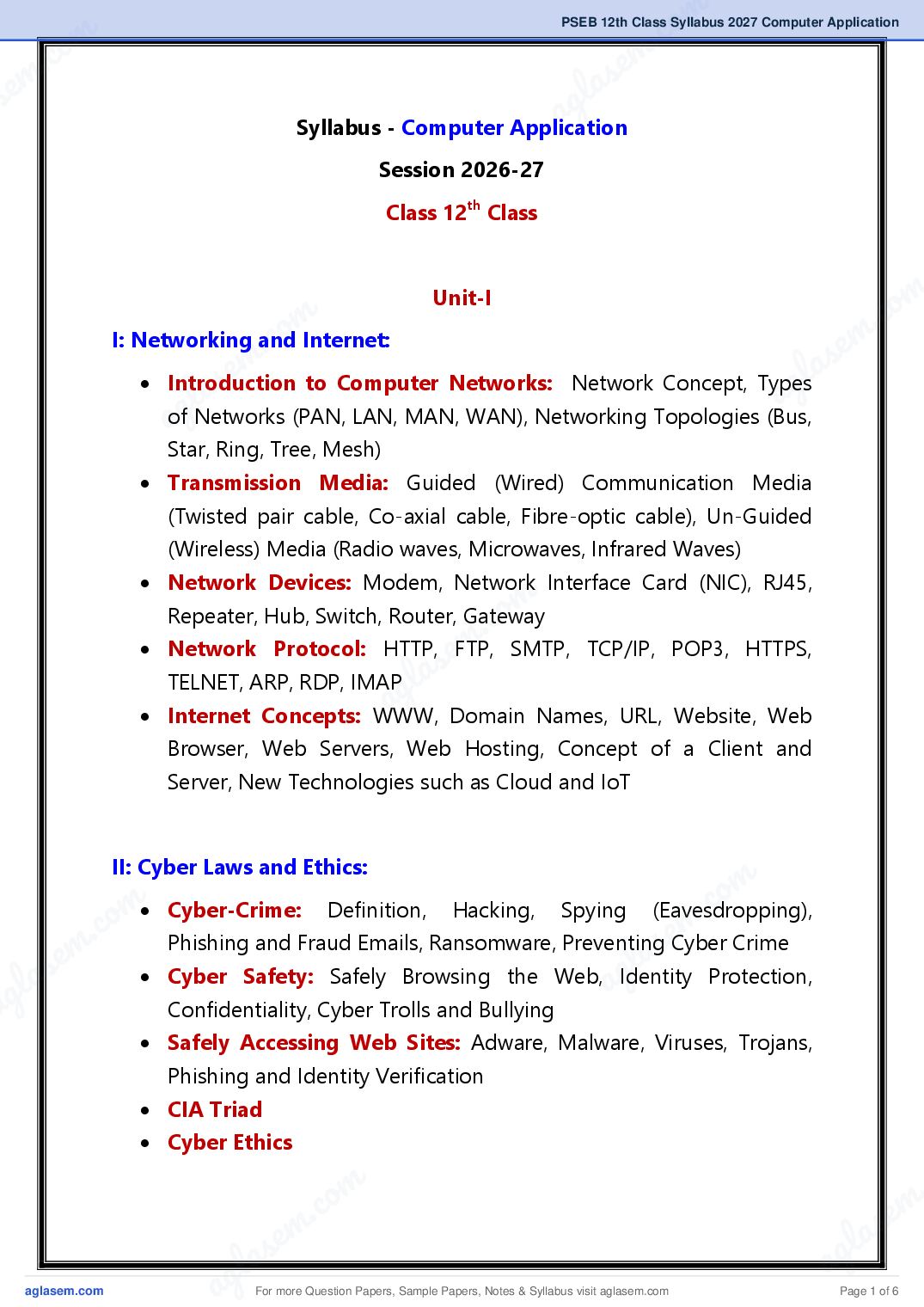
Syllabus - Computer Application
Session 2026-27
Class 12th Class
m
.co
Unit-I
m
.co
I: Networking and Internet:
s e m
s em to Computer Networks: Network Concept, Types g l a
l a
Introduction
a
aofgNetworks (PAN, LAN, MAN, WAN), Networking Topologies (Bus,
Star, Ring, Tree, Mesh)
Transmission Media: Guided (Wired) Communication Media
(Twisted pair cable, Co-axial cable, Fibre-optic cable), Un-Guided
(Wireless) Media (Radio waves, Microwaves, Infrared Waves)
Network Devices: Modem, Network Interface Card (NIC), RJ45,
m
Repeater, Hub, Switch, Router, Gateway
.co
em
Network Protocol: HTTP, FTP, SMTP, TCP/IP, POP3, HTTPS,
s
TELNET, ARP, RDP, IMAP la
ag
Internet Concepts: WWW, Domain Names, URL, Website, Web
Browser, Web Servers, Web Hosting, Concept of a Client and
Server, New Technologies such as Cloud and IoT
II: Cyber Laws and Ethics:
o m
c
m Cyber-Crime: Definition, Hacking, Spying (Eavesdropping),
m. Crime
c. o Phishing and Fraud Emails, Ransomware, PreventingseCyber
s em Cyber Safety: Safely Browsing the Web, Identity g l a
l a a Protection,
ag Confidentiality, Cyber Trolls and Bullying
Safely Accessing Web Sites: Adware, Malware, Viruses, Trojans,
Phishing and Identity Verification
CIA Triad
Cyber Ethics
m .
.co s e m
s em l a
g la ag
a For more Question Papers, Sample Papers, Notes & Syllabus visit Page 1 of 6
Page 3
Gadgets
IT Act: Indian Information Technology Act (IT Act) 2000
Unit-II
III: Database Management System
Database concepts: Introduction to Data, Information, Database
and its needs, Traditional File System v/s Database System
Data Models: Introduction, Hierarchical Data Model, Network Data
Model, Relational Data Model
Introduction to DBMS: DBMS, Components of DBMS
Relational Data Model: Relation, Attribute, Tuple, Domain,
Degree, Cardinality, Keys (Candidate Key, Primary Key, Alternate
Key, Foreign Key)
Normalization: Anomalies in Unnormalized Database,
Dependencies, Normal Forms, 1NF, 2NF, 3NF
MySQL: Introduction to MySQL, Data Types, Data Definition:
CREATE TABLE, DROP TABLE, ALTER TABLE; Data Query: SELECT,
FROM, WHERE; Data Manipulation: INSERT, UPDATE, DELETE; Using
Inbuilt Functions such as: Math functions, Text functions etc;
Querying and manipulating data using Group by, Having, Order by.
IV: Software Engineering:
Software and Software Engineering: Approach
Software Development Life Cycle: SDLC and Its Phases
Software Development Process Models: Waterfall, Prototyping
For more Question Papers, Sample Papers, Notes & Syllabus visit Page 2 of 6
Page 4
m .co
m .co s e m
se g l a
Unit-III a
V: Introduction to Python:
Introduction to Python: Python and its features
Setting up Python: System Requirements for Python, Downloading m
o m
and Installing Python, Intro to Python IDE, Executing a Simple "hello
c m .co
m . s e
s e
world" Program
Basicaconcepts for Python Programming: Python Character Set, g l a
l a
ag Tokens (Keyword, Identifier, Literal, Operator, Punctuator),
Python
Variables, Concept of L-Value and R-Value, Use of Comments
VI: Data Types, Operators and Expression in Python:
Data Types: Number (Integer, Floating Point, Complex), Boolean,
m
.co
Sequence (String, List, Tuple), None, Mapping (Dictionary), Mutable
and Immutable Data Types
s em
g la
Operators: Arithmetic Operators, Relational Operators, Logical
a
Operators, Assignment Operator, Augmented Assignment
Operators, Identity Operators (is, is not), Membership Operators (in,
not in)
Expressions, Statement, Type Conversion & Input/Output:
Precedence of Operators, Expression, Evaluation of Expression,
o m
Python Statement, Type Conversion (Explicit & Implicit Conversion),
m c
.Output
c. o Accepting Data as Input from the Console and Displaying
s e m
e m l a
l as ag
ag VII: Control Statements in Python:
Introduction: Use of Indentation, Sequential Flow, Conditional and
Iterative Flow control
Conditional Statements: if, if-else, if-elif-else, Flowcharts, Simple
Programs: e.g.: absolute value, largest of 2 and 3 numbers, finding
divisibility of numbers etc
m .
.co s e m
s em l a
g la ag
a For more Question Papers, Sample Papers, Notes & Syllabus visit Page 3 of 6
Page 5
Flowcharts, break and continue statements, nested loops, Suggested
Programs: Generating Pattern, Summation of series, Finding the
Factorial of a positive number etc
Unit-IV
VIII: Strings in Python:
Introduction: Indexing, String Operations (Concatenation,
Repetition, Membership & Slicing)
Built-In Functions: len(), capitalize(), title(), lower(), upper(), count(),
find(), index(), endswith(), startswith(), isalnum(), isalpha(), isdigit(),
islower(), isupper(), isspace(), lstrip(), rstrip(), strip(), replace(), join(),
partition(), split()
IX: Lists, Tuples and Dictionaries in Python:
Lists: Introduction, indexing, list operations (concatenation,
repetition, membership & slicing), traversing a list using loops, built-
in functions: len(), list(), append(), extend(), insert(), count(), index(),
remove(), pop(), reverse(), sort(), sorted(), min(), max(), sum(); nested
lists
Tuples: Introduction, indexing, tuple operations (concatenation,
repetition, membership & slicing), built-in functions: len(), tuple(),
count(), index(), sorted(), min(), max(), sum(); tuple assignment,
nested tuple
Dictionary: Introduction, accessing items in a dictionary using keys,
mutability of dictionary (adding a new item, modifying an existing
item), traversing a dictionary, built-in functions: len(), dict(), keys(),
values(), items(), get(), update(), del(), clear(), fromkeys(), copy(),
pop(), popitem(), setdefault(), max(), min(), count(), sorted(), copy()
For more Question Papers, Sample Papers, Notes & Syllabus visit Page 4 of 6
Page 6
m .co
m .co s e m
se g l a
Practical Activities a
1. Create the following table in MySQL with table name: stu_table
and insert the records as shown below:
Roll No Student Name Class Marks Result
101 Dazy 12th 56 Pass
m
.co
102 Amit 12th 15 Fail
m
.co
103 Rohit 12th 72 Pass
s e m
s em l a
ag
104 Param 12th 96 Pass
g la105 Divya
a 12th 76 Pass
2. Write a query In MySQL which shows records (using above
table: stu_table) as per the following criteria:
a. Marks between 50 to 80
b. Where Student Name ends with t
c. Where Result is Fail
3. Perform the following on the table: stu_table
m
.co
a. Update the marks to 60 for the student with Roll No 101
m
e
b. Delete the record with Student Name “Rohit”
s
la
c. Insert a new entry of student with Roll No 106
g
a
d. Show the table in sorted form (descending order) as per
the marks obtained by the student
4. Write a program in Python to calculate the Area of Circle
5. Write a program in Python to Swap two numbers
6. Write a program in Python to find the largest of two numbers
7. Write a program in Python to check if the given number is Zero,
Negative or Positive
m
m
8. Write a program in Python to Check whether a given character is
.co
m .co a vowel or consonant
s e m
s e 9. Write a program in Python to find the factorial of a given
g l a
g la number. a
a 10. Write a program in Python to Calculate the sum of digits of a
given number.
11. Write a program in Python to reverse a number.
12. Write a program in Python to linearly search an element from a
List
13. Write a program in Python to find the sum numbers stored in a
List.
m .
.co s e m
s em l a
g la ag
a For more Question Papers, Sample Papers, Notes & Syllabus visit Page 5 of 6
Page 7
* 1234 E
** 123 ED
*** 12 EDC
**** 1 EDCB
15. Write a program in Python to check if given string is Palindrome
or not.
16. Write a Python program which shows the use of various String
Operations (Concatenation, Repetition, Membership & Slicing)
17. Write a Python program to sort the list of fruits alphabetically.
18. Write a Python program to show the different methods of slicing
on Strings
19. Write a Python program to add the individual elements of two
Lists.
20. Write a Python program to create a list of lists (Nested or 2D
Lists) and show the Nested List in Matrix form
21. Write a Python program to count the occurrences of an element
in a Tuple
22. Write a Python program which shows how to work with
Dictionaries
Charts/Models
Prepare a chart/model which shows the different types of
Network Topologies
Prepare a chart/model which shows the different types of
Transmission Media
Prepare a chart/Model which depicts the Concept of a Client
and Server.
Prepare a chart/Model for the CIA Triad.
Prepare a chart/model for Waterfall-Software Development
Process Model
Prepare a chart/model that shows the concept of Data and
Information
Prepare a chart/model that shows the MySQL Query
Processing Model
Prepare a chart/model that shows the basic terminologies of
Relational Model
For more Question Papers, Sample Papers, Notes & Syllabus visit Page 6 of 6
Document Details
| Board / Org | Punjab Board |
| Exam | Class 12 |
| Type | Syllabus |
| Pages | 6 |
| Updated | 04 Nov 2026 |