HBSE Class 12 Sample Paper 2026 Chemistry
Finished viewing? Save it for later —
Download HBSE Class 12 Sample Paper 2026 Chemistry (PDF · 17 pages)About HBSE Class 12 Sample Paper 2026 Chemistry
HBSE Class 12 Sample Paper 2026 Chemistry is available here for free download. Published by Haryana Board for Class 12, this sample paper can be viewed online or downloaded as a PDF (17 pages). Candidates preparing for Class 12 can use HBSE Class 12 Sample Paper 2026 Chemistry to understand the exam pattern, the type of questions asked, and the overall difficulty level.
Frequently Asked Questions
How can I download HBSE Class 12 Sample Paper 2026 Chemistry?
Open this page and click the Download button to save HBSE Class 12 Sample Paper 2026 Chemistry as a PDF. It is completely free on AglaSem Docs.
Is HBSE Class 12 Sample Paper 2026 Chemistry free to download?
Yes. HBSE Class 12 Sample Paper 2026 Chemistry can be viewed online and downloaded as a PDF free of cost on AglaSem Docs.
How many pages does HBSE Class 12 Sample Paper 2026 Chemistry have?
HBSE Class 12 Sample Paper 2026 Chemistry contains 17 pages, which you can read online or download together as a single PDF.
Where can I find more Class 12 study material?
You can find more Class 12 question papers, sample papers, syllabus, and answer keys on AglaSem Docs.
HBSE Class 12 Sample Paper 2026 Chemistry – Text
Read the full text of this sample paper below — useful to quickly search, copy and reference the content online without downloading the PDF.
📄 View text version (17 pages)
Page 1
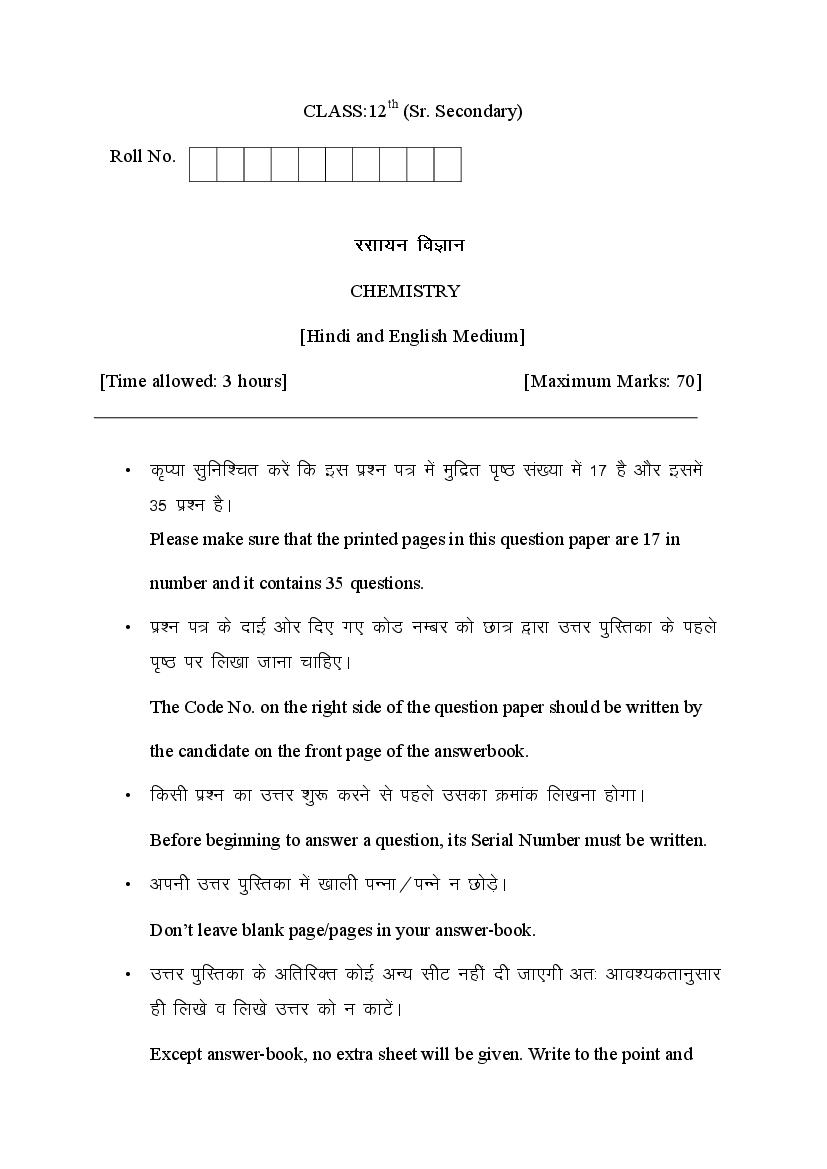
Roll No.
CHEMISTRY
[Hindi and English Medium]
[Time allowed: 3 hours] [Maximum Marks: 70]
• d`I;k lqfuf”pr djsa fd bl iz”u i= esa eqfnzr i`’B la[;k esa 17 gS vkSj blesa
35 iz”u gSA
Please make sure that the printed pages in this question paper are 17 in
number and it contains 35 questions.
• iz”u i= ds nkbZ vksj fn, x, dksM uEcj dks Nk= }kjk mÙkj iqfLrdk ds igys
i`’B ij fy[kk tkuk pkfg,A
The Code No. on the right side of the question paper should be written by
the candidate on the front page of the answerbook.
• fdlh iz”u dk mÙkj “kq: djus ls igys mldk Øekad fy[kuk gksxkA
Before beginning to answer a question, its Serial Number must be written.
• viuh mÙkj iqfLrdk esa [kkyh iUuk@iUus u NksM+sA
Don’t leave blank page/pages in your answer-book.
• mÙkj iqfLrdk ds vfrfjDr dksbZ vU; lhV ugha nh tk,xh vr% vko”;drkuqlkj
gh fy[ks o fy[ks mÙkj dks u dkVsaA
Except answer-book, no extra sheet will be given. Write to the point and
Page 2
• ijh{kkFkhZ viuk jksy uEcj iz”u i= ij vo”; fy[ksaA
Candidates must write their Roll Number on the question paper.
• d`Ik;k iz”uksa dk mÙkj nsus ls iwoZ ;g lqfuf”pr dj ysa fd iz”u i= iw.kZ o lgh
gS] ijh{kk ds mijkUr bl laca/k esa dksbZ Hkh nkok Lohdkj ugha fd;k tk,xkA
Before answering the questions, ensure that you have been supplied the
correct and complete question paper, no claim in this regard, will be
entertained after examination.
lkekU; funsZ”k %
(i) lHkh iz”u vfuok;Z gSA
(ii) oLrqfu’B iz”uksa ds mÙkj lgh fodYi fy[ksaA
(iii) izR;sd iz”u ds vad mlds lkeus n”kkZ, x, gSaA
General Instructions:
i) All questions are compulsory.
ii) Write the correct option in objective type questions.
iii) Marks of each question are indicated against it.
1. Which of the following is an example of ideal solution? (1)
(a) Bromobenzene and Bromoethane
(b) Chloroethane and Chlorobenzene
(c) Benzene and Ethanol
(d) Benzene and Toluene
fuEufyf[kr esa ls dkSu lk vkn”kZ foy;u dk ,d mnkgj.k gS \
(a) czksekscsUthu ,oa czkseks,Fksu
Page 3
(c) csUthu ,oa ,FksukWy
(d) csUthu ,oa VkWywbZu
2. Which of the following is not affected by catalyst? (1)
(a) Enthalpy
(b) Gibbs energy
(c) Speed of reaction
(d) None of the above
fuEufyf[kr esa ls dkSu mRizsjd ls izHkkfor ugha gksrk gS \
(a) ,UFkSYih ¼ÅtkZ½
(b) fxCt ÅtkZ
(c) vfHkfØ;k dk osx
(d) mi;qZDr esa ls dksbZ ugh
3. What is order of thermal decomposition of HI on gold surface? (1)
(a) 1 (b) 1.5
(c) 0 (d) 0.5
Lo.kZ lrg ij HI ds Å’eh; fo;kstu dh dksfV D;k gS \
(a) 1 (b) 1.5
(c) 0 (d) 0.5
4. Which of the following ion has highest oxidation state of Mn. (1)
(a) Mn 2+ (b) 𝑀𝑛𝑂
Page 4
fuEufyf[kr esa ls fdl vk;u esa Mn dh vf/kdre vkWDlhtu voLFkk gS \
a) Mn 2+ (b) 𝑀𝑛𝑂
(c) 𝑀𝑛𝑂 (d) mi;qZDr lHkh
5. Which of the following has the highest magnetic moment? (1)
(a) V2+ (b) Ti 2 +
(c) Cr 2+ (d) CO 2 +
fuEufyf[kr esa ls fdldk pqacdh; vk?kw.kZ lcls vf/kd gS \
(a) V2+ (b) Ti 2 +
(c) Cr 2+ (d) CO 2 +
6. What is oxidation number of Ni in [Ni(CO) 4 ]? (1)
(a) 0 (b) 1
(c) 2 (d) 4
[Ni(CO) 4 ] esa Ni dh vkWDlhtu la[;k D;k gS \
(a) 0 (b) 1
(c) 2 (d) 4
7. Which of the following has the highest boiling point? (1)
(a) Bromomethane (b) Bromoform
(c) Chloromethane (d) Dibromomethane
fuEufyf[kr esa ls fdldk DoFkukad lcls vf/kd gS \
(a) czkseksesFksu (b) czkseksQkWeZ
(c) DyksjksesFksu (d) MkbczkseksesFksu
Page 5
(a) tert-Butyl bromide
(b) sec-Butyl bromide
(c) Isobutyl bromide
(d) n-Butyl bromide
fuEufyf[kr esa ls dkSu lk fØ;kfof/k n~okjk vfHkfØ;k djus ds fy, lcls rhoz
gS \
(a) tert-C;wfVy czksekbM
(b) sec-C;wfVy czksekbM
(c) vkbZlksC;wfVy czksekbM
(d) n-C;wfVy czksekbM
9. Which of the following is obtained from isopropyl benzene? (1)
(a) Phenol
(b) Acetone
(c) Both of the above
(d) None of the above
fuEufyf[kr esa ls dkSu D;k vkblksizksfiy csUthu ls izkIr fd;k tkrk gS \
(a) QhukWy
(b) ,slhVksu
(c) mi;qZDr nksuksa
(d) buesa ls dksbZ ugh
Page 6
fuEufyf[kr iz”uksa ¼10&12½ esa fjDr LFkku Hkjsa %
10. ……………… obeys Raoul’s law in all stages of concentration. (1)
------------------------ ,dkxzrk ds lHkh pj.kksa esa jkmYV ds fu;e dk ikyu djrk gSA
11. Lanthanoids are known as ………………… elements. (1)
ySUFksukWbM~l dks ----------------------- rRo ds :i esa tkuk tkrk gSA
12. Vitamin B12 is a coordination compound of …………… transition metal. (1)
foVkfeu ch12 ------------------------------ laØe.k /kkrq dk ,d leU;o; ;kSfxd gSA
13. How many amino acids are present in insulin? (1)
balqfyu esa fdrus vehuksa ,flM ekStwn gksrs gSa \
14. Which isomeric alcohols are the most soluble in water? (1)
dkSu lk vkblksesfjd vYdksgy ikuh esa lcls vf/kd ?kqyu”khy gS \
15. Phosgene is commonly known as. (1)
QkWLthu dks vkerkSj ij fdl uke ls tkuk tkrk gS \
Note: In the following questions (Q. Nos. 16, 17 and 18 ) two statements are given for
each. Assertion (A) and Reason (R). Study both the statement carefully and
decide which answer option is correct and write the correct answer by selecting
the given options (a), (b), (c), & (d):
Options:
(a) Both Assertion (A) and Reason (R) are true and Reason (R) is the correct
explanation of Assertion (A).
(b) Both Assertion (A) and Reason (R) are true, but Reason (R) is not the
correct explanation of Assertion (A).
Page 7
(d) Assertion (A) is false, but Reason (R) is true.
uksV % fuEufyf[kr iz”uksa ¼iz0 la0 16] 17 ,oa 18½ esa nks dFku fn;s x;s gSaA
vfHkdFku(A) rFkk dkj.k(R) nksuksa dFkuksa dk /;kuiwoZd v/;;u djsa ,oa fu.kZ;
yhft, dh dkSu&lk mRrj fodYi lgh gS rFkk lgh mRrj dks fn;s x;s fodYi
(a), (b), (c), & (d) ,oa esa ls pqudj fyf[k, %
fodYi %
(a) vfHkdFku(A) rFkk dkj.k(R) nksuksa lR; gS vkSj dkj.k(R) vfHkdFku(A)
dh lgh O;k[;k gSA
(b) vfHkdFku(A) rFkk dkj.k(R) nksuksa lR; gS] ijUrq dkj.k(R) vfHkdFku(A)
dh lgh O;k[;k ugh gSA
(c) vfHkdFku(A) lR; gS] ijUrq dkj.k(R) vlR; gSA
(d) vfHkdFku(A) vlR; gS] ijUrq dkj.k(R) lR; gSA
16. Assertion (A) : Mercury cell is a primary cell. (1)
Reason (R): In primary battery reaction occurs only once and cannot be
reused again.
vfHkdFku (A) % ejD;wjh lsy ,d izkFkfed lsy gSA ;s csdkj gSA
dkj.k (R) % izkFkfed cSVjh esa izfrfØ;k dsoy ,d ckj gksrh gS vkSj fQj
ls iqu mi;ksx ugh dh tk ldrh gSA
17. Assertion (A): Half – life of a first order reaction is variable. (1)
Reason (R): For first order reaction, half-life is independent of initial
concentration of reactant.
vfHkdFku (A) % izFke dksfV dh vfHkfØ;k dh v/kZvk;q fLFkjkad gSA
Page 8
izkjafHkd lkanzrk ij fuHkZj ugh djrh gSA
18. Assertion (A) : Aldehydes are more reactive than ketones towards
nucleophilic addition reaction. (1)
Reason (R) : Aldehydes give positive Tollen’s test.
vfHkdFku (A) % ,fYMgkbM ukHkhdjkxh ;ksxt vfHkfØ;kvksa esa dhVksuksa dh
vis{kk vf/kd vfHkfØ;k”khy gksrs gSaA
dkj.k (R) % ,fYMgkbM ldkjkRed Vksysu&ijh{k.k nsrs gSaA
Section – B
[k.M & c
(Very Short Answer Type Questions)
¼vfr&y?kwÙkjkRed iz”u½
19. State Henry’s law. Write its two applications. (2)
gSujh dk fu;e crkb,A blds nks vuqiz;ksx fyf[k,A
(OR)
vFkok
1.00 g of a non – electrolyte solute dissolved in 50 g of benzene lowered the
freezing point of benzene by 0.40K. The freezing point depression constant of
benzene is 5.12 K kg mol-1. Find the molar mass of the solute. (2)
,d oSn;qrvi?kV~; ds 1-00 g dks 50 g csUthu esa ?kksyus ij blds fgekad esa
0-40 K dh deh gks tkrh gSA csUthu dk fgekad voueu fLFkjkad 5-12 K kg
mol-1 gSA foys; dk eksyj nzO;eku Kkr dhft,A
Page 9
applications. (2)
vk;uksa ds Lora= vfHkxeu dk dksyjkm”k fu;e crkb,A blds nks vuqiz;ksx
fy[ksaA
21. Draw structures of geometrical isomers of [Fe(NH3)2(CN)4]-. (2)
[Fe(NH3)2(CN)4]- ds T;kferh; leko;oksa dh ljapuk n”kkZb,A
22. Draw structures of following derivatives: (2)
^fuEufyf[kr O;qriUuksa dh ljapuk cukb, %
(i) Cyclopropanone oxime
(i) lkbDyksizsisuksu vkWfDle
(ii) Methyl hemiacetal of formaldehyde
(ii) QkWesZfYMgkbM dk esfFky gseh,slhVsy
23. Give plausible explanation for each of the following: (2)
fuEufyf[kr ds laHkkfor dkj.k nhft, %
(i) Cyclohexanone forms cyanohydrins in good yield but 2, 2, 6-
trimethylcyclohexanone does not.
lkbDyksgsDlsuksu vPNh yfC/k esa lk;uksgkbfMªu cukrk gS ijUrq 2] 2]
6&VªkbesfFkylkbDyksgsDlsuksu ,slk ugh djrk gSA
(ii) There are two –NH2 groups in semicarbazide. However, only one –NH2 is
involved in the formation of semicarbazones.
lsehdkcksZtkbM esa nks –NH2 lewg gksrs gS ijUrq dsoy ,d –NH2 lewg gh
lsehdkcksZtksu fojpu esa iz;qDr gksrk gSA
24. What is aldol? Give an example of a reaction. (2)
Page 10
(OR)
vFkok
Give simple chemicals tests to distinguish between the following pairs of
compounds. (2)
fuEufyf[kr ;kSfxd ;qxyksa esa foHksn djus ds fy, ljy jklk;fud ijh{k.k
nhft, %
(i) Ethanal and Propanone
,FksuSy ,oa izksisuksu
(ii) Propanal and Benzaldehyde
izksius Sy ,oa csUtSfYMgkbM
25. What is quaternary structure of proteins? Give an example. (2)
izksfVu dh prq’d ljapuk D;k gS \ ,d mnkgj.k nhft,A
Section – C
[k.M & l
(Short Answer Type Questions)
¼y?kwÙkjkRed iz”u½
26. Define molar conductivity for the solution of an electrolyte. How does it vary
with concentration for a weak electrolyte? (3)
fdlh oSn~;qrvi?kV~; ds foy;u dh eksyj pkydrk dh ifjHkk’kk nhft,A
;g ,d nqcZy oSn~;qrvi?kV~; ds fy, lkanzrk ds lkFk dSls ifjofrZr gksrk
gS \
Page 11
vFkok
Draw a labelled diagram of standard hydrogen electrode. (3)
ekud gkbMªkstu bySDVªM dk ukekafdr vkjs[k cuk;saA
27. The cell in which of the following reaction occurs:
2𝐹𝑒 (𝑎𝑞) + 2𝐼 (𝑎𝑞) → 2𝐹𝑒 (𝑎𝑞) + 𝐼 (𝑠) has 𝐸 = 0.236 V at 298 K.
Calculate the standard Gibbs energy and the equilibrium constant of the cell
reaction. (3)
,d lsy ftlesa fuEufyf[kr vfHkfØ;k gksrh gS %
2𝐹𝑒 (𝑎𝑞) + 2𝐼 (𝑎𝑞) → 2𝐹𝑒 (𝑎𝑞) + 𝐼 (𝑠) dk 298 K rki ij 𝐸 =
0.236 V gSA lsy vfHkfØ;k dh ekud fxCt ÅtkZ ,oa lkE; fLFkjkad dk
ifjdyu dhft,A
28. Write IUPAC names of following coordination compounds: (3)
fuEufyf[kr milgla;kstu ;kSfxdksa ds IUPAC uke fyf[k,A
(i) [Pt(NH3)2Cl(NO2)]
(ii) K3[Cr(C2O4)3]
(iii) [CO(NH3)5(CO3)]Cl
29. Write the mechanism of acid dehydration of ethanol to yield ethane. (3)
,FksukWy ds vEyh; futZyu ls ,Fkhu izkIr djus dh fØ;kfof/k fyf[k,A
(OR)
vFkok
Explain how you will distinguish between primary, secondary and tertiary
alcohols. (3)
Page 12
djsaxsA
30. What happens when D – glucose is treated with the following reagents? (3)
D;k gksrk gS tc D- Xywdksl dh vfHkfØ;k fuEufyf[kr vfHkdeZdksa ls djrs gSa\
(i) HI
(ii) Bromine water
czkes hu ty
(iii) HNO3
Section – D
[k.M & n
(Case Study Type Questions)
¼dsl v/;;u izdkj ds iz”u½
31. Read the passage given below and answer the following questions.
uhps fn, x, xn~;ka”k dks i<+s vkSj fuEufyf[kr iz”uksa ds mÙkj nsa %
The spontaneous flow of solvent through a semipermeable membrane from a
pure solvent to solution or from a dilute solution to a concentrated solution is
called osmosis. The phenomenon of osmosis can be demonstrated by taking two
eggs of the same size. In an egg, the membrane below the shell and around the
egg material is semi-permeable. The outer hard shell can be removed by putting
the egg in dilute hydrochloric acid. After removing the hard shell, one egg is
placed in distilled water and the other in a saturated salt solution. After some
time, the egg placed in distilled water swells-up while the egg placed in salt
solution shrinks. The external pressure applied to stop the osmosis is termed as
osmotic pressure which is a colligative property.
Page 13
foy;u ls ,d lkanz foy;u rd foyk;d ds lgt izokg dks ijklj.k dgk
tkrk gSA ,d gh vkdkj ds nks vaMs ysdj ijklj.k dh ?kVuk dk izn”kZu fd;k
tk ldrk gSA ,d vaMs esa] dop ds uhps vkSj vaMs dh lkexzh ds pkjksa vksj
f>Yyh v/kZ&ikjxE; gksrh gSA vaMs dks ruq gkbMªksDyksfjd vEy esa Mkydj ckgjh
dBksj dop dks gVk;k tk ldrk gSA dBksj dop dks gVkus ds ckn] ,d vaMs
dks vklqr ty esa vkSj nwljs dks lar`Ir ued ds foy;u esa j[kk tkrk gSA dqN
le; ckn] vklqr ty esa j[kk vaMk Qwy tkrk gS tcfd ued ds foy;u esa
j[kk vaMk fldqM+ tkrk gSA ijklj.k dks jksdus ds fy, ykxw ckgjh ncko dks
ijklj.k nkc dgk tkrk gS tks ,d v.kqla[; xq.k/keZ gSA
Questions :
(i) What is reverse osmosis? (1)
Ikzfrykse ijklj.k D;k gS\
(ii) What would happen if red blood corpuscels were placed in 0.5% NaCl
solution? (1)
D;k gksxk ;fn yky jDr df.kdkvksa dks 0.5% NaCl foy;u esa j[kk
tk,\
(OR)
vFkok
What are isotonic solutions? (1)
Leijklkjh foy;u D;k gSa\
(iii) Write one application of osmosis in food preservation. (1)
[kkn~; ifjj{k.k esa ijklj.k dk ,d vuqiz;ksx fyf[k,A
Page 14
pressure? (1)
1 M KCl vkSj 1 M ;wfj;k esa ls fdldk mPp ijklj.k nkc gksxk\
32. Read the passage given below and answer the following questions:
uhps fn, x, xn~;ka”k dks i<+s vkSj fuEufyf[kr iz”uksa ds mÙkj nsa %
Primary alkyl halide C4H9Br(A) reacted with alcoholic KOH to give compound
(B). Compound (B) is reacted with HBr to give (C) which is an isomer of (A).
When (A) is reacted with sodium metal it gives compound (D), C8H18 which is
different from the compound formed when n-butyl bromide is reacted with
sodium.
izkFkfed ,sfYdy gSykbM C4H9Br(A), ,sYdksgkWfyd KOH esa vfHkfØ;k n~okjk
;kSfxd (B) nsrk gSA ;kSfxd (B) HBr ds lkFk vfHkfØ;k ls ;kSfxd (C) nsrk gS
tks fd ;kSfxd (A) dk leko;oh gSA tc ;kSfxd (A) dh vfHkfØ;k lksfM;e /kkrq
ls gksrh gS rks ;kSfxd (D), C8H18 curk gS] tks fd C;wfVy czksekbM dh lksfM;e
ls vfHkfØ;k n~okjk cus mRikn ls fHkUu gSA
(i) Which type of isomerism is present between compounds (A) and (C) ?
(1)
;kSfxdksa (A) ,oa (C) ds e/; fdl izdkj dh leko;ork gS\
(ii) Write IUPAC name of compound (D). (1)
;kSfxd (D) dk IUPAC uke fyf[k,A
(iii) Draw structure of compound (B). (1)
;kSfxd (B) dh ljapuk cukb,A
(iv) How will you convert compound (B) to (A)? (1)
Vki ;kSfxd (B) dks (A) esa dSls ifjofrZr djsaxsaA
Page 15
vFkok
What is the name of the reaction in which compound (A) is converted to
compound (D). (1)
ml vfHkfØ;k dk uke D;k gS ftlesa ;kSfxd (A) dks ;kSfxd (D) esa ifjofrZr
fd;k tkrk gSA
Section – E
[k.M & ;
(Long Answer Type Questions)
¼nh?kZ mÙkjkRed iz”u½
33. Answer the following :
fuEufyf[kr dkmRrj nsa %
(i) Calculate 𝐸 for the following reaction at 298 K : (2)
2 Cr(s) + 3Fe3+ (0.01 M) 2Cr3+ (0.01M) + 3Fe(s)
Given Ecell = 0.261 V
298 K ij fuEufyf[kr izfrfØ;k ds fy, 𝐸 dh x.kuk djsa %
¼fn;k x;k½ Ecell = 0.261 V
(ii) Using the E0 values of A and B, predict which one is better for coating the
surface of iron [𝐸 = 0.44𝑉] to prevent corrosion and why ? (3)
Given [𝐸 ⁄ = −2.37 V :𝐸( ⁄ ) = −0.14𝑉
A vkSj B ds E0 ekuksa dk mi;ksx djds vuqeku yxk, fd tax dks jksdus
ds fy, yksgs dh lrg ij dksfVax djus ds fy, dkSu lk cSgrj gS
Page 16
¼fn;k x;k½ [𝐸 ⁄ = −2.37 V :𝐸( ⁄ ) = −0.14𝑉
(OR)
vFkok
The time required for 10% completion of a first order reaction at 298K is equal
to that required for its 25% completion at 308K. If the value of A is 4 x 10¹⁰s-1.
Calculate k at 318K and Ea. (5)
298 K Rki ij izFke dksfV dh vfHkfØ;k ds 10 izfr”kr iw.kZ gksus dk le;
308 K rki ij 25 izfr”kr vfHkfØ;k iw.kZ gksus esa yxs le; ds cjkcj gSA ;fn
A dk eku 4 x 10¹⁰s-1 gks rks 318 K rki ij k rFkk Ea dh x.kuk dhft,A
34. What are lanthanoids? Write their general electronic configuration. What is
lanthanoid contraction? What are the consequences of lanthanoid contraction?
(1+1+1+2)
ySUFksukW;M D;k gSa\ budk lkekU; bysDVªkWfud foU;kl fy[ksaA ySUFksukW;M
vkdqapu D;k gS\ ySUFksukW;M vkdqapu ds ifj.kke D;k gS\
(OR)
vFkok
Describe the preparation of potassium permanganate. How does the acidified
permanganate solution react with (a) iron (II) ions (b) SO2 and (c) oxalic acid?
Write the ionic equations for the reactions. (2+1+1+1)
iksVSf”k;e ijeSaxusV dks cukus dh fof/k dk o.kZu dhft,A vEyh; iksVSf”k;e
ijeSaxusV fdl izdkj (a) vk;ju (II) vk;u (b) SO2 rFkk (C) vkWDlSfyd vEy ls
vfHkfØ;k djrk gS\ vfHkfØ;kvksa ds fy, jklk;fud lehdj.k fyf[k,A
Page 17
forms compound ‘B’ which on heating with Br2 and KOH forms a compound
‘C’ of molecular formula C6H7N. Write the structures and IUPAC names of
compounds A, B and C. (1+1+1+2)
,d ,sjkseSfVd ;kSfxd ‘A’ tyh; veksfu;k ds lkFk xje djus ij ;kSfxd ‘B’
curk gS tks Br2 ,oa KOH ds lkFk xje djus ij v.kq lw= C6H7N okyk ;kSfxd
‘C’ cukrk gSA A, B ,oa C ;kSfxdksa dh ljapuk ,oa buds IUPAC uke fyf[k,A
(OR)
vFkok
Complete the following reactions: (5)
fuEufyf[kr vfHkfØ;kvksa dks iw.kZ dhft, %
(i) C6H5N2Cl + H3PO2 + H2O
(ii) C6H5NH2 + (CH3CO)2O
(iii) C6H5SO2Cl + CH3NH2
(iv) C6H5NH2 + CHCl3 + alc. KOH
(v) C6H5NH2 + H2SO4 (conc.)
Document Details
| Board / Org | Haryana Board |
| Exam | Class 12 |
| Type | Sample Paper |
| Pages | 17 |
| Updated | 24 Sep 2026 |