HBSE Class 10 Sample Paper 2027 Social Science Stepwise Marking Scheme
Finished viewing? Save it for later —
Download HBSE Class 10 Sample Paper 2027 Social Science Stepwise Marking Scheme (PDF · 5 pages)About HBSE Class 10 Sample Paper 2027 Social Science Stepwise Marking Scheme
HBSE Class 10 Sample Paper 2027 Social Science Stepwise Marking Scheme is available here for free download. Published by Haryana Board for Class 10, this answer key can be viewed online or downloaded as a PDF (5 pages). Candidates preparing for Class 10 can use HBSE Class 10 Sample Paper 2027 Social Science Stepwise Marking Scheme to understand the exam pattern, the type of questions asked, and the overall difficulty level.
Frequently Asked Questions
How can I download HBSE Class 10 Sample Paper 2027 Social Science Stepwise Marking Scheme?
Open this page and click the Download button to save HBSE Class 10 Sample Paper 2027 Social Science Stepwise Marking Scheme as a PDF. It is completely free on AglaSem Docs.
Is HBSE Class 10 Sample Paper 2027 Social Science Stepwise Marking Scheme free to download?
Yes. HBSE Class 10 Sample Paper 2027 Social Science Stepwise Marking Scheme can be viewed online and downloaded as a PDF free of cost on AglaSem Docs.
How many pages does HBSE Class 10 Sample Paper 2027 Social Science Stepwise Marking Scheme have?
HBSE Class 10 Sample Paper 2027 Social Science Stepwise Marking Scheme contains 5 pages, which you can read online or download together as a single PDF.
Where can I find more Class 10 study material?
You can find more Class 10 question papers, sample papers, syllabus, and answer keys on AglaSem Docs.
HBSE Class 10 Sample Paper 2027 Social Science Stepwise Marking Scheme – Text
Read the full text of this answer key below — useful to quickly search, copy and reference the content online without downloading the PDF.
📄 View text version (6 pages)
Page 1
HBSE Class 10 Sample
Paper 2027 Social
Science Stepwise
Marking Scheme
EXAM YEAR TYPE SUBJECT
Haryana Class 10 2027 Answer Key Social Science
Notes · Sample Papers · Previous Year Papers · Mock Tests
Page 2
.co s e m
s em l a
a ag
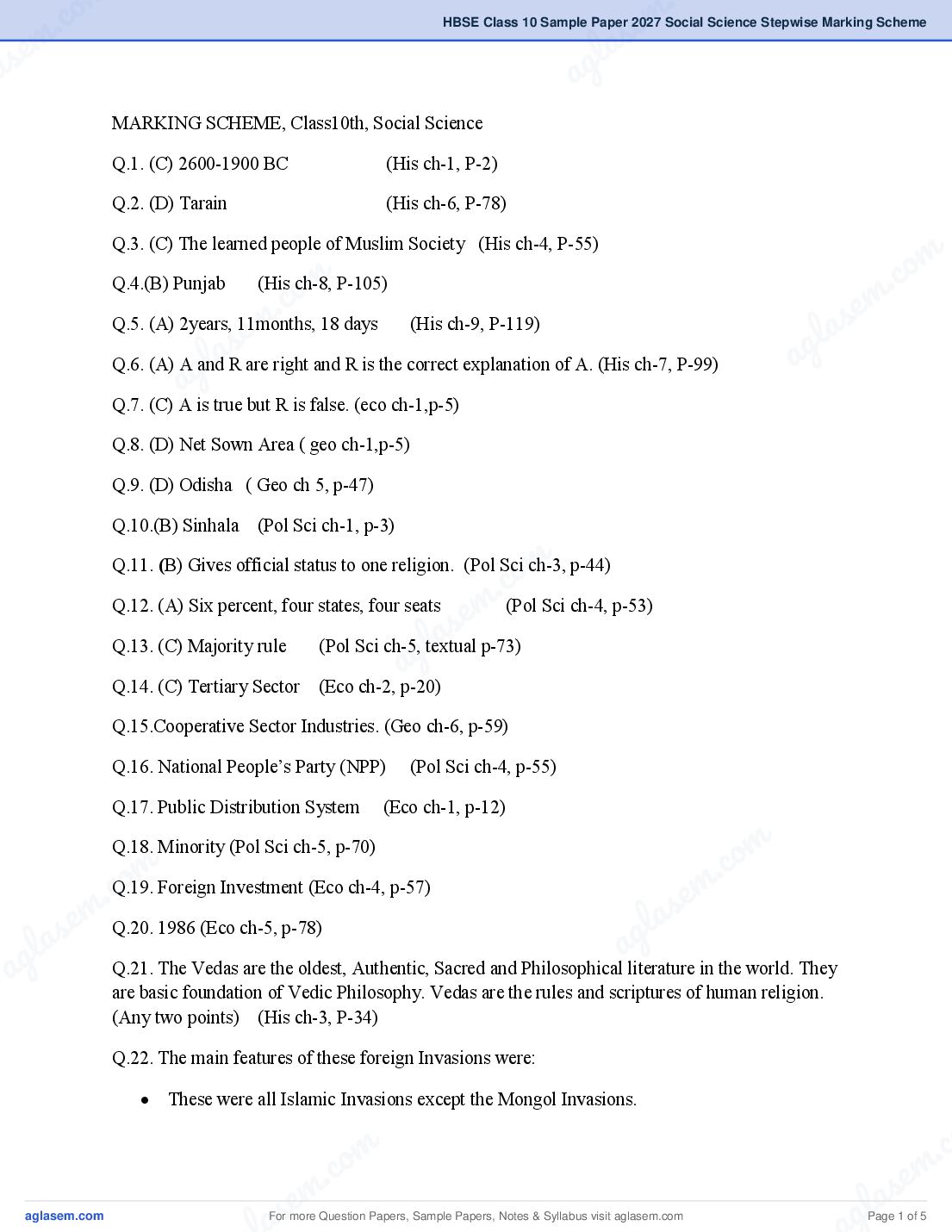
MARKING SCHEME, Class10th, Social Science
Q.1. (C) 2600-1900 BC (His ch-1, P-2)
Q.2. (D) Tarain (His ch-6, P-78)
Q.3. (C) The learned people of Muslim Society (His ch-4, P-55)
m
Q.4.(B) Punjab
om
(His ch-8, P-105) . co
. c em
em 18 days (His ch-9, P-119)
Q.5. (A) 2years, 11months,
l as
s
laR are right and R is the correct explanation of A. (His ch-7, P-99) ag
g
Q.6. (A) A and
a
Q.7. (C) A is true but R is false. (eco ch-1,p-5)
Q.8. (D) Net Sown Area ( geo ch-1,p-5)
Q.9. (D) Odisha ( Geo ch 5, p-47)
Q.10.(B) Sinhala (Pol Sci ch-1, p-3)
m
.co
Q.11. (B) Gives official status to one religion. (Pol Sci ch-3, p-44)
Q.12. (A) Six percent, four states, four seats
e m (Pol Sci ch-4, p-53)
l as p-73)
Q.13. (C) Majority rule
g
(Pol Sci ch-5, textual
a
Q.14. (C) Tertiary Sector (Eco ch-2, p-20)
Q.15.Cooperative Sector Industries. (Geo ch-6, p-59)
Q.16. National People’s Party (NPP) (Pol Sci ch-4, p-55)
Q.17. Public Distribution System (Eco ch-1, p-12)
m
.co
Q.18. Minority (Pol Sci ch-5, p-70)
m
.co
Q.19. Foreign Investment (Eco ch-4, p-57)
s e m
s em Q.20. 1986 (Eco ch-5, p-78) g l a
g la Q.21. The Vedas are the oldest, Authentic, Sacred and Philosophicalaliterature in the world. They
a are basic foundation of Vedic Philosophy. Vedas are the rules and scriptures of human religion.
(Any two points) (His ch-3, P-34)
Q.22. The main features of these foreign Invasions were:
These were all Islamic Invasions except the Mongol Invasions.
m . c
c. o s e m
s em
Page 1 of 5
Page 3
Plundering and killing took place. (Any two points) (His ch-6, P-82)
Q.23. a) In Sariska Tiger Reserve, Rajasthan, villagers have fought against Mining by citing
Wildlife Protection Act.
b) The inhabitants of five villages in Alwar, Rajasthan , declared 1200 hectares of forest as the
Bhairo Dev Dakav ‘sonchuri’, do not allow hunting and protecting wildlife. ( Geo ch2,p-16)
Q.24. a) The tree plant grows well in tropical and subtropical climates endowed with deep and
fertile well drained soil, rich in humus and organic matter.
b) Warm and Moist frost free climate.
c) Frequent showers distributed over the years. (any two) ( Geography ch-4,p-37)
Q.25. When Power is shared among different Social groups such as Religious and Linguistic
groups. Ex – Belgium. (Pol Sci ch-1, p-9)
Q.26.a) China b) United States of America or United Kingdom (Pol Sci ch-4, p-51)
Q.27. The RBI monitors the banks in actually maintaining cash balance. It seems that bank gives
loan to small cultivators, small scale scale industries. Banks have to submit information to the
RBI on how much they are lending, to whom and at what interest rate. (Any two points)
(Eco ch-3, p-48)
Q.28. More and more goods and services, investments and technology are moving between
countries. (Eco ch-4, p-62)
Q.29. Case Study (His ch-6, p-72)
Q.29.1 Due to prosperity and abundance of wealth.
Q.29.2 To plunder wealth
Q29.3 7th century
Q.30. Case Study (Geo ch-7, P-75)
30.1 Pipeline transport
30.2 Solids can be transported through pipeline when converted into slurry.
30.3 Refineries, fertilizers factories and big thermal power plants.
Q.31. Case Study (Pol Sci ch-5, P-64)
For more Question Papers, Sample Papers, Notes & Syllabus visit Page 2 of 5
Page 4
.co s e m
s em l a
a ag
31.1 Hundred
31.2 Have formal constitutions, hold elections, have parties.
31.3 Social situations, economic achievements, cultures.
Q.32. Case Study (Eco ch-2,p-32)
m
om
32.1. Weavers, Blacksmith, Carpenters, Goldsmiths (Any two) . co
. c e m
32.2. 80 percent m
e l as
a s g
32.3. Timelyldelivery of seeds, agricultural inputs, storage facility, marketing outlets (Anyatwo)
a g
Q.33. Azad Hind Fauj was a unique organization. The extra ordinary work of Subhash Chandra
Bose and his Azad Hind Fauj had a very deep impact on the Indian people. He uttered the slogan
‘Delhi Chalo’. There were huge demonstration all over the country. When Azad Hind Fauj’s
officers were prosecuted by the British government, movements erupted in the entire nation. (His
ch-8, p-112)
Q.34. Hydro electricity is generated by fast flowing water, which is a renewable resource. India
m
.co
has a number of multipurpose projects like Bhakra Nangal, Damodar valley corporation, the
Kopili Hydel Project etc. producing hydroelectric power. Thermal electricity is generated by
e m
for generating electricity. l s
using coal, petroleum and natural gas. The thermal power stations use non renewable fossil fuels
a
(geo ch-5,p-52)
ag
Q.35. It involves the use of sacred symbols, religious leaders, emotional appeal and plain fear in
order to bring the followers of one religion together in the political arena. In electoral politics
this often involves special appeal to the interest or emotions of voters of one religiosn in
preference to others. (Pol Sci ch -3, p-37)
Q.36. 1) Right to be informed about the particulars of goods and services they purchase. 2) Any
consumer who receives a service in whatever capacity, regardless of age, gender and nature of
m
.co
service has the Right to choose whether to continue to receive the service. 3) Consumers have
om
Right to seek redressal against unfair trade practices and exploitation.( Eco ch-5, p-80-82)
c.Q.37. e m
e m In the towns of civilization, two mounds are often found in the east
l a s
and west directions.
las The residential area was situated on the east mound and fort was situatedag on the west mound.
ag These towns were equipped with ramparts. The turrets were built on the defense ramparts. The
main road divided the town into five or six blocks. The main roads in Mohenjodaro were 9.15
metre wide and the streets were 3.0 metre wide on average. The drains of the houses led to the
big drain on the side of the road. Then the water was drained out of the town through these
drains. The drains were mainly made of paved bricks. The drains were covered with bricks of
large size. Residential and community buildings are also found in the Saraswati-Sindhu
civilization. The houses of rich people also had wells and toilets. Evidence of stairs in building is
m . c
c. o s e m
s em
Page 3 of 5
Page 5
(His ch-1, P-2,3)
OR
The administration of the Egyptian civilization can be explained as follow:
Pharaoh (King): Pharaoh had unlimited rights. He was an Autocratic ruler. All the
powers of governance were vested in his hands.
Wazir: He used to help the Pharaoh in governance. His main function was to collect
taxes and to keep records of income and expenditure.
Military organization: It was based on feudal system. Later Pharaoh built a permanent
army.
Local government: The administration of the villages was in the hands of feudal lords
who had the powers of police and justice. In cities, there was an administrative officer
who used to maintain peace and collect revenue.
The empire was divided into many provinces.
Pharaoh was the chief justice. (His ch-2, p-14)
Q.38. a) Dams were traditionally built to impound rivers and rainwater that could be used later to
irrigate agricultural fields but today they are used for electricity generation, water supply, flood
control, recreation etc. Many uses of the impounded water are integrated with one another.
b) Regulating and damming of rivers affect their natural flow causing sedimentation at the
bottom of the reservoir, resulting in rockier stream beds and poorer habitat for the rivers’aquatic
life. Dams also fragment rivers making it difficult for aquatic fauna to migrate. The reservoirs
created on flood plains submerge the vegetation and soil leading to its decomposition.
(Geo ch-3, p-22-23)
OR
a) The denudation of the soil cover and subsequent washing down is described as soil
erosion. It is caused by natural forces like wind, glaciers, and water and human activities
like deforestation and overgrazing.
b) Ploughing along the contour lines can decelerate the flow of water down the slopes. It is
called Contour ploughing. Steps can be cutout on the slopes making terraces. Terrace
cultivation restricts erosion. Large fields can be divided into strips. Strips of grass are left
to grow between the crops. This breaks the force of winds. It is known as Strip cropping.
( Geography ch1,p-10)
Q.39. The constitution provides a three-fold distribution of Legislative powers between the
Union Government and the State Governments which are as follow :
For more Question Papers, Sample Papers, Notes & Syllabus visit Page 4 of 5
Page 6
.co s e m
s em l a
a ag
Union list includes subjects of National importance, such as Defense, foreign affairs,
banking and currency. We need a uniform policy on these matters throughout the
country. The Union Government alone can make laws relating to the subjects mentioned
in the Union list.
State list contains subjects of State and local importance, such as police, trade, agriculture
and irrigation. The State Governments alone can make law related to these subjects.
m
om
Concurrent list includes subjects of common interest to both the Union Government as
. co
. c
well as the State Governments, such as education, forests and trade unions.
em
e m (Pol Sci ch-2, P-16)
l as
l as OR
ag
ag
Federalism is a system of government in which a power is divided between a central
authority and various constituents of the country.
Some of the key features of Federalism are :
There are two or more levels (or tiers) of government.
Different tiers of government govern the same citizens, but each tier has its own
Jurisdiction in specific matter of legislation, taxation and administration.
The fundamental provisions of the constitution cannot be unilaterally changed by one
m
.co
levels of government.
Courts have the power to interpret the constitution and the powers of different level of
e m
government.
s
(pol Sci ch-2, P-14-15)
l a
Q.40. Map work
ag
a) HISTORY
Important port – Lothal
c) GEOGRAPHY
Sugarcane producing state: Uttar Pradesh or Maharashtra
m
m .co
m .co s e m
s e g la
g la a
a
m . c
c. o s e m
s em
Page 5 of 5
Document Details
| Board / Org | Haryana Board |
| Exam | Class 10 |
| Type | Answer Key |
| Pages | 5 |
| Updated | 03 Nov 2026 |