HBSE Class 12 Sample Paper 2026 Economics
Finished viewing? Save it for later —
Download HBSE Class 12 Sample Paper 2026 Economics (PDF · 9 pages)About HBSE Class 12 Sample Paper 2026 Economics
HBSE Class 12 Sample Paper 2026 Economics is available here for free download. Published by Haryana Board for Class 12, this sample paper can be viewed online or downloaded as a PDF (9 pages). Candidates preparing for Class 12 can use HBSE Class 12 Sample Paper 2026 Economics to understand the exam pattern, the type of questions asked, and the overall difficulty level.
Frequently Asked Questions
How can I download HBSE Class 12 Sample Paper 2026 Economics?
Open this page and click the Download button to save HBSE Class 12 Sample Paper 2026 Economics as a PDF. It is completely free on AglaSem Docs.
Is HBSE Class 12 Sample Paper 2026 Economics free to download?
Yes. HBSE Class 12 Sample Paper 2026 Economics can be viewed online and downloaded as a PDF free of cost on AglaSem Docs.
How many pages does HBSE Class 12 Sample Paper 2026 Economics have?
HBSE Class 12 Sample Paper 2026 Economics contains 9 pages, which you can read online or download together as a single PDF.
Where can I find more Class 12 study material?
You can find more Class 12 question papers, sample papers, syllabus, and answer keys on AglaSem Docs.
HBSE Class 12 Sample Paper 2026 Economics – Text
Read the full text of this sample paper below — useful to quickly search, copy and reference the content online without downloading the PDF.
📄 View text version (9 pages)
Page 1
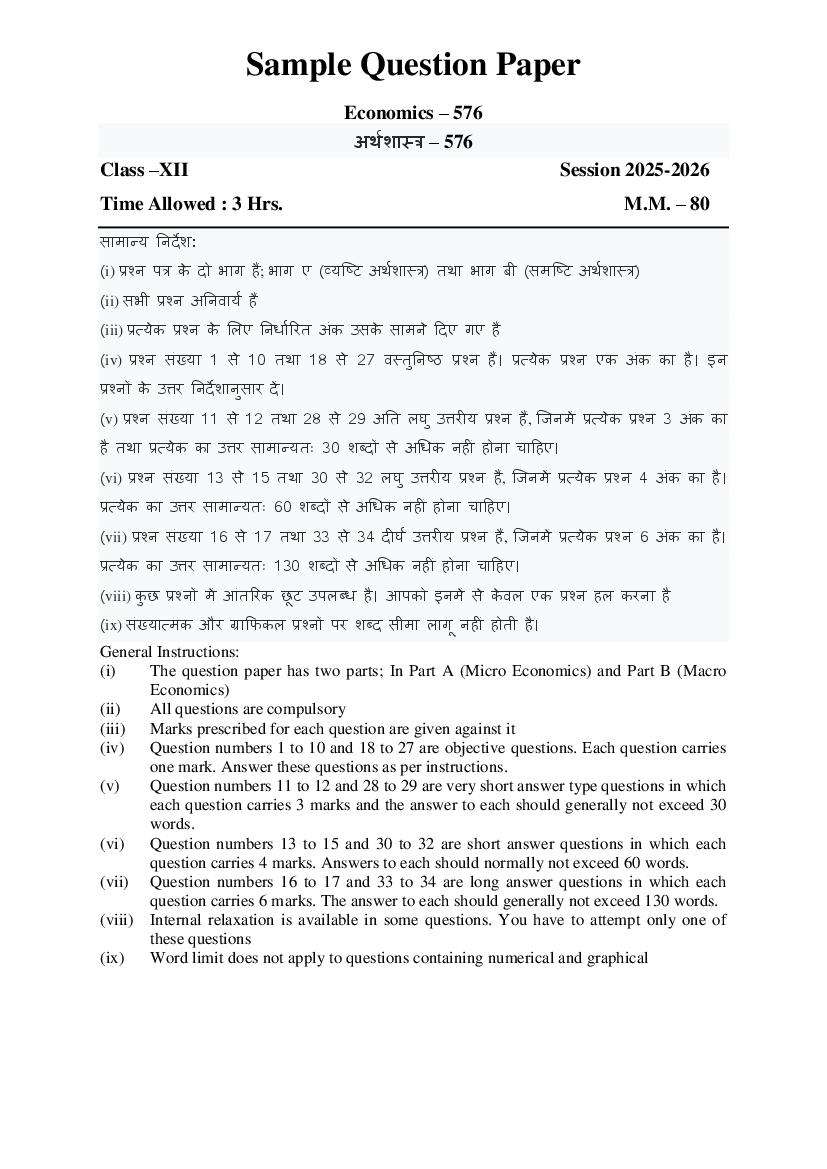
Economics – 576
अर्थशास्त्र – 576
Class –XII Session 2025-2026
Time Allowed : 3 Hrs. M.M. – 80
सामान्य निर्दे श:
(i) प्रश्ि पर के र्दो भाग हैं; भाग ए (व्यष्टि अर्थशास्त्र) तर्ा भाग बी (समष्टि अर्थशास्त्र)
(ii) सभी प्रश्ि अनिवायथ हैं
(iii) प्रत्येक प्रश्ि के लिए निर्ाथरित अंक उसके सामिे दर्दए गए हैं
(iv) प्रश्ि संख्या 1 से 10 तर्ा 18 से 27 वस्त्तनु िटठ प्रश्ि हैं। प्रत्येक प्रश्ि एक अंक का है । इि
प्रश्िों के उत्ति निर्दे शािस
ु ाि र्दें ।
(v) प्रश्ि संख्या 11 से 12 तर्ा 28 से 29 अनत िघु उत्तिीय प्रश्ि हैं, ष्ििमें प्रत्येक प्रश्ि 3 अंक का
है तर्ा प्रत्येक का उत्ति सामान्यतः 30 शब्र्दों से अधर्क िहीं होिा चादहए।
(vi) प्रश्ि संख्या 13 से 15 तर्ा 30 से 32 िघु उत्तिीय प्रश्ि हैं, ष्ििमें प्रत्येक प्रश्ि 4 अंक का है ।
प्रत्येक का उत्ति सामान्यतः 00 शब्र्दों से अधर्क िहीं होिा चादहए।
(vii) प्रश्ि संख्या 10 से 17 तर्ा 33 से 34 र्दीघथ उत्तिीय प्रश्ि हैं, ष्ििमें प्रत्येक प्रश्ि 0 अंक का है ।
प्रत्येक का उत्ति सामान्यतः 130 शब्र्दों से अधर्क िहीं होिा चादहए।
(viii) कुछ प्रश्िों में आंतरिक छूि उपिब्र् है । आपको इिमें से केवि एक प्रश्ि हि कििा है
(ix) संख्यात्मक औि ग्राफिकि प्रश्िों पि शब्र्द सीमा िागू िहीं होती है ।
General Instructions:
(i) The question paper has two parts; In Part A (Micro Economics) and Part B (Macro
Economics)
(ii) All questions are compulsory
(iii) Marks prescribed for each question are given against it
(iv) Question numbers 1 to 10 and 18 to 27 are objective questions. Each question carries
one mark. Answer these questions as per instructions.
(v) Question numbers 11 to 12 and 28 to 29 are very short answer type questions in which
each question carries 3 marks and the answer to each should generally not exceed 30
words.
(vi) Question numbers 13 to 15 and 30 to 32 are short answer questions in which each
question carries 4 marks. Answers to each should normally not exceed 60 words.
(vii) Question numbers 16 to 17 and 33 to 34 are long answer questions in which each
question carries 6 marks. The answer to each should generally not exceed 130 words.
(viii) Internal relaxation is available in some questions. You have to attempt only one of
these questions
(ix) Word limit does not apply to questions containing numerical and graphical
Page 2
(Part A)
प्रश्ि 1 कीमत लसदर्ांत को इस िाम से िािा िाता है :
(A) व्यष्टि अर्थशास्त्र (B) समष्टि अर्थशास्त्र (C) मल्
ू य नियंरण (D) मल्
ू य संति
ु ि
The Price Theory is known as :
(A) Microeconomics (B) Macroeconomics (C) Price control (D) Price Equilibrium
प्रश्ि 2 पण
ू थ प्रनतयोधगता बािाि में िमथ का मांग वक्र होता है-
(A) + VE (B) - VE (C) OX अक्ष के समािांति (D) OY अक्ष के समािांति
In Perfect Competition market firm demand curve is-
(A) + VE (B) - VE (C) Parallel to OX Axis (D) Parallel to OY Axis
प्रश्ि 3 अवसि िागत से तात्पयथ है :-
(A) वैकष्ल्पक उपयोग की िागत (B) वास्त्तववक िागत (C) कुि िागत (D) इिमें से कोई िहीं
Opportunity cost is meant by:-
(A) cost of alternative use (B) Actual cost (C) total cost (D) None of these
प्रश्ि 4 पण
ू थ प्रनतस्त्पर्ाथ में एक िमथ संति
ु ि की ष्स्त्र्नत में होती है िब:
(A) MC= शन्
ू य (B) MC=TR (C) MC=MR (D) AC=AR
In perfect competition a firm is in a state of equilibrium when:
(A) MC= Zero (B) MC=TR (C) MC=MR (D) AC=AR
प्रश्ि 5 सही सर
ू का चयि किें :
(A) MC = TC-TVC (B) MC=TFC+TVC
(C) MC = TCN+1-TCN (D) TFC=AFC/Q
Select the correct formula:
(A) MC=TC-TVC (B) MC=TFC+TVC
(C) MC=TCN+1-TCN (D) TFC=AFC/Q
प्रश्ि 6 िब MP शन्
ू य हो:
(A) TP= शन्ू य (B) TP= +ive (C) TP= -ive (D) TP= अधर्कतम
When MP is Zero:
(A) TP= Zero (B) TP= +ive (C) TP= -ive (D) TP= maximum
प्रश्ि 7 AR वक्र को ______________ के िाम से भी िािा िाता है । (मांग वक्र / आपनू तथ वक्र)
AR curve is also known as ______________.(Demand curve/ Supply curve)
Page 3
ू य सिकाि दवािा संति
ु ि मल्
ू य से_______________ निर्ाथरित फकया िाता है ।
(िीचे/ऊपि)
Support price is determined by the government..... the equilibrium price.
(below/above)
प्रश्ि 9 पनू तथ वक्र का ढिाि कैसा होता है ?
What is the slope of the Supply curve?
निम्िलिखित कर्ि को पढें - अलभकर्ि (A) औि कािण (R)। िीचे दर्दए गए सही ववकल्पों में से
एक चुिें।
(A) अलभकर्ि (A) औि कािण (R) र्दोिों सत्य हैं औि कािण (R) अलभकर्ि (A) की सही व्याख्या
है
(B) अलभकर्ि (A) औि कािण (R) र्दोिों सत्य हैं औि कािण (R) अलभकर्ि (A) की सही व्याख्या
िहीं है
(C) अलभकर्ि (A) सत्य है , िेफकि कािण (R) असत्य है ।
(D) अलभकर्ि (A) असत्य है , िेफकि कािण (R) सत्य है ।
Read the following statement- Assertion (A) and Reason (R) . Choose one of the correct
alternatives given below .
(A) Both Assertion (A) and Reason (R) are true and Reason (R) is the correct
explanation of Assertion (A)
(B) Both Assertion (A) and Reason (R) are true and Reason (R) is not the
correct explanation of Assertion (A)
(C) Assertion (A) is true , but Reason (R) is false.
(D) Assertion (A) is false , but Reason (R) is true.
प्रश्ि 10 अलभकर्ि (A) : औसत ष्स्त्र्ि िागत वक्र U आकाि का होता है ।
कािण (R) : AFC=TFC/Q
Assertion (A) : The average fixed cost curve is U shaped.
Reason (R) : AFC=TFC/Q 1 x 10 = 10
प्रश्ि 11 अर्थशास्त्र समस्त्या के कािण क्या हैं?
What are causes of economics problems ? 3
प्रश्ि 12 उर्दासीिता वक्र की ववशेषताओं का वणथि किें
Describe the characteristics of indifference curves.
Page 4
ु ि की व्याख्या कीष्िए।
Explain consumer’s equilibrium with the help of Indifference curves approach. 3
प्रश्ि 13. कािक के घिते प्रनतिि को तालिका एवं ग्राि की सहायता से समझाइए।
Explain the diminishing returns of factors with the help of table and graph. 4
प्रश्ि 14. औसत िागत औि सीमांत िागत के बीच संबर्
ं स्त्पटि किें ।
Explain the relationship between average cost and marginal cost.
(Output) (TC) (AFC) (AVC) (MC)
0 36 - - -
1 - - - 18
2 - - - 14
3 - - 16 -
4 - - - 24
उपिोक्त तालिका को पिू ा किें ।
Complete the above table. 4
प्रश्ि 15. नियंरण मल्
ू य औि समर्थि मल्
ू य में अंति स्त्पटि किें ।
Explain the difference between control price and support price.
माि िीष्िए फकसी वस्त्तु की मांग औि आपनू तथ वक्र निम्िलिखित र्दो समीकिणों दवािा दर्दए गए हैं:
Qd= 200 - P औि Qs= 50 + 2P
संति
ु ि कीमत औि मारा ज्ञात किें A
Suppose the demand and supply curves of a commodity is given by the following two
equations :
Qd= 200 - P and Qs= 50 + 2P
Find the equilibrium price and quantity 4
Page 5
Describe total expenditure method of measuring price elasticity of demand.
बिि िे िा क्या है? बिि िे िा में खिसकाव के कािणों की व्याख्या किें ।
What is Budget Line ? Explain the causes of shift in Budget Line . 6
प्रश्ि 17. उत्पार्दक संति
ु ि से क्या अलभप्राय है? सीमांत ववधर् दवािा उत्पार्दक संति
ु ि की व्याख्या
कीष्िए।
What is meant by producer equilibrium? Explain producer equilibrium by marginal method.
पण
ू थ प्रनतस्त्पर्ी बािाि का अर्थ एवं ववशेषताएँ समझाइए।
Explain the meaning and characteristics of a perfectly competitive market. 6
भाग बी
(Part B)
प्रश्ि 18. निम्िलिखित में से कौि-सी एक समष्टि अवर्ािणा है?
(A) िोिगाि का लसदर्ांत (B) मांग की कीमत िोच
(C) फकिाये का लसदर्ांत (D) वस्त्तु का कीमत
Which of the following is a macro concept?
(A) Theory of employment (B) Price elasticity of demand
(C) Theory of rent (D) Price of goods
प्रश्ि 19. यदर्द MPC = 0.75 तो गण
ु क का माि क्या होगा ?
(A) 5 (B) 2.5 (C) 4 (D) 3.5
If MPC=0.75 then what will be the value of the multiplier ?
(A) 5 (B) 2.5 (C) 4 (D) 3.5
प्रश्ि 20. भाित का केन्रीय बैंक कौि सा है?
(A) RBI (B) SBI (C) PNB (D) HDFC
Which one is Central bank of India ?
(A) RBI (B) SBI (C) PNB (D) HDFC
प्रश्ि 21. र्दोहिी गणिा की समस्त्या फकस ववधर् में पाई िाती है?
(A) आय ववधर् (B) उत्पार्द ववधर् (C) व्यय ववधर् (D) उपयक्
ुथ त सभी
In which method the problem of double counting is found ?
(A) Income method (B) Product Method
(C) Expenditure method (D) All of the above
Page 6
ु होता है ?
(A) 1 िुिाई (B) 1 अप्रैि (C) 1 ििविी (D) इिमें से कोई िहींa
When does the financial year begin?
(A) 1 July (B) 1 April (C) 1 January (D) None of these
प्रश्ि 23. भग
ु ताि संति
ु ि में कौि सी मर्दें शालमि हैं?
A) दृश्य मर्दें (B) अदृश्य मर्दें (C) पि
ंू ी हस्त्तांतिण (D) उपिोक्त सभी
Which item is included in the balance of payments?
(A) Visible items (B) Invisible items (C) Capital transfer (D) All of the above
प्रश्ि 24. आयकि एक …………कि है । (प्रत्यक्ष/अप्रत्यक्ष)
Income tax is a…………tax. (Direct/ Indirect)
प्रश्ि 25. मर
ु ा पनू तथ का अधर्कतम तिि रूप _____________ है । (M3/M1)
The most liquid form of money supply is ______ . (M3/M1)
प्रश्ि 26. संपवत्त औि उदयमववृ त्त से प्राप्त आय को क्या कहते हैं?
Income received from property and entrepreneurship is called.
निम्िलिखित कर्ि को पढें - अलभकर्ि (A) औि कािण (R)। िीचे दर्दए गए सही ववकल्पों में से
एक चुिें।
(A) अलभकर्ि (A) औि कािण (R) र्दोिों सत्य हैं औि कािण (R) अलभकर्ि (A) की सही व्याख्या
है
(B) अलभकर्ि (A) औि कािण (R) र्दोिों सत्य हैं औि कािण (R) अलभकर्ि (A) की सही व्याख्या
िहीं है
(C) अलभकर्ि (A) सत्य है , िेफकि कािण (R) असत्य है ।
(D) अलभकर्ि (A) असत्य है , िेफकि कािण (R) सत्य है ।
Read the following statement- Assertion (A) and Reason (R) . Choose one of the correct
alternatives given below .
(A) Both Assertion (A) and Reason (R) are true and Reason (R) is the correct
explanation of Assertion (A)
(B) Both Assertion (A) and Reason (R) are true and Reason (R) is not the
correct explanation of Assertion (A)
(C) Assertion (A) is true , but Reason (R) is false.
(D) Assertion (A) is false , but Reason (R) is true.
Page 7
कािण (R): िब आय शन्
ू य हो तो उपभोग शन्ू य िहीं होता ।
Assertion (A): In the short run APC > MPC.
Reason (R): Consumption is not zero when income is zero. 1 x 10 = 10
प्रश्ि 28. व्यापाि संति
ु ि औि भग
ु ताि संति
ु ि के बीच अंति स्त्पटि किें ।
Explain the difference between balance of trade and balance of payments. 3
प्रश्ि 29. समग्र मांग के निर्ाथिकों की व्याख्या किें ।
Explain the determinants of aggregate demand.
सीमांत उपभोग प्रववृ त्त औि सीमांत बचत प्रववृ त्त ज्ञात कीष्िए।
Find marginal propensity to consume and marginal propensity to save.
आय (Income)
0 50 100 150 200
उपभोग (Consumptions)
20 60 100 120 140
3
प्रश्ि 30. व्यष्टि अर्थशास्त्र औि समष्टि अर्थशास्त्र के बीच अंति स्त्पटि किें ।
Explain the difference between microeconomics and macroeconomics. 4
प्रश्ि 31. निवेश गण
ु क से आपका क्या अलभप्राय है? निवेश गण
ु क की प्रफक्रया को समझाइए, यह मािते
हुए फक निवेश में परिवतथि (∆I) 4000 किोड़ है तर्ा सीमांत उपभोग प्रववृ त्त (MPC) 0.5 है ।
What do you mean by Investment Multiplier? Explain the process of Investment Multiplier
assuming change in Investment (∆I) is 4000 crores and marginal propensity to consume
(MPC) is 0.5.
Page 8
निम्िलिखित की गणिा किें
a) MPS b) स्त्वायत्त उपभोग
c) गण
ु क d) बचत फंक्शि
Consumption equation is given as C = 200 + 0.80Y
Calculate the followings
a) MPS b) Autonomous Consumption
c) Multiplier d) Saving Function 4
प्रश्ि 32. सिकािी बिि औि उसके उदर्दे श्यों से आप क्या समझते हैं ?
What do you mean by government budget and its objectives ?
प्रत्यक्ष औि अप्रत्यक्ष किों के बीच अंति स्त्पटि किें ।
Explain the difference between direct and indirect taxes. 4
प्रश्ि 33. केन्रीय बैंक के कायों की व्याख्या कीष्िए।
Explain the functions of Central Bank.
“मर
ु ा वह है िो मर
ु ा का कायथ किें । ” स्त्पटि कीष्िए।
“Money is that which acts as Money” Explain. 6
प्रश्ि 34. िाटरीय आय को मापिे की व्यय ववधर् का वणथि कीष्िए।
Describe the Expenditure method of measuring national income.
Page 9
ू य ज्ञात कीष्िए।
क्रमांक ववविण िालश (किोड़ ोपए)
i. बािाि मल्
12000
ू य पि उत्पार्दि का मल्
ू य
ii. ववर्दे श से शद
ु र् कािक आय 1000
iii. शद
ु र् अप्रत्यक्ष कि 50
iv. मध्यवती उपभोग 3500
v. कमथचारियों का पारिश्रलमक 5000
vi. स्त्र्ायी पि
ूं ी का उपभोग 250
Based on the given information, calculate the value of Operating Surplus.
Serial number Description Amount (crore rupees)
i. Value of output at market price 12000
ii Net factor income from abroad 1000
iii Net indirect tax 50
iv. Intermediate Consumption 3500
v. Compensation of Employees 5000
vi. Consumption of fixed capital 250
6
Document Details
| Board / Org | Haryana Board |
| Exam | Class 12 |
| Type | Sample Paper |
| Pages | 9 |
| Updated | 24 Sep 2026 |