HBSE Class 12 Sample Paper 2026 English Elective
Finished viewing? Save it for later —
Download HBSE Class 12 Sample Paper 2026 English Elective (PDF · 6 pages)About HBSE Class 12 Sample Paper 2026 English Elective
HBSE Class 12 Sample Paper 2026 English Elective is available here for free download. Published by Haryana Board for Class 12, this sample paper can be viewed online or downloaded as a PDF (6 pages). Candidates preparing for Class 12 can use HBSE Class 12 Sample Paper 2026 English Elective to understand the exam pattern, the type of questions asked, and the overall difficulty level.
Frequently Asked Questions
How can I download HBSE Class 12 Sample Paper 2026 English Elective?
Open this page and click the Download button to save HBSE Class 12 Sample Paper 2026 English Elective as a PDF. It is completely free on AglaSem Docs.
Is HBSE Class 12 Sample Paper 2026 English Elective free to download?
Yes. HBSE Class 12 Sample Paper 2026 English Elective can be viewed online and downloaded as a PDF free of cost on AglaSem Docs.
How many pages does HBSE Class 12 Sample Paper 2026 English Elective have?
HBSE Class 12 Sample Paper 2026 English Elective contains 6 pages, which you can read online or download together as a single PDF.
Where can I find more Class 12 study material?
You can find more Class 12 question papers, sample papers, syllabus, and answer keys on AglaSem Docs.
HBSE Class 12 Sample Paper 2026 English Elective – Text
Read the full text of this sample paper below — useful to quickly search, copy and reference the content online without downloading the PDF.
📄 View text version (6 pages)
Page 1
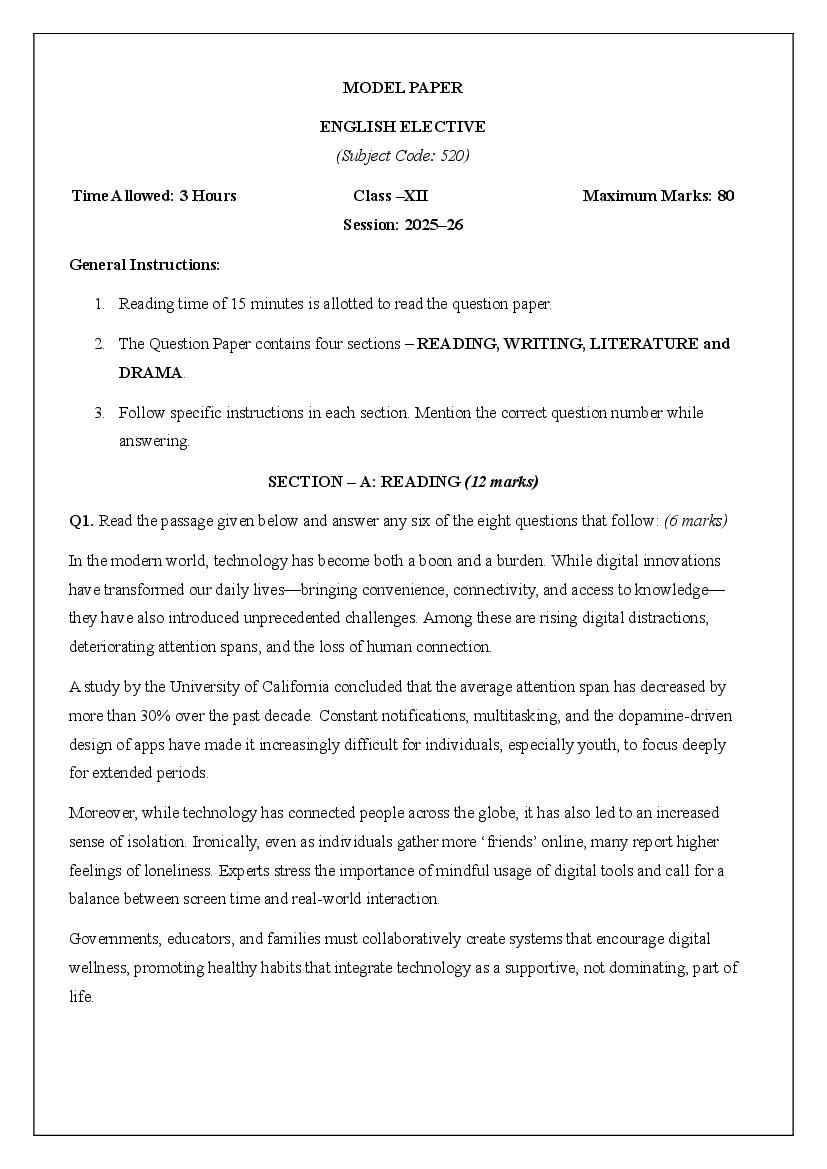
ENGLISH ELECTIVE
(Subject Code: 520)
Time Allowed: 3 Hours Class –XII Maximum Marks: 80
Session: 2025–26
General Instructions:
1. Reading time of 15 minutes is allotted to read the question paper.
2. The Question Paper contains four sections – READING, WRITING, LITERATURE and
DRAMA.
3. Follow specific instructions in each section. Mention the correct question number while
answering.
SECTION – A: READING (12 marks)
Q1. Read the passage given below and answer any six of the eight questions that follow: (6 marks)
In the modern world, technology has become both a boon and a burden. While digital innovations
have transformed our daily lives—bringing convenience, connectivity, and access to knowledge—
they have also introduced unprecedented challenges. Among these are rising digital distractions,
deteriorating attention spans, and the loss of human connection.
A study by the University of California concluded that the average attention span has decreased by
more than 30% over the past decade. Constant notifications, multitasking, and the dopamine-driven
design of apps have made it increasingly difficult for individuals, especially youth, to focus deeply
for extended periods.
Moreover, while technology has connected people across the globe, it has also led to an increased
sense of isolation. Ironically, even as individuals gather more ‘friends’ online, many report higher
feelings of loneliness. Experts stress the importance of mindful usage of digital tools and call for a
balance between screen time and real-world interaction.
Governments, educators, and families must collaboratively create systems that encourage digital
wellness, promoting healthy habits that integrate technology as a supportive, not dominating, part of
life.
Page 2
a) What are two major negative consequences of modern digital innovations mentioned in the
passage?
b) According to the passage, how has multitasking contributed to digital distraction?
c) What ironic situation is mentioned regarding online connectivity and loneliness?
d) What does the passage suggest as a solution to digital overload?
e) Which of the following best describes the main idea of the passage?
(i) Technology must be completely avoided
(ii) Digital tools are more dangerous than useful
(iii) Mindful and balanced use of technology is essential
(iv) Social media should be banned
f) What does the term “dopamine-driven design” imply in the context of apps?
g) Which word in the passage is a synonym for "harm"?
1. Burden
2. Boon
3. Attention
4. Innovation
h) The phrase “supportive, not dominating” means:
1. Completely necessary
2. To be used in moderation
3. Uncontrollable
4. Technologically advanced
Q2. Read the poem extract below and answer the questions: (6 marks)
The woods are lovely, dark and deep,
But I have promises to keep,
And miles to go before I sleep,
And miles to go before I sleep.
The quiet snow lies thick and still,
Beneath the trees upon the hill,
Page 3
My path demands I not yet miss.
a) What temptation is the speaker facing in the poem?
b) What do “promises” symbolize in the poem?
c) Identify the repetition used in the poem and its effect.
d) What natural scene is described, and what mood does it create?
e) Which word best describes the speaker’s tone?
1. Restless
2. Determined
3. Lazy
4. Fearful
f) The phrase “miles to go before I sleep” implies:
1. The speaker is lost
2. He is physically tired
3. He has a long way to travel in life
4. He wants to sleep soon
SECTION – B: WRITING SKILLS AND GRAMMAR (12 marks)
Q3. Attempt any two of the following: (6 marks)
a) You are Reema/Rajan of Class XII, Golden Public School, Jaipur. Write a letter to the Manager,
India Book House, seeking information about bulk discounts for ordering textbooks for your school
library.
b) Write a paragraph in 80–100 words on the topic: “Books vs Screens – The Reading Dilemma.”
c) You are Kriti/Anuj, Secretary of Environment Club. Write a report in 100–125 words on “Tree
Plantation Drive” held in your school.
Q4. Do as directed: (6 marks)a) Change to indirect speech:
She said, “You must submit the form before Friday.”
b) Change the voice:
The students organized a farewell party.
Page 4
You _______ obey traffic rules at all times. (must/should/can)
d) Correct the error:
The team have completed their project.
e) Fill in the blank with appropriate preposition:
The cat jumped ___ the table.
f) Complete the sentence with a suitable conjunction:
She was late ______ she missed the bus.
SECTION – C: LITERATURE (23 marks)
Q5. Choose one extract and answer the questions: (5 marks)
A.
“Hope” is the thing with feathers—
That perches in the soul—
And sings the tune without the words—
And never stops—at all—
i) Name the poet and poem.
ii) What is being compared to a bird?
iii) What does the bird's singing represent?
iv) What figure of speech is used in the line “sings the tune without the words”?
v) The mood of the poem is best described as:
1. Optimistic
2. Doubtful
3. Regretful
4. Confused
OR
B.
“Not marble, nor the gilded monuments
Of princes, shall outlive this powerful rhyme;
Page 5
Than unswept stone, besmeared with sluttish time.”
i) What does the poet suggest about poetry and memory?
ii) How does time affect physical monuments?
iii) What poetic device is used in “sluttish time”?
iv) Name the poem and poet.
v) The poet compares the poem's durability to that of:
1. Gold
2. Marble
3. Royal palaces
4. History books
Q6. Answer any two of the following in 120–150 words: (2×5=10 marks)
a) Why is the character of Eveline conflicted, and how does it reflect her psychological state?
b) Discuss the theme of self-perception in “Broken Images” by Girish Karnad.
c) Explain the symbolic contrast of light and shadow in the poem “The Soul’s Prayer”.
Q7. Answer any four of the following in 30–40 words: (2×4=8 marks)
a) Why are gardens described as both “bright” and “irrigated by sinuous rills”?
b) What insight does the poem give into the poet's state of mind on observing swans in flight?
c) How does the poet portray Time as “envious”?
d) What is the significance of “tassel-like trees” in the poem?
e) How do humans metaphorically create “shadows” according to the poem?
SECTION – D: DRAMA (17 marks)
Q8. Answer any one of the following in 120–150 words: (5 marks)
a) Discuss how Prakriti’s name and character embody the themes of natural instinct and
transformation.
b) What role does Manjula’s internal conflict play in shaping the narrative of Broken Images?
Page 6
a) What does Prakriti ask her mother to do in relation to the monk?
b) Who is Pramod Murty, and what role does he play in the story?
c) What do you understand by the term bhikshu in the play?
d) Why was Manjula’s use of English in her new novel controversial?
e) Why does Prakriti’s mother remain skeptical about the monk’s intentions?
f) Who is described as “attractive to women,” and why?
Q10. Answer the following questions based on poetic devices: (4 marks)
a) Identify the figure of speech:
“The thunder grumbled like an old man.”
b) Define metaphor with an example.
c) What poetic device is used in the line:
“The moon smiled over the lake”?
d) Define Alliteration and give an example.
Document Details
| Board / Org | Haryana Board |
| Exam | Class 12 |
| Type | Sample Paper |
| Pages | 6 |
| Updated | 24 Sep 2026 |