Unicus Science Olympiad (USO) Class 7 Sample Paper
Finished viewing? Save it for later —
Download Unicus Science Olympiad (USO) Class 7 Sample Paper (PDF · 5 pages)About Unicus Science Olympiad (USO) Class 7 Sample Paper
Unicus Science Olympiad (USO) Class 7 Sample Paper is available here for free download. Published by Default for Unicus, this sample paper can be viewed online or downloaded as a PDF (5 pages). Candidates preparing for Unicus can use Unicus Science Olympiad (USO) Class 7 Sample Paper to understand the exam pattern, the type of questions asked, and the overall difficulty level.
Frequently Asked Questions
How can I download Unicus Science Olympiad (USO) Class 7 Sample Paper?
Open this page and click the Download button to save Unicus Science Olympiad (USO) Class 7 Sample Paper as a PDF. It is completely free on AglaSem Docs.
Is Unicus Science Olympiad (USO) Class 7 Sample Paper free to download?
Yes. Unicus Science Olympiad (USO) Class 7 Sample Paper can be viewed online and downloaded as a PDF free of cost on AglaSem Docs.
How many pages does Unicus Science Olympiad (USO) Class 7 Sample Paper have?
Unicus Science Olympiad (USO) Class 7 Sample Paper contains 5 pages, which you can read online or download together as a single PDF.
Where can I find more Unicus study material?
You can find more Unicus question papers, sample papers, syllabus, and answer keys on AglaSem Docs.
Unicus Science Olympiad (USO) Class 7 Sample Paper – Text
Read the full text of this sample paper below — useful to quickly search, copy and reference the content online without downloading the PDF.
📄 View text version (5 pages)
Page 1
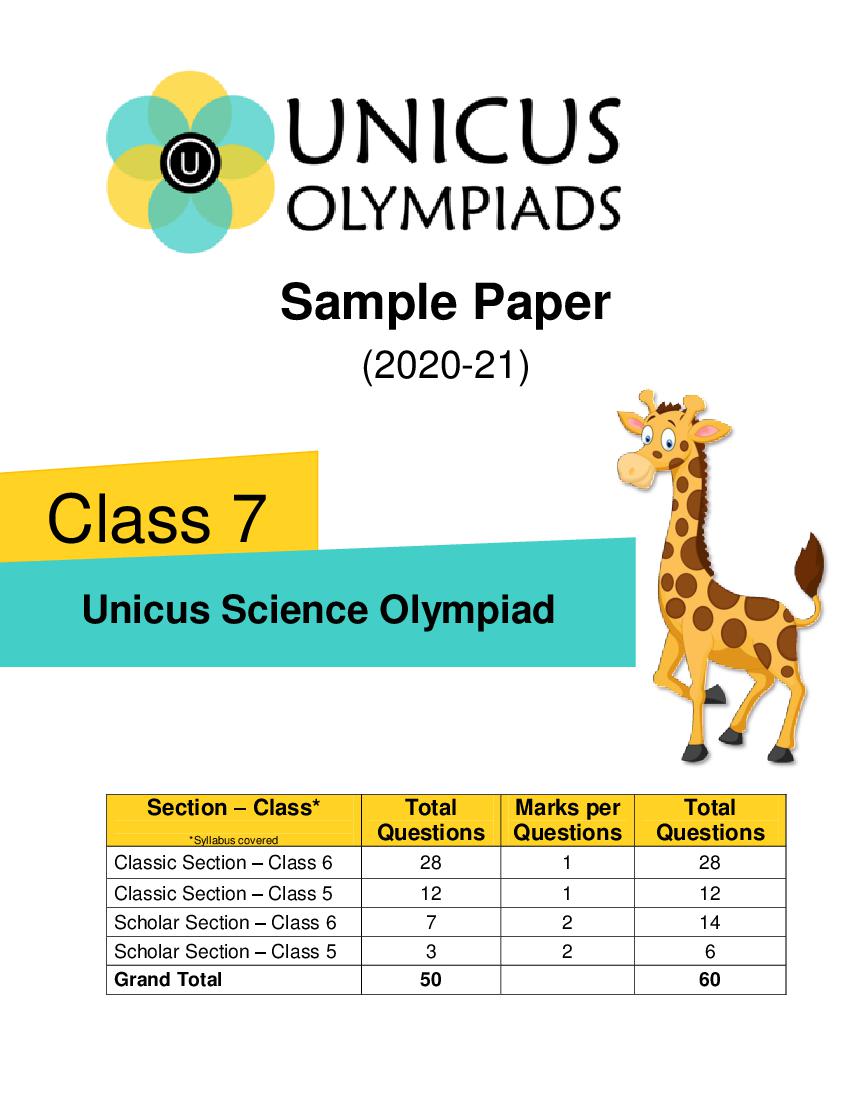
(2020-21)
Class 7
Unicus Science Olympiad
Section – Class* Total Marks per Total
*Syllabus covered Questions Questions Questions
Classic Section – Class 6 28 1 28
Classic Section – Class 5 12 1 12
Scholar Section – Class 6 7 2 14
Scholar Section – Class 5 3 2 6
Grand Total 50 60
Page 2
X is an impurity which needs to be removed. What type of separating method will you
use to obtain pure solid Y?
a) Sieving b) Winnowing
c) Threshing d) Magnetic separation
Correct Answer: b 1 Mark
2. Read the following statements and choose the correct option:
Statement 1: A boy wearing coloured contact lens, grey in the left eye and green in the
right eye, standing in front of a plane mirror observes the left eye green
and the right eye as grey.
Statement 2: Lateral inversion makes the left side appears right and right side appears
left.
a) Statement 1 is correct but statement 2 is incorrect.
b) Statement 1 is incorrect but statement 2 is correct.
c) Both the statements are correct and statement 2 is the correct explanation of
statement 1.
d) Both the statements are correct but statement 2 is not the correct explanation of
statement 1.
Correct Answer: c 1 Mark
3. Consider the table given below and select the correct option:
Habitat Plant/Animal Adaptive feature
Mountain A Strong hooves
B C Long ears
D Cactus Long roots
a) A – Mountain goats, B –Rainforests, C – Camel, D – Desert
b) A – Deer, B – Desert, C – Yak, D – Temperate forest
c) A –Yak, B – Grasslands, C – Deer, D – Desert
d) A –Yak, B – Desert, C – Camel, D – Desert
Correct Answer: c 1 Mark
2
Page 3
at 11:00 am. It makes a scheduled halt of 30 minutes and then starts for place ‘R’ which
is 60 km from ‘Q’. If it reaches ‘R’ at 1:30 pm. Find the average speed of the train:
a) 280/9 kmh-1 b) 300/7 kmh-1
c) 280 kmh-1 d) 150 kmh-1
Correct Answer: a 1 Mark
5. Shravan connected two bulbs across two cells in a simple circuit. How can he make the
bulbs glow dimmer?
a) Replace one cell with a piece of chalk. b) Replace one bulb with a piece of wire.
c) Replace one bulb with another cell. d) Replace one cell with a piece of wire.
Correct Answer: d 1 Mark
6. Match the following:
List I List II
P. Dissolution 1. Non-periodic change
Q. Heating of sugar 2. Chemical change
R. Occurrence of a new moon 3. Physical change
S. Occurrence of a rainbow 4. Periodic change
a) P – 3, Q – 2, R – 4, S – 1 b) P – 2, Q – 3, R – 4, S – 1
c) P – 3, Q – 2, R – 1, S – 4 d) P – 2, Q – 3, R – 1, S – 4
Correct Answer: a 1 Mark
3
Page 4
following machines work the same way?
a) Wheelbarrow b) Tongs
c) Claw hammer d) Scissors
Correct Answer: c 1 Mark
8.
Read the following clues about the constellation ‘X’ shown above and identify ‘X’:
Clue 1: It is also called The Hunter.
Clue 2: This constellation is visible in the winter season.
Clue 3: The brightest star in the sky, Sirius, can be located with the help of this
constellation.
a) Ursa major b) Ursa minor
c) Orion d) Cassiopeia
Correct Answer: c 1 Mark
4
Page 5
in his science laboratory. He held one end of the cotton yarn with a tong and brought
the other end over the flame of a candle. He then performed the same activity with
different yarns and observed carefully.
Which of the following observations is/are correct?
1.Cotton yarn does not catch fire easily. It does not shrink or melt on burning. It gives
the odour of burning hair on heating
2. Wool yarn catches fire easily. It shrinks and melt on burning. It gives the odour of
burning paper on heating.
3. Silk yarn does not catch fire easily. It shrinks away from the flame but does not melt.
It gives the odour of charred meat on heating.
a) 1 only b) 2 only
c) 3 only d) Both 2 and 3
Correct Answer: c 2 Marks
10. Anamika poured equal amounts of water, each of a different temperature into two identical
glasses, A and B. She then covered them with the identical lids. After five minutes, she
observed the water droplets as shown below:
a) Water in Glass A – Cold, Water in Glass B - Cold
b) Water in Glass A – Hot, Water in Glass B - Hot
c) Water in Glass A – Cold, Water in Glass B - Hot
d) Water in Glass A – Hot, Water in Glass B - Cold
Correct Answer: d 2 Marks
5
Document Details
| Board / Org | Default |
| Exam | Unicus |
| Type | Sample Paper |
| Pages | 5 |
| Language | english |
| Updated | 22 Jul 2026 |