PSEB 12th Class Syllabus 2027 Economics
Finished viewing? Save it for later —
Download PSEB 12th Class Syllabus 2027 Economics (PDF · 4 pages)About PSEB 12th Class Syllabus 2027 Economics
PSEB 12th Class Syllabus 2027 Economics is available here for free download. Published by Punjab Board for Class 12, this syllabus can be viewed online or downloaded as a PDF (4 pages). Candidates preparing for Class 12 can use PSEB 12th Class Syllabus 2027 Economics to understand the exam pattern, the type of questions asked, and the overall difficulty level.
Frequently Asked Questions
How can I download PSEB 12th Class Syllabus 2027 Economics?
Open this page and click the Download button to save PSEB 12th Class Syllabus 2027 Economics as a PDF. It is completely free on AglaSem Docs.
Is PSEB 12th Class Syllabus 2027 Economics free to download?
Yes. PSEB 12th Class Syllabus 2027 Economics can be viewed online and downloaded as a PDF free of cost on AglaSem Docs.
How many pages does PSEB 12th Class Syllabus 2027 Economics have?
PSEB 12th Class Syllabus 2027 Economics contains 4 pages, which you can read online or download together as a single PDF.
Where can I find more Class 12 study material?
You can find more Class 12 question papers, sample papers, syllabus, and answer keys on AglaSem Docs.
PSEB 12th Class Syllabus 2027 Economics – Text
Read the full text of this syllabus below — useful to quickly search, copy and reference the content online without downloading the PDF.
📄 View text version (5 pages)
Page 1
PSEB 12th Class
Syllabus 2027
Economics
EXAM YEAR TYPE SUBJECT
Punjab Class 12 2027 Syllabus Economics
Notes · Sample Papers · Previous Year Papers · Mock Tests
Page 2
m c. o
c. o
e m
em l a s
s ag
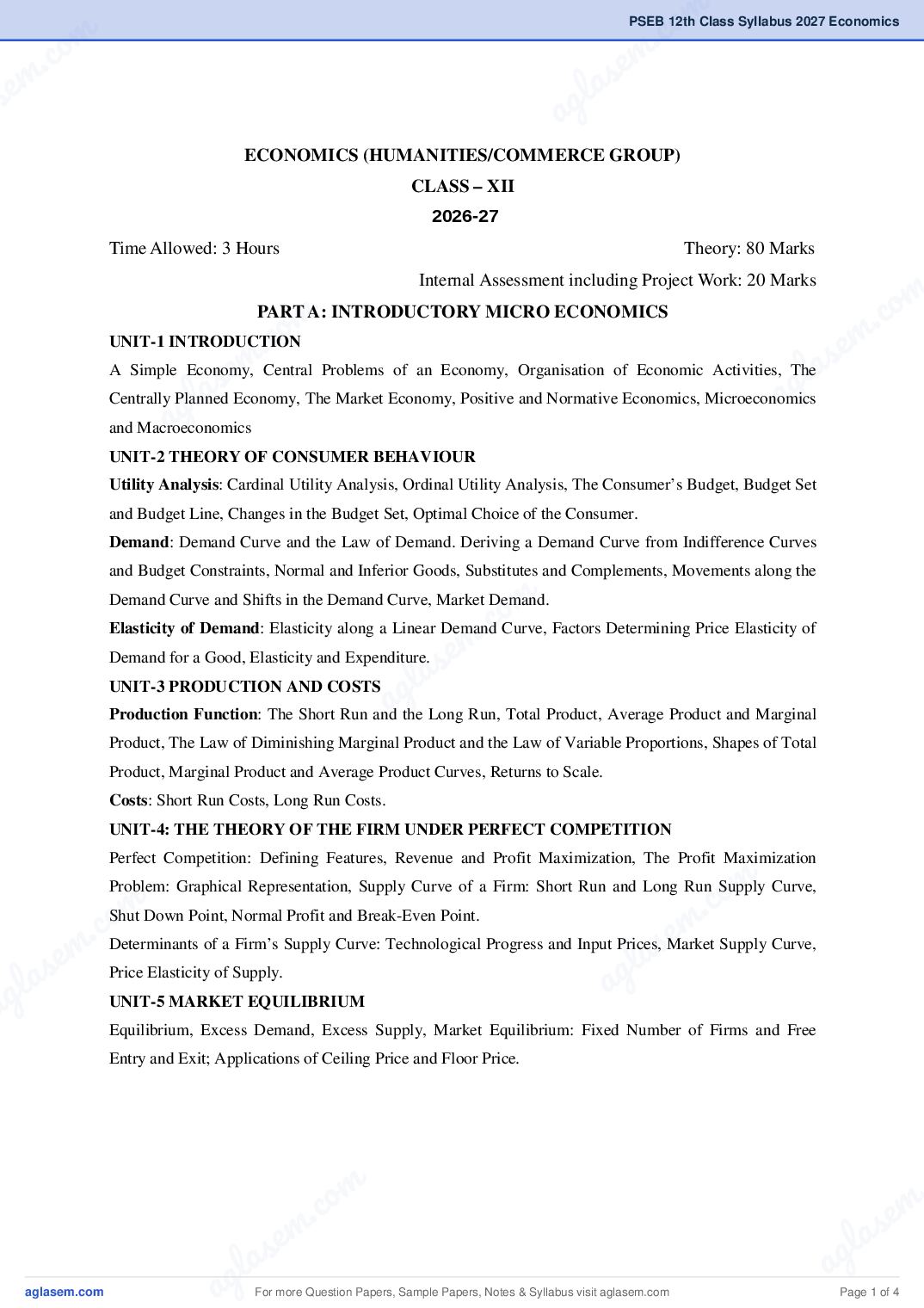
ECONOMICS (HUMANITIES/COMMERCE GROUP)
CLASS – XII
2026-27
Time Allowed: 3 Hours Theory: 80 Marks
m
.co
Internal Assessment including Project Work: 20 Marks
m
co m
PART A: INTRODUCTORY MICRO ECONOMICS
m . s e
e Central Problems of an Economy, Organisation of Economic Activities, The a
UNIT-1 INTRODUCTION
a s g l
l a
A Simple Economy,
ag
Centrally Planned Economy, The Market Economy, Positive and Normative Economics, Microeconomics
and Macroeconomics
UNIT-2 THEORY OF CONSUMER BEHAVIOUR
Utility Analysis: Cardinal Utility Analysis, Ordinal Utility Analysis, The Consumer’s Budget, Budget Set
and Budget Line, Changes in the Budget Set, Optimal Choice of the Consumer.
Demand: Demand Curve and the Law of Demand. Deriving a Demand Curve from Indifference Curves
m
and Budget Constraints, Normal and Inferior Goods, Substitutes and Complements, Movements along the
c. o
Demand Curve and Shifts in the Demand Curve, Market Demand.
Demand for a Good, Elasticity and Expenditure. em
Elasticity of Demand: Elasticity along a Linear Demand Curve, Factors Determining Price Elasticity of
l a s
agthe Long Run, Total Product, Average Product and Marginal
UNIT-3 PRODUCTION AND COSTS
Production Function: The Short Run and
Product, The Law of Diminishing Marginal Product and the Law of Variable Proportions, Shapes of Total
Product, Marginal Product and Average Product Curves, Returns to Scale.
Costs: Short Run Costs, Long Run Costs.
UNIT-4: THE THEORY OF THE FIRM UNDER PERFECT COMPETITION
m
Perfect Competition: Defining Features, Revenue and Profit Maximization, The Profit Maximization
omDown Point, Normal Profit and Break-Even Point. c. o
Problem: Graphical Representation, Supply Curve of a Firm: Short Run and Long Run Supply Curve,
c. Shut e m Supply Curve,
Determinants of a Firm’s Supply Curve: Technological Progress and Input Prices,sMarket
s em Price Elasticity of Supply. g l a
gla a
a UNIT-5 MARKET EQUILIBRIUM
Equilibrium, Excess Demand, Excess Supply, Market Equilibrium: Fixed Number of Firms and Free
Entry and Exit; Applications of Ceiling Price and Floor Price.
m .
.co s e m
e m l a
l a s ag
ag For more Question Papers, Sample Papers, Notes & Syllabus visit Page 1 of 4
Page 3
UNIT-1 INTRODUCTION
Introduction and Emergence of Macroeconomics
UNIT-2 NATIONAL INCOME ACCOUNTING
Some Basic Concepts of Macroeconomics; Circular Flow of Income and Methods of Calculating National
Income: The Product or Value-Added Method, Expenditure Method and Income Method. Concepts of
Factor Cost, Basic Prices and Market Prices.
Some Macroeconomic Identities, Nominal and Real GDP, GDP and Welfare
UNIT-3 MONEY AND BANKING
Functions of Money, Demand for Money and Supply of Money, Money Creation by Banking System:
Balance Sheet of a Fictional Bank, Limits to Credit Creation and Money Multiplier. Policy Tools to
Control Money Supply.
UNIT-4 DETERMINATION OF INCOME AND EMPLOYMENT
Aggregate Demand and its Components: Consumption, Investment. Determination of Income in Two-
Sector Model.
Determination of Equilibrium Income in the Short Run: Macroeconomic Equilibrium with Price Level
Fixed, Effect of an Autonomous Change in Aggregate Demand on Income and Output. The Multiplier
Mechanism.
UNIT- 5 GOVERNMENT BUDGET AND THE ECONOMY
Government Budget – Meaning and its Components, Objectives of Government Budget, Classification of
Receipts, Classification of Expenditure, Balanced, Surplus and Deficit Budget, Measures of Government
Deficit.
UNIT-6 OPEN ECONOMY MACROECONOMICS
Balance of Payments: Current Account, Capital Account, Balance of Payments Surplus and Deficit.
The Foreign Exchange Market: Foreign Exchange Rate, Determination of the Exchange Rate, Merits
and Demerits of Flexible and Fixed Exchange Rate Systems, Managed Floating.
Developing Project in Economics
The students may be encouraged to develop projects, as per the suggested project guidelines.
Case studies of a few organisations/outlets may also be encouraged. Under this, the students will
do only ONE comprehensive project using concepts from Part A, B and C of their syllabus.
Guidelines for Project Work in Economics
The objectives of the project work are to enable learners to:
Probe deeper into theoretical concepts learnt in XI and XII
Analyse and evaluate real world economic scenarios using theoretical constructs and
arguments
Demonstrate the learning of economic theory
For more Question Papers, Sample Papers, Notes & Syllabus visit Page 2 of 4
Page 4
m c. o
c. o
e m
em l a s
s ag
Follow up aspects of Economics in which learners have interest
Develop the communication skills to argue Logically
The expectations of the project work are that:
Learners will complete ONE project and will work on one topic of Moral Values and try
to imbibe those values along with the Project Work in each academic session.
m
.co
Project should be of 1000 words (excluding diagrams & graphs), preferably hand-written
m
It will be an independent, self-directed piece of study
.co e m
Role of the teacher
em
The teacher plays a critical role in developing thinking skills of the learners. A teacher should:
la s
l a s
Help each learner select the topic based on recently published extracts from the news
a g
ag
media, government policies, RBI bulletin, NITI Aayog reports, IMF/World Bank reports
etc., after detailed discussions and deliberations of the topic.
Play the role of a facilitator and supervisor to monitor the project work of the learner
through periodic discussions
Guide the research work in terms of sources for the relevant data.
Educate learner about plagiarism and the importance of quoting the source of the
information to ensure authenticity of research work
Prepare the learner for the presentation of the project work
m
co
Arrange a presentation of the project file
.
Scope of the project
s em
Learners may work upon the following lines as a suggested flow chart:
l a
Choose a title/topic of the research problem
a g
Set objectives of the research problem
Design of a questionnaire /Selection of Sources
Framing a sample & collection of data / material
Classification of data / material
m
m c. o
c. o Analysis of data/ material (with various statistical techniques i.e. mean,smedian,
m SD, CV,
Presentation of data/ material (with graphs and tables)
e
s em g l a
gla a
different derivations of economics laws and models etc.)
a Interpretation of data (draw the relevant conclusion from the collected data/material)
Suggestions to solve the problem
References / Bibliography
m .
.co s e m
e m l a
l a s a g
ag For more Question Papers, Sample Papers, Notes & Syllabus visit Page 3 of 4
Page 5
Introduction of topic/title
Identifying the causes, consequences and/or remedies
Various stakeholders and effect on each of them
Advantages and disadvantages of situations or issues identified
Short-term and long-term implications of economic strategies suggested in the course of
research.
Validity, reliability, appropriateness and relevance of data used for research work and for
presentation in the project file.
Presentation and writing that is succinct and coherent in project file
Citation of the materials referred to, in the file in footnotes, resources section,
bibliography etc.
Mode of presentation/submission of the Project
At the end of the stipulated term, each student will present the research work in the Project File
to the External and Internal examiner. The questions should be asked from the Research Work/
Project File of the learner through viva-voce. The Internal Examiner should ensure that the
research report submitted by the learner is his/her own original work. In case of any doubt,
authenticity should be checked and verified.
Some of the examples of the projects are as follows (they are not mandatory but only
suggestive):
1. Goods and Services Tax and its impact on GDP
2. A critical analysis of the present year Government Budget
3. Digital India- A step towards the future
4. Role of RBI in controlling Money Supply in India
5. Analysis of functions of commercial banks.
6. Application of law of demand in real life.
7. Analysis of different market situations.
8. Analysis of cost structure of any local industry/agricultural farm.
9. Analysis of revenue receipts of any local industry.
10. Prepare a report on working of local shopping mall/grain market.
11. Comparative analysis of exchange rates of different currencies.
12. Visit and prepare a report on working of bank in your vicinity.
13. Make a time series of nominal and real GDP/GNP of India.
14. Prepare monthly budget of your family and draw budge line.
Moral Value Topics:
1. Sarv Shiksha Abhiyan- Cost benefit Analysis
2. Waste Management- A need of the Hour
3. Make in India- The way ahead
4. Rain water harvesting- A solution to water problem in India
5. Organic Farming- Back to the nature
For more Question Papers, Sample Papers, Notes & Syllabus visit Page 4 of 4
Document Details
| Board / Org | Punjab Board |
| Exam | Class 12 |
| Type | Syllabus |
| Pages | 4 |
| Updated | 04 Nov 2026 |