RRB Section Controller 2026 Question Paper Feb 11 Shift 2
Finished viewing? Save it for later —
Download RRB Section Controller 2026 Question Paper Feb 11 Shift 2 (PDF · 24 pages)About RRB Section Controller 2026 Question Paper Feb 11 Shift 2
RRB Section Controller 2026 Question Paper Feb 11 Shift 2 is available here for free download. Published by Railway for Railway Section Controller, this question paper can be viewed online or downloaded as a PDF (24 pages). Candidates preparing for Railway Section Controller can use RRB Section Controller 2026 Question Paper Feb 11 Shift 2 to understand the exam pattern, the type of questions asked, and the overall difficulty level.
Frequently Asked Questions
How can I download RRB Section Controller 2026 Question Paper Feb 11 Shift 2?
Open this page and click the Download button to save RRB Section Controller 2026 Question Paper Feb 11 Shift 2 as a PDF. It is completely free on AglaSem Docs.
Is RRB Section Controller 2026 Question Paper Feb 11 Shift 2 free to download?
Yes. RRB Section Controller 2026 Question Paper Feb 11 Shift 2 can be viewed online and downloaded as a PDF free of cost on AglaSem Docs.
How many pages does RRB Section Controller 2026 Question Paper Feb 11 Shift 2 have?
RRB Section Controller 2026 Question Paper Feb 11 Shift 2 contains 24 pages, which you can read online or download together as a single PDF.
Where can I find more Railway Section Controller study material?
You can find more Railway Section Controller question papers, sample papers, syllabus, and answer keys on AglaSem Docs.
RRB Section Controller 2026 Question Paper Feb 11 Shift 2 – Text
Read the full text of this question paper below — useful to quickly search, copy and reference the content online without downloading the PDF.
📄 View text version (24 pages)
Page 1
Test Time 1:00 PM - 3:00 PM
Subject RRB SECTION CONTROLLER CBT 1
* Note
Correct Answer will carry 1 mark per Question.
Incorrect Answer will carry 1/3 Negative mark per Question.
1. Options shown in green color with a tick icon are correct.
2. Chosen option on the right of the question indicates the option selected by the candidate.
Section : RRB SECTION CONTROLLER CBT 1
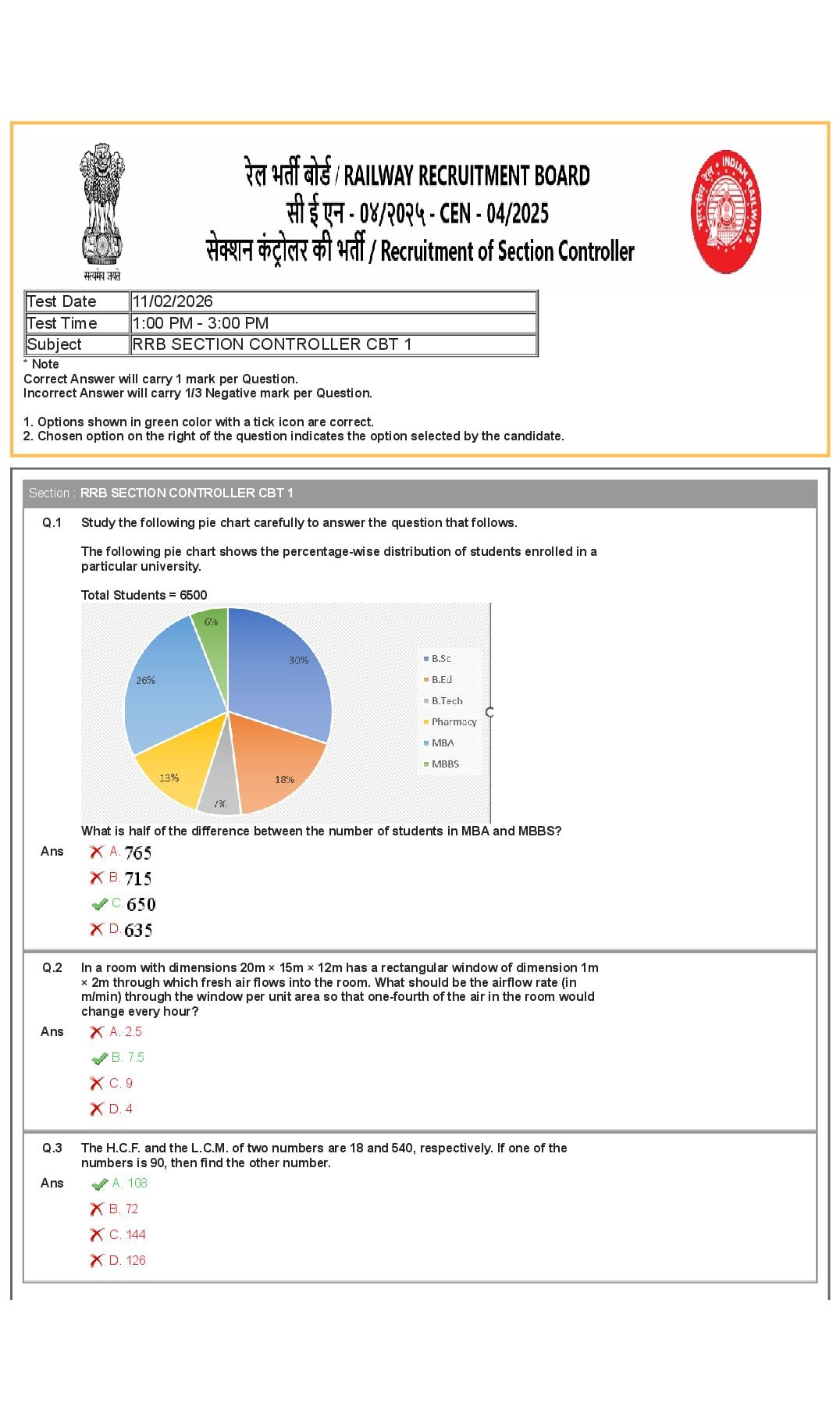
Q.1 Study the following pie chart carefully to answer the question that follows.
The following pie chart shows the percentage-wise distribution of students enrolled in a
particular university.
Total Students = 6500
What is half of the difference between the number of students in MBA and MBBS?
Ans A.
B.
C.
D.
Q.2 In a room with dimensions 20m × 15m × 12m has a rectangular window of dimension 1m
× 2m through which fresh air flows into the room. What should be the airflow rate (in
m/min) through the window per unit area so that one-fourth of the air in the room would
change every hour?
Ans A. 2.5
B. 7.5
C. 9
D. 4
Q.3 The H.C.F. and the L.C.M. of two numbers are 18 and 540, respectively. If one of the
numbers is 90, then find the other number.
Ans A. 108
B. 72
C. 144
D. 126
Page 2
60 consumers in a locality.
Monthly Consumption (in Number of
units) consumers
50 - 65 5
65 - 80 8
80 - 95 12
95 - 110 18
110 - 125 10
125 - 140 7
What is the median of the data (correct to 2 decimal places)?
Ans A. 81.19
B. 85.13
C. 73.27
D. 99.17
Q.5 The position(s) of how many letters will remain unchanged if each letter in the word
JOURNAL is arranged in the English alphabetical order?
Ans A. 0
B. 3
C. 2
D. 1
Q.6 The prices of each article of types P, Q, and R are ₹280, ₹180, and ₹110, respectively.
Shanu buys articles of each type in the ratio 3 : 2 : 5 for a total of ₹7000. How many
articles of type Q did he purchase?
Ans A. 10
B. 6
C. 8
D. 4
Q.7 Find the sum of all prime numbers greater than 2 but less than 30.
Ans A. 129
B. 127
C. 136
D. 178
Q.8 The 7-digit number 34A690B is divisible by 3. What is the maximum value of (A + B)?
Ans A. 16
B. 17
C. 14
D. 18
Q.9 In what ratio must a grocer mix two varieties of wheat worth ₹68 per kg and ₹128 per kg,
so that if he sells the mixture at ₹138 per kg, he may gain 38%?
Ans A. 7:8
B. 1:1
C. 15:17
D. 17:13
Page 3
Monday and ending on Sunday of the same week. N has a flight immediately before I. P
has a flight on one of the days after G. Only three people have flights before O. H has a
flight immediately after I. Only one person has a flight after J. How many people have
flights between P and H?
Ans A. Two
B. Four
C. Three
D. One
Comprehension:
Read the given passage and answer questions that follow.
The Ajanta and Ellora caves, nestled in the rugged hills of Maharashtra, stand as monumental testaments to India’s artistic and
spiritual legacy. Carved meticulously between the 2nd century BCE and the 10th century CE, these rock-cut sanctuaries embody the
seamless blend of devotion, architecture, and aesthetic mastery. The Ajanta caves, primarily Buddhist, depict the evolution of Buddhist
thought through exquisite murals, sculptures, and chaitya halls that narrate the Jataka tales—the stories of the Buddha’s previous
lives. Their walls come alive with vibrant frescoes that capture both divine and human emotions, executed with natural pigments that
have withstood centuries. Ellora, located a short distance away, is celebrated for its religious plurality—housing Buddhist, Hindu, and
Jain monuments within a single complex. The crowning jewel, the Kailasa Temple (Cave 16), carved from a single basalt rock, is a
marvel of engineering and imagination. Dedicated to Lord Shiva, it replicates Mount Kailasa and symbolizes the cosmic centre of
creation. The intricate carvings, soaring pillars, and multi-tiered structures reflect a synthesis of art and devotion unparalleled in world
architecture. Together, Ajanta and Ellora transcend time, offering insight into India’s cultural harmony and artistic brilliance. They are
not merely monuments but living galleries—chiselled by faith, guided by precision, and preserved as echoes of an era where art was
prayer and stone became scripture.
SubQuestion No : 11
Q.11 According to the passage, which feature of the Ajanta caves is directly responsible for
conveying the evolution of Buddhist thought?
Ans A. The chronological span of cave excavation from the 2nd century BCE onward
B. The execution of frescoes using natural pigments that endured over time
C. The depiction of divine and human emotions through mural techniques
D. The chaitya halls and sculptural programs narrating the Jataka tales
Comprehension:
Read the given passage and answer questions that follow.
The Ajanta and Ellora caves, nestled in the rugged hills of Maharashtra, stand as monumental testaments to India’s artistic and
spiritual legacy. Carved meticulously between the 2nd century BCE and the 10th century CE, these rock-cut sanctuaries embody the
seamless blend of devotion, architecture, and aesthetic mastery. The Ajanta caves, primarily Buddhist, depict the evolution of Buddhist
thought through exquisite murals, sculptures, and chaitya halls that narrate the Jataka tales—the stories of the Buddha’s previous
lives. Their walls come alive with vibrant frescoes that capture both divine and human emotions, executed with natural pigments that
have withstood centuries. Ellora, located a short distance away, is celebrated for its religious plurality—housing Buddhist, Hindu, and
Jain monuments within a single complex. The crowning jewel, the Kailasa Temple (Cave 16), carved from a single basalt rock, is a
marvel of engineering and imagination. Dedicated to Lord Shiva, it replicates Mount Kailasa and symbolizes the cosmic centre of
creation. The intricate carvings, soaring pillars, and multi-tiered structures reflect a synthesis of art and devotion unparalleled in world
architecture. Together, Ajanta and Ellora transcend time, offering insight into India’s cultural harmony and artistic brilliance. They are
not merely monuments but living galleries—chiselled by faith, guided by precision, and preserved as echoes of an era where art was
prayer and stone became scripture.
SubQuestion No : 12
Q.12 What specific aspect of the Kailasa Temple is presented as evidence of its architectural
and symbolic ambition?
Ans A. Its excavation from a single basalt rock forming a multi-tiered structure
B. Its dedication to Lord Shiva as a sacred embodiment of Mount Kailasa
C. Its intricate carvings and soaring pillars reflecting artistic devotion
D. Its location within a complex containing monuments of multiple faiths
Page 4
Read the given passage and answer questions that follow.
The Ajanta and Ellora caves, nestled in the rugged hills of Maharashtra, stand as monumental testaments to India’s artistic and
spiritual legacy. Carved meticulously between the 2nd century BCE and the 10th century CE, these rock-cut sanctuaries embody the
seamless blend of devotion, architecture, and aesthetic mastery. The Ajanta caves, primarily Buddhist, depict the evolution of Buddhist
thought through exquisite murals, sculptures, and chaitya halls that narrate the Jataka tales—the stories of the Buddha’s previous
lives. Their walls come alive with vibrant frescoes that capture both divine and human emotions, executed with natural pigments that
have withstood centuries. Ellora, located a short distance away, is celebrated for its religious plurality—housing Buddhist, Hindu, and
Jain monuments within a single complex. The crowning jewel, the Kailasa Temple (Cave 16), carved from a single basalt rock, is a
marvel of engineering and imagination. Dedicated to Lord Shiva, it replicates Mount Kailasa and symbolizes the cosmic centre of
creation. The intricate carvings, soaring pillars, and multi-tiered structures reflect a synthesis of art and devotion unparalleled in world
architecture. Together, Ajanta and Ellora transcend time, offering insight into India’s cultural harmony and artistic brilliance. They are
not merely monuments but living galleries—chiselled by faith, guided by precision, and preserved as echoes of an era where art was
prayer and stone became scripture.
SubQuestion No : 13
Q.13 The author’s description of Ajanta and Ellora as “living galleries” most plausibly implies
that these sites:
Ans A. Remain dynamic conveyors of cultural and spiritual meaning
B. Were primarily designed for public exhibition rather than worship
C. Continue to attract modern artistic reinterpretations
D. Functioned as static repositories of religious artefacts
Comprehension:
Read the given passage and answer questions that follow.
The Ajanta and Ellora caves, nestled in the rugged hills of Maharashtra, stand as monumental testaments to India’s artistic and
spiritual legacy. Carved meticulously between the 2nd century BCE and the 10th century CE, these rock-cut sanctuaries embody the
seamless blend of devotion, architecture, and aesthetic mastery. The Ajanta caves, primarily Buddhist, depict the evolution of Buddhist
thought through exquisite murals, sculptures, and chaitya halls that narrate the Jataka tales—the stories of the Buddha’s previous
lives. Their walls come alive with vibrant frescoes that capture both divine and human emotions, executed with natural pigments that
have withstood centuries. Ellora, located a short distance away, is celebrated for its religious plurality—housing Buddhist, Hindu, and
Jain monuments within a single complex. The crowning jewel, the Kailasa Temple (Cave 16), carved from a single basalt rock, is a
marvel of engineering and imagination. Dedicated to Lord Shiva, it replicates Mount Kailasa and symbolizes the cosmic centre of
creation. The intricate carvings, soaring pillars, and multi-tiered structures reflect a synthesis of art and devotion unparalleled in world
architecture. Together, Ajanta and Ellora transcend time, offering insight into India’s cultural harmony and artistic brilliance. They are
not merely monuments but living galleries—chiselled by faith, guided by precision, and preserved as echoes of an era where art was
prayer and stone became scripture.
SubQuestion No : 14
Q.14 From the passage’s treatment of Ellora’s religious plurality, one may reasonably infer
that the creators of the complex endorsed:
Ans A. A neutral artistic agenda detached from theological significance
B. Competitive religious expression within a shared geographic space
C. Sequential religious dominance reflected through architectural change
D. An integrative cultural framework accommodating multiple belief systems
Page 5
Read the given passage and answer questions that follow.
The Ajanta and Ellora caves, nestled in the rugged hills of Maharashtra, stand as monumental testaments to India’s artistic and
spiritual legacy. Carved meticulously between the 2nd century BCE and the 10th century CE, these rock-cut sanctuaries embody the
seamless blend of devotion, architecture, and aesthetic mastery. The Ajanta caves, primarily Buddhist, depict the evolution of Buddhist
thought through exquisite murals, sculptures, and chaitya halls that narrate the Jataka tales—the stories of the Buddha’s previous
lives. Their walls come alive with vibrant frescoes that capture both divine and human emotions, executed with natural pigments that
have withstood centuries. Ellora, located a short distance away, is celebrated for its religious plurality—housing Buddhist, Hindu, and
Jain monuments within a single complex. The crowning jewel, the Kailasa Temple (Cave 16), carved from a single basalt rock, is a
marvel of engineering and imagination. Dedicated to Lord Shiva, it replicates Mount Kailasa and symbolizes the cosmic centre of
creation. The intricate carvings, soaring pillars, and multi-tiered structures reflect a synthesis of art and devotion unparalleled in world
architecture. Together, Ajanta and Ellora transcend time, offering insight into India’s cultural harmony and artistic brilliance. They are
not merely monuments but living galleries—chiselled by faith, guided by precision, and preserved as echoes of an era where art was
prayer and stone became scripture.
SubQuestion No : 15
Q.15 The frescoes of Ajanta are described as “vibrant”. Which option best conveys the
antonym of this term in the given context?
Ans A. Paintings rendered with pigments resilient to time
B. Murals that evoke divine and human emotion through colour
C. Walls whose imagery lacks visual vitality and expressive force
D. Frescoes preserved as evidence of artistic mastery
Q.16
Ans A. 3528
B. 3530
C. 3536
D. 3527
Q.17 In the given figure, O is the centre of the circle. Find ∠ BAC.
1102
Ans A. 72°
B. 80°
C. 65°
D. 84°
Page 6
the same day?
Ans
A.
B.
C.
D.
Q.19 The sum of the present ages of Lokesh and Taresh is 28 years. After 2 years from now,
Lokesh's age will be three times that of Taresh. Lokesh's present age (in years) is:
Ans A. 16
B. 24
C. 22
D. 19
Q.20 Find the value of m for which it satisfies
Ans
A.
B.
C.
D.
Q.21 Based on the English alphabetical order, three of the following four letter-clusters are
alike in a certain way and thus form a group. Which letter-cluster DOES NOT belong to
that group?
(Note: The odd one out is not based on the number of consonants/vowels or their
position in the letter-cluster.)
Ans A. CZTR
B. LICA
C. RPJG
D. VSMK
Q.22 If each of the digits in the number cluster 5389436 is arranged in ascending order from
left to right, the position of how many digits will remain unchanged as compared to that
in the original number?
Ans A. Four
B. Three
C. Two
D. One
Page 7
Counting is to be done from left to right only. (Note: All numbers are single-digit
numbers only)
(Left) 2 8 # $ 2 4 @ 5 7 5 9 @ 9 \ > & 7 9 @ > * ^ & (Right)
How many such numbers are there each of which is immediately preceded by a symbol
and also immediately followed by a symbol?
Ans A. One
B. Zero
C. Two
D. Three
Q.24 Eight people are sitting in two parallel rows containing 4 people each in such a way that
there is equal distance between adjacent persons.
In row 1 – S, T, U and V are seated and all of them are facing south.
In row 2 – C, D, E and F are seated and all of them are facing north.
Thus each person faces another person from the other row.
T sits third to the right of S. The one facing F is an immediate neighbour of S. The one
facing V is an immediate neighbour of F. The one facing T is an immediate neighbour of
D. C sits at some place to the left of E.
Who amongst the following faces D?
Ans A. V
B. S
C. U
D. T
Q.25 Which of the following letter-clusters should replace # and % so that the pattern and
relationship followed between the letter-cluster pair on the left side of :: is the same as
that on the right side of :: ?
# : HKO :: FIM : %
Ans A. # = KLJ, % = CKL
B. # = POR, % = CNJ
C. # = KNJ, % = CJK
D. # = KNR, % = CFJ
Q.26 The simplified value of 81 - [54 - (56 ÷ 8 - (18 - 32 ÷ 4) ÷ 4)] is:
Ans
A.
B.
C.
D.
Q.27 By how much is 30% of 65 greater than 35% of 40?5385
Ans A. 0.5
B. 7.5
C. 2.5
D. 5.5
Page 8
Read the given passage and answer questions that follow.
Tuesday, September 11, 2001, began like any other late-summer morning in the eastern United States — mild, sunlit, and calm. The
sky over New York City was an unbroken blue, reflecting off the glass façades of its skyscrapers. Across the country, millions stirred
into their daily rhythm — parents preparing children for school, commuters boarding trains, and office workers hurrying toward another
routine day. In Lower Manhattan, thousands made their way into the Twin Towers, the proud centerpiece of the World Trade Center
complex, unaware that history was quietly converging upon them.
In Arlington, Virginia, the Pentagon’s corridors filled with the measured pace of military precision, while across the Potomac River,
Congress reconvened in session, its agenda focused on domestic policy and budgetary matters. At the White House, tourists gathered
expectantly for their morning tours, cameras ready to capture an ordinary day in the capital.
Farther south, in Sarasota, Florida, President George W Bush began his day with an early jog before visiting a local school to discuss
education reform. Air traffic across the nation operated under perfect conditions — clear skies and steady winds, ideal for flying.
Among the countless travellers navigating airports that morning were two men, Mohamed Atta and Abdul Aziz al-Omari, who arrived
quietly at Portland International Jetport in Maine.
No one yet knew that within hours, this serene morning would fracture into one of the darkest days in modern history — when calm
skies became witnesses to unimaginable tragedy.
SubQuestion No : 28
Q.28 According to the passage, what was the primary focus of Congress on the morning of
September 11, 2001?
Ans A. It was reconvened to discuss domestic policy and budgetary concerns.
B. It was addressing emergency legislation related to military preparedness.
C. It was meeting to review intelligence reports and defence strategies.
D. It was engaged in debates on foreign policy and national security matters.
Comprehension:
Read the given passage and answer questions that follow.
Tuesday, September 11, 2001, began like any other late-summer morning in the eastern United States — mild, sunlit, and calm. The
sky over New York City was an unbroken blue, reflecting off the glass façades of its skyscrapers. Across the country, millions stirred
into their daily rhythm — parents preparing children for school, commuters boarding trains, and office workers hurrying toward another
routine day. In Lower Manhattan, thousands made their way into the Twin Towers, the proud centerpiece of the World Trade Center
complex, unaware that history was quietly converging upon them.
In Arlington, Virginia, the Pentagon’s corridors filled with the measured pace of military precision, while across the Potomac River,
Congress reconvened in session, its agenda focused on domestic policy and budgetary matters. At the White House, tourists gathered
expectantly for their morning tours, cameras ready to capture an ordinary day in the capital.
Farther south, in Sarasota, Florida, President George W Bush began his day with an early jog before visiting a local school to discuss
education reform. Air traffic across the nation operated under perfect conditions — clear skies and steady winds, ideal for flying.
Among the countless travellers navigating airports that morning were two men, Mohamed Atta and Abdul Aziz al-Omari, who arrived
quietly at Portland International Jetport in Maine.
No one yet knew that within hours, this serene morning would fracture into one of the darkest days in modern history — when calm
skies became witnesses to unimaginable tragedy.
SubQuestion No : 29
Q.29 In which sequence of locations does the passage most clearly trace the morning’s
unfolding across the United States?
Ans A. Florida → Virginia → Maine → New York
B. Washington, D.C. → Maine → New York → Florida
C. Maine → New York → Florida → Virginia
D. New York → Virginia → Washington, D.C. → Florida → Maine
Page 9
Read the given passage and answer questions that follow.
Tuesday, September 11, 2001, began like any other late-summer morning in the eastern United States — mild, sunlit, and calm. The
sky over New York City was an unbroken blue, reflecting off the glass façades of its skyscrapers. Across the country, millions stirred
into their daily rhythm — parents preparing children for school, commuters boarding trains, and office workers hurrying toward another
routine day. In Lower Manhattan, thousands made their way into the Twin Towers, the proud centerpiece of the World Trade Center
complex, unaware that history was quietly converging upon them.
In Arlington, Virginia, the Pentagon’s corridors filled with the measured pace of military precision, while across the Potomac River,
Congress reconvened in session, its agenda focused on domestic policy and budgetary matters. At the White House, tourists gathered
expectantly for their morning tours, cameras ready to capture an ordinary day in the capital.
Farther south, in Sarasota, Florida, President George W Bush began his day with an early jog before visiting a local school to discuss
education reform. Air traffic across the nation operated under perfect conditions — clear skies and steady winds, ideal for flying.
Among the countless travellers navigating airports that morning were two men, Mohamed Atta and Abdul Aziz al-Omari, who arrived
quietly at Portland International Jetport in Maine.
No one yet knew that within hours, this serene morning would fracture into one of the darkest days in modern history — when calm
skies became witnesses to unimaginable tragedy.
SubQuestion No : 30
Q.30 What can be inferred about the narrative perspective from the way the events are
presented?
Ans A. It reflects the hindsight of a chronicler aware of the disaster’s magnitude.
B. It mirrors the dispassionate tone of a news report.
C. It adopts the tone of an official government statement.
D. It imitates the viewpoint of an eyewitness at the scene.
Comprehension:
Read the given passage and answer questions that follow.
Tuesday, September 11, 2001, began like any other late-summer morning in the eastern United States — mild, sunlit, and calm. The
sky over New York City was an unbroken blue, reflecting off the glass façades of its skyscrapers. Across the country, millions stirred
into their daily rhythm — parents preparing children for school, commuters boarding trains, and office workers hurrying toward another
routine day. In Lower Manhattan, thousands made their way into the Twin Towers, the proud centerpiece of the World Trade Center
complex, unaware that history was quietly converging upon them.
In Arlington, Virginia, the Pentagon’s corridors filled with the measured pace of military precision, while across the Potomac River,
Congress reconvened in session, its agenda focused on domestic policy and budgetary matters. At the White House, tourists gathered
expectantly for their morning tours, cameras ready to capture an ordinary day in the capital.
Farther south, in Sarasota, Florida, President George W Bush began his day with an early jog before visiting a local school to discuss
education reform. Air traffic across the nation operated under perfect conditions — clear skies and steady winds, ideal for flying.
Among the countless travellers navigating airports that morning were two men, Mohamed Atta and Abdul Aziz al-Omari, who arrived
quietly at Portland International Jetport in Maine.
No one yet knew that within hours, this serene morning would fracture into one of the darkest days in modern history — when calm
skies became witnesses to unimaginable tragedy.
SubQuestion No : 31
Q.31 What main idea does the passage convey by showing an ordinary morning before the
attacks?
Ans A. That weather conditions caused travel problems
B. That peaceful normalcy can hide approaching danger
C. That life in America was dull and repetitive
D. That political activity was the focus of the morning
Page 10
Read the given passage and answer questions that follow.
Tuesday, September 11, 2001, began like any other late-summer morning in the eastern United States — mild, sunlit, and calm. The
sky over New York City was an unbroken blue, reflecting off the glass façades of its skyscrapers. Across the country, millions stirred
into their daily rhythm — parents preparing children for school, commuters boarding trains, and office workers hurrying toward another
routine day. In Lower Manhattan, thousands made their way into the Twin Towers, the proud centerpiece of the World Trade Center
complex, unaware that history was quietly converging upon them.
In Arlington, Virginia, the Pentagon’s corridors filled with the measured pace of military precision, while across the Potomac River,
Congress reconvened in session, its agenda focused on domestic policy and budgetary matters. At the White House, tourists gathered
expectantly for their morning tours, cameras ready to capture an ordinary day in the capital.
Farther south, in Sarasota, Florida, President George W Bush began his day with an early jog before visiting a local school to discuss
education reform. Air traffic across the nation operated under perfect conditions — clear skies and steady winds, ideal for flying.
Among the countless travellers navigating airports that morning were two men, Mohamed Atta and Abdul Aziz al-Omari, who arrived
quietly at Portland International Jetport in Maine.
No one yet knew that within hours, this serene morning would fracture into one of the darkest days in modern history — when calm
skies became witnesses to unimaginable tragedy.
SubQuestion No : 32
Q.32 In the context of the phrase 'an ordinary day in the capital', which term expresses the
opposite meaning of 'ordinary'?
Ans A. Monumental
B. Predictable
C. Routine
D. Civil
Q.33 A, B, C, D, E, F, G and H are sitting around a square table. Some of them are sitting at
the corners, while some are sitting at the exact centres of the sides. All of them are
facing the centre. Only three people are sitting between B and F when counted from the
left of B. D is sitting to the immediate right of F. Only three people are sitting between D
and E when counted from the left of D. E is not sitting at any of the corners. Only two
people are sitting between G and H when counted from the left of G. A is sitting to the
immediate right of G. G is not an immediate neighbour of E. How many people are
sitting between C and F, when counted from the right of C?
Ans A. Three
B. Two
C. Zero
D. One
Q.34 Select the triad that follows the same pattern as that followed by the two triads given
below. Both triads follow the same pattern.
DK-GM-IL
GN-JP-LO
Ans A. IQ-MS-PR
B. IQ-MT-PR
C. JQ-MS-OR
D. JQ-MS-PR
Page 11
Read the given passage carefully and answer the questions that follow.
Waste is among the most pressing environmental issues in India. As the world's second-most populous nation with nearly 1.4 billion
people, India inevitably generates a staggering 277 million tonnes of Municipal Solid Waste (MSW) annually. Experts estimate that by
2030, MSW is likely to reach 387.8 million tonnes and will more than double the current value by 2050. India’s rapid urbanisation
makes waste management extremely challenging. Currently, about 5% of the total collected waste is recycled, 18% is composted, and
the remaining is dumped at landfill sites.
The plastic crisis in India is one of the worst on the planet. According to the Central Pollution Control Board (CPCB), India currently
produces more than 25,000 tonnes of plastic waste every day on average, which accounts for almost 6% of the total solid waste
generated in the country. India stands second among the top 20 countries having a high proportion of riverine plastic emissions, both
nationally and globally. The Indus, Brahmaputra, and Ganges rivers are known as the ‘highways of plastic flows’ as they carry and
drain most of the plastic debris in the country. Together with ten other topmost polluted rivers, they leak nearly 90% of plastics into the
sea globally.
To tackle this issue, in 2020, the government announced that it would ban the manufacture, sale, distribution, and use of single-use
plastics from July 1, 2022, onwards.
SubQuestion No : 35
Q.35 Which of the following most accurately states the main idea of the passage?
Ans A. The catastrophic effect of riverine plastic emissions from the Ganges, Indus, and Brahmaputra on global oceans.
B. The vast scale and specific challenges of municipal solid waste and plastic pollution in India.
C. Expert estimates show the massive projected increase in India's Municipal Solid Waste (MSW) production by 2030 and 2050.
D. The high rate of plastic waste generation (25,000 tonnes daily) and India's second-place ranking in riverine pollution.
Comprehension:
Read the given passage carefully and answer the questions that follow.
Waste is among the most pressing environmental issues in India. As the world's second-most populous nation with nearly 1.4 billion
people, India inevitably generates a staggering 277 million tonnes of Municipal Solid Waste (MSW) annually. Experts estimate that by
2030, MSW is likely to reach 387.8 million tonnes and will more than double the current value by 2050. India’s rapid urbanisation
makes waste management extremely challenging. Currently, about 5% of the total collected waste is recycled, 18% is composted, and
the remaining is dumped at landfill sites.
The plastic crisis in India is one of the worst on the planet. According to the Central Pollution Control Board (CPCB), India currently
produces more than 25,000 tonnes of plastic waste every day on average, which accounts for almost 6% of the total solid waste
generated in the country. India stands second among the top 20 countries having a high proportion of riverine plastic emissions, both
nationally and globally. The Indus, Brahmaputra, and Ganges rivers are known as the ‘highways of plastic flows’ as they carry and
drain most of the plastic debris in the country. Together with ten other topmost polluted rivers, they leak nearly 90% of plastics into the
sea globally.
To tackle this issue, in 2020, the government announced that it would ban the manufacture, sale, distribution, and use of single-use
plastics from July 1, 2022, onwards.
SubQuestion No : 36
Q.36 Which is the best description of the tone of the passage?
Ans A. Casual and conversational
B. Humorous and entertaining
C. Serious and cautionary
D. Optimistic and celebratory
Page 12
Read the given passage carefully and answer the questions that follow.
Waste is among the most pressing environmental issues in India. As the world's second-most populous nation with nearly 1.4 billion
people, India inevitably generates a staggering 277 million tonnes of Municipal Solid Waste (MSW) annually. Experts estimate that by
2030, MSW is likely to reach 387.8 million tonnes and will more than double the current value by 2050. India’s rapid urbanisation
makes waste management extremely challenging. Currently, about 5% of the total collected waste is recycled, 18% is composted, and
the remaining is dumped at landfill sites.
The plastic crisis in India is one of the worst on the planet. According to the Central Pollution Control Board (CPCB), India currently
produces more than 25,000 tonnes of plastic waste every day on average, which accounts for almost 6% of the total solid waste
generated in the country. India stands second among the top 20 countries having a high proportion of riverine plastic emissions, both
nationally and globally. The Indus, Brahmaputra, and Ganges rivers are known as the ‘highways of plastic flows’ as they carry and
drain most of the plastic debris in the country. Together with ten other topmost polluted rivers, they leak nearly 90% of plastics into the
sea globally.
To tackle this issue, in 2020, the government announced that it would ban the manufacture, sale, distribution, and use of single-use
plastics from July 1, 2022, onwards.
SubQuestion No : 37
Q.37 What is the synonym of the word ‘dumped‘ from the passage?
Ans A. Protected
B. Decorated
C. Domesticated
D. Discarded
Comprehension:
Read the given passage carefully and answer the questions that follow.
Waste is among the most pressing environmental issues in India. As the world's second-most populous nation with nearly 1.4 billion
people, India inevitably generates a staggering 277 million tonnes of Municipal Solid Waste (MSW) annually. Experts estimate that by
2030, MSW is likely to reach 387.8 million tonnes and will more than double the current value by 2050. India’s rapid urbanisation
makes waste management extremely challenging. Currently, about 5% of the total collected waste is recycled, 18% is composted, and
the remaining is dumped at landfill sites.
The plastic crisis in India is one of the worst on the planet. According to the Central Pollution Control Board (CPCB), India currently
produces more than 25,000 tonnes of plastic waste every day on average, which accounts for almost 6% of the total solid waste
generated in the country. India stands second among the top 20 countries having a high proportion of riverine plastic emissions, both
nationally and globally. The Indus, Brahmaputra, and Ganges rivers are known as the ‘highways of plastic flows’ as they carry and
drain most of the plastic debris in the country. Together with ten other topmost polluted rivers, they leak nearly 90% of plastics into the
sea globally.
To tackle this issue, in 2020, the government announced that it would ban the manufacture, sale, distribution, and use of single-use
plastics from July 1, 2022, onwards.
SubQuestion No : 38
Q.38 Which of the following represents the structure of the passage?
Ans A. Problem-Solution
B. Chronological
C. Compare-Contrast
D. Definition
Page 13
Read the given passage carefully and answer the questions that follow.
Waste is among the most pressing environmental issues in India. As the world's second-most populous nation with nearly 1.4 billion
people, India inevitably generates a staggering 277 million tonnes of Municipal Solid Waste (MSW) annually. Experts estimate that by
2030, MSW is likely to reach 387.8 million tonnes and will more than double the current value by 2050. India’s rapid urbanisation
makes waste management extremely challenging. Currently, about 5% of the total collected waste is recycled, 18% is composted, and
the remaining is dumped at landfill sites.
The plastic crisis in India is one of the worst on the planet. According to the Central Pollution Control Board (CPCB), India currently
produces more than 25,000 tonnes of plastic waste every day on average, which accounts for almost 6% of the total solid waste
generated in the country. India stands second among the top 20 countries having a high proportion of riverine plastic emissions, both
nationally and globally. The Indus, Brahmaputra, and Ganges rivers are known as the ‘highways of plastic flows’ as they carry and
drain most of the plastic debris in the country. Together with ten other topmost polluted rivers, they leak nearly 90% of plastics into the
sea globally.
To tackle this issue, in 2020, the government announced that it would ban the manufacture, sale, distribution, and use of single-use
plastics from July 1, 2022, onwards.
SubQuestion No : 39
Q.39 What is the ANTONYM of the word 'challenging’?
Ans A. Manageable
B. Frequent
C. Uninspiring
D. Tolerable
Q.40 What will come in place of the question mark (?) in the following equation if ‘+’ and ‘−’
are interchanged and ‘×’ and ‘÷’ are interchanged?
16 ÷ 2 − 48 × 6 + 15 = ?
Ans A. 20
B. 17
C. 28
D. 25
Q.41 The 11th term of the A.P. whose first and second terms are 32 and 9 , is:
Ans A. -198
B. -195
C. -197
D. -201
Q.42 Select the pair which follows the same pattern as that followed by the two pairs given
below. Both pairs follow the same pattern.
TVT−PRP
BDB−XZX
Ans A. OPM−KMK
B. OQO−KMK
C. OQO−JMJ
D. OPM−JLJ
Q.43 Each of G, H, I, J, N, O and P has a flight on a different day of a week starting from
Monday and ending on Sunday of the same week. Only three people have a flight
between H and G. Only one person has a flight between P and N. O has a flight
immediately the day before I. Only two people have a flight before H. J doesn't have a
flight on Friday. P has a flight immediately after J. How many people have a flight before
J?
Ans A. None
B. One
C. Three
D. Two
Page 14
the probability that the sum of the numbers rolled is greater than 8?
Ans
A.
B.
C.
D.
Q.45
322
Ans A.
B.
C.
D.
Q.46 If a man bought 8 board pins for ₹4, and sold them at 5 board pins for ₹9, then the gain
percentage is:
Ans A. 270%
B. 250%
C. 280%
D. 260%
Q.47 Consider the data set: 4, 8, 6, 5, 3, 9. Find the standard deviation (correct up to two
decimal places).
Ans A. 2.11
B. 1.76
C. 2.31
D. 1.83
Q.48 The circumference of the base of a cylindrical vessel is 440 cm and its height is 25 cm.
How many litres of water can it hold?
Ans A. 349
B. 399
C. 424
D. 385
Q.49 Six boxes A, B, C, D, E, and F are kept one over the other but not necessarily in the
same order. D is kept third from the bottom. Only one box is kept between D and F. A is
kept immediately below B. C is kept immediately below D. E is kept immediately above
B.
Which box is third from the top?
Ans A. E
B. F
C. B
D. A
Page 15
average be?
Ans A. 71
B. 57
C. 64
D. 8
Q.51 In what ratio must a grocer mix two varieties of rice worth ₹66 per kg and ₹108 per kg,
so that if he sells the mixture at ₹143 per kg, he may gain 43%?
Ans A. 4:17
B. 3:16
C. 1:3
D. 7:11
Q.52 Find the class interval corresponding to the class mark xi = 27, where the lower limit of
the first continuous class interval is 7.
xi fi
11 3
19 7
27 11
35 5
43 3
Ans A. 23 – 31
B. 21 – 33
C. 22 – 32
D. 24 – 30
Q.53 A and B started a business with investments in the ratio 5 : 6. After 6 months, A
increased his investment by 60% and B decreased his investment by 25%. At the end of
the year, the total profit was ₹28,153. Find A’s share in the profit.
Ans A. ₹10,616
B. ₹13,616
C. ₹21,616
D. ₹15,574
Q.54 A data set consists of six test scores: 18, 22, 24, 28, 30, and 35. Find the median of this
data set.
Ans A. 32
B. 26
C. 24
D. 28
Q.55 A man adds water to milk to gain profit. He mixes water with milk worth ₹70/litre to get a
final mixture costing ₹55/litre. What is the ratio of milk to water in the mixture?
Ans A. 11 : 3
B. 8 : 3
C. 12 : 5
D. 9 : 4
Page 16
cluster.
ELS BIP YFM VCJ SZG PVD
Ans A. VCJ
B. YFM
C. SZG
D. PVD
Q.57 If x is added to the numbers 2, 8, 1, 5, the resulting numbers, in order, are in proportion.
Find the mean proportion of the terms 2x + 1 and 5x - 2.
Ans A. 3
B. 7
C. 1
D. 5
Q.58
Ans
A.
B.
C.
D.
Q.59 Based on the English alphabetical order, three of the following four letter-clusters are
alike in a certain way and thus form a group. Which letter-cluster DOES NOT belong to
that group?
(Note: The odd one out is not based on the number of consonants/vowels or their
position in the letter-cluster.)
Ans A. PRV
B. GIL
C. NPT
D. KMQ
Q.60 The perimeter of an isosceles triangle is 36 cm and the altitude to its base is 12 cm.
Find the area of the triangle (in cm2).
Ans A. 60
B. 90
C. 140
D. 120
Q.61 In an A.P., the common difference is -7 and the first term is 31. Find the 10th term.
Ans A. -29
B. -32
C. -30
D. -33
Page 17
the ratio of the radii of their bases is 4 : 3. If the volume of the cylinder is 630 cm3, then
the volume (in cm3) of the cone is:
Ans A. 441
B. 449
C. 444
D. 448
Q.63 A worker earns ₹1,200 for working 8 hours. At the same rate, how much will he earn for
working 12 hours?
Ans A. ₹1,800
B. ₹2,000
C. ₹1,400
D. ₹2,200
Q.64 A large cuboid-shaped container has the following dimensions: length = 15 meters,
width = 8 meters, and height = 6 meters. A cube-shaped object with an edge length of 4
meters is placed inside the container. How many such cubes can be placed inside the
container without any part sticking out?
Ans A. 10
B. 12
C. 8
D. 6
Q.65 The sum of two positive numbers is 59 and their product is 564. The positive difference
between them is:
Ans A. 35
B. 34
C. 47
D. 55
Q.66 In a certain code language, ‘came after me’ is coded as ‘bg sp zh’ and ‘who came first’ is
coded as ‘km cy sp’. How is ‘came’ coded in the given language?
Ans A. bg
B. sp
C. cy
D. zh
Q.67 The following table shows the wages (in ₹) of a group of workers.
20-30 30-40 40-50 50-60 60-70
Wages (in ₹)
25 12 15 13 5
Number of Workers
Find the median wage. (Round your answer to the nearest paise.)
Ans A.
B.
C.
D.
Page 18
ARN XVK UZH SDF OHB LLY
Ans A. OHB
B. XVK
C. SDF
D. LLY
Q.69
315
Ans A. 19.404
B. 38.808
C. 9.702
D. 28.702
Q.70 A train P going at the speed of 33 km/h completely passes train Q of length 452 m,
going in the same direction on parallel tracks, at 24 km/h, in 9.5 minutes. How much
time (in seconds) will P take to completely cross train R of length 482 m, going at 21
km/h in the opposite direction?
Ans A. 96
B. 97
C. 83
D. 112
Q.71 The curved surface area and the total surface area of a cylinder are in the ratio 1:16. If
the total surface area of the right cylinder is 6028.8 cm2, then its volume (in cm3) is:
1565
Ans A. 5656
B. 5648
C. 5652
D. 5624
Q.72 q is the mean proportional of p and r. q2 is the mean proportional of p2r and r3. Find the
value of q if p = 169, where p, q, r are natural numbers.
Ans A. 13
B. 45
C. 52
D. 26
Q.73 F is the sister of G. G is the brother of S. T is the father of V. V is the son of S. How is F
related to T?
Ans A. Father's sister
B. Wife's sister
C. Sister
D. Wife's mother
Page 19
what is his profit percentage?
(Round off your answer to two decimal places.)
Ans A. 38.67%
B. 28.87%
C. 27.87%
D. 39.67%
Q.75 78 is related to 97 following a certain logic. Following the same logic, 117 is related to
136. To which of the given options is 148 related, following the same logic?
(NOTE: Operations should be performed on the whole numbers, without breaking down
the numbers into their constituent digits. E.g. 13 – Operations on 13 such as adding
to/subtracting from/multiplying with 13 can be performed. Breaking down 13 into 1 and
3 and then performing mathematical operations on 1 and 3 is not allowed.)
Ans A. 171
B. 183
C. 159
D. 167
Q.76 A right circular cone and a right circular cylinder have equal base and equal height. If
the radius of the base and the height are in the ratio 5 : 12, then the ratio of the total
surface area of the cylinder to that of the cone is:
Ans A. 0.5875
B. 12 : 4
C. 16 : 5
D. 17 : 9
Q.77 Based on the English alphabetical order, three of the following four letter-cluster pairs
are alike in a certain way and thus form a group. Which letter-cluster pair DOES NOT
belong to that group?
(Note: The odd one out is not based on the number of consonants/vowels or their
position in the letter-cluster.)
Ans A. JN - HL
B. JK - JI
C. PT - NR
D. QU - OS
Q.78 The mean and mode of a data set are 52 and 55, respectively. Find the median of the
data set.
Ans A. 50
B. 53
C. 48
D. 51
Q.79 What will come in the place of the question mark (?) in the following equation, if '+' and
'−' are interchanged and ‘×’ and ‘÷’ are interchanged?
304 − 17 ÷ 11 + 253 × 11 = ?
Ans A. 468
B. 475
C. 470
D. 466
Page 20
on alternate days, starting with B on the first day, then in how many days will the work
be completed?
Ans
A. 14
B.
C.
D. 15
Q.81 A hemispherical dome of radius 14 m is to be painted both inside and outside. If the
cost of painting is ₹45 per m2 and a platform costing ₹1,200 is needed for the work, find
the total cost.
Ans A. ₹1,10,200
B. ₹1,12,080
C. ₹1,08,500
D. ₹1,14,500
Q.82 Study the line graph and answer the question that follows.
The given line graph shows the temperature in °C in a city over six days.
What is the difference between the maximum and minimum temperatures recorded?
Ans A. 5°C
B. 7°C
C. 6°C
D. 4°C
Q.83 AB is parallel to CD. A transversal PQ intersects AB and CD at E and F, respectively, and
∠ PEB = 65°. G is a point between AB and CD such that ∠ BEG = 22° and ∠ GFE = 12°.
What is the measure of ∠ EGF?
Ans A. 63°
B. 88°
C. 73°
D. 75°
Page 21
price. He sells X by giving two successive discounts of 20% and 35% and still earns
₹616 as profit. If he sells Y at a single discount of 48%, then what is the profit
percentage on Y?
Ans A. 6%
B. 6.7%
C. 7%
D. 7.7%
Q.85 A circular ground has a radius of 42 meters. A running track surrounds this ground, and
it is 7 meters wide. Find the outer perimeter of the running track. (Use )
Ans A. 254 meters
B. 224 meters
C. 154 meters
D. 308 meters
Q.86 A mobile phone is marked at ₹88,500. After applying successive discounts of 8%, 5%
and 2%, what will be its final selling price (in ₹), rounded to the nearest integer?
Ans A. 75,802
B. 74,098
C. 72,345
D. 76,781
Q.87 Each of the digits in the number 2597836 is arranged in ascending order from left to
right. What will be the sum of the digits that are second from the left and second from
the right in the new number thus formed?
Ans A. 7
B. 9
C. 11
D. 13
Q.88 Three numbers are in the ratio 1:2:3. If their LCM is 198, find their HCF.
Ans A. 11
B. 18
C. 33
D. 9
Q.89 The 7-digit number 23A908B is divisible by 3. What is the maximum value of (A + B)?
Ans A. 16
B. 17
C. 14
D. 13
Q.90 Refer to the following number series and answer the question that follows. Counting is
to be done from left to right only. (All numbers are single-digit numbers only.)
(Left) 6 7 5 1 7 1 2 7 6 4 3 9 4 5 3 2 3 5 1 6 8 4 6 2 4 5 8 (Right)
How many such even numbers are there that are immediately preceded by an odd
number and also immediately followed by an odd number?
Ans A. Two
B. Three
C. Four
D. Five
Page 22
can B alone do 70-times of the same work?
Ans A. 280
B. 260
C. 272
D. 281
Q.92 The average of the numbers 6.5, 10.6, 20.3 and a is 18. The value of a is:
Ans A. 36.6
B. 33.6
C. 35.6
D. 34.6
Q.93 Saeed allows two successive discounts of 30% and 10% on the marked price of a pen,
which is equal to a single discount of ₹592. Then how much profit (in %) will Saeed get
on that pen, if the cost price is ₹900?961
Ans A. 12%
B. 10%
C. 11%
D. 13%
Q.94 The following data gives the information on the observed lifetime (in hours) of 225
electronic components.
Lifetime (in 0 - 10 10 - 20 20 - 30 30 - 40 40 - 50 50 - 60
hours)
Number of 11 36 52 61 37 28
electronic
components
What is the modal lifetime (in hours, rounded to 2 decimal places) of the components?
Ans A. 32.73
B. 32.33
C. 33.72
D. 37.32
Q.95 A person saves 90% of his income. If his expenditure is ₹600, then his income (in ₹) is:
Ans A. 5400
B. 6040
C. 6000
D. 6080
Q.96 What should come in place of the question mark (?) in the given series?
212 213 217 226 242 ?
Ans A. 266
B. 264
C. 265
D. 267
Page 23
Class interval Frequency
0-80 8
8-16 7
16-24 16
24-32 24
32-40 15
40-48 7
(Round off your answer to two decimal places)
Ans A.
B.
C.
D.
Q.98 Read the given statement(s) and conclusions carefully. Assuming that the information
given in the statements is true, even if it appears to be at variance with commonly
known facts, decide which of the given conclusions logically follow(s) from the
statement(s).
Statements:
All vegetables are leeches.
All fruits are leeches.
Conclusions:
(I): Some vegetables are fruits.
(II): Some leeches are fruits.
Ans A. Neither conclusion (I) nor (II) follows
B. Only conclusion (I) follows
C. Only conclusion (II) follows
D. Both conclusions (I) and (II) follow
Q.99 The following pie chart shows the details of material used in the construction of a
building. The total cost of construction is ₹25,00,000. Study the chart and answer the
question that follows.
Calculate the expenditure on iron, bricks and cement used in the construction of the
building.
Ans A. ₹14,50,000
B. ₹15,50,000
C. ₹12,50,000
D. ₹17,50,000
Page 24
first train runs at the rate of 60 km/h and the second train at the rate of 48 km/h. How
long will they take to cross each other?
Ans A. 19 seconds
B. 25 seconds
C. 12 seconds
D. 17 seconds
"
Document Details
| Board / Org | Railway |
| Exam | Railway Section Controller |
| Type | Question Paper |
| Pages | 24 |
| Language | english |
| Updated | 24 Sep 2026 |