RRB Section Controller 2026 Question Paper Feb 12 Shift 2
Finished viewing? Save it for later —
Download RRB Section Controller 2026 Question Paper Feb 12 Shift 2 (PDF · 23 pages)About RRB Section Controller 2026 Question Paper Feb 12 Shift 2
RRB Section Controller 2026 Question Paper Feb 12 Shift 2 is available here for free download. Published by Railway for Railway Section Controller, this question paper can be viewed online or downloaded as a PDF (23 pages). Candidates preparing for Railway Section Controller can use RRB Section Controller 2026 Question Paper Feb 12 Shift 2 to understand the exam pattern, the type of questions asked, and the overall difficulty level.
Frequently Asked Questions
How can I download RRB Section Controller 2026 Question Paper Feb 12 Shift 2?
Open this page and click the Download button to save RRB Section Controller 2026 Question Paper Feb 12 Shift 2 as a PDF. It is completely free on AglaSem Docs.
Is RRB Section Controller 2026 Question Paper Feb 12 Shift 2 free to download?
Yes. RRB Section Controller 2026 Question Paper Feb 12 Shift 2 can be viewed online and downloaded as a PDF free of cost on AglaSem Docs.
How many pages does RRB Section Controller 2026 Question Paper Feb 12 Shift 2 have?
RRB Section Controller 2026 Question Paper Feb 12 Shift 2 contains 23 pages, which you can read online or download together as a single PDF.
Where can I find more Railway Section Controller study material?
You can find more Railway Section Controller question papers, sample papers, syllabus, and answer keys on AglaSem Docs.
RRB Section Controller 2026 Question Paper Feb 12 Shift 2 – Text
Read the full text of this question paper below — useful to quickly search, copy and reference the content online without downloading the PDF.
📄 View text version (23 pages)
Page 1
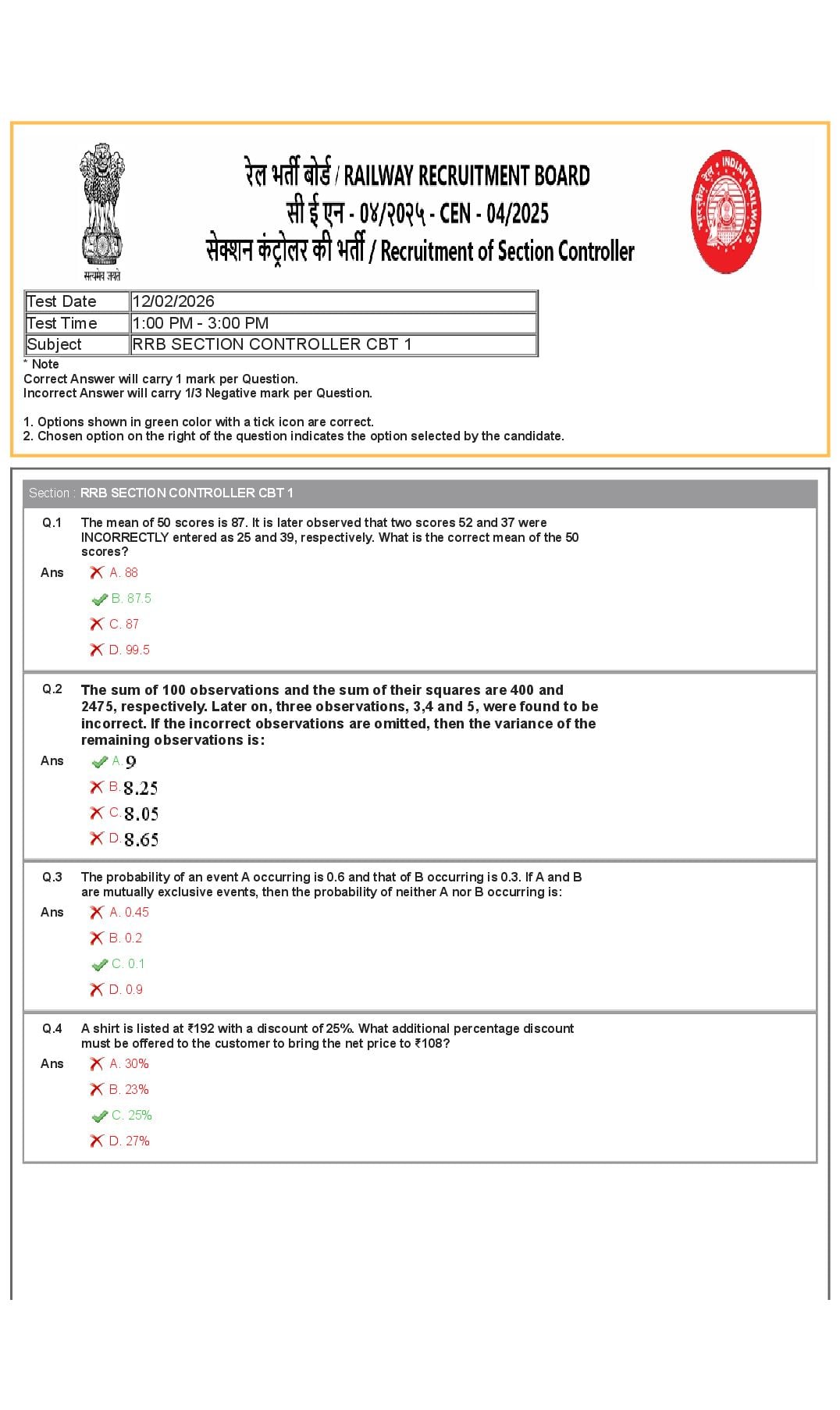
Test Time 1:00 PM - 3:00 PM
Subject RRB SECTION CONTROLLER CBT 1
* Note
Correct Answer will carry 1 mark per Question.
Incorrect Answer will carry 1/3 Negative mark per Question.
1. Options shown in green color with a tick icon are correct.
2. Chosen option on the right of the question indicates the option selected by the candidate.
Section : RRB SECTION CONTROLLER CBT 1
Q.1 The mean of 50 scores is 87. It is later observed that two scores 52 and 37 were
INCORRECTLY entered as 25 and 39, respectively. What is the correct mean of the 50
scores?
Ans A. 88
B. 87.5
C. 87
D. 99.5
Q.2 The sum of 100 observations and the sum of their squares are 400 and
2475, respectively. Later on, three observations, 3,4 and 5, were found to be
incorrect. If the incorrect observations are omitted, then the variance of the
remaining observations is:
Ans A.
B.
C.
D.
Q.3 The probability of an event A occurring is 0.6 and that of B occurring is 0.3. If A and B
are mutually exclusive events, then the probability of neither A nor B occurring is:
Ans A. 0.45
B. 0.2
C. 0.1
D. 0.9
Q.4 A shirt is listed at ₹192 with a discount of 25%. What additional percentage discount
must be offered to the customer to bring the net price to ₹108?1090
Ans A. 30%
B. 23%
C. 25%
D. 27%
Page 2
efficient than B. B and C work together for 36 days. A alone will complete the remaining
work in:
Ans A. 67 days
B. 72 days
C. 77 days
D. 71 days
Q.6
11166
Ans A. 19 minutes
B. 20 minutes
C. 16 minutes
D. 11 minutes
Q.7 What should come in place of the question mark (?) in the given series?
717 720 710 714 705 710 702 ?
Ans A. 712
B. 708
C. 706
D. 710
Q.8 Refer to the following letter series and answer the question that follows.
(Left) M E Q A K Q G Z Y B R I S O V C P F U H D (Right)
How many letters are there in the English alphabetical series between the letter which is
second from the right end and second from the left end of the series? 11234
Ans A. Three
B. Two
C. One
D. None
Comprehension:
Read the given passage carefully and answer the questions that follow.
Until about five years ago, the very idea that peptide hormones might be made anywhere in the brain besides the hypothalamus was
astounding. Peptide hormones, scientists thought, were made by endocrine glands and the hypothalamus was thought to be the
brains’ only endocrine gland. What is more, because peptide hormones cannot cross the blood-brain barrier, researchers believed that
they never got to any part of the brain other than the hypothalamus, where they were simply produced and then released into the
bloodstream. But these beliefs about peptide hormones were questioned as laboratory after laboratory found that antiserums to
peptide hormones, when injected into the brain, bind in places other than the hypothalamus, indicating that either the hormones or
substances that cross-react with the antiserums are present. The immunological method of detecting peptide hormones by means of
antiserums, however, is imprecise. Cross-reactions are possible and this method cannot determine whether the substances detected
by the antiserums really are the hormones, or merely close relatives. Furthermore, this method cannot be used to determine the
location in the body where the detected substances are actually produced. New techniques of molecular biology, however, provide a
way to answer these questions. It is possible to make specific complementary DNA’s (cDNA’s) that can serve as molecular probes to
seek out the messenger RNA’s (mRNA’s) of the peptide hormones.
SubQuestion No : 9
Q.9 According to the passage, what was the traditional belief about peptide hormones in the
brain?
Ans A. Peptide hormones were widely produced throughout the brain in multiple locations.
B. Peptide hormones were made only by endocrine glands and the hypothalamus.
C. Peptide hormones could freely cross the blood-brain barrier to reach all brain regions.
D. Peptide hormones were involved in cognitive processes rather than endocrine functions.
Page 3
Read the given passage carefully and answer the questions that follow.
Until about five years ago, the very idea that peptide hormones might be made anywhere in the brain besides the hypothalamus was
astounding. Peptide hormones, scientists thought, were made by endocrine glands and the hypothalamus was thought to be the
brains’ only endocrine gland. What is more, because peptide hormones cannot cross the blood-brain barrier, researchers believed that
they never got to any part of the brain other than the hypothalamus, where they were simply produced and then released into the
bloodstream. But these beliefs about peptide hormones were questioned as laboratory after laboratory found that antiserums to
peptide hormones, when injected into the brain, bind in places other than the hypothalamus, indicating that either the hormones or
substances that cross-react with the antiserums are present. The immunological method of detecting peptide hormones by means of
antiserums, however, is imprecise. Cross-reactions are possible and this method cannot determine whether the substances detected
by the antiserums really are the hormones, or merely close relatives. Furthermore, this method cannot be used to determine the
location in the body where the detected substances are actually produced. New techniques of molecular biology, however, provide a
way to answer these questions. It is possible to make specific complementary DNA’s (cDNA’s) that can serve as molecular probes to
seek out the messenger RNA’s (mRNA’s) of the peptide hormones.
SubQuestion No : 10
Q.10 Select the option that the passage is primarily based upon.
Ans A. The effects of peptide hormones on cognitive and behavioral functions and activities in humans.
B. The established and standardized methods used to synthesize peptide hormones in laboratory conditions.
C. The traditional and classical role of endocrine glands in regulating hormones throughout the body.
D. The discovery and study of peptide hormones in regions of the brain beyond the hypothalamus.
Comprehension:
Read the given passage carefully and answer the questions that follow.
Until about five years ago, the very idea that peptide hormones might be made anywhere in the brain besides the hypothalamus was
astounding. Peptide hormones, scientists thought, were made by endocrine glands and the hypothalamus was thought to be the
brains’ only endocrine gland. What is more, because peptide hormones cannot cross the blood-brain barrier, researchers believed that
they never got to any part of the brain other than the hypothalamus, where they were simply produced and then released into the
bloodstream. But these beliefs about peptide hormones were questioned as laboratory after laboratory found that antiserums to
peptide hormones, when injected into the brain, bind in places other than the hypothalamus, indicating that either the hormones or
substances that cross-react with the antiserums are present. The immunological method of detecting peptide hormones by means of
antiserums, however, is imprecise. Cross-reactions are possible and this method cannot determine whether the substances detected
by the antiserums really are the hormones, or merely close relatives. Furthermore, this method cannot be used to determine the
location in the body where the detected substances are actually produced. New techniques of molecular biology, however, provide a
way to answer these questions. It is possible to make specific complementary DNA’s (cDNA’s) that can serve as molecular probes to
seek out the messenger RNA’s (mRNA’s) of the peptide hormones.
SubQuestion No : 11
Q.11 Which of the following best describes the structure of the passage?
Ans A. It presents traditional beliefs about peptide hormones and introduces modern detection methods.
B. It evaluates the effects of peptide hormones on behavior and cognitive processes in animals.
C. It traces the discovery of peptide hormones and explains their known functions in the brain.
D. It compares peptide hormones with other hormones in terms of production and activity.
Comprehension:
Read the given passage carefully and answer the questions that follow.
Until about five years ago, the very idea that peptide hormones might be made anywhere in the brain besides the hypothalamus was
astounding. Peptide hormones, scientists thought, were made by endocrine glands and the hypothalamus was thought to be the
brains’ only endocrine gland. What is more, because peptide hormones cannot cross the blood-brain barrier, researchers believed that
they never got to any part of the brain other than the hypothalamus, where they were simply produced and then released into the
bloodstream. But these beliefs about peptide hormones were questioned as laboratory after laboratory found that antiserums to
peptide hormones, when injected into the brain, bind in places other than the hypothalamus, indicating that either the hormones or
substances that cross-react with the antiserums are present. The immunological method of detecting peptide hormones by means of
antiserums, however, is imprecise. Cross-reactions are possible and this method cannot determine whether the substances detected
by the antiserums really are the hormones, or merely close relatives. Furthermore, this method cannot be used to determine the
location in the body where the detected substances are actually produced. New techniques of molecular biology, however, provide a
way to answer these questions. It is possible to make specific complementary DNA’s (cDNA’s) that can serve as molecular probes to
seek out the messenger RNA’s (mRNA’s) of the peptide hormones.
SubQuestion No : 12
Q.12 Which of the following inferences can be drawn from the passage?
Ans A. All detection methods for peptide hormones are precise and without limitations.
B. Peptide hormones may be produced in multiple brain regions, not just the hypothalamus.
C. Peptide hormones have no significant role in brain function beyond endocrine signaling.
D. Traditional beliefs about hormones in the brain were accurate and need no revision.
Page 4
Read the given passage carefully and answer the questions that follow.
Until about five years ago, the very idea that peptide hormones might be made anywhere in the brain besides the hypothalamus was
astounding. Peptide hormones, scientists thought, were made by endocrine glands and the hypothalamus was thought to be the
brains’ only endocrine gland. What is more, because peptide hormones cannot cross the blood-brain barrier, researchers believed that
they never got to any part of the brain other than the hypothalamus, where they were simply produced and then released into the
bloodstream. But these beliefs about peptide hormones were questioned as laboratory after laboratory found that antiserums to
peptide hormones, when injected into the brain, bind in places other than the hypothalamus, indicating that either the hormones or
substances that cross-react with the antiserums are present. The immunological method of detecting peptide hormones by means of
antiserums, however, is imprecise. Cross-reactions are possible and this method cannot determine whether the substances detected
by the antiserums really are the hormones, or merely close relatives. Furthermore, this method cannot be used to determine the
location in the body where the detected substances are actually produced. New techniques of molecular biology, however, provide a
way to answer these questions. It is possible to make specific complementary DNA’s (cDNA’s) that can serve as molecular probes to
seek out the messenger RNA’s (mRNA’s) of the peptide hormones.
SubQuestion No : 13
Q.13 Which of the following is the most appropriate connection of the passage to real-life
situations?
Ans A. Peptide hormones have no direct relevance to medicine or understanding of brain function in humans.
B. Laboratory methods are always perfectly precise and do not need improvements for biological research.
C. All hormones in the human body function exactly as initially believed by scientists and require no further study.
D. Scientific understanding evolves as new methods reveal that earlier assumptions may be inaccurate.
Q.14 E, F, G, H, M, N, O and P are sitting around a square table, facing the centre of the table.
Some of them are sitting at the corners while some are sitting at the exact centre of the
sides.
N sits second to the right of G. Only three people sit between F and M. F is an
immediate neighbour of G. Only three people sit between G and H when counted from
the left of G. G sits at one of the corners. O sits to the immediate right of N. P is not an
immediate neighbour of M.
How many people sit between E and O when counted from the left of O?
Ans A. Three
B. Four
C. One
D. Two
Q.15 10 chairs and 5 tables cost ₹2400 and 16 chairs and 6 tables cost ₹3200. What is the
cost of 5 chairs and 7 tables?
Ans A. ₹2640
B. ₹2642
C. ₹2638
D. ₹2637
Q.16 The sum of the digits of the greatest number that will divide 1359, 1871 and 2767 leaving
the same remainder 15 in each case is:
Ans A. 10
B. 8
C. 9
D. 12
Q.17 What will come in place of the question mark (?) in the following equation if ‘+’ and ‘−’
are interchanged and ‘×’ and ‘÷’ are interchanged?
123 ÷ 4 − 4277 × 7 + 54 = ?
Ans A. 1140
B. 1103
C. 1023
D. 1049
Page 5
Find the median.
Weights of ear No of year Cumulative
heads ( in g) head (f) frequency (f)
60-80 22 22
80-100 38 60
100-120 45 105
120-140 35 140
140-160 24 164
Total 164
(Round off your answer to two decimal places)
Ans A. 109.24 g
B. 1108.26 g
C. 108.54 g
D. 109.78 g
Q.19 A shopkeeper marks an article at ₹x and offers a discount of 50% on it. He sells it for
₹252 after charging a VAT of 44% on the discounted price. What is the value of x?
Ans A. 375
B. 350
C. 400
D. 800
Q.20 If x is inversely proportional to y, and y = 2 when x = 7, find the value of x, when y = 37.
Ans
A.
B.
C.
D.
Q.21 The volume (in cm3) of a rod of diameter 10 cm and length 35 m is:
Ans A. 2,75,000
B. 2,75,900
C. 2,74,400
D. 2,75,200
Q.22 In an A.P., the common difference is -9 and the first term is 50. Find the 3rd term.
Ans A. 30
B. 31
C. 34
D. 32
Page 6
The given pie chart shows the expenditure distribution of a family's monthly income of
₹80,000.
How much does the family spend on 'Education'?
Ans A. ₹20,000
B. ₹16,000
C. ₹14,000
D. ₹18,000
Q.24 The average height of 16 boys out of a class of 50 boys is 160 cm. If the average height
of the remaining boys is 167 cm, then the average height of the whole class (in cm) is:
Ans A. 163.5
B. 164.5
C. 165.76
D. 164.76
Q.25 The following table gives the total number of employees and the percentage of males
and females working in 5 different companies A, B, C, D and E. Study the graph and
answer the question.
Company Total no. of Percentage of Percentage
employees males of females
A 900 60% 40%
B 600 55% 45%
C 500 75% 25%
D 800 65% 35%
E 700 70% 30%
The total number of females in companies B, C and D is what percentage of the total
number of males in companies A and E (up to 2 decimal places)?
Ans A. 55.63%
B. 66.43%
C. 60.33%
D. 65.53%
Page 7
Ans A. 49, 15
B. 37, 27
C. 42, 22
D. 44, 20
Q.27 In what ratio must a grocer mix two varieties of rice worth ₹65 per kg and ₹89 per kg, so
that if he sells the mixture at ₹123 per kg, he may gain 64%?
Ans A. 9:7
B. 17:10
C. 3:2
D. 7:5
Q.28 By how much is 30% of 60 greater than 30% of 35?5391
Ans A. 7.5
B. 2.5
C. 9.5
D. 4.5
Q.29 At a health club, 54% of the members are women and 46% of the members are men. If
the average age of the men is 45 years and the average age of the women is 50 years,
what is the average age (in years) of all the members?
Ans A. 47.7
B. 46.4
C. 46.8
D. 47.2
Q.30 Amit and Sumit started a business, investing amounts of ₹800 and ₹950, respectively. If
Sumit's share in the profit earned by them is ₹570, what is the total profit (in ₹) earned
by them together?5917
Ans A. 1122
B. 1050
C. 900
D. 1124
Q.31 Median of the data 8, 4, 2, 1, 5, 3, 2, 1, 4, 2, 8, 1, 2, 9, 0, 4, 5, 4, 6, 7, 11, 3, 13, −1 is
_______.
Ans A. 3
B. 3.5
C. 4.5
D. 4
Q.32 Based on the English alphabetical order, three of the following four letter cluster pairs
are alike in a certain way and thus form a group. Which is the one that does NOT belong
to that group? (Note: The odd man out is not based on the number of
consonants/vowels or their position in the letter cluster.)
Ans A. LO - JM
B. HK - FL
C. NQ - LO
D. PS - NQ
Page 8
Ans
A.
B.
C.
D.
Q.34
Ans A. 6
B. 4
C. 2
D. 8
Q.35
Ans
A.
B.
C.
D.
Q.36 The 7-digit number 82A337B is divisible by 3. What is the maximum value of (A + B)?
Ans A. 11
B. 18
C. 17
D. 16
Q.37 The simplified value of 55 - [76 - (54 ÷ 6 - (14 - 24 ÷ 2) ÷ 9)] is:
Ans
A.
B.
C.
D.
Page 9
there is equal distance between adjacent persons.
In row 1, I, K, O and L are seated and all of them are facing south.
In row 2, S, W, Z and A are seated and all of them are facing north.
Thus, each person faces another person from the other row.
S sits third to the left of A. The one facing K is an immediate neighbour of A. O sits at
some place to the right of K and is not facing W. I sits third to the right of L. Which of
the following represents both people sitting at extreme ends of the line?
Ans A. S, K
B. O, W
C. I, W
D. I, S
Q.39 Based on the English alphabetical order, three of the following four letter-clusters are
alike in a certain way and thus form a group. Which letter-cluster DOES NOT belong to
that group?
(Note: The odd one out is not based on the number of consonants/vowels or their
position in the letter-cluster.)
Ans A. JLO
B. MOQ
C. GIL
D. RTW
Q.40 Two taps can fill a cistern in 3 hours and 49 hours, respectively. A third tap can empty
the filled cistern in 49 hours. How long (in hours) will it take to fill two-third of the empty
cistern if all of them are opened together?
Ans A. 4
B. 6
C. 2
D. 8
Q.41 On the diameter AB of a circle with radius 7 units, a triangle ABC is made. The vertex C
lies on the circle and the ratio of two adjacent sides at C is 2:3. What is the area of the
triangle ABC in square units?
Ans
A.
B.
C.
D.
Q.42
Ans A. 125°
B. 125.5°
C. 120.5°
D. 120°
Q.43 Based on the English alphabetical order, three of the following four letter-cluster pairs
are alike in a certain way and thus form a group. Which letter-cluster pair DOES NOT
belong to that group?
(Note: The odd one out is not based on the number of consonants/vowels or their
position in the letter-cluster.)
Ans A. OQ - JL
B. SP - PR
C. FH - AC
D. NP - IK
Page 10
what is his profit percentage?
Ans A. 50%
B. 51%
C. 33.33%
D. 34.33%
Q.45 The 30th term of the A.P. whose first and second terms are -2 and 13 , is:
Ans A. 435
B. 436
C. 434
D. 433
Q.46 If 1 is added to each odd digit and 2 is subtracted from each even digit in the number
1325374, what will be difference between the highest and lowest digits in the number
thus formed?
Ans A. 8
B. 4
C. 5
D. 6
Q.47 Study the pie chart and answer the question that follows.
The given pie chart shows the monthly expenses of a family, whose income is ₹80,000.
If the family's income increases by 25% next month and they maintain the same
percentage distribution, what will be the new amount spent on 'Rent'?
Ans A. ₹25,000
B. ₹27,500
C. ₹30,000
D. ₹22,500
Page 11
of the two longer sides (each 14 cm), three equilateral triangles of side 2 cm are cut out.
From each of the two shorter sides (each 11 cm), a semicircle is cut out, such that none
of the triangles or semicircles overlap with one another. If the perimeter of the
cardboard after all these cuttings is 70 cm, find the radius (in cm) of each semicircle cut
out.
.
Ans A. 7
B. 1.75
C. 3.5
D. 10.5
Q.49 Seven boxes, G, H, I, J, N, O and P, are kept one over the other but not necessarily in the
same order. Only N is kept below J. Only P is kept above H. Only G is kept between H
and O. How many boxes are kept above I?
Ans A. Three
B. Two
C. One
D. Four
Q.50 In the following series, only one letter-cluster is incorrect. Select the INCORRECT letter-
cluster.
YDI EJO KPO QVA WBG CHM
Ans A. QVA
B. KPO
C. WBG
D. EJO
Q.51
Ans
A.
B.
C.
D.
Q.52 Which of the following letter-clusters should replace # and % so that the pattern and
relationship followed between the letter-cluster pair on the left side of :: is the same as
that on the right side of :: ?
# : HNJ :: RXT : %
Ans A. # = MNP, % = LOQ
B. # = NNB, % = UIN
C. # = NXP, % = LIO
D. # = NTP, % = LRN
Page 12
radius 14 cm and a cylinder with radius 7 cm. If the heights of the cone and cylinder are
equal, what is their common height?
Ans A. 106 cm
B. 104 cm
C. 105 cm
D. 108 cm
Q.54 The average of 41 numbers is 42. The average of the first 13 numbers is 70 and the
average of the last 29 numbers is 81. If the 13th number from the beginning is excluded,
then what is the average of the remaining numbers?
Ans A. 4.625
B. 10.5
C. 2.268
D. 0.86
Q.55 Six people, H, I, J, N, O and P, live on six different floors of the same building. The
lowermost floor in the building is numbered 1, the floor above it is numbered 2 and so
on, till the topmost floor, which is numbered 6. Only N lives above P. Only J lives below
O. H lives immediately below P. How many people live between I and O?
Ans A. Two
B. Three
C. One
D. None
Comprehension:
Read the following passage carefully and choose the best answer to each question out of the four alternatives.
The rate of biodiversity loss is alarming, with recent estimates showing that species extinctions are currently 10 to 100 times higher
than the natural baseline. This is largely due to human activities like deforestation, habitat fragmentation, and climate change. This
loss threatens essential ecosystem services, including pollination, soil fertility, and water purification, with direct consequences for
human health. For example, the degradation of wetlands, which filter freshwater, has led to a 35% decline in global wetland coverage
since 1970, thus increasing waterborne diseases and reducing water availability for over 2 billion people.
Biodiversity loss and ecosystem degradation are becoming major health concerns. When ecosystems are disrupted, services like
clean air, water, and food can be affected. Additionally, we lose valuable natural resources – like plants and animals – that may hold
untapped benefits for health and medicine.
Biodiversity serves as the foundation of healthy, sustainable food systems. It directly influences the availability and nutritional value of
food, as a diverse range of plant and animal species, ecosystems, and genetic resources contribute to healthier, more resilient food
production. Access to enough nutritious and varied food is a fundamental determinant of health.
Nutrition and biodiversity are interconnected at various levels, from ecosystems that provide food to the genetic diversity within
species. This diversity affects the nutritional composition of food, including micronutrient availability. Healthy diets with adequate
nutrient intake depend on high biodiversity.
SubQuestion No : 56
Q.56 Which of the following options most accurately states the main idea of the passage?
Ans A. Nutrition and biodiversity are interconnected at various levels, impacting the micronutrient availability in food.
B. The degradation of global wetlands has directly led to a 35% decline in coverage since 1970, increasing waterborne diseases.
C. Biodiversity loss is occurring 10 to 100 times faster than the natural baseline due to deforestation and climate change.
D. The critical role of biodiversity in supporting essential ecosystem services, human health, and sustainable food systems.
Page 13
Read the following passage carefully and choose the best answer to each question out of the four alternatives.
The rate of biodiversity loss is alarming, with recent estimates showing that species extinctions are currently 10 to 100 times higher
than the natural baseline. This is largely due to human activities like deforestation, habitat fragmentation, and climate change. This
loss threatens essential ecosystem services, including pollination, soil fertility, and water purification, with direct consequences for
human health. For example, the degradation of wetlands, which filter freshwater, has led to a 35% decline in global wetland coverage
since 1970, thus increasing waterborne diseases and reducing water availability for over 2 billion people.
Biodiversity loss and ecosystem degradation are becoming major health concerns. When ecosystems are disrupted, services like
clean air, water, and food can be affected. Additionally, we lose valuable natural resources – like plants and animals – that may hold
untapped benefits for health and medicine.
Biodiversity serves as the foundation of healthy, sustainable food systems. It directly influences the availability and nutritional value of
food, as a diverse range of plant and animal species, ecosystems, and genetic resources contribute to healthier, more resilient food
production. Access to enough nutritious and varied food is a fundamental determinant of health.
Nutrition and biodiversity are interconnected at various levels, from ecosystems that provide food to the genetic diversity within
species. This diversity affects the nutritional composition of food, including micronutrient availability. Healthy diets with adequate
nutrient intake depend on high biodiversity.
SubQuestion No : 57
Q.57 Which is the best description of the tone of the passage?
Ans A. Analytical and detached
B. Highly emotional and dramatic
C. Humorous and casually descriptive
D. Urgent and cautionary
Comprehension:
Read the following passage carefully and choose the best answer to each question out of the four alternatives.
The rate of biodiversity loss is alarming, with recent estimates showing that species extinctions are currently 10 to 100 times higher
than the natural baseline. This is largely due to human activities like deforestation, habitat fragmentation, and climate change. This
loss threatens essential ecosystem services, including pollination, soil fertility, and water purification, with direct consequences for
human health. For example, the degradation of wetlands, which filter freshwater, has led to a 35% decline in global wetland coverage
since 1970, thus increasing waterborne diseases and reducing water availability for over 2 billion people.
Biodiversity loss and ecosystem degradation are becoming major health concerns. When ecosystems are disrupted, services like
clean air, water, and food can be affected. Additionally, we lose valuable natural resources – like plants and animals – that may hold
untapped benefits for health and medicine.
Biodiversity serves as the foundation of healthy, sustainable food systems. It directly influences the availability and nutritional value of
food, as a diverse range of plant and animal species, ecosystems, and genetic resources contribute to healthier, more resilient food
production. Access to enough nutritious and varied food is a fundamental determinant of health.
Nutrition and biodiversity are interconnected at various levels, from ecosystems that provide food to the genetic diversity within
species. This diversity affects the nutritional composition of food, including micronutrient availability. Healthy diets with adequate
nutrient intake depend on high biodiversity.
SubQuestion No : 58
Q.58 What is the synonym of the word ‘alarming‘ from the passage?
Ans A. essential
B. dramatic
C. disturbing
D. resilient
Page 14
Read the following passage carefully and choose the best answer to each question out of the four alternatives.
The rate of biodiversity loss is alarming, with recent estimates showing that species extinctions are currently 10 to 100 times higher
than the natural baseline. This is largely due to human activities like deforestation, habitat fragmentation, and climate change. This
loss threatens essential ecosystem services, including pollination, soil fertility, and water purification, with direct consequences for
human health. For example, the degradation of wetlands, which filter freshwater, has led to a 35% decline in global wetland coverage
since 1970, thus increasing waterborne diseases and reducing water availability for over 2 billion people.
Biodiversity loss and ecosystem degradation are becoming major health concerns. When ecosystems are disrupted, services like
clean air, water, and food can be affected. Additionally, we lose valuable natural resources – like plants and animals – that may hold
untapped benefits for health and medicine.
Biodiversity serves as the foundation of healthy, sustainable food systems. It directly influences the availability and nutritional value of
food, as a diverse range of plant and animal species, ecosystems, and genetic resources contribute to healthier, more resilient food
production. Access to enough nutritious and varied food is a fundamental determinant of health.
Nutrition and biodiversity are interconnected at various levels, from ecosystems that provide food to the genetic diversity within
species. This diversity affects the nutritional composition of food, including micronutrient availability. Healthy diets with adequate
nutrient intake depend on high biodiversity.
SubQuestion No : 59
Q.59 Which of the following options represents the structure of the passage?
Ans A. Chronological
B. Enumeration
C. Problem-Cause-Effect
D. Generalisation–Example
Comprehension:
Read the following passage carefully and choose the best answer to each question out of the four alternatives.
The rate of biodiversity loss is alarming, with recent estimates showing that species extinctions are currently 10 to 100 times higher
than the natural baseline. This is largely due to human activities like deforestation, habitat fragmentation, and climate change. This
loss threatens essential ecosystem services, including pollination, soil fertility, and water purification, with direct consequences for
human health. For example, the degradation of wetlands, which filter freshwater, has led to a 35% decline in global wetland coverage
since 1970, thus increasing waterborne diseases and reducing water availability for over 2 billion people.
Biodiversity loss and ecosystem degradation are becoming major health concerns. When ecosystems are disrupted, services like
clean air, water, and food can be affected. Additionally, we lose valuable natural resources – like plants and animals – that may hold
untapped benefits for health and medicine.
Biodiversity serves as the foundation of healthy, sustainable food systems. It directly influences the availability and nutritional value of
food, as a diverse range of plant and animal species, ecosystems, and genetic resources contribute to healthier, more resilient food
production. Access to enough nutritious and varied food is a fundamental determinant of health.
Nutrition and biodiversity are interconnected at various levels, from ecosystems that provide food to the genetic diversity within
species. This diversity affects the nutritional composition of food, including micronutrient availability. Healthy diets with adequate
nutrient intake depend on high biodiversity.
SubQuestion No : 60
Q.60 What is the antonym of the word 'fragmentation’?
Ans A. complexity
B. destruction
C. separation
D. integration
Q.61 A right circular cone and a right circular cylinder have equal base and equal height. If
the radius of the base and the height are in the ratio 12 : 5, then the ratio of the total
surface area of the cylinder to that of the cone is:
Ans A. 33 : 26
B. 35 : 24
C. 29 : 21
D. 34 : 25
Page 15
relationship followed between the letter-cluster pair on the left side of :: is the same as
that on the right side of ::?
# : OUH :: PVI : %
Ans A. # = SYW, % = KFJ
B. # = SYL, % = LRE
C. # = UYX, % = KLG
D. # = SWQ, % = HLM
Q.63 In the following series, only one letter-cluster is incorrect. Select the INCORRECT letter-
cluster.
WQK AUO EYS ICW MGA QKC
Ans A. ICW
B. QKC
C. MGA
D. EYS
Q.64 A smartphone is offered with two successive discounts of 20% and 10%. If the marked
price is ₹25,000, then what is the final selling price?
Ans A. ₹18,500
B. ₹19,000
C. ₹17,500
D. ₹18,000
Q.65 A sector is formed by opening out a cone of a base radius of 12 cm and a height of 9
cm. Then the radius of the sector is:
Ans A. 12 cm
B. 15 cm
C. 6 cm
D. 9 cm
Q.66 The mode of the following data is 3.5. Find the value of x.
Class 0-1 1-2 2-3 3-4 4-5
Intervals
Frequency 1 3 x 7 4
Ans A. 4
B. 3
C. 5
D. 6
Page 16
Ans
A.
B.
C.
D.
Q.68 The circumference of the base of a cylindrical vessel is 440 cm and its height is 60 cm.
How many litres of water can it hold?
Ans A. 886
B. 924
C. 928
D. 936
Q.69 In a certain code language,
A @ B means ‘A is the daughter of B’
A # B means ‘A is the son of B’
A ≠ B means ‘A is the sister of B’
A + B means ‘A is the father of B’
Based on the above, how is F related to V if 'F @ G + S ≠ T # V'?
Ans A. Wife
B. Sister
C. Daughter
D. Sister's daughter
Q.70 What will come in place of the question mark (?) in the following equation, if ‘+’ and ‘−’
are interchanged and ‘×’ and ‘÷’ are interchanged?
124 × 4 ÷ 8 − 92 + 26 = ?
Ans A. 322
B. 298
C. 306
D. 314
Page 17
the following sets.
(NOTE: Operations should be performed on the whole numbers, without breaking down
the numbers into their constituent digits. E.g. 13 – Operations on 13 such as adding
to/subtracting from/multiplying with 13 can be performed. Breaking down 13 into 1 and
3 and then performing mathematical operations on 1 and 3 is not allowed.)
19 - 3 - 16
3-1-2
Ans A. 7 - 2 - 6
B. 19 - 4 - 15
C. 50 - 25 - 35
D. 22 - 9 - 11
Q.72 A man incurs a loss of 24% by selling an article for ₹171. If he sells it for ₹234, what will
be his gain or loss percentage?
Ans A. Gain, 1%
B. Loss, 5%
C. Loss, 2%
D. Gain, 4%
Q.73 Refer to the given letter series and answer the question that follows. Counting to be
done from left to right only.
(Left) B E Q A K Q H Z Y M R I S O V D P F U G C (Right)
How many letters are there in the English alphabetical series between the letter that is
fifth from the right end and fifth from the left end of the series?
Ans A. Four
B. Five
C. Three
D. Six
Q.74 The sum of two positive numbers is 40 and their product is 76. The positive difference
between them is:
Ans A. 42
B. 49
C. 36
D. 26
Q.75
Ans A. 15
B. 60
C. 20
D. 30
Page 18
examination from 2019 to 2023. Study the bar graph and answer the question that
follows.
In which two consecutive years was the percentage increase in the number of qualified
students the highest?
Ans A. 2019 - 2020
B. 2020 - 2021
C. 2022 - 2023
D. 2021 - 2022
Q.77 The volume of a cube is 1728 cm3. What is the surface area of the cube?
Ans A. 868 cm2
B. 664 cm2
C. 872 cm2
D. 864 cm2
Q.78 Read the given statement(s) and conclusions carefully. Assuming that the information
given in the statements is true, even if it appears to be at variance with commonly
known facts, decide which of the given conclusions logically follow(s) from the
statement(s).
Statements:
Some buckets are pictures.
Some pictures are chairs.
Conclusions:
(I): Some buckets are chairs.
(II): All chairs are pictures.
Ans A. Only conclusion (II) follows
B. Neither conclusion (I) nor (II) follows
C. Both conclusions (I) and (II) follow
D. Only conclusion (I) follows
Q.79 If ‘P’ stands for ‘÷’ , ‘Q’ stands for ‘x’, ‘R’ stands for ‘+’ and ‘S’ stands for ‘-‘ , then what
will come in place of the question mark (?) in the following equation?
76 P 4 R 12 Q 9 S 6 = ?
Ans A. 121
B. 128
C. 118
D. 120
Page 19
What is the code for ‘U’ in the given code language?
Ans A. 7
B. 5
C. 3
D. 6
Q.81 Suppose that an unbiased pair of dice is rolled. Let A denote the event that the same
number shows on each die. Let B denote the event that the sum is greater than 7. Find
P(A\B) and P(B\A), respectively.
Ans
A.
B.
C.
D.
Q.82 The simplified value of 52 - [71 - (66 ÷ 6 - (13 - 28 ÷ 7) ÷ 5)] is:
Ans
A.
B.
C.
D.
Q.83 The total surface area (in m2) of a cube, each of whose edges measures 238 m, is:
Ans A. 339882
B. 339864
C. 339852
D. 339834
Q.84 The average of 8 numbers is 59. If each number is increased by 7, what will the new
average be?
Ans A. 73
B. 8
C. 66
D. 59
Q.85 The marks of 9 students are:
18, 22, 25, 28, 30, 35, 38, 40, 45.
If the marks of the students who scored 45 are replaced by 50, find the new median.
Ans A. 28
B. 30
C. 25
D. 29
Page 20
bananas at the same rate, how many bananas does he buy in total?
Ans A. 90
B. 94
C. 100
D. 97
Q.87 Seven boxes, G, H, I, J, N, O and P, are kept one over the other but not necessarily in the
same order. Only two boxes are kept below G. H is kept immediately above G. N is kept
immediately above I. Only one box is kept above O. P is kept at some place below J.
How many boxes are kept between J and N?
Ans A. Two
B. One
C. Four
D. Three
Q.88 If a man travels at the rate of 48 kmph, he misses a train by 19 minutes. However, if he
travels at the rate of 50 kmph, he reaches the station 8 minutes before the arrival of the
train. Find the distance covered by him to reach the station.
Ans A. 534 km
B. 546 km
C. 531 km
D. 540 km
Q.89 Select the pair which follows the same pattern as that followed by the two pairs given
below. Both pairs follow the same pattern.
WYW−SUS
XZX−TVT
Ans A. ABY−WYW
B. ACA−VYV
C. ACA−WYW
D. ABY−VXV
Q.90 The median of the data given below is _____, approximately.
Class Frequency
0-25 6
25-50 4
50-75 9
75-100 5
Ans A. 56.66
B. 54.44
C. 55.55
D. 57.77
Page 21
Read the given passage and answer the questions that follow.
Traditionally, the study of history has had fixed boundaries and focal points—periods, countries, dramatic events, and great leaders. It
also has had clear and firm notions of scholarly procedure: how one inquires into a historical problem, how one presents and
documents one’s findings, what constitutes admissible and adequate proof. Anyone who has followed recent historical literature can
testify to the revolution that is taking place in historical studies. The currently fashionable subjects come directly from the sociology
catalogue: childhood, work, leisure. The new subjects are accompanied by new methods. Where history once was primarily narrative,
it is now entirely analytic. The old questions “What happened?” and “How did it happen?” have given way to the question “Why did it
happen?” Prominent among the methods used to answer the question “Why” is psychoanalysis, and its use has given rise to
psychohistory. Psychohistory does not merely use psychological explanations in historical contexts. Historians have always used such
explanations when they were appropriate and when there was sufficient evidence for them. But this pragmatic use of psychology is
not what psych-historians intend. They are committed, not just to psychology in general, but to Freudian psychoanalysis. This
commitment precludes a commitment to history as historians have always understood it.
SubQuestion No : 91
Q.91 Which of the following statements presents a fact explicitly mentioned in the passage?
Ans A. Traditional history followed fixed methods and focused on periods and leaders.
B. Psychohistory emerged as a minor branch of literature in modern psychology.
C. Historians today completely reject the use of analytical or causal explanation.
D. Freudian psychoanalysis has strengthened the documentary basis of history.
Comprehension:
Read the given passage and answer the questions that follow.
Traditionally, the study of history has had fixed boundaries and focal points—periods, countries, dramatic events, and great leaders. It
also has had clear and firm notions of scholarly procedure: how one inquires into a historical problem, how one presents and
documents one’s findings, what constitutes admissible and adequate proof. Anyone who has followed recent historical literature can
testify to the revolution that is taking place in historical studies. The currently fashionable subjects come directly from the sociology
catalogue: childhood, work, leisure. The new subjects are accompanied by new methods. Where history once was primarily narrative,
it is now entirely analytic. The old questions “What happened?” and “How did it happen?” have given way to the question “Why did it
happen?” Prominent among the methods used to answer the question “Why” is psychoanalysis, and its use has given rise to
psychohistory. Psychohistory does not merely use psychological explanations in historical contexts. Historians have always used such
explanations when they were appropriate and when there was sufficient evidence for them. But this pragmatic use of psychology is
not what psych-historians intend. They are committed, not just to psychology in general, but to Freudian psychoanalysis. This
commitment precludes a commitment to history as historians have always understood it.
SubQuestion No : 92
Q.92 Which of the following best describes the structure of the passage?
Ans A. It evaluates the failures of classical historiography through psychological examples.
B. It traces the chronological evolution of historical events across different civilisations.
C. It contrasts the traditional framework of history with the emerging trends of psychohistory.
D. It summarises the key achievements of historians who adopted Freudian theories.
Comprehension:
Read the given passage and answer the questions that follow.
Traditionally, the study of history has had fixed boundaries and focal points—periods, countries, dramatic events, and great leaders. It
also has had clear and firm notions of scholarly procedure: how one inquires into a historical problem, how one presents and
documents one’s findings, what constitutes admissible and adequate proof. Anyone who has followed recent historical literature can
testify to the revolution that is taking place in historical studies. The currently fashionable subjects come directly from the sociology
catalogue: childhood, work, leisure. The new subjects are accompanied by new methods. Where history once was primarily narrative,
it is now entirely analytic. The old questions “What happened?” and “How did it happen?” have given way to the question “Why did it
happen?” Prominent among the methods used to answer the question “Why” is psychoanalysis, and its use has given rise to
psychohistory. Psychohistory does not merely use psychological explanations in historical contexts. Historians have always used such
explanations when they were appropriate and when there was sufficient evidence for them. But this pragmatic use of psychology is
not what psych-historians intend. They are committed, not just to psychology in general, but to Freudian psychoanalysis. This
commitment precludes a commitment to history as historians have always understood it.
SubQuestion No : 93
Q.93 Select the main theme of the passage.
Ans A. The growing influence of Freudian theory in interpreting anthropological phenomena.
B. The continued emphasis on documentation and evidence in classical historical research.
C. The shift of historical study from traditional narrative to analytic and psychoanalytic approaches.
D. The development of historical inquiry across different societies and chronological periods.
Page 22
Read the given passage and answer the questions that follow.
Traditionally, the study of history has had fixed boundaries and focal points—periods, countries, dramatic events, and great leaders. It
also has had clear and firm notions of scholarly procedure: how one inquires into a historical problem, how one presents and
documents one’s findings, what constitutes admissible and adequate proof. Anyone who has followed recent historical literature can
testify to the revolution that is taking place in historical studies. The currently fashionable subjects come directly from the sociology
catalogue: childhood, work, leisure. The new subjects are accompanied by new methods. Where history once was primarily narrative,
it is now entirely analytic. The old questions “What happened?” and “How did it happen?” have given way to the question “Why did it
happen?” Prominent among the methods used to answer the question “Why” is psychoanalysis, and its use has given rise to
psychohistory. Psychohistory does not merely use psychological explanations in historical contexts. Historians have always used such
explanations when they were appropriate and when there was sufficient evidence for them. But this pragmatic use of psychology is
not what psych-historians intend. They are committed, not just to psychology in general, but to Freudian psychoanalysis. This
commitment precludes a commitment to history as historians have always understood it.
SubQuestion No : 94
Q.94 Which of the following best summarises the passage?
Ans A. The study of history continues to examine events and societies using structured methods.
B. Historical study has shifted from narrative accounts to analytic methods including psychohistory.
C. Historians have followed traditional methods while sometimes adopting new analytic approaches.
D. Psychohistory uses Freudian theory in historical research while challenging old methods.
Comprehension:
Read the given passage and answer the questions that follow.
Traditionally, the study of history has had fixed boundaries and focal points—periods, countries, dramatic events, and great leaders. It
also has had clear and firm notions of scholarly procedure: how one inquires into a historical problem, how one presents and
documents one’s findings, what constitutes admissible and adequate proof. Anyone who has followed recent historical literature can
testify to the revolution that is taking place in historical studies. The currently fashionable subjects come directly from the sociology
catalogue: childhood, work, leisure. The new subjects are accompanied by new methods. Where history once was primarily narrative,
it is now entirely analytic. The old questions “What happened?” and “How did it happen?” have given way to the question “Why did it
happen?” Prominent among the methods used to answer the question “Why” is psychoanalysis, and its use has given rise to
psychohistory. Psychohistory does not merely use psychological explanations in historical contexts. Historians have always used such
explanations when they were appropriate and when there was sufficient evidence for them. But this pragmatic use of psychology is
not what psych-historians intend. They are committed, not just to psychology in general, but to Freudian psychoanalysis. This
commitment precludes a commitment to history as historians have always understood it.
SubQuestion No : 95
Q.95 Which of the following statements best describes the most appropriate connection of
the passage to real-life situations?
Ans A. The passage shows how professional fields evolve by adopting new methods and perspectives.
B. The passage shows how every field must strictly follow narrative methods for credibility.
C. The passage shows how traditional approaches are always superior to new analytic methods.
D. The passage shows how historical analysis can predict future events using modern theories.
Q.96 Refer to the following number series and answer the question that follows. Counting is
to be done from left to right only. (All numbers are single-digit numbers only.)
(Left) 5 1 9 5 3 9 6 3 8 7 9 4 5 3 4 5 3 2 2 1 4 7 3 7 9 4 6 (Right)
How many such odd numbers are there that are immediately preceded by an even
number and also immediately followed by an even number?
Ans A. One
B. Two
C. Four
D. Three
Q.97 The number of green balls and red balls in a bag is in the ratio 8:7. If there are a total of
105 balls, how many are red balls?
Ans A. 32
B. 49
C. 56
D. 63
Page 23
is 20 m and lengths of the perpendiculars from the opposite corners on it are of lengths
12 m and 18 m, respectively.
Ans A.
B.
C.
D.
Q.99 An article is currently priced at ₹11,875. Its price increases by 10% in the first year and
by 44% in the second year, but then decreases by 30% in the third year. What will be the
price of the article at the end of the third year?
Ans A. 13,162
B. 13,168
C. 13,166
D. 13,167
Q.100 If x is inversely proportional to y, and y = 21 when x = 30, find the value of x, when y =
5.5850
Ans A. 126
B. 117
C. 129
D. 135
"
Document Details
| Board / Org | Railway |
| Exam | Railway Section Controller |
| Type | Question Paper |
| Pages | 23 |
| Language | english |
| Updated | 24 Sep 2026 |