RRB Section Controller 2026 Question Paper Feb 12 Shift 1
Finished viewing? Save it for later —
Download RRB Section Controller 2026 Question Paper Feb 12 Shift 1 (PDF · 23 pages)About RRB Section Controller 2026 Question Paper Feb 12 Shift 1
RRB Section Controller 2026 Question Paper Feb 12 Shift 1 is available here for free download. Published by Railway for Railway Section Controller, this question paper can be viewed online or downloaded as a PDF (23 pages). Candidates preparing for Railway Section Controller can use RRB Section Controller 2026 Question Paper Feb 12 Shift 1 to understand the exam pattern, the type of questions asked, and the overall difficulty level.
Frequently Asked Questions
How can I download RRB Section Controller 2026 Question Paper Feb 12 Shift 1?
Open this page and click the Download button to save RRB Section Controller 2026 Question Paper Feb 12 Shift 1 as a PDF. It is completely free on AglaSem Docs.
Is RRB Section Controller 2026 Question Paper Feb 12 Shift 1 free to download?
Yes. RRB Section Controller 2026 Question Paper Feb 12 Shift 1 can be viewed online and downloaded as a PDF free of cost on AglaSem Docs.
How many pages does RRB Section Controller 2026 Question Paper Feb 12 Shift 1 have?
RRB Section Controller 2026 Question Paper Feb 12 Shift 1 contains 23 pages, which you can read online or download together as a single PDF.
Where can I find more Railway Section Controller study material?
You can find more Railway Section Controller question papers, sample papers, syllabus, and answer keys on AglaSem Docs.
RRB Section Controller 2026 Question Paper Feb 12 Shift 1 – Text
Read the full text of this question paper below — useful to quickly search, copy and reference the content online without downloading the PDF.
📄 View text version (23 pages)
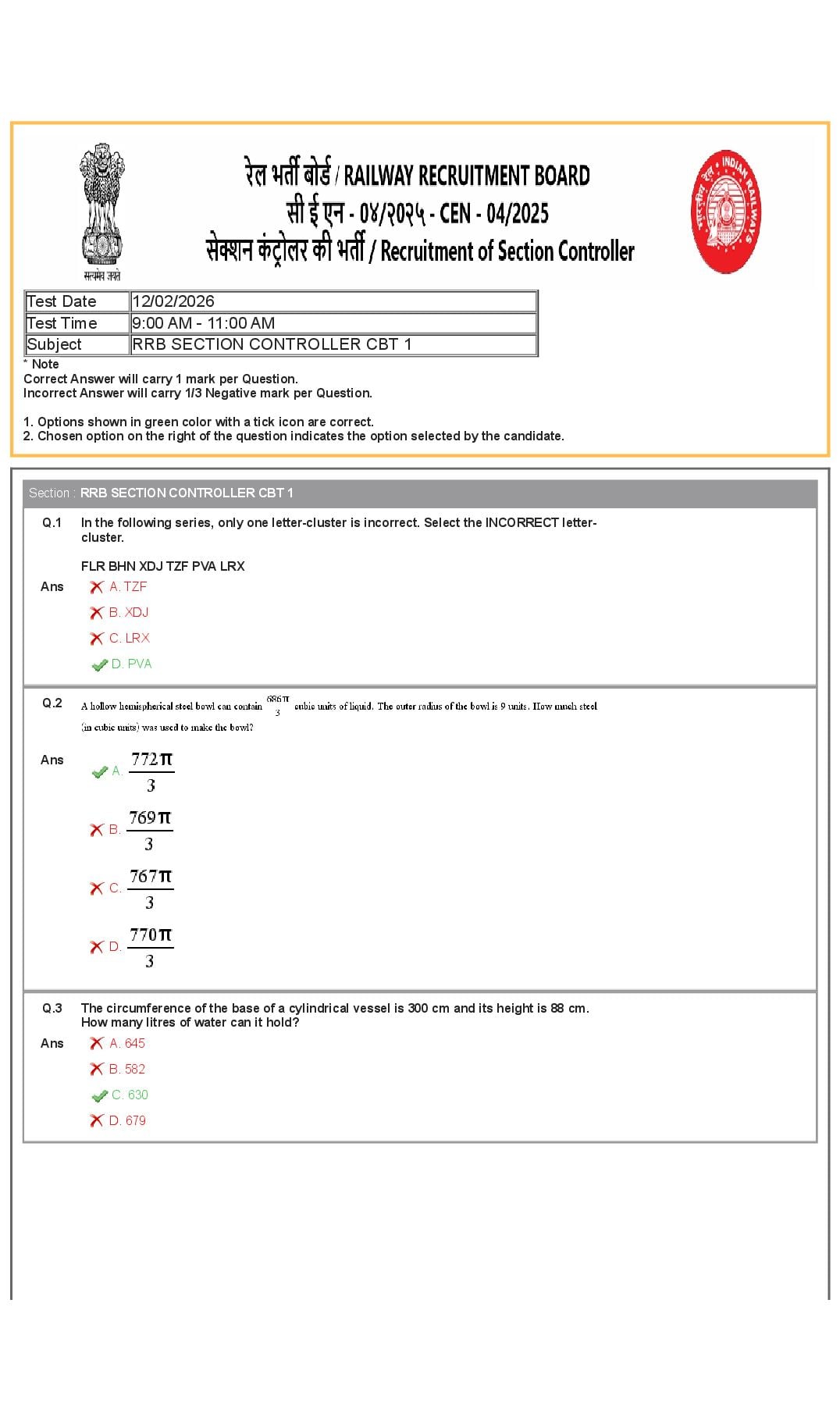
Page 1
Test Time 9:00 AM - 11:00 AM
Subject RRB SECTION CONTROLLER CBT 1
* Note
Correct Answer will carry 1 mark per Question.
Incorrect Answer will carry 1/3 Negative mark per Question.
1. Options shown in green color with a tick icon are correct.
2. Chosen option on the right of the question indicates the option selected by the candidate.
Section : RRB SECTION CONTROLLER CBT 1
Q.1 In the following series, only one letter-cluster is incorrect. Select the INCORRECT letter-
cluster.
FLR BHN XDJ TZF PVA LRX
Ans A. TZF
B. XDJ
C. LRX
D. PVA
Q.2
1631
Ans
A.
B.
C.
D.
Q.3 The circumference of the base of a cylindrical vessel is 300 cm and its height is 88 cm.
How many litres of water can it hold?
Ans A. 645
B. 582
C. 630
D. 679
Page 2
'−' are interchanged and '×' and ‘÷’ are interchanged?
96 × 16 − 13 ÷ 12 + 28 = ?
Ans A. 134
B. 133
C. 131
D. 132
Q.5 Three varieties of wheat are mixed in the ratio (weight in kgs) of 4:5:8. When 5 kg of the
first variety, 10 kg of the second variety and P kg of the third variety are added to the
mixture, the ratio becomes 5:7:9. Find the value of P.
Ans A. 4
B. 5
C. 4.5
D. 5.5
Q.6 Find the mode for the following data representing weekly wages (₹) of workers.
Wage Range (₹) Frequency
200-250 6
250-300 12
300-350 20
350-400 25
400-450 10
450-500 7
Ans A. 360.5
B. 364
C. 362.5
D. 361
Q.7 A shopkeeper buys an article for ₹2,400 and marks it for sale at a price that gives him
80% profit on his cost price. He, however, gives a 41% discount on the marked price to
his customer. Find the actual profit made by the shopkeeper.
Ans A. ₹147.80
B. ₹148.80
C. ₹149.80
D. ₹146.80
Q.8 All 46 students in a class are standing in a row facing north. Jaya is 15th from the right
end, while Sanjay is 26th from the left end. How many people stand between Jaya and
Sanjay?
Ans A. 7
B. 6
C. 4
D. 5
Page 3
54 and 64 is:
Ans A. 1439
B. 1632
C. 1721
D. 1245
Q.10 A shopkeeper marks an article at 30% above the cost price and allows a discount of
10%. Find his profit percentage.
Ans A. 17%
B. 12%
C. 15%
D. 20%
Q.11 Refer to the following number series and answer the question that follows. Counting is
to be done from left to right only. (All numbers are single-digit numbers only.)
(Left) 2 6 4 6 2 6 7 3 8 6 3 1 8 6 1 9 8 9 1 7 7 6 3 7 5 5 2 (Right)
How many such odd numbers are there that are immediately preceded by an odd
number and also immediately followed by an odd number?
Ans A. Five
B. Four
C. Six
D. Three
Q.12 Find the value of the following expression.
Ans A. 9525
B. 9625
C. 8625
D. 10525
Page 4
across various departments in a company.
If there are 600 men and 900 women in the company, find the total number of workers in
the Production department.
Ans A. 402
B. 350
C. 450
D. 500
Q.14 A man buys 12 identical articles for a total of ₹20. If he sells each of them for ₹2.1, then
what is his profit percentage?
Ans A. 27%
B. 21.63%
C. 20.63%
D. 26%
Q.15 The ratio of the speed of a boat in still water to the speed of a stream is 16:5. A boat
goes 16.5 km upstream in 45 minutes. Find the time (in minutes) taken by the boat to
cover 17.5 km downstream.
Ans A. 25
B. 30
C. 22
D. 27
Q.16 A, B, C, D, J, K, L and M are sitting around a square table, facing the centre of the table.
Some of them are sitting at the corners while some are sitting at the exact centre of the
sides.
Only three people sit between L and M. L sits at the centre of one of the sides. A sits
second to the left of M. D sits second to the right of C. J sits at one of the corners and is
not an immediate neighbour of M. Only three people sit between D and K. J is not an
immediate neighbour of B.
Who sits fourth to the left of B?
Ans A. A
B. M
C. J
D. K
Page 5
times of B's share = 5 times of C's share. Find A’s share.
Ans A. ₹4,000
B. ₹4,076
C. ₹3,990
D. ₹3,867
Q.18 Find the mean deviation from the mean for the following data, given that the mean is
9.55. (Round off your answer to two decimal places.)
Size of items 4 6 8 10 12 14 16
Frequency 2 5 5 3 2 1 4
Ans A.
B.
C.
D.
Q.19 An arithmetic progression has 54 as its first term and 72 as its last term, with a total of
10 terms. What is the sum of these 10 terms?
Ans A. 627
B. 632
C. 631
D. 630
Q.20 3 chairs and 15 tables cost ₹6300 and 7 chairs and 12 tables cost ₹7800. What is the
cost of 11 chairs and 16 tables?
Ans A. ₹11404
B. ₹11398
C. ₹11400
D. ₹11397
Q.21
Ans A. 20
B. 19
C. 16
D. 18
Q.22
Ans A.
B.
C.
D.
Page 6
relationship followed between the letter-cluster pair on the left side of :: is the same as
that on the right side of ::?
# : INQ :: FKO : %
Ans A. # = TJV, % = HEL
B. # = SRP, % = GFE
C. # = RTP, % = DEJ
D. # = LQU, % = CHK
Q.24 A, B, C, D, E and F live on six different floors of the same building. The lowermost floor
in the building is numbered 1, the floor above it, number 2 and so on till the topmost
floor is numbered 6. B lives on an odd numbered floor but not on floor number 5. Only
three people live between C and A. A lives immediately below B. F lives immediately
above E. How many people live between D and F?
Ans A. One
B. Two
C. Three
D. None
Q.25 In a certain code language, ‘DENT’ is coded as ‘6924’ and ‘PADS’ is coded as ‘1359’.
What is the code for ‘D’ in the given code language?
Ans A. 9
B. 6
C. 5
D. 3
Q.26 In the following triads, each group of letters is related to the subsequent one following a
certain logic. Select from the given options, the one which follows the same logic.
FLAP - LAFP - PALF
COIN - OICN - NIOC
Ans A. GOLF - GLOF - FLOG
B. HALF - ALHF - FLAH
C. DISC - ISDC - ISCD
D. BASE - ABSE - EASB
Q.27 Refer to the following letter-symbol series and answer the question that follows.
Counting is to be done from left to right only.
(Left) K @ % H U # A W N * Z Σ V F Ω L $ E P & M (Right)
How many such symbols are there each of which is immediately preceded by a vowel
but not immediately followed by a vowel?10785
Ans A. Two
B. Three
C. One
D. None
Q.28 The average of 8 numbers is 59. If each number is increased by 6, what will the new
average be?
Ans A. 59
B. 8
C. 65
D. 71
Page 7
numbers is 102, then find the other number.
Ans A. 64
B. 122
C. 121
D. 136
Q.30 A can complete a piece of work in 12 days and B can complete it in 18 days. If they work
on alternate days, starting with B on the first day, then in how many days will the work
be completed?
Ans
A. 15
B. 14
C.
D.
Comprehension:
Read the passage and answer the questions.
In 2011, violent riots erupted across London and several English cities. Petrol bombs were hurled, properties vandalised, and shops
looted. Despite extensive CCTV footage, most images were unclear, with rioters masking their faces. Gary Collins, an off-duty police
officer, was watching the riots on television when he recognised several individuals. Interrupting his holiday, he spent six months
meticulously examining CCTV footage and successfully identified 190 offenders—many solely by their eyes. His extraordinary
contribution proved invaluable, especially since facial-recognition software identified only one person from 200,000 hours of film.
Collins is a super-recogniser, a rare individual capable of recalling faces with exceptional precision. Coined in 2009, the term refers to
the 1–2% of people who remember up to 95% of faces they encounter, in contrast to the average person’s 20%. Inspired by Collins’s
achievement, London’s Metropolitan Police established the world’s first super-recogniser unit in 2015. This small team of six officers
has since been responsible for nearly a quarter of all identifications in London, despite the presence of over 30,000 officers. Their
success, amplified by Britain’s extensive CCTV network, has aided in convicting criminals ranging from petty thieves to murderers.
Though rarely sole evidence, their findings often direct investigations, with many culprits pleading guilty upon recognition.
SubQuestion No : 31
Q.31 Which of the following is the most suitable title for the passage?
Ans A. Convicting the Criminals: How to Recognise Faces
B. Artificial Intelligence in Criminal Detection
C. Faces Behind the Masks: The Rise of Super-Recognisers
D. The Evolution of CCTV Technology
Comprehension:
Read the passage and answer the questions.
In 2011, violent riots erupted across London and several English cities. Petrol bombs were hurled, properties vandalised, and shops
looted. Despite extensive CCTV footage, most images were unclear, with rioters masking their faces. Gary Collins, an off-duty police
officer, was watching the riots on television when he recognised several individuals. Interrupting his holiday, he spent six months
meticulously examining CCTV footage and successfully identified 190 offenders—many solely by their eyes. His extraordinary
contribution proved invaluable, especially since facial-recognition software identified only one person from 200,000 hours of film.
Collins is a super-recogniser, a rare individual capable of recalling faces with exceptional precision. Coined in 2009, the term refers to
the 1–2% of people who remember up to 95% of faces they encounter, in contrast to the average person’s 20%. Inspired by Collins’s
achievement, London’s Metropolitan Police established the world’s first super-recogniser unit in 2015. This small team of six officers
has since been responsible for nearly a quarter of all identifications in London, despite the presence of over 30,000 officers. Their
success, amplified by Britain’s extensive CCTV network, has aided in convicting criminals ranging from petty thieves to murderers.
Though rarely sole evidence, their findings often direct investigations, with many culprits pleading guilty upon recognition.
SubQuestion No : 32
Q.32 Identify the tone of the passage.
Ans A. Factual and explanatory
B. Dramatic and emotional
C. Persuasive and critical
D. Humorous and casual
Page 8
Read the passage and answer the questions.
In 2011, violent riots erupted across London and several English cities. Petrol bombs were hurled, properties vandalised, and shops
looted. Despite extensive CCTV footage, most images were unclear, with rioters masking their faces. Gary Collins, an off-duty police
officer, was watching the riots on television when he recognised several individuals. Interrupting his holiday, he spent six months
meticulously examining CCTV footage and successfully identified 190 offenders—many solely by their eyes. His extraordinary
contribution proved invaluable, especially since facial-recognition software identified only one person from 200,000 hours of film.
Collins is a super-recogniser, a rare individual capable of recalling faces with exceptional precision. Coined in 2009, the term refers to
the 1–2% of people who remember up to 95% of faces they encounter, in contrast to the average person’s 20%. Inspired by Collins’s
achievement, London’s Metropolitan Police established the world’s first super-recogniser unit in 2015. This small team of six officers
has since been responsible for nearly a quarter of all identifications in London, despite the presence of over 30,000 officers. Their
success, amplified by Britain’s extensive CCTV network, has aided in convicting criminals ranging from petty thieves to murderers.
Though rarely sole evidence, their findings often direct investigations, with many culprits pleading guilty upon recognition.
SubQuestion No : 33
Q.33 What percentage of people are estimated to be super-recognisers?
Ans A. 20–25%
B. 15–18%
C. 1–2%
D. 5–10%
Comprehension:
Read the passage and answer the questions.
In 2011, violent riots erupted across London and several English cities. Petrol bombs were hurled, properties vandalised, and shops
looted. Despite extensive CCTV footage, most images were unclear, with rioters masking their faces. Gary Collins, an off-duty police
officer, was watching the riots on television when he recognised several individuals. Interrupting his holiday, he spent six months
meticulously examining CCTV footage and successfully identified 190 offenders—many solely by their eyes. His extraordinary
contribution proved invaluable, especially since facial-recognition software identified only one person from 200,000 hours of film.
Collins is a super-recogniser, a rare individual capable of recalling faces with exceptional precision. Coined in 2009, the term refers to
the 1–2% of people who remember up to 95% of faces they encounter, in contrast to the average person’s 20%. Inspired by Collins’s
achievement, London’s Metropolitan Police established the world’s first super-recogniser unit in 2015. This small team of six officers
has since been responsible for nearly a quarter of all identifications in London, despite the presence of over 30,000 officers. Their
success, amplified by Britain’s extensive CCTV network, has aided in convicting criminals ranging from petty thieves to murderers.
Though rarely sole evidence, their findings often direct investigations, with many culprits pleading guilty upon recognition.
SubQuestion No : 34
Q.34 What does the passage imply about human versus machine recognition?
Ans A. Humans remain superior in complex facial identification tasks.
B. Machines outperform humans in identifying subtle facial traits.
C. Both perform equally well under pressure.
D. Human memory is unreliable in criminal investigations.
Comprehension:
Read the passage and answer the questions.
In 2011, violent riots erupted across London and several English cities. Petrol bombs were hurled, properties vandalised, and shops
looted. Despite extensive CCTV footage, most images were unclear, with rioters masking their faces. Gary Collins, an off-duty police
officer, was watching the riots on television when he recognised several individuals. Interrupting his holiday, he spent six months
meticulously examining CCTV footage and successfully identified 190 offenders—many solely by their eyes. His extraordinary
contribution proved invaluable, especially since facial-recognition software identified only one person from 200,000 hours of film.
Collins is a super-recogniser, a rare individual capable of recalling faces with exceptional precision. Coined in 2009, the term refers to
the 1–2% of people who remember up to 95% of faces they encounter, in contrast to the average person’s 20%. Inspired by Collins’s
achievement, London’s Metropolitan Police established the world’s first super-recogniser unit in 2015. This small team of six officers
has since been responsible for nearly a quarter of all identifications in London, despite the presence of over 30,000 officers. Their
success, amplified by Britain’s extensive CCTV network, has aided in convicting criminals ranging from petty thieves to murderers.
Though rarely sole evidence, their findings often direct investigations, with many culprits pleading guilty upon recognition.
SubQuestion No : 35
Q.35 The phrase “exceptional precision” most nearly means ___________________.
Ans A. frequent confusion
B. average accuracy
C. unusual clarity
D. minor detail
Page 9
Ans A. 537
B. 535
C. 533
D. 531
Q.37 Each of G, H, I, J, N, O and P has a flight on a different day of the week, starting from
Monday and ending on Sunday of the same week. Only I has a flight after H. Only three
people have flights between N and H. Only three people have flights between O and I. J
has a flight on some day before P and on some day after G. How many people have
flights between G and J?
Ans A. One
B. Two
C. Three
D. Four
Q.38 The sum of two positive numbers is 76 and their product is 1408. The positive
difference between them is:
Ans A. 5
B. 9
C. 8
D. 12
Q.39 Find the probability that a randomly chosen number from the first 80 natural numbers is
either a perfect square or divisible by 7.
Ans
A.
B.
C.
D.
Q.40 Refer to the given letter, symbol series and answer the question that follows. Counting
to be done from left to right only.
(Left) # F * G W # C # Y R & @ W Z @ L & L N % # W (Right)
How many such letter are there, each of which is immediately preceded by a symbol
and also immediately followed by a symbol?
Ans A. 5
B. 3
C. 2
D. 4
Page 10
Class frequency
Interval
s
0-6 13
6 – 12 f
12 – 18 7
18 – 24 10
24 - 30 8
Ans A. 19
B. 15
C. 21
D. 16
Q.42 There are 6,200 candidates appeared in a CAT examination and the ratio of boys to girls
in the school is 23 : 39. Find the number of boys appeared in the CAT examination.
Ans A. 2,300
B. 2,304
C. 2,306
D. 2,293
Q.43 Two sets of numbers are given below. In each set of numbers, certain mathematical
operation(s) on the first number result(s) in the second number. Similarly, certain
mathematical operation(s) on the second number result(s) in the third number and so
on. Which of the given options follows the same set of operations as in the given sets?
(NOTE: A two/three digit number cannot be broken into individual digits for operations.
E.g.: If 37 is followed by 10, the operation cannot be 3 + 7 as a two digit number cannot
be broken into individual digits.)
20 – 33 – 27 – 35
15 – 28 – 22 – 30
Ans A. 7 – 20 – 14 – 6
B. 8 – 21 – 15 – 23
C. 9 – 22 – 16 – 25
D. 4 – 17 – 23 – 31
Q.44 What should come in place of the question mark (?) in the given series?
451 450 460 458 470 467 481 ?
Ans A. 479
B. 478
C. 476
D. 477
Q.45
Ans
A.
B.
C.
D.
Page 11
cm2, then find the area of PQST (in cm2).
1426
Ans A. 182
B. 204
C. 220
D. 198
Q.47 Find the area of the triangle whose sides are in the ratio of 7:4:8 with a perimeter of 38
cm.
Ans A.
B.
C.
D.
Q.48 Based on the English alphabetical order, three of the following four letter-cluster pairs
are alike in a certain way and thus form a group. Which letter-cluster pair DOES NOT
belong to that group?
(Note: The odd one out is not based on the number of consonants/vowels or their
position in the letter-cluster.)
Ans A. DF–HK
B. SU–WY
C. PR–TV
D. IK–MO
Q.49 An arithmetic progression has 32 as its first term and 48 as its last term, with a total of
12 terms. What is the sum of these 12 terms?
Ans A. 478
B. 479
C. 482
D. 480
Q.50 In a cloth store, 10 varieties of sarees are arranged on two parallel racks. Rack 1 is
facing towards the South and it has the following variety of sarees: A, B, C, D and E.
Rack 2 is facing towards the North and it has the following variety of sarees: F, G, H, I
and J. Thus, each saree in Rack 1 is placed in front of a saree in Rack 2 and vice versa.
Variety D and B sarees are placed at extreme ends and are opposite Variety I and G
sarees on the opposite rack, respectively. Variety C is at the middlemost position and is
opposite neither H nor J. Variety A sarees are placed to the immediate right of B, H is
not the saree variety opposite to Variety A. Which variety of sarees are opposite H?
Ans A. B
B. E
C. D
D. A
Page 12
are alike in a certain way and thus form a group. Which letter-cluster pair DOES NOT
belong to that group?
(Note: The odd one out is not based on the number of consonants/vowels or their
position in the letter-cluster.)
Ans A. MR - OT
B. SX - UZ
C. OI - LK
D. QV - SX
Q.52 In the given figure, PAB is a secant and PT is a tangent to the circle from P. If PT = 6 cm,
PA = 4 cm and AB = x cm, then x is equal to:
1104
Ans A. 4
B. 3
C. 5
D. 6
Q.53 In the following series, only one letter-cluster is incorrect. Select the INCORRECT letter-
cluster.
YEK UAG QWC MSY IOV EKQ
Ans A. IOV
B. MSY
C. QWC
D. EKQ
Q.54 A garrison of 1,210 men has provisions for 16 days. How long (in days) will the
provisions last if the garrison be increased by 550 men?
Ans A. 9
B. 11
C. 12
D. 10
Q.55 The area of the base of a right circular cone is 2464 cm2 and its height is 45 cm. What is
the curved surface area of the cone?
(Use π = 22/7)
Ans A. 5058 cm2
B. 4224 cm2
C. 3646 cm2
D. 4664 cm2
Q.56 What will come in place of the question mark (?) in the following equation, if ‘+’ and ‘−’
are interchanged and ‘×’ and ‘÷’ are interchanged?
38 ÷ 5 − 14 + 26 × 2 = ?
Ans A. 203
B. 195
C. 191
D. 197
Page 13
areas is 4 cm2, find the difference between the length and breadth of the rectangle (in
cm).
Ans A. 4
B. 2
C. 8
D. 6
Comprehension:
Read the given passage and answer the questions that follow.
We are aware that adolescence brings striking physical changes, but profound neurological transformations also occur. To understand
them, we must first grasp the brain’s composition. The brain contains about 100 billion neurons—nerve cells that communicate
through intricate networks. Each neuron transmits electrical impulses along an axon, which then leap across minute synapses to the
dendrites of another neuron, forming a vast circuit of communication. Although infants possess nearly all their neurons at birth, they
have few connections, limiting their abilities. Rapid synaptic growth in early childhood enables skills such as walking and speaking.
Contrary to earlier beliefs, brain development continues throughout life, with adolescence marking the most intense period of
restructuring. During puberty, neural connections proliferate before undergoing “pruning,” much like trimming a plant to promote
healthy growth. Frequently used connections strengthen, while unused ones fade, illustrating why repetition enhances proficiency—
validating the adage practice makes perfect. Thus, teenagers actively sculpt their own neural architecture through chosen activities,
from mastering instruments to acquiring languages. Interestingly, the frontal cortex—the region governing judgment, self-control, and
reasoning—matures last. Until then, adolescents rely heavily on the brain’s emotional centre for decision-making. Hence, impulsive or
risk-prone teenage behaviour, often attributed to hormones, may stem more from neurological development than from mood alone.
SubQuestion No : 58
Q.58 Identify the most appropriate title for the passage.
Ans A. The Adolescent Brain: A Work in Progress
B. The Hormonal Havoc of Adolescence
C. Emotional Turbulence in Teenage Years
D. Understanding Early Childhood Development
Comprehension:
Read the given passage and answer the questions that follow.
We are aware that adolescence brings striking physical changes, but profound neurological transformations also occur. To understand
them, we must first grasp the brain’s composition. The brain contains about 100 billion neurons—nerve cells that communicate
through intricate networks. Each neuron transmits electrical impulses along an axon, which then leap across minute synapses to the
dendrites of another neuron, forming a vast circuit of communication. Although infants possess nearly all their neurons at birth, they
have few connections, limiting their abilities. Rapid synaptic growth in early childhood enables skills such as walking and speaking.
Contrary to earlier beliefs, brain development continues throughout life, with adolescence marking the most intense period of
restructuring. During puberty, neural connections proliferate before undergoing “pruning,” much like trimming a plant to promote
healthy growth. Frequently used connections strengthen, while unused ones fade, illustrating why repetition enhances proficiency—
validating the adage practice makes perfect. Thus, teenagers actively sculpt their own neural architecture through chosen activities,
from mastering instruments to acquiring languages. Interestingly, the frontal cortex—the region governing judgment, self-control, and
reasoning—matures last. Until then, adolescents rely heavily on the brain’s emotional centre for decision-making. Hence, impulsive or
risk-prone teenage behaviour, often attributed to hormones, may stem more from neurological development than from mood alone.
SubQuestion No : 59
Q.59 The tone of the passage can best be described as ____________________.
Ans A. nostalgic and emotional
B. analytical and informative
C. persuasive and argumentative
D. critical and disapproving
Page 14
Read the given passage and answer the questions that follow.
We are aware that adolescence brings striking physical changes, but profound neurological transformations also occur. To understand
them, we must first grasp the brain’s composition. The brain contains about 100 billion neurons—nerve cells that communicate
through intricate networks. Each neuron transmits electrical impulses along an axon, which then leap across minute synapses to the
dendrites of another neuron, forming a vast circuit of communication. Although infants possess nearly all their neurons at birth, they
have few connections, limiting their abilities. Rapid synaptic growth in early childhood enables skills such as walking and speaking.
Contrary to earlier beliefs, brain development continues throughout life, with adolescence marking the most intense period of
restructuring. During puberty, neural connections proliferate before undergoing “pruning,” much like trimming a plant to promote
healthy growth. Frequently used connections strengthen, while unused ones fade, illustrating why repetition enhances proficiency—
validating the adage practice makes perfect. Thus, teenagers actively sculpt their own neural architecture through chosen activities,
from mastering instruments to acquiring languages. Interestingly, the frontal cortex—the region governing judgment, self-control, and
reasoning—matures last. Until then, adolescents rely heavily on the brain’s emotional centre for decision-making. Hence, impulsive or
risk-prone teenage behaviour, often attributed to hormones, may stem more from neurological development than from mood alone.
SubQuestion No : 60
Q.60 According to the passage, which part of the brain matures last?
Ans A. The hippocampus
B. The cerebellum
C. The limbic system
D. The frontal cortex
Comprehension:
Read the given passage and answer the questions that follow.
We are aware that adolescence brings striking physical changes, but profound neurological transformations also occur. To understand
them, we must first grasp the brain’s composition. The brain contains about 100 billion neurons—nerve cells that communicate
through intricate networks. Each neuron transmits electrical impulses along an axon, which then leap across minute synapses to the
dendrites of another neuron, forming a vast circuit of communication. Although infants possess nearly all their neurons at birth, they
have few connections, limiting their abilities. Rapid synaptic growth in early childhood enables skills such as walking and speaking.
Contrary to earlier beliefs, brain development continues throughout life, with adolescence marking the most intense period of
restructuring. During puberty, neural connections proliferate before undergoing “pruning,” much like trimming a plant to promote
healthy growth. Frequently used connections strengthen, while unused ones fade, illustrating why repetition enhances proficiency—
validating the adage practice makes perfect. Thus, teenagers actively sculpt their own neural architecture through chosen activities,
from mastering instruments to acquiring languages. Interestingly, the frontal cortex—the region governing judgment, self-control, and
reasoning—matures last. Until then, adolescents rely heavily on the brain’s emotional centre for decision-making. Hence, impulsive or
risk-prone teenage behaviour, often attributed to hormones, may stem more from neurological development than from mood alone.
SubQuestion No : 61
Q.61 Which statement best captures the author’s viewpoint?
Ans A. Emotional decisions are superior to logical ones.
B. The adolescent brain provides an ideal period for skill refinement.
C. Brain connections weaken with practice.
D. Teenagers’ brains are fixed and resistant to change.
Comprehension:
Read the given passage and answer the questions that follow.
We are aware that adolescence brings striking physical changes, but profound neurological transformations also occur. To understand
them, we must first grasp the brain’s composition. The brain contains about 100 billion neurons—nerve cells that communicate
through intricate networks. Each neuron transmits electrical impulses along an axon, which then leap across minute synapses to the
dendrites of another neuron, forming a vast circuit of communication. Although infants possess nearly all their neurons at birth, they
have few connections, limiting their abilities. Rapid synaptic growth in early childhood enables skills such as walking and speaking.
Contrary to earlier beliefs, brain development continues throughout life, with adolescence marking the most intense period of
restructuring. During puberty, neural connections proliferate before undergoing “pruning,” much like trimming a plant to promote
healthy growth. Frequently used connections strengthen, while unused ones fade, illustrating why repetition enhances proficiency—
validating the adage practice makes perfect. Thus, teenagers actively sculpt their own neural architecture through chosen activities,
from mastering instruments to acquiring languages. Interestingly, the frontal cortex—the region governing judgment, self-control, and
reasoning—matures last. Until then, adolescents rely heavily on the brain’s emotional centre for decision-making. Hence, impulsive or
risk-prone teenage behaviour, often attributed to hormones, may stem more from neurological development than from mood alone.
SubQuestion No : 62
Q.62 The word 'pruning' as used in the text suggests _________________.
Ans A. neglecting connections
B. planting new ideas
C. cutting down to enhance growth
D. adding new structures
Page 15
relationship followed between the letter-cluster pair on the left side of :: is the same as
that on the right side of ::?
# : SNJ :: QLH : %
Ans A. # = MHD, % = WRN
B. # = IOD, % = WNB
C. # = OPD, % = WVN
D. # = MNM, % = AZN
Q.64 Based on the English alphabetical order, three of the following four letter cluster pairs
are alike in a certain way and thus form a group. Which is the one that does NOT belong
to that group? (Note: The odd man out is not based on the number of
consonants/vowels or their position in the letter cluster.)
Ans A. MQ - PT
B. LO - NL
C. IM - LP
D. EI - HL
Q.65 A solid hemisphere of radius 14 cm is melted and recast into small hemispheres each of
radius 7 cm. How many small hemispheres are formed?
Ans A. 8
B. 16
C. 27
D. 6
Comprehension:
Read the given passage and answer the questions that follow.
Vincent van Gogh was a Dutch painter, generally considered the greatest after Rembrandt van Rijn, and one of the greatest of the
Post-Impressionists. The striking colour, emphatic brushwork, and contoured forms of his work powerfully influenced the current of
Expressionism in modern art. Van Gogh’s art became astoundingly popular after his death when his work sold for record-breaking
sums at auctions around the world and was featured in blockbuster touring exhibitions. Van Gogh, the eldest of six children of a
Protestant pastor, was born and reared in a small village in the Brabant region of the southern Netherlands. He was a quiet, self-
contained youth, spending his free time wandering the countryside to observe nature. At 16, he was apprenticed to The Hague branch
of the art dealers Goupil and Co., of which his uncle was a partner. Van Gogh worked for Goupil in London and in Paris. Daily contact
with works of art aroused his artistic sensibility, and he soon formed a taste for Rembrandt, Frans Hals, and other Dutch masters,
although his preference was for two contemporary French painters, Jean-François Millet and Camille Corot, whose influence was to
last throughout his life. Van Gogh disliked art dealing. Moreover, his approach to life darkened when his love was rejected by a
London woman in 1874. His burning desire for human affection thwarted, he became increasingly solitary. He worked as a language
teacher and lay preacher in England and, in 1877, worked for a bookseller in Dordrecht, Netherlands.
SubQuestion No : 66
Q.66 What is the central theme of the passage?
Ans A. The role of French painters in Dutch culture
B. The formative influences and later recognition of Van Gogh's art
C. The tragic and melancholic love life of Vincent Van Gogh
D. The religious background of Dutch painters
Page 16
Read the given passage and answer the questions that follow.
Vincent van Gogh was a Dutch painter, generally considered the greatest after Rembrandt van Rijn, and one of the greatest of the
Post-Impressionists. The striking colour, emphatic brushwork, and contoured forms of his work powerfully influenced the current of
Expressionism in modern art. Van Gogh’s art became astoundingly popular after his death when his work sold for record-breaking
sums at auctions around the world and was featured in blockbuster touring exhibitions. Van Gogh, the eldest of six children of a
Protestant pastor, was born and reared in a small village in the Brabant region of the southern Netherlands. He was a quiet, self-
contained youth, spending his free time wandering the countryside to observe nature. At 16, he was apprenticed to The Hague branch
of the art dealers Goupil and Co., of which his uncle was a partner. Van Gogh worked for Goupil in London and in Paris. Daily contact
with works of art aroused his artistic sensibility, and he soon formed a taste for Rembrandt, Frans Hals, and other Dutch masters,
although his preference was for two contemporary French painters, Jean-François Millet and Camille Corot, whose influence was to
last throughout his life. Van Gogh disliked art dealing. Moreover, his approach to life darkened when his love was rejected by a
London woman in 1874. His burning desire for human affection thwarted, he became increasingly solitary. He worked as a language
teacher and lay preacher in England and, in 1877, worked for a bookseller in Dordrecht, Netherlands.
SubQuestion No : 67
Q.67 What is the ANTONYM of 'solitary' as used in the passage?
Ans A. Reserved
B. Lonely
C. Thoughtful
D. Sociable
Comprehension:
Read the given passage and answer the questions that follow.
Vincent van Gogh was a Dutch painter, generally considered the greatest after Rembrandt van Rijn, and one of the greatest of the
Post-Impressionists. The striking colour, emphatic brushwork, and contoured forms of his work powerfully influenced the current of
Expressionism in modern art. Van Gogh’s art became astoundingly popular after his death when his work sold for record-breaking
sums at auctions around the world and was featured in blockbuster touring exhibitions. Van Gogh, the eldest of six children of a
Protestant pastor, was born and reared in a small village in the Brabant region of the southern Netherlands. He was a quiet, self-
contained youth, spending his free time wandering the countryside to observe nature. At 16, he was apprenticed to The Hague branch
of the art dealers Goupil and Co., of which his uncle was a partner. Van Gogh worked for Goupil in London and in Paris. Daily contact
with works of art aroused his artistic sensibility, and he soon formed a taste for Rembrandt, Frans Hals, and other Dutch masters,
although his preference was for two contemporary French painters, Jean-François Millet and Camille Corot, whose influence was to
last throughout his life. Van Gogh disliked art dealing. Moreover, his approach to life darkened when his love was rejected by a
London woman in 1874. His burning desire for human affection thwarted, he became increasingly solitary. He worked as a language
teacher and lay preacher in England and, in 1877, worked for a bookseller in Dordrecht, Netherlands.
SubQuestion No : 68
Q.68 Which of the following is a fact stated in the passage?
Ans A. He worked as a lay preacher in England.
B. He enjoyed his work as an art dealer.
C. Van Gogh was never influenced by French artists.
D. He was the youngest of six children.
Comprehension:
Read the given passage and answer the questions that follow.
Vincent van Gogh was a Dutch painter, generally considered the greatest after Rembrandt van Rijn, and one of the greatest of the
Post-Impressionists. The striking colour, emphatic brushwork, and contoured forms of his work powerfully influenced the current of
Expressionism in modern art. Van Gogh’s art became astoundingly popular after his death when his work sold for record-breaking
sums at auctions around the world and was featured in blockbuster touring exhibitions. Van Gogh, the eldest of six children of a
Protestant pastor, was born and reared in a small village in the Brabant region of the southern Netherlands. He was a quiet, self-
contained youth, spending his free time wandering the countryside to observe nature. At 16, he was apprenticed to The Hague branch
of the art dealers Goupil and Co., of which his uncle was a partner. Van Gogh worked for Goupil in London and in Paris. Daily contact
with works of art aroused his artistic sensibility, and he soon formed a taste for Rembrandt, Frans Hals, and other Dutch masters,
although his preference was for two contemporary French painters, Jean-François Millet and Camille Corot, whose influence was to
last throughout his life. Van Gogh disliked art dealing. Moreover, his approach to life darkened when his love was rejected by a
London woman in 1874. His burning desire for human affection thwarted, he became increasingly solitary. He worked as a language
teacher and lay preacher in England and, in 1877, worked for a bookseller in Dordrecht, Netherlands.
SubQuestion No : 69
Q.69 Which title best captures the essence of the passage?
Ans A. The Art Dealers of Paris and London
B. The Early Life and Lasting Influence of Van Gogh
C. Van Gogh: A Miserable Life
D. A Short History of Dutch Paintings and their influence
Page 17
Read the given passage and answer the questions that follow.
Vincent van Gogh was a Dutch painter, generally considered the greatest after Rembrandt van Rijn, and one of the greatest of the
Post-Impressionists. The striking colour, emphatic brushwork, and contoured forms of his work powerfully influenced the current of
Expressionism in modern art. Van Gogh’s art became astoundingly popular after his death when his work sold for record-breaking
sums at auctions around the world and was featured in blockbuster touring exhibitions. Van Gogh, the eldest of six children of a
Protestant pastor, was born and reared in a small village in the Brabant region of the southern Netherlands. He was a quiet, self-
contained youth, spending his free time wandering the countryside to observe nature. At 16, he was apprenticed to The Hague branch
of the art dealers Goupil and Co., of which his uncle was a partner. Van Gogh worked for Goupil in London and in Paris. Daily contact
with works of art aroused his artistic sensibility, and he soon formed a taste for Rembrandt, Frans Hals, and other Dutch masters,
although his preference was for two contemporary French painters, Jean-François Millet and Camille Corot, whose influence was to
last throughout his life. Van Gogh disliked art dealing. Moreover, his approach to life darkened when his love was rejected by a
London woman in 1874. His burning desire for human affection thwarted, he became increasingly solitary. He worked as a language
teacher and lay preacher in England and, in 1877, worked for a bookseller in Dordrecht, Netherlands.
SubQuestion No : 70
Q.70 What best describes the tone of the passage?
Ans A. Humorous and playful
B. Melancholic and bitter
C. Critical and sceptical
D. Admiring and informative
Q.71 Fourth proportion to 12, 18 and 6 is same as the third proportion to 4 and k. What is the
positive value of k?
Ans A.
B.
C.
D.
Q.72 If a data set has a median of 92 and a mean of 84, what is the value of the mode?
Ans A. 96
B. 108
C. 98
D. 102
Q.73
Ans A. 1256
B. 1271
C. 1275
D. 1265
Q.74 On a 2295 m long circular track, Siddharth finishes one round in 85 seconds and Yash
finishes one round in 45 seconds. How many different meeting points are there on the
track if they are running in the opposite directions?
Ans A. 26
B. 36
C. 20
D. 33
Page 18
intervals mentioned are at the end of every 5 minutes. What is the time taken (in
minutes) for Rishi's constant increase of speed from 55 km/h to a speed of 70 km/h?
Ans A. 10
B. 20
C. 5
D. 15
Q.76 At a health club, 44% of the members are women and 56% of the members are men. If
the average age of the men is 52 years and the average age of the women is 67 years,
what is the average age (in years) of all the members?
Ans A. 66.4
B. 56.5
C. 68.4
D. 58.6
Q.77 Find the value of m for which it satisfies
Ans
A.
B.
C.
D.
Page 19
faces turned up exceeds 7 is:
Ans
A.
B.
C.
D.
Q.79 Read the given statements and conclusions carefully. Assuming that the information
given in the statements is true, even if it appears to be at variance with commonly
known facts, decide which of the given conclusions logically follow(s) from the
statements.
Statements:
Some cranes are marbles.
All marbles are balls.
Conclusions:
(I) Some cranes are balls.
(II) All balls are marbles.
Ans A. Neither conclusion (I) nor (II) follows.
B. Both conclusions (I) and (II) follow.
C. Only conclusion (II) follows.
D. Only conclusion (I) follows.
Q.80 By how much is 30% of 65 greater than 35% of 30?5386
Ans A. 6
B. 9
C. 4
D. 11
Q.81 Calculate the volume of a cube whose side length is 23 millimetres.
Ans A. 12,157 mm3
B. 12,167 mm3
C. 12,147 mm3
D. 12,177 mm3
Q.82 The length (in mm) of the shoes of few students were measured and observations are
as under. Find the median length of the shoes (in mm).
Length: 123 124 122 120 121 125
Number of students: 6 8 10 12 15 9
Ans A. 122
B. 124
C. 121
D. 123
Page 20
of the frustum are 5 cm and 3 cm, and the height of the frustum is 12 cm, find the
volume of the original cone. (Take )
Ans
A.
B.
C.
D.
Q.84 If x-1 is the mean proportion between x-2 and x-8 ,then find the value of x.
Ans
A.
B.
C.
D.
Q.85 A cuboid of dimension 48 cm by 80 cm by 96 cm is to be divided in to identical cubes.
With the maximum possible value of side of the identical cube possible, find the total
volume of all the cubes (in cm3).
Ans A. 5,52,960
B. 2,14,230
C. 1,61,440
D. 3,68,640
Q.86
Ans A. 7301
B. 7296
C. 7290
D. 7295
Q.87 A man incurs a loss of 12% by selling an article for ₹264. If he sells it for ₹495, what will
be his gain percentage?
Ans A. 64%
B. 65%
C. 60%
D. 62%
Q.88 An article is currently priced at ₹10,000. Its price increases by 26% in the first year and
by 65% in the second year, but then decreases by 20% in the third year. What will be the
price (in ₹) of the article at the end of the third year?
Ans A. 16,634
B. 16,628
C. 16,637
D. 16,632
Page 21
1669
Ans A. 44426 cm3
B. 44506 cm3
C. 44492 cm3
D. 44580 cm3
Q.90 The average height of 16 boys out of a class of 50 boys is 160 cm. If the average height
of the remaining boys is 168 cm, then the average height of the whole class (in cm) is:
Ans A. 166.44
B. 164
C. 165.44
D. 165
Q.91 Study the given table carefully and answer the questions that follow. The given table
indicates the production of different types of cars (in thousands) from 1998 to 2003.
Year 1998 1999 2000 2001 2002 2003
Types
A 36 34 40 35 43 45
B 20 22 25 23 20 16
C 14 30 16 25 30 35
D 60 40 45 55 60 60
E 40 44 48 50 80 100
In which year is the total production of A and D together equal to the total production of
C and E together?
Ans A. 1999
B. 2001
C. 2000
D. 1998
Q.92 The average of 41 numbers is 36. The average of the first 19 numbers is 57 and the
average of the last 23 numbers is 30. If the 19th number from the beginning is excluded,
then what is the average of the remaining numbers?
Ans A. 33.689
B. 25.25
C. 27.1
D. 29.475
Page 22
seven towns in 2021 is shown in the pie chart.
If the total population of all the towns is 3,07,500 and 40% of the population of the town
G is under poverty line. The number of people under poverty line of town G is:
Ans A. 19,450
B. 18,450
C. 18,540
D. 19,540
Q.94 What will come in place of the question mark (?) in the following equation if ‘+’ and ‘−’
are interchanged and ‘×’ and ‘÷’ are interchanged?
15 ÷ 2 − 63 × 7 + 11 = ?
Ans A. 36
B. 25
C. 28
D. 30
Q.95 If 135 kg of corn feeds 45 horses for 8 days, for how long will the same quantity of corn
feed 24 horses?
Ans A.
B.
C.
D.
Q.96 In a certain code language,
A @ B means ‘A is the sister of B’
A # B means ‘A is the wife of B’
A ≠ B means ‘A is the father of B’
A + B means ‘A is the brother of B’
Based on the above, how is F related to V if 'F # G ≠ S @ T + V'?
Ans A. Mother's mother
B. Mother
C. Wife
D. Sister
Page 23
the shopkeeper earns a 27% profit. Find the discount percentage allowed by the
shopkeeper.
Ans A. 50%
B. 53%
C. 48%
D. 47%
Q.98 If 2 is added to each odd digit and 1 is subtracted from each even digit in the number
1324756, then what will be the sum of the digits that are second from the left and
second from the right in the new number thus formed?
Ans A. 5
B. 7
C. 12
D. 6
Q.99 and are such that point D lies on side BC. If AB = AD, AC = AE and
, then which of the following relations is correct?
Ans A.
B.
C.
D.
Q.100 The fourth proportional of the numbers x, (x+2) and 3x is 33. Find the second
proportional; x is a natural number.
Ans A. 18
B. 11
C. 9
D. 27
"
Document Details
| Board / Org | Railway |
| Exam | Railway Section Controller |
| Type | Question Paper |
| Pages | 23 |
| Language | english |
| Updated | 24 Sep 2026 |