CBSE Class 10 Social Science Question Paper 2020 Set 32-5-2
Finished viewing? Save it for later —
Download CBSE Class 10 Social Science Question Paper 2020 Set 32-5-2 (PDF · 19 pages)About CBSE Class 10 Social Science Question Paper 2020 Set 32-5-2
CBSE Class 10 Social Science Question Paper 2020 Set 32-5-2 is available here for free download. Published by CBSE for Class 10, this question paper can be viewed online or downloaded as a PDF (19 pages). Candidates preparing for Class 10 can use CBSE Class 10 Social Science Question Paper 2020 Set 32-5-2 to understand the exam pattern, the type of questions asked, and the overall difficulty level.
Frequently Asked Questions
How can I download CBSE Class 10 Social Science Question Paper 2020 Set 32-5-2?
Open this page and click the Download button to save CBSE Class 10 Social Science Question Paper 2020 Set 32-5-2 as a PDF. It is completely free on AglaSem Docs.
Is CBSE Class 10 Social Science Question Paper 2020 Set 32-5-2 free to download?
Yes. CBSE Class 10 Social Science Question Paper 2020 Set 32-5-2 can be viewed online and downloaded as a PDF free of cost on AglaSem Docs.
How many pages does CBSE Class 10 Social Science Question Paper 2020 Set 32-5-2 have?
CBSE Class 10 Social Science Question Paper 2020 Set 32-5-2 contains 19 pages, which you can read online or download together as a single PDF.
Where can I find more Class 10 study material?
You can find more Class 10 question papers, sample papers, syllabus, and answer keys on AglaSem Docs.
CBSE Class 10 Social Science Question Paper 2020 Set 32-5-2 – Text
Read the full text of this question paper below — useful to quickly search, copy and reference the content online without downloading the PDF.
📄 View text version (19 pages)
Page 1
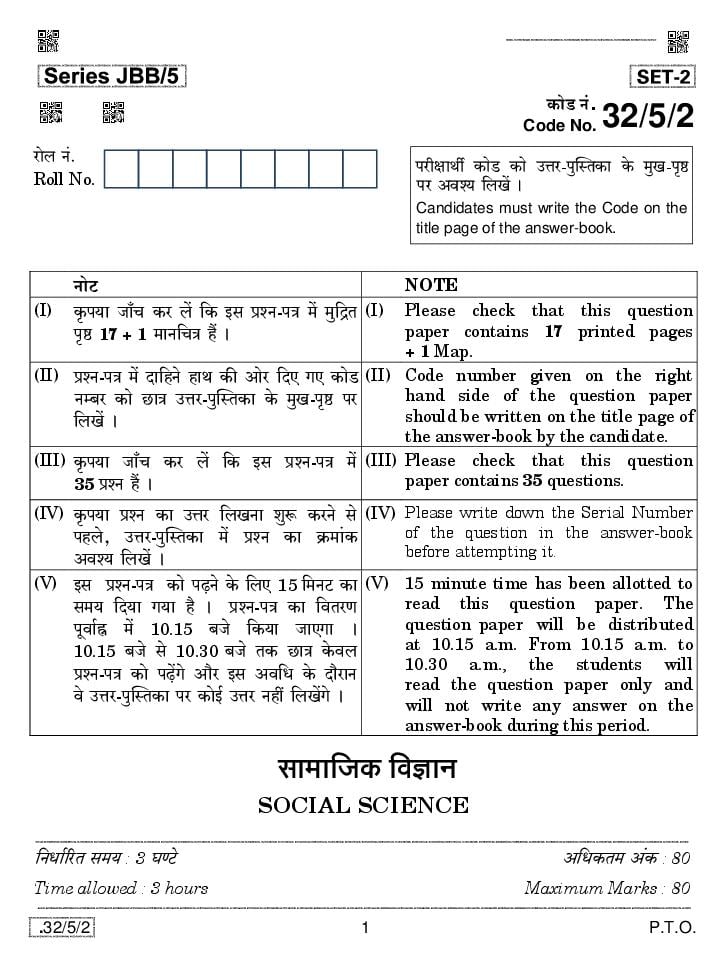
Code No. 32/5/2
amob Z§. narjmWu H$moS >H$mo CÎma-nwpñVH$m Ho$ _wI-n¥ð
Roll No. >na Adí` {bIo§ &
Candidates must write the Code on the
title page of the answer-book.
ZmoQ> NOTE
(I) H¥$n`m Om±M H$a b| {H$ Bg àíZ-nÌ _o§ _w{ÐV (I)Please check that this question
n¥ð> 17 + 1 _mZ{MÌ h¢ & paper contains 17 printed pages
+ 1 Map.
(II) àíZ-nÌ _| Xm{hZo hmW H$s Amoa {XE JE H$moS (II) Code number given on the right
>Zå~a H$mo N>mÌ CÎma-nwpñVH$m Ho$ _wI-n¥ð> na hand side of the question paper
{bI| & should be written on the title page of
the answer-book by the candidate.
(III) H¥$n`m Om±M H$a b| {H$ Bg àíZ-nÌ _| (III) Please check that this question
>35 àíZ h¢ & paper contains 35 questions.
(IV) H¥$n`m àíZ H$m CÎma {bIZm ewê$ H$aZo go (IV) Please write down the Serial Number
nhbo, CÎma-nwpñVH$m _| àíZ H$m H«$_m§H$ of the question in the answer-book
before attempting it.
Adí` {bI| &
(V) Bg àíZ-nÌ H$mo n‹T>Zo Ho$ {bE 15 {_ZQ >H$m (V) 15 minute time has been allotted to
g_` {X`m J`m h¡ & àíZ-nÌ H$m {dVaU read this question paper. The
nydm©• _| 10.15 ~Oo {H$`m OmEJm & question paper will be distributed
10.15 ~Oo go 10.30 ~Oo VH$ N>mÌ Ho$db at 10.15 a.m. From 10.15 a.m. to
10.30 a.m., the students will
àíZ-nÌ H$mo n‹T>|Jo Am¡a Bg Ad{Y Ho$ Xm¡amZ read the question paper only and
do CÎma-nwpñVH$m na H$moB© CÎma Zht {bI|Jo & will not write any answer on the
answer-book during this period.
gm_m{OH$ {dkmZ
SOCIAL SCIENCE
{ZYm©[aV g_` : 3 KÊQ>o A{YH$V_ A§H$ : 80
Time allowed : 3 hours Maximum Marks : 80
.32/5/2 1 P.T.O.
Page 2
{ZåZ{b{IV {ZX}em| H$mo ~hþV gmdYmZr go n{‹T>E Am¡a CZH$m g™Vr go nmbZ H$s{OE :
(i) àíZ-nÌ Mma IÊS>m| _| {d^m{OV {H$`m J`m h¡ – H$, I, J Ed§ K & Bg àíZ-nÌ _| àíZm| H$s
g§»`m 35 h¡ & g^r àíZ A{Zdm`© h¢ &
(ii) IÊS> H$ _| àíZ g§»`m 1 go 20 VH$ A{V bKw-CÎmar` àH$ma Ho$ àíZ h¢, àË`oH$ àíZ 1 A§H$ H$m
h¡ &
(iii) IÊS> I _| àíZ g§»`m 21 go 28 VH$ bKw-CÎmar` àH$ma Ho$ àíZ h¢, àË`oH$ àíZ 3 A§H$ H$m
h¡ & àË`oH$ àíZ H$m CÎma 80 eãXm| _| {b{IE &
(iv) IÊS> J _| àíZ g§»`m 29 go 34 VH$ XrK©-CÎmar` àH$ma Ho$ àíZ h¢, àË`oH$ àíZ 5 A§H$ H$m
h¡ & àË`oH$ àíZ H$m CÎma 120 eãXm| _| {b{IE &
(v) IÊS> K _| àíZ g§»`m 35 _mZ{MÌ AmYm[aV h¡ & `h àíZ 6 A§H$ H$m h¡, Omo {H$ B{Vhmg go
(35(a) – 2 A§H$) VWm ^yJmob (35(b) – 4 A§H$) go g§~§{YV h¡ &
(vi) CÎma g§{já VWm {~ÝXþdma hmoZo Mm{hE Am¡a gmW hr Cn`w©º$ eãX gr_m H$m `Wmg§^d nmbZ
H$s{OE &
(vii) àíZ-nÌ _| g_J« na H$moB© {dH$ën Zht h¡ & VWm{n, Hw$N> àíZm| _| Am§V[aH$ {dH$ën {XE JE
h¢ & Eogo àíZm| _| go Ho$db EH$ hr {dH$ën H$m CÎma {b{IE &
(viii) _mZ{MÌ H$mo AnZr CÎma-nwpñVH$m Ho$ gmW ZËWr H$s{OE &
(ix) BgHo$ A{V[aº$, Amdí`H$VmZwgma, àË`oH$ IÊS> Am¡a àíZ Ho$ gmW `Wmo{MV {ZX}e {XE JE h¢ &
IÊS> H$
1. H¥$îUm {ZH$Q> Ho$ IoV _| H¥${f _µOXÿa Ho$ ê$n _| ~hþV H$_ _µOXÿar na H$m_ H$aVr h¡ &
AMmZH$ ~r_ma n‹S>Zo na `m n[adma _| {H$gr g_mamoh na IM© H$aZo Ho$ {bE ^r Cgo H$O©
boZm n‹S>Vm h¡ & ^yñdm_r Cgo 5 à{VeV _m{gH$ ã`mO Xa na G$U XoVm h¡ & dV©_mZ _| Cgo
^yñdm_r Ho$ < 5,000 XoZo h¢ &
D$na Xr JB© G$U ì`dñWm H$m {díbofU H$s{OE & 1>
.32/5/2 2
Page 3
Read the following instructions very carefully and strictly follow them :
(i) Question paper comprises four Sections – A, B, C and D. There are
35 questions in the question paper. All questions are compulsory.
(ii) Section A – Question no. 1 to 20 are very short answer type questions, carrying
1 mark each.
(iii) Section B – Question no. 21 to 28 are short answer type questions, carrying
3 marks each. Answer to each question should not exceed 80 words.
(iv) Section C – Question no. 29 to 34 are long answer type questions, carrying
5 marks each. Answer to each question should not exceed 120 words.
(v) Section D – Question no. 35 is map based, carrying 6 marks with two parts,
35(a) from History (2 marks) and 35(b) from Geography (4 marks).
(vi) Answers should be brief and to the point; also the above word limit be adhered
to as far as possible.
(vii) There is no overall choice in the question paper. However, an internal choice
has been provided in few questions. Only one of the choices in such questions
have to be attempted.
(viii) Attach map along with your answer-book.
(ix) In addition to this, separate instructions are given with each section and
question, wherever necessary.
SECTION A
1. Krishna is working in a neighboring field with very less wages. Expenses
on sudden illnesses or functions in the family are also met through loans.
The landowner charges an interest rate of 5 percent per month. At
present she owes the landowner < 5,000.
Analyse the credit arrangements given above. 1
.32/5/2 3 P.T.O.
Page 4
h¡ & H$WZm| H$mo n{‹T>E Am¡a ghr {dH$ën H$m M`Z H$s{OE & 1
Ñ‹T>H$WZ (A) : ^maV _| gaH$ma {H$gmZm| go C{MV _yë` na Johÿ± Am¡a Mmdb IarXVr h¡ &
H$maU (R) : gmd©O{ZH$ joÌH$ Am{W©H$ {dH$mg _| `moJXmZ XoVm h¡ &
{dH$ën :
(A) (A) Am¡a (R) XmoZm| ghr h¢ Am¡a (R), (A) H$s ghr ì`m»`m h¡ &
(B) (A) Am¡a (R) XmoZm| ghr h¢, naÝVw (R), (A) H$s ghr ì`m»`m Zht h¡ &
(C) (A) ghr h¡, naÝVw (R) µJbV h¡ &
(D) (A) µJbV h¡, naÝVw (R) ghr h¡ &
3. ^maV _| d¡ídrH$aU Ho$ H$maH$m| Ho$ g§~§Y _| ghr H$WZ H$m M`Z H$s{OE : 1
I. n[adhZ àm¡Úmo{JH$s _| gwYma &
II. {dXoer ì`mnma Am¡a {dXoer {Zdoe H$m CXmarH$aU &
III. {dH${gV Xoem| H$s VwbZm _| ^maV Ho$ à{V {díd ì`mnma g§JR>Z Ho$ AZwHy$b {Z`_ &
ZrMo {XE JE H$moS> _| go ghr {dH$ën H$m M`Z H$s{OE :
(A) Ho$db I Am¡a II
(B) Ho$db I Am¡a III
(C) Ho$db II Am¡a III
(D) Ho$db III
4. ^maV _| ñWmZr` àemgZ _| _{hbmAm| H$mo {H$VZm à{VeV AmajU {X`m OmVm h¡ ? 1
AWdm
^maV _| àË`oH$ amÁ` _| n§Mm`V Am¡a ZJanm{bH$m MwZmd H$amZo Ho$ {bE H$m¡Z-gr g§ñWm ~ZmB©
JB© h¡ ? 1
5. ‘AmZÝX_R >’ CnÝ`mg Ho$ boIH$ H$m Zm_ {b{IE & 1
6. [aº$ ñWmZ H$s ny{V© H$s{OE : 1
AmYw{ZH$ ^maV _| Om{V H$s g§aMZm Am¡a Om{V ì`dñWm _| ^mar ~Xbmd Am`m h¡ Š`m|{H$
______________ &
AWdm
^maVr` g§{dYmZ g^r ZmJ[aH$m| Am¡a g_wXm`m| H$mo {H$gr ^r Y_© H$m nmbZ H$aZo Am¡a àMma
H$aZo H$s AmµOmXr XoVm h¡ Š`m|{H$ _____________ &
.32/5/2 4
Page 5
Read the statements and choose the correct option. 1
Assertion (A) : The Government of India buys wheat and rice from
farmers at fair price.
Reason (R) : Public sector contributes to the economic development.
Options :
(A) Both (A) and (R) are true and (R) is the correct explanation of (A).
(B) Both (A) and (R) are true, but (R) is not the correct explanation of (A).
(C) (A) is true, but (R) is false.
(D) (A) is false, but (R) is true.
3. Choose the correct statement about factors regarding globalization in
India : 1
I. Improvement in transportation technology.
II. Liberalization of foreign trade and foreign investment.
III. Favourable rules of WTO towards India in comparison to
developed countries.
Choose the correct options from the codes given below :
(A) Only I and II
(B) Only I and III
(C) Only II and III
(D) Only III
4. What percentage of reservation is given to women in local administration
in India ? 1
OR
Which institution has been created in each State of India to conduct
Panchayat and Municipal elections ? 1
5. Name the author of the novel ‘Anandmath’. 1
6. Fill in the blank : 1
Castes and Caste system in modern India have undergone a great change
because ____________ .
OR
The Indian Constitution provides to all individuals and communities
freedom to profess, practise and propagate any religion because _______ .
.32/5/2 5 P.T.O.
Page 6
~hþOZ g_mO nmQ>u (~r.Eg.nr.) H$m JR>Z _m`mdVr Ho$ ZoV¥Ëd _| hþAm &
8. {ZåZ{b{IV Vm{bH$m H$mo A Am¡a B Ho$ {bE ghr OmZH$mar Ho$ gmW nyam H$s{OE : 1
BgH$s d¥{Õ Ho$ {bE
JÞo H$s Ano{jV dm{f©H$ dfm© Obdm`w Ano{jV Vmn_mZ
µ\$gb ({S>J«r _|)
A? CîU Am¡a AmЩ B?
9. ^maVr` aob Ho$ _mÜ`_ go VrW© n`©Q>Z H$mo ~‹T>mZo H$m H$moB© EH$ VarH$m gwPmBE & 1
10. {ZåZ{b{IV _| go ghr gw_o{bV Omo‹S>o H$m M`Z H$s{OE : 1
(A) Am°Q>mo dm°Z {~ñ_mH©$ — O_©Zr
(B) Zonmo{b`Z — ñnoZ
(C) Á`wgono J¡ar~m°ëS>r — \«$m§g
(D) ~y~m] amOm — BQ>br>
11. [aº$ ñWmZ H$s ny{V© H$s{OE : 1
^maV _| _mZd {dH$mg gyMH$m§H$ (EM.S>r.AmB©.) H$m ñVa ____________ Ho$ _mÜ`_ go
gwYmam Om gH$Vm h¡ &
12. ^maV _| nQ>gZ dñÌ CÚmoJ H$mo ~‹T>mdm XoZo H$m H$moB© EH$ VarH$m gwPmBE & 1
13. VmZmemhr emgZ _| Am{W©H$ {dH$mg H$m H$moB© EH$ CXmhaU {b{IE & 1
14. ZrMo {XE JE {dH$ënm| _| go g{dZ` Adkm Am§XmobZ _| Am¡Úmo{JH$ l{_H$m| H$s µJ¡a-^mJrXmar
Ho$ C{MV H$maU H$s nhMmZ H$s{OE & 1
(A) CÚmoJn{V H$m±J«og Ho$ H$ar~ Wo
(B) A§J«oµOm| Zo CÝh| AÀN>m doVZ àñVm{dV {H$`m
(C) do {dXoer gm_mZ Ho$ ~{hîH$ma Ho$ à{V A{ZÀNw>H$ Wo
(D) g_mOdmX H$m {dH$mg
.32/5/2 6
Page 7
Bahujan Samaj Party (BSP) was formed under the leadership of
Mayawati.
8. Complete the following table with correct information for A and B : 1
Temperature
Annual Rainfall
Climate required for its
Sugarcane required
growth (in degrees)
Crop
Hot and
A? B?
Humid
9. Suggest any one way to enhance pilgrimage tourism through Indian
Railways. 1
10. Choose the correctly matched pair from the following : 1
(A) Otto Von Bismarck — Germany
(B) Napoleon — Spain
(C) Giuseppe Garibaldi — France
(D) Bourbon Kings — Italy
11. Fill in the blank : 1
Human Development Index (HDI) level in India can be improved through
________________ .
12. Suggest any one way to promote jute textile industry in India. 1
13. Give any one example of economic development in dictatorial regimes. 1
14. Identify the appropriate reason from the following options, for the
non-participation of industrial workers in the Civil Disobedience
Movement. 1
(A) Industrialists were close to the Congress
(B) British offered them good salaries
(C) They were reluctant towards the boycott of foreign goods
(D) Growth of Socialism
.32/5/2 7 P.T.O.
Page 8
AWdm
‘A_a OrdZ ’ {H$Vm~ Ho$ boIH$ H$m Zm_ {b{IE & 1
16. \«o${S´>H$ gm°a`y Ho$ {MÌ ‘{dídì`mnr àOmVm§{ÌH$ Am¡a gm_m{OH$ JUamÁ`m| H$m ñdßZ’ _|
ñdV§ÌVm H$s à{V_m Ho$ _hÎd H$s naI H$s{OE & 1
17. gmB_Z H$_reZ ^maV _| Š`m| Am`m Wm ? {ZåZ{b{IV {dH$ënm| _| go ghr H$maU H$s nhMmZ
H$s{OE & 1
(A) A§J«oµOm| Ho$ {déÕ eham| _| A{^`mZ H$mo {Z`§{ÌV H$aZo Ho$ {bE
(B) A§J«oµOm| Ho$ H$m_H$mO na Ü`mZ XoZo Ho$ {bE
(C) ^maV _| Z_H$ H$mZyZ H$mo Ama§^ H$aZo Ho$ {bE
(D) ^maV _| g§d¡Ym{ZH$ ì`dñWm H$s H$m`©e¡br _| n[adV©Z Ho$ gwPmd XoZo Ho$ {bE
18. qàqQ>J àog H$m Am{dîH$ma {H$gZo {H$`m Wm ? 1
AWdm
Voahdt eVmãXr Ho$ Xm¡amZ, BQ>br _| dwS>ãbm°H$ dmbr N>nmB© H$s VH$ZrH$ H$m kmZ H$m¡Z bm`m
Wm ? 1
19. {ZåZ{b{IV _| go H$m¡Z-gm EH$ {ZOr joÌH$ H$m CÚmoJ h¡ ? 1
(A) ~r.EM.B©.Eb. (BHEL)
(B) {Q>ñH$mo (TISCO)
(C) Amo.AmB©.Eb. (OIL)
(D) gob (SAIL)
20. boQ>amBQ> _¥Xm _| H¥${f`mo½` _w»` ì`mdgm{`H$ µ\$gb H$m EH$ CXmhaU {b{IE & 1
AWdm
gm_wXm{`H$ ñdm{_Ëd dmbo g§gmYZm| H$m H$moB© EH$ CXmhaU {b{IE & 1
.32/5/2 8
Page 9
OR
Name the author of ‘Amar Jiban’. 1
16. Examine the significance of the Statue of Liberty in Frédéric Sorrieu’s
paintings, ‘The Dream of Worldwide Democratic and Social Republics’. 1
17. Why did the Simon Commission come to India ? Identify the correct
reason from the following options. 1
(A) To control the campaign against the British in cities
(B) To look into the functioning of the British
(C) To initiate salt law in India
(D) To suggest changes in the functioning of the constitutional system
in India
18. Who invented the Printing Press ? 1
OR
Who brought the knowledge of woodblock printing technique to Italy
during the 13th century ? 1
19. Which one of the following is a private sector industry ? 1
(A) BHEL
(B) TISCO
(C) OIL
(D) SAIL
20. Give one example of the main commercial crop cultivable in laterite soil. 1
OR
Give one example of the Community Owned Resources. 1
.32/5/2 9 P.T.O.
Page 10
21. \«$m§grgr bmoJm| _| EH$ gm_y{hH$ nhMmZ H$s ^mdZm n¡Xm H$aZo Ho$ {bE \«$m§grgr H«$m§{VH$m[a`m|
Ûmam CR>mE JE {H$Ýht VrZ H$X_m| H$mo COmJa H$s{OE & 13=3
22. ZrMo {XE JE CÕaU H$mo n{‹T>E Am¡a CgHo$ ZrMo {XE JE àíZm| H$m CÎma Xr{OE : 1+2=3
CÞrgdt gXr H$s ewéAmV go hr Ym{_©H$ _gbm| H$mo boH$a ~hgmo§ H$m ~mµOma J_© Wm &
AbJ-AbJ g_yh Am¡n{Zdo{eH$ g_mO _| hmo aho ~Xbmdm| go OyPVo hþE, Y_© H$s
AnZr-AnZr ì`m»`m noe H$a aho Wo & Hw$N> Vmo _m¡OyXm ar{V-[admOm| H$s AmbmoMZm H$aVo hþE
CZ_| gwYma MmhVo Wo, O~{H$ Hw$N> AÝ` g_mO-gwYmaH$m| Ho$ VH$m] Ho$ {˜bmµ\$ I‹S>o Wo & `o
gmao dmX-{ddmX qàQ> _|, gaoAm_ npãbH$ _| hþE & N>nr hþB© nwpñVH$mAm| Am¡a A˜~mam| Zo Z
Ho$db ZE {dMmam| H$m àMma-àgma {H$`m, ~pëH$ CÝhm|Zo ~hg H$s eŠb ^r V` H$s & BZ
~hgm| _| ì`mnH$ OZ-g_wXm` ^r {hñgm bo gH$Vm Wm, AnZo _V µOm{ha H$a gH$Vm Wm & Bg
Vah Ho$ _V-_Vm§Va go ZE {dMma C^ao & `h dh g_` Wm O~ g_mO Am¡a Y_©-gwYmaH$m| VWm
{hÝXÿ ê${‹T>dm{X`m| Ho$ ~rM {dYdm-Xmh, EHo$ídadmX, ~«m÷U nwOmardJ© Am¡a _y{V©-nyOm O¡go
_wÔm| H$mo boH$a VoµO ~hg R>Zr hþB© Wr & ~§Jmb _| O¡go-O¡go ~hg Mbr, bJmVma ~‹T>Vr VmXmX
_| nwpñVH$mAm| Am¡a A˜~mam| Ho$ µO[aE Vah-Vah Ho$ VH©$ g_mO Ho$ ~rM AmZo bJo & µÁ`mXm
go µÁ`mXm bmoJm| VH$ nhþ±MZo Ho$ ˜`mb go BÝh| Am_ ~mobMmb H$s ^mfm _| N>mnm J`m &
(22.1) Ym{_©H$ _gbm| na hþB© ~hg Ho$ {H$gr EH$ _wÔo H$m {díbofU H$s{OE &
(22.2) BZ ~hgm| _| qàQ> _r{S>`m H$s ^y{_H$m H$s naI H$s{OE &
23. ‘‘I{ZO h_mao OrdZ Ho$ An[ahm`© ^mJ h¢ &’’ Bg H$WZ H$s CXmhaUm| g{hV nw{îQ> H$s{OE & 3
AWdm
‘‘I{ZO AZoH$ ê$nm| _| nmE OmVo h¢ &’’ Bg H$WZ H$s CXmhaUm| g{hV nw{îQ> H$s{OE & 3
24. ^maVr` gaH$ma Ûmam H¥${f Ho$ joÌ _| bmE JE àm¡Úmo{JH$s` gwYmam| H$m dU©Z H$s{OE & 3
25. g§KdmX H$s {H$Ýht VrZ {deofVmAm| H$m dU©Z H$s{OE & 13=3
26. {d{dYVmAm| H$mo g_m`mo{OV H$aZo _| ~opëO`_ Ho$ _m°S>b Ho$ VÎdm| H$m dU©Z H$s{OE & 3
AWdm
gÎmm H$s gmPoXmar _| j¡{VO àM{bV ñdê$n H$m dU©Z H$s{OE & 3
.32/5/2 10
Page 11
21. Highlight any three measures and practices that French revolutionaries
introduced to create a sense of collective identity among the French
people. 13=3
22. Read the extract given below and answer the questions that follow : 1+2=3
From the early nineteenth century, there were intense debates around
religious issues. Different groups confronted the changes happening
within colonial society in different ways, and offered a variety of new
interpretations of the beliefs of different religions. Some criticised
existing practices and campaigned for reform, while others countered the
arguments of reformers. These debates were carried out in public and in
print. Printed tracts and newspapers not only spread the new ideas, but
they shaped the nature of the debate. A wider public could now
participate in these public discussions and express their views. New ideas
emerged through these clashes of opinions. This was a time of intense
controversies between social and religious reformers and the Hindu
orthodoxy over matters like widow immolation, monotheism,
Brahmanical priesthood and idolatry. In Bengal, as the debate developed,
tracts and newspapers proliferated, circulating a variety of arguments.
To reach a wider audience, the ideas were printed in the everyday,
spoken language of ordinary people.
(22.1) Analyse any one issue of intense debate around religious issues.
(22.2) Examine the role of print media in these debates.
23. ‘‘Minerals are an indispensable part of our lives.’’ Support this statement
with examples. 3
OR
‘‘Minerals occur in various forms.’’ Support this statement with examples. 3
24. Describe the technological reforms taken by the Indian Government in
the field of agriculture. 3
25. Describe any three features of federalism. 13=3
26. Describe the elements of Belgian model for accommodating diversities. 3
OR
Describe the horizontal power sharing arrangements. 3
.32/5/2 11 P.T.O.
Page 12
AWdm
CYmaXmVm CYma XoVo g_` g_W©H$ G$UmYma H$s _m±J Š`m| H$aVo h¢ ? ñnîQ> H$s{OE & 3
28. Ag§J{R>V joÌ$ Ho$ l{_H$m| H$mo emofU go ~MmZo Ho$ {bE H$moB© VrZ VarHo$ gwPmBE & 13=3
IÊS> J
29. ‘‘bmoH$V§Ì ZmJ[aH$m| H$s J[a_m Am¡a AmµOmXr H$mo ~‹T>mdm XoVm h¡ &’’ H$WZ H$s naI H$s{OE & 5
AWdm
‘‘bmoH$V§Ì ~ohVa n[aUm_ XoZo Ho$ {bE g~go Cn`wº$ h¡ &’’ H$WZ H$s naI H$s{OE & 5
30. ZrMo {XE JE òmoVm| H$mo n{‹T>E Am¡a CZgo g§~§{YV àíZm| Ho$ CÎma {b{IE : 1+2+2=5
òmoV A d¡ídrH$aU Am¡a ^maVr` AW©ì`dñWm
AmO Ho$ {díd _|, Cn^moº$m Ho$ ê$n _| h_ _| go Hw$N> Ho$ gm_Zo dñVwAm| Am¡a godmAm| Ho$
{dñV¥V {dH$ën h¢ & {díd Ho$ erf©ñW {d{Z_m©VmAm| Ûmam {Z{_©V {S>{OQ>b H¡$_ao, _mo~mBb
µ\$moZ Am¡a Q>obr{dµOZ Ho$ ZdrZV_ _m°S>b h_mao {bE gwb^ h¢ & h_oem ^maV H$s g‹S>H$m| na
Jm{‹S>`m| Ho$ ZE _m°S>b XoIo Om gH$Vo h¢ &
òmoV B {dXoer ì`mnma Am¡a ~mµOmam| H$m EH$sH$aU
{dXoer ì`mnma Kaoby ~mµOmam| AWm©V² AnZo Xoe Ho$ ~mµOmam| go ~mha Ho$ ~mµOmam| _| nhþ±MZo Ho$
{bE CËnmXH$m| H$mo EH$ Adga àXmZ H$aVm h¡ & CËnmXH$ Ho$db AnZo Xoe Ho$ ~mµOmam| _| hr
AnZo CËnmX Zht ~oM gH$Vo h¢, ~pëH$ {díd Ho$ AÝ` Xoem| Ho$ ~mµOmam| _| ^r à{VñnYm© H$a
gH$Vo h¢ & Bgr àH$ma, Xÿgao Xoem| _| CËnm{XV dñVwAm| Ho$ Am`mV go IarXXmam| Ho$ g_j CZ
dñVwAm| Ho$ Kaoby CËnmXZ Ho$ AÝ` {dH$ënm| H$m {dñVma hmoVm h¡ &
òmoV C Ý`m`g§JV d¡ídrH$aU Ho$ {bE g§Kf©
{dJV Hw$N> dfm] _|, ~‹S>o A{^`mZm| Am¡a OZg§JR>Zm| Ho$ à{V{Z{Y`m| Zo {díd ì`mnma g§JR>Z Ho$
ì`mnma Am¡a {Zdoe go g§~§{YV _hÎdnyU© {ZU©`m| H$mo à^m{dV {H$`m h¡ & `h àX{e©V H$aVm h¡
{H$ OZVm ^r Ý`m`g§JV d¡ídrH$aU Ho$ g§Kf© _| _hÎdnyU© ^y{_H$m {Z^m gH$Vr h¡ &
.32/5/2 12
Page 13
OR
Why do lenders ask for collateral while lending ? Explain. 3
28. Suggest any three ways to save workers of unorganized sector from
exploitation. 13=3
SECTION C
29. ‘‘Democracy promotes dignity and freedom of the people.’’ Examine the
statement. 5
OR
‘‘Democracy is best suited to produce better results.’’ Examine the
statement. 5
30. Read the sources given below and answer the questions related to
them : 1+2+2=5
Source A Globalisation and the Indian economy
As consumers in today’s world, some of us have a wide choice of goods
and services before us. The latest models of digital cameras, mobile
phones and televisions made by the leading manufacturers of the world
are within our reach. Every season, new models of automobiles can be
seen on Indian roads.
Source B Foreign trade and integration of markets
Foreign trade creates an opportunity for the producers to reach beyond
the domestic markets, i.e., markets of their own countries. Producers can
sell their produce not only in markets located within the country but can
also compete in markets located in other countries of the world.
Similarly, for the buyers, import of goods produced in another country is
one way of expanding the choice of goods beyond what is domestically
produced.
Source C The struggle for fair globalisation
In the past few years, massive campaigns and representation by people’s
organisations have influenced important decisions relating to trade and
investments at the WTO. This has demonstrated that people also can
play an important role in the struggle for fair globalisation.
.32/5/2 13 P.T.O.
Page 14
d¡ídrH$aU H$m à^md Cn^moº$mAm| na H¡$go {XImB© n‹S>Vm h¡ ?
(30.2) òmoV B {dXoer ì`mnma Am¡a ~mµOmam| H$m EH$sH$aU
{dXoer ì`mnma ~mµOmam| H$mo {H$g àH$ma EH$sH¥$V H$aVm h¡ ? ñnîQ> H$s{OE &
(30.3) òmoV C Ý`m`g§JV d¡ídrH$aU Ho$ {bE g§Kf©
Ý`m`g§JV d¡ídrH$aU Ho$ g§Kf© _| bmoJ H¡$go _hÎdnyU© ^y{_H$m {Z^mVo h¢ ? ñnîQ>
H$s{OE &
31. ‘‘bmoH$V§Ì H$m à^mdr CnH$aU ~Zo ahZo Ho$ {bE amOZr{VH$ Xbm| H$mo H$B© MwZm¡{V`m| H$m
gm_Zm H$aZm n‹S>Vm h¡ &>’’ Bg H$WZ H$s CXmhaUm| g{hV ì`m»`m H$s{OE & 5
32. ^maVr` aob Omb Ho$ {dVaU à{Vê$n H$mo à^m{dV H$aZo dmbo ^y-AmH¥${VH$ Am¡a Am{W©H$
H$maH$m| H$m dU©Z H$s{OE & 5
AWdm
g‹S>H$ n[adhZ H$s ~‹T>Vr _hÎmm H$m dU©Z H$s{OE & 5
33. YmaUr`Vm H$m {df` {dH$mg Ho$ {bE _hÎdnyU© Š`m| h¡ ? ñnîQ> H$s{OE & 5
34. {ÛVr` {díd `wÕmoÎma ~§Xmo~ñV _| ~«oQ>Z dwS²>g g§ñWmZm| H$s ^y{_H$m H$mo ñnîQ> H$s{OE & 5
AWdm
CZ VarH$m| H$s ì`m»`m H$s{OE {OZHo$ Ûmam {~«{Q>e {Z_m©VmAm| Zo gånyU© ^maVr` ~mµOma na
H$ãOm H$aZo Ho$ à`mg {H$E & 5
IÊS> K
35. (a) Xmo ñWmZ ‘A’ Am¡a ‘B’ {XE JE ^maV Ho$ amOZr{VH$ aoIm-_mZ{MÌ (n¥ð> 19 na) _|
A§{H$V {H$E JE h¢ & BZ ñWmZm| H$mo {ZåZ{b{IV OmZH$mar H$s ghm`Vm go nhMm{ZE
Am¡a CZHo$ ghr Zm_ CZHo$ {ZH$Q> ItMr JBª aoImAm| na {b{IE : 12=2
(A) dh ñWmZ Ohm± ^maVr` amîQ´>r` H$m±J«og H$m 1927 _| A{YdoeZ hþAm Wm &
(B) dh ñWmZ Ohm± Agh`moJ Am§XmobZ H$mo qhgm Ho$ H$maU ~rM _| amoH$Zm n‹S>m &
.32/5/2 14
Page 15
How is the impact of globalisation visible on consumers ?
(30.2) Source B Foreign trade and integration of markets
How does foreign trade integrate the markets ? Explain.
(30.3) Source C The struggle for fair globalisation
How do people play an important role in the struggle for fair
globalisation ? Explain.
31. ‘‘Political parties need to face certain challenges in order to remain
effective instruments of democracy.’’ Explain the statement with
examples. 5
32. Describe the physical and economic factors that influenced the
distribution pattern of the Indian Railways network. 5
OR
Describe the growing importance of road transport. 5
33. Why is the issue of sustainability important for development ? Explain. 5
34. Explain the role of Bretton Woods institutions in post-Second World War
settlement. 5
OR
Explain the ways through which British manufacturers attempted to
take over the Indian market. 5
SECTION D
35. (a) Two places ‘A’ and ‘B’ are marked on the given political outline
map of India (on page 19). Identify these places with the help of
the following information and write their correct names on the
lines marked near them : 12=2
(A) The place where the Indian National Congress session was
held in 1927.
(B) The place where the Non-Cooperation Movement ended
abruptly due to violence.
.32/5/2 15 P.T.O.
Page 16
H$mo Cn`wº$ {M•m| go Xem©BE Am¡a CZHo$ Zm_ {b{IE : 14=4
(i) hpëX`m — g_wÐr nÎmZ
(ii) nwUo — gm°âQ>do`a Q>oŠZmobm°Or nmH©$
(iii) {^bmB© — bmohm Ed§ BñnmV g§`§Ì
(iv) H$mH$amnmam >— AmpÊdH$ D$Om© g§`§Ì
(v) hramHw$S> >— ~m±Y
(vi) B§{Xam Jm±Yr hdmB© nÎmZ — AÝVam©îQ´>r` hdmB© nÎmZ
ZmoQ> : {ZåZ{b{IV àíZ Ho$db Ñ{ï>~m{YV narjm{W©`m| Ho$ {bE àíZ g§»`m 35 Ho$ ñWmZ na
h¢ & {H$Ýht N>… àíZm| Ho$ CÎma {b{IE :
(35.1) Cg amÁ` H$m Zm_ {b{IE Ohm± Zrb H$s IoVr H$aZo dmbo {H$gmZm| Zo gË`mJ«h
{H$`m &
(35.2) Cg amÁ` H$m Zm_ {b{IE Ohm± Agh`moJ Am§XmobZ H$mo qhgm Ho$ H$maU ~rM _|
amoH$Zm n‹S>m &
(35.3) Cg ñWmZ H$m Zm_ {b{IE Ohm± ^maVr` amï´>r` H$m±J«og H$m 1927 _| A{YdoeZ
hþAm &
(35.4) Cg amÁ` H$m Zm_ {b{IE Ohm± hpëX`m g_wÐr nÎmZ pñWV h¡ &
(35.5) Cg amÁ` H$m Zm_ {b{IE Ohm± nwUo gm°âQ>do`a Q>oŠZmobm°Or nmH©$ pñWV h¡ &
(35.6) Cg amÁ` H$m Zm_ {b{IE Ohm± H$mH$amnmam AmpÊdH$ D$Om© g§`§Ì pñWV h¡ &
(35.7) Cg amÁ` H$m Zm_ {b{IE Ohm± hramHw$S ~m±Y pñWV h¡ &
(35.8) ^maV Ho$ g~go CÎmar A§Vam©îQ´>r` hdmB© nÎmZ H$m Zm_ {b{IE & 1 6=6
.32/5/2 16
Page 17
on the same given political outline map of India : 14=4
(i) Haldia — Sea-port
(ii) Pune — Software Technology Park
(iii) Bhilai — Iron and Steel Plant
(iv) Kakrapara — Nuclear Power Plant
(v) Hirakud — Dam
(vi) Indira Gandhi Airport — International Airport
Note : The following questions are for the Visually Impaired Candidates
only, in lieu of Q. No. 35. Attempt any six questions :
(35.1) Name the State where the Indigo planters organized Satyagraha.
(35.2) Name the State where the Non-Cooperation Movement ended
abruptly due to violence.
(35.3) Name the place where the Indian National Congress session was
held in 1927.
(35.4) Name the State where Haldia sea-port is located.
(35.5) Name the State where Pune Software Technology Park is
located.
(35.6) Name the State where Kakrapara Nuclear Power Plant is
located.
(35.7) Name the State where Hirakud Dam is located.
(35.8) Name the northernmost International Airport of India. 16=6
.32/5/2 17 P.T.O.
Page 18
Page 19
^maV H$m aoIm-_mZ{MÌ (amOZr{VH$)
Outline Map of India (Political)
B
A
.32/5/2 19 P.T.O.
Document Details
| Board / Org | CBSE |
| Exam | Class 10 |
| Type | Question Paper |
| Pages | 19 |
| Updated | 22 Jul 2026 |