CBSE Class 10 Question Paper 2021 Maths Basic (Compartment)
Finished viewing? Save it for later —
Download CBSE Class 10 Question Paper 2021 Maths Basic (Compartment) (PDF · 20 pages)About CBSE Class 10 Question Paper 2021 Maths Basic (Compartment)
CBSE Class 10 Question Paper 2021 Maths Basic (Compartment) is available here for free download. Published by CBSE for Class 10, this question paper can be viewed online or downloaded as a PDF (20 pages). Candidates preparing for Class 10 can use CBSE Class 10 Question Paper 2021 Maths Basic (Compartment) to understand the exam pattern, the type of questions asked, and the overall difficulty level.
Frequently Asked Questions
How can I download CBSE Class 10 Question Paper 2021 Maths Basic (Compartment)?
Open this page and click the Download button to save CBSE Class 10 Question Paper 2021 Maths Basic (Compartment) as a PDF. It is completely free on AglaSem Docs.
Is CBSE Class 10 Question Paper 2021 Maths Basic (Compartment) free to download?
Yes. CBSE Class 10 Question Paper 2021 Maths Basic (Compartment) can be viewed online and downloaded as a PDF free of cost on AglaSem Docs.
How many pages does CBSE Class 10 Question Paper 2021 Maths Basic (Compartment) have?
CBSE Class 10 Question Paper 2021 Maths Basic (Compartment) contains 20 pages, which you can read online or download together as a single PDF.
Where can I find more Class 10 study material?
You can find more Class 10 question papers, sample papers, syllabus, and answer keys on AglaSem Docs.
CBSE Class 10 Question Paper 2021 Maths Basic (Compartment) – Text
Read the full text of this question paper below — useful to quickly search, copy and reference the content online without downloading the PDF.
📄 View text version (20 pages)
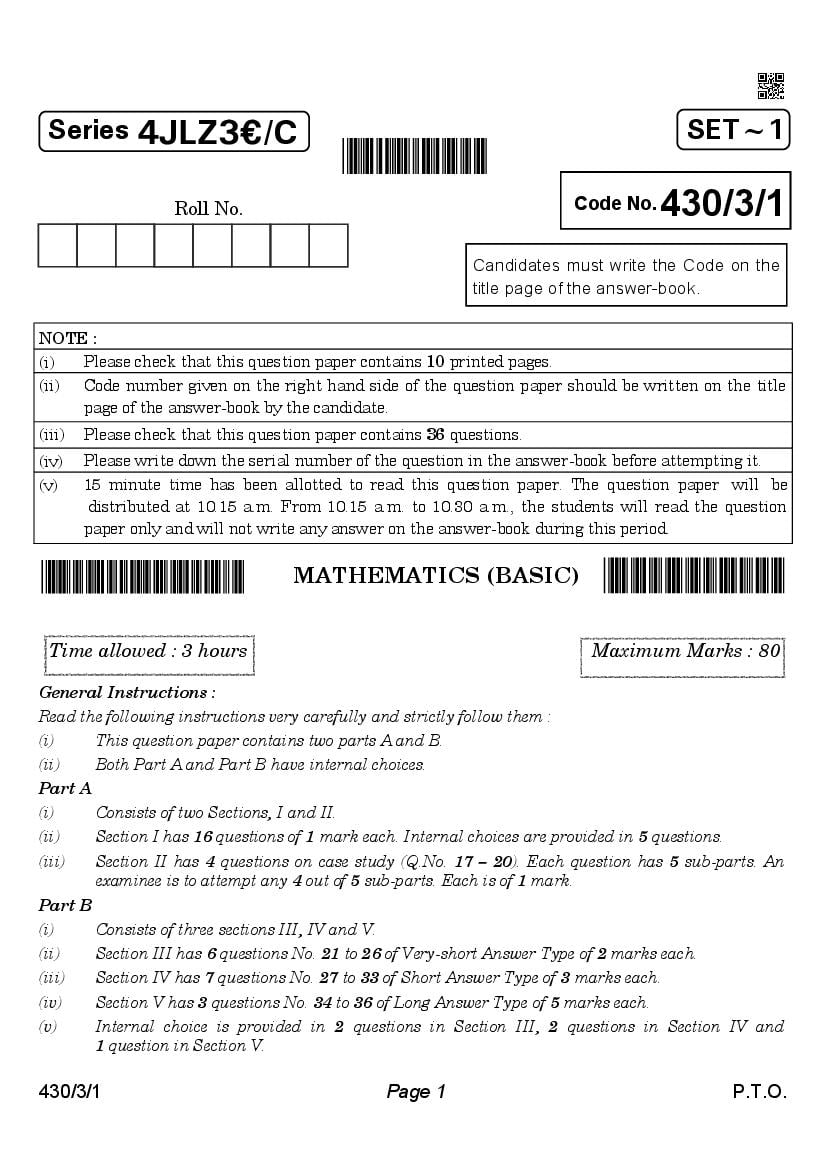
Page 1
Roll No. Code No. 430/3/1
Candidates must write the Code on the
title page of the answer-book.
NOTE :
(i) Please check that this question paper contains 10 printed pages.
(ii) Code number given on the right hand side of the question paper should be written on the title
page of the answer-book by the candidate.
(iii) Please check that this question paper contains 36 questions.
(iv) Please write down the serial number of the question in the answer-book before attempting it.
(v) 15 minute time has been allotted to read this question paper. The question paper will be
distributed at 10.15 a.m. From 10.15 a.m. to 10.30 a.m., the students will read the question
paper only and will not write any answer on the answer-book during this period.
MATHEMATICS (BASIC)
Time allowed : 3 hours Maximum Marks : 80
General Instructions :
Read the following instructions very carefully and strictly follow them :
(i) This question paper contains two parts A and B.
(ii) Both Part A and Part B have internal choices.
Part A
(i) Consists of two Sections, I and II.
(ii) Section I has 16 questions of 1 mark each. Internal choices are provided in 5 questions.
(iii) Section II has 4 questions on case study (Q.No. 17 20). Each question has 5 sub-parts. An
examinee is to attempt any 4 out of 5 sub-parts. Each is of 1 mark.
Part B
(i) Consists of three sections III, IV and V.
(ii) Section III has 6 questions No. 21 to 26 of Very-short Answer Type of 2 marks each.
(iii) Section IV has 7 questions No. 27 to 33 of Short Answer Type of 3 marks each.
(iv) Section V has 3 questions No. 34 to 36 of Long Answer Type of 5 marks each.
(v) Internal choice is provided in 2 questions in Section III, 2 questions in Section IV and
1 question in Section V.
430/3/1 Page 1 P.T.O.
Page 2
SECTION I
7 2
1. Find the distance between the points A , 5 and B ,5 . 1
3 3
2. Express 288 as product of its prime factors. 1
1 4 7 10
3. (a) Write the common difference of the A.P. : , , , , ... 1
5 5 5 5
OR
th
(b) Find the 8 term of the A.P. whose first term is 2 and common difference is 3. 1
2
4. Find the sum and product of zeroes of the polynomial p(x) = x + 5x + 6. 1
5. Check whether 13 cm, 12 cm, 5 cm can be the sides of a right triangle. 1
6. If 2 cos = 3 , then find the value of . 1
7.
Figure 1
(a) In the given Figure 1, ABC PQR. Write similarity criterion by which
ABC and PQR are similar. 1
OR
(b) Corresponding sides of two similar triangles are in the ratio 3 : 5. What is the
ratio of their areas ? 1
8. The graph of y = p(x) is shown in Figure 2 for some polynomial p(x). Find the number of
zeroes of p(x). 1
Figure 2
2
9. Find the discriminant of the quadratic equation 2x 5x 6 = 0. 1
10. A card is drawn at random from a well-shuffled pack of 52 playing cards. Find the
probability of getting a red face card. 1
11. Show that the tangents drawn at the ends of a diameter of a circle are parallel. 1
430/3/1 Page 2
Page 3
and PL = 4 cm, find the length of OP, where radius of the circle is 3 cm. 1
OR
(b) Find the distance between two parallel tangents of a circle of radius 2·5 cm. 1
13. (a) Two different coins are tossed simultaneously. Write all the possible outcomes. 1
OR
(b) A die is thrown once. Write the probability of getting a number less than 7. 1
14. (a)
the radius 1
OR
(b) 1
15. A vertical pole is 100 metres high. Find the angle subtended by the pole at a point on
the ground 100 3 meters from the base of the pole. 1
16. In ABC, right-angled at A, if AB = 7 cm and AC = 24 cm, then find sin B and tan C. 1
SECTION II
Case study based questions (Q. No. 17 20) are compulsory. Attempt any 4 sub-parts from each
question. Each sub-part carries 1 mark.
17. During the lockdown period, many families got bored of watching TV all the time. Out of
these families, one family of 6 members decided to play a card game. 17 cards numbered
1, 2, 3, 4, ..., 17 are put in a box and mixed thoroughly. One card is drawn by one
member at random and other family members bet for the chances of drawing the
number either prime, odd or even etc.
1 2 3 4 5 6 7 8 9
10 11 12 13 14 15 16 17
430/3/1 Page 3 P.T.O.
Page 4
(i) The first member of the family draws a card at random and another member
bets that it is an even prime number. What is the probability of his winning the
bet ? 1
2
(A)
17
3
(B)
17
1
(C)
17
4
(D)
17
(ii) The second member of the family draws a card at random and some other
member bets that it is an even number. What is the probability of his winning
the bet ? 1
7
(A)
17
8
(B)
17
9
(C)
17
10
(D)
17
(iii) What is the probability that the number on the card drawn at random is
divisible by 5 ? 1
5
(A)
17
4
(B)
17
3
(C)
17
2
(D)
17
(iv) What is the probability that the number on the card drawn at random is a
multiple of 3 ? 1
5
(A)
17
6
(B)
17
7
(C)
17
8
(D)
17
430/3/1 Page 4
Page 5
9
(A)
17
3
(B)
17
8
(C)
17
1
(D)
17
18. Roshni being a plant lover decides to start a nursery. She bought few plants with pots.
She placed the pots in such a way that the number of pots in the first row is 2, in the
second is 5, in the third row is 8 and so on.
Based on the above, answer the following questions :
(i) How many pots were placed in the 7th row ? 1
(A) 20
(B) 23
(C) 77
(D) 29
(ii) If Roshni wants to place 100 pots in total, then total number of rows formed in
the arrangement will be 1
(A) 8
(B) 9
(C) 10
(D) 12
(iii) How many pots are placed in the last row ? 1
(A) 20
(B) 23
(C) 26
(D) 29
(iv) If Roshni has sufficient space for 12 rows, then how many total number of pots
are placed by her with the same arrangement ? 1
(A) 222
(B) 155
(C) 187
(D) 313
430/3/1 Page 5 P.T.O.
Page 6
(v) The difference in number of pots placed in the 4 row and the 2 row, is 1
(A) 3
(B) 4
(C) 6
(D) 8
19. To explain how trigonometry can be used to measure the height of an inaccessible
object, a teacher gave the following example to students :
A TV tower stands vertically on the bank of a canal. From a point on the other bank
directly opposite the tower, the angle of the elevation of the top of the tower is 60 . From
another point 20 m away from this point on the line joining this point to the foot of the
tower, the angle of elevation of the top of the tower is 30 (as shown in Figure 3).
Figure 3
Based on the above, answer the following questions :
(i) The width of the canal is 1
(A) 10 3 m
(B) 20 3 m
(C) 10 m
(D) 20 m
(ii) Height of the tower is 1
(A) 10 3 m
(B) 10 m
(C) 20 3 m
(D) 20 m
430/3/1 Page 6
Page 7
(A) 20 m
(B) 30 m
(C) 10 m
(D) 20 3 m
(iv) The angle formed by the line of sight with the horizontal when it is above the
horizontal line is known as 1
(A) angle of depression
(B) line of sight
(C) angle of elevation
(D) obtuse angle
(v) In Figure 3, measure of angle XAC is 1
(A) 30
(B) 60
(C) 90
(D) 45
20.
the park, there is a circular region for younger children to play. It is fenced with three
layers of wire. The radius of the circular region is 3 m.
Figure 4
Based on the above, answer the following questions :
(i) The perimeter (or circumference) of the circular region is 1
(A) 3 m
(B) 18 m
(C) 6 m
(D) 9 m
430/3/1 Page 7 P.T.O.
Page 8
(A) 9 m
(B) 18 m
(C) 54 m
(D) 27 m
(iii) The area of the circular region is 1
2
(A) 54 m
2
(B) 3 m
2
(C) 18 m
2
(D) 9 m
2
(iv) If BD = 6 m, DC = 9 m and ar ( ABC) = 54 m , then the length of sides AB and
AC, respectively, are 1
(A) 9 m, 12 m
(B) 12 m, 9 m
(C) 10 m, 12 m
(D) 12 m, 10 m
(v) The perimeter of ABC is 1
(A) 28 m
(B) 37 m
(C) 36 m
(D) 38 m
PART B
SECTION III
All questions are compulsory. In case of internal choices, attempt any one.
21. Find the LCM and HCF of two numbers 26 and 91 by the method of prime factorization. 2
3 1
22. (a) If sin (A + B) = , sin (A B) = , where 0 < A + B < 90 ; A > B, then find
2 2
the values of A and B. 2
OR
sin 30 tan 45 cosec 60
(b) Simplify : 2
sec 30 cos 60 cot 45
430/3/1 Page 8
Page 9
AB + CD = AD + BC. 2
Figure 5
24. The greater of two supplementary angles exceeds the smaller by 18 . Find the two
angles. 2
25. Find the coordinates of the point which divides the line segment joining the points
A(7, 1) and B( 3, 4) in the ratio 2 : 3. 2
26. (a) Find whether the following pair of linear equations are consistent or
inconsistent. 2
5x 3y = 11, 10x + 6y = 22
OR
(b) Solve for x and y :
x + y = 6, 2x 3y = 4 2
SECTION IV
27. Draw a pair of tangents to a circle of radius 4 cm which are inclined to each other at an
angle of 45 . 3
28. Prove that 7 2 is an irrational number, given that 2 is an irrational number. 3
29. Prove that the angle between the two tangents drawn from an external point to a circle
is supplementary to the angle subtended by the line segment joining the points of
contact at the centre. 3
30. (a) D and E are points on the sides CA and CB respectively of a triangle ABC,
right-angled at C.
2 2 2 2
Prove that AE + BD = AB + DE . 3
OR
(b) Diagonals of a trapezium ABCD with AB DC intersect each other at the point
O. If AB = 2 CD, find the ratio of the areas of triangles AOB and COD. 3
430/3/1 Page 9 P.T.O.
Page 10
sec (1 sin ) (sec + tan ) = 1
OR
(b) Prove that 3
1 sec A sin2 A
sec A 1 cos A
32. Show that the points A(1, 7), B(4, 2), C( 1, 1) and D( 4, 4) are the vertices of a square
ABCD. 3
2
33. If , are zeroes of the quadratic polynomial x + 9x + 20, form a quadratic polynomial
whose zeroes are ( + 1) and ( + 1). 3
SECTION V
34. A cone of height 36 cm and radius of base 9 cm is made up of moulding clay. A child
reshapes it in the form of a sphere. Find the diameter of the sphere. 5
35. The table shows the daily expenditure on food of 25 households in a locality :
Daily Expenditure (<) 100 150 150 200 200 250 250 300 300 350
Number of Households 4 5 12 2 2
Find the mean daily expenditure on food. Also, find the modal expenditure. 5
36. (a) The diagonal of a rectangular field is 60 metres longer than the shorter side. If
the longer side is 30 metres more than the shorter side, find the sides of the
field. 5
OR
(b) The sum of the ages of a father and his son is 45 years. Five years ago, the
product of their ages (in years) was 124. Determine their present ages. 5
430/3/1 Page 10
Page 11
H$moS> Z§. 430/3/1
amob Z§.
narjmWu H$moS >H$mo CÎma-nwpñVH$m Ho$ _wI-n¥ð
>na Adí` {bIo§ &
ZmoQ> :
(i) H¥$n`m Om±M H$a b| {H$ Bg àíZ-nÌ _o§ _w{ÐV n¥ð> 10 h¢ &
(ii) àíZ-nÌ _| Xm{hZo hmW H$s Amoa {XE JE H$moS >Zå~a H$mo N>mÌ CÎma -nwpñVH$m Ho$ _wI-n¥ð> na {bI| &
(iii) H¥$n`m Om±M H$a b| {H$ Bg àíZ-nÌ _| >36 àíZ h¢ &
(iv) H¥$n`m àíZ H$m CÎma {bIZm ewê$ H$aZo go nhbo, CÎma-nwpñVH$m _| àíZ H$m H«$_m§H$ Adí` {bI| &
(v) Bg àíZ-nÌ 15 {_ZQ >H$m g_` {X`m J`m h¡ & àíZ-nÌ H$m {dVaU n 10.15 ~Oo {H$`m
OmEJm & 10.15 ~Oo go 10.30 ~Oo VH$ N>mÌ Ho$db àíZ- -nwpñVH$m na H$moB©
CÎma Zht {bI|Jo &
J{UV (~w{Z`mXr)
:3 : 80
:
:
(i)
(ii)
(i) I II
(ii) I 16 1 5
(iii) II 4 17 20 5 4
1
(i) III, IV V
(ii) III 6 21 26 2
(iii) IV 7 27 33 3
(iv) V 3 34 36 5
(v) III 2 IV 2 V 1
430/3/1 Page 11 P.T.O.
Page 12
IÊS> I$
7
1. {~ÝXþAm| A ,5 VWm B 2 , 5 Ho$ ~rM H$s Xÿar kmV H$s{OE & 1
3 3
2. 288 H$mo A^mÁ` JwUZI§S>m| Ho$ JwUZ\$b Ho$ ê$n _| ì`º$ H$s{OE & 1
3. (a) g_m§Va loT>r : 1 , 4 , 7 , 10 , ... H$m gmd© A§Va {b{IE & 1
5 5 5 5
AWdm
(b) g_m§Va loT>r, {OgH$m àW_ nX 2 Am¡a gmd© A§Va 3 h¡, H$m 8dm± nX kmV H$s{OE & 1
4. ~hþnX p(x) = x2 + 5x + 6 Ho$ eyÝ`H$m| H$m `moJ\$b Am¡a JwUZ\$b kmV H$s{OE & 1
5. 13 go_r, 12 go_r, 5 go_r bå~r ^wOmE± EH$ g_H$moU {Ì^wO H$s hmo gH$Vr h¢ & 1
6. `{X 2 cos = 3 h¡, Vmo H$m _mZ kmV H$s{OE & 1
7.
1
(a) Xr JB© AmH¥${V 1 _|, ABC PQR & Cg g_ê$nVm H$gm¡Q>r H$mo {b{IE {OgH$m à`moJ H$aHo$
{Ì^wO ABC, {Ì^wO PQR Ho$ g_ê$n h¡ & 1
AWdm
(b) Xmo g_ê$n {Ì^wOm| H$s g§JV ^wOmAm| _| AZwnmV 3 : 5 h¡ & CZHo$ joÌ\$bm| H$m AZwnmV ? 1
8. AmH¥${V 2 _|, ~hþnX y = p(x) H$m J«m\$ {XIm`m J`m h¡ & p(x) Ho$ eyÝ`H$m| H$s g§»`m kmV H$s{OE & 1
2
9. {ÛKmV g_rH$aU 2x2 5x 6 = 0 H$m {d{dº$H$a (discriminant) kmV H$s{OE & 1
10. 52 Vme Ho$ nÎmm| H$s AÀN>r àH$ma go \|$Q>r JB© EH$ JÈ>r _| go EH$ nÎmm `mÑÀN>`m {ZH$mbm OmVm h¡ & bmb a§J
H$m Vgdra dmbm nÎmm àmá hmoZo H$s àm{`H$Vm kmV H$s{OE & 1
11. Xem©BE {H$ {H$gr d¥Îm Ho$ {H$gr ì`mg Ho$ {gam| na ItMr JB© ñne©-aoImE± g_mÝVa hmoVr h¢ & 1
430/3/1 Page 12
Page 13
PL = 4 go_r h¡, Vmo OP H$s bå~mB© kmV H$s{OE, O~{H$ d¥Îm H$s {ÌÁ`m 3 go_r h¡ & 1
AWdm
(b) {ÌÁ`m 2·5 go_r Ho$ d¥Îm H$s Xmo g_m§Va ñne©-aoImAm| Ho$ ~rM H$s Xÿar kmV H$s{OE & 1
13. (a) Xmo {^Þ-{^Þ {g¸$m| H$mo EH$ gmW CN>mbm OmVm h¡ & g^r g§^m{dV n[aUm_ {b{IE & 1
AWdm
(b) EH$ nmgm EH$ ~ma \|$H$m OmVm h¡ & 7 go H$_ H$s g§»`m àmßV hmoZo H$s àm{`H$Vm {b{IE & 1
14. (a) {ÌÁ`m Am¡a D±$MmB© {ÌÁ`m H$s VrZ JwZm dmbo EH$ e§Hw$ Ho$ Am`VZ H$s A{^ì`{º$ {b{IE & 1
AWdm
(b) {ÌÁ`m Ho$ EH$ R>mog AY©Jmobo Ho$ gånyU© n¥îR>r` joÌ\$b H$s A{^ì`{º$ {b{IE & 1
15. EH$ D$Üdm©Ya I§^m 100 _rQ>a D±$Mm h¡ & YaVr (^y{_) Ho$ EH$ {~ÝXþ na, Omo I§^o Ho$ AmYma go 100 3 _rQ>a
Xÿa h¡, `h I§^m Omo A§V[aV H$moU ~ZmVm h¡, Cgo kmV H$s{OE & 1
16. {Ì^wO ABC _|, H$moU A g_H$moU h¡ & `{X AB = 7 go_r Am¡a AC = 24 go_r h¡, Vmo sin B Am¡a tan C
kmV H$s{OE & 1
IÊS> II
17 20 4
1
17. bm°H$S>mCZ H$s Ad{Y _| H$m\$s n[adma Q>r.dr. XoI-XoI H$a D$~ JE Wo & BZ n[admam§o _| go, EH$ 6-gXñ`m| dmbo
n[adma Zo H$mS>mªo go IobZo H$m {ZU©` {b`m & CÝhm|Zo EH$ _| 17 H$mS>©, {OZ na 1, 2, 3, 4, ..., 17 VH$ H$s
g§»`mE± A§{H$V h¢, S>mbo Am¡a AÀN>r Vah go {_bm {XE & Bg _| go, EH$ gXñ` EH$ H$mS>© `mÑÀN>`m
{ZH$mbVm h¡ Am¡a AÝ` gXñ` Bg H$mS>© na A^mÁ`, {df_ AWdm g_, BË`m{X g§»`m Ho$ {bIo hmoZo na eV©
bJmVo h¢ &
1 2 3 4 5 6 7 8 9
10 11 12 13 14 15 16 17
430/3/1 Page 13 P.T.O.
Page 14
(i) n[adma H$m nhbm gXñ` go EH$ H$mS>© `mÑÀN>`m {ZH$mbVm h¡ Am¡a EH$ AÝ` gXñ` Bg H$mS>© na
g_ A^mÁ` g§»`m {bIr hmoZo H$s eV© bJmVm h¡ & CgH$s eV© OrVZo ? 1
2
(A)
17
3
(B)
17
1
(C)
17
4
(D)
17
(ii) n[adma H$m Xÿgam gXñ` go EH$ H$mS>© `mÑÀN>`m {ZH$mbVm h¡ Am¡a AÝ` EH$ gXñ` Bg H$mS>© na
g_ g§»`m {bIr hmoZo H$s eV© bJmVm h¡ & CgH$s eV© OrVZo H$ ? 1
7
(A)
17
8
(B)
17
9
(C)
17
10
(D)
17
(iii) `mÑÀN>`m {ZH$mbo JE H$mS>© na, 5
h¡ ? 1
5
(A)
17
4
(B)
17
3
(C)
17
2
(D)
17
(iv) `mÑÀN>`m {ZH$mbo JE H$mS>© na, 3 H$m EH$ JwUO dmbr g§»`m Ho$ {bIo hmoZo H$s ? 1
5
(A)
17
6
(B)
17
7
(C)
17
8
(D)
17
430/3/1 Page 14
Page 15
9
(A)
17
3
(B)
17
8
(C)
17
1
(D)
17
18. nm¡Ym| H$s ào_r, amoeZr nm¡Yembm (Zg©ar) Amaå^ H$aZo H$m \¡$gbm H$aVr h¡ & dh J_bm| g{hV Hw$N> nm¡Yo bmVr
h¡ & dh J_bm| H$mo n§{º$`m| _| Bg àH$ma aIVr h¡ {H$ nhbr n§{º$ _| 2 J_bo, Xÿgar n§{º$ _| 5 J_bo, Vrgar n§{º$
_| 8 J_bo, BË`m{X h¢ &
Cn`w©º$ Ho$ AmYma na, {ZåZ{b{IV àíZm| Ho$ CÎma Xr{OE :
(i) 7dt n§{º$ _| {H$VZo J_bo aIo JE Wo ? 1
(A) 20
(B) 23
(C) 77
(D) 29
(ii) `{X amoeZr Hw$b 100 J_bo aIZm Mmho, Vmo Bg ì`dñWm _| n§{º$`m| H$s Hw$b g§»`m hmoJr 1
(A) 8
(B) 9
(C) 10
(D) 12
(iii) A§{V_ n§{º$ _| Hw$b {H$VZo J_bo aIo JE h¢ ?$ 1
(A) 20
(B) 23
(C) 26
(D) 29
(iv) `{X amoeZr Ho$ nmg 12 n§{º$`m± ~ZmZo H$m n`m©á ñWmZ CnbãY hmo, Vmo Cgr ì`dñWm Ho$ AZwgma dh
Hw$b {H$VZo J_bo aI nmEJr ? 1
(A) 222
(B) 155
(C) 187
(D) 313
430/3/1 Page 15 P.T.O.
Page 16
(A) 3
(B) 4
(C) 6
(D) 8
19. XþJ©_ dñVwAm| H$s D±$MmB© _mnZo _| {ÌH$moU{_{V H$m à`moJ H¡$go {H$`m OmVm h¡ , Bgo g_PmZo hoVw EH$ AÜ`mnH$
AnZo N>mÌm| H$mo {ZåZ{b{IV CXmhaU XoVm h¡ :
EH$ Zha Ho$ EH$ VQ> na EH$ Q>rdr Q>m°da D$Üdm©YaV: a Ho$ R>rH$ gm_Zo Xÿgao VQ> Ho$ EH$ AÝ` {~ÝXþ
go Q>m°da Ho$ {eIa H$m CÞ`Z H$moU 60 h¡ & Bgr VQ> na Bg {~ÝXþ go 20 _r Xÿa Am¡a Bg {~ÝXþ H$mo Q>m°da Ho$ nmX
go {_bmZo dmbr aoIm na pñWV EH$ AÝ` {~ÝXþ go Q>m°da Ho$ {eIa H$m CÞ`Z H$moU 30 h¡ O¡gm AmH¥${V 3 _|
{XIm`m J`m h¡ &
3
Cn`w©º$ Ho$ AmYma na, {ZåZ{b{IV àíZm| Ho$ CÎma Xr{OE :
(i) ¡ 1
(A) 10 3 _r
(B) 20 3 _r
(C) 10 _r
(D) 20 _r
(ii) Q>m°da H$s D±$MmB© h¡ 1
(A) 10 3 _r
(B) 10 _r
(C) 20 3 _r
(D) 20 _r
430/3/1 Page 16
Page 17
(A) 20 _r
(B) 30 _r
(C) 10 _r
(D) 20 3 _r
(iv) ÑpîQ> aoIm Am¡a j¡{VO aoIm go ~Zm H$moU, O~{H$ ÑpîQ> aoIm j¡{VO aoIm Ho$ D$na h¡, H$hbmVm h¡ 1
(A) AdZ_Z H$moU
(B) ÑpîQ> aoIm
(C) CÞ`Z H$moU
(D) A{YH$ H$moU
(v) AmH¥${V 3 _|, H$moU XAC H$s _mn h¡ 1
(A) 30
(B) 60
(C) 90
(D) 45
20. wOmH$ma AmH$ma H$m h¡, O¡gm {H$ AmH¥${V 4 _| ZrMo Xem©`m J`m h¡ & nmH©$ Ho$ ~rM _|, N>moQ>o
joÌ h¡ {OgH$s {ÌÁ`m 3 _r VWm {OgH$s n[agr_m na Vma Ho$ VrZ MH«$m|
(naVm|)
4
Cn`w©º$ Ho$ AmYma na, {ZåZ{b{IV àíZm| Ho$ CÎma Xr{OE :
(i) d¥ÎmmH$ma joÌ H$m n[a_mn (n[a{Y) h¡ 1
(A) 3 _r
(B) 18 _r
(C) 6 _r
(D) 9 _r
430/3/1 Page 17 P.T.O.
Page 18
(A) 9 _r
(B) 18 _r
(C) 54 _r
(D) 27 _r
(iii) d¥ÎmmH$ma joÌ H$m joÌ\$b h¡ 1
(A) 54 _r2
(B) 3 _r2
(C) 18 _r2
(D) 9 _r2
2
(iv) `{X BD = 6 _r, DC = 9 _r VWm joÌ\$b ( ABC) = 54 _r h¡, Vmo ^wOmAm| AB VWm AC H$s
b§~mB`m± H«$_e: h¢ 1
(A) 9 _r, 12 _r
(B) 12 _r, 9 _r
(C) 10 _r, 12 _r
(D) 12 _r, 10 _r
(v) ABC H$m n[a_mn h¡ 1
(A) 28 _r
(B) 37 _r
(C) 36 _r
(D) 38 _r
^mJ> I
IÊS> III
21. A^mÁ` JwUZI§S>Z {d{Y Ûmam Xmo g§»`mAm| 26 Am¡a 91 Ho$ LCM Am¡a HCF kmV H$s{OE & 2
3 1
22. (a) `{X sin (A + B) = , sin (A B) = , Ohm± 0 < A + B < 90 ; A > B hmo, Vmo A Am¡a
2 2
B Ho$ _mZ kmV H$s{OE & 2
AWdm
sin 30 tan 45 cos ec 60
(b) gab H$s{OE : 2
sec 30 cos 60 cot 45
430/3/1 Page 18
Page 19
AB + CD = AD + BC
5
24. 18 2
25. {~ÝXþAm| A(7, 1) VWm B( 3, 4) 2 : 3 Ho$ AZwnmV _| {d^m{OV H$aVm
h¡, Cg {~ÝXþ Ho$ {ZX}oem§H$ kmV H$s{OE & 2
26. (a) kmV H$s{OE {H$ {ZåZ{b{IV a¡{IH$ g_rH$aUm| H$m `w½_ g§JV h¡ `m Ag§JV : 2
5x 3y = 11, 10x + 6y = 22
AWdm
(b) x Am¡a y Ho$ {bE hb H$s{OE : 2
x + y = 6, 2x 3y = 4
IÊS> IV
27. 4 go_r {ÌÁ`m Ho$ EH$ d¥Îm na Eogr Xmo ñne© -aoImE± It{ME, Omo nañna 45 Ho$ H$moU na PwH$s hm| & 3
28. {gÕ H$s{OE {H$ 7 2 EH$ An[a_o` g§»`m h¡, {X`m J`m h¡ {H$ 2 EH$ An[a_o` g§»`m h¡ & 3
29. {gÕ H$s{OE {H$ {H$gr ~mø {~ÝXþ go {H$gr d¥Îm na ItMr JB© Xmo ñne©-aoImAm| Ho$ ~rM H$m H$moU ñne© {~ÝXþAm|
H$mo {_bmZo dmbo aoImI§S> Ûmam Ho$ÝÐ na A§V[aV H$moU H$m g§nyaH$ hmoVm h¡ & 3
30. (a) EH$ {Ì^wO ABC {OgH$m H$moU C g_H$moU h¡, H$s ^wOmAm| CA Am¡a CB na H«$_e: {~ÝXþ D Am¡a E
pñWV h¢ & {gÕ H$s{OE {H$ AE2 + BD2 = AB2 + DE2. 3
AWdm
(b) EH$ g_b§~ ABCD {Og_| AB DC h¡, Ho$ {dH$U© nañna {~ÝXþ O na à{VÀN>oX H$aVo h¢ & `{X
AB = 2 CD hmo, Vmo {Ì^wOm| AOB Am¡a COD Ho$ joÌ\$bm| H$m AZwnmV kmV H$s{OE & 3
430/3/1 Page 19 P.T.O.
Page 20
sec (1 sin ) (sec + tan ) = 1
AWdm
(b) {gÕ H$s{OE {H$ : 3
1 sec A sin2 A
sec A 1 cos A
32. Xem©BE {H$ {~ÝXþ A(1, 7), B(4, 2), C( 1, 1) Am¡a D( 4, 4) EH$ dJ© ABCD Ho$ erf© h¢ & 3
33. `{X , {ÛKmV ~hþnX x2 + 9x + 20 Ho$ eyÝ`H$ hm|, Vmo EH$ {ÛKmV ~hþnX kmV H$s{OE {OgHo$ eyÝ`H$ ( + 1)
Am¡a ( + 1) hm| & 3
IÊS> V
34. gm±Mo _| T>mbZo dmbr {_Å>r go D±$MmB© 36 go_r Am¡a AmYma {ÌÁ`m 9 go_r dmbm EH$ e§Hw$ ~Zm`m J`m h¡ & EH$
o$ AmH$ma _| ~Xb {X`m & Jmobo H$m ì`mg kmV H$s{OE & 5
35. {ZåZ{b{IV gmaUr {H$gr _mohëbo Ho$ 25 n[admam| _| ^moOZ na hþE X¡{ZH$ ì`` H$mo Xem©Vr h¡ :
X¡{ZH$ ì`` (<) 100 150 150 200 200 250 250 300 300 350
n[admam| H$s g§»`m 4 5 12 2 2
X¡{ZH$ ^moOZ na hþAm _mÜ` ì`` kmV H$s{OE & ~hþbH$ ì`` ^r kmV H$s{OE & 5
36. (a) EH$ Am`VmH$ma IoV H$m {dH$U© CgH$s N>moQ>r ^wOm go 60 _rQ>a N>moQ>r
^wOm go 30 _rQ>a A{YH$ b§~r hmo, Vmo IoV H$s ^wOmE± kmV H$s{OE & 5
AWdm
(b) EH$ {nVm Am¡a CgHo$ nwÌ H$s Am`wAm| H$m `moJ\$b 45 df© h¡ & nm±M df© nyd©, CZH$s Am`wAm| (dfmªo _|)
H$m JwUZ\$b 124 Wm & CZH$s dV©_mZ Am`wE± kmV H$s{OE & 5
430/3/1 Page 20
Document Details
| Board / Org | CBSE |
| Exam | Class 10 |
| Type | Question Paper |
| Pages | 20 |
| Language | english |
| Updated | 22 Jul 2026 |