CBSE Class 10 Social Science Question Paper 2020 Set 32-4-1
Finished viewing? Save it for later —
Download CBSE Class 10 Social Science Question Paper 2020 Set 32-4-1 (PDF · 19 pages)About CBSE Class 10 Social Science Question Paper 2020 Set 32-4-1
CBSE Class 10 Social Science Question Paper 2020 Set 32-4-1 is available here for free download. Published by CBSE for Class 10, this question paper can be viewed online or downloaded as a PDF (19 pages). Candidates preparing for Class 10 can use CBSE Class 10 Social Science Question Paper 2020 Set 32-4-1 to understand the exam pattern, the type of questions asked, and the overall difficulty level.
Frequently Asked Questions
How can I download CBSE Class 10 Social Science Question Paper 2020 Set 32-4-1?
Open this page and click the Download button to save CBSE Class 10 Social Science Question Paper 2020 Set 32-4-1 as a PDF. It is completely free on AglaSem Docs.
Is CBSE Class 10 Social Science Question Paper 2020 Set 32-4-1 free to download?
Yes. CBSE Class 10 Social Science Question Paper 2020 Set 32-4-1 can be viewed online and downloaded as a PDF free of cost on AglaSem Docs.
How many pages does CBSE Class 10 Social Science Question Paper 2020 Set 32-4-1 have?
CBSE Class 10 Social Science Question Paper 2020 Set 32-4-1 contains 19 pages, which you can read online or download together as a single PDF.
Where can I find more Class 10 study material?
You can find more Class 10 question papers, sample papers, syllabus, and answer keys on AglaSem Docs.
CBSE Class 10 Social Science Question Paper 2020 Set 32-4-1 – Text
Read the full text of this question paper below — useful to quickly search, copy and reference the content online without downloading the PDF.
📄 View text version (19 pages)
Page 1
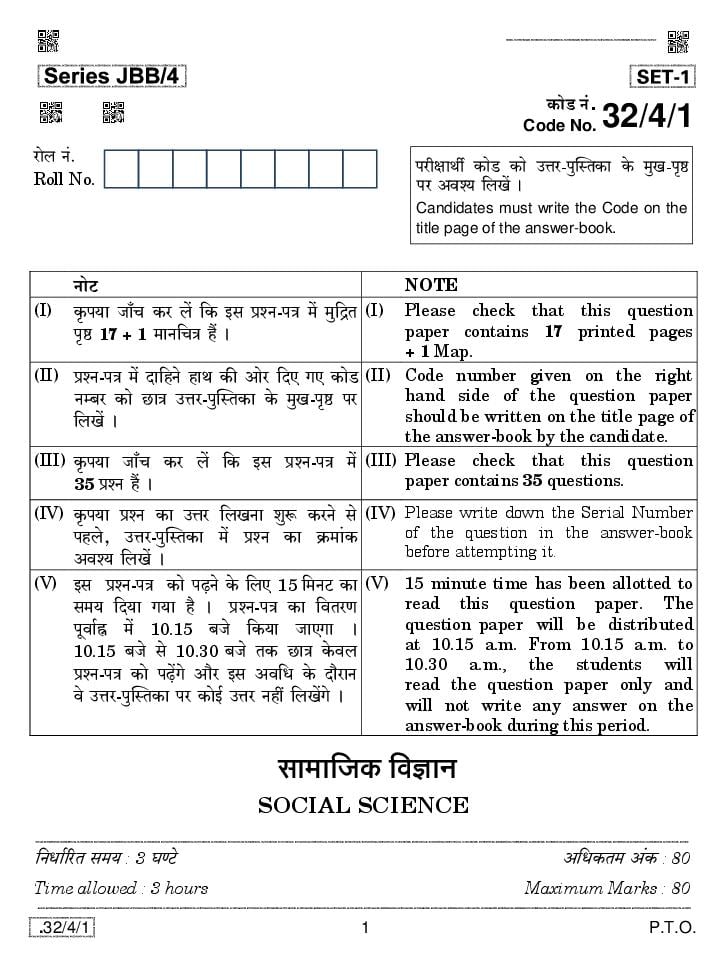
Code No. 32/4/1
amob Z§. narjmWu H$moS >H$mo CÎma-nwpñVH$m Ho$ _wI-n¥ð
Roll No. >na Adí` {bIo§ &
Candidates must write the Code on the
title page of the answer-book.
ZmoQ> NOTE
(I) H¥$n`m Om±M H$a b| {H$ Bg àíZ-nÌ _o§ _w{ÐV (I)Please check that this question
n¥ð> 17 + 1 _mZ{MÌ h¢ & paper contains 17 printed pages
+ 1 Map.
(II) àíZ-nÌ _| Xm{hZo hmW H$s Amoa {XE JE H$moS (II) Code number given on the right
>Zå~a H$mo N>mÌ CÎma-nwpñVH$m Ho$ _wI-n¥ð> na hand side of the question paper
{bI| & should be written on the title page of
the answer-book by the candidate.
(III) H¥$n`m Om±M H$a b| {H$ Bg àíZ-nÌ _| (III) Please check that this question
>35 àíZ h¢ & paper contains 35 questions.
(IV) H¥$n`m àíZ H$m CÎma {bIZm ewê$ H$aZo go (IV) Please write down the Serial Number
nhbo, CÎma-nwpñVH$m _| àíZ H$m H«$_m§H$ of the question in the answer-book
before attempting it.
Adí` {bI| &
(V) Bg àíZ-nÌ H$mo n‹T>Zo Ho$ {bE 15 {_ZQ >H$m (V) 15 minute time has been allotted to
g_` {X`m J`m h¡ & àíZ-nÌ H$m {dVaU read this question paper. The
nydm©• _| 10.15 ~Oo {H$`m OmEJm & question paper will be distributed
10.15 ~Oo go 10.30 ~Oo VH$ N>mÌ Ho$db at 10.15 a.m. From 10.15 a.m. to
10.30 a.m., the students will
àíZ-nÌ H$mo n‹T>|Jo Am¡a Bg Ad{Y Ho$ Xm¡amZ read the question paper only and
do CÎma-nwpñVH$m na H$moB© CÎma Zht {bI|Jo & will not write any answer on the
answer-book during this period.
gm_m{OH$ {dkmZ
SOCIAL SCIENCE
{ZYm©[aV g_` : 3 KÊQ>o A{YH$V_ A§H$ : 80
Time allowed : 3 hours Maximum Marks : 80
.32/4/1 1 P.T.O.
Page 2
{ZåZ{b{IV {ZX}em| H$mo ~hþV gmdYmZr go n{‹T>E Am¡a CZH$m g™Vr go nmbZ H$s{OE :
(i) àíZ-nÌ Mma IÊS>m| _| {d^m{OV {H$`m J`m h¡ – H$, I, J Ed§ K & Bg àíZ-nÌ _| àíZm| H$s
g§»`m 35 h¡ & g^r àíZ A{Zdm`© h¢ &
(ii) IÊS> H$ _| àíZ g§»`m 1 go 20 VH$ A{V bKw-CÎmar` àH$ma Ho$ àíZ h¢, àË`oH$ àíZ 1 A§H$ H$m
h¡ &
(iii) IÊS> I _| àíZ g§»`m 21 go 28 VH$ bKw-CÎmar` àH$ma Ho$ àíZ h¢, àË`oH$ àíZ 3 A§H$ H$m
h¡ & àË`oH$ àíZ H$m CÎma 80 eãXm| _| {b{IE &
(iv) IÊS> J _| àíZ g§»`m 29 go 34 VH$ XrK©-CÎmar` àH$ma Ho$ àíZ h¢, àË`oH$ àíZ 5 A§H$ H$m
h¡ & àË`oH$ àíZ H$m CÎma 120 eãXm| _| {b{IE &
(v) IÊS> K _| àíZ g§»`m 35 _mZ{MÌ AmYm[aV h¡ & `h àíZ 6 A§H$ H$m h¡, Omo {H$ B{Vhmg go
(35(a) – 2 A§H$) VWm ^yJmob (35(b) – 4 A§H$) go g§~§{YV h¡ &
(vi) CÎma g§{já VWm {~ÝXþdma hmoZo Mm{hE Am¡a gmW hr Cn`w©º$ eãX gr_m H$m `Wmg§^d nmbZ
H$s{OE &
(vii) àíZ-nÌ _| g_J« na H$moB© {dH$ën Zht h¡ & VWm{n, Hw$N> àíZm| _| Am§V[aH$ {dH$ën {XE JE
h¢ & Eogo àíZm| _| go Ho$db EH$ hr {dH$ën H$m CÎma {b{IE &
(viii) _mZ{MÌ H$mo AnZr CÎma-nwpñVH$m Ho$ gmW ZËWr H$s{OE &
(ix) BgHo$ A{V[aº$, Amdí`H$VmZwgma, àË`oH$ IÊS> Am¡a àíZ Ho$ gmW `Wmo{MV {ZX}e {XE JE h¢ &
IÊS> H$
1. {ZåZ{b{IV _| go {H$go 1871 _| O_©Zr H$m àW_ g_«mQ> Kmo{fV {H$`m J`m ? 1
(A) {d{b`_ àW_
(B) {d{b`_ {ÛVr`
(C) \«o$S>arI {dëho_ àW_
(D) \«o$S>arI {dëho_ MVwW©
2. ^maV Ho$ Hw$N> _wpñb_ amOZr{VH$ g§JR>Zm| Zo g{dZ` Adkm Am§XmobZ Ho$ à{V H$moB© CËgmh
Š`m| Zht {XIm`m ? à_wI H$maU {b{IE & 1
3. _wÐU `wJ go nyd© ^maV _| nmÊSw>{b{n`m± ì`mnH$ Cn`moJ _| Š`m| Zht Wt ? 1
.32/4/1 2
Page 3
Read the following instructions very carefully and strictly follow them :
(i) Question paper comprises four Sections – A, B, C and D. There are
35 questions in the question paper. All questions are compulsory.
(ii) Section A – Question no. 1 to 20 are very short answer type questions, carrying
1 mark each.
(iii) Section B – Question no. 21 to 28 are short answer type questions, carrying
3 marks each. Answer to each question should not exceed 80 words.
(iv) Section C – Question no. 29 to 34 are long answer type questions, carrying
5 marks each. Answer to each question should not exceed 120 words.
(v) Section D – Question no. 35 is map based, carrying 6 marks with two parts,
35(a) from History (2 marks) and 35(b) from Geography (4 marks).
(vi) Answers should be brief and to the point; also the above word limit be adhered
to as far as possible.
(vii) There is no overall choice in the question paper. However, an internal choice
has been provided in few questions. Only one of the choices in such questions
have to be attempted.
(viii) Attach map along with your answer-book.
(ix) In addition to this, separate instructions are given with each section and
question, wherever necessary.
SECTION A
1. Who among the following was proclaimed as the first German Emperor in
1871 ? 1
(A) William I
(B) William II
(C) Friedrich Wilhelm I
(D) Friedrich Wilhelm IV
2. Why were some of the Muslim political organisations in India lukewarm
in their response to the Civil Disobedience Movement ? Give the main
reason. 1
3. Why were manuscripts not widely used in India before the age of print ? 1
.32/4/1 3 P.T.O.
Page 4
AWdm
‘AmZÝX_R >’ CnÝ`mg Ho$ boIH$ H$m¡Z Wo ? 1
5. [aº$ ñWmZ H$s ny{V© H$s{OE : 1
`§J BQ>br ______________ Ho$ Ûmam ~ZmB© JB© &
6. ‘dob_’ h¡ 1
(A) Vm‹S>nÌ na N>nmB©
(B) H$mµJµO na N>nmB©
(C) M_©-nÌ `m OmZdam| Ho$ M_‹S>o go ~Zr boIZ H$s gVh
(D) H$n‹S>o na N>nmB©
7. {ZåZ{b{IV _| go {H$gZo H$hm h¡ {H$ ‘‘_wÐU B©ída H$s Xr hþB© _hmZV_ XoZ h¡, g~go ~‹S>m
Vmohµ\$m’’ ? 1
(A) byBg Mm¡Xh
(B) A~«mh_ qbH$Z
(C) _m{Q>©Z byWa
(D) _hmË_m Jm±Yr
1 1
8. Cn`wº$ gyMZm go {ZåZ{b{IV Vm{bH$m Ho$ [aº$ ñWmZm| H$mo nyam H$s{OE : + =1
2 2
g_mß`Vm Ho$ AmYma na g§gmYZ
g§gmYZ CXmhaU / àH$ma
(A) ................................................... gm¡a VWm ndZ D$Om©
(B) ................................................... I{ZO Am¡a Ordmí_ BªYZ
.32/4/1 4
Page 5
OR
Who was the author of the novel ‘Anandmath’ ? 1
5. Fill in the blank : 1
Young Italy was formed by ________________ .
6. ‘Vellum’ is 1
(A) Printing on palm leaves
(B) Printing on paper
(C) A parchment made from the skin of animals
(D) Printing on cloth
7. Who among the following said that ‘‘Printing is the ultimate gift of God
and the greatest one’’ ? 1
(A) Louis XIV
(B) Abraham Lincoln
(C) Martin Luther
(D) Mahatma Gandhi
1 1
8. Fill in the blanks of the following table with suitable information : + =1
2 2
Resource on the basis of exhaustibility
Resource Examples/ Type
(A) ................................................... Solar and Wind energy
(B) ................................................... Mineral and Fossil fuels
.32/4/1 5 P.T.O.
Page 6
Ho$ {bE {H$`m J`m & 1
AWdm
Cg g_wÐr-nÎmZ H$m Zm_ {b{IE {OgH$m {dH$mg H$mobH$mVm nÎmZ Ho$ ~‹T>Vo ^ma go Nw>Q>H$mam
nmZo Ho$ {bE {H$`m J`m & 1
10. Zamoam AmpÊdH$ D$Om© g§`§Ì {ZåZ{b{IV _| go {H$g amÁ` _| pñWV h¡ ? 1
(A) H$Zm©Q>H$
(B) Ho$ab
(C) V{_b ZmSw>
(D) CÎma àXoe
11. {ZåZ{b{IV _| go ghr gw_o{bV Omo‹S>o H$m M`Z H$s{OE : 1
(A) H$bmob Vob-joÌ — JwOamV
(B) ~m°ŠgmBQ> H$s ImZ| — _hmamï´>
(C) MÝÐnwa Vmnr` D$Om© g§`§Ì — Amo{S>em
(D) _`ya^§O bmoh A`ñH$ H$s ImZ| — PmaI§S>
1 1
12. [aº$ ñWmZm| H$s ny{V© H$s{OE : + =1
2 2
‘Jmo~a J¡g ßbm§Q>’ {H$gmZm| H$mo Xmo àH$ma go bm^mpÝdV H$aVo h¢ :
EH$ _____________ Ho$ ê$n _| Am¡a Xÿgam _____________ Ho$ ê$n _| &
13. lrb§H$m _| {ZåZ{b{IV _| go H$m¡Z-gm ~hþg§»`H$ dJ© h¡ ? 1
(A) V{_b
(B) B©gmB©
(C) qghbr
(D) _wpñb_
14. gÎmm H$s gmPoXmar Š`m| Amdí`H$ h¡ ? EH$ H$maU ñnï> H$s{OE & 1
AWdm
EH$ bmoH$Vm§{ÌH$ Xoe Ho$ àemgZ _| {d{dY gm_m{OH$ g_yhm| H$mo {hñgoXmar XoZo H$s
Amdí`H$Vm Š`m| h¡ ? H$moB© EH$ H$maU {b{IE & 1
15. ~opëO`_ H$s ‘gm_wXm{`H$ gaH$ma’ _| {ZåZ{b{IV _| go {H$gHo$ _Ü` gÎmm _| gmPoXmar h¡ ? 1
(A) {d{^Þ gm_m{OH$ g_yhm| Ho$ _Ü`
(B) emgZ Ho$ {d{^Þ A§Jmo§ Ho$ _Ü`
(C) Ho$ÝÐ Am¡a amÁ` gaH$ma Ho$ _Ü`
(D) amÁ` gaH$ma Am¡a gm_wXm{`H$ gaH$ma Ho$ _Ü`
.32/4/1 6
Page 7
Mumbai port. 1
OR
Name the sea-port that was developed to relieve growing pressure on the
Kolkata port. 1
10. In which of the following States is Narora Nuclear Power Plant located ? 1
(A) Karnataka
(B) Kerala
(C) Tamil Nadu
(D) Uttar Pradesh
11. Choose the correctly matched pair from the following : 1
(A) Kalol Oil-fields — Gujarat
(B) Bauxite Mines — Maharashtra
(C) Chandrapur Thermal — Odisha
Power Plant
(D) Mayurbhanj Iron Ore Mines — Jharkhand >
1 1
12. Fill in the blanks : + =1
2 2
‘Gobar gas plants’ provide twin benefits to the farmers in the form of
____________ and ____________.
13. Which of the following is the majority group in Sri Lanka ? 1
(A) Tamils
(B) Christians
(C) Sinhalese
(D) Muslims
14. Why is power sharing desirable ? Explain one reason. 1
OR
Why is there a need to give space to diverse social groups in the
administration of a democratic country ? Give any one reason. 1
15. Under which of the following is power shared in the ‘Community
Government’ of Belgium ? 1
(A) Different social groups
(B) Different organs of government
(C) Central and State government
(D) State government and Community government
.32/4/1 7 P.T.O.
Page 8
Cnm` gwPmBE & 1
AWdm
‘‘^maV _| H$^r-H$^r MwZmd Om{V`m| na hr {Z^©a H$aVo h¢ &’’ Bg pñW{V go Nw>Q>H$mam H¡$go
nm`m Om gH$Vm h¡ ? 1
17. {ZåZ{b{IV _| go ghr gw_o{bV {dH$ën H$m M`Z H$s{OE : 1
ñVå^ I (ì`{º$ H$s loUr) ñVå^ II ({dH$mg Ho$ bú`)
(A) {H$gmZ Omo IoVr Ho$ {bE — H$m_ H$aZo Ho$ A{YH$ {XZ VWm ~ohVa _µOXÿar
Ho$db dfm© na {Z^©a h¢
(B) ^y{_hrZ J«m_rU _µOXÿa — {H$gmZm| H$mo CZH$s CnO Ho$ {bE µÁ`mXm g_W©Z
_yë`
(C) n§Om~ Ho$ g_¥Õ {H$gmZ — {Z`§{ÌV doVZ
(D) Z_©Xm KmQ>r H$m EH$ Am{Xdmgr — Or{dH$m CnmO©Z H$s ny{V©
18. Vm{bH$m H$m AÜ``Z H$s{OE VWm ZrMo {XE JE àíZ H$m CÎma Xr{OE :
h[a`mUm, Ho$ab Am¡a {~hma Ho$ Hw$N> VwbZmË_H$ Am±H$‹S>o
{Zdb CnpñW{V AZwnmV
amÁ` {eew _¥Ë`w Xa à{V gmjaVm Xa % (à{V 100 ì`{º$) CƒVa
1,000 ì`{º$ (2016) (2011) ñVa (Am`w 14 VWm 15
df©) 2013 – 14
h[a`mUm 33 82 61
Ho$ab 10 94 83
{~hma 38 62 43
àíZ :
{H$g amÁ` H$m CƒVa ñVa na {Zdb CnpñW{V H$m AZwnmV g~go H$_ h¡ ? 1
19. ^maVr` Am¡Úmo{JH$ H$_©Mm[a`m| H$s Am` ~‹T>mZo Ho$ {bE H$moB© EH$ VarH$m gwPmBE & 1
20. ^maV _| V¥Vr`H$ joÌH$ BVZm _hÎdnyU© Š`m| hmo ahm h¡ ? à_wI H$maU ñnîQ> H$s{OE & 1
AWdm
amoµOJma Ho$ g§X^© _| g§J{R>V joÌH$ H$s à_wI gw{dYm H$mo ñnîQ> H$s{OE & 1
.32/4/1 8
Page 9
measure to abolish it. 1
OR
‘‘Sometimes elections are all about caste in India.’’ How can this situation
be avoided ? 1
17. Choose the correctly matched option from the following : 1
Column I (Category of Person) Column II (Development Goal)
(A) Farmers who depend only — More days of work and better
on rain for growing crops wages
(B) Landless rural labourers — Higher support prices for their
crops
(C) Prosperous farmers from — Regular wages
Punjab
(D) An Adivasi from Narmada — To fulfil livelihood
Valley
18. Study the table and answer the question given below :
Some Comparative Data on Haryana, Kerala and Bihar
Net Attendance Ratio
Infant Mortality
Literacy Rate % (per 100 persons)
State Rate per 1,000
(2011) Secondary stage (age 14
live births (2016)
and 15 years) 2013 – 14
Haryana 33 82 61
Kerala 10 94 83
Bihar 38 62 43
Question :
Which State has the lowest net attendance ratio at Secondary stage ? 1
19. Suggest any one way to increase the income of Indian industrial workers. 1
20. Why is the tertiary sector becoming so important in India ? Explain the
main reason. 1
OR
Explain the main advantage of organised sector in respect of
employment. 1
.32/4/1 9 P.T.O.
Page 10
21. {ZåZ{b{IV CÕaU H$mo n{‹T>E Am¡a CgHo$ ZrMo {XE JE àíZm| H$m CÎma Xr{OE : 1+1+1=3
òmoV – ~mµJmZm| _| ñdamO
_hmË_m Jm±Yr Ho$ {dMmam| Am¡a ñdamO H$s AdYmaUm Ho$ ~mao _| _µOXÿam| H$s AnZr g_P Wr &
Ag_ Ho$ ~mµJmZr _µOXÿam| Ho$ {bE AmµOmXr H$m _Vb~ `h Wm {H$ do CZ MmaXrdm[a`m| go O~
Mmho Am-Om gH$Vo h¢ {OZ_| CZH$mo ~§X H$aHo$ aIm J`m Wm & CZHo$ {bE AmµOmXr H$m _Vb~
Wm {H$ do AnZo Jm±dm| go g§nH©$ aI nmE±Jo & 1859 Ho$ BZb¢S> B{_J«oeZ EoŠQ> Ho$ VhV ~mµJmZm|
_| H$m_ H$aZo dmbo _µOXÿam| H$mo {~Zm BOmµOV ~mµJmZ go ~mha OmZo H$s Ny>Q> Zht hmoVr Wr,
Am¡a `h BOmµOV CÝh| {dabo hr H$^r {_bVr Wr & O~ CÝhm|Zo Agh`moJ Am§XmobZ Ho$ ~mao _|
gwZm Vmo hµOmam| _µOXya AnZo A{YH$m[a`m| H$s AdhobZm H$aZo bJo & CÝhm|Zo ~mµJmZ N>mo‹S> {XE
Am¡a AnZo Ka H$mo Mb {XE & CZH$mo bJVm Wm {H$ A~ Jm±Yr amO Am ahm h¡ Bg{bE A~
Vmo haoH$ H$mo Jm±d _| µO_rZ {_b OmEJr & bo{H$Z do AnZr _§{µOb na Zht nhþ±M nmE & aobdo
Am¡a ñQ>r_am| H$s h‹S>Vmb Ho$ H$maU do amñVo _| hr \±$go ah JE & CÝh| nw{bg Zo nH$‹S> {b`m
Am¡a CZH$s ~war Vah {nQ>mB© hþB© &
(21.1) Ag_ Ho$ ~mµJmZr _µOXÿam| Ho$ {bE ‘ñdamO’ H$s AdYmaUm H$mo ñnîQ> H$s{OE &
(21.2) ~mµJmZr _µOXÿam| H$s AmµOmXr _| ~mYH$ Ho$ ê$n _| 1859 Ho$ BZb¢S> B{_J«oeZ EoŠQ
H$mo ñnîQ> H$s{OE &
(21.3) _µOXÿam| Ho$ Agh`moJ Am§XmobZ _| {hñgm boZo Ho$ à_wI n[aUm_ H$mo ñnîQ> H$s{OE &
22. CÞrgdt eVmãXr Ho$ Xm¡amZ A§Vam©ï´>r` AW©em{ñÌ`m| Ûmam ~VmE JE VrZ àH$ma Ho$ àdmhm| H$mo
ñnîQ> H$s{OE & 13=3
AWdm
AR>mahdt eVmãXr Ho$ A§V _| ^maV Ho$ H$n‹S>m {Z`m©V _| {JamdQ> Š`m| Zht AmB© ? ñnîQ>
H$s{OE & 3
23. g_mO _| g§gmYZm| Ho$ Ý`m`g§JV ~±Q>dmao H$s _hÎmm H$m dU©Z H$s{OE & 3
AWdm
_mZd OrdZ Ho$ {bE g§gmYZm| H$s Amdí`H$Vm H$m dU©Z H$s{OE & 3
24. ‘‘^maV _| aob n[adhZ g_ñ`mAm| go _wº$ Zht h¡ &’’ CXmhaUm| g{hV Bg H$WZ H$s nw{îQ>
H$s{OE & 3
.32/4/1 10
Page 11
21. Read the extract given below and answer the questions that follows : 1+1+1=3
Source – Swaraj in the Plantations
Workers too had their own understanding of Mahatma Gandhi and the
notion of Swaraj. For plantation workers in Assam, freedom meant the
right to move freely in and out of the confined space in which they were
enclosed, and it meant retaining a link with the village from which they
had come. Under the Inland Emigration Act of 1859, plantation workers
were not permitted to leave the tea gardens without permission, and in
fact they were rarely given such permission. When they heard of the
Non-Cooperation Movement, thousands of workers defied the authorities,
left the plantations and headed home. They believed that Gandhi Raj was
coming and everyone would be given land in their own villages. They,
however, never reached their destination. Stranded on the way by a
railway and steamer strike, they were caught by the police and brutally
beaten up.
(21.1) Explain the understanding of ‘Swaraj’ for plantation workers in
Assam.
(21.2) Explain the Inland Emigration Act of 1859 as a barrier to
freedom of plantation workers.
(21.3) Explain the main outcome of the participation of workers in
the Non-Cooperation Movement.
22. Explain the three types of movement or flows identified by the
international economists in the nineteenth century. 13=3
OR
Why did textile exports from India not decline in the late eighteenth
century ? Explain. 3
23. Describe the importance of an equitable distribution of resources in the
society. 3
OR
Describe the need of resources for human survival. 3
24. ‘‘Rail transport suffers from certain problems in India.’’ Support the
statement with examples. 3
.32/4/1 11 P.T.O.
Page 12
H$s{OE & 13=3
26. ^maV _o§ _{hbmAm| Ho$ à{V ^oX^md Ho$ VarH$m| H$m dU©Z H$s{OE & 3
AWdm
AmYw{ZH$ ^maV _| Om{V H$s g§aMZm Am¡a Om{V ì`dñWm _| AmE ~Xbmdm| H$m dU©Z
H$s{OE & 3
27. {dH$mg _mnZo H$m g§`wº$ amîQ´>r` {dH$mg H$m`©H«$_ (`y.EZ.S>r.nr.) H$m _mnX§S> {H$Z AmYmam|
na {díd ~¢H$ Ho$ _mnX§S> go {^Þ h¡ ? ñnîQ> H$s{OE & 3
28. ‘‘Ag§J{R>V joÌH$ _| l{_H$m| Ho$ g§ajU Am¡a ghm`Vm H$s Amdí`H$Vm h¡ &’’ Bg H$WZ H$m
_yë`m§H$Z H$s{OE & 3
AWdm
‘‘{ZOr joÌH$ H$s J{V{d{Y`m| H$m à_wI CÔoí` bm^ A{O©V H$aZm hmoVm h¡ &’’ Bg H$WZ H$m
_yë`m§H$Z H$s{OE & 3
IÊS> J
29. Eogm Š`m| H$hm OmVm h¡ {H$ 1830 H$m XeH$ `yamon _| ^mar H${R>ZmB`m± boH$a Am`m ? H$maUm|
H$mo ñnîQ> H$s{OE & 5
AWdm
gm_«mÁ`dmX go Ow‹S>H$a amï´>dmX {H$g àH$ma àW_ {díd `wÕ H$m H$maU ~Zm ? ñnîQ> H$s{OE & 5
30. ‘dm{UpÁ`H$ H¥${f’ H$s {H$Ýht nm±M {deofVmAm| H$m {díbofU H$s{OE & 15=5
31. bmoH$V§Ì _| amOZr{VH$ Xbm| H$s Amdí`H$Vm H$m dU©Z H$s{OE & 5
32. ‘‘bmoH$Vm§{ÌH$ ì`dñWm amOZr{VH$ g_mZVm na AmYm[aV hmoVr h¡ &’’ CXmhaUm| g{hV Bg
H$WZ H$s nw{îQ> H$s{OE & 5
33. ‘‘ñd`§ ghm`Vm g_yh J«m_rU joÌm| Ho$ µJar~m| H$mo g§J{R>V H$aZo _| _XX H$aVo h¢ &’’ CXmhaUm|
g{hV H$WZ H$s nw{îQ> H$s{OE & 5
AWdm
‘‘_wÐm H$m BñVo_mb h_mao X¡{ZH$ OrdZ H$m ~hþV ~‹S>m {hñgm h¡ &’’ CXmhaUm| g{hV H$WZ H$s
nw{îQ> H$s{OE & 5
.32/4/1 12
Page 13
Centre and States in India. 13=3
26. Describe the ways of discrimination faced by women in India. 3
OR
Describe the changes in castes and caste system in modern India. 3
27. On what bases is the criterion used by the United Nations Development
Programme (UNDP) for measuring development different from the one
used by the World Bank ? Explain. 3
28. ‘‘There is need for protection and support for the workers in the
unorganised sector.’’ Evaluate this statement. 3
OR
‘‘Activities in the private sector are guided by the main motive to earn
profit.’’ Evaluate this statement. 3
SECTION C
29. Why is it said that the 1830s were the years of great hardship in
Europe ? Explain. 5
OR
How did nationalism aligned with imperialism become the cause of the
First World War ? Explain. 5
30. Analyse any five features of Commercial Farming. 15=5
31. Describe the necessity of political parties in democracy. 5
32. ‘‘Democracy is based on political equality.’’ Support the statement with
examples. 5
33. ‘‘Self Help Groups (SHGs) are the building blocks of organisation of the
rural poor.’’ Support the statement with examples. 5
OR
‘‘The use of money spans a very large part of our everyday life.’’ Support
the statement with examples. 5
.32/4/1 13 P.T.O.
Page 14
òmoV A – {dXoer ì`mnma Am¡a ~mµOmam| H$m EH$sH$aU
ì`mnma Ho$ IwbZo go dñVwAm| H$m EH$ ~mµOma go Xÿgao ~mµOma _| AmdmJ_Z hmoVm h¡ & ~mµOma _§o
dñVwAm| Ho$ {dH$ën ~‹T> OmVo h¢ & Xmo ~mµOmam| _§o EH$ hr dñVw H$m _yë` EH$g_mZ hmoZo bJVm
h¡ & A~ Xmo Xoem| Ho$ CËnmXH$ EH$-Xÿgao go hOmam| _rb Xÿa hmoH$a ^r EH$-Xÿgao go à{VñnYm©
H$a gH$Vo h¢ & Bg àH$ma, {dXoer ì`mnma {d{^Þ Xoem| Ho$ ~mµOmam| H$mo Omo‹S>Zo `m EH$sH$aU _|
ghm`H$ hmoVm h¡ &
òmoV B – d¡ídrH$aU
dñVwAm|, godmAm|, {Zdoem| Am¡a àm¡Úmo{JH$s Ho$ A{V[aº$ {d{^Þ Xoem| H$mo Amng _| Omo‹S>Zo H$m
EH$ Am¡a _mÜ`_ hmo gH$Vm h¡ & `h _mÜ`_ h¡ {d{^Þ Xoem| Ho$ ~rM bmoJm| H$m AmdmJ_Z &
àm`: bmoJ ~ohVa Am`, ~ohVa amoµOJma Ed§ {ejm H$s Vbme _| EH$ Xoe go Xÿgao Xoe _|
AmdmJ_Z H$aVo h¢ & {H$ÝVw, {dJV Hw$N> XeH$m| _§o AZoH$ à{V~§Ym| Ho$ H$maU {d{^Þ Xoem| Ho$
~rM bmoJm| Ho$ AmdmJ_Z _| A{YH$ d¥{Õ Zht hwB© h¡ &
òmoV C – {díd ì`mnma g§JR>Z
`Ú{n {díd ì`mnma g§JR>Z g^r Xoem| H$mo _wº$ ì`mnma H$s gw{dYm XoVm h¡, na§Vw ì`dhma _|
`h XoIm J`m h¡ {H$ {dH${gV Xoem| Zo AZw{MV T>§J go ì`mnma AdamoYH$m| H$mo ~aH$ama aIm
h¡ & Xÿgar Amoa, {díd ì`mnma g§JR>Z Ho$ {Z`_m| Zo {dH$mgerb Xoem| Ho$ ì`mnma AdamoYmo| H$mo
hQ>mZo Ho$ {bE {dde {H$`m h¡ & BgH$m EH$ CXmhaU H¥${f CËnmXm| Ho$ ì`mnma na dV©_mZ
~hg h¡ &
(34.1) òmoV A – {dXoer ì`mnma Am¡a ~mµOmam| H$m EH$sH$aU
{dXoer ì`mnma ~mµOmam| H$mo H¡$go EH$sH¥$V H$aVm h¡ ?
(34.2) òmoV B – d¡ídrH$aU
d¡ídrH$aU H¡$go joÌm| Am¡a _hmÛrnm| _| _mZd J{V{d{Y H$m {dñVma H$a ahm h¡ ?
(34.3) òmoV C – {díd ì`mnma g§JR>Z
‘‘{díd ì`mnma g§JR>Z Ho$ H$m`m] Am¡a {d{Y`m| Zo _µO~yV ~hg H$mo OÝ_ {X`m
h¡ &’’ H$WZ na AnZo {dMma ñnîQ> H$s{OE &
.32/4/1 14
Page 15
Source A – Foreign Trade and the Integration of Markets
With the opening of trade, goods travel from one market to another.
Choice of goods in the markets rises. Prices of similar goods in the two
markets tend to become equal. And, producers in the two countries now
closely compete against each other even though they are separated by
thousands of miles. Foreign trade thus results in connecting the markets
or integration of markets in different countries.
Source B – Globalisation
Besides the movements of goods, services, investments and technology,
there is one more way in which the countries can be connected. This is
through the movement of people between countries. People usually move
from one country to another in search of better income, better jobs or
better education. In the past few decades, however, there has not been
much increase in the movement of people between countries due to
various restrictions.
Source C – World Trade Organisation
Though WTO is supposed to allow free trade for all, in practice, it is seen
that the developed countries have unfairly retained trade barriers. On
the other hand, WTO rules have forced the developing countries to
remove trade barriers. An example of this is the current debate on trade
in agricultural products.
(34.1) Source A – Foreign Trade and the Integration of Markets
How does foreign trade integrate markets ?
(34.2) Source B – Globalisation
How is globalisation expanding human activity across regions
and continents ?
(34.3) Source C – World Trade Organisation
‘‘The actions and methods of the WTO have evoked strong
debate.’’ Elucidate your views on the statement.
.32/4/1 15 P.T.O.
Page 16
35. (a) Xmo ñWmZ ‘A’ Am¡a ‘B’ {XE JE ^maV Ho$ amOZr{VH$ aoIm-_mZ{MÌ (n¥ð> 19 na) _|
A§{H$V {H$E JE h¢ & BZ ñWmZm| H$mo {ZåZ{b{IV OmZH$mar H$s ghm`Vm go nhMm{ZE
Am¡a CZHo$ ghr Zm_ CZHo$ {ZH$Q> ItMr JBª aoImAm| na {b{IE : 12=2
(A) dh ñWmZ Ohm± Jm±YrOr Zo Z_H$ H$mZyZ Vmo‹S>m &
(B) dh ñWmZ Ohm± ^maVr` amîQ´>r` H$m±J«og H$m A{YdoeZ hþAm &
(b) Bgr {XE JE ^maV Ho$ amOZr{VH$ aoIm-_mZ{MÌ _| {ZåZ{b{IV _| go {H$Ýht Mma
H$mo Cn`wº$ {M•m| go Xem©BE Am¡a CZHo$ Zm_ {b{IE : 14=4
(i) hramHw$S> — ~m±Y
(ii) H$mZnwa — gyVr dñÌ CÚmoJ Ho$ÝÐ
(iii) H$m±S>bm — g_wÐr nÎmZ
(iv) gob_ >— bmohm Ed§ BñnmV g§`§Ì
(v) A_¥Vga (amOm gm§gr) — AÝVam©îQ´>r` hdmB© nÎmZ
(vi) h¡Xam~mX — gm°âQ>do`a Q>oŠZmobm°Or nmH©$
ZmoQ> : {ZåZ{b{IV àíZ Ho$db Ñ{ï>~m{YV narjm{W©`m| Ho$ {bE àíZ g§»`m 35 Ho$ ñWmZ na
h¢ & {H$Ýht N>… àíZm| Ho$ CÎma {b{IE :
(35.1) Cg ñWmZ H$m Zm_ {b{IE Ohm± Jm±YrOr Zo Z_H$ H$mZyZ Vmo‹S>m &
(35.2) JwOamV Ho$ Cg ñWmZ H$m Zm_ {b{IE Ohm± {H$gmZm| Zo ‘gË`mJ«h’ {H$`m &
(35.3) Cg amÁ` H$m Zm_ {b{IE Ohm± hramHw$S> ~m±Y pñWV h¡ &
(35.4) Cg amÁ` H$m Zm_ {b{IE Ohm± _`ya^§O bm¡h A`ñH$ H$s ImZ| pñWV h¢ &
(35.5) _wå~B© hmB© Vob joÌ go g§~§{YV amÁ` H$m Zm_ {b{IE &
(35.6) Cg amÁ` H$m Zm_ {b{IE Ohm± gob_ bmohm Ed§ BñnmV g§`§Ì pñWV h¡ &
(35.7) Cg amÁ` H$m Zm_ {b{IE Ohm± amOm gm§gr hdmB© nÎmZ pñWV h¡ &
(35.8) n§Om~ Ho$ Cg ñWmZ H$m Zm_ {b{IE Ohm± gm°âQ>do`a Q>oŠZmobm°Or nmH©$ pñWV
h¡ & 1 6=6
.32/4/1 16
Page 17
35. (a) Two places ‘A’ and ‘B’ are marked on the given political outline
map of India (on page 19). Identify these places with the help of
the following information and write their correct names on the
lines marked near them : 12=2
(A) The place where Gandhiji violated the salt law.
(B) The place where the Indian National Congress Session was
held.
(b) Locate and label any four of the following with appropriate symbols
on the same given political outline map of India : 14=4
(i) Hirakud — Dam
(ii) Kanpur — Coton Textile Industrial Centre
(iii) Kandla — Sea-port
(iv) Salem — Iron and Steel Plant
(v) Amritsar (Raja Sansi) — International Airport
(vi) Hyderabad — Software Technology Park
Note : The following questions are for the Visually Impaired Candidates
only, in lieu of Q. No. 35. Attempt any six questions :
(35.1) Write the name of place where Gandhiji violated the salt law.
(35.2) Name the place of Gujarat where the peasants started
‘Satyagraha’.
(35.3) Name the State where Hirakud Dam is located.
(35.4) Name the State where Mayurbhanj Iron Ore Mines are located.
(35.5) Name the related State to Mumbai High Oil-field.
(35.6) Name the State where Salem Iron and Steel Plant is located.
(35.7) Name the State where Raja Sansi Airport is located.
(35.8) Name the place in Punjab where a Software Technology Park is
located. 16=6
.32/4/1 17 P.T.O.
Page 18
Page 19
^maV H$m aoIm-_mZ{MÌ amOZr{VH$)
Outline Map of India (Political)
B
A
.32/4/1 19 P.T.O.
Document Details
| Board / Org | CBSE |
| Exam | Class 10 |
| Type | Question Paper |
| Pages | 19 |
| Updated | 22 Jul 2026 |