CBSE Class 10 Social Science Question Paper 2020 Set 32-2-3
Finished viewing? Save it for later —
Download CBSE Class 10 Social Science Question Paper 2020 Set 32-2-3 (PDF · 16 pages)About CBSE Class 10 Social Science Question Paper 2020 Set 32-2-3
CBSE Class 10 Social Science Question Paper 2020 Set 32-2-3 is available here for free download. Published by CBSE for Class 10, this question paper can be viewed online or downloaded as a PDF (16 pages). Candidates preparing for Class 10 can use CBSE Class 10 Social Science Question Paper 2020 Set 32-2-3 to understand the exam pattern, the type of questions asked, and the overall difficulty level.
Frequently Asked Questions
How can I download CBSE Class 10 Social Science Question Paper 2020 Set 32-2-3?
Open this page and click the Download button to save CBSE Class 10 Social Science Question Paper 2020 Set 32-2-3 as a PDF. It is completely free on AglaSem Docs.
Is CBSE Class 10 Social Science Question Paper 2020 Set 32-2-3 free to download?
Yes. CBSE Class 10 Social Science Question Paper 2020 Set 32-2-3 can be viewed online and downloaded as a PDF free of cost on AglaSem Docs.
How many pages does CBSE Class 10 Social Science Question Paper 2020 Set 32-2-3 have?
CBSE Class 10 Social Science Question Paper 2020 Set 32-2-3 contains 16 pages, which you can read online or download together as a single PDF.
Where can I find more Class 10 study material?
You can find more Class 10 question papers, sample papers, syllabus, and answer keys on AglaSem Docs.
CBSE Class 10 Social Science Question Paper 2020 Set 32-2-3 – Text
Read the full text of this question paper below — useful to quickly search, copy and reference the content online without downloading the PDF.
📄 View text version (16 pages)
Page 1
.
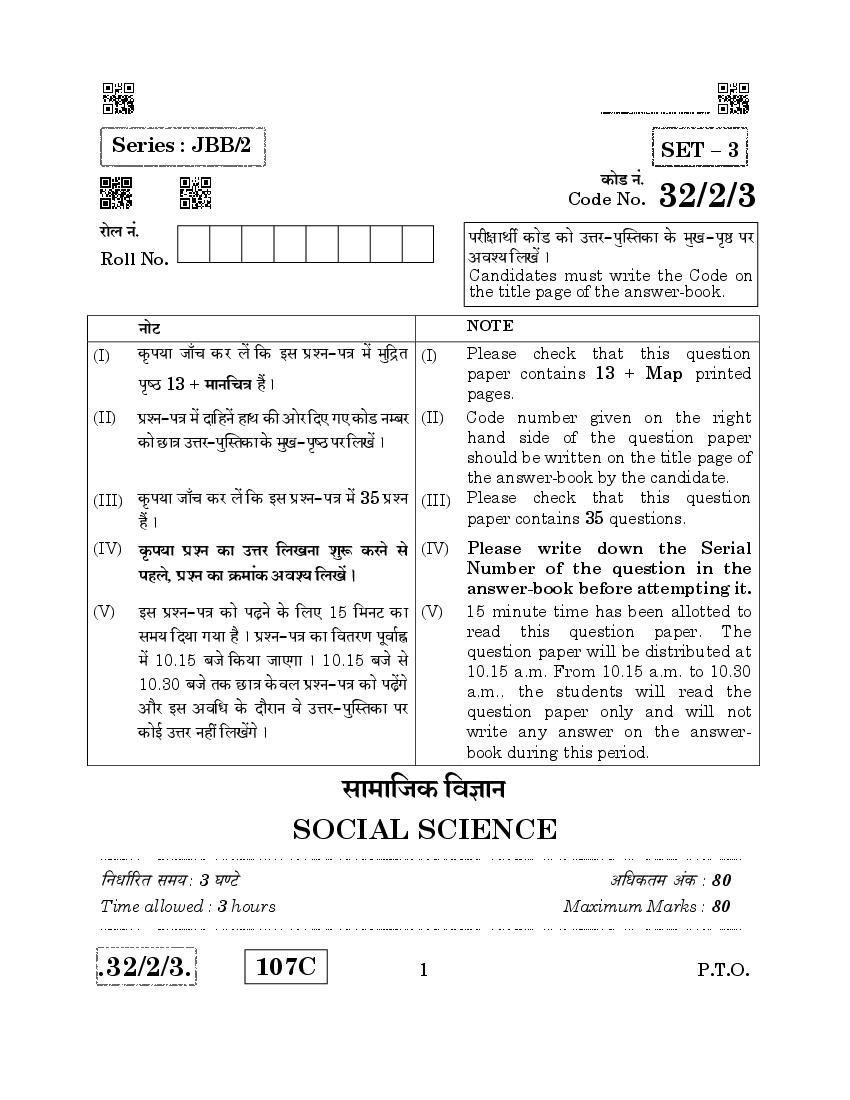
Code No. 32/2/3
. - -
Roll No.
Candidates must write the Code on
the title page of the answer-book.
NOTE
(I) - (I) Please check that this question
paper contains 13 + Map printed
13 + pages.
(II) - (II) Code number given on the right
- - hand side of the question paper
should be written on the title page of
the answer-book by the candidate.
(III) - 35 (III) Please check that this question
paper contains 35 questions.
(IV) (IV) Please write down the Serial
, Number of the question in the
answer-book before attempting it.
(V) - 15 (V) 15 minute time has been allotted to
- read this question paper. The
question paper will be distributed at
10.15 10.15
10.15 a.m. From 10.15 a.m. to 10.30
10.30 - a.m., the students will read the
- question paper only and will not
write any answer on the answer-
book during this period.
SOCIAL SCIENCE
{ZYm©[aV g‘¶ : 3 KÊQ>o A{YH$V‘ A§H$ : 80
Time allowed : 3 hours Maximum Marks : 80
.32/2/3. 107C 1 P.T.O.
Page 2
(i) - – , ,
35
(ii) - 1 20 1
(iii) - 21 28 3
80
(iv) - 29 34 5
120
(v) - 35 , 6 (35 -
) (35 - )
(vi)
(vii) -
(viii)
(ix) , ,
–
1. 1815 ?
(a)
(b)
(c)
(d) 39 1
2. ‘ ’ 1
.32/2/3. 2
Page 3
Read the following instructions very carefully and strictly follow them :
(i) Question paper comprises four Sections, A, B C and D.
There are 35 questions in the question paper. All questions are compulsory.
(ii) Section A – question no. 1 to 20 are very short answer type questions,
carrying 1 mark each.
(iii) Section B – question no. 21 to 28 are short answer type questions, carrying 3
marks each. Answer to each question should not exceed 80 words.
(iv) Section C – question no. 29 to 34 are long answer type questions, carrying 5
marks each. Answer to each question should not exceed 120 words.
(v) Section D – question no. 35 is map based carrying 6 marks with two parts
35 a from History (2 marks) and 35 b from Geography (4 marks).
(vi) Answer should be brief and to the point. Also the above word limit be
adhered to as far as possible.
(vii) There is no overall choice in the question paper. However, an internal choice
has been provided in few questions. Only one of the choices in such questions
have to be attempted.
(viii) Attach MAP along with your answer book.
(ix) In addition to this, separate instructions are given with each section and
question, wherever necessary.
Section – A
1. Which one of the following was NOT the result of the Treaty of Vienna 1815 ?
(a) The Kingdom of the Netherlands was setup in the North.
(b) Austria was given control of Northern Italy.
(c) Prussia was given important new territories on its western frontiers.
(d) Russia was given German confederation of 39 states. 1
2. Define the terms ‘indentured labourer’. 1
.32/2/3. 3 P.T.O.
Page 4
(a)
(b)
(c) ,
(d) , 1
4. 1
1
5. A B :
A B
(a) (i)
(b) (ii)
(c) (iii)
(d) (iv) 1
6. 1
‘ ’ 1
7. :
,
%
( 100 )
1,000
(2011) ( 14 15 ) 2013-14
(2016)
33 82 61
10 94 83
38 62 43
: , 2017-18 2, ,
( 575)
? 1
.32/2/3. 4
Page 5
government.
(a) Among different pressure groups.
(b) Among different social groups.
(c) Legislature, Executive and Judiciary.
(d) Union Government, State Government and Local bodies. 1
4. Suggest any one way to pay equal wages to women in all areas of work as
equal to men. 1
OR
Suggest any one way to change ‘family laws’ of all religions. 1
5. Match Column A with Column B and choose the correct option given below :
Column A Column B
(a) Prosperous farmers from Punjab. (i) More days of work and better wages.
(b) Landless rural labourers. (ii) Availability of additional sources of
irrigation facilities.
(c) Farmers who depend only on (iii) Higher support prices for their
rain for growing crops. crops for farmers.
(d) A girl from a rich urban family. (iv) She gets as much freedom as her
brother. 1
6. Distinguish between ‘Organised’ and ‘Unorganised Sector’. 1
OR
Explain the meaning of Disguised Unemployment. 1
7. Study the table and answer the question that follow :
Some comparative data on Haryana, Kerala and Bihar
Infant Mortality Literacy Net Attendance Ratio (per
State Rate per 1,000 Rate % 100 persons) secondary stage
live births (2016) (2011) (age 14 and 15 years) 2013-14
Haryana 33 82 61
Kerala 10 94 83
Bihar 38 62 43
Sources : Economic Survey 2017-18 Vol. 2. Government of India ;
National Sample Survey Organisation. (Report No. 575).
Which State has the highest literacy rate ? 1
.32/2/3. 5 P.T.O.
Page 6
9. 1
1
10. ?
(a) (b)
(c) (d) 1
11. ‘ ’ 1
‘ ’ ? 1
12. 868 . ? 1
13. ?
(a) (b)
(c) (d) 1
14. 1
15.
______ 1
16. A B
A B
(a) (i)
(b) (ii)
(c) (iii)
(d) (iv) 1
17. :
/
____________
A? ,
____________
B? ½+½=1
18. “ ”
?
(a)
(b)
(c) -
(d) 1
.32/2/3. 6
Page 7
‘Secondary Sector’. 1
9. Name the first major sea port developed soon after Independence on the
Western Coast. 1
OR
Name the inland riverine major sea port of India. 1
10. In which of the following States is Khetri Copper Mines located ?
(a) Rajasthan (b) Tamil Nadu
(c) Uttar Pradesh (d) Punjab 1
11. Define the term ‘Tariff’. 1
OR
What is a ‘Fly Shuttle’ ? 1
12. Which country printed the Buddhist Diamond Sutra in 868 A.D. ? 1
13. Which two languages among the following are prominently spoken by
Belgium Nationals ?
(a) French and English (b) Dutch and French
(c) Russian and Dutch (d) Russian and French 1
14. Explain the meaning of horizontal distribution of power. 1
15. Fill in the blank :
_______ is well known for effective use of wind energy in Rajasthan. 1
16. Choose correct option from Column A and Column B.
Column A Column B
(a) Mayurbhanj Iron Ore Mines (i) Gujarat
(b) Chandrapura Thermal Power Plant (ii) Jharkhand
(c) Bauxite Mines (iii) Odisha
(d) Kalol Oil Fields (iv) Amarkantak 1
17. Fill in the blanks of the following table with suitable information.
Type of Resources : On the basis of Ownership
Resource Examples / Type
____________
A? Grazing grounds, ponds etc.
____________
B? Cultivated land of farmer. ½+½=1
18. “Print culture created the conditions within which French Revolution
occurred.” Which one of the following option support this statement ?
(a) Print popularized the ideas of the enlightened thinkers.
(b) Provided a critical commentary on modernity and despotism.
(c) Print created a new culture of dialogue and debate of clergies.
(d) Print culture spread the views of Nobility only. 1
.32/2/3. 7 P.T.O.
Page 8
(a)
(b)
(c)
(d) 1
2 0.
________ 1
1579 ______ 1
–
21. () 13=3
13=3
22. “ ‘ ’ ” 3
“ ” 3
23. 13=3
13=3
24. “ - ” 13=3
25. 13=3
3
26. ‘ ’ 13=3
27. 1+2=3
.32/2/3. 8
Page 9
option from the following :
(a) They were cheap and small books.
(b) They were promoted by the State.
(c) They were voluminous and colourful.
(d) They were printed on good quality of paper. 1
20. Fill in the blanks :
The printing press first came to Goa with _______ missionaries. 1
OR
Catholic priests printed the first _______ book in 1579 at Cochin. 1
Section – B
21. Describe any three major problems faced by the Jute industry in India. 1 3 = 3
OR
Describe any three factors affecting location of industry in a region. 13=3
22. “Workers in the organized sector enjoy security of employment.” Evaluate
the statement. 3
OR
“All the services of the ‘service sector’ are not growing equally well.”
Evaluate the statement. 3
23. Explain any three effects of scraping Corn laws in Britain. 13=3
OR
Explain any three reasons for the domination of silk and cotton goods of
India in the International market, before the age of machine industries. 1 3 = 3
24. “The Indian postal network is the largest in the world.” Support the
statement with examples. 13=3
25. Describe any three problems of communalism in Indian politics. 13=3
OR
Describe the problems of low representation of women in Indian
legislature. 3
26. Describe any three characteristics of ‘Union List’ mentioned in the Indian
Constitution. 13=3
27. Suggest any three ways to improve education in India. 1+2=3
.32/2/3. 9 P.T.O.
Page 10
?
(1909)
?
, , , , ,
1920
(28.1) ?
(28.2) ?
(28.3) 13=3
–
29. 5
5
30. 15=5
31. 15=5
32 :
– A ,
-
– B
– C
– A ,
(32.1) ? 1
.32/2/3. 10
Page 11
Why Non-cooperation ?
In his famous book Hind Swaraj (1909) Mahatma Gandhi declared that British
rule was established in India with the cooperation of Indians, and had survived
only because of this cooperation. If Indians refused to cooperate, British rule in
India would collapse within a year, and swaraj would come.
How could non-cooperation become a movement ? Gandhiji proposed that the
movement should unfold in stages. It should begin with the surrender of titles
that the government awarded, and a boycott of civil services, army, police,
courts and legislative councils, schools, and foreign goods. Then, in case the
government used repression, a full civil disobedience campaign would be
launched. Through the summer of 1920 Mahatma Gandhi and Shaukat Ali
toured extensively, mobilizing popular support for the movement.
(28.1) What was the weapon of Gandhiji to fight against British Empire in India ?
(28.2) How did the British survive in India ?
(28.3) Explain Gandhiji’s idea for making non-cooperation as movement.
13=3
Section – C
29. Explain the role of Otto Von Bismarck in the Unification of Germany. 5
OR
Explain the role of Giuseppe Mazzini in the Unification of Italy. 5
30. Explain the effects of globalization on Indian agriculture. 15=5
31. Describe any five features of Indian National Congress Party. 15=5
32. Read the following sources and answer the questions that follows :
Source A – Accountable, responsive and legitimate government
In a democracy, we are most concerned with ensuring that people will have
the right to choose their rulers and people will have control over the rulers.
Whenever possible and necessary, citizens should be able to participate in
decision making that affects them all. Therefore, the most basic outcome of
democracy should be that it produces a government that is accountable to
the citizens, and responsive to the needs and expectations of the citizens.
Source B – Economic growth and development
The difference in the rates of economic development between less developed
countries with dictatorships and democracies is negligible. Overall, we
cannot say that democracy is a guarantee of economic development. But we
can expect democracy not to lag behind dictatorships in this respect.
Source C – Dignity and freedom of the citizens
Democracy in India has strengthened the claims of the disadvantaged and
discriminated castes for equal status and equal opportunity. There are
instances still of caste-based inequalities and atrocities, but these lack the
moral and legal foundations. Perhaps it is the recognition that makes
ordinary citizens value their democratic rights.
Source A – Accountable, responsive and legitimate government
(32.1) How does democratic government develop mechanism for
citizens to be the part of political decision making ? 1
.32/2/3. 11 P.T.O.
Page 12
(32.2) ?
2
– C
(32.3) ?
2
33. “ ”
51=5
“ ”
5
34. - ‘ ’
5
–
35. (a) ‘A’ ‘B’ -
(A)
(B) 12=2
(b) -
(i) –
(ii) –
(iii) –
(iv) –
(v) –
(vi) – 4
: 35 ,
(35.1)
(35.2)
(35.3) 1927
(35.4)
(35.5)
(35.6)
(35.7)
(35.8) 1×6=6
____________
.32/2/3. 12
Page 13
(32.2) To what extent we can say democracy work for economic
development ? Elucidate your answer in two points. 2
Source C – Dignity and freedom of the citizens
(32.3) To what extent democracy promote dignity and freedom of
individual ? Elucidate with an example. 2
33. “The Reserve Bank of India supervises the functioning of formal sources of
loans.” Support the statement with examples. 51=5
OR
“The Self-Help Groups help borrowers to overcome the problem of lack of
collateral security.” Support the statement with examples. 5
34. Analyse the role of Multi-National Corporation (MNCs) in interlinking
production across countries. 5
Section – D
Map Based Question
35. (a) Two features A and B are marked on the given political outline map
of India. Identify these features with the help of the following
informations and write their correct names on the lines marked near
them.
(A) The place where Jallianwalla Bagh incident took place.
(B) The place where Gandhiji organized ‘Satyagraha’ in favour of
cotton mill workers. 12=2
(b) Locate and label any four of the following with appropriate symbols
on the same given political outline map of India.
(i) Tehri – Dam
(ii) Indore – Cotton Textile Industrial Centre
(iii) Vijaynagar – Iron and Steel Plant
(iv) Noida – Software Technology Park
(v) Chennai – Major Sea Port
(vi) Tarapur – Nuclear Power Plant 4
Note : The following questions are for visually impaired candidates
only in lieu of Q. No. 35. Attempt any six questions.
(35.1) Name the State where Jallianwalla Bagh incident took place.
(35.2) Name the place where Gandhiji organized ‘Satyagraha’ in favour
of cotton mill workers.
(35.3) Name the place where Indian National Congress Session of 1927
took place.
(35.4) Name the State where ‘Tehri Dam’ located.
(35.5) Name the State where Durg iron ore mines located.
(35.6) Name the State where Vijaynagar Iron and Steel Plant located.
(35.7) Name the State where Noida Software Technology Park located.
(35.8) Name the State where Chennai sea port located. 1×6=6
____________
.32/2/3. 13 P.T.O.
Page 14
Page 15
Page 16
Document Details
| Board / Org | CBSE |
| Exam | Class 10 |
| Type | Question Paper |
| Pages | 16 |
| Updated | 22 Jul 2026 |