CBSE Class 10 Science Question Paper 2020 Set 31-5-1
Finished viewing? Save it for later —
Download CBSE Class 10 Science Question Paper 2020 Set 31-5-1 (PDF · 23 pages)About CBSE Class 10 Science Question Paper 2020 Set 31-5-1
CBSE Class 10 Science Question Paper 2020 Set 31-5-1 is available here for free download. Published by CBSE for Class 10, this question paper can be viewed online or downloaded as a PDF (23 pages). Candidates preparing for Class 10 can use CBSE Class 10 Science Question Paper 2020 Set 31-5-1 to understand the exam pattern, the type of questions asked, and the overall difficulty level.
Frequently Asked Questions
How can I download CBSE Class 10 Science Question Paper 2020 Set 31-5-1?
Open this page and click the Download button to save CBSE Class 10 Science Question Paper 2020 Set 31-5-1 as a PDF. It is completely free on AglaSem Docs.
Is CBSE Class 10 Science Question Paper 2020 Set 31-5-1 free to download?
Yes. CBSE Class 10 Science Question Paper 2020 Set 31-5-1 can be viewed online and downloaded as a PDF free of cost on AglaSem Docs.
How many pages does CBSE Class 10 Science Question Paper 2020 Set 31-5-1 have?
CBSE Class 10 Science Question Paper 2020 Set 31-5-1 contains 23 pages, which you can read online or download together as a single PDF.
Where can I find more Class 10 study material?
You can find more Class 10 question papers, sample papers, syllabus, and answer keys on AglaSem Docs.
CBSE Class 10 Science Question Paper 2020 Set 31-5-1 – Text
Read the full text of this question paper below — useful to quickly search, copy and reference the content online without downloading the PDF.
📄 View text version (23 pages)
Page 1
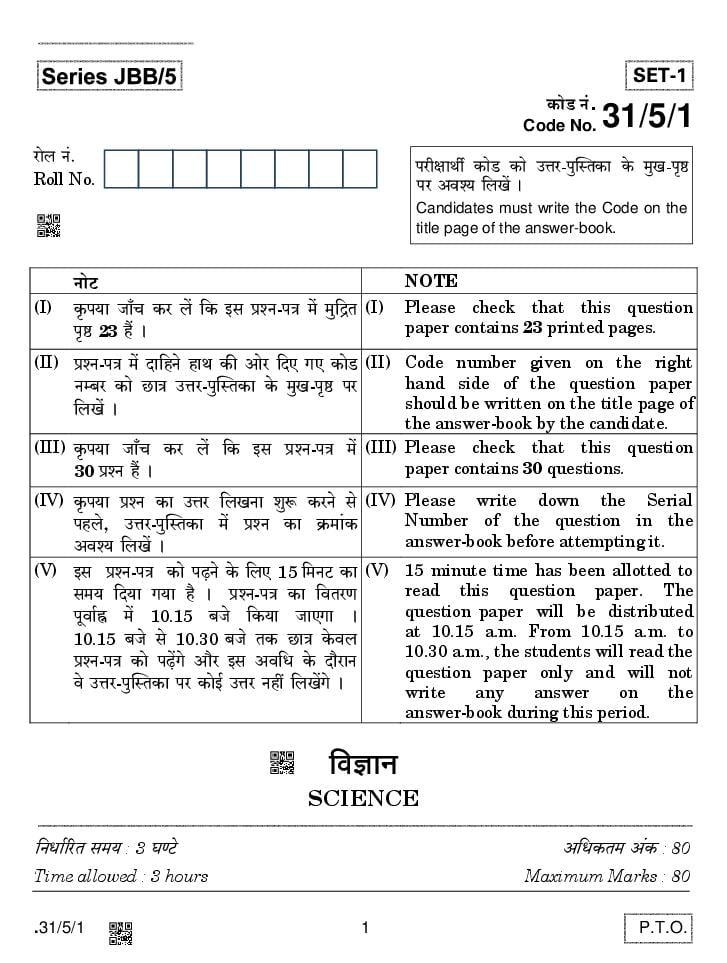
Code No. 31/5/1
amob Z§. narjmWu H$moS >H$mo CÎma-nwpñVH$m Ho$ _wI-n¥ð
Roll No. >na Adí` {bIo§ &
Candidates must write the Code on the
title page of the answer-book.
ZmoQ> NOTE
(I) H¥$n`m Om±M H$a b| {H$ Bg àíZ-nÌ _o§ _w{ÐV (I) Please check that this question
n¥ð> 23 h¢ & paper contains 23 printed pages.
(II) àíZ-nÌ _| Xm{hZo hmW H$s Amoa {XE JE H$moS (II) Code number given on the right
>Zå~a H$mo N>mÌ CÎma-nwpñVH$m Ho$ _wI-n¥ð> na hand side of the question paper
{bI| & should be written on the title page of
the answer-book by the candidate.
(III) H¥$n`m Om±M H$a b| {H$ Bg àíZ-nÌ _| (III) Please check that this question
>30 àíZ h¢ & paper contains 30 questions.
(IV) H¥$n`m àíZ H$m CÎma {bIZm ewê$ H$aZo go (IV) Please write down the Serial
nhbo, CÎma-nwpñVH$m _| àíZ H$m H«$_m§H$ Number of the question in the
Adí` {bI| & answer-book before attempting it.
(V) Bg àíZ-nÌ H$mo n‹T>Zo Ho$ {bE 15 {_ZQ >H$m (V) 15 minute time has been allotted to
g_` {X`m J`m h¡ & àíZ-nÌ H$m {dVaU read this question paper. The
nydm©• _| 10.15 ~Oo {H$`m OmEJm & question paper will be distributed
10.15 ~Oo go 10.30 ~Oo VH$ N>mÌ Ho$db at 10.15 a.m. From 10.15 a.m. to
10.30 a.m., the students will read the
àíZ-nÌ H$mo n‹T>|Jo Am¡a Bg Ad{Y Ho$ Xm¡amZ question paper only and will not
do CÎma-nwpñVH$m na H$moB© CÎma Zht {bI|Jo & write any answer on the
answer-book during this period.
{dkmZ
SCIENCE
{ZYm©[aV g_` : 3 KÊQ>o A{YH$V_ A§H$ : 80
Time allowed : 3 hours Maximum Marks : 80
.31/5/1 1 P.T.O.
Page 2
{ZåZ{b{IV {ZX}em| H$mo ~hþV gmdYmZr go n{‹T>E Am¡a CZH$m g™Vr go nmbZ H$s{OE :
(i) `h àíZ-nÌ VrZ IÊS>m| _§o {d^m{OV {H$`m J¶m h¡ H$, I Am¡a J & Bg àíZ-nÌ _|
30 àíZ h¢ & g^r àíZ A{Zdm`© h¢ &
(ii) IÊS> H$ Ho$ g^r àíZ/CZHo$ ^mJ, àíZ g§»`m 1 go 14 VH$ EH$-EH$ A§H$ Ho$ h¢ & BZ
àíZm| _| ~hþ{dH$ënr àíZ, A{V bKw-CÎmar` àíZ VWm A{^H$WZ-H$maU àH$ma Ho$ àíZm| H$mo
gpå_{bV {H$`m J`m h¡ & BZ àíZm| Ho$ CÎma EH$ eãX AWdm EH$ dmŠ` _| {XE OmZo
Mm{hE &
(iii) IÊS> I _| àíZ g§»`m 15 go 24 VH$ bKw-CÎmar` àH$ma Ho$ àíZ h¢, àË`oH$ àíZ 3 A§H$
H$m h¡ & àË`oH$ àíZ H$m CÎma bJ^J 50 go 60 eãXm| go A{YH$ Zht hmoZm Mm{hE &
(iv) IÊS> J _| àíZ g§»`m 25 go 30 VH$ XrK©-CÎmar` àH$ma Ho$ àíZ h¢, àË`oH$ àíZ 5 A§H$
H$m h¡ & àË`oH$ àíZ H$m CÎma bJ^J 80 go 90 eãXm| go A{YH$ Zht hmoZm Mm{hE &
(v) CÎma g§{já VWm q~Xþdma hmoZm Mm{hE Am¡a gmW hr Cn`w©º$ eãX gr_m H$m `Wmg§^d nmbZ
{H$`m OmZm Mm{hE &
(vi) àíZ-nÌ _| g_J« na H$moB© {dH$ën Zht h¡ & VWm{n àË`oH$ IÊS> _| Hw$N> àíZm| _| Am§V[aH$
{dH$ën {XE JE h¢ & Eogo àíZm| _§o go Ho$db EH$ hr {dH$ën H$m CÎma {b{IE &
(vii) BgHo$ A{V[aº$, Amdí`H$VmZwgma, àË`oH$ IÊS> Am¡a àíZ Ho$ gmW `Wmo{MV {ZX}e {XE JE
h¢ &
IÊS> H$
1. ghg§`moOr `m¡{JH$ gm_mÝ`V: {dÚwV² Ho$ Hw$MmbH$ hmoVo h¢ & Š`m| ? 1
2. {ZåZ{b{IV VÎdm| Ho$ gm_mÝ` JwU H$m CëboI H$s{OE : 1
~moam°Z, {g{bH$m°Z, O_}{Z`_ Am¡a Amg}{ZH$
AWdm
Cg AmdV© {Z`_ H$m CëboI H$s{OE {Og na AmYw{ZH$ AmdV© gmaUr AmYm[aV h¡ & 1
.31/5/1 2
Page 3
Read the following instructions very carefully and strictly follow them :
(i) This question paper comprises three Sections A, B and C. There are
30 questions in the question paper. All questions are compulsory.
(ii) Section A – Questions no. 1 to 14 — all questions or part thereof are of
one mark each. These questions comprise Multiple Choice Questions
(MCQ), Very Short Answer (VSA) and Assertion–Reason type questions.
Answer to these questions should be given in one word or one sentence.
(iii) Section B – Questions no. 15 to 24 are short answer type questions,
carrying 3 marks each. Answer to these questions should not exceed 50 to
60 words.
(iv) Section C – Questions no. 25 to 30 are long answer type questions,
carrying 5 marks each. Answer to these questions should not exceed 80 to
90 words.
(v) Answers should be brief and to the point. Also the above mentioned word
limit be adhered to as far as possible.
(vi) There is no overall choice in the question paper. However, an internal
choice has been provided in some questions in each Section. Only one of
the choices in such questions have to be attempted.
(vii) In addition to this, separate instructions are given with each section and
question, wherever necessary.
SECTION A
1. Covalent compounds are generally poor conductors of electricity. Why ? 1
2. State the common characteristic of the following elements : 1
Boron, Silicon, Germanium and Arsenic
OR
State the Periodic Law on which the Modern Periodic Table is based. 1
.31/5/1 3 P.T.O.
Page 4
g§»`m 3(a) go 3(d) Ho$ CÎma Xr{OE :
^maV _| gm¡a e{º$ EH$ Vrd« {dH${gV hmoVm hþAm CÚmoJ h¡ & 31 OwbmB©, 2019 VH$ Xoe H$s
gm¡a à{VîR>m{nV j_Vm 30.071 GW VH$ nhþ±M JB© Wr & ^maV _| à{VîR>m{nV gm¡a e{º$
g§`§Ìm| H$s à{V MW ny±Or bmJV g~go H$_ h¡ & OZdar 2019 _| gm¡a {dÚwV² OZZ Hw$b
Cn`moJ hmoZo dmbr {dÚwV² OZZ H$m bJ^J 3.4% [aH$m°S>© H$s JB© & {ZåZ{b{IV Vm{bH$m _|
{nN>bo N>: dfm] _| dm{f©H$ gm¡a e{º$ OZZ H$mo Xem©`m J`m h¡ &
df© gm¡a e{º$ OZZ (TWh)
2013 14 3.35
2014 15 4.60
2015 16 7.45
2016 17 12.09
2017 18 25.87
2018 19 39.27
h_mam Xoe ^m½`embr h¡ {H$ df© Ho$ A{YH$m§e ^mJ _| gm¡a D$Om© àmßV hmoVr ahVr h¡ & Eogm
AZw_mZ h¡ {H$ ^maV 5000 {Q´>{b`Z kWh Ho$ Vwë` D$Om© go A{YH$ D$Om© EH$ df© _| gy`© go
àmßV H$aVm h¡ &
3(a) gm¡a gob Š`m h¢ ? 1
3(b) Yyn _| aIo OmZo na {H$gr àê$nr gm¡a gob go {H$VZr dmoëQ>Vm {dH${gV Am¡a {H$VZr
{dÚwV² CËnÞ H$s Om gH$Vr h¡ ? 1
3(c) ^maV _| gm¡a D$Om© Ûmam e{º$ OZZ H$m ^{dî` CÁÁdb h¡ & BgH$m H$maU Xr{OE & 1
3(d) gm¡a gobm| Ho$ Xmo bm^m| H$mo gyMr~Õ H$s{OE & 1
.31/5/1 4
Page 5
of the following paragraph and the related studied concepts :
Solar power in India is a fast developing industry. The country’s solar
installed capacity reached 30·071 GW as of 31 July, 2019. India has the
lowest capital cost per MW to install solar power plants. Solar electricity
generation recorded nearly 3·4% of total utility electricity generation in
January 2019. The following table shows Annual Solar Power Generation
of the last six years.
Year Solar Power Generation (TWh)
2013 – 14 3·35
2014 – 15 4·60
2015 – 16 7·45
2016 – 17 12·09
2017 – 18 25·87
2018 – 19 39·27
Our country is lucky to receive solar energy for the greater part of the
year. It is estimated that during a year India receives the energy
equivalent to more than 5000 trillion kWh from the Sun.
3(a) What are solar cells ? 1
3(b) How much voltage can be developed and how much electricity can
be produced by one typical solar cell when exposed to the Sun ? 1
3(c) The future of power generation by solar energy is bright in India.
Give reason. 1
3(d) List two advantages of solar cells. 1
.31/5/1 5 P.T.O.
Page 6
AmYm[aV h¢ &
WmBam°BS> CÔrnH$ hm°_m}Z (TSH) Wm`am°pŠgZ CËnÞ H$aZo Ho$ {bE WmBam°BS> J«§{W H$mo CÔrßV
H$aVm h¡ & ZrMo Xr JB© Vm{bH$m H$m AÜ``Z H$s{OE &
Vm{bH$m : J^m©dñWm H$s Ad{Y _| TSH Ho$ ñVa
J^m©dñWm H$m gm_mÝ` {ZåZ CÀM
MaU (mU/L) (mU/L) (mU/L)
àW_ {V_mhr 0 .2 2 . 5 < 0.2 2.5 10
{ÛVr` {V_mhr 0 .3 3 . 0 < 0.3 3.01 4.5
V¥Vr` {V_mhr 0 .8 5 . 2 < 0.8 > 5.3
J^m©dñWm _| TSH Ho$ ñVa H$mo _m°ZrQ>a H$aZm _hÎdnyU© hmoVm h¡ & TSH H$m CÀM ñVa Am¡a
hmBnmoWmBam°B{S>µÁ_ J^m©nmV Ho$ g§`moJ H$mo {deof ê$n go à^m{dV H$a gH$Vm h¡ & AV:
WmBam°BS> J«§{W H$s g_w{MV {H«$`m Ho$ {Z`_Z/{Z`§ÌU Ho$ {bE S>m°ŠQ>a Ho$ nam_e© Ûmam C{MV
XdmB`m± ({M{H$Ëgm) XoZm Amdí`H$ hmoVm h¡ &
4(a) TSH H$m nyam Zm_ {b{IE & 1
4(b) TSH Ho$ à_wI H$m`© H$m CëboI H$s{OE & 1
4(c) J^©dVr _{hbmAm| Ho$ TSH ñVa H$mo _m°ZrQ>a H$aZo H$s Amdí`H$Vm Š`m| h¡ ? 1
4(d) {H$gr J^©dVr _{hbm H$m TSH ñVa 8.95 mU/L h¡ & Cgo {H$g àH$ma H$s
XoI-^mb H$s Amdí`H$Vm h¡ ? 1
5. O~ h_ gm_mÝ` ZoÌ go {H$gr {~å~ H$s Xÿar _| d¥{Õ H$aVo h¢, Vmo A{^ZoÌ b|g go à{V{~å~
Xÿar 1
(A) ~‹T> OmVr h¡ &
(B) KQ> OmVr h¡ &
(C) _| H$moB© n[adV©Z Zht hmoVm &
(D) ZoÌ-JmobH$ Ho$ gmBµO na {Z^©a H$aVr h¡ &
.31/5/1 6
Page 7
information in the passage given below.
Thyroid Stimulating Hormone (TSH) stimulates thyroid gland to produce
thyroxine. Study the table given below.
Table : TSH levels during pregnancy
Normal Low High
Stage of pregnancy
(mU/L) (mU/L) (mU/L)
First trimester 0·2 – 2·5 < 0·2 2·5 – 10
Second trimester 0·3 – 3·0 < 0·3 3·01 – 4·5
Third trimester 0·8 – 5·2 < 0·8 > 5·3
It is important to monitor TSH levels during pregnancy. High TSH levels
and hypothyroidism can especially affect chances of miscarriage.
Therefore, proper medication in consultation with a doctor is required to
regulate/control the proper functioning of the thyroid gland.
4(a) Give the full form of TSH. 1
4(b) State the main function of TSH. 1
4(c) Why do TSH levels in pregnant women need to be monitored ? 1
4(d) A pregnant woman has TSH level of 8·95 mU/L. What care is
needed for her ? 1
5. The image distance from the eye lens in the normal eye when we increase
the distance of an object from the eye 1
(A) increases.
(B) decreases.
(C) remains unchanged.
(D) depends on the size of the eyeball.
.31/5/1 7 P.T.O.
Page 8
(A) 10 6 A Am¡a 109 A
(B) 103 A Am¡a 10 6 A
(C) 103 A Am¡a 109 A
(D) 10 6 A Am¡a 103 A
7. bå~mB© ‘l’ VWm EH$g_mZ AZwàñW-H$mQ> joÌ\$b ‘A’ Ho$ {H$gr ~obZmH$ma MmbH$ H$m à{VamoY
‘R’ h¡ & Cgr nXmW© Ho$ {H$gr AÝ` MmbH$ {OgH$s bå~mB© 2.5 l VWm à{VamoY 0.5 R h¡, H$m
AZwàñW-H$mQ> joÌ\$b hmoJm 1
(A) 5A
(B) 2 .5 A
(C) 0 .5 A
1
(D) A
5
8. {H$gr ZB© n[a`moOZm H$mo Amaå^ H$aVo g_` gm_mÝ`V: H$s OmZo dmbr {ZåZ{b{IV
AmbmoMZmAm| na {dMma H$s{OE :
I. {~Zm _wAmdµOm {XE {H$gmZm| Am¡a ñWmZr` Am{Xdm{g`m| H$m {dñWmnZ &
II. {~Zm {H$gr bm^ Ho$ OZVm Ho$ ~hþV A{YH$ YZ H$mo brb OmZm &
III. dZmoÝ_ybZ Am¡a O¡d{d{dYVm H$s hm{Z &
{deofH$a ~‹S>o ~m±Ym| Ho$ ~mao _| hmoZo dmbr AmbmoMZmE± h¢ 1
(A) I Am¡a II
(B) II Am¡a III
(C) I Am¡a III
(D) I, II Am¡a III
AWdm
AZmdí`H$ ~ë~m| Am¡a n§Im| Ho$ pñdM Am°\$ H$aZm VWm [agmd dmbr Q>m|{Q>`m| H$s _aå_V
H$amZm nm±M àH$ma Ho$ ‘R’ _| go {H$go ghr n[a^m{fV H$aVm h¡ ? 1
(A) nwZ: MH«$U
(B) nwZ: Cn`moJ
(C) nwZ: à`moOZ
(D) H$_ Cn`moJ>
.31/5/1 8
Page 9
(A) 10–6 A and 10–9 A respectively
(B) 10–3 A and 10–6 A respectively
(C) 10–3 A and 10–9 A respectively
(D) 10–6 A and 10–3 A respectively
7. A cylindrical conductor of length ‘l’ and uniform area of cross-section ‘A’
has resistance ‘R’. Another conductor of length 2·5 l and resistance 0·5 R
of the same material has area of cross-section 1
(A) 5A
(B) 2·5 A
(C) 0·5 A
1
(D) A
5
8. Consider the following criticisms that are generally addressed when a
new project is launched :
I. Displacement of peasants and local tribals without compensation.
II. Swallowing up large amount of public money without any benefits.
III. Deforestation and loss of biodiversity.
The criticisms about large dams in particular are 1
(A) I and II
(B) II and III
(C) I and III
(D) I, II and III
OR
Switching off unnecessary lights and fans and repairing leaking taps
correctly defines which term of 5R’s ? 1
(A) Recycle
(B) Reuse
(C) Repurpose
(D) Reduce
.31/5/1 9 P.T.O.
Page 10
(A) EH$ hr àH$ma Ho$ d¥jm| nmBZ (Mr‹S>), gmJm¡Z (Q>rH$) Am¡a `yHo${bßQ>g CJmZm
(_moZmoH$ëMa)
(B) {MnH$mo AmÝXmobZ
(C) {dñV¥V O¡d{d{dYVm
(D) dZm| Ho$ Xj à~§YZ _| ñWmZr` bmoJm| H$s ^mJrXmar
10. \o$ag gë\o$Q> H$mo AË`{YH$ VßV H$aZo na H$moB© ^yam R>mog Am¡a Xmo J¡g| ~ZVr h¢ & Bg
A{^{H«$`m H$mo {H$Z àH$mam| _| dJuH¥$V {H$`m Om gH$Vm h¡ ? 1
(A) {dñWmnZ Am¡a aoS>m°Šg
(B) {d`moOZ Am¡a aoS>m°Šg
(C) {dñWmnZ Am¡a D$î_memofr
(D) {d`moOZ Am¡a D$î_m-CÝ_moMr (D$î_mjonr)
11. `{X g_mZ gm§ÐVm Ho$ 10 mL H2SO4 H$mo 10 mL Mg(OH)2 Ho$ gmW {_bm`m OmE, Vmo
n[aUm_r {db`Z gmd©{ÌH$ gyMH$ H$mo {ZåZ{b{IV _| go H$m¡Z-gm a§J XoJm ? 1
(A) bmb
(B) nrbm
(C) ham
(D) Zrbm
12. na_mUw H«$_m§H$ 12 H$m H$moB© VÎd X na_mUw H«$_m§H$ 17 Ho$ {H$gr AÝ` VÎd Y Ho$ gmW H$moB©
`m¡{JH$ ~ZmVm h¡ & Bg àH$ma ~Zo `m¡{JH$ H$m gyÌ hmoJm 1
(A) XY
(B) XY2
(C) X2Y
(D) X2Y3
AWdm
H$moB© VÎd X Aåbr` Am°ŠgmBS> ~ZmVm h¡ & BgH$s AmYw{ZH$ AmdV© gmaUr _| gdm©{YH$
g§^m{dV pñW{V h¡ 1
(A) J«wn 1 Am¡a AmdV© 3
(B) J«wn 16 Am¡a AmdV© 3
(C) J«wn 17 Am¡a AmdV© 3
(D) J«wn 2 Am¡a AmdV© 3
.31/5/1 10
Page 11
(A) Monocultures of pine, teak and eucalyptus.
(B) Chipko Movement.
(C) Extensive biodiversity.
(D) Participation of local people in efficient management of forests.
10. Strong heating of ferrous sulphate leads to the formation of a brown solid
and two gases. This reaction can be categorised as 1
(A) displacement and redox.
(B) decomposition and redox.
(C) displacement and endothermic.
(D) decomposition and exothermic.
11. If 10 mL of H2SO4 is mixed with 10 mL of Mg(OH)2 of the same
concentration, the resultant solution will give the following colour with
universal indicator : 1
(A) Red
(B) Yellow
(C) Green
(D) Blue
12. An element X with atomic number 12 forms a compound with element Y
with atomic number 17. The formula of the compound formed is 1
(A) XY
(B) XY2
(C) X2Y
(D) X2Y3
OR
An element X is forming acidic oxide. Its most probable position in the
modern periodic table is 1
(A) Group 1 and Period 3
(B) Group 16 and Period 3
(C) Group 17 and Period 3
(D) Group 2 and Period 3
.31/5/1 11 P.T.O.
Page 12
H$mo H$maU (R) Ûmam A§{H$V {H$`m J`m h¡ & BZ àíZm| Ho$ ghr CÎma ZrMo {XE JE H$mo S>m| (i),
(ii), (iii) Am¡a (iv) _| go MwZH$a Xr{OE &
(i) (A) Am¡a (R) XmoZm| ghr h¢ VWm (R), A{^H$WZ (A) H$s ghr ì`m»`m H$aVm h¡ &
(ii) (A) Am¡a (R) XmoZm| ghr h¢, naÝVw (R), A{^H$WZ (A) H$s ghr ì`m»`m Zht H$aVm h¡ &
(iii) (A) ghr h¡, naÝVw (R) µJbV h¡ &
(iv) (A) µJbV h¡, naÝVw (R) ghr h¡ &
13. A{^H$WZ (A) : H$m~©Z H$s `m Vmo BboŠQ´>m°Z ImoH$a AWdm BboŠQ´>m°Z J«hU H$aHo$ CËH¥$îQ> J¡g
{dÝ`mg àmßV H$aZo H$s à~b àd¥{Îm hmoVr h¡ &
H$maU (R) : H$m~©Z Ho$ ~møV_ H$moe _| Mma BboŠQ´>m°Z hmoVo h¢ Am¡a Bg_| H$m~©Z AWdm
AÝ` VÎdm| Ho$ BboŠQ´>m°Zm| go gmPoXmar H$aZo H$s àd¥{Îm hmoVr h¡ & 1
14. A{^H$WZ (A) : Cƒ Vmnm| na YmVwAm| Ho$ Vmam| _| bKwnWZ H$s A{YH$ g§^mdZm hmoVr h¡ &
H$maU (R) : {H$gr nXmW© H$m à{VamoY Am¡a à{VamoYH$Vm XmoZm| hr Vmn Ho$ gmW {dMaU
H$aVo h¢ & 1
IÊS> I
15. H$moB© M_H$Xma YmVw ‘M’ ObZo na MH$mMm¢Y H$aZo dmbr g\o$X Ádmbm go ObVr h¡ Am¡a
g\o$X nmCS>a ‘N’ _| ~Xb OmVr h¡ &
(a) ‘M’ Am¡a ‘N’ H$s nhMmZ H$s{OE &
(b) Cn`w©º$ A{^{H«$`m H$mo g§Vw{bV amgm`{ZH$ g_rH$aU Ho$ ê$n _| {Zê${nV H$s{OE &
(c) Bg A{^{H«$`m _| ‘M’ H$m CnM`Z hmoVm h¡ AWdm AnM`Z ? AnZo CÎma H$s nw{ï>
H$s{OE & 3
16. Ob Ho$ {dÚwV²-AnKQ>Z _|
(a) EoZmoS> Am¡a H¡$WmoS> na _wº$ hmoZo dmbr J¡gm| Ho$ Zm_ {b{IE &
(b) EH$ BboŠQ´>moS> na _wº$ hmoZo dmbr J¡g H$m Am`VZ Xÿgao BboŠQ´>moS> na _wº$ hmoZo dmbr
J¡g Ho$ Am`VZ H$m XþJwZm Š`m| hmoVm h¡ ?
(c) `{X Ob _| VZw H2SO4 Z {_bmE± Vmo Š`m hmoJm ? 3
AWdm
{H$gr amgm`{ZH$ `m¡{JH$ ‘X’ H$m Cn`moJ gm~wZ Am¡a H$m±M CÚmoJ _| hmoVm h¡ & Bgo
bdU-Ob (~«mBZ) go ~Zm`m OmVm h¡ &
(a) ‘X’ H$m amgm`{ZH$ Zm_, gm_mÝ` Zm_ Am¡a amgm`{ZH$ gyÌ {b{IE &
(b) BgHo$ ~ZZo _§o hmoZo dmbr A{^{H«$`m H$m g_rH$aU {b{IE &
(c) Š`m hmoVm h¡ O~ `h Eogo Ob go A{^{H«$`m H$aVm h¡ {Og_| Ca `m Mg Ho$ bdU Kwbo
hmoVo h¢ ? 3
.31/5/1 12
Page 13
Assertion (A) and the other labelled Reason (R). Select the correct
answer to these questions from the codes (i), (ii), (iii) and (iv) as given
below.
(i) Both (A) and (R) are true and (R) is correct explanation of the
assertion (A).
(ii) Both (A) and (R) are true, but (R) is not the correct explanation of
the assertion (A).
(iii) (A) is true, but (R) is false.
(iv) (A) is false, but (R) is true.
13. Assertion (A) : Carbon has a strong tendency to either lose or gain
electrons to attain noble gas configuration.
Reason (R) : Carbon has four electrons in its outermost shell and has
the tendency to share electrons with carbon or other
elements. 1
14. Assertion (A) : At high temperatures, metal wires have a greater chance
of short circuiting.
Reason (R) : Both resistance and resistivity of a material vary with
temperature. 1
SECTION B
15. A shining metal ‘M’, on burning gives a dazzling white flame and changes
to a white powder ‘N’.
(a) Identify ‘M’ and ‘N’.
(b) Represent the above reaction in the form of a balanced chemical
equation.
(c) Does ‘M’ undergo oxidation or reduction in this reaction ? Justify. 3
16. In the electrolysis of water
(a) Name the gases liberated at anode and cathode.
(b) Why is it that the volume of gas collected on one electrode is two
times that on the other electrode ?
(c) What would happen if dil. H2SO4 is not added to water ? 3
OR
A chemical compound ‘X’ is used in the soap and glass industry. It is
prepared from brine.
(a) Write the chemical name, common name and chemical formula of ‘X’.
(b) Write the equation involved in its preparation.
(c) What happens when it is treated with water containing Ca or Mg
salts ? 3
.31/5/1 13 P.T.O.
Page 14
(a) g_mZ g_yh (J«wn) Ho$ VÎd
(b) Xmo BboŠQ´>m°Z ImoZo H$s àd¥{Îm dmbm VÎd
(c) dh VÎd Omo AnZm Aï>H$ nyam H$aZo Ho$ {bE BboŠQ´>m°Zm| H$s gmPoXmar H$mo àmW{_H$Vm
XoVm h¡
(d) g~go A{YH$ YmpËdH$ VÎd
(e) dh VÎd Omo Aåbr` Am°ŠgmBS> ~ZmVm h¡
(f) g_yh 13 H$m VÎd 3
18. Amhma ûm¥§Ibm _| nmofr ñVa go Š`m VmËn`© h¡ ? Mma nmofr ñVam| H$s ñWbr` Amhma ûm¥§Ibm
~ZmBE & Amhma ûm¥§Ibm _| D$Om© àdmh gX¡d EH${X{eH$ hmoVm h¡ & Š`m| ? 3
AWdm
nm[aV§Ì Am¡a CgHo$ g§KQ>H$m| na AmYm[aV {ZåZ{b{IV àdmh AmaoI H$mo nyam H$s{OE & 3
19. (a) ídgZ à{H«$`m _| Hy${nH$m Ho$ H$m`© H$m C„oI H$s{OE &
(b) ñWbr` Ordm| H$s Anojm Obr` Ordmo§ H$s ídmg Xa ~hþV A{YH$ (ÐþV) hmoVr h¡ &
BgH$m H$maU Xr{OE &
(c) ½byH$moµO Ho$ {dIÊS>Z H$mo Xem©Zo dmbo {ZåZ{b{IV nW H$mo nyam H$s{OE : 3
.31/5/1 14
Page 15
(a) elements belonging to the same group.
(b) element which has the tendency to lose two electrons.
(c) element which prefers sharing of electrons to complete its octet.
(d) most metallic element.
(e) element that forms acidic oxide.
(f) element that belongs to group 13. 3
18. What is meant by trophic level in a food chain ? Construct a terrestrial
food chain with four trophic levels. The energy flow in a food chain is
always unidirectional. Why ? 3
OR
Complete the following flow chart based on ecosystem and its components. 3
19. (a) In the process of respiration, state the function of alveoli.
(b) Rate of breathing in aquatic organisms is much faster than that in
terrestrial organisms. Give reasons.
(c) Complete the following pathway showing the breakdown of glucose : 3
.31/5/1 15 P.T.O.
Page 16
Vmo F1 nr‹T>r Ho$ g^r nm¡Yo gX¡d bå~o hr Š`m| hmoVo h¢ ?
(b) F1 g§V{V Ho$ nm¡Ym| H$m ñdnamJU H$amZo na àmßV F2 g§V{V Ho$ nm¡Yo F1 g§V{V Ho$
nm¡Ym| go {H$g àH$ma {^Þ hmoVo h¢ ? Bg àojU H$m H$maU Xr{OE &
(c) Bg àojU Ho$ AmYma na {ZH$mbm Om gH$Zo dmbm EH$ {ZîH$f© {b{IE & 3
21. (a) _mZd ewH«$mUwAm| H$mo nmofU H$m¡Z àXmZ H$aVm h¡ ? ewH«$mUwAm| H$m AmZwd§{eH$ g§KQ>Z
{b{IE &
(b) (i) {H$gr _mXm {eew, VWm (ii) {H$gr Za {eew H$m qbJ {ZYm©aU H$aZo dmbo `w½_ZO
_o| CnpñWV JwUgyÌm| Ho$ `wJbm| H$m C„oI H$s{OE & 3
22. {ZåZ{b{IV àË`oH$ àH$aU _| `h Xem©Zo Ho$ {bE {H$aU AmaoI It{ME {H$ namdV©Z Ho$
níMmV² Cg Amn{VV {H$aU H$m Š`m hmoVm h¡ O~ dh
(a) {H$gr CÎmb Xn©U na CgHo$ _w»` Aj Ho$ g_mÝVa AmnVZ H$aVr h¡ &
(b) {H$gr AdVb Xn©U na CgHo$ _w»` \$moH$g go JwµOaVo hþE AmnVZ H$aVr h¡ &
(c) {H$gr CÎmb Xn©U Ho$ Y«wd na Xn©U Ho$ _w»` Aj Ho$ {V`©H$ AmVr hþB© AmnVZ H$aVr h¡ & 3
23. (a) {dÚwVamoYr Vma H$s H$moB© Hw$ÊS>br {H$gr J¡ëd¡Zmo_rQ>a go g§`mo{OV h¡ & Cg pñW{V _|
Š`m àojU {H$`m OmEJm `{X {H$gr à~b N>‹S> Mwå~H$ Ho$ X{jU Y«wd H$mo Bg
Hw$ÊS>br Ho$ EH$ {gao
(i) H$s Amoa VoµOr go bm`m OmEJm ?
(ii) go VoµOr go Xÿa bo Om`m OmEJm ?
(iii) Ho$ nmg pñWa aIm OmEJm ?
(b) hmoZo dmbr n[aKQ>Zm H$m Zm_ {b{IE &
(c) Cn`w©º$ VrZ àH$aUm| (i), (ii) Am¡a (iii) Ho$ àojUm| Ho$ AmYma na {ZH$bZo dmbm
{ZîH$f© {b{IE & 3
24. H$moB© N>mÌ – 2·5 m \$moH$g Xÿar Ho$ Mí_o H$m Cn`moJ H$aVm h¡ &
(a) CgHo$ Ñ{ï> Xmof H$m Zm_ {b{IE &
(b) Bg Xmof Ho$ g§emoYZ Ho$ {bE H$m¡Z-go b|g H$m Cn`moJ {H$`m OmVm h¡ ?
(c) Bg Ñ{ï> Xmof Ho$ hmoZo Ho$ Xmo à_wI H$maUm| H$s gyMr ~ZmBE &
(d) Bg b|g H$s e{º$ n[aH${bV H$s{OE & 3
AWdm
H$maU Xr{OE :
(a) ˜Vao Ho$ g§Ho$V ({g½Zbm|) Ho$ {bE bmb a§J MwZm OmVm h¡ &
(b) A§V[aj _| AmH$me H$mbm àVrV hmoVm h¡ &
(c) dmñV{dH$ gy`m©ñV Am¡a Am^mgr gy`m©ñV Ho$ ~rM g_` H$m AÝVa bJ^J 2 {_ZQ> h¡ & 3
.31/5/1 16
Page 17
is crossed with a short pea plant ?
(b) How is F2 progeny obtained by self-pollination of F1 progeny
different from F1 progeny ? Give reason for this observation.
(c) State a conclusion that can be drawn on the basis of this
observation. 3
21. (a) What provides nutrition to human sperms ? State the genetic
constitution of a sperm.
(b) Mention the chromosome pair present in zygote which determines
the sex of (i) a female child, and (ii) a male child. 3
22. Draw ray diagram in each of the following cases to show what happens
after reflection to the incident ray when
(a) it is parallel to the principal axis and falling on a convex mirror.
(b) it is falling on a concave mirror while passing through its principal
focus.
(c) it is coming oblique to the principal axis and falling on the pole of a
convex mirror. 3
23. (a) A coil of insulated wire is connected to a galvanometer. What
would be observed if a strong bar magnet with its south pole
towards one face of the coil is
(i) moved quickly toward it ?
(ii) moved quickly away from it ?
(iii) held stationary near it ?
(b) Name the phenomena involved.
(c) State the conclusion based on the observations in (i), (ii)
and (iii). 3
24. A student uses spectacles of focal length – 2·5 m.
(a) Name the defect of vision he is suffering from.
(b) Which lens is used for the correction of this defect ?
(c) List two main causes of developing this defect.
(d) Compute the power of this lens. 3
OR
Give reasons :
(a) Red colour is selected for danger signals.
(b) The sky appears dark in space.
(c) The time difference between actual sunset and apparent sunset is
about 2 minutes. 3
.31/5/1 17 P.T.O.
Page 18
25. Xmo A`ñH$ X Am¡a Y {bE JE & BZ A`ñH$m| H$mo J_© H$aZo na `h nm`m J`m {H$
(a) A`ñH$ X go CO2 J¡g {ZH$bVr h¡, VWm
(b) A`ñH$ Y go SO2 J¡g {ZH$bVr h¡ &
hmoZo dmbr A{^{H«$`mAmo§ Ho$ amgm`{ZH$ g_rH$aU XoVo hþE BZ A`ñH$mo| H$mo YmVwAm| _|
n[ad{V©V H$aZo Ho$ MaUm| H$mo {b{IE & 5
AWdm
(a) {dÚwV²-AnKQ>Z Ûmam H$m°na Ho$ n[aîH$aU H$s {d{Y H$s ì`m»`m AmaoI H$s ghm`Vm
go H$s{OE &
(b) Qy>Q>r hþB© aob H$s nQ>[a`m| H$mo {H$g àH$ma Omo‹S>m OmVm h¡ ? Bg à{H«$`m H$m Zm_ VWm
hmoZo dmbr A{^{H«$`m H$m amgm`{ZH$ g_rH$aU Xr{OE & 5
26. (a) g_md`dVm H$s n[a^mfm Xr{OE & ã`yQ>oZ Ho$ g^r g§^m{dV g_md`d It{ME &
(b) ‘‘H$moB© `m¡{JH$ ‘X’ XhZ hmoZo na AË`{YH$ YwE± Ho$ gmW nrbr Ádmbm XoVm h¡ &’’ Bg
H$WZ go Amn Š`m {ZîH$f© {ZH$mbVo h¢ ?
(c) {H$gr EoëH$mohm°b H$mo VXZwê$nr H$m~m}pŠg{bH$ Aåb _| n[ad{V©V H$aZo H$s A{^{H«$`m
_| jmar` KMnO4 H$s ^y{_H$m H$m C„oI H$s{OE & 5
27. H$maU Xr{OE :
(a) A{bÝX H$s VwbZm _| {Zb` H$s noer` {^{Îm`m± _moQ>r hmoVr h¢ &
(b) nm¡Ym| _| n[adhZ {ZH$m` Yr_m hmoVm h¡ &
(c) Obr` H$eoé{H$`m| _§o é{Ya n[ag§MaU ñWbr` H$eoé{H$`m| _| é{Ya n[ag§MaU go {^Þ
hmoVm h¡ &
(d) {XZ _| µOmBb_ _| Ob Am¡a I{ZOm| H$s J{V am{Ì H$s VwbZm _| A{YH$ hmoVr h¡ &
(e) {eamAm| _| dmëd hmoVo h¡§ O~{H$ Y_{Z`m| _| Zht hmoVo & 5
.31/5/1 18
Page 19
25. Two ores X and Y were taken. On heating these ores it was observed that
(a) ore X gives CO2 gas, and
(b) ore Y gives SO2 gas.
Write steps to convert these ores into metals, giving chemical equations
of the reactions that take place. 5
OR
(a) With the help of a diagram explain the method of refining of copper
by electrolysis.
(b) How are broken railway tracks joined ? Give the name of the
process and the chemical equation of the reaction involved. 5
26. (a) Define isomerism. Draw all possible isomers of butane.
(b) ‘‘A compound ‘X’ on combustion gives a yellow flame with lots of
smoke.’’ What inference would you draw from this statement ?
(c) State the role of alkaline KMnO4 in the reaction involving
conversion of an alcohol to corresponding carboxylic acid. 5
27. Give reasons :
(a) Ventricles have thicker muscular walls than atria.
(b) Transport system in plants is slow.
(c) Circulation of blood in aquatic vertebrates differs from that in
terrestrial vertebrates.
(d) During the daytime, water and minerals travel faster through
xylem as compared to the night.
(e) Veins have valves whereas arteries do not. 5
.31/5/1 19 P.T.O.
Page 20
B
A
_yÌme`
D
C
d¥fU
(a) ^mJ A, B, C Am¡a D H$m Zm_m§H$Z H$s{OE &
(b) d¥fU Ûmam òm{dV hm°_m}Z H$m Zm_ {b{IE Am¡a BgH$s ^y{_H$m H$m CëboI H$s{OE &
(c) OZZ à{H«$`m _| B Am¡a C Ho$ H$m`m] H$m C„oI H$s{OE & 5
AWdm
(a) {ZåZ{b{IV Ordm| Ho$ OZZ H$s {dYmAm| Ho$ Zm_ {b{IE Am¡a n«Ë`oH$ {dYm H$s
_hÎdnyU© {deofVm H$m C„oI H$s{OE :
(i) ßboZo[a`m
(ii) hmBS´>m
(iii) amBµOmong
(b) h_ ~«m`mo{\$b_ H$s n{Îm`m| go ZE nm¡Yo àmá H$a gH$Vo h¢ & {Q>ßnUr H$s{OE &
(c) OZZ H$s AÝ` {dYmAm| H$s VwbZm _| H$m{`H$ àdY©Z Ho$ Xmo bm^m| H$s gyMr
~ZmBE & 5
.31/5/1 20
Page 21
B
A
Bladder
D
C
Testis
(a) Label the parts A, B, C and D.
(b) Name the hormone secreted by testis and mention its role.
(c) State the functions of B and C in the process of reproduction. 5
OR
(a) Name the mode of reproduction of the following organisms and
state the important feature of each mode :
(i) Planaria
(ii) Hydra
(iii) Rhizopus
(b) We can develop new plants from the leaves of Bryophyllum.
Comment.
(c) List two advantages of vegetative propagation over other modes of
reproduction. 5
.31/5/1 21 P.T.O.
Page 22
nmíd© _| g§`mo{OV h¢ & Bg n[anW go àdm{hV Hw$b Ymam n[aH${bV H$s{OE &
(b) Xmo à{VamoYH$m| X Am¡a Y, {OZHo$ à{VamoY H«$_e: 2 Am¡a 3 h¢, H$mo nhbo nmíd©
_| Am¡a {\$a loUr _| g§`mo{OV {H$`m J`m h¡ & àË`oH$ àH$aU _| Amny{V© H$s dmoëQ>Vm
5 V h¡ &
(i) àË`oH$ àH$aU _| à{VamoYH$m| Ho$ g§`moOZ H$mo Xem©Zo Ho$ {bE n[anW AmaoI
It{ME &
(ii) à{VamoYH$m| Ho$ loUr g§`moOZ _| 3 Ho$ à{VamoYH$ Ho$ {gam| na dmoëQ>Vm
n[aH${bV H$s{OE & 5
30. (a) {H$gr H$m±M Ho$ ñb¡~ Ho$ {H$gr \$bH$ na {V`©H$ {Xem _| Amn{VV {H$gr àH$me
{H$aU H$m nW Xem©Zo Ho$ {bE Zm_m§{H$V {H$aU AmaoI It{ME &
(b) H$m±M Ho$ ñb¡~ Ho$ nXmW© H$m AndV©Zm§H$ n[aH${bV H$s{OE & {X`m J`m h¡ : H$m±M Ho$
ñb¡~ _| àH$me H$s Mmb 2 108 m/s VWm dm`w _| àH$me H$s Mmb 3 108 m/s
h¡ &
(c) `{X {H$gr b|g H$s e{º$ – 2·5 D h¡, Vmo CgH$s \$moH$g Xÿar n[aH${bV H$s{OE & 5
AWdm
(a) {ZH$Q>-Ñ{ï> Xmof go nr{‹S>V {H$gr ì`{º$ H$mo – 2·5 D j_Vm Ho$ g§emoYH$ b|g H$m
Mí_m nhZZo H$m gwPmd {X`m J`m & Bgr \$moH$g Xÿar Ho$ {H$gr Jmobr` b|g H$mo
à`moJembm _| bm`m J`m & H$moB© N>mÌ Bg b|g go {H$gr {~å~ H$mo {H$VZr Xÿar na
aIo Vm{H$ Cg {~å~ H$m à{V{~å~ b|g go 10 cm Xÿar na ~Zo ?
(b) Cn`w©º$ àH$aU _| ~Zo à{V{~å~ H$s pñW{V Am¡a àH¥${V H$mo Xem©Zo Ho$ {bE {H$aU
AmaoI It{ME & 5
.31/5/1 22
Page 23
parallel to 220 V supply. Calculate the total current through the
circuit.
(b) Two resistors X and Y of resistances 2 and 3 respectively are
first joined in parallel and then in series. In each case the voltage
supplied is 5 V.
(i) Draw circuit diagrams to show the combination of resistors
in each case.
(ii) Calculate the voltage across the 3 resistor in the series
combination of resistors. 5
30. (a) Draw a labelled ray diagram to show the path of a ray of light
incident obliquely on one face of a glass slab.
(b) Calculate the refractive index of the material of a glass slab. Given
that the speed of light through the glass slab is 2 108 m/s and in
air is 3 108 m/s.
(c) Calculate the focal length of a lens, if its power is – 2·5 D. 5
OR
(a) A person suffering from myopia (near-sightedness) was advised to
wear corrective lens of power 2·5 D. A spherical lens of same
focal length was taken in the laboratory. At what distance should a
student place an object from this lens so that it forms an image at
a distance of 10 cm from the lens ?
(b) Draw a ray diagram to show the position and nature of the image
formed in the above case. 5
.31/5/1 23 P.T.O.
Document Details
| Board / Org | CBSE |
| Exam | Class 10 |
| Type | Question Paper |
| Pages | 23 |
| Updated | 22 Jul 2026 |