CBSE Class 11 Fine Arts Syllabus 2020-21
Finished viewing? Save it for later —
Download CBSE Class 11 Fine Arts Syllabus 2020-21 (PDF · 4 pages)About CBSE Class 11 Fine Arts Syllabus 2020-21
CBSE Class 11 Fine Arts Syllabus 2020-21 is available here for free download. Published by CBSE for Class 11, this syllabus can be viewed online or downloaded as a PDF (4 pages). Candidates preparing for Class 11 can use CBSE Class 11 Fine Arts Syllabus 2020-21 to understand the exam pattern, the type of questions asked, and the overall difficulty level.
Frequently Asked Questions
How can I download CBSE Class 11 Fine Arts Syllabus 2020-21?
Open this page and click the Download button to save CBSE Class 11 Fine Arts Syllabus 2020-21 as a PDF. It is completely free on AglaSem Docs.
Is CBSE Class 11 Fine Arts Syllabus 2020-21 free to download?
Yes. CBSE Class 11 Fine Arts Syllabus 2020-21 can be viewed online and downloaded as a PDF free of cost on AglaSem Docs.
How many pages does CBSE Class 11 Fine Arts Syllabus 2020-21 have?
CBSE Class 11 Fine Arts Syllabus 2020-21 contains 4 pages, which you can read online or download together as a single PDF.
Where can I find more Class 11 study material?
You can find more Class 11 question papers, sample papers, syllabus, and answer keys on AglaSem Docs.
CBSE Class 11 Fine Arts Syllabus 2020-21 – Text
Read the full text of this syllabus below — useful to quickly search, copy and reference the content online without downloading the PDF.
📄 View text version (4 pages)
Page 1
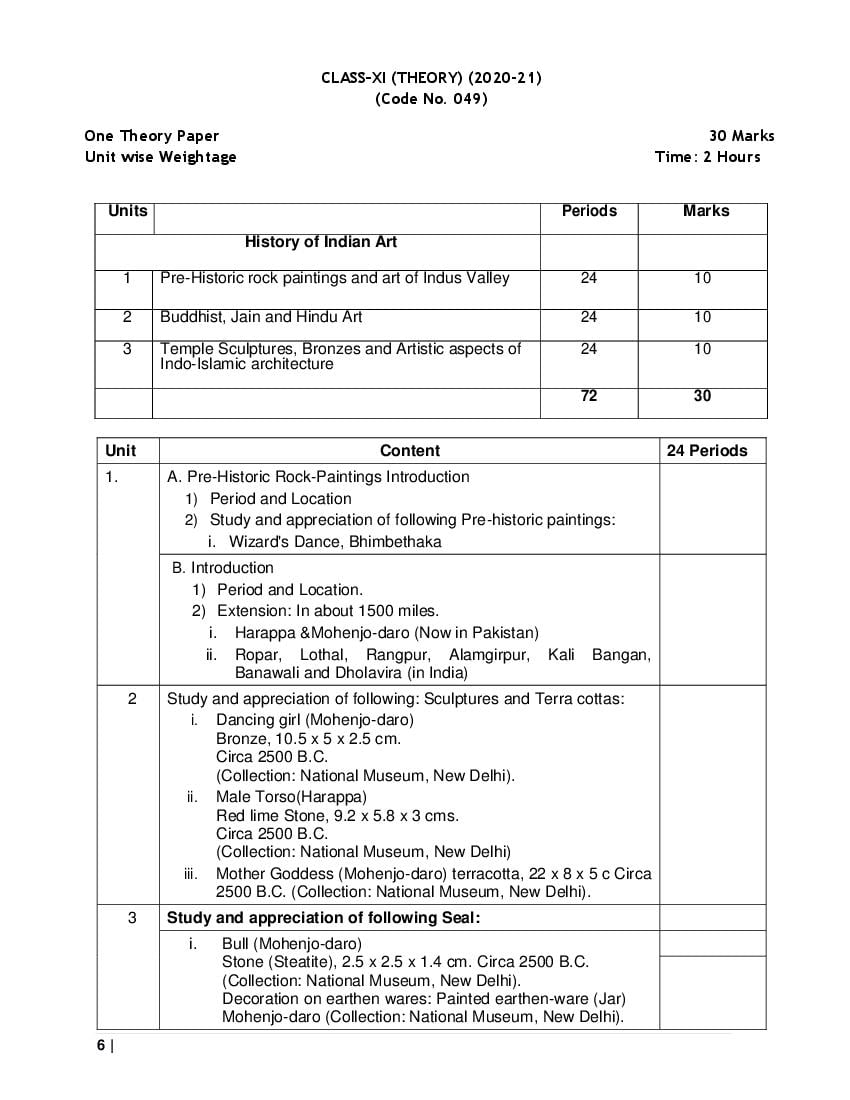
(Code No. 049)
One Theory Paper 30 Marks
Unit wise Weightage Time: 2 Hours
Units Periods Marks
History of Indian Art
1 Pre-Historic rock paintings and art of Indus Valley 24 10
2 Buddhist, Jain and Hindu Art 24 10
3 Temple Sculptures, Bronzes and Artistic aspects of 24 10
Indo-Islamic architecture
72 30
Unit Content 24 Periods
1. A. Pre-Historic Rock-Paintings Introduction
1) Period and Location
2) Study and appreciation of following Pre-historic paintings:
i. Wizard's Dance, Bhimbethaka
B. Introduction
1) Period and Location.
2) Extension: In about 1500 miles.
i. Harappa &Mohenjo-daro (Now in Pakistan)
ii. Ropar, Lothal, Rangpur, Alamgirpur, Kali Bangan,
Banawali and Dholavira (in India)
2 Study and appreciation of following: Sculptures and Terra cottas:
i. Dancing girl (Mohenjo-daro)
Bronze, 10.5 x 5 x 2.5 cm.
Circa 2500 B.C.
(Collection: National Museum, New Delhi).
ii. Male Torso(Harappa)
Red lime Stone, 9.2 x 5.8 x 3 cms.
Circa 2500 B.C.
(Collection: National Museum, New Delhi)
iii. Mother Goddess (Mohenjo-daro) terracotta, 22 x 8 x 5 c Circa
2500 B.C. (Collection: National Museum, New Delhi).
3 Study and appreciation of following Seal:
i. Bull (Mohenjo-daro)
Stone (Steatite), 2.5 x 2.5 x 1.4 cm. Circa 2500 B.C.
(Collection: National Museum, New Delhi).
Decoration on earthen wares: Painted earthen-ware (Jar)
Mohenjo-daro (Collection: National Museum, New Delhi).
6|
Page 2
(3rd century B.C. to 8th century A.D.)
1. General Introduction to Art during Mauryan, Shunga, Kushana
(Gandhara and Mathura styles) and Gupta period:
2. Study and appreciation of following Sculptures:
i. Lion Capital from Sarnath (Mauryan period) Polished
sandstone, Circa 3rd Century B.C. (Collection: Sarnath
Museum, U.P.)
ii. Chauri Bearer from Didar Ganj (Yakshi) (Mauryan period)
Polished sandstone Circa 3rd Century B.C.(Collection:
Patna Museum, Bihar)
iii. Seated Buddha from Katra Mound, Mathura-(Kushan
Period-Mathura Style) Red-spotted Sand Stone, Circa 3rd
Century AD. (Collection: Govt. Museum, Mathura)
iv. Jain Tirathankara (Gupta period) Stone Circa 5th Century
A.D. (Collection: State Museum, Lucknow U.P.)
3. Introduction to Ajanta Location
Period, No of caves, Chaitya and Vihara, paintings and sculptures,
subject matter and technique etc.
Unit 3 Temple Sculpture, Bronzes and artistic aspects of Indo-Islamic 24 Periods
Architecture
(A) Artistic aspects of Indian Temple sculpture (6th Century A.D. to 13th
Century A.D.)
1) Introduction to Temple Sculpture
(6th Century A.D. to 13th Century A.D.)
2) Study and appreciation of following Temple-Sculptures:
i. Descent of Ganga (Pallava period, Mahabalipuram,
Tamil Nadu), granite rock Circa 7th Century A.D.
ii. Trimuti (Elephanta, Maharashtra) Stone Circa 9th
Century A.D.
iii. Lakshmi Narayana (Kandariya Mahadev Temple)
(Chandela period, Khajuraho, Madhya Pradesh)
Stone Circa 10th Century A.D.
iv. Cymbal Player, Sun Temple (Ganga Dynasty,
Konark, Orrisa) Stone Circa 13th Century A.D.
v. Mother and Child (Vimal-Shah Temple, Solanki
Dynasty, Dilwara, Mount Abu; Rajasthan) white
marble, Circa 13th Century A.D.
(B) Bronzes :
1. Introduction to Indian Bronzes.
2. Method of casting (solid and hollow)
3. Study and appreciation of following South Indian Bronze:
i. Nataraj (Chola period Thanjavur Distt.,Tamil Nadu) 12th
Century A.D.
(Collection : National Museum, New Delhi)
7|
Page 3
1. Introduction
2. Study and appreciation of following architecture:
i. Qutub Minar, Delhi
ii. Gol Gumbad of Bijapur
8|
Page 4
(PRACTICAL)
One Practical Paper 70 Marks
Time: 6 Hours (3+3)
Unit wise Weightage
Units Content Periods Marks
1 Nature and Object Study 50 25
2 Painting Composition 50 25
3 Portfolio Assessment 48 20
148 70
Unit 1: Nature and Object Study 25 Marks 50 Periods
Study of two or three natural and geometric forms in pencil with light and shade from a fixed point
of view. Natural forms like plants, vegetables, fruits and flowers, etc., are to be used. Geometrical
forms of objects like cubes, cones, prisms, cylinders and spheres should be used.
Unit 2: Painting Composition 25 Marks 50 Periods
(i) Simple exercises of basic design in variation of geometric and rhythmic shapes in
geometrical and decorative designs and colours to understand designs as organised
visual arrangements. 10 Marks 25 Periods
(ii) Sketches from life and nature 15 Marks 25 Periods
Unit 3: Portfolio Assessment 20 Marks 48 Periods
(a) Record of the entire years' performance from sketch to finished product. 10 Marks
(b) Five selected nature and object study exercises in any media done during session
including the minimum of two still life exercises. 05 Marks
(c) One selected work of paintings composition done during the year 03 Marks
(d) Two selected works of paintings done during the year 02 Marks
These selected works prepared during the course by the candidates and certified by the
school authorities as the work done in the school will be placed before the examiners for
assessment.
Note:
1. The candidates should be given one hour-break after first three hours.
2. The time-table to be so framed as to allow the students to work continuously for minimum
of two periods at a stretch.
9|
Document Details
| Board / Org | CBSE |
| Exam | Class 11 |
| Type | Syllabus |
| Pages | 4 |
| Updated | 22 Jul 2026 |