CBSE Class 10 Science Question Paper 2020 Set 31-4-1
Finished viewing? Save it for later —
Download CBSE Class 10 Science Question Paper 2020 Set 31-4-1 (PDF · 23 pages)About CBSE Class 10 Science Question Paper 2020 Set 31-4-1
CBSE Class 10 Science Question Paper 2020 Set 31-4-1 is available here for free download. Published by CBSE for Class 10, this question paper can be viewed online or downloaded as a PDF (23 pages). Candidates preparing for Class 10 can use CBSE Class 10 Science Question Paper 2020 Set 31-4-1 to understand the exam pattern, the type of questions asked, and the overall difficulty level.
Frequently Asked Questions
How can I download CBSE Class 10 Science Question Paper 2020 Set 31-4-1?
Open this page and click the Download button to save CBSE Class 10 Science Question Paper 2020 Set 31-4-1 as a PDF. It is completely free on AglaSem Docs.
Is CBSE Class 10 Science Question Paper 2020 Set 31-4-1 free to download?
Yes. CBSE Class 10 Science Question Paper 2020 Set 31-4-1 can be viewed online and downloaded as a PDF free of cost on AglaSem Docs.
How many pages does CBSE Class 10 Science Question Paper 2020 Set 31-4-1 have?
CBSE Class 10 Science Question Paper 2020 Set 31-4-1 contains 23 pages, which you can read online or download together as a single PDF.
Where can I find more Class 10 study material?
You can find more Class 10 question papers, sample papers, syllabus, and answer keys on AglaSem Docs.
CBSE Class 10 Science Question Paper 2020 Set 31-4-1 – Text
Read the full text of this question paper below — useful to quickly search, copy and reference the content online without downloading the PDF.
📄 View text version (23 pages)
Page 1
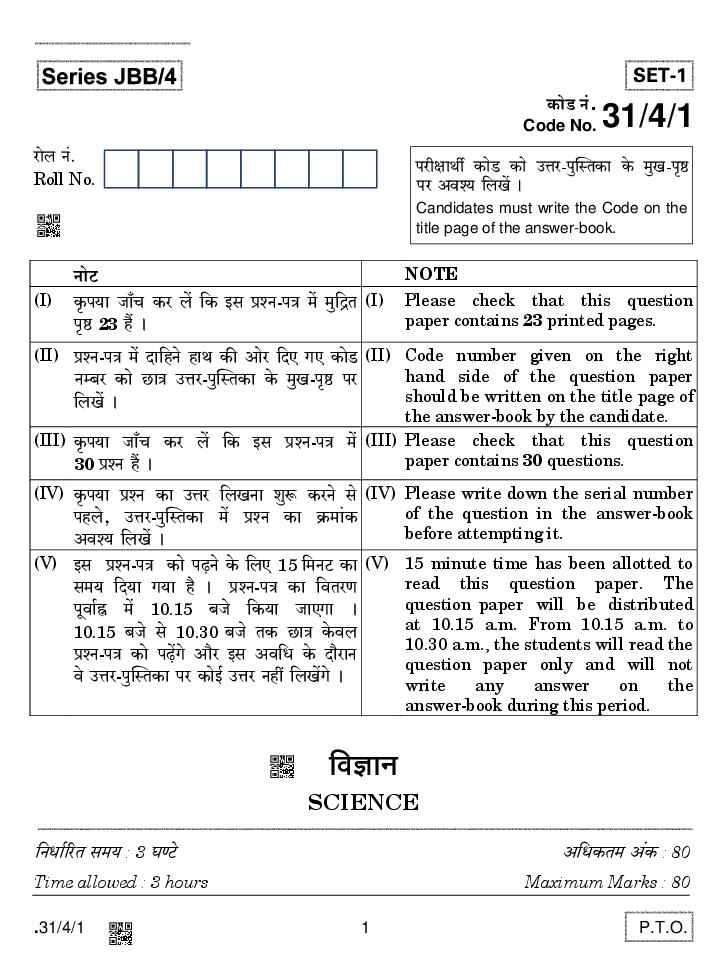
Code No. 31/4/1
amob Z§. narjmWu H$moS >H$mo CÎma-nwpñVH$m Ho$ _wI-n¥ð
Roll No. >na Adí` {bIo§ &
Candidates must write the Code on the
title page of the answer-book.
ZmoQ> NOTE
(I) H¥$n`m Om±M H$a b| {H$ Bg àíZ-nÌ _o§ _w{ÐV (I) Please check that this question
n¥ð> 23 h¢ & paper contains 23 printed pages.
(II) àíZ-nÌ _| Xm{hZo hmW H$s Amoa {XE JE H$moS (II) Code number given on the right
>Zå~a H$mo N>mÌ CÎma-nwpñVH$m Ho$ _wI-n¥ð> na hand side of the question paper
{bI| & should be written on the title page of
the answer-book by the candidate.
(III) H¥$n`m Om±M H$a b| {H$ Bg àíZ-nÌ _| (III) Please check that this question
>30 àíZ h¢ & paper contains 30 questions.
(IV) H¥$n`m àíZ H$m CÎma {bIZm ewê$ H$aZo go (IV) Please write down the serial number
nhbo, CÎma-nwpñVH$m _| àíZ H$m H«$_m§H$ of the question in the answer-book
Adí` {bI| & before attempting it.
(V) Bg àíZ-nÌ H$mo n‹T>Zo Ho$ {bE 15 {_ZQ >H$m (V) 15 minute time has been allotted to
g_` {X`m J`m h¡ & àíZ-nÌ H$m {dVaU read this question paper. The
nydm©• _| 10.15 ~Oo {H$`m OmEJm & question paper will be distributed
10.15 ~Oo go 10.30 ~Oo VH$ N>mÌ Ho$db at 10.15 a.m. From 10.15 a.m. to
10.30 a.m., the students will read the
àíZ-nÌ H$mo n‹T>|Jo Am¡a Bg Ad{Y Ho$ Xm¡amZ question paper only and will not
do CÎma-nwpñVH$m na H$moB© CÎma Zht {bI|Jo & write any answer on the
answer-book during this period.
{dkmZ
SCIENCE
{ZYm©[aV g_` : 3 KÊQ>o A{YH$V_ A§H$ : 80
Time allowed : 3 hours Maximum Marks : 80
.31/4/1 1 P.T.O.
Page 2
{ZåZ{b{IV {ZX}em| H$mo ~hþV gmdYmZr go n{‹T>E Am¡a CZH$m g™Vr go nmbZ H$s{OE :
(i) `h àíZ-nÌ VrZ IÊS>m| _§o {d^m{OV {H$`m J¶m h¡ — H$, I Am¡a J & Bg àíZ-nÌ _| àíZm|
H$s g§»`m 30 h¡ & g^r àíZ A{Zdm`© h¢ &
(ii) IÊS> H$ Ho$ g^r àíZ/CZHo$ ^mJ, àíZ g§»`m 1 go 14 VH$ EH$-EH$ A§H$ Ho$ h¢ & BZ àíZm|
_| ~hþ{dH$ënr àíZ, A{V bKw-CÎmar` àíZ VWm A{^H$WZ-H$maU àH$ma Ho$ àíZm| H$mo
gpå_{bV {H$`m J`m h¡ & BZ àíZm| Ho$ CÎma EH$ eãX AWdm EH$ dmŠ` _| {XE OmZo Mm{hE &
(iii) IÊS> I _| àíZ g§»`m 15 go 24 VH$ bKw-CÎmar` àH$ma Ho$ àíZ h¢, àË`oH$ àíZ 3 A§H$
H$m h¡ & BZ àíZm| H$m CÎma 50 go 60 eãXm| go A{YH$ Zht hmoZm Mm{hE &
(iv) IÊS> J _| àíZ g§»`m 25 go 30 VH$ XrK©-CÎmar` àH$ma Ho$ àíZ h¢, àË`oH$ àíZ 5 A§H$
H$m h¡ & BZ àíZm| H$m CÎma 80 go 90 eãXm| go A{YH$ Zht hmoZm Mm{hE &
(v) CÎma g§{já VWm q~Xþdma hmoZo Mm{hE Am¡a gmW hr Cn`w©º$ eãX gr_m H$m `Wmg§^d nmbZ
{H$`m OmZm Mm{hE &
(vi) àíZ-nÌ _| g_J« na H$moB© {dH$ën Zht h¡ & VWm{n àË`oH$ IÊS> _| Hw$N> àíZm| _| Am§V[aH$
{dH$ën {XE JE h¢ & Eogo àíZm| _§o go Ho$db EH$ hr {dH$ën H$m CÎma {b{IE &
(vii) BgHo$ A{V[aº$, Amdí`H$VmZwgma, àË`oH$ IÊS> Am¡a àíZ Ho$ gmW `Wmo{MV {ZX}e {XE JE
h¢ &
IÊS> H$
1. ZmBQ´>moOZ na_mUw 147 N _| CnpñWV g§`moOr BboŠQ´>m°Zm| H$s g§»`m {b{IE & 1
2. ào[aV {dÚwV² Ymam H$s n[a^mfm {b{IE & 1
3. {ZåZ{b{IV AZwÀN>oX Am¡a n‹T>r J`t g§~§{YV g§H$ënZmAm| H$s ì`m»`m Ho$ AmYma na àíZ
g§»`m 3(a) go 3(d) Ho$ CÎma Xr{OE :
gZ² 1800 Ho$ bJ^J VH$ Ho$db 30 VÎd hr kmV Wo & 1817 _| S>m°~oamBZa Am¡a
1866 _| Ý`yb¢S²>g Zo V~ VH$ kmV VÎdm| H$mo ì`dpñWV H$aZo Ho$ {bE à`mg {H$E Am¡a Hw$N>
{Z`_ ~ZmE {OÝh| d¡km{ZH$m| Zo AñdrH$ma H$a {X`m & CZ àñVm{dV {Z`_m| Ho$ AñdrH$ma
{H$E OmZo Ho$ níMmV² ^r H$B© d¡km{ZH$m| Zo Eogo à{Vê$nm| H$s ImoO Omar aIr {Oggo VÎdm| Ho$
JwUY_m] H$m CZHo$ na_mUw Ðì`_mZm| Ho$ gmW g§~§Y ñWm{nV hmo gHo$ &
.31/4/1 2
Page 3
Read the following instructions very carefully and strictly follow them.
(i) This question paper comprises three Sections — A, B and C. There are
30 questions in the question paper. All questions are compulsory.
(ii) Section A – Questions no. 1 to 14 — all questions or part thereof are of
one mark each. These questions comprise Multiple Choice Questions
(MCQ), Very Short Answer (VSA) and Assertion–Reason type questions.
Answer to these questions should be given in one word or one sentence.
(iii) Section B – Questions no. 15 to 24 are short answer type questions,
carrying 3 marks each. Answer to these questions should not exceed 50 to
60 words.
(iv) Section C – Questions no. 25 to 30 are long answer type questions,
carrying 5 marks each. Answer to these questions should not exceed 80 to
90 words.
(v) Answers should be brief and to the point. Also the above mentioned word
limit be adhered to as far as possible.
(vi) There is no overall choice in the question paper. However, an internal
choice has been provided in some questions in each section. Only one of
the choices in such questions have to be attempted.
(vii) In addition to this, separate instructions are given with each section and
question, wherever necessary.
SECTION A
1. Write the number of valence electrons present in a nitrogen atom 147 N. 1
2. Define the term induced electric current. 1
3. Answer question numbers 3(a) 3(d) on the basis of your understanding
of the following paragraph and the related studied concepts :
Around the year 1800, only 30 elements were known. Dobereiner
in 1817 and Newlands in 1866 tried to arrange the then known elements
and framed laws which were rejected by the scientists. Even after the
rejection of the proposed laws, many scientists continued to search for a
pattern that correlated the properties of elements with their atomic
masses.
.31/4/1 3 P.T.O.
Page 4
gmaUr Ho$ àma§{^H$ {dH$mg _| gdm©{YH$ _hÎdnyU© `moJXmZ {X`m & CÝhm|Zo VÎdm| H$mo CZHo$ _yb
JwUY_©, na_mUw Ðì`_mZ VWm amgm`{ZH$ JwUY_m] _| g_mZVm Ho$ AmYma na ì`dpñWV
{H$`m & CZHo$ hmBS´>mBS>m| Am¡a Am°ŠgmBS>m| Ho$ gyÌm| H$mo VÎdm| Ho$ dJuH$aU H$m _yb _mnXÊS>
_mZm J`m &
naÝVw _oÝS>obr\$ Ho$ dJuH$aU _| ^r Hw$N> H${_`m± Wt, Š`m|{H$ Bg_| g_ñWm{ZH$m| H$mo
H$moB© ñWmZ Zht {X`m J`m Wm & CÝhm|Zo AmdV© gmaUr _| Hw$N> [aº$ ñWmZ ^r N>mo‹S> {XE Wo &
3(a) _oÝS>obr\$ H$m AmdV© {Z`_ {b{IE & 1
3(b) _oÝS>obr\$ Zo AmdV© gmaUr _| Hw$N> [aº$ ñWmZ Š`m| N>mo‹S> {XE Wo ? 1
3(c) `{X {H$gr g_yh _| {H$gr VÎd H$mo ‘R’ Aja go {Zê${nV {H$`m OmVm h¡, Vmo H$m~©Z
Ho$ hmBS´>mBS> Am¡a Am°ŠgmBS> H$mo H«$_e: {H$g àH$ma {Zê${nV {H$`m OmEJm ? 1
(i) RH4, RO
(ii) RH4, RO2
(iii) RH2, RO2
(iv) RH2, RO
3(d) g_ñWm{ZH$ 1
(i) {H$gr VÎd Ho$ dh na_mUw h¢ {OZHo$ amgm`{ZH$ JwUY_© g_mZ naÝVw na_mUw
Ðì`_mZ {^Þ hmoVo h¢ &
(ii) {^Þ-{^Þ VÎdm| Ho$ dh na_mUw h¢ {OZHo$ amgm`{ZH$ JwUY_© g_mZ naÝVw
na_mUw Ðì`_mZ {^Þ hmoVo h¢ &
(iii) {H$gr VÎd Ho$ dh na_mUw h¢ {OZHo$ amgm`{ZH$ JwUY_© {^Þ naÝVw na_mUw
Ðì`_mZ g_mZ hmoVo h¢ &
(iv) {^Þ-{^Þ VÎdm| Ho$ dh na_mUw h¢ {OZHo$ amgm`{ZH$ JwUY_© {^Þ naÝVw
na_mUw Ðì`_mZ g_mZ hmoVo h¢ &
.31/4/1 4
Page 5
most important contribution to the early development of a Periodic table
of elements wherein he arranged the elements on the basis of their
fundamental property, the atomic mass and also on the similarity of
chemical properties. The formulae of their hydrides and oxides were
treated as basic criteria for the classification of the elements.
However, Mendeleev’s classification also had some limitations as it
could not assign the position to isotopes. He also left some gaps in the
periodic table.
3(a) State Mendeleev’s Periodic Law. 1
3(b) Why did Mendeleev leave some gaps in the Periodic table ? 1
3(c) If the letter ‘R’ was used to represent any of the elements in the
group, then the hydride and oxide of carbon would respectively be
represented as 1
(i) RH4, RO
(ii) RH4, RO2
(iii) RH2, RO2
(iv) RH2, RO
3(d) Isotopes are 1
(i) Atoms of an element with similar chemical properties but
different atomic masses.
(ii) Atoms of different elements with similar chemical properties
but different atomic masses.
(iii) Atoms of an element with different chemical properties but
same atomic masses.
(iv) Atoms of different elements with different chemical
properties but same atomic masses.
.31/4/1 5 P.T.O.
Page 6
g§»`m 4(a) go 4(d) Ho$ CÎma Xr{OE :
^maV AmO g§gmYZm| Ho$ AË`{YH$ XmohZ, Ob Am¡a _¥Xm Ho$ g§XÿfU VWm H$Mao H$mo
g§gm{YV H$aZo H$s {d{Y`m| H$s H$_r H$s g_ñ`m H$m gm_Zm H$a ahm h¡ & A~ g_` Am J`m
h¡ {H$ g§gma ‘‘EH$b-Cn`moJ ßbmpñQ>H$’’ H$mo {dXm H$ho & BgHo$ n`m©daU-{hV¡fr {dH$ënm|,
An{eîQ> ßbmpñQ>H$ H$m à^mdr EH$ÌrH$aU Am¡a CgH$m {ZnQ>mam H$aZo H$s {d{Y`m± {dH${gV
H$aZo Ho$ {bE à`mg {H$E OmZo Mm{hE &
BÝXm¡a Zo _mÌ 3 df© _| O¡d-IZZ Am¡a O¡d-CnMm`© H$s à{H«$`mAm| Ûmam 15 bmI
_r{Q´>H$ Q>Z H$Mao H$mo g§gm{YV {H$`m h¡ & O¡d-CnMm`© _| {H$gr b¡ÊS>{\$b _| OrdmUwAm| H$mo
S>mbH$a H$Mao H$mo àmH¥${VH$ ê$n go ‘AnK{Q>V’ {H$`m OmVm h¡ VWm O¡d-IZZ _| Q´>mo_b
_erZm| Ûmam H$Mao H$mo N>mZH$a ‘_¥Xm’ H$mo H$Mao go n¥WH²$ {H$`m OmVm h¡ & Bg eha Zo bJ^J
10 H$amo‹S> én`o IM© H$aHo$ 15 bmI _r{Q´>H$ Q>Z H$Mao H$m {ZnQ>mam H$aZo _| g\$bVm nmB© &
Eogm hr EH$ g\$b à`moJ Ah_Xm~mX _| ^r {H$`m J`m &
4(a) AnZo {dÚmb` _| An{eîQ> ßbmpñQ>H$ H$mo EH$Ì H$aZo H$s Xmo à^mdr {d{Y`m| H$m
CëboI H$s{OE & 1
4(b) ‘‘EH$b-Cn`moJ ßbmpñQ>H$’’ Ho$ X¡{ZH$ OrdZ _| H$moB© Xmo Cn`moJ {b{IE & 1
4(c) `{X ßbmpñQ>H$ H$m Cn`moJ amoH$ {X`m OmE, Vmo BgHo$ ñWmZ na H$moB© n`m©daU-{hV¡fr
{dH$ën H¡$go àXmZ {H$`m Om gH$Vm h¡ ? 1
4(d) Š`m Amn Eogm gmoMVo h¢ {H$ b¡ÊS>{\$b ñWb _| OrdmUw Cgr àH$ma H$m`© H$a|Jo O¡gm
do à`moJembm _| H$aVo h¢ ? AnZo CÎma H$s nw{îQ> H$s{OE & 1
.31/4/1 6
Page 7
of the following paragraph and the related studied concepts :
India today is facing the problem of overuse of resources,
contamination of water and soil and lack of methods of processing the
waste. The time has come for the world to say goodbye to ‘‘single-use
plastics’’. Steps must be undertaken to develop environment-friendly
substitutes, effective plastic waste collection and methods of its disposal.
Indore treated 15 lakh metric tonnes of waste in just 3 years,
through biomining and bioremediation techniques. Bioremediation
involves introducing microbes into a landfill to naturally ‘break’ it down
and biomining involves using trommel machines to sift through the waste
to separate the ‘soil’ and the waste component. The city managed to chip
away 15 lakh metric tonnes of waste at a cost of around < 10 crore. A
similar experiment was successfully carried out in Ahmedabad also.
4(a) State two methods of effective plastic waste collection in your
school. 1
4(b) Name any two uses of ‘‘single-use plastic’’ in daily life. 1
4(c) If we discontinue the use of plastic, how can an
environment-friendly substitute be provided ? 1
4(d) Do you think microbes will work similarly in landfill sites as they
work in the laboratory ? Justify your answer. 1
.31/4/1 7 P.T.O.
Page 8
(A) é{Ya Ho$db Am°ŠgrOZ H$m dhZ H$aVm h¡ VWm H$m~©Z S>mBAm°ŠgmBS> H$m dhZ Zht
H$aVm &
(B) _mZd öX` _| nm±M H$moîR> hmoVo h¢ &
(C) dmëd é{Ya Ho$ níM àdmh na amoH$ H$mo gw{ZpíMV H$aVo h¢ &
(D) öX` _| Am°ŠgrOZ-~hþb Am¡a Am°ŠgrOZ-Ý`yZ XmoZm| é{Ya {_{lV hmoVo h¢ &
6. Adm`dr` à{H«$`m 1
(A) {H$ÊdZ Ho$ g_` `rñQ> _| hmoVr h¡ &
(B) Am°ŠgrOZ H$s CnpñW{V _| hmoVr h¡ &
(C) _mZdm| H$s no{e`m| _| Ho$db D$Om© CËnÞ H$aVr h¡ &
(D) _| EWoZm°b, Am°ŠgrOZ Am¡a D$Om© CËnÞ hmoVr h¡ &
AWdm
^moOZ H$m A{YH$m§e nmMZ Am¡a AdemofU H$hm± hmoVm h¡ ? 1
(A) jwÐm§Ì _|
(B) `H¥$V _|
(C) Am_me` _|
(D) ~¥hÐm§Ì _|
7. {ZfoMZ dh à{H«$`m h¡ {Og_| 1
(A) Za `w½_H$ H$m _mXm `w½_H$ H$s Amoa ñWmZmÝVaU hmoVm h¡ &
(B) Za Am¡a _mXm `w½_H$ Ho$ Ho$ÝÐH$m| H$m g§b`Z hmoVm h¡ &
(C) Za Am¡a _mXm OZZm§Jm| H$m Amg§OZ ({MnH$md) hmoVm h¡ &
(D) {H$gr OZZm§J Ûmam `w½_H$ ~ZVo h¢ &
.31/4/1 8
Page 9
circulatory system ? 1
(A) Blood transports only oxygen and not carbon dioxide.
(B) Human heart has five chambers.
(C) Valves ensure that the blood does not flow backwards.
(D) Both oxygen-rich and oxygen-deficient blood gets mixed in the
heart.
6. Anaerobic process 1
(A) takes place in yeast during fermentation.
(B) takes place in the presence of oxygen.
(C) produces only energy in the muscles of human beings.
(D) produces ethanol, oxygen and energy.
OR
Most of the digestion and absorption of the food takes place in the 1
(A) small intestine.
(B) liver.
(C) stomach.
(D) large intestine.
7. Fertilisation is the process of 1
(A) transfer of male gamete to female gamete.
(B) fusion of nuclei of male and female gamete.
(C) adhesion of male and female reproductive organs.
(D) the formation of gametes by a reproductive organ.
.31/4/1 9 P.T.O.
Page 10
5
g§`mo{OV H$aHo$ {H$VZm A{YH$V_ à{VamoY àmßV H$a gH$Vm h¡ ? 1
(A) 1
(B) 5
(C) 10
(D) 25
AWdm
{H$gr à{VamoYH$ H$m à{VamoY CgHo$ àmapå^H$ _mZ H$m AmYm H$a {X`m J`m h¡ & Eogm H$aZo
_|, `{X n[anW Ho$ AÝ` àmMbm| H$mo n[ad{V©V Z {H$`m OmE, Vmo Bg à{VamoYH$ _| VmnZ
à^md hmo OmEJm 1
(A) XþJwZm
(B) AmYm
(C) EH$-Mm¡WmB©
(D) Mma JwZm
9. âboq_J H$m X{jU-hñV {Z`_ ~VmVm h¡ 1
(A) ào[aV Ymam H$m n[a_mU &
(B) Mwå~H$s` joÌ H$m n[a_mU &
(C) ào[aV Ymam H$s {Xem &
(D) ào[aV Ymam H$s {Xem Am¡a n[a_mU, XmoZm| &
.31/4/1 10
Page 11
8. If a person has five resistors each of value , then the maximum
5
resistance he can obtain by connecting them is 1
(A) 1
(B) 5
(C) 10
(D) 25
OR
The resistance of a resistor is reduced to half of its initial value. In doing
so, if other parameters of the circuit remain unchanged, the heating
effects in the resistor will become 1
(A) two times.
(B) half.
(C) one-fourth.
(D) four times.
9. Fleming’s Right-hand rule gives 1
(A) magnitude of the induced current.
(B) magnitude of the magnetic field.
(C) direction of the induced current.
(D) both, direction and magnitude of the induced current.
.31/4/1 11 P.T.O.
Page 12
H$WZ gË` Zht h¡ ? 1
(A) Bg_| D$Om© Zm{^H$s` {dIÊS>Z H$s à{H«$`m Ûmam àmßV hmoVr h¡ &
(B) Bg_| `yao{Z`_ Ho$ Zm{^H$ na CÀM D$Om© dmbo Ý`yQ´>m°Zm| H$s ~_~mar H$s OmVr h¡ &
(C) Bg à{H«$`m _| ûm¥§Ibm A{^{H«$`m hmoVr h¡ &
(D) Bg à{H«$`m _| {Z`§{ÌV Xa na {demb _mÌm _| D$Om© _wº$ hmoVr h¡ &
AWdm
n¥Ïdr Ho$ n¥îR> na D$Om© H$m g~go ~‹S>m òmoV h¡ 1
(A) O¡d_mÌm (~m`mo_mg)
(B) gm¡a {d{H$aU
(C) Ádma-^mQ>m
(D) ndZ
11. Amhma Omb ~ZVm h¡ 1
(A) Ordm| Am¡a n`m©daU Ho$ ~rM g§~§Y Ûmam
(B) nmXnm| Am¡a OÝVwAm| Ho$ ~rM g§~§Y Ûmam
(C) {H$gr nm[aV§Ì _| {d{^Þ Amhma ûm¥§IbmAm| Ho$ Omo‹S> go
(D) OÝVwAm| Am¡a n`m©daU Ho$ ~rM g§~§Y Ûmam
12. {ZåZ{b{IV _| go AgË` H$WZ Mw{ZE : 1
(A) Am°ŠgrOZ Ho$ VrZ na_mUwAm| go AmoµOmoZ H$m EH$ AUw ~ZVm h¡ &
(B) AmoµOmoZ nam~¢JZr {d{H$aUm| go n¥Ïdr Ho$ n¥îR> H$s gwajm H$aVr h¡ &
(C) AmoµOmoZ AË`ÝV {df¡br hmoVr h¡ &
(D) AmoµOmoZ nam~¢JZr {d{H$aUm| Ûmam AnK{Q>V ({d`mo{OV) hmo OmVr h¡ &
.31/4/1 12
Page 13
generation in a nuclear reactor ? 1
(A) Energy is obtained by a process called nuclear fission.
(B) The nucleus of Uranium is bombarded with high energy neutrons.
(C) A chain reaction is set in the process.
(D) In this process a tremendous amount of energy is released at a
controlled rate.
OR
The biggest source of energy on Earth’s surface is 1
(A) Biomass
(B) Solar radiations
(C) Tides
(D) Winds
11. Food web is constituted by 1
(A) relationship between the organisms and the environment.
(B) relationship between plants and animals.
(C) various interlinked food chains in an ecosystem.
(D) relationship between animals and environment.
12. Choose the incorrect statement from the following : 1
(A) Ozone is a molecule formed by three atoms of oxygen.
(B) Ozone shields the surface of the Earth from ultraviolet radiations.
(C) Ozone is deadly poisonous.
(D) Ozone gets decomposed by UV radiations.
.31/4/1 13 P.T.O.
Page 14
H$mo H$maU (R) Ûmam A§{H$V {H$`m J`m h¡ & BZ àíZm| Ho$ ghr CÎma ZrMo {XE JE H$moS>m| (a),
(b), (c) Am¡a (d) _| go MwZH$a Xr{OE &
(a) (A) Am¡a (R) XmoZm| ghr h¢ Am¡a (R), A{^H$WZ (A) H$s ghr ì`m»`m H$aVm h¡ &
(b) (A) Am¡a (R) XmoZm| ghr h¢, naÝVw (R), A{^H$WZ (A) H$s ghr ì`m»`m Zht H$aVm h¡ &
(c) (A) ghr h¡, naÝVw (R) µJbV h¡ &
(d) (A) µJbV h¡, naÝVw (R) ghr h¡ &
13. A{^H$WZ (A) : {ZåZ{b{IV g§Vw{bV amgm`{ZH$ g_rH$aU Am`aZ na ^mn H$s {H«$`m Ho$
{bE h¡ :
3Fe + 4H2O Fe3O4 + 4H2
H$maU (R) : {H$gr amgm`{ZH$ g_rH$aU na Ðì`_mZ Ho$ g§ajU H$m {Z`_ bmJy hmoVm
h¡ & 1
14. A{^H$WZ (A) : _mZdm| _| {H$gr {eew H$m qbJ CgHo$ {nVm Ûmam d§emZwJV JwUgyÌ Ho$
àH$ma Ûmam {ZYm©[aV hmoVm h¡ &
H$maU (R) : dh {eew Omo AnZo {nVm go ‘X’ JwUgyÌ d§emZwJV H$aVm h¡ b‹S>H$s (XX)
hmoVr h¡ O~{H$ dh {eew Omo AnZo {nVm go ‘Y’ JwUgyÌ d§emZwJV H$aVm h¡
b‹S>H$m (XY) hmoVm h¡ & 1
IÊS> I
15. H$moB© naIZbr, {Og_| nmoQ>¡{e`_ Am`moS>mBS> H$m {db`Z ^am h¡, _| b¡S> ZmBQ´>oQ> {db`Z
{_bm`m J`m h¡ &
(a) Adjo{nV `m¡{JH$ H$m Zm_ Am¡a a§J {b{IE &
(b) hmoZo dmbr A{^{H«$`m H$m g§Vw{bV amgm`{ZH$ g_rH$aU {b{IE &
(c) Bg A{^{H«$`m Ho$ àH$ma H$m Zm_ {b{IE Am¡a AnZo CÎma H$s nw{îQ> H$s{OE & 3
AWdm
Š`m hmoVm h¡ O~ dgm VWm V¡br` ImÚ gm_J«r bå~o g_` VH$ aIr ah OmVr h¡ ? àojU
`mo½` Xmo n[adV©Zm| H$s gyMr ~ZmBE Am¡a Bg n[aKQ>Zm go ~Mmd Ho$ VrZ Cnm` gwPmBE & 3
.31/4/1 14
Page 15
labelled as Assertion (A) and the other labelled as Reason (R). Select the
correct answer to these questions from the codes (a), (b), (c) and (d) as
given below :
(a) Both (A) and (R) are true and (R) is the correct explanation of the
assertion (A).
(b) Both (A) and (R) are true, but (R) is not the correct explanation of
the assertion (A).
(c) (A) is true, but (R) is false.
(d) (A) is false, but (R) is true.
13. Assertion (A) : Following is a balanced chemical equation for the action
of steam on iron :
3Fe + 4H2O Fe3O4 + 4H2
Reason (R) : The law of conservation of mass holds good for a chemical
equation. 1
14. Assertion (A) : The sex of a child in human beings will be determined by
the type of chromosome he/she inherits from the father.
Reason (R) : A child who inherits ‘X’ chromosome from his father
would be a girl (XX), while a child who inherits a
‘Y’ chromosome from the father would be a boy (XY). 1
SECTION B
15. Lead nitrate solution is added to a test tube containing potassium iodide
solution.
(a) Write the name and colour of the compound precipitated.
(b) Write the balanced chemical equation for the reaction involved.
(c) Name the type of this reaction justifying your answer. 3
OR
What happens when food materials containing fats and oils are left for a
long time ? List two observable changes and suggest three ways by which
this phenomenon can be prevented. 3
.31/4/1 15 P.T.O.
Page 16
AWdm
Vm{bH$m Ho$ ê$n _| {ZåZ{b{IV YmVwAm| H$s R>§S>o Am¡a J_© Ob Ho$ gmW A{^{H«$`merbVmAm|
H$s VwbZm H$s{OE :
(a) gmo{S>`_
(b) H¡$pëg`_
(c) _¡½Zr{e`_ 3
17. H$m~©Z, Omo {H$ g_yh 14 H$m gXñ` h¡, AË`{YH$ g§»`m _| H$m~©Z `m¡{JH$m| H$m {Z_m©U H$aVm
h¡ {OZH$s AZw_m{ZV g§»`m bJ^J 30 bmI h¡ & Bgr JwwUY_© H$mo Bgr g_yh Ho$ AÝ` VÎd
àX{e©V Š`m| Zht H$aVo h¢ ? ì`m»`m H$s{OE & 3
18. H$moB© MrVm, AnZo {eH$ma H$mo XoIH$a, CgH$s Amoa AË`{YH$ Vrd« J{V go Xm¡‹S>Vm h¡ & CgH$s
no{e`m| H$mo {H$g àH$ma J{V {_bVr h¡ ? Bg n[aKQ>Zm Ho$ g_` no{e`m| Ho$ H$mo{eH$s` Ad`dm|
Ho$ agm`Z _| Š`m n[adV©Z hmoVm h¡ ? 3
19. JwéËdmZwdV©Z H$s n[a^mfm {b{IE & {H$gr nmXn Ho$ ^mJm| _| JwéËdmZwdVu J{V`m| H$mo Xem©Zo
Ho$ {bE Zm_m§{H$V AmaoI It{ME & 3
20. {dH$mg H$s n[a^mfm {b{IE & ‘‘{dH$mg H$mo àJ{V Ho$ g_mZ Zht _mZm Om gH$Vm h¡ &’’ Bg
H$WZ H$s nw{îQ> H$s{OE & 3
AWdm
‘‘{dH$mg H$s à{H«$`m H$s Ad{Y _|, A§J AWdm bjU ZE H$m`m] Ho$ {bE AZwHy${bV hmo
gH$Vo h¢ &’’ H$moB© Cn`wº$ CXmhaU XoH$a Bg VÏ` H$s ì`m»`m H$s{OE & 3
21. {H$gr AdVb Xn©U H$m Cn`moJ {H$gr {~å~ H$s {d{^Þ pñW{V`m| _| CgH$m à{V{~å~ ~ZmZo
Ho$ {bE {H$`m J`m h¡ & O~ `h {~å~ 15 cm \$moH$g Xÿar Ho$ AdVb Xn©U Ho$ Y«wd go
10 cm Xÿar na aIm h¡, Vmo Bg pñW{V _| {ZåZ{b{IV Ho$ {df` _| Š`m {ZîH$f© {ZH$mbo Om
gH$Vo h¢ ?
(a) à{V{~å~ H$s pñW{V
(b) à{V{~å~ H$m gmBµO
(c) à{V{~å~ H$s àH¥${V
AnZo {ZîH$fm] H$s nw{îQ> Ho$ {bE Zm_m§{H$V {H$aU AmaoI It{ME & 3
.31/4/1 16
Page 17
and alloying. 3
OR
Compare in tabular form the reactivities of the following metals with cold
and hot water :
(a) Sodium
(b) Calcium
(c) Magnesium 3
17. Carbon, a member of group 14, forms a large number of carbon
compounds estimated to be about three million. Why is this property not
exhibited by other elements of this group ? Explain. 3
18. A cheetah, on seeing a prey, moves towards him at a very high speed.
What causes the movement of his muscles ? How does the chemistry of
cellular components of muscles change during this event ? 3
19. Define geotropism. Draw a labelled diagram of a plant showing geotropic
movements of its parts. 3
20. Define the term evolution. ‘‘Evolution cannot be equated with progress.’’
Justify this statement. 3
OR
‘‘During the course of evolution, organs or features may be adapted for
new functions.’’ Explain this fact by choosing an appropriate example. 3
21. A concave mirror is used for image formation for different positions of an
object. What inferences can be drawn about the following when an object
is placed at a distance of 10 cm from the pole of a concave mirror of focal
length 15 cm ?
(a) Position of the image
(b) Size of the image
(c) Nature of the image
Draw a labelled ray diagram to justify your inferences. 3
.31/4/1 17 P.T.O.
Page 18
gmnoj AndV©Zm§H$ 4/3 h¡ & _mÜ`_ ‘x’ Ho$ gmnoj _mÜ`_ ‘z’ H$m AndV©Zm§H$ kmV H$s{OE &
`{X _mÜ`_ ‘x’ _| àH$me H$s Mmb 3 108 ms1 h¡, Vmo _mÜ`_ ‘y’ _| àH$me H$s Mmb
n[aH${bV H$s{OE & 3
23. H$moB© ì`{º$ {ZH$Q>-Ñ{îQ>> Xmof VWm XrK©-Ñ{îQ> Xmof XmoZm| go nr{‹S>V hmo gH$Vm h¡ &
(a) Bg pñW{V H$mo Š`m H$hVo h¢ ?
(b) `h pñW{V H$~ CËnÞ hmoVr h¡ ?
(c) Bg Xmof go nr{‹S>V ì`{º$`m| H$mo àm`: {Og àH$ma Ho$ b|gm| H$s Amdí`H$Vm hmoVr h¡
CgH$m Zm_ {b{IE & Bg àH$ma Ho$ b|gm| H$m Zm_m§{H$V AmaoI It{ME & 3
24. Amn H$m±M Ho$ Xmo gd©g_ {àµÁ_m| H$m Cn`moJ {H$g àH$ma H$a|Jo {Oggo {H$ nhbo {àµÁ_ na
Amn{VV H$moB© nVbm ídoV àH$me nw§O Xÿgao {àµÁ_ go ídoV àH$me nw§O Ho$ ê$n _| hr {ZJ©V
hmo ? {H$aU AmaoI ItMH$a Cgo Zm_m§{H$V H$s{OE & 3
IÊS> J
25. ß`mµO Ho$ ag _| {^JmoH$a {ZH$mbr JB© H$n‹S>o H$s {H$gr nÅ>r H$m Cn`moJ {H$gr Ðd ‘X’ Ho$
narjU Ho$ {bE {H$`m J`m & Ðd ‘X’ Zo CgH$s J§Y H$mo n[ad{V©V H$a {X`m & ß`mµO H$m ag
{H$g àH$ma H$m gyMH$ h¡ ? `hr Ðd ‘X’ Zrbo {bQ>_g H$mo bmb H$a XoVm h¡ & {ZåZ{b{IV Ho$
gmW Ðd ‘X’ H$s A{^{H«$`m Ho$ àojUm| H$mo Xem©Zo Ho$ {bE gyMr ~ZmBE :
(a) qµOH$ H$s H${UH$mE±
(b) R>mog gmo{S>`_ H$m~m}ZoQ>
hmoZo dmbr A{^{H«$`mAm| Ho$ amgm`{ZH$ g_rH$aU {b{IE & 5
AWdm
{H$ñQ>bZ Ob H$s n[a^mfm {b{IE & CXmhaUm| Ho$ ê$n _| Xmo `m¡{JH$m| Ho$ amgm`{ZH$ gyÌ
{b{IE & `h {H$g àH$ma gË`m{nV {H$`m Om gH$Vm h¡ {H$ {H«$ñQ>bZ Ob `m¡{JH$m| H$s
AdñWm Am¡a a§J _| AÝVa H$a gH$Vm h¡ ? 5
.31/4/1 18
Page 19
and the refractive index of medium ‘y’ with respect to medium ‘z’ is 4/3.
Find the refractive index of medium ‘z’ with respect to medium ‘x’. If the
speed of light in medium ‘x’ is 3 108 ms1, calculate the speed of light
in medium ‘y’. 3
23. A person may suffer from both myopia and hypermetropia defects.
(a) What is this condition called ?
(b) When does it happen ?
(c) Name the type of lens often required by the persons suffering from
this defect. Draw labelled diagram of such lenses. 3
24. How will you use two identical glass prisms so that a narrow beam of
white light incident on one prism emerges out of the second prism as
white light ? Draw and label the ray diagram. 3
SECTION C
25. A cloth strip dipped in onion juice is used for testing a liquid ‘X’. The
liquid ‘X’ changes its odour. Which type of an indicator is onion juice ?
The liquid ‘X’ turns blue litmus red. List the observations the liquid ‘X’
will show on reacting with the following :
(a) Zinc granules
(b) Solid sodium carbonate
Write the chemical equations for the reactions involved. 5
OR
Define water of crystallisation. Give the chemical formula for two
compounds as examples. How can it be proved that the water of
crystallisation makes a difference in the state and colour of the
compounds ? 5
.31/4/1 19 P.T.O.
Page 20
Cn`wº$ ~ZmVo h¢ &
(ii) CZ Xmo YmVwAm| Ho$ Zm_ {b{IE Omo D$î_m Ho$ g~go AÀN>o MmbH$ h¢ ?
(iii) CZ Xmo YmVwAm| Ho$ Zm_ {b{IE Omo hWobr na aIZo na {nKb OmVr h¢ &
(b) BboŠQ´>m°Z-{~ÝXþ g§aMZm g{hV Am`Zr `m¡{JH$ CaO Ho$ ~ZZo H$s ì`m»`m H$s{OE &
H¡$pëg`_ Am¡a Am°ŠgrOZ Ho$ na_mUw H«$_m§H$ H«$_e: 20 Am¡a 8 h¢ & 5
27. (a) _mZd eara Ho$ {bE nmofU Š`m| Amdí`H$ h¡ ?
(b) Amhma Zmb Ho$ ^rVa ^moOZ H$mo H$m¡Z J{V àXmZ H$aVm h¡ ?
(c) _m§gmhm[a`m| H$s VwbZm _| emH$mhm[a`m| H$s jwÐm§Ì A{YH$ bå~r Š`m| hmoVr h¡ ?
(d) `{X OR>a J«§{W`m± íboî_m H$m òdU Z H$a|, Vmo Š`m hmoJm ? 5
28. {H$gr nwîn _| {ZfoMZ H$mo Xem©Zo H$m ñdÀN> AmaoI It{ME Am¡a Cg na (a) namJZbr,
(b) Za OZZ-H$mo{eH$m Am¡a (c) _mXm OZZ-H$mo{eH$m H$mo Zm_m§{H$V H$s{OE & nwîn _| {ZfoMZ
H$s à{H«$`m H$s ì`m»`m H$s{OE & {ZfoMZ Ho$ níMmV² (i) AÊS>me` Am¡a (ii) ~rOmÊS> H$m
Š`m hmoVm h¡ ? 5
AWdm
(a) `m¡dZmaå^ {H$go H$hVo h¢ ?
(b) _mZd Za OZZ V§Ì _| ZrMo {XE JE ^mJm| Ho$ H$m`m] H$m g§jon _| dU©Z H$s{OE :
(i) d¥fU
(ii) ewH«$me`
(iii) ewH«$dm{hH$m
(iv) _yÌ_mJ©
(c) d¥fU CXa Jwhm Ho$ ~mha pñWV Š`m| hmoVo h¢ ?
(d) CëboI H$s{OE {H$ ewH«$mUw _mXm OZZ-H$mo{eH$m H$s Amoa {H$g àH$ma J{V H$aVo h¢ & 5
.31/4/1 20
Page 21
metal for ornaments.
(ii) Name two metals which are the best conductors of heat.
(iii) Name two metals which melt when you keep them on your
palm.
(b) Explain the formation of ionic compound CaO with electron-dot
structure. Atomic numbers of calcium and oxygen are 20 and 8
respectively. 5
27. (a) Why is nutrition necessary for the human body ?
(b) What causes movement of food inside the alimentary canal ?
(c) Why is small intestine in herbivores longer than in carnivores ?
(d) What will happen if mucus is not secreted by the gastric glands ? 5
28. Draw a neat diagram showing fertilisation in a flower and label (a) Pollen
tube, (b) Male germ cell and (c) Female germ cell, on it. Explain the
process of fertilisation in a flower. What happens to the (i) ovary and
(ii) ovule after fertilisation ? 5
OR
(a) What is puberty ?
(b) Describe in brief the functions of the following parts in the human
male reproductive system :
(i) Testes
(ii) Seminal vesicle
(iii) Vas deferens
(iv) Urethra
(c) Why are testes located outside the abdominal cavity ?
(d) State how sperms move towards the female germ cell. 5
.31/4/1 21 P.T.O.
Page 22
g§`mo{OV 10 , 20 VWm 30 Ho$ VrZ à{VamoYH$m| H$m g§`moOZ, EH$ ßbJ Hww§$Or VWm EH$
Eo_rQ>a, g^r loUr _| g§`mo{OV h¢ & Bg n[anW H$m Cn`moJ H$aHo$ {ZåZ{b{IV H$m _mZ kmV
H$s{OE :
(a) àË`oH$ à{VamoYH$ go àdm{hV Ymam
(b) n[anW _| àdm{hV Hw$b Ymam
(c) n[anW H$m Hw$b à^mdr à{VamoY 5
AWdm
{H$gr 6 V H$s ~¡Q>ar go Xmo gd©g_ à{VamoYH$, {OZ_| àË`oH$ H$m à{VamoY 15 h¡,
~mar-~mar go nhbo (i) loUr _|, Am¡a {\$a (ii) nmíd© _| g§`mo{OV {H$E JE h¢ & àË`oH$ àH$aU
_| à{VamoYH$m| Ho$ g§`moOZ Ûmam Cn^wº$ e{º$ Ho$ AZwnmV H$m n[aH$bZ H$s{OE & 5
30. (a) âboq_J H$m dm_-hñV {Z`_ {b{IE &
(b) h_ AnZo Kam| _| {Og {dÚwV² Ymam H$m Cn`moJ H$aVo h¢ CgHo$ VrZ {d{eîQ> bjUm|
H$s gyMr ~ZmBE &
(c) â`yµO Š`m hmoVm h¡ ? Bgo gwajm `w{º$ Š`m| H$hVo h¢ ?
(d) YmVw Ho$ AmdaU dmbo {dÚwV² gm{YÌm| H$mo ^ygån{H©$V H$aZm Š`m| Amdí`H$ h¡ ? 5
.31/4/1 22
Page 23
2 V each, a combination of three resistors of 10 , 20 and 30
connected in parallel, a plug key and an ammeter, all connected in series.
Use this circuit to find the value of the following :
(a) Current through each resistor
(b) Total current in the circuit
(c) Total effective resistance of the circuit 5
OR
Two identical resistors, each of resistance 15 , are connected in
(i) series, and (ii) parallel, in turn to a battery of 6 V. Calculate the ratio
of the power consumed in the combination of resistors in each case. 5
30. (a) State Fleming’s Left-hand rule.
(b) List three characteristic features of the electric current used in our
homes.
(c) What is a fuse ? Why is it called a safety device ?
(d) Why is it necessary to earth metallic electric appliances ? 5
.31/4/1 23 P.T.O.
Document Details
| Board / Org | CBSE |
| Exam | Class 10 |
| Type | Question Paper |
| Pages | 23 |
| Updated | 22 Jul 2026 |