CBSE Class 10 Science Question Paper 2020 Set 31-3-3
Finished viewing? Save it for later —
Download CBSE Class 10 Science Question Paper 2020 Set 31-3-3 (PDF · 24 pages)About CBSE Class 10 Science Question Paper 2020 Set 31-3-3
CBSE Class 10 Science Question Paper 2020 Set 31-3-3 is available here for free download. Published by CBSE for Class 10, this question paper can be viewed online or downloaded as a PDF (24 pages). Candidates preparing for Class 10 can use CBSE Class 10 Science Question Paper 2020 Set 31-3-3 to understand the exam pattern, the type of questions asked, and the overall difficulty level.
Frequently Asked Questions
How can I download CBSE Class 10 Science Question Paper 2020 Set 31-3-3?
Open this page and click the Download button to save CBSE Class 10 Science Question Paper 2020 Set 31-3-3 as a PDF. It is completely free on AglaSem Docs.
Is CBSE Class 10 Science Question Paper 2020 Set 31-3-3 free to download?
Yes. CBSE Class 10 Science Question Paper 2020 Set 31-3-3 can be viewed online and downloaded as a PDF free of cost on AglaSem Docs.
How many pages does CBSE Class 10 Science Question Paper 2020 Set 31-3-3 have?
CBSE Class 10 Science Question Paper 2020 Set 31-3-3 contains 24 pages, which you can read online or download together as a single PDF.
Where can I find more Class 10 study material?
You can find more Class 10 question papers, sample papers, syllabus, and answer keys on AglaSem Docs.
CBSE Class 10 Science Question Paper 2020 Set 31-3-3 – Text
Read the full text of this question paper below — useful to quickly search, copy and reference the content online without downloading the PDF.
📄 View text version (24 pages)
Page 1
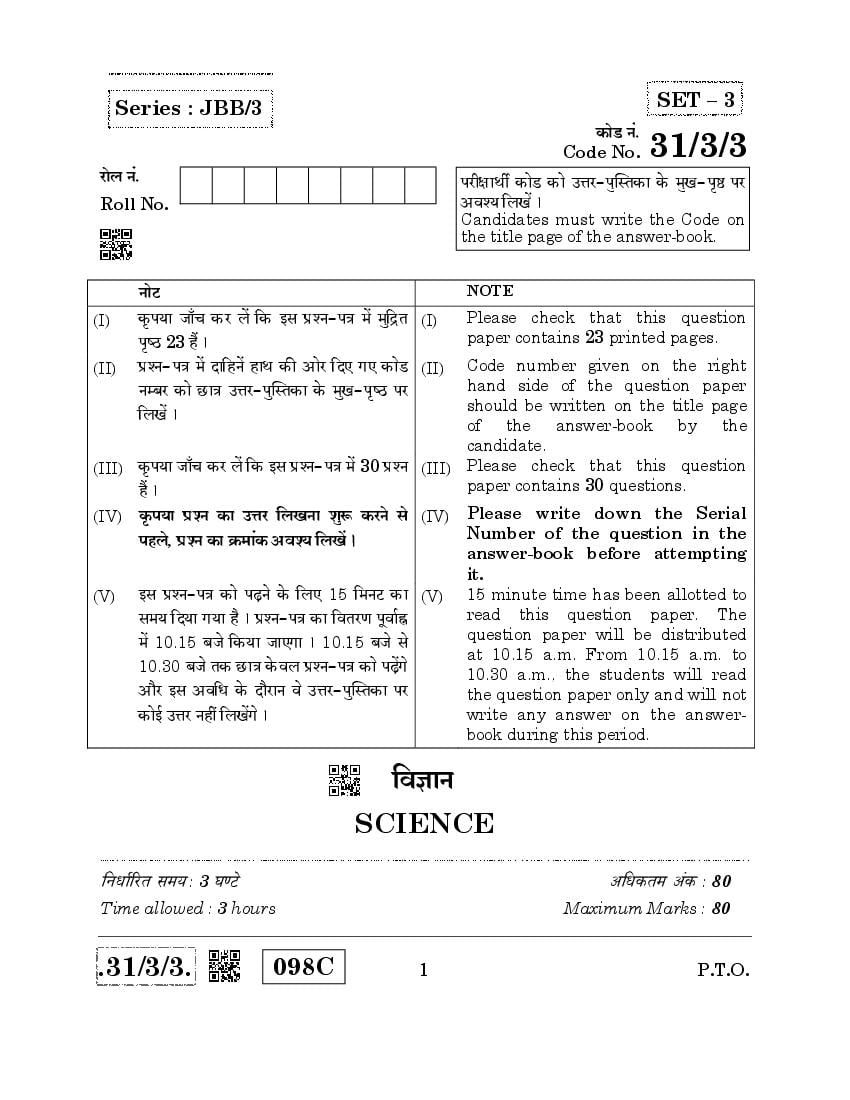
.
Code No. 31/3/3
. - -
Roll No.
Candidates must write the Code on
the title page of the answer-book.
NOTE
(I) - (I) Please check that this question
23 paper contains 23 printed pages.
(II) - (II) Code number given on the right
- - hand side of the question paper
should be written on the title page
of the answer-book by the
candidate.
(III) - 30 (III) Please check that this question
paper contains 30 questions.
(IV) (IV) Please write down the Serial
, Number of the question in the
answer-book before attempting
it.
(V) - 15 (V) 15 minute time has been allotted to
- read this question paper. The
question paper will be distributed
10.15 10.15
at 10.15 a.m. From 10.15 a.m. to
10.30 - 10.30 a.m., the students will read
- the question paper only and will not
write any answer on the answer-
book during this period.
SCIENCE
{ZYm©[aV g‘¶ : 3 KÊQ>o A{YH$V‘ A§H$ : 80
Time allowed : 3 hours Maximum Marks : 80
.31/3/3. 098C 1 P.T.O.
Page 2
(i) - – ,
30
(ii) - / ( 1 14 ) -
, - -
1 1
(iii) - 15 24 3
50 60
(iv) - 25 30 5
80 90
(v)
(vi)
(vii) , ,
–
: 1 2 (A)
(R) (a), (b),
(c) (d)
(a) (A) (R) (R)
(b) (A) (R) (R)
(c) (A) (R)
(d) (A) (R)
.31/3/3. 2
Page 3
Read the following instructions very carefully and strictly follow them :
(i) The question paper comprises three Sections, A, B and C. There are 30
questions in the question paper. All questions are compulsory.
(ii) Section A – all questions / or parts (question no. 1 to 14) thereof in this
section are one mark questions comprising MCQ, VSA type and
Assertion–Reason type questions. They are to be answered in one word
or in one sentence.
(iii) Section B – question no. 15 to 24 are short answer type questions,
carrying 3 marks each. Answer to these questions should not exceed 50 to
60 words.
(iv) Section C – question no. 25 to 30 are long answer type questions,
carrying 5 marks each. Answer to these questions should not exceed 80 to
90 words.
(v) Answer should be brief and to the point. Also the above mentioned word
limit be adhered to as far as possible.
(vi) There is no overall choice in the question paper. However, an internal
choice has been provided in some questions in each section. Only one of
the choices in such questions have to be attempted.
(vii) In addition to this, separate instructions are given with each section and
question, wherever necessary.
Section – A
Note : For question numbers 1 and 2, two statements are given-one
labelled Assertion (A) and the other labelled Reason (R). Select
the correct answer to these questions from the codes (a), (b), (c)
and (d) as given below :
(a) Both (A) and (R) are true and (R) is correct explanation of the
assertion.
(b) Both (A) and (R) are true but (R) is not the correct explanation of the
assertion.
(c) (A) is true but (R) is false.
(d) (A) is false but (R) is true.
.31/3/3. 3 P.T.O.
Page 4
(R) : , –CH2 –
, 1
2. (A) : ,
(R) :
1
3. ? 1
4. 1
:
(pm)
Na 86
K 231
Rb 244
Cs 282
1
.31/3/3. 4
Page 5
CH3OH, CH3CH2OH, CH3CH2CH2OH
Reason (R) : A series of compounds with same functional group but
differing by – CH2 – unit is called a homologous series. 1
2. Assertion (A) : Alloys are commonly used in electrical heating devices
like electric iron and heater.
Reason (R) : Resistivity of an alloy is generally higher than that of its
constituent metals but the alloys have low melting points then their
constituent metals. 1
3. How are covalent bonds formed ? 1
4. Define electropositivity. 1
OR
The atomic radii of first group elements are given below :
Group-I element Atomic Radii (pm)
Na 86
K 231
Rb 244
Cs 282
State the reason behind the observed trend in the above elements. 1
.31/3/3. 5 P.T.O.
Page 6
2l ?
A
(a)
2
3A
(b)
2
(c) 2A
(d) 3A 1
6. , 1 ,
2
?
(a) 2
(b) 1
(c) 2.5
(d) 8 1
7.
(a)
(b)
(c)
(d) 1
8. ‘X’
(a) 1 3
(b) 2 3
(c) 13 3
(d) 16 3 1
‘X’ 13 ,
(A)
(B) 3
(C) XCl3
(a) (A)
(b) (B)
(c) (A) (C)
(d) (A), (B) (C) 1
.31/3/3. 6
Page 7
has resistance ‘R’. The area of cross section of another conductor of same
material and same resistance but of length ‘2l’ is
A
(a)
2
3A
(b)
2
(c) 2A
(d) 3A 1
6. The maximum resistance which can be made using four resistors each of
1
resistance is
2
(a) 2
(b) 1
(c) 2.5
(d) 8 1
7. The sky appears dark to passengers flying at very high altitudes mainly
because :
(a) Scattering of light is not enough at such heights.
(b) There is no atmosphere at great heights.
(c) The size of molecules is smaller than the wavelength of visible light.
(d) The light gets scattered towards the earth. 1
8. An element ‘X’ is forming an acidic oxide. Its position in modern periodic
table will be
(a) Group 1 and Period 3
(b) Group 2 and Period 3
(c) Group 13 and Period 3
(d) Group 16 and Period 3 1
OR
Consider the following statements about an element ‘X’ with number of
protons 13.
(A) It forms amphoteric oxide
(B) Its valency is three
(C) The formula of its chloride is XCl3
The correct statements(s) is/are
(a) only (A)
(b) only (B)
(c) (A) and (C)
(d) (A), (B) and (C) 1
.31/3/3. 7 P.T.O.
Page 8
‘B’ ‘A’ ‘B’
?
(a) A B
(b) A B
(c) A pH 7 B pH 7
(d) A pH 7 B pH 7 1
10. ?
(a)
(b)
(c)
(d) 1
11. A B
A
B A B –
(a) A B
(b) B A -
(c) A B
(d) B A 1
12.
?
(a) A = ; B =
C =
.31/3/3. 8
Page 9
of an aqueous solution ‘B’ to ‘A’, the pink colour disappears. The following
statement is true for solution ‘A’ and ‘B’.
(a) A is strongly basic and B is a weak base.
(b) A is strongly acidic and B is a weak acid.
(c) A has pH greater than 7 and B has pH less than 7.
(d) A has pH less than 7 and B has pH greater than 7. 1
10. In which of the following, the identity of initial substance remains
unchanged ?
(a) Curdling of milk
(b) Formation of crystals by process of crystallisation
(c) Fermentation of grapes
(d) Digestion of food 1
11. Several factories were pouring their wastes in rivers A and B. Water
samples were collected from these two rivers. It was observed that sample
collected from river A was acidic while that of river B was basic. The
factories located near A and B are
(a) Soaps and detergents factories near A and alcohol distillery near B.
(b) Soaps and detergents factories near B and alcohol distillery near A.
(c) Lead storage battery manufacturing factories near A and soaps and
detergents factories near B.
(d) Lead storage battery manufacturing factories near B and soaps and
detergents factories near A. 1
12. A diagram of traditional water harvesting system is given below :
The statement which defines the system and its parts is
(a) This is an ideal setting of the Khadin system and A = Catchment
area; B = Saline area & C = Shallow dugwell
.31/3/3. 9 P.T.O.
Page 10
C =
(c) A = , B =
C =
(d) A = , B = C = 1
(a)
(b)
(c)
(d) 1
13. 13(a) 13(d)
4.0 km3 52 km2
, 1000 MW
1980 2014
1,00,000
,
(a) ? 1
(b) 1 MW 1
(c) 1
(d) ? 1
.31/3/3. 10
Page 11
Catchment area; B = Saline area and C = Khadin
(c) This is an ideal setting of Catchement area and A = Khadin, B =
Saline area and C = Shallow dugwell
(d) This is showing Saline area and A = Catchment area; B = Khadin
and C = Shallow dugwell 1
OR
The major ill effect of mono culture practice in forests is on the
(a) biodiversity which faces large destruction
(b) local people whose basic needs can no longer be met from such
forests
(c) industries
(d) forest department 1
13. Answer question numbers 13(a) to 13(d) on the basis of your
understanding of the following paragraph and the related studies
concepts.
The Tehri dam is the highest dam in India and one of the highest in the
World. The Tehri dam withholds a reservoir of capacity 4.0 km 3 and
surface area 52 km2. It is used for irrigation, municipal water supply and
the generation of 1000 MW of hydro electricity.
The Tehri Dam has been the object of protests. Environment activist Shri
Sunder Lal Bahuguna led the “Anti Tehri Dam Movement” from 1980s to
2014. The protest was against the displacement of town inhabitants and
environmental consequences of the weak ecosystem. The relocation of
more than 1,00,000 people from the area has led to protracted legal
battles over resettlement rights and ultimately resulted in the delayed
completion of the project.
(a) How is hydropower harnessed ? 1
(b) Define 1 MW. 1
(c) Mention two disadvantages of constructing Tehri Dam. 1
(d) What happens when water from great heights is made to fall on
blades of turbine ? 1
.31/3/3. 11 P.T.O.
Page 12
(TSH)
(mU/L) (mU/L)
18 – 29 0.4 – 2.34 mU/L < 0.4 mU/L
30 – 49 0.4 – 4.0 mU/L < 0.4 mU/L
50 – 79 0.46 – 4.68 mU/L < 0.46 mU/L
,
5%
3% TSH
, 2013 TSH 2017
TSH
(a) 35 TSH 6.03 mU/L
? 1
(b) TSH ? 1
(c) TSH 1
(d) 1
–
15.
(i)
(ii) 3
.31/3/3. 12
Page 13
the table in which the levels of Thyroid Stimulating Hormone (TSH) in
women are given and answer the questions that follow on the basis of
understanding of the following paragraph and the related studied
concepts.
Age Range Normal (mU/L) Low (mU/L)
18 – 29 years 0.4 – 2.34 mU/L < 0.4 mU/L
30 – 49 years 0.4 – 4.0 mU/L < 0.4 mU/L
50 – 79 years 0.46 – 4.68 mU/L < 0.46 mU/L
Women are at greater risk for developing abnormal TSH levels during
menstruation, while giving birth and after going through menopause.
Around 5% of women in the United States have some kind of thyroid
problem compared to 3% of men. Despite claims that high TSH increases
your risk for heart disease, a 2013 study found no link between high TSH
and heart diseases. But a 2017 study showed that older women are
especially at risk for developing thyroid cancer if they have high TSH
levels along with thyroid nodules.
(a) A 35 year old woman has TSH level 6.03 mU/L. What change should
she bring in her diet to control this level ? 1
(b) When do women face a greater risk of abnormal TSH level ? 1
(c) State the consequence of low TSH level. 1
(d) Name the mineral that is responsible for synthesis of hormone
secreted by thyroid gland. 1
Section – B
15. Identity the type of each of the following reactions.
Also write balanced chemical equation for each reaction.
(i) A reaction in which the reaction mixture becomes warm.
(ii) A reaction in which an insoluble substance is formed. 3
.31/3/3. 13 P.T.O.
Page 14
Li 7
A Na 23
K 39
N 14
B P 31
As 74
B 10.8
C Al 27
Ga 69.7
(i) A, B C
(ii) A, B C () ?
(iii) ?
3
17.
(i) NaOH(aq) + Zn(s)
(ii) CaCO3(s) + H2O(l) + CO2(g)
(iii) HCl(aq) + H2O(l) 3
() ‘G’ ‘G’
, ‘C’
(i) ‘G’ ‘C’
(ii)
(iii) ‘C’ ? 3
18. (a)
(b) ?
? 3
?
1980 ? 3
.31/3/3. 14
Page 15
Category Name of the element Atomic Mass
Li 7
A Na 23
K 39
N 14
B P 31
As 74
B 10.8
C Al 27
Ga 69.7
(i) From the given three categories A, B and C, pick the one which
forms Dobereiner’s Triads.
(ii) Why did Mendeleev placed elements of category A, B and C in three
different groups ?
(iii) Is Newland law of octaves applicable to all the three categories ?
Give reason to justify your answer. 3
17. Complete and balance the following chemical equations :
(i) NaOH(aq) + Zn(s)
(ii) CaCO3(s) + H2O(l) + CO2(g)
(iii) HCl(aq) + H2O(l) 3
OR
During electrolysis of brine, a gas ‘G’ is liberated at anode. When this gas
‘G’ is passed through slaked lime, a compound ‘C’ is formed, which is used
for disinfecting drinking water.
(i) Write formula of ‘G’ and ‘C’.
(ii) State the chemical equation involved.
(iii) What is common name of compound ‘C’ ? Give its chemical name. 3
18. (a) State with reason the consequence of decrease in number of
carnivores in an ecosystem.
(b) In a food chain, state the trophic level at which the concentration of
harmful chemicals is maximum. Why is it so ? 3
OR
How is ozone layer formed ? State its importance to all life forms on
earth ? Why the amount of ozone in the atmosphere dropped sharply in
the 1980s ? 3
.31/3/3. 15 P.T.O.
Page 16
(i)
(ii)
(b)
3
20. GG
gg
(a)
(i) F1 ,
(ii) F1 F2
,
(iii) F2 GG Gg
(b) ? 3
21. (a) :
(i)
(ii)
(iii)
(iv)
(b)
3
22. (a)
(b)
3
23. (a)
(b)
? 3
.31/3/3. 16
Page 17
(i) Enzyme trypsin
(ii) Enzyme lipase
(b) List two functions of finger like projections present in the small
intestine. 3
20. A green stemmed rose plant denoted by GG and a brown stemmed rose
plant denoted by gg are allowed to undergo a cross with each other.
(a) List your observations regarding
(i) Colour of stem in their F1 progeny
(ii) Percentage of brown stemmed plants in F 2 progeny if F1 plants
are self pollinated.
(iii) Ratio of GG and Gg in the F2 progeny.
(b) Based on the findings of this cross, what conclusion can be drawn ? 3
21. (a) Classify the following as homologous or analogous pairs :
(i) Broccoli and Cabbage
(ii) Ginger and Raddish
(iii) Fore limbs of birds and lizard
(iv) Wings of a bat and Wings of a bird
(b) State the main feature that categorises a given pair of organs as
homologous or analogous. 3
22. (a) State Snell’s law of refraction of light.
(b) When a ray of light travelling in air enters obliquely into a glass
slab, it is observed that the light ray emerges parallel to the incident
ray but it is shifted sideways slightly. Draw a labelled ray diagram
to illustrate it. 3
23. (a) With the help of labelled ray diagram show the path followed by a
narrow beam of monochromatic light when it passes through a glass
prism.
(b) What would happen if this beam is replaced by a narrow beam of
white light ? 3
OR
.31/3/3. 17 P.T.O.
Page 18
(i) ?
(ii) ?
(b) + 3D
–3D
3
24.
(i)
(ii)
(iii) () ()
3
–
25. (a) ()
(b) ?
(c)
(d)
H
|
H– C –C–H
|| |
O H 5
26. ‘M’
(a) ‘M’
(b)
.31/3/3. 18
Page 19
(i) What kind of lenses can correct this defect ?
(ii) How are these lenses prepared ?
(b) A person needs a lens of power + 3D for correcting his near vision
and –3D for correcting his distant vision. Calculate the focal lengths
of the lenses required to correct these defects. 3
24. Give reasons for the following :
(i) There is either a convergence or a divergence of magnetic field lines
near the ends of a current carrying straight solenoid.
(ii) The current carrying solenoid when suspended freely rests along a
particular direction.
(iii) The burnt out fuse should be replaced by another fuse of identical
rating. 3
Section – C
25. (a) Compare soaps and detergents on the basis of their composition and
cleansing action in hard water.
(b) What happens when ethanol is treated with sodium metal ? State
about the behaviour of ethanol in this reaction.
(c) Draw the structure of cyclohexane.
(d) Name the following compound.
H
|
H– C –C–H
|| |
O H 5
26. A metal ‘M’ is stored under kerosene. It vigorously catches fire, if a small
piece of this metal is kept open in air. Dissolution of this metal in water
releases great amount of energy and the metal catches fire. The solution
so formed turns red litmus blue.
(a) Name the metal ‘M’.
(b) Write formula of the compound formed when this metal is exposed to
air.
.31/3/3. 19 P.T.O.
Page 20
(d)
?
(e)
(i) ‘M’
(ii) ‘M’
(iii) 5
(a) Ca ( 20) O( 8) -
(b)
(c)
(d) 5
27. (a)
(b) ? 5
28. (a)
(b)
(c) 5
(a)
(b)
(c) ? 5
29. (a) 5 m
20 m ,
,
(b)
5
.31/3/3. 20
Page 21
(d) If oxide of this metal is treated with hydrochloric acid, what would be
the products ?
(e) Write balanced equations for :
(i) Reaction of ‘M’ with air.
(ii) Reaction of ‘M’ with water.
(iii) Reaction of metal oxide with hydrochloric acid. 5
OR
(a) Write electron dot structures of Ca (At. No. 20) and O(At. No. 8).
(b) Show the formation of calcium oxide by transfer of electrons.
(c) Name the ions present in this compound.
(d) List four important characteristics of this compound. 5
27. (a) Write the correct sequence of steps followed during journey of oxygen
rich blood from lungs to various organs of human body.
(b) What happens when the system of blood vessels develop a leak ? 5
28. (a) Suggest any two categories of contraceptive methods to control the
size of human population which is essential for the prosperity of a
country. Also explain about each method briefly.
(b) Name two bacterial and two viral infections each that can get
sexually transmitted.
(c) List two advantages of using condom during sexual act. 5
OR
(a) Draw a diagram to show spore formation in Rhizopus.
(b) With the help of an example differentiate between the process of
Budding and Fragmentation.
(c) Why is vegetative propagation practiced for growing some type of
plants ? 5
29. (a) A security mirror used in a big showroom has radius of curvature
5 m. If a customer is standing at a distance of 20 m from the cash
counter, find the position, nature and size of the image formed in the
security mirror.
(b) Neha visited a dentist in his clinic. She observed that the dentist was
holding an instrument fitted with a mirror. State the nature of this
mirror and reason for its use in the instrument used by dentist. 5
OR
.31/3/3. 21 P.T.O.
Page 22
(i)
(ii)
?
(iii) 10 cm 5 cm ,
5
30. (a) 200 V ; 100 W ?
(b) 3 10 ,
(c) 1 ` 6.50 5
(a) “ 1 ” ?
(b) ,
(c) 132 220 V
5 A 5
____________
.31/3/3. 22
Page 23
for this purpose.
(i) State the nature of the lens and reason for its use.
(ii) Where should the palmist place/hold the lens so as to have a real and
magnified image of an object ?
(iii) If the focal length of this lens is 10 cm, the lens is held at a distance
of 5 cm from the palm, use lens formula to find the position and size
of the image. 5
30. (a) An electric bulb is rated at 200 V; 100 W. What is its resistance ?
(b) Calculate the energy consumed by 3 such bulbs if they glow
continuously for 10 hours for complete month of November.
(c) Calculate the total cost if the rate is ` 6.50 per unit. 5
OR
(a) What is meant by the statement, “The resistance of a conductor is
one ohm” ?
(b) Define electric power. Write an expression relating electric power,
potential difference and resistance.
(c) How many 132 resistors in parallel are required to carry 5 A on a
220 V line ? 5
____________
.31/3/3. 23 P.T.O.
Page 24
Document Details
| Board / Org | CBSE |
| Exam | Class 10 |
| Type | Question Paper |
| Pages | 24 |
| Updated | 22 Jul 2026 |