CMI Entrance Exam 2024 Question Paper Solutions M.Sc PhD Computer Science
Finished viewing? Save it for later —
Download CMI Entrance Exam 2024 Question Paper Solutions M.Sc PhD Computer Science (PDF · 13 pages)About CMI Entrance Exam 2024 Question Paper Solutions M.Sc PhD Computer Science
CMI Entrance Exam 2024 Question Paper Solutions M.Sc PhD Computer Science is available here for free download. Published by Default for CMI Entrance Exam, this solution can be viewed online or downloaded as a PDF (13 pages). Candidates preparing for CMI Entrance Exam can use CMI Entrance Exam 2024 Question Paper Solutions M.Sc PhD Computer Science to understand the exam pattern, the type of questions asked, and the overall difficulty level.
Frequently Asked Questions
How can I download CMI Entrance Exam 2024 Question Paper Solutions M.Sc PhD Computer Science?
Open this page and click the Download button to save CMI Entrance Exam 2024 Question Paper Solutions M.Sc PhD Computer Science as a PDF. It is completely free on AglaSem Docs.
Is CMI Entrance Exam 2024 Question Paper Solutions M.Sc PhD Computer Science free to download?
Yes. CMI Entrance Exam 2024 Question Paper Solutions M.Sc PhD Computer Science can be viewed online and downloaded as a PDF free of cost on AglaSem Docs.
How many pages does CMI Entrance Exam 2024 Question Paper Solutions M.Sc PhD Computer Science have?
CMI Entrance Exam 2024 Question Paper Solutions M.Sc PhD Computer Science contains 13 pages, which you can read online or download together as a single PDF.
Where can I find more CMI Entrance Exam study material?
You can find more CMI Entrance Exam question papers, sample papers, syllabus, and answer keys on AglaSem Docs.
CMI Entrance Exam 2024 Question Paper Solutions M.Sc PhD Computer Science – Text
Read the full text of this solution below — useful to quickly search, copy and reference the content online without downloading the PDF.
📄 View text version (13 pages)
Page 1
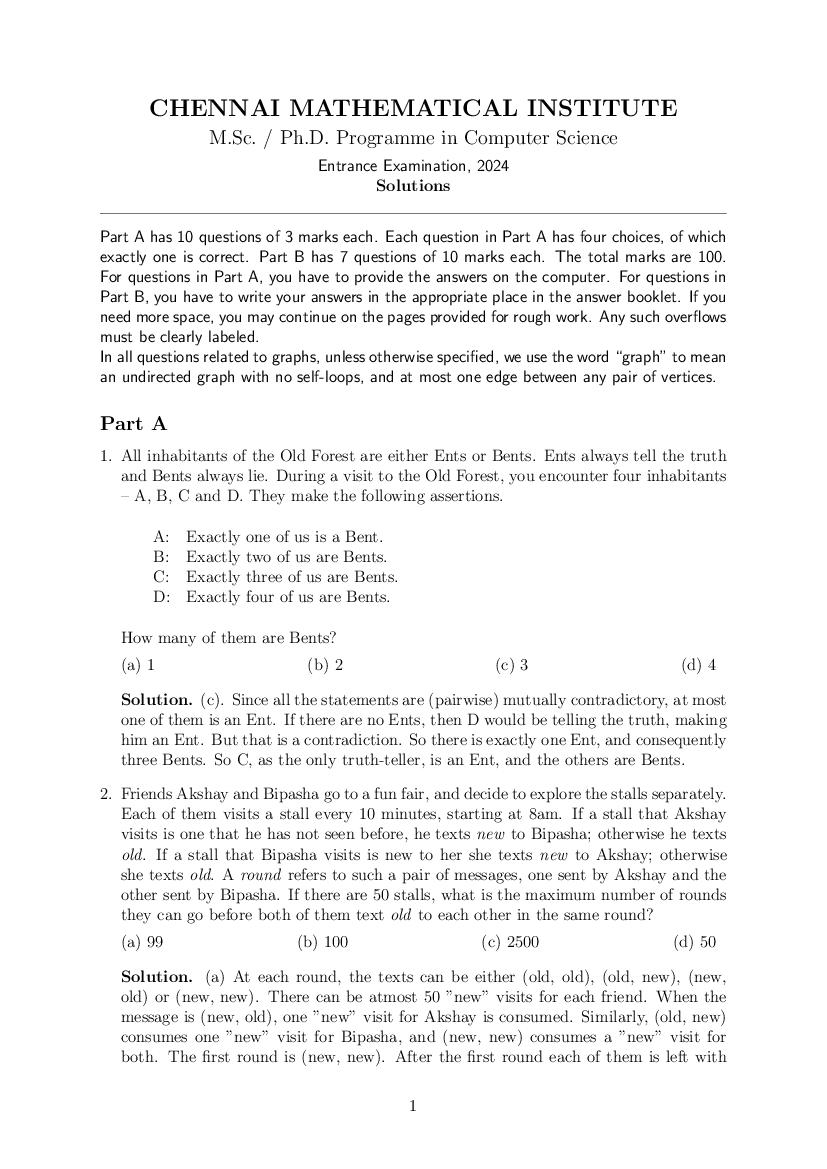
M.Sc. / Ph.D. Programme in Computer Science
Entrance Examination, 2024
Solutions
Part A has 10 questions of 3 marks each. Each question in Part A has four choices, of which
exactly one is correct. Part B has 7 questions of 10 marks each. The total marks are 100.
For questions in Part A, you have to provide the answers on the computer. For questions in
Part B, you have to write your answers in the appropriate place in the answer booklet. If you
need more space, you may continue on the pages provided for rough work. Any such overflows
must be clearly labeled.
In all questions related to graphs, unless otherwise specified, we use the word “graph” to mean
an undirected graph with no self-loops, and at most one edge between any pair of vertices.
Part A
1. All inhabitants of the Old Forest are either Ents or Bents. Ents always tell the truth
and Bents always lie. During a visit to the Old Forest, you encounter four inhabitants
– A, B, C and D. They make the following assertions.
A: Exactly one of us is a Bent.
B: Exactly two of us are Bents.
C: Exactly three of us are Bents.
D: Exactly four of us are Bents.
How many of them are Bents?
(a) 1 (b) 2 (c) 3 (d) 4
Solution. (c). Since all the statements are (pairwise) mutually contradictory, at most
one of them is an Ent. If there are no Ents, then D would be telling the truth, making
him an Ent. But that is a contradiction. So there is exactly one Ent, and consequently
three Bents. So C, as the only truth-teller, is an Ent, and the others are Bents.
2. Friends Akshay and Bipasha go to a fun fair, and decide to explore the stalls separately.
Each of them visits a stall every 10 minutes, starting at 8am. If a stall that Akshay
visits is one that he has not seen before, he texts new to Bipasha; otherwise he texts
old. If a stall that Bipasha visits is new to her she texts new to Akshay; otherwise
she texts old. A round refers to such a pair of messages, one sent by Akshay and the
other sent by Bipasha. If there are 50 stalls, what is the maximum number of rounds
they can go before both of them text old to each other in the same round?
(a) 99 (b) 100 (c) 2500 (d) 50
Solution. (a) At each round, the texts can be either (old, old), (old, new), (new,
old) or (new, new). There can be atmost 50 ”new” visits for each friend. When the
message is (new, old), one ”new” visit for Akshay is consumed. Similarly, (old, new)
consumes one ”new” visit for Bipasha, and (new, new) consumes a ”new” visit for
both. The first round is (new, new). After the first round each of them is left with
1
Page 2
old). In total, there can be at most 99 rounds.
Here is a sequence that hits 99 rounds. Akshay visits the stall in this order: 1 1 2 2 3
3 ... 50 50. Bipasha visits in this order: 1 2 1 3 1 4.. 1 50. The texts would be (new,
new) (old, new) (new, old) (old, new)....(old, new).
3. You live in ∆-City, which is a large equilateral triangle with each side of length 2km.
The corners are named A, B and C. The city is partitioned into triangular blocks
with sides of 500m each, and there are roads at the boundaries of the blocks.
You live in corner A and your office is at corner B.
A
B C
You have decided to walk from home to the office everyday, and you are willing to
change your route, as long as the total distance is at most 2.5kms. How many such
routes are possible from A to B?
(a) 5 (b) 11 (c) 21 (d) 45
Solution (b). The smallest route is to go directly from A to B in 4 steps, moving
South-West (each step is 500m long). There is no other route with 4 steps. To go from
A to B in 5 steps, you can take a diagonal path going South-East, and compensate for it
later with a horizontal West step. So, in all, you can take three South-West steps, with
a South-East step and a later West step inserted. The number of permutations of 3
5!
South-West, 1 South-East, 1 West, where South-East occurs before West is = 10.
3! · 2
Overall, there are 11 routes.
4. Rohit and Ben participate in a new toss system introduced by the ICC. The umpire
repeatedly tosses a fair coin (which comes up heads with probability 21 and tails with
probability 12 ), until one of them wins. Rohit wins if the result of two consecutive
tosses is heads (i.e., the pattern HH is seen), while Ben wins if the pattern TH is seen.
What are the winning probabilities for Rohit and Ben?
(a) 41 and 34 (b) 14 and 14 (c) 12 and 12 (d) 13 and 23
Solution: (a). Suppose the first toss results in a T. Then Rohit can never win from
here on: either the rest of the tosses yield T, or the first time a H appears, Ben wins.
The probability that all tosses are T is 0. Therefore, if the first toss results in T, Ben
wins with probability 1.
Suppose the first toss results in a H. Then, if the second toss is also H, Rohit wins.
Otherwise, the second toss is T. Applying the same argument as above, from this
point, Ben wins with probability 1.
2
Page 3
Therefore Ben wins with probability 21 + 14 = 34 . For Rohit to win, the first two tosses
need to be HH. Hence, he wins with probability 14 .
5. Let Σ = {a, b, c}. What is the language generated by the following grammar?
S := ϵ | aS | Sb | cS
(a) (a + b + c)∗ b∗ (b) (a + b + c)∗ c∗
(c) (a + c)∗ b∗ (d) (a + b)∗ c∗
Solution: (c). Consider a word in (a + c)∗ b∗ . It is of the form w1 w2 . . . wm bn where
each wi is either a or c and n ≥ 0. This can be generated as follows: S → w1 S →
w1 w2 S → · · · → w1 w2 . . . wm S followed by a sequence of application of the rule S → Sb
ending in S → ϵ. So each word in (a + c)∗ b∗ can be generated by the grammar.
Conversely, we need to show that any word generated by the grammar satisfies the
regular expression (a + c)∗ b∗ , that is, it is of the form w1 w2 . . . wm bn as above. Notice
that in any word generated by S, after a b, there can be no a or c; and before an a or
c there can be no b. We can show by induction, that in any derivation of k steps the
string generated is of the form w1 . . . wm Sbn where each wi ∈ {a, c}.
6. Let Σ = {a1 , a2 , . . . , an } for some n ≥ 1. Consider the two languages:
L1 = {w ∈ Σ∗ | ∃ai ∈ Σ such that ai occurs at least two times in w}
L2 = Σ∗ (a1 a1 + a2 a2 + · · · an an ) Σ∗
Which of the following statements are true?
(I) There is an NFA with O(n) states accepting L1 .
(II) There is a DFA with O(n) states accepting L1 .
(III) There is an NFA with O(n) states accepting L2 .
(IV) There is a DFA with O(n) states accepting L2 .
(a) All of the above (b) I, III, IV
(c) I and III (d) I, II and III
Solution. (b).
Here is an NFA with O(n) states for L1 . There are n initial states qi , each of them
Σ\ai
guessing the letter ai that will occur at least twice. Transitions are as follows: qi −−→
a i Σ\ai a i Σ
qi , qi −
→ pi , pi −−→ pi , pi −
→ ri , ri −
→ ri . Each ri is a final state.
Here is a DFA with O(n) states for L2 . States are q0 , q1 , . . . , qn and f , with q0 the
ai ai
initial state, and f the final state. Transitions are as follows: q0 − → qi , qi −
→ f,
aj ̸=ai Σ
qi −−−→ qj , f −
→ f . Since a DFA is also an NFA, this is also an NFA with O(n) states.
Finally, we will show that there is no DFA with O(n) states for L1 . In fact, any DFA
for L1 will require 2n states. Let w and w′ be two words such that no letter appears
twice in each of them, and there exists ai such that is in w but not w′ . Then wai ∈ L1 ,
but w′ ai ∈
/ L1 . This shows that w and w′ need to go to different states. Therefore,
for every two distinct subsets of letters, we can find words that go to different states.
This shows there are at least 2n states.
3
Page 4
• T1 (n) = T1 ( n2 ) + T1 ( n3 ) + Θ(n), T1 (1) = 2
• T2 (n) = T2 ( 2n
3
) + T2 ( n3 ) + Θ(n), T2 (1) = 2
Which of the following statements is true?
(a) T1 (n) = Θ(n) and T2 (n) = Θ(n)
(b) T1 (n) = Θ(n log n) and T2 (n) = Θ(n log n)
(c) T1 (n) = Θ(n) and T2 (n) = Θ(n log n)
(d) T1 (n) = Θ(n log n) and T2 (n) = Θ(n)
Solution. (c).
(a) We consider T1 (n) first. For any n, there is a k such that n ≤ 6k ≤ 6n. Now,
suppose T1 (n) = T1 ( n2 ) + T1 ( n3 ) + 5n. Define S(i, j) = T1 (2i 3j ). We thus get a
recurrence for S as: S(0, 0) = 2 and S(i, j) = S(i − 1, j) + S(i, j − 1) + 5 · 2i · 3j .
We can show by induction on i + j that S(i, j) ≤ 30 · 2i 3j . For the base case,
S(0, 0) = 2 ≤ 30 · 20 30 . For the induction step,
S(i, j) = S(i − 1, j) + S(i, j − 1) + 5 · 2i 3j
≤ 30 · 2i−1 3j + 30 · 2i 3j−1 + 5 · 2i · 3j
≤ 2i 3j (15 + 10 + 5)
= 30 · 2i 3j .
Thus T1 (n) ≤ S(k, k) = 30 · 6k ≤ 30 · 6n = 180n. Thus T1 (n) = Θ(n).
(b) We consider T2 (n) next. For any n, there is a k such that n ≤ 3k ≤ 3n. Now,
suppose T2 (n) = T2 ( 2n 3
) + T2 ( n3 ) + 8n. Define S(i, j) = T2 (2i 3j ). We get the
following recurrence for S: S(0, 0) = 2 and S(i, j) = S(i + 1, j − 1) + S(i, j − 1) +
8 · 2i 3j . By induction on i + 2j, we can show that S(i, j) ≤ 8(i + 2j + 1)2i 3j . For
the base case, we have S(0, 0) = 2 ≤ 8(0 + 1)20 30 . For the induction step,
S(i, j) = S(i + 1, j − 1) + S(i, j − 1) + 8.2i 3j
≤ 8(i + 1 + 2j − 2 + 1)2i+1 3j−1 + 8(i + 2j − 2 + 1)2i 3j−1 + 8 · 2i 3j
≤ 8(2(i + 2j)/3 + (i + 2j)/3 + 1)2i 3j
= 8(i + 2j + 1)2i 3j .
Now
T2 (n) ≤ T2 (3k )
= S(0, k)
≤ 8(0 + 2k + 1)20 3k
≤ 8 · 3n · (2 log3 n + 3)
≤ 96n log3 n.
Thus T2 (n) = Θ(n log n).
4
Page 5
edge with maximum weight and emin the edge with minimum weight. What can you
say about the following statements?
(I) Every minimum spanning tree of G must contain emin
(II) Every minimum spanning tree must exclude emax
(a) I is True, but II is False (b) I is False, but II is True
(c) Both I and II are False (d) Both I and II are True
Solution. (a). Recall Kruskal’s algorithm for finding minimum spanning tree. It
starts by picking the edge with the smallest weight. As for the second statement,
consider a graph which is simply a path with two edges emin emax . Here, we need to
pick both the edges to span all the vertices.
9. Let G be a directed graph with distinct and nonnegative edge weights. Let s be a
starting vertex and t a destination vertex. Assume that G has at least one s-t path.
What can you say about the following statements?
(I) Every shortest s-t path (minimum weight) must include the minimum-weight
edge of G.
(II) Every shortest s-t path must exclude the maximum-weight edge of G.
(a) I is True, but II is False (b) I is False, but II is True
(c) Both I and II are False (d) Both I and II are True
0 100 10
Solution (c). Consider a graph: s →
− s1 −−→ t and s −
→ t. Clearly, the shortest path
10
is s −
→ t which excludes the minimum-weight edge.
0 1
Consider a graph with just two edges s → − s1 →
− t. The shortest s − t path needs to
include both the edges, in particular, the one with maximum-weight.
10. In the following code, A is an array indexed from 0, and for two integers a, b the
expression a//b returns ⌊ ab ⌋, the largest integer which is not larger than a/b.
foo(A, first, last)
1 if first ≥ last
2 then return A[first]
3 else
4 mid ← (first + last)//2
5 l ← foo(A, first, mid )
6 r ← foo(A, mid +1, last)
7 return l + r
If A = [1, 2, 3, 4, 5, 6], what will foo(A, 0, 5) return?
(a) 3 (b) 7 (c) 15 (d) 21
Solution: (d), 21.
5
Page 6
indices in A, the call foo(A, j, i) computes the sum of the elements in A[i . . . j]. In
the base case, we have i = j and the function returns A[i], which is the sum of all
elements in A[i . . . i]. For the induction step, we see that recursive calls return the
sums of A[i . . . m] and A[m + 1 . . . j], so their sum is A[i . . . j], as desired.
6
Page 7
1. A binary search tree is a binary tree whose proper subtrees are binary search trees,
and whose root is strictly greater than all elements in the left subtree, and strictly
less than all elements in the right subtree. A preorder listing of a tree is obtained by
listing the root first, then recursively listing all elements of the left subtree in preorder,
followed by all elements of the right subtree in preorder.
Provide algorithms for the following two problems, and calculate their worst-case run-
ning times.
(a) Input is an array of integers A[1..n]. Output is “Yes” if A is the preorder listing
of a binary search tree, and “No” otherwise.
(b) Input is an array of integers A[1..n] which is guaranteed to be the preorder listing
of a binary search tree. Output is a binary tree t such that A is the preorder
listing of t.
Solution.
(a) Given A[1..n], check if there is a j ∈ [2..n] such that every element in A[2..j] is
strictly less than A[1], and every element in A[j + 1..n] is strictly greater than
A[1]. If no such j exists, return “No”. Else, make a recursive call of the algorithm
on A[2..j] and A[j + 1..n].
(b) We can build the tree using the above algorithm. Each call now returns a tree.
Since A[1..n] is guaranteed to be a preorder listing of a binary search tree, the
call to A[1..n] will have a j, as above. In fact, it will be a unique j. Make A[1]
as root, and the tree obtained by the call to A[2..j] as the left sub-tree, and the
one obtained by A[j + 1..n] as the right sub-tree.
Since the tree could be skewed, both the above algorithms take O(n2 ) time in the
worst case.
7
Page 8
finite automaton (NFA) accepting a language L1 ⊆ {0, 1}∗ . Let ϵ denote the null string.
We construct a new NFA M2 = (Q2 , {q2 }, ∆2 , F2 ), where ∆2 ⊆ Q2 × (Σ ∪ {ϵ}) × Q2 ,
as follows.
• Q2 = Q1 .
• q2 = q 1 .
• F2 = F1 ∪ {q1 }.
• (p, a, p′ ) ∈ ∆2 iff either (p, a, p′ ) ∈ ∆1 or (p ∈ F1 and a = ϵ and p′ = q1 )
Prove or disprove: The language L2 accepted by M2 is L∗1 .
Solution. No. In M2 we make q1 a final state, whereas q1 may not be final in M1 .
Let M1 be the automaton with two states q1 and p, with p the single final state.
Transitions are:
a
q1 →
− q1
b
q1 →
− p
a,b
p −→ p
Automaton M1 accepts all words containing a b. The automaton M2 that we construct
from M1 makes q1 a final state, and therefore also accepts the word a.
8
Page 9
toss the coin. If you get heads you move two steps to your right, to position 2. On
the other hand if you get tails you move one step to your right, to position 1. You
continue tossing the coin. Every time you get heads you move two steps to the right
of the position you are in currently, and if you get tails you move one step to the right
of the position you are in currently.
Show that the probability of landing in position n is
1 1
[2 + (− )n ]
3 2
.
Solution.
Denote by Pn the probability of landing in position n. We prove by induction on n ≥ 0
that Pn = 31 [2 + (− 12 )n ].
For n = 0, we start at position 0, so P0 = 1 = 13 [2 + 1] = 13 3[2 + (− 12 )0 ]. For n = 1, we
lanf at position 1 if the first toss lands tails up. So P1 = 21 = 13 [2 − 12 ] = 13 [2 + (− 12 )1 ].
For n ≥ 2, we can get to n by first getting to n − 2 and tossing heads, or by getting
to n − 1 and tossing a tail. These two are disjoint events, so the probabilities can be
added up, and we get
1 1
Pn = Pn−1 + Pn−1
2 2
1 1 1 1 1 1
= · [2 + (− )n−2 ] + · [2 + (− )n−1 ]
2 3 2 2 3 2
1 1 n−2 1
= [4 + (− ) (1 + (− ))]
6 2 2
1 4 1 1 n−2 1
= [ + (− ) ]
3 2 2 2 2
1 1 1
= [2 + ( )2 (− )n−2 ]
3 2 2
1 1 2 1 n−2
= [2 + (− ) (− ) ]
3 2 2
1 1 n
= [2 + (− ) ]
3 2
9
Page 10
or green. Show that there is an isosceles right angled triangle all of whose vertices are
the same colour.
Solution. If we have two consecutive points (a, b), (a, b + 1) on a line parallel to y axis
which are coloured blue and if any of (a − 1, b), (a + 1, b), (a − 1, b + 1), (a + 1, b + 1)
is coloured the same, we are done. Otherwise there are two points with coordinates
(x, y), (x + 2, y) with green colour. (Likewise if we have consecutive points on a line
parallel to x axis coloured identically we are done or (x, y), (x, y + 2) will be coloured
the same). Assume the first case - if both (x, y) and (x + 2, y) are coloured green,
consider the points (x + 1, y + 1), (x, y + 2) and (x + 2, y + 2). If any one is green we
are done. Otherwise all are blue and we are done.
10
Page 11
rev(ϵ) = ϵ and rev(wa) = a·rev(w) for w ∈ Σ∗ and a ∈ Σ. For example, rev(aab) = baa.
For a language L, we define rev(L) := {rev(w) | w ∈ L}.
(a) Is rev(L1 ∩ L2 ) equal to rev(L1 ) ∩ rev(L2 )?
(b) Prove or disprove the following statement: w ∈ L ∩ rev(L) iff w = rev(w).
(c) Show that if L is regular, rev(L) is also regular.
Solution.
(a) Yes.
To show rev(L1 ∩ L2 ) ⊆ rev(L1 ) ∩ rev(L2 ): Suppose w ∈ rev(L1 ∩ L2 ). Then,
rev(w) ∈ L1 ∩ L2 . This implies, rev(w) ∈ L1 and rev(w) ∈ L2 . Hence, w ∈ rev(L1 )
and w ∈ rev(L2 ), proving that w ∈ rev(L1 ) ∩ rev(L2 ).
To show rev(L1 ) ∩ rev(L2 ) ⊆ rev(L1 ∩ L2 ): Pick w ∈ rev(L1 ) ∩ rev(L2 ). Hence
rev(w) ∈ L1 ∩ L2 . This implies w ∈ rev(L1 ∩ L2 ).
(b) No. Take L = {ab, ba} and w = ab. Observe that rev(L) = L. Therefore,
w ∈ L ∩ rev(L). But w ̸= rev(w).
a a
(c) Take a DFA A for L. Reverse all transitions: change q → − q ′ to q ′ →
− q. Make all
final states of A as initial states, and the initial state of A as a final state. The
resulting automaton accepts rev(L).
11
Page 12
pair of vertices. A king in a tournament is a vertex v such that every other vertex is
reachable from v via a directed path of length at most 2.
(a) Prove that in any tournament there is at least one king.
(b) Can there be more than one king in a tournament? Justify your answer.
Solution.
(a) Proof by induction. Suppose the statement is true for n − 1 vertices. Consider a
graph G with n vertices, and pick an arbitrary vertex v. Let G′ be the tournament
obtained by deleting v. By induction hypothesis, there is a king v ′ in G′ . We
claim that either v or v ′ is a king in G.
If G contains edge v ′ → v, then v ′ is also a king in G. Otherwise, there is a edge
v → v ′ . In G′ , let V1 be the set of vertices reachable from king v ′ in one step.
Similarly, let V2 be the vertices reachable from v ′ in exactly 2 steps. Since v ′ is
king, V1 ∪ V2 contains all vertices of G′ , except v ′ . If there is an edge from v to
all vertices of V1 , then v is a king in G. Else, there is an edge from some u ∈ V1
to v. In this case, v ′ is also a king in G: there is a path v ′ → u → v.
(b) Yes. Consider a directed triangle. All vertices are kings.
12
Page 13
elements of A without changing the order of the remaining elements. The input to the
Subsequence Sum problem consists of (i) an array A[1 . . . n] of n positive integers,
and (ii) a target integer T ≥ 0. The problem is to decide if there exists a subsequence
B of A such that the sum of all the elements of B is exactly T . We define the sum of the
empty subsequence (one with no elements) to be zero, and the sum of a subsequence
with one element, to be that element.
Describe an algorithm that solves this problem in O(nc T d ) time for some constants
c, d. The algorithm should take an array A[1 . . . n] and an integer T as described
above. It should output True if there is a subsequence B of A such that the sum of
all the elements of B is exactly T , and False otherwise. It is not required that the
algorithm find a subsequence whose sum is T .
Clearly explain why your algorithm correctly solves the problem, and why it runs in
time O(nc T d ). What are the constants c, d that you get?
Solution.
First, do some preprocessing: If T is zero, return True. Otherwise, if no element of A
is smaller than T , return False.
Construct an n × (T + 1) table DP [1 . . . n][0 . . . T ]. For 1 ≤ i ≤ n and 0 ≤ j ≤ T , we
will compute DP [i][j] to be True if some subsequence of A[1 . . . i] adds up to exactly
j ≤ T , and False otherwise. We prove correctness by induction on the row index of
the DP table. Initialize all entries of DP to False.
For 1 ≤ i ≤ n, do:
(a) Set DP [i][0] = T rue
(b) if A[i] ≤ T then set DP [i][A[i]] = T rue.
The first assignment is correct because the sum of the empty subsequence is zero by
definition. The second assignment is correct because the sum of the subsequence {A[i]}
is A[i] by definition. These assignments ensure that the base case of the induction is
correct; that is, that all the entries in the row DP [1] are set correctly.
For 2 ≤ i ≤ n and for 1 ≤ j ≤ T , do:
(a) If DP [i − 1][j] = T rue then set DP [i][j] = T rue
(b) Else, if j ≥ A[i] and DP [i − 1][j − A[i]] = T rue then set DP [i][j] = T rue
The first assignment is correct because DP [i − 1][j] is True—inductively—iff there is
some subsequence of A[1 . . . (i−1)] that already adds up to j. The second assignment is
correct because DP [i − 1][j − A[i]] is True—inductively—iff there is some subsequence
of A[1 . . . (i − 1)] that adds up to j − A[i]. And adding A[i] to this sum results in the
sum being j.
If there is a subsequence of A[1 . . . i] that adds up to j, then it either contains A[i] or
not. The two assignments cover both these cases. So these are exhaustive.
After the loops are done, return DP [n][T ].
Filling in the table takes O(nT ) time, and the other operations take O(n) or O(T )
time each.
13
Document Details
| Board / Org | Default |
| Exam | CMI Entrance Exam |
| Type | Solution |
| Pages | 13 |
| Updated | 30 Apr 2026 |