CBSE Class 10 Science Question Paper 2020 Set 31-2-3
Finished viewing? Save it for later —
Download CBSE Class 10 Science Question Paper 2020 Set 31-2-3 (PDF · 24 pages)About CBSE Class 10 Science Question Paper 2020 Set 31-2-3
CBSE Class 10 Science Question Paper 2020 Set 31-2-3 is available here for free download. Published by CBSE for Class 10, this question paper can be viewed online or downloaded as a PDF (24 pages). Candidates preparing for Class 10 can use CBSE Class 10 Science Question Paper 2020 Set 31-2-3 to understand the exam pattern, the type of questions asked, and the overall difficulty level.
Frequently Asked Questions
How can I download CBSE Class 10 Science Question Paper 2020 Set 31-2-3?
Open this page and click the Download button to save CBSE Class 10 Science Question Paper 2020 Set 31-2-3 as a PDF. It is completely free on AglaSem Docs.
Is CBSE Class 10 Science Question Paper 2020 Set 31-2-3 free to download?
Yes. CBSE Class 10 Science Question Paper 2020 Set 31-2-3 can be viewed online and downloaded as a PDF free of cost on AglaSem Docs.
How many pages does CBSE Class 10 Science Question Paper 2020 Set 31-2-3 have?
CBSE Class 10 Science Question Paper 2020 Set 31-2-3 contains 24 pages, which you can read online or download together as a single PDF.
Where can I find more Class 10 study material?
You can find more Class 10 question papers, sample papers, syllabus, and answer keys on AglaSem Docs.
CBSE Class 10 Science Question Paper 2020 Set 31-2-3 – Text
Read the full text of this question paper below — useful to quickly search, copy and reference the content online without downloading the PDF.
📄 View text version (24 pages)
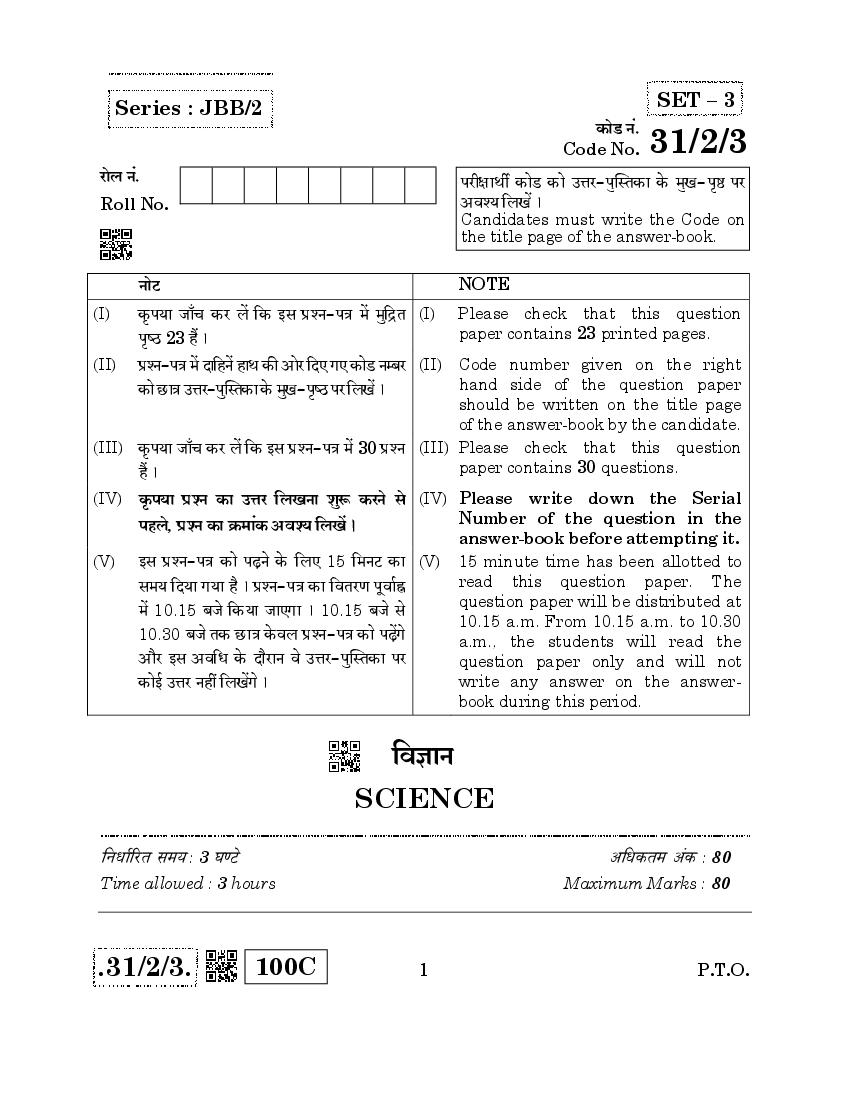
Page 1
.
Code No. 31/2/3
. - -
Roll No.
Candidates must write the Code on
the title page of the answer-book.
NOTE
(I) - (I) Please check that this question
23 paper contains 23 printed pages.
(II) - (II) Code number given on the right
- - hand side of the question paper
should be written on the title page
of the answer-book by the candidate.
(III) - 30 (III) Please check that this question
paper contains 30 questions.
(IV) (IV) Please write down the Serial
, Number of the question in the
answer-book before attempting it.
(V) - 15 (V) 15 minute time has been allotted to
- read this question paper. The
question paper will be distributed at
10.15 10.15
10.15 a.m. From 10.15 a.m. to 10.30
10.30 - a.m., the students will read the
- question paper only and will not
write any answer on the answer-
book during this period.
SCIENCE
{ZYm©[aV g‘¶ : 3 KÊQ>o A{YH$V‘ A§H$ : 80
Time allowed : 3 hours Maximum Marks : 80
.31/2/3. 100C 1 P.T.O.
Page 2
(i) - – ,
30
(ii) - / ( 1 14 ) -
, - -
1 1
(iii) - 15 24 3
50 60
(iv) - 25 30 5
80 90
(v)
(vi)
(vii) , ,
.31/2/3. 2
Page 3
Read the following instructions very carefully and strictly follow them :
(i) The question paper comprises three Sections, A, B and C. There are 30
questions in the question paper. All questions are compulsory.
(ii) Section A – all questions / or parts (question no. 1 to 14) thereof in this
section are one mark questions comprising MCQ, VSA type and
Assertion–Reason type questions. They are to be answered in one word
or in one sentence.
(iii) Section B – question no. 15 to 24 are short answer type questions,
carrying 3 marks each. Answer to these questions should not exceed 50 to
60 words.
(iv) Section C – question no. 25 to 30 are long answer type questions,
carrying 5 marks each. Answer to these questions should not exceed 80 to
90 words.
(v) Answer should be brief and to the point. Also the above mentioned word
limit be adhered to as far as possible.
(vi) There is no overall choice in the question paper. However, an internal
choice has been provided in some questions in each section. Only one of
the choices in such questions have to be attempted.
(vii) In addition to this, separate instructions are given with each section and
question, wherever necessary.
.31/2/3. 3 P.T.O.
Page 4
1 2 (A)
(R) (a), (b), (c) (d)
:
(a) (A) (R) (R)
(b) (A) (R) (R)
(c) (A) (R)
(d) (A) (R)
1. (A) :
(R) : 290 K
1
2. (A) :
(R) : () 1
3. - ? 1
4. ? 1
5. 2 -
(a) 2 (b) 4
(c) 8 (d) 16 1
.31/2/3. 4
Page 5
For question numbers 1 and 2, two statements are given – one labelled as
Assertion (A) and the other labelled as Reason (R). Select the correct
answer to these questions from the codes (a), (b), (c) and (d) as given below :
(a) Both (A) and (R) are true and (R) is correct explanation of the
assertion.
(b) Both (A) and (R) are true but (R) is not the correct explanation of the
assertion.
(c) (A) is true but (R) is false.
(d) (A) is false but (R) is true.
1. Assertion (A) : Ethanoic acid is also known as glacial acetic acid.
Reason (R) : The melting point of pure ethanoic acid is 290 K and hence
it often freezes during winters in cold climates. 1
2. Assertion (A) : The metals and alloys are good conductors of electricity.
Reason (R) : Bronze is an alloy of copper and tin and it is not a good
conductor of electricity. 1
3. Covalent compounds have low melting and boiling point. Why ? 1
4. How many metals are present in second period of periodic table ? 1
5. The maximum resistance which can be made using four resistors each of
2 is
(a) 2 (b) 4
(c) 8 (d) 16 1
.31/2/3. 5 P.T.O.
Page 6
(a) R1 = R2 = R3
(b) R1 > R2 > R3
(c) R3 > R2 > R1
(d) R2 > R1 > R3 1
7.
A.
B.
C.
D.
(a) A C
(b) B, C D
(c) A B
(d) C D 1
//
(a)
(b)
(c)
(d) 1
.31/2/3. 6
Page 7
resistances R1, R2 and R3. Choose from the following the statement that
holds true for this graph.
(a) R1 = R2 = R3
(b) R1 > R2 > R3
(c) R3 > R2 > R1
(d) R2 > R1 > R3 1
7. Consider the following reasons for the reddish appearance of the sun at
the sunrise or the sunset :
A. Light from the sun near the horizon passes through thinner layers of
air.
B. Light from the sun covers larger distance of the earth’s atmosphere
before reaching our eyes.
C. Near the horizon, most of the blue light and shorter wavelengths are
scattered away by the particles.
D. Light from the sun near the horizon passes through thicker layers of
air.
The correct reasons are
(a) A and C only
(b) B, C and D
(c) A and B only
(d) C and D only 1
OR
Person suffering from cataract has
(a) elongated eyeball
(b) excessive curvature of eye lens
(c) weakened ciliary muscles
(d) opaque eye lens 1
.31/2/3. 7 P.T.O.
Page 8
8. 5X ‘X’
(a) 15 2 (b) 13 2
(c) 9 5 (d) 13 5 1
11 ‘X’ 8 ‘Y’
–
(a) XY (b) X2Y
(c) XY2 (d) X2Y3 1
9.
- -
(a)
(b)
(c) ()
(d) 1
10. ‘x’, ‘y’ ‘z’
( y)
2 KClO3 (x)
2 KCl (x) + O2(z)
(a) x = ; y = ; z =
(b) x = ; y = ; z =
(c) x = KClO3 ; y = ; z =
(d) x = KClO3 KCl ; y = ; z = O2
1
.31/2/3. 8
Page 9
8. On the basis of electronic configuration of 5 X, the group number and
period of the element ‘X’ is :
(a) Group 15 period 2 (b) Group 13 period 2
(c) Group 9 period 5 (d) Group 13 period 5 1
OR
An element ‘X’ with atomic number 11 forms a compound with element ‘Y’
with atomic number 8. The formula of the compound formed is
(a) XY (b) X2Y
(c) XY2 (d) X2Y3 1
9. A visually challenged student, has to perform a lab test to detect the
presence of acid in a given solution. The acid-base indicator preferred by
him will be :
(a) Blue litmus
(b) Clove oil
(c) Red cabbage extract
(d) Hibiscus extract 1
10. Identify ‘x’, ‘y’ and ‘z’ in the following reaction :
( y)
2 KClO3 (x)
2 KCl (x) + O2(z)
(a) x = gas ; y = reaction condition; z = gas
(b) x = solid ; y = liquid; z = gas
(c) x = number of moles of KClO3; y = reaction condition; z = no. of
molecules of oxygen.
(d) x = physical state of KClO3 and KCl; y = reaction condition;
z = physical state of O2. 1
.31/2/3. 9 P.T.O.
Page 10
(a) (b)
(c) (d) 1
12. ?
(a) () (b)
(c) (d) 1
(a) (b)
(c) (d) 1
13. 13(a)
13(d)
,
, (
)
1970 -
350
10000
MW , , , ,
, - – ,
(A.C.) ?
(a) ? 1
(b)
1
(c) 1
(d) (D.C.) (A.C.) 1
.31/2/3. 10
Page 11
found in
(a) Bihar (b) Maharashtra
(c) Tamil Nadu (d) Rajasthan 1
12. Which of the following are water intensive crops ?
(a) Wheat and rice (b) Wheat and sugarcane
(c) Sugarcane and rice (d) Wheat and gram 1
OR
The most poisonous product formed by incomplete combustion of fossil
fuels is
(a) Carbon dioxide (b) Nitrogen dioxide
(c) Carbon monoxide (d) Sulphur dioxide 1
13. Answer question numbers 13(a) to 13(d) on the basis of your
understanding of the following paragraph and the related studied
concepts.
Geothermal energy is the energy produced by the heat of molten
rocks formed in the deeper hot regions of the earth’s crust. This energy is
harnessed to generate electricity. When water is made to flow deep
underground in the rocks it returns as steam (or hot water, which is later
converted to steam) to drive a turbine on an electric power generator.
In India, exploration and study of geothermal fields started in 1970.
The Geological Survey in India has identified 350 geothermal energy
locations in the country. The most promising of these is in Puga valley of
Ladakh. The estimated potential for geothermal energy in India is about
10000 MW. There are seven geothermal provinces in India namely the
Himalayas, Sohna, West coast, Cambay, Son-Narmada-Tapi; Godavari
and Mahanadi. Most power stations in India produce
Alternating Current (A.C).
(a) What are geothermal energy hot-spots ? 1
(b) Name two countries, other than India, where power plants based on
geothermal energy are operational. 1
(c) Name the phenomenon that explains the working of an electric
generator. 1
(d) State an important advantage of using AC over DC. 1
.31/2/3. 11 P.T.O.
Page 12
,
(TSH)
(Goitre)
(a) ? 1
(b) 1
(c) ? 1
(d) ? 1
–
15. :
(a)
(b)
(c)
(d) 2
(e) A C
(f) 3
.31/2/3. 12
Page 13
understanding of the following information and related studied concepts.
Thyroid gland is a bilobed structure situated in our neck region. It
secretes a hormone called thyroxine. Iodine is necessary for the thyroid
gland to make thyroxine. Thyroxine regulates carbohydrate, protein and
fat metabolism in the body. It promotes growth of body tissues also. When
there is an excess of thyroxine in the body, a person suffers from
hyperthyroidism and if this gland is underactive it results in
hypothyroidism. Hyperthyroidism is diagnosed by blood tests that
measure the levels of thyroxine and Thyroid Stimulating Hormone (TSH).
Hypothyroidism is caused due to the deficiency of iodine in our diet
resulting in a disease called goitre. Iodised salt can be included in our diet
to control it.
(a) Where is thyroid gland situated in our body ? 1
(b) State the function of thyroxine in human body. 1
(c) What is hyperthyroidism ? 1
(d) How can we control hypothyroidism ? 1
Section – B
15. From the elements identify :
(a) the most electro positive element.
(b) a noble gas.
(c) a metalloid.
(d) an element which will gain 2 electrons to attain nearest noble gas
configuration.
(e) formula of compound formed between A and C.
(f) elements belonging to same period. 3
.31/2/3. 13 P.T.O.
Page 14
‘B’
(i) A B
(ii) A
(iii) 3
17. (a) ?
(b)
(i) ?
(ii) 373 K ? 3
3
18. (a)
(b) ?
(c)
3
() ?
3
.31/2/3. 14
Page 15
water, it evolves a large amount of heat and forms compound ‘B’.
(i) Identify A and B.
(ii) Write chemical equation for the reaction of A with water.
(iii) List two types of reaction in which this reaction may be classified. 3
17. (a) What is ‘Water of crystalisation’ ?
(b) With the help of equations, state what happens when
(i) baking soda is heated during cooking ?
(ii) gypsum is heated at 373 K ? 3
OR
With the help of labelled diagram, show an experimental setup for the
reaction of Magnesium with dilute sulphuric acid.
Give equation of the reaction involved. 3
18. (a) State one important function of ozone layer at the higher level in the
atmosphere.
(b) How is ozone formed ?
(c) It has been observed that ozone layer is getting depleted. Name the
compound responsible for ozone depletion. 3
OR
What are decomposers ? List two consequences of their absence in the
ecosystem. 3
.31/2/3. 15 P.T.O.
Page 16
3
20. ?
3
21.
(i)
(ii) 3
22.
(i) ?
(ii) ?
(iii) ? 3
23. 3
(a) ?
(b) ?
(c) ? 3
.31/2/3. 16
Page 17
3
20. What are chromosomes ? Explain how in sexually reproducing organisms
the number of chromosomes in the progeny is maintained. 3
21. Explain giving an example how the following provide evidences in favour
of evolution in organisms.
(i) Homologous organs
(ii) Fossils 3
22. What happens after refraction, when :
(i) a ray of light parallel to the principal axis passes through a concave
lens ?
(ii) a ray of light falls on a convex lens while passing through its
principal focus ?
(iii) a ray of light passes through the optical centre of a convex lens ? 3
23. List three common refractive defects of vision. Suggest the ways of
correcting these defects. 3
OR
(a) How is a rainbow formed ?
(b) Why do stars twinkle ?
(c) Why do the sky appear dark instead of blue to an astronaut ? 3
.31/2/3. 17 P.T.O.
Page 18
1
(i) K
(ii) K
3
–
25.
5
(a)
(b)
(c)
5
26. (a) ?
(b)
(i)
(ii) 5
.31/2/3. 18
Page 19
cylinder as shown. Coil 1 has comparative large number of turns. State
your observations, when
(i) Key K is closed.
(ii) Key K is opened.
Give reason for each of your observations. 3
Section – C
25. Write all the steps in proper sequence of obtaining pure copper from the
ore in which it exists in nature. 5
OR
(a) Show the formation of aluminium ion and chloride ion by transfer of
electrons.
(b) State the formula and the nature of compound formed if electron
transfer takes place between the two .
(c) State with reason any three characteristics of the compounds formed
by transfer of electrons. 5
26. (a) What is a homologous series ? Explain with an example.
(b) Define the following terms giving one example of each.
(i) Esterification
(ii) Addition reaction 5
.31/2/3. 19 P.T.O.
Page 20
(b) ?
(c)
5
(a)
(i) (ii)
(b)
(i)
(ii)
(c) 5
28. (a) :
(i)
(ii)
(iii)
(iv)
(b) 5
29. (a)
(b)
.31/2/3. 20
Page 21
(b) Why has Government of India prohibited prenatal sex determination
by law ? State its benefits in the long run.
(c) Unsafe sexual act can lead to various infections. Name two bacterial
and two viral infections caused due to unsafe sex. 5
OR
(a) In the female reproductive system of human beings, state the
funtions of
(i) ovary (ii) oviduct
(b) Mention the changes which the uterus undergoes, when
(i) it has to receive a zygote.
(ii) no fertilization takes place.
(c) State the function of placenta. 5
28. (a) Draw a diagram of human excretory system and label on it the
following parts :
(i) Kidney
(ii) Ureter
(iii) Urinary bladder
(iv) Urethra
(b) Write one main function each of the labelled parts. 5
29. (a) Draw and complete the following ray diagram on you answer sheet to
show lateral displacement.
(b) Define absolute refractive index. Give its mathematical expression.
.31/2/3. 21 P.T.O.
Page 22
I = , O =
1 2 5
(a) SI
(b)
50 cm
(c) (b) 5
30. (a) X Y, 30 cm 10 cm
2 cm 1 cm ,
(b) , 6 V 10
, 500 mA
5
____________
.31/2/3. 22
Page 23
I = Image, O = Object
Identify Mirror 1 and Mirror 2 and state one use of each. 5
OR
(a) Define power of a lens and write its SI unit. Name the type of lens
whose power is negative.
(b) A convex lens forms a real and inverted image of finite size at a
distance of 50 cm from it. Where is the object placed in front of the
lens ? Give all possible positions of the object stating reason in each
case.
(c) Draw labelled ray diagram for any one position of the object
mentioned in (b) above. 5
30. (a) Find the ratio of resistances of two copper rods X and Y of lengths 30
cm and 10 cm respectively and having radii 2 cm and 1 cm
respectively.
(b) A current of 500 mA flows in a series circuit containing an electric
lamp and a conductor of 10 when connected to 6 V battery. Find
the resistance of the electric lamp. 5
_____________
.31/2/3. 23 P.T.O.
Page 24
Document Details
| Board / Org | CBSE |
| Exam | Class 10 |
| Type | Question Paper |
| Pages | 24 |
| Updated | 22 Jul 2026 |