HBSE Class 12 Sample Paper 2026 Physics
Finished viewing? Save it for later —
Download HBSE Class 12 Sample Paper 2026 Physics (PDF · 10 pages)About HBSE Class 12 Sample Paper 2026 Physics
HBSE Class 12 Sample Paper 2026 Physics is available here for free download. Published by Haryana Board for Class 12, this sample paper can be viewed online or downloaded as a PDF (10 pages). Candidates preparing for Class 12 can use HBSE Class 12 Sample Paper 2026 Physics to understand the exam pattern, the type of questions asked, and the overall difficulty level.
Frequently Asked Questions
How can I download HBSE Class 12 Sample Paper 2026 Physics?
Open this page and click the Download button to save HBSE Class 12 Sample Paper 2026 Physics as a PDF. It is completely free on AglaSem Docs.
Is HBSE Class 12 Sample Paper 2026 Physics free to download?
Yes. HBSE Class 12 Sample Paper 2026 Physics can be viewed online and downloaded as a PDF free of cost on AglaSem Docs.
How many pages does HBSE Class 12 Sample Paper 2026 Physics have?
HBSE Class 12 Sample Paper 2026 Physics contains 10 pages, which you can read online or download together as a single PDF.
Where can I find more Class 12 study material?
You can find more Class 12 question papers, sample papers, syllabus, and answer keys on AglaSem Docs.
HBSE Class 12 Sample Paper 2026 Physics – Text
Read the full text of this sample paper below — useful to quickly search, copy and reference the content online without downloading the PDF.
📄 View text version (10 pages)
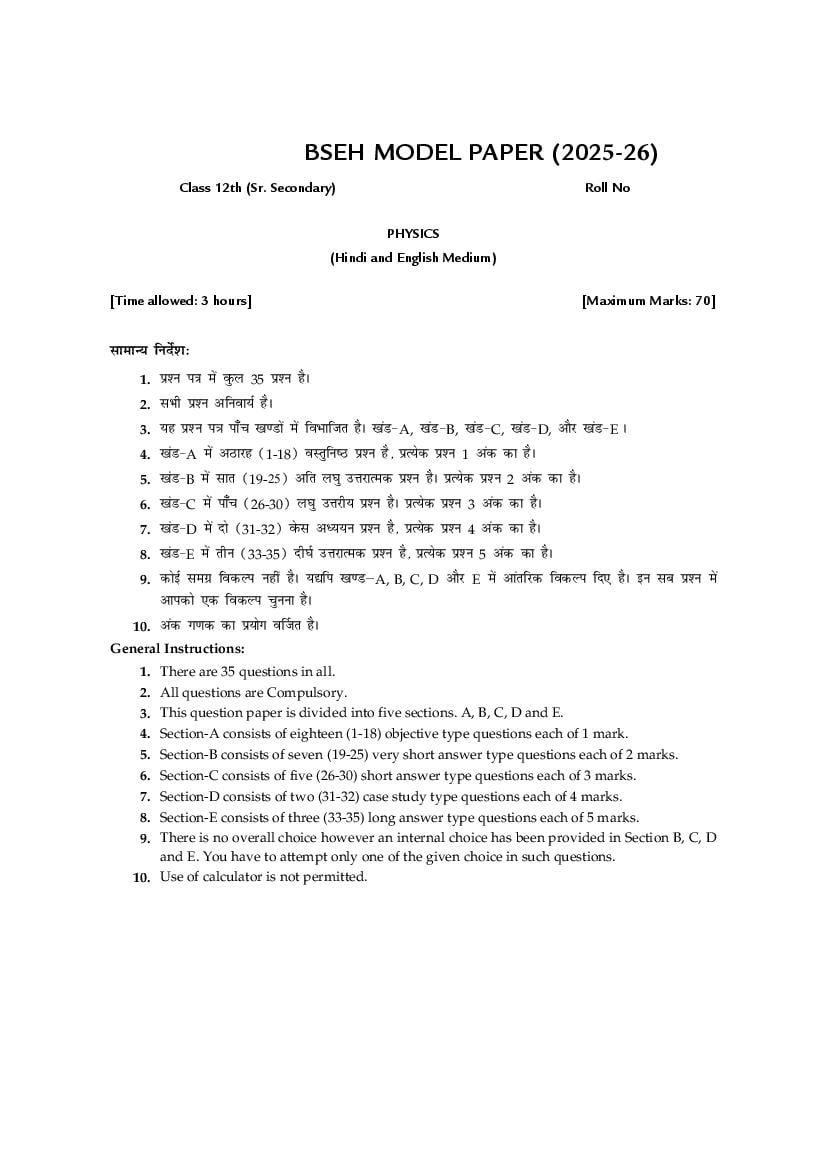
Page 1
Class 12th (Sr. Secondary) Roll No
PHYSICS
(Hindi and English Medium)
[Time allowed: 3 hours] [Maximum Marks: 70]
lkekU; funsZ'k%
1. iz'u i=k esa oqQy 35 iz'u gSA
2. lHkh iz'u vfuok;Z gSA
3. ;g iz'u i=k ik¡p [k.Mksa esa foHkkftr gSA [kaM&A, [kaM&B, [kaM&C, [kaM&D, vkSj [kaM&E A
4. [kaM&A esa vBkjg (1-18) oLrqfu"B iz'u gS] izR;sd iz'u 1 vad dk gSA
5. [kaM&B esa lkr (19-25) vfr y?kq mÙkjkRed iz'u gSA izR;sd iz'u 2 vad dk gSA
6. [kaM&C esa ik¡p (26-30) y?kq mÙkjh; iz'u gSA izR;sd iz'u 3 vad dk gSA
7. [kaM&D esa nks (31-32) osQl vè;;u iz'u gS] izR;sd iz'u 4 vad dk gSA
8. [kaM&E esa rhu (33-35) nh?kZ mÙkjkRed iz'u gS] izR;sd iz'u 5 vad dk gSA
9. dksbZ lexz fodYi ugha gSA ;|fi [k.MµA, B, C, D vkSj E esa vkarfjd fodYi fn, gSA bu lc iz'u esa
vkidks ,d fodYi pquuk gSA
10. vad x.kd dk iz;ksx o£tr gSA
General Instructions:
1. There are 35 questions in all.
2. All questions are Compulsory.
3. This question paper is divided into five sections. A, B, C, D and E.
4. Section-A consists of eighteen (1-18) objective type questions each of 1 mark.
5. Section-B consists of seven (19-25) very short answer type questions each of 2 marks.
6. Section-C consists of five (26-30) short answer type questions each of 3 marks.
7. Section-D consists of two (31-32) case study type questions each of 4 marks.
8. Section-E consists of three (33-35) long answer type questions each of 5 marks.
9. There is no overall choice however an internal choice has been provided in Section B, C, D
and E. You have to attempt only one of the given choice in such questions.
10. Use of calculator is not permitted.
Page 2
1. K
d
d
1
K K
1
K
K
An alpha particle approaches a gold nucleus in Geiger-Marsden experiment with kinetic energy
K. It momentarily stops at a distance d from the nucleus and reverses its direction. Then d is
proportional to :
1
(A) (B) K
K
1
(C) (D) K
K
2. cm B = (1.0 ˆi + 0 5 ˆj) mT
(0.6 ˆi + 0.8 ˆj)
(A) 0·314 Wb (B) 3·14 Wb
(C) 31·4 Wb (D) 1·256 Wb
A circular coil of radius 10 cm is placed in a magnetic field B = (1.0 ˆi + 0 5 ˆj) mT such that the
outward unit vector normal to the surface of the coil is (0·6 ^i + 0·8 ^j ). The magnetic flux linked
with the coil is :
(A) 0·314 Wb (B) 3·14 Wb
(C) 31·4 Wb (D) 1·256 Wb
3.
(A) X (B)
(C) (D)
Welders wear special goggles or masks having glass windows to protect their eyes
from radiations produced by welding sparks. These radiations are
(A) X-rays (B) Ultraviolet rays
(C) Infrared waves (D) Gamma rays
4.
(A) (B)
(C) (D)
Page 3
coils of an ideal transformer ?
Current, Voltage, Power, Magnetic flux
(A) Current only
(B) Voltage only
(C) Power only
(D) Magnetic flux and Power both
5. I
λ
4
I0 I0
(A) (B)
4 2
(C) I 0 (D)
In Young’s double-slit experiment, the intensity on the screen is I0 at a point
λ
where path difference is ?. The intensity at the point where path difference
4
is:
I0 I0
(A) (B)
4 2
(C) I0 (D) zero
6. eV eV
(A) 0·54 eV (B) 1·07 eV
(C) 1·61 eV (D) 2·14 eV
A photosensitive surface has a work function of 2·00 eV. The maximum kinetic
energy of electrons ejected from this surface by radiation of wavelength 300 nm
is :
(A) 0·54 eV (B) 1·07 eV
(C) 1·61 eV (D) 2·14 eV
7. R
R R
A B
4 2
C R (D) 2R
A plane wave is incident on a concave mirror of radius of curvature R. The reflected
wave is a spherical wave of radius:
R R
A B
4 2
C R (D) 2R
Page 4
N7 + 4He2 X + 1 H1 X
A 16
O7 B 17
N8
C 17
O8 (D) 16
N7
In the nuclear reaction 14N7 + 4He2 X + 1H1 , X represents:
A 16
O7 B 17
N8
C 17
O8 (D) 16N7
H
H n
n
(A) 15 (B) 20 (C) 25 (D) 33
A small object lies at the bottom of a vessel filled with water (refractive index 4/3)
up to a height H. When viewed from a point above the surface of water, the
object appears raised by n percent of H. The value of n is :
(A) 15 (B) 20 (C) 25 (D) 33
10.
What is the electric field inside a conductor?
11. V vd V
V
2
Electrons drift with speed vd in a conductor with potential difference V across its
V
ends. If V is reduced to , then what will be drift speed.
2
12. X3
7 4
Y3
Out of X3 and 4Y3 , which one is more stable.
7
13.
The semiconductor behaves as an insulator at .................... .
14. K
C
The capacitance of a parallel plate capacitor having a medium of dielectric constant
K = 4 in between the plates is C. If this medium is removed, then the capacitance of the
capacitor becomes .............................
15.
.................... illustrate the particle nature of light.
16-18 (A) R
A A R R, A
B A R R, A
C A R
D A R
Page 5
other labelled Reason (R). Select the correct answer codes given below.
(A) Both A and R are true and R is the correct explanation of A.
(B) Both A and R are true and R is not the correct explanation of A.
(C) A is true abut R is false.
(D) A is false but R is also false.
16. A
R
Assertion (A) : Silicon is preferred over germanium for making semiconductor
devices.
Reason (R) : The energy gap for germanium is more than the energy gap for
silicon.
17. A
R
Assertion (A) : The magnetic field produced by a current carrying solenoid is
independent of its length and cross-sectional area.
Reason (R) : The magnetic field inside the solenoid is uniform.
18. A
R
Assertion (A) : Work done in moving a charge around a closed path in an electric
field is always zero.
Reason (R) : Electrostatic force is a conservative force.
SECTION-B
19.
X
How are infrared wave produced? Why are these waves referred to as heat
waves?
Or
How are X-rays produced? Give any two uses of these.
20. D
cm
The power of a thin lens is +5D. When it is immersed in a liquid it behaves like a
concave lens of focal length 100 cm. Calculate the refractive index of the liquid.
Given refractive index of glass = 1.5.
21.
Page 6
Or
Define the term mass defect. How is it related to stability of the nucleus?
22. V V mA
mA
In a silicon diode, the current increases from 10 mA to 20 mA when the voltage changes
from 0.6 V to 0.7 V. Calculate the dynamic resistance of the diode.
23. A B
A B
Define the term magnetic susceptibility. Two magnetic materials A and B have relative
permeabilities of 0.96 and 500. Identify the magnetic materials A and B.
24.
State Gauss’s law in electrostatics and Prove it.
25.
How does resistance differ from impedance?
SECTION-C
26. p-n
p-n V-I
With the help of circuit diagram, briefly explain the working of a full-wave rectifier
using p-n junction diode. Or Draw V-I characteristics of a p-n junction diode. Explain
how these characteristics make a diode suitable for rectification.
27. (i)
(ii)
(i) An electron in a hydrogen atom jumps from second excited state to the first
excited state. Name the spectral series in the spectrum of hydrogen atom to
which the emitted radiation belongs.
(ii) Find the ratio of the wavelengths of the “most energetic spectral” line in the Balmer
series to that in Paschen series of Hydrogen spectrum.
28. nm
× J
i
ii
Page 7
wavelength 330 nm. The minimum amount of energy required to emit the electrons
from the surface is 3.5 × 10⁻¹⁹ J. Calculate:
(i) the energy of incident radiation, and
(ii) the kinetic energy of the photoelectron.
29. (i) E p
t
(ii)
(i) Obtain expression for the torque ( t ) experienced by an electric dipole of dipole
moment ( p ) in a uniform electric field E ? .
(ii) What will happen if the field were not uniform?
pf V
Two identical capacitors of 12 pf each are connected in series across a battery of 50V.
How much electrostatic energy is stored in the combination? Find the charge drawn
from the battery.
30. MN, TO SP
Use Kirchhoff's rule to determine the currents flowing through the branches MN, TO and SP in
the circuit shown in the figure.
SECTION-D (CASE STUDY)
31. R
r
emf
V
i
A
Page 8
B
C V Ir
D V I
ii V V emf
emf
(A) 2·0 V (B) 2·8 V
(C) 6·0 V (D) 8·0 V
(iii)
V+ (V+ > 0)
– (V–) (V– 0)
(A) = V+ + V– > 0 (B) = V+ – V– > 0
(C) = V+ + V– < 0 (D) = V+ + V– = 0
(iv) V emf
(A) 0·05 A (B) 0·1 A
(C) 0·15 A (D) 0·2 A
V A
V
(A) 1·0 (B) 1·5
(C) 2·0 (D) 2·5
When the terminals of a cell are connected to a conductor of resistance R, an
electric current flows through the circuit. The electrolyte of the cell also offers
some resistance in the path of the current, like the conductor. This resistance
offered by the electrolyte is called internal resistance of the cell (r). It depends
upon the nature of the electrolyte, the area of the electrodes immersed in the
electrolyte and the temperature. Due to internal resistance, a part of the energy
supplied by the cell is wasted in the form of heat.
When no current is drawn from the cell, the potential difference between the two
electrodes in known as emf of the cell (). With a current drawn from the cell, the
potential difference between the two electrodes is termed as terminal potential
difference (V).
(i) Choose the incorrect statement :
(A) The potential difference (V) between the two terminals of a cell in a
closed circuit is always less than its emf (), during discharge of the
cell.
(B) The internal resistance of a cell decreases with the decrease in temperature
of the electrolyte.
(C) When current is drawn from the cell then V = – Ir.
Page 9
of the cell (V) and the current (I) through it is a straight line with a
negative slope.
(ii) Two cells of emfs 2·0 V and 6·0 V and internal resistances 0.1 and 0.4
respectively, are connected in parallel. The equivalent emf of the combination
will be :
(A) 2·0 V (B) 2·8 V
(C) 6·0 V (D) 8·0 V
(iii) Dipped in the solution, the electrode exchanges charges with the electrolyte.
The positive electrode develops a potential V+ (V+ > 0), and the negative
electrode develops a potential – (V–) (V– 0), relative to the electrolyte
adjacent to it. When no current is drawn from the cell then :
(A) = V+ + V– > 0 (B) = V+ – V– > 0
(C) = V+ + V– < 0 (D) = V+ + V– = 0
iv) (a) Five identical cells, each of emf 2 V and internal resistance 0·1 are
connected in parallel. This combination in turn is connected to an
external resistor of 9·98 . The current flowing through the resistor is :
(A) 0·05 A (B) 0·1 A
(C) 0·15 A (D) 0·2 A
OR
(b) Potential difference across a cell in the open circuit is 6 V. It becomes
4 V when a current of 2 A is drawn from it. The internal resistance
of the cell is :
(A) 1·0 (B) 1·5
(C) 2·0 (D) 2·5
32.
i
ii
iii
iv
The crucial new feature of waves is interference of amplitudes from different
sources which can be both constructive and destructive as shown in Young’s
experiment. Diffraction phenomena define the limits of ray optics. The limit of
the ability of microscopes and telescopes to distinguish very close objects is set
by the wavelength of light. Most interference and diffraction effects exist even
for longitudinal waves like sound in air. But polarisation phenomena are special to
Page 10
(i) Define the term-coherent sources.
(ii) Write the conditions on path difference under which constructive and
destructive interference occur in Young’s double slit experiment.
(iii) Draw a diagram to show cylindrical wave front.
OR
State the conditions that must be satisfied for two light sources to be coherent.
(iv) What happens to the interference pattern when two coherent sources are
far apart from each other.
SECTION-E
33.
Derive an expression for the force between two long straight parallel conductors
carrying current in same direction. Hence define one ampere.
OR
Explain principle, construction and working of moving coil galvanometer by drawing
its diagram.
34.
What is total internal reflection? State the essential conditions for the phenomenon
of total internal reflection to take place. Explain briefly with the help of a necessary
diagram, how the phenomenon of total internal reflection is used in optical fibres.
OR
State Huygen’s Principle. Using Huygen’s construction explain refraction of a
plane wave by a plane surface.
35. (i)
(ii)
(i) Draw a phasor diagram when a pure capacitor is connected to an alternating
source and show that there is a phase difference of 90° between the voltage
and current.
(ii) Write down the Faraday’s laws of electromagnetic induction.
What is A.C. generator? With the help of circuit diagram explain its principle and
working.
Document Details
| Board / Org | Haryana Board |
| Exam | Class 12 |
| Type | Sample Paper |
| Pages | 10 |
| Updated | 24 Sep 2026 |