AHSEC 1st Year Syllabus Accountancy
Finished viewing? Save it for later —
Download AHSEC 1st Year Syllabus Accountancy (PDF · 4 pages)About AHSEC 1st Year Syllabus Accountancy
AHSEC 1st Year Syllabus Accountancy is available here for free download. Published by Assam Board for Class 11, this syllabus can be viewed online or downloaded as a PDF (4 pages). Candidates preparing for Class 11 can use AHSEC 1st Year Syllabus Accountancy to understand the exam pattern, the type of questions asked, and the overall difficulty level.
Frequently Asked Questions
How can I download AHSEC 1st Year Syllabus Accountancy?
Open this page and click the Download button to save AHSEC 1st Year Syllabus Accountancy as a PDF. It is completely free on AglaSem Docs.
Is AHSEC 1st Year Syllabus Accountancy free to download?
Yes. AHSEC 1st Year Syllabus Accountancy can be viewed online and downloaded as a PDF free of cost on AglaSem Docs.
How many pages does AHSEC 1st Year Syllabus Accountancy have?
AHSEC 1st Year Syllabus Accountancy contains 4 pages, which you can read online or download together as a single PDF.
Where can I find more Class 11 study material?
You can find more Class 11 question papers, sample papers, syllabus, and answer keys on AglaSem Docs.
AHSEC 1st Year Syllabus Accountancy – Text
Read the full text of this syllabus below — useful to quickly search, copy and reference the content online without downloading the PDF.
📄 View text version (4 pages)
Page 1
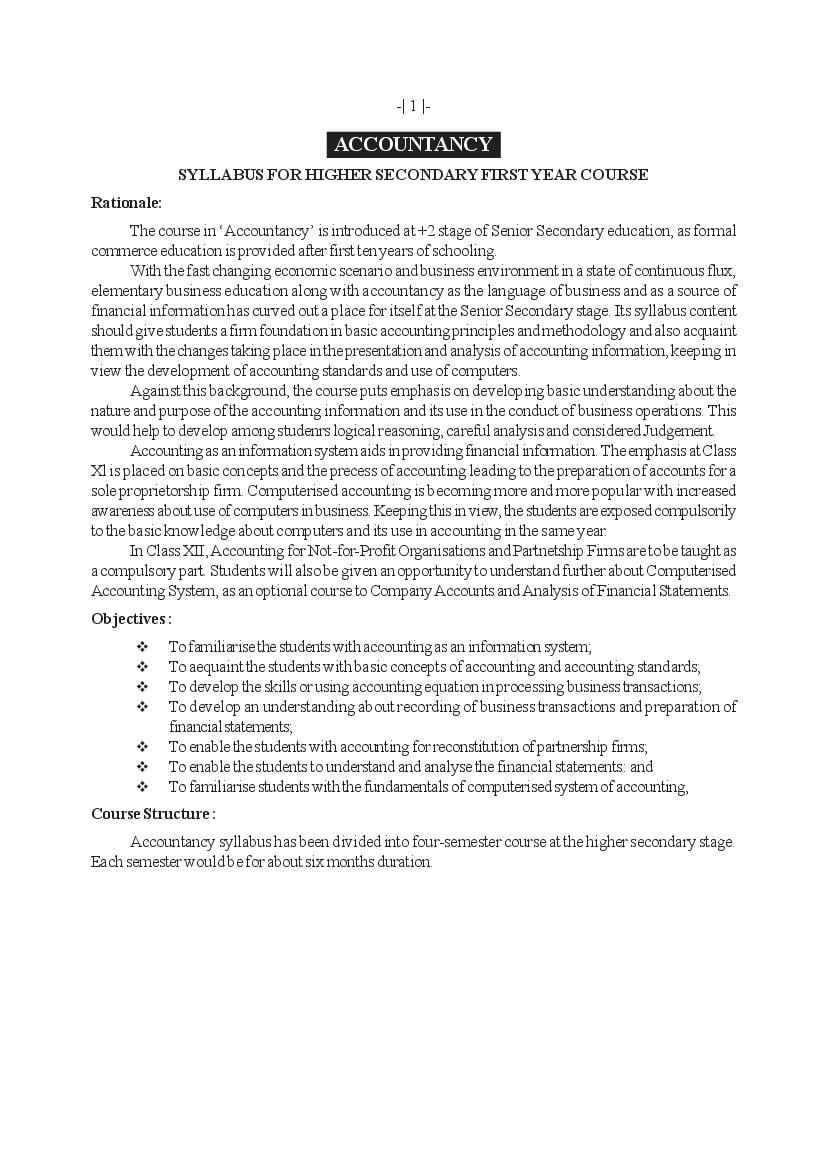
Rationale:
The course in ‘Accountancy’ is introduced at +2 stage of Senior Secondary education, as formal
commerce education is provided after first ten years of schooling.
With the fast changing economic scenario and business environment in a state of continuous flux,
elementary business education along with accountancy as the language of business and as a source of
financial information has curved out a place for itself at the Senior Secondary stage. Its syllabus content
should give students a firm foundation in basic accounting principles and methodology and also acquaint
them with the changes taking place in the presentation and analysis of accounting information, keeping in
view the development of accounting standards and use of computers.
Against this background, the course puts emphasis on developing basic understanding about the
nature and purpose of the accounting information and its use in the conduct of business operations. This
would help to develop among studenrs logical reasoning, careful analysis and considered Judgement.
Accounting as an information system aids in providing financial information. The emphasis at Class
Xl is placed on basic concepts and the precess of accounting leading to the preparation of accounts for a
sole proprietorship firm. Computerised accounting is becoming more and more popular with increased
awareness about use of computers in business. Keeping this in view, the students are exposed compulsorily
to the basic knowledge about computers and its use in accounting in the same year.
In Class XII, Accounting for Not-for-Profit Organisations and Partnetship Firms are to be taught as
a compulsory part. Students will also be given an opportunity to understand further about Computerised
Accounting System, as an optional course to Company Accounts and Analysis of Financial Statements.
Objectives :
To familiarise the students with accounting as an information system;
To aequaint the students with basic concepts of accounting and accounting standards;
To develop the skills or using accounting equation in processing business transactions;
To develop an understanding about recording of business transactions and preparation of
financial statements;
To enable the students with accounting for reconstitution of partnership firms;
To enable the students to understand and analyse the financial statements: and
To familiarise students with the fundamentals of computerised system of accounting,
Course Structure :
Accountancy syllabus has been divided into four-semester course at the higher secondary stage.
Each semester would be for about six months duration.
Page 2
One Paper Time : Three hours Marks : 100
Unitwise Distribution of Marks & Periods :
Unit Topics Marks Periods
PART-A : FINANCIAL ACCOUNTING-I (60 Marks)
Unit-1 : Introduction to Accounting 06 10
Unit-2 : Theory Base of Accounting 06 10
Unit-3 : Recording of Business Transactions 20 40
Unit-4 : Trial Balance and Rectification of Errors 08 20
Unit-5 : Depreciation, Provision and Reserves 10 20
Unit-6 : Accounting for Bills of Exchange Transactions 10 20
PART-B : FINANCIAL ACCOUNTlNG-II (40 Marks)
Unit-7 : Financial statements 18 25
Unit-8 : Accounts from incomplete records 12 15
Unit-9 : Computers in Accounting 06 10
Unit-10 : Accounting and Database System 04 10
Total : 100 180
Part-I : Financial Accounting-I
Part-II : Financial Accounting-II
Unitwise Distribution of Course contents:
Part-I : FINANCIAL ACCOUNTING-I
Unit-1 : Introduction to Accounting Marks : 06
Accounting– Meaning. Objectives, Accounting as source of information, Internal and External users
of accounting infonnation and their needs.
Qualitative Characteristics of Accounting Infonnation– Reliability, Relevance, Understand ability
and Comparability.
Basic Accounting Terms– Asset, Liability, Capital, Expense, Income, Expenditure, Revenue. Debtors,
Creditors, Goods, Cost, Gain, Stock, Purchase, Sales, Loss, Profit, Voucher, Discount, Transaction,
Drawings.
Unit-2 : Theory Base of Accounting Marks : 06
Accounting Principles– Meaning and Nature.
Accounting Concepts : Entity, Money Measurement, Going Concern. Accounting Period, Cost
Concept, Dual Aspect, Revenue Recognition (Realisation), Matching, Accrual, Full Disclosure,
Page 3
Consistency, Conservatism, Materiality.
Accounting Standards– Concept and List of Indian Accounting Standards.
Accounting Mechanism– Single Entry and Double Entry.
Bases of Accounting– Cash Basis, Accrual Basis.
Unit-3 : Recording of Business Transaction Marks : 20
Voucher and Transaction : Origin of Transactions– Source documents and Vouchers, Preparation
of vouchers; Accounting equation approach– Meaning and Analysis of transactions using accounting
equation; Rules of debit and credit.
Recording of Transaction : Books of original entry– Journal, Special purpose books : (i) Cash
book- Simple, Cashbook with bank column and Petty cashbook, (ii) Purchases book, Sales book,
Purchases returns book, Sale returns book; Ledger : Meaning, Utility, Format; Posting from journal
and subsidiary books; Balancing of accounts .
Bank Reconciliation Statement : Meaning, Need and Preparation, Correct cash balance.
Unit-4: Trial Balance and Rectification of Errors Marks : 08
Trial Balance : Meaning, Objectives and Preparation.
Errors : Types of Errors; Errors affecting trial balance; Errors not affecting trial balance.
Detection and Rectification of Errors (one sided and two sided); uses of suspense account.
Unit-5: Depreciation, Provisions and Reserves Marks : 10
Depreciation : Meaning and Need for charging deprcciation, Factors affecting depreciation,
Methods of depreciation– Straight line method, Written down value method (excluding change in
method), Method of recording depreciation– charging to asset account, creating provision for
depreciation/ accumulated depreciation account; Treatment of disposal of an asset
Provision and Reserve : Meaning, Importance, Difference between provisions and reserves, Types
of reserves : Revenue reserve, Capital reserve, General reserve. Specific reserve and Secret reserve.
Unit-6 : Accounting for Bills of Exchange Transactions Marks : 10
Bills of exchange and Promissory note : Definition, Features, Parties, Specimen and Distinction.
Important Terms : Term of Bill, Concept of Accommodation Bill, Days of grace, Date of maturity,
Bill after date, Negotiation, Endorsement, Discounting of bill, Dishonour, Retirement and Renewal
of a bill.
Accounting treatment of bill transactions,
Part-II Financial Accounting-II
Unit-7 : Financial Statements Marks : 18
Financial Statements : Meaning and Users,
Distinction between capital expenditure and revenue expenditure.
Trading and Profit and Loss Account : Gross profit, Operating profit, Net profit .
Balance Sheet ; Need., Grouping, Marshalling of assets and Iiabilitles, Vertical presentation of
financial statement.
Adjustments in preparation of financial statements with respect to Closing stock, Outstanding
expenses, Prepaid expenses, Accrued income; Income received in advance. Depreciation. Bad
Page 4
debts. Provision for doubtful debts. Provision for discount on debtors, Managers’ commission.
Preparation of trading and profit and loss account and balance sheet of sole proprietorship.
Unit-8: Accounts from Incomplete Records Marks : 12
Incomplete Records : Meaning, Uses and Limitations.
Ascertainment of profit/loss by Statement of Affairs method .
Preparation of trading and profit and Joss account and balance sheet
Ascertaining missing figures in Total debtors account, Total creditors account, Bill receivables, Bills
payables and Cash book and Opening statement of affairs.
Unit-9: Computers in Accounting Marks : 06
Introduction to Computer and Accounting Information System (AlS).
Applications of computers in accounting :
Automation of accounting process, designing accounting reports, MIS reporting, data exchange
with other information systems .
Comparison of accounting processes in manual and computerised accounting, highlighting advantages
and limitations of automation.
Sourcing of accounting system : Readymade and customised and tailor-made accounting system.
Advantages and disadvantages of each option.
Unit-10: Accounting and Database System Marks : 04
Accounting and Database Management System.
Concept of Entity and Relationship : Entities and relationships in an Accounting System : Designing
and Creating Simple Tables. Forms, Queries and Reports in the context of accounting system.
Prescribed Textbook : 1. Accountancy, Part I, Published by NCERT.
2. Accountancy, Part II, Published by NCERT.
1º ø˝√√‰¬±¬Û ˙±¶a, õ∂Ô˜ ‡G, Published by AHSEC.
2º ø˝√√‰¬±¬Û ˙±¶a, ø¡ZÓ¬œ˚˛ ‡G, Published by AHSEC.
Document Details
| Board / Org | Assam Board |
| Exam | Class 11 |
| Type | Syllabus |
| Pages | 4 |
| Updated | 30 Apr 2026 |