NIOS Class 10 Question Paper 2023 Economics
Finished viewing? Save it for later —
Download NIOS Class 10 Question Paper 2023 Economics (PDF · 33 pages)About NIOS Class 10 Question Paper 2023 Economics
NIOS Class 10 Question Paper 2023 Economics is available here for free download. Published by NIOS for National Institute of Open Schooling Class 10, this question paper can be viewed online or downloaded as a PDF (33 pages). Candidates preparing for National Institute of Open Schooling Class 10 can use NIOS Class 10 Question Paper 2023 Economics to understand the exam pattern, the type of questions asked, and the overall difficulty level.
Frequently Asked Questions
How can I download NIOS Class 10 Question Paper 2023 Economics?
Open this page and click the Download button to save NIOS Class 10 Question Paper 2023 Economics as a PDF. It is completely free on AglaSem Docs.
Is NIOS Class 10 Question Paper 2023 Economics free to download?
Yes. NIOS Class 10 Question Paper 2023 Economics can be viewed online and downloaded as a PDF free of cost on AglaSem Docs.
How many pages does NIOS Class 10 Question Paper 2023 Economics have?
NIOS Class 10 Question Paper 2023 Economics contains 33 pages, which you can read online or download together as a single PDF.
Where can I find more National Institute of Open Schooling Class 10 study material?
You can find more National Institute of Open Schooling Class 10 question papers, sample papers, syllabus, and answer keys on AglaSem Docs.
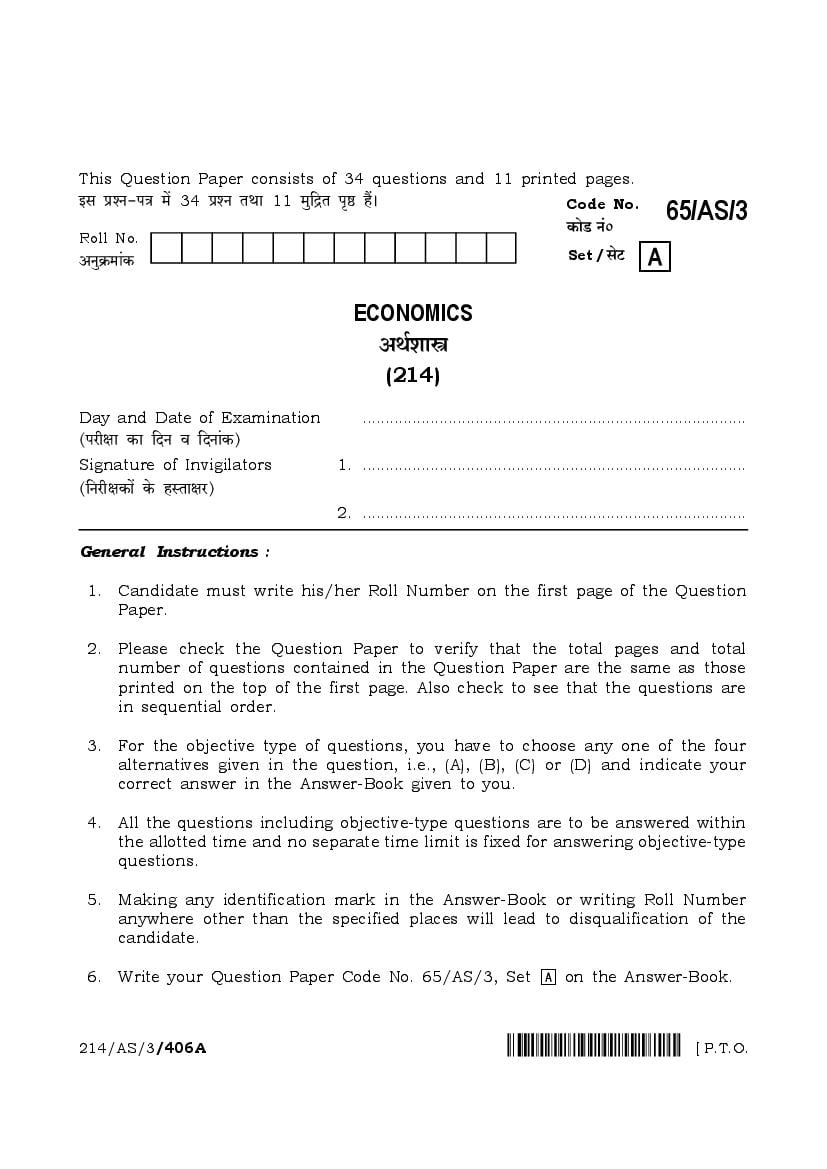
NIOS Class 10 Question Paper 2023 Economics – Text
Read the full text of this question paper below — useful to quickly search, copy and reference the content online without downloading the PDF.
📄 View text version (33 pages)
Page 1
Bg àíZ-nÌ ‘| 34 àíZ VWm 11 ‘w{ÐV n¥ð> h¢& Code No.
65/AS/3
u
H$moS> Z§0
Roll No.
AZwH«$‘m§H$ Set / goQ>
ECONOMICS
AW©emó
(214)
Day and Date of Examination .....................................................................................
(narjm H$m {XZ d {XZm§H$)
Signature of Invigilators 1. .....................................................................................
({ZarjH$m| Ho$ hñVmja)
2. .....................................................................................
General Instructions :
1. Candidate must write his/her Roll Number on the first page of the Question
Paper.
2. Please check the Question Paper to verify that the total pages and total
number of questions contained in the Question Paper are the same as those
printed on the top of the first page. Also check to see that the questions are
in sequential order.
3. For the objective type of questions, you have to choose any one of the four
alternatives given in the question, i.e., (A), (B), (C) or (D) and indicate your
correct answer in the Answer-Book given to you.
4. All the questions including objective-type questions are to be answered within
the allotted time and no separate time limit is fixed for answering objective-type
questions.
5. Making any identification mark in the Answer-Book or writing Roll Number
anywhere other than the specified places will lead to disqualification of the
candidate.
6. Write your Question Paper Code No. 65/AS/3, Set u on the Answer-Book.
214/AS/3/406A [ P.T.O.
Page 2
wish, you can answer in any one of the languages listed below :
English, Hindi, Urdu, Punjabi, Bengali, Tamil, Malayalam, Kannada,
Telugu, Marathi, Odia, Gujarati, Konkani, Manipuri, Assamese, Nepali,
Kashmiri, Sanskrit and Sindhi.
You are required to indicate the language you have chosen to answer in
the box provided in the Answer-Book.
(b) If you choose to write the answer in the language other than Hindi and
English, the responsibility for any errors/mistakes in understanding the
questions will be yours only.
gm‘mݶ AZwXoe …
1. narjmWu àíZ-nÌ Ho$ nhbo n¥ð> na AnZm AZwH«$‘m§H$ Adí¶ {bI|&
2. H¥$n¶m àíZ-nÌ H$mo Om±M b| {H$ àíZ-nÌ Ho$ Hw$b n¥ð>m| VWm àíZm| H$s CVZr hr g§»¶m h¡ {OVZr àW‘ n¥ð> Ho$ g~go
D$na N>nr h¡& Bg ~mV H$s Om±M ^r H$a b| {H$ àíZ H«${‘H$ ê$n ‘| h¢&
3. dñVw{Zð> àíZm| _o§ AmnH$mo Mma {dH$ënm| (A), (B), (C) VWm (D) _| go H$moB© EH$ CÎma MwZZm h¡ VWm Xr JB©
CÎma-nwpñVH$m _| Amn ghr CÎma {bIZm h¡&
4. dñVw{Zð> àíZm| Ho$ gmW-gmW g^r àíZm| Ho$ CÎma {ZYm©[aV Ad{Y Ho$ ^rVa hr XoZo h¢Ÿ& dñVw{Zð> àíZm| Ho$ {bE AbJ
go g_` Zht {X`m OmEJmŸ&
5. CÎma-nwpñVH$m ‘| nhMmZ-{M• ~ZmZo AWdm {Z{X©ï> ñWmZm| Ho$ A{V[aº$ H$ht ^r AZwH«$‘m§H$ {bIZo na narjmWu H$mo
A¶mo½¶ R>ham¶m Om¶oJm&
6. AnZr CÎma-nwpñVH$m na àíZ-nÌ H$m H$moS> Z§0 65/AS/3, goQ u {bI|&
7. (H$) n«íZ-nÌ Ho$db {hÝXr/A§J«oOr ‘| h¡& {’$a ^r, ¶{X Amn Mmh| Vmo ZrMo Xr JB© {H$gr EH$ ^mfm ‘| CÎma Xo
gH$Vo h¢ …
A§J«oOr, {hÝXr, CXÿ©, n§Om~r, ~§Jbm, V{‘b, ‘b¶mb‘, H$Þ‹S>, VobwJy, ‘amR>r, C{‹S>¶m, JwOamVr, H$m|H$Ur,
‘{Unwar, Ag{‘¶m, Zonmbr, H$í‘rar, g§ñH¥$V Am¡a {gÝYr&
H¥$n¶m CÎma-nwpñVH$m ‘| {XE JE ~m°³g ‘| {bI| {H$ Amn {H$g ^mfm ‘| CÎma {bI aho h¢&
(I) ¶{X Amn {hÝXr Ed§ A§J«oOr Ho$ A{V[aº$ {H$gr Aݶ ^mfm ‘| CÎma {bIVo h¢, Vmo àíZm| H$mo g‘PZo ‘| hmoZo dmbr
Ìw{Q>¶m|/Jb{V¶m| H$s {Oå‘oXmar Ho$db AmnH$s hmoJr&
214/AS/3/406A 2
Page 3
AW©emó
(214)
Time : 3 Hours ] [ Maximum Marks : 100
g‘¶ … 3 KÊQ>o ] [ nyUmªH$ … 100
Note : (i) All questions are compulsory.
(ii) Marks allotted to each question are indicated against it.
(iii) Each question from Question Nos. 1 to 8 has four alternatives (A), (B),
(C) and (D), out of which one is the most appropriate. Select the correct
answer and write it in your Answer-Book against the number of the
question.
{ZX}e … (i) g^r àíZ A{Zdm¶© h¢&
(ii) à˶oH$ àíZ Ho$ A§H$ CgHo$ gm‘Zo Xem©E JE h¢&
(iii) dñVw{Zð> àíZ H«$‘m§H$ 1 go 8 VH$, à˶oH$ àíZ ‘| Mma d¡H$pënH$ CÎma (A), (B), (C) Am¡a (D)
{XE JE h¢ {OZ‘| go EH$ ghr ¶m gdm©{YH$ C{MV h¡& ghr CÎma Mw{ZE VWm AnZr CÎma-nwpñVH$m
‘| Cgo àíZ H«$‘m§H$ Ho$ gm‘Zo {b{IE&
1. The branch of economics which deals with the issue of employment and
unemployment is called
(A) positive economics
(B) normative economics
(C) micro-economics
(D) macro-economics 1
amoOJma Am¡a ~oamoOJmar Ho$ ~mao ‘| AW©emó H$s emIm H$mo ³¶m H$hm OmVm h¡?
(A) dmñV{dH$ AW©emó
(B) AmXe© AW©emó
(C) ì¶{ï> AW©emó
(D) g‘{ï> AW©emó
214/AS/3/406A 3 [ P.T.O.
Page 4
(A) Capitalist Economy
(B) Socialist Economy
(C) Mixed Economy
(D) None of the above
{H$g AW©ì¶dñWm ‘| "Cn^moº$m amOm H$s Vah hmoVm h¡'?
(A) ny±OrdmXr AW©ì¶dñWm
(B) g‘mOdmXr AW©ì¶dñWm
(C) {‘{lV AW©ì¶dñWm
(D) Cnamoº$ ‘| go H$moB© Zht
3. The factor of production which is a ‘gift of nature’ is called
(A) entrepreneurship
(B) capital
(C) labour
(D) land 1
"àH¥${V Ho$ Cnhma' CËnmXZ g§gmYZ H$mo ³¶m H$hm OmVm h¡?
(A) CÚ‘
(B) ny±Or
(C) l‘
(D) ^y{‘
214/AS/3/406A 4
Page 5
(A) Indian Railways
(B) Tata Iron and Steel Company
(C) Kendriya Bhandar
(D) Google
{ZåZ{b{IV ‘| go H$m¡Z-gr ghH$mar g{‘{V h¡?
(A) ^maVr¶ aob
(B) Q>mQ>m Am¶aZ EoÊS> ñQ>rb H$ånZr
(C) Ho$ÝÐr¶ ^ÊS>ma
(D) JwJb
5. The formula for calculating average product (AP ) is
TP
(A)
L
(B) TP L
(C) TP L
(D) TP L 1
Am¡gV CËnmX (AP ) kmV H$aZo H$m ’$m‘y©bm ³¶m h¡?
Hw$b CËnmX
(A)
l‘
(B) Hw$b CËnmX × l‘
(C) Hw$b CËnmX + l‘
(D) Hw$b CËnmX – l‘
214/AS/3/406A 5 [ P.T.O.
Page 6
are called
(A) normal goods
(B) inferior goods
(C) substitute goods
(D) complementary goods 1
H«o$Vm H$s Am¶ ‘| d¥{Õ go {OZ dñVwAm| H$s ‘m±J H$‘ hmo, CÝho§ ³¶m H$hm OmVm h¡?
(A) gm‘mݶ dñVw
(B) {ZH¥$ï> (K{Q>¶m) dñVw
(C) ñWmZmnÞ dñVw
(D) nyaH$ dñVw
7. Which out of the following is a discrete variable? 1
(A) Intelligence
(B) Weight
(C) Number of children
(D) Height
{ZåZ{b{IV ‘| go H$m¡Z-gm {d{N>Þ Ma h¡?
(A) ‘mZ{gH$ ¶mo½¶Vm
(B) dOZ
(C) ~ƒm| H$s g§»¶m
(D) bå~mB©
8. The Consumer Protection Act (CPA) was amended in
(A) 1986
(B) 2003
(C) 1954
(D) 1976 1
214/AS/3/406A 6
Page 7
(A) 1986
(B) 2003
(C) 1954
(D) 1976
9. ‘‘Present wants are more important than future wants.’’ Explain this
characteristic of wants with the help of a suitable example from your
daily life. 2
""dV©‘mZ Amdí¶H$VmE± ^{dî¶ H$s Amdí¶H$VmAm| go A{YH$ ‘hÎdnyU© hmoVr h¢&'' AnZo X¡{ZH$ OrdZ
go EH$ Cn¶wº$ CXmhaU XoVo hþE Amdí¶H$VmAm| H$s Bg {deofVm H$s ì¶m»¶m H$s{OE&
10. Describe the ‘private property’ feature of a capitalist economy. 2
ny±OrdmXr AW©ì¶dñWm H$s "{ZOr gån{Îm' {deofVm H$m dU©Z H$s{OE&
11. Distinguish between labour-intensive technology and capital-intensive
technology. 2
l‘-JhZ VH$ZrH$s Am¡a ny±Or-JhZ VH$ZrH$s ‘| A§Va ~VmBE&
12. Suppose a shopkeeper sold 50 kg of wheat, 40 kg of mustard oil and
60 packets of biscuits in a given week. The prices of these goods are
R 30 per kg of wheat, R 70 per kg of mustard oil and R 20 per packet of
biscuits. Calculate Total Revenue (TR ) from all the goods. 2
‘mZ br{OE {H$ EH$ XþH$mZXma Zo EH$ gámh ‘| 50 {H$bmo Johÿ±, 40 {H$bmo gagm| H$m Vob Am¡a {~ñHw$Q>
Ho$ 60 n¡Ho$Q> ~oMo& BZH$s H$s‘V| R 30 à{V {H$bmo Johÿ±, R 70 à{V {H$bmo gagm| H$m Vob VWm
R 20 à{V n¡Ho$Q> {~ñHw$Q> h¡& g^r dñVwAm| go àmá Hw$b AmJ‘ (TR ) kmV H$s{OE&
214/AS/3/406A 7 [ P.T.O.
Page 8
a commodity. 2
g‘PmBE {H$ {H$g àH$ma é{M Am¡a dar¶Vm ‘| n[adV©Z ‘m±J na à^md S>mbVo h¢&
14. Draw an imaginary demand curve for oranges and mark its components. 2
Zma§Jr Ho$ {bE EH$ H$mën{ZH$ ‘m±J dH«$ ~ZmBE Am¡a BgHo$ KQ>H$ {M{•V H$s{OE&
15. Explain the ‘store of value’ function of money. 2
‘wÐm H$m "H«$¶e{º$ H$m g§M¶'$ H$m¶© g‘PmBE&
16. Distinguish between individual series and discrete series. 2
ì¶{º$JV ûm¥§Ibm Am¡a {d{N>Þ ûm¥§Ibm ‘| A§Va ~VmBE&
17. Which are the two major natural sources of air pollution? 2
dm¶w àXÿfU Ho$ H$m¡Z-go Xmo à‘wI àmH¥${VH$ òmoV h¢?
18. State any two measures you will take as a responsible citizen to reduce the
harmful effects of noise pollution. 2
EH$ {Oå‘oXma ZmJ[aH$ Ho$ ê$n ‘| Üd{Z àXÿfU Ho$ hm{ZH$maH$ à^mdm| H$mo H$‘ H$aZo Ho$ {bE Amn
H$m¡Z-go Xmo Cnm¶ H$a|Jo?
19. Describe how single-use goods are different from durable-use goods.
Give example. 4
dU©Z H$s{OE {H$ {H$g àH$ma EH$b-Cn¶moJr dñVwE± XrKm}n¶moJr dñVwAm| go AbJ h¢& CXmhaU Xr{OE&
214/AS/3/406A 8
Page 9
economic development. 4
Am{W©H$ {dH$mg H$s à{H«$¶m H$mo à^m{dV H$aZo dmbo H$moB© Mma ‘hÎdnyU© Am{W©H$ H$maH$ g‘PmBE&
21. Explain the distinction between private production units and government
production units. 4
{ZOr CËnmXZ BH$mB¶m| Am¡a gaH$mar CËnmXZ BH$mB¶m| ‘| ^oX g‘PmBE&
22. Describe any two important factors which influence the decision of a
seller in fixing the price of a commodity. 4
Eogo H$moB© Xmo ‘hÎdnyU© H$maH$m| H$m dU©Z H$s{OE Omo {dH«o$Vm Ûmam EH$ dñVw H$s H$s‘V {ZYm©[aV H$aZo
Ho$ {ZU©¶ H$mo à^m{dV H$aVo h¢&
23. Define ‘savings’. Explain how savings is useful. 4
"~MV' H$s n[a^mfm Xr{OE& g‘PmBE {H$ ~MV ³¶m| Cn¶moJr h¡&
24. Suppose there is a person X in the economy who works in a risky profession
like construction. Which insurance scheme he should buy? Explain the
process involved in this scheme. 4
‘mZ br{OE {H$ AW©ì¶dñWm ‘| EH$ ì¶{º$ X h¡ Omo {H$ Omo{I‘ ^ao {Z‘m©U H$m¶© ‘| H$m‘ H$aVm h¡&
Cgo H$m¡Z-gr ~r‘m ¶moOZm IarXZr Mm{hE? Bg ¶moOZm H$s à{H«$¶m g‘PmBE&
25. State four functions of averages. 4
Am¡gVm| Ho$ Mma H$m¶© ~VmBE&
26. Distinguish in any two ways between the primary data and secondary
data. 4
àmW{‘H$ Am±H$‹S>m| Am¡a {ÛVr¶H$ Am±H$‹S>m| ‘| {H$Ýht Xmo àH$ma go ^oX H$s{OE&
214/AS/3/406A 9 [ P.T.O.
Page 10
method with step deviation) : 4
Marks (X) 0–10 10–20 20–30 30–40 40–50
No. of Students (f ) 5 15 20 10 50
ZrMo {XE JE Am±H$‹S>m| go g‘mÝVa ‘mܶ kmV H$s{OE (nX {dMbZ g{hV gab {d{Y H$m Cn¶moJ H$s{OE) …
A§H$ (X) 0–10 10–20 20–30 30–40 40–50
{dÚm{W©¶m| H$s g§»¶m (f ) 5 15 20 10 50
28. Explain briefly the ‘existence of poverty’ feature of the Indian economy. 4
^maVr¶ AW©ì¶dñWm H$s "Jar~r H$m hmoZm' {deofVm g§jon ‘| g‘PmBE&
29. Suppose you are the Education Minister of the country. Explain any two
schemes you will adopt to develop elementary education in the country. 4
‘mZ br{OE {H$ Amn Xoe Ho$ {ejm ‘§Ìr h¢& Eogr H$moB© Xmo ¶moOZmE± g‘PmBE Omo Amn Xoe ‘| àmapå^H$
{ejm Ho$ {dH$mg Ho$ {bE AnZmE±Jo&
30. State in any four ways the need for ‘Consumer Awareness’. 4
{H$Ýht Mma àH$ma go "Cn^moº$m OmJê$H$Vm' H$s Amdí¶H$Vm ~VmBE&
31. Explain the three factors affecting market demand for a commodity which
are in addition to those factors which affect the individual demand for a
commodity. 6
EH$ dñVw H$s ~mOma ‘m±J H$mo à^m{dV H$aZo dmbo Eogo VrZ H$maH$ g‘PmBE Omo {H$ ì¶{º$JV ‘m±J H$mo
à^m{dV H$aZo dmbo H$maH$m| go AbJ hm|&
214/AS/3/406A 10
Page 11
reasons for it. 6
h‘ à{V df© AnZr Am¶ ‘| d¥{Õ ³¶m| MmhVo h¢? BgHo$ H$moB© VrZ H$maU ~VmBE&
33. Explain in any three ways the role played by the government in controlling
prices. 6
H$s‘Vm| H$m {Z¶§ÌU H$aZo ‘| gaH$ma H$s ^y{‘H$m {H$Ýht VrZ àH$ma go g‘PmBE&
34. Explain any three major causes of soil degradation. 6
^y{‘ Ho$ {ZåZrH$aU Ho$ H$moB© VrZ à‘wI H$maU g‘PmBE&
214/AS/3/406A [V23] 11
Page 12
Bg àíZ-nÌ ‘| 34 àíZ VWm 11 ‘w{ÐV n¥ð> h¢& Code No.
65/AS/3
v
H$moS> Z§0
Roll No.
AZwH«$‘m§H$ Set / goQ>
ECONOMICS
AW©emó
(214)
Day and Date of Examination .....................................................................................
(narjm H$m {XZ d {XZm§H$)
Signature of Invigilators 1. .....................................................................................
({ZarjH$m| Ho$ hñVmja)
2. .....................................................................................
General Instructions :
1. Candidate must write his/her Roll Number on the first page of the Question
Paper.
2. Please check the Question Paper to verify that the total pages and total
number of questions contained in the Question Paper are the same as those
printed on the top of the first page. Also check to see that the questions are
in sequential order.
3. For the objective type of questions, you have to choose any one of the four
alternatives given in the question, i.e., (A), (B), (C) or (D) and indicate your
correct answer in the Answer-Book given to you.
4. All the questions including objective-type questions are to be answered within
the allotted time and no separate time limit is fixed for answering objective-type
questions.
5. Making any identification mark in the Answer-Book or writing Roll Number
anywhere other than the specified places will lead to disqualification of the
candidate.
6. Write your Question Paper Code No. 65/AS/3, Set v on the Answer-Book.
214/AS/3/406B [ P.T.O.
Page 13
wish, you can answer in any one of the languages listed below :
English, Hindi, Urdu, Punjabi, Bengali, Tamil, Malayalam, Kannada,
Telugu, Marathi, Odia, Gujarati, Konkani, Manipuri, Assamese, Nepali,
Kashmiri, Sanskrit and Sindhi.
You are required to indicate the language you have chosen to answer in
the box provided in the Answer-Book.
(b) If you choose to write the answer in the language other than Hindi and
English, the responsibility for any errors/mistakes in understanding the
questions will be yours only.
gm‘mݶ AZwXoe …
1. narjmWu àíZ-nÌ Ho$ nhbo n¥ð> na AnZm AZwH«$‘m§H$ Adí¶ {bI|&
2. H¥$n¶m àíZ-nÌ H$mo Om±M b| {H$ àíZ-nÌ Ho$ Hw$b n¥ð>m| VWm àíZm| H$s CVZr hr g§»¶m h¡ {OVZr àW‘ n¥ð> Ho$ g~go
D$na N>nr h¡& Bg ~mV H$s Om±M ^r H$a b| {H$ àíZ H«${‘H$ ê$n ‘| h¢&
3. dñVw{Zð> àíZm| _o§ AmnH$mo Mma {dH$ënm| (A), (B), (C) VWm (D) _| go H$moB© EH$ CÎma MwZZm h¡ VWm Xr JB©
CÎma-nwpñVH$m _| ghr CÎma {bIZm h¡&
4. dñVw{Zð> àíZm| Ho$ gmW-gmW g^r àíZm| Ho$ CÎma {ZYm©[aV Ad{Y Ho$ ^rVa hr XoZo h¢Ÿ& dñVw{Zð> àíZm| Ho$ {bE AbJ
go g_` Zht {X`m OmEJmŸ&
5. CÎma-nwpñVH$m ‘| nhMmZ-{M• ~ZmZo AWdm {Z{X©ï> ñWmZm| Ho$ A{V[aº$ H$ht ^r AZwH«$‘m§H$ {bIZo na narjmWu H$mo
A¶mo½¶ R>ham¶m Om¶oJm&
6. AnZr CÎma-nwpñVH$m na àíZ-nÌ H$m H$moS> Z§0 65/AS/3, goQ v {bI|&
7. (H$) n«íZ-nÌ Ho$db {hÝXr/A§J«oOr ‘| h¡& {’$a ^r, ¶{X Amn Mmh| Vmo ZrMo Xr JB© {H$gr EH$ ^mfm ‘| CÎma Xo
gH$Vo h¢ …
A§J«oOr, {hÝXr, CXÿ©, n§Om~r, ~§Jbm, V{‘b, ‘b¶mb‘, H$Þ‹S>, VobwJy, ‘amR>r, C{‹S>¶m, JwOamVr, H$m|H$Ur,
‘{Unwar, Ag{‘¶m, Zonmbr, H$í‘rar, g§ñH¥$V Am¡a {gÝYr&
H¥$n¶m CÎma-nwpñVH$m ‘| {XE JE ~m°³g ‘| {bI| {H$ Amn {H$g ^mfm ‘| CÎma {bI aho h¢&
(I) ¶{X Amn {hÝXr Ed§ A§J«oOr Ho$ A{V[aº$ {H$gr Aݶ ^mfm ‘| CÎma {bIVo h¢, Vmo àíZm| H$mo g‘PZo ‘| hmoZo dmbr
Ìw{Q>¶m|/Jb{V¶m| H$s {Oå‘oXmar Ho$db AmnH$s hmoJr&
214/AS/3/406B 2
Page 14
AW©emó
(214)
Time : 3 Hours ] [ Maximum Marks : 100
g‘¶ … 3 KÊQ>o ] [ nyUmªH$ … 100
Note : (i) All questions are compulsory.
(ii) Marks allotted to each question are indicated against it.
(iii) Each question from Question Nos. 1 to 8 has four alternatives (A), (B),
(C) and (D), out of which one is the most appropriate. Select the correct
answer and write it in your Answer-Book against the number of the
question.
{ZX}e … (i) g^r àíZ A{Zdm¶© h¢&
(ii) à˶oH$ àíZ Ho$ A§H$ CgHo$ gm‘Zo Xem©E JE h¢&
(iii) dñVw{Zð> àíZ H«$‘m§H$ 1 go 8 VH$, à˶oH$ àíZ ‘| Mma d¡H$pënH$ CÎma (A), (B), (C) Am¡a (D)
{XE JE h¢ {OZ‘| go EH$ ghr ¶m gdm©{YH$ C{MV h¡& ghr CÎma Mw{ZE VWm AnZr CÎma-nwpñVH$m
‘| Cgo àíZ H«$‘m§H$ Ho$ gm‘Zo {b{IE&
1. The branch of economics which deals with price determination of a good
is called
(A) micro-economics
(B) macro-economics
(C) positive economics
(D) normative economics 1
EH$ dñVw Ho$ H$s‘V {ZYm©aU go g§~§{YV AW©emó H$s emIm ³¶m H$hbmVr h¡?
(A) ì¶{ï> AW©emó
(B) g‘{ï> AW©emó
(C) dmñV{dH$ AW©emó
(D) AmXe© AW©emó
214/AS/3/406B 3 [ P.T.O.
Page 15
(A) entrepreneurship
(B) capital
(C) labour
(D) land 1
"àH¥${V Ho$ Cnhma' CËnmXZ g§gmYZ H$mo ³¶m H$hm OmVm h¡?
(A) CÚ‘
(B) ny±Or
(C) l‘
(D) ^y{‘
3. In which economy ‘consumers are like a king’? 1
(A) Capitalist Economy
(B) Socialist Economy
(C) Mixed Economy
(D) None of the above
{H$g AW©ì¶dñWm ‘| "Cn^moº$m amOm H$s Vah hmoVm h¡'?
(A) ny±OrdmXr AW©ì¶dñWm
(B) g‘mOdmXr AW©ì¶dñWm
(C) {‘{lV AW©ì¶dñWm
(D) Cnamoº$ ‘| go H$moB© Zht
214/AS/3/406B 4
Page 16
TP
(A)
L
(B) TP L
(C) TP L
(D) TP L 1
Am¡gV CËnmX (AP ) kmV H$aZo H$m ’$m‘y©bm ³¶m h¡?
Hw$b CËnmX
(A)
l‘
(B) Hw$b CËnmX × l‘
(C) Hw$b CËnmX + l‘
(D) Hw$b CËnmX – l‘
5. Which of the following is a cooperative society? 1
(A) Indian Railways
(B) Tata Iron and Steel Company
(C) Kendriya Bhandar
(D) Google
{ZåZ{b{IV ‘| go H$m¡Z-gr ghH$mar g{‘{V h¡?
(A) ^maVr¶ aob
(B) Q>mQ>m Am¶aZ EoÊS> ñQ>rb H$ånZr
(C) Ho$ÝÐr¶ ^ÊS>ma
(D) JwJb
214/AS/3/406B 5 [ P.T.O.
Page 17
(A) 1986
(B) 2003
(C) 1954
(D) 1976 1
Cn^moº$m g§ajU A{Y{Z¶‘ (CPA) H$m {H$g df© g§emoYZ {H$¶m J¶m Wm?
(A) 1986
(B) 2003
(C) 1954
(D) 1976
7. The goods whose demand decreases with a fall in price of other goods are
called
(A) substitute goods
(B) complementary goods
(C) inferior goods
(D) normal goods 1
Eogr dñVwE± {OZH$s ‘m±J {H$gr Aݶ dñVw H$s H$s‘V {JaZo go {JaVr h¡ ³¶m H$hbmVr h¢?
(A) ñWmZmnÞ dñVwE±
(B) nyaH$ dñVwE±
(C) {ZH¥$ï> dñVwE±
(D) gm‘mݶ dñVwE±
214/AS/3/406B 6
Page 18
(A) Number of chairs
(B) Length
(C) Number of children
(D) Beauty
{ZåZ{b{IV ‘| go H$m¡Z-gm A{d{N>Þ Ma h¡?
(A) Hw${g©¶m| H$s g§»¶m
(B) bå~mB©
(C) ~ƒm| H$s g§»¶m
(D) gw§XaVm
9. Describe the ‘collective ownership of means of production’ feature of a
socialist economy. 2
g‘mOdmXr AW©ì¶dñWm H$s "CËnmXZ gmYZm| H$m gm‘y{hH$ ñdm{‘Ëd' {deofVm g‘PmBE&
10. ‘‘Present wants are more important than future wants.’’ Explain this
characteristic of wants with the help of a suitable example from your
daily life. 2
""dV©‘mZ Amdí¶H$VmE± ^{dî¶ H$s Amdí¶H$VmAm| go A{YH$ ‘hÎdnyU© hmoVr h¢&'' AnZo X¡{ZH$ OrdZ
go EH$ Cn¶wº$ CXmhaU XoVo hþE Amdí¶H$VmAm| H$s Bg {deofVm H$s ì¶m»¶m H$s{OE&
11. Suppose a shopkeeper sold 50 kg of wheat, 40 kg of mustard oil and
60 packets of biscuits in a given week. The prices of these goods are
R 30 per kg of wheat, R 70 per kg of mustard oil and R 20 per packet of
biscuits. Calculate Total Revenue (TR ) from all the goods. 2
‘mZ br{OE {H$ EH$ XþH$mZXma Zo EH$ gámh ‘| 50 {H$bmo Johÿ±, 40 {H$bmo gagm| H$m Vob Am¡a {~ñHw$Q>
Ho$ 60 n¡Ho$Q> ~oMo& BZH$s H$s‘V| R 30 à{V {H$bmo Johÿ±, R 70 à{V {H$bmo gagm| H$m Vob VWm
R 20 à{V n¡Ho$Q> {~ñHw$Q> h¡& g^r dñVwAm| go àmá Hw$b AmJ‘ (TR ) kmV H$s{OE&
214/AS/3/406B 7 [ P.T.O.
Page 19
technology. 2
l‘-JhZ VH$ZrH$s Am¡a ny±Or-JhZ VH$ZrH$s ‘| A§Va ~VmBE&
13. State any two measures you will take as a responsible citizen to reduce the
harmful effects of noise pollution. 2
EH$ {Oå‘oXma ZmJ[aH$ Ho$ ê$n ‘| Üd{Z àXÿfU Ho$ hm{ZH$maH$ à^mdm| H$mo H$‘ H$aZo Ho$ {bE Amn
H$m¡Z-go Xmo Cnm¶ H$a|Jo?
14. Explain how change in the taste and preferences affects the demand for
a commodity. 2
g‘PmBE {H$ {H$g àH$ma é{M Am¡a dar¶Vm ‘| n[adV©Z ‘m±J na à^md S>mbVo h¢&
15. Draw an imaginary demand curve for oranges and mark its components. 2
Zma§Jr Ho$ {bE EH$ H$mën{ZH$ ‘m±J dH«$ ~ZmBE Am¡a BgHo$ KQ>H$ {M{•V H$s{OE&
16. Explain the ‘medium of exchange’ function of money. 2
‘wÐm H$m "{d{Z‘¶ H$m ‘mܶ‘' H$m¶© g‘PmBE&
17. Distinguish between individual series and discrete series. 2
ì¶{º$JV ûm¥§Ibm Am¡a {d{N>Þ ûm¥§Ibm ‘| A§Va ~VmBE&
18. Which are the two major natural sources of air pollution? 2
dm¶w àXÿfU Ho$ H$m¡Z-go Xmo à‘wI àmH¥${VH$ òmoV h¢?
214/AS/3/406B 8
Page 20
economic development. 4
Am{W©H$ {dH$mg H$s à{H«$¶m H$mo à^m{dV H$aZo dmbo H$moB© Mma ‘hÎdnyU© Am{W©H$ H$maH$ g‘PmBE&
20. Explain the distinction between private production units and government
production units. 4
{ZOr CËnmXZ BH$mB¶m| Am¡a gaH$mar CËnmXZ BH$mB¶m| ‘| ^oX g‘PmBE&
21. Describe how consumer goods are different from producer goods. Give
examples. 4
dU©Z H$s{OE {H$ Cn^moº$m dñVwE± CËnmXH$ dñVwAm| go {H$g àH$ma {^Þ h¢& CXmhaU Xr{OE&
22. Explain the use of saving for development of economy. 4
AW©ì¶dñWm Ho$ {dH$mg ‘| ~MV H$m Cn¶moJ g‘PmBE&
23. Describe any two important factors which influence the decision of a
seller in fixing the price of a commodity. 4
Eogo H$moB© Xmo ‘hÎdnyU© H$maH$m| H$m dU©Z H$s{OE Omo {dH«o$Vm Ûmam EH$ dñVw H$s H$s‘V {ZYm©[aV H$aZo
Ho$ {ZU©¶ H$mo à^m{dV H$aVo h¢&
24. State four functions of averages. 4
Am¡gVm| Ho$ Mma H$m¶© ~VmBE&
25. Suppose there is a person X in the economy who works in a risky profession
like construction. Which insurance scheme he should buy? Explain the
process involved in this scheme. 4
‘mZ br{OE {H$ AW©ì¶dñWm ‘| EH$ ì¶{º$ X h¡ Omo {H$ Omo{I‘ ^ao {Z‘m©U H$m¶© ‘| H$m‘ H$aVm h¡&
Cgo H$m¡Z-gr ~r‘m ¶moOZm IarXZr Mm{hE? Bg ¶moOZm H$s à{H«$¶m g‘PmBE&
214/AS/3/406B 9 [ P.T.O.
Page 21
method with step deviation) : 4
Marks (X) 0–10 10–20 20–30 30–40 40–50
No. of Students (f ) 5 15 20 10 50
ZrMo {XE JE Am±H$‹S>m| go g‘mÝVa ‘mܶ kmV H$s{OE (nX {dMbZ g{hV gab {d{Y H$m Cn¶moJ H$s{OE) …
A§H$ (X) 0–10 10–20 20–30 30–40 40–50
{dÚm{W©¶m| H$s g§»¶m (f ) 5 15 20 10 50
27. Explain the distinction between discrete series and continuous series. 4
{d{N>Þ ûm¥§Ibm Am¡a A{d{N>Þ ûm¥§Ibm ‘| A§Va g‘PmBE&
28. Suppose you are the Education Minister of the country. Explain any two
schemes you will adopt to develop elementary education in the country. 4
‘mZ br{OE {H$ Amn Xoe Ho$ {ejm ‘§Ìr h¢& Eogr H$moB© Xmo ¶moOZmE± g‘PmBE Omo Amn Xoe ‘| àmapå^H$
{ejm Ho$ {dH$mg Ho$ {bE AnZmE±Jo&
29. State in any four ways the need for ‘Consumer Awareness’. 4
{H$Ýht Mma àH$ma go "Cn^moº$m OmJê$H$Vm' H$s Amdí¶H$Vm ~VmBE&
30. Explain briefly the ‘existence of poverty’ feature of the Indian economy. 4
^maVr¶ AW©ì¶dñWm H$s "Jar~r H$m hmoZm' {deofVm g§jon ‘| g‘PmBE&
31. Explain in any three ways the role played by the government in controlling
prices. 6
H$s‘Vm| H$m {Z¶§ÌU H$aZo ‘| gaH$ma H$s ^y{‘H$m {H$Ýht VrZ àH$ma go g‘PmBE&
214/AS/3/406B 10
Page 22
are in addition to those factors which affect the individual demand for a
commodity. 6
EH$ dñVw H$s ~mOma ‘m±J H$mo à^m{dV H$aZo dmbo Eogo VrZ H$maH$ g‘PmBE Omo {H$ ì¶{º$JV ‘m±J H$mo
à^m{dV H$aZo dmbo H$maH$m| go AbJ hm|&
33. Why do we want our income to increase every year? Give any three
reasons for it. 6
h‘ à{V df© AnZr Am¶ ‘| d¥{Õ ³¶m| MmhVo h¢? BgHo$ H$moB© VrZ H$maU ~VmBE&
34. What is meant by ‘habitat degradation’? Give any four major causes of
habitat degradation. 6
"àmH¥${VH$ Amdmg Ho$ {ZåZrH$aU' go ³¶m A{^àm¶ h¡? àmH¥${VH$ Amdmg Ho$ {ZåZrH$aU Ho$ H$moB© Mma
à‘wI H$maU ~VmBE&
214/AS/3/406B [V23] 11
Page 23
Bg àíZ-nÌ ‘| 34 àíZ VWm 11 ‘w{ÐV n¥ð> h¢& Code No.
65/AS/3
w
H$moS> Z§0
Roll No.
AZwH«$‘m§H$ Set / goQ>
ECONOMICS
AW©emó
(214)
Day and Date of Examination .....................................................................................
(narjm H$m {XZ d {XZm§H$)
Signature of Invigilators 1. .....................................................................................
({ZarjH$m| Ho$ hñVmja)
2. .....................................................................................
General Instructions :
1. Candidate must write his/her Roll Number on the first page of the Question
Paper.
2. Please check the Question Paper to verify that the total pages and total
number of questions contained in the Question Paper are the same as those
printed on the top of the first page. Also check to see that the questions are
in sequential order.
3. For the objective type of questions, you have to choose any one of the four
alternatives given in the question, i.e., (A), (B), (C) or (D) and indicate your
correct answer in the Answer-Book given to you.
4. All the questions including objective-type questions are to be answered within
the allotted time and no separate time limit is fixed for answering objective-type
questions.
5. Making any identification mark in the Answer-Book or writing Roll Number
anywhere other than the specified places will lead to disqualification of the
candidate.
6. Write your Question Paper Code No. 65/AS/3, Set w on the Answer-Book.
214/AS/3/406C [ P.T.O.
Page 24
wish, you can answer in any one of the languages listed below :
English, Hindi, Urdu, Punjabi, Bengali, Tamil, Malayalam, Kannada,
Telugu, Marathi, Odia, Gujarati, Konkani, Manipuri, Assamese, Nepali,
Kashmiri, Sanskrit and Sindhi.
You are required to indicate the language you have chosen to answer in
the box provided in the Answer-Book.
(b) If you choose to write the answer in the language other than Hindi and
English, the responsibility for any errors/mistakes in understanding the
questions will be yours only.
gm‘mݶ AZwXoe …
1. narjmWu àíZ-nÌ Ho$ nhbo n¥ð> na AnZm AZwH«$‘m§H$ Adí¶ {bI|&
2. H¥$n¶m àíZ-nÌ H$mo Om±M b| {H$ àíZ-nÌ Ho$ Hw$b n¥ð>m| VWm àíZm| H$s CVZr hr g§»¶m h¡ {OVZr àW‘ n¥ð> Ho$ g~go
D$na N>nr h¡& Bg ~mV H$s Om±M ^r H$a b| {H$ àíZ H«${‘H$ ê$n ‘| h¢&
3. dñVw{Zð> àíZm| _o§ AmnH$mo Mma {dH$ënm| (A), (B), (C) VWm (D) _| go H$moB© EH$ CÎma MwZZm h¡ VWm Xr JB©
CÎma-nwpñVH$m _| ghr CÎma {bIZm h¡&
4. dñVw{Zð> àíZm| Ho$ gmW-gmW g^r àíZm| Ho$ CÎma {ZYm©[aV Ad{Y Ho$ ^rVa hr XoZo h¢Ÿ& dñVw{Zð> àíZm| Ho$ {bE AbJ
go g_` Zht {X`m OmEJmŸ&
5. CÎma-nwpñVH$m ‘| nhMmZ-{M• ~ZmZo AWdm {Z{X©ï> ñWmZm| Ho$ A{V[aº$ H$ht ^r AZwH«$‘m§H$ {bIZo na narjmWu H$mo
A¶mo½¶ R>ham¶m Om¶oJm&
6. AnZr CÎma-nwpñVH$m na àíZ-nÌ H$m H$moS> Z§0 65/AS/3, goQ w {bI|&
7. (H$) n«íZ-nÌ Ho$db {hÝXr/A§J«oOr ‘| h¡& {’$a ^r, ¶{X Amn Mmh| Vmo ZrMo Xr JB© {H$gr EH$ ^mfm ‘| CÎma Xo
gH$Vo h¢ …
A§J«oOr, {hÝXr, CXÿ©, n§Om~r, ~§Jbm, V{‘b, ‘b¶mb‘, H$Þ‹S>, VobwJy, ‘amR>r, C{‹S>¶m, JwOamVr, H$m|H$Ur,
‘{Unwar, Ag{‘¶m, Zonmbr, H$í‘rar, g§ñH¥$V Am¡a {gÝYr&
H¥$n¶m CÎma-nwpñVH$m ‘| {XE JE ~m°³g ‘| {bI| {H$ Amn {H$g ^mfm ‘| CÎma {bI aho h¢&
(I) ¶{X Amn {hÝXr Ed§ A§J«oOr Ho$ A{V[aº$ {H$gr Aݶ ^mfm ‘| CÎma {bIVo h¢, Vmo àíZm| H$mo g‘PZo ‘| hmoZo dmbr
Ìw{Q>¶m|/Jb{V¶m| H$s {Oå‘oXmar Ho$db AmnH$s hmoJr&
214/AS/3/406C 2
Page 25
AW©emó
(214)
Time : 3 Hours ] [ Maximum Marks : 100
g‘¶ … 3 KÊQ>o ] [ nyUmªH$ … 100
Note : (i) All questions are compulsory.
(ii) Marks allotted to each question are indicated against it.
(iii) Each question from Question Nos. 1 to 8 has four alternatives (A), (B),
(C) and (D), out of which one is the most appropriate. Select the correct
answer and write it in your Answer-Book against the number of the
question.
{ZX}e … (i) g^r àíZ A{Zdm¶© h¢&
(ii) à˶oH$ àíZ Ho$ A§H$ CgHo$ gm‘Zo Xem©E JE h¢&
(iii) dñVw{Zð> àíZ H«$‘m§H$ 1 go 8 VH$, à˶oH$ àíZ ‘| Mma d¡H$pënH$ CÎma (A), (B), (C) Am¡a (D)
{XE JE h¢ {OZ‘| go EH$ ghr ¶m gdm©{YH$ C{MV h¡& ghr CÎma Mw{ZE VWm AnZr CÎma-nwpñVH$m
‘| Cgo àíZ H«$‘m§H$ Ho$ gm‘Zo {b{IE&
1. The branch of economics which gives value judgements about things and
tell us what should have happened is called
(A) macro-economics
(B) positive economics
(C) normative economics
(D) micro-economics 1
AW©emó H$s dh emIm Omo {H$ MrOm| Ho$ ~mao ‘| Z¡{VH$ ‘yë¶m§H$Z CnbãY H$amVr h¡ Am¡a h‘| ~VmVr
h¡ {H$ ³¶m hmoZm Mm{hE Wm, ³¶m H$hbmVr h¡?
(A) g‘{ï> AW©emó
(B) dmñV{dH$ AW©emó
(C) AmXe© AW©emó
(D) ì¶{ï> AW©emó
214/AS/3/406C 3 [ P.T.O.
Page 26
TP
(A)
L
(B) TP L
(C) TP L
(D) TP L 1
Am¡gV CËnmX (AP ) kmV H$aZo H$m ’$m‘y©bm ³¶m h¡?
Hw$b CËnmX
(A)
l‘
(B) Hw$b CËnmX × l‘
(C) Hw$b CËnmX + l‘
(D) Hw$b CËnmX – l‘
3. Which of the following is a cooperative society? 1
(A) Indian Railways
(B) Tata Iron and Steel Company
(C) Kendriya Bhandar
(D) Google
{ZåZ{b{IV ‘| go H$m¡Z-gr ghH$mar g{‘{V h¡?
(A) ^maVr¶ aob
(B) Q>mQ>m Am¶aZ EoÊS> ñQ>rb H$ånZr
(C) Ho$ÝÐr¶ ^ÊS>ma
(D) JwJb
214/AS/3/406C 4
Page 27
(A) Capitalist Economy
(B) Socialist Economy
(C) Mixed Economy
(D) None of the above
{H$g AW©ì¶dñWm ‘| "Cn^moº$m amOm H$s Vah hmoVm h¡'?
(A) ny±OrdmXr AW©ì¶dñWm
(B) g‘mOdmXr AW©ì¶dñWm
(C) {‘{lV AW©ì¶dñWm
(D) Cnamoº$ ‘| go H$moB© Zht
5. The factor of production which is a ‘gift of nature’ is called
(A) entrepreneurship
(B) capital
(C) labour
(D) land 1
"àH¥${V Ho$ Cnhma' CËnmXZ g§gmYZ H$mo ³¶m H$hm OmVm h¡?
(A) CÚ‘
(B) ny±Or
(C) l‘
(D) ^y{‘
214/AS/3/406C 5 [ P.T.O.
Page 28
(A) Height
(B) Weight
(C) Number of children
(D) Intelligence
{ZåZ{b{IV ‘| go H$m¡Z-gm JwU h¡?
(A) bå~mB©
(B) dOZ
(C) ~ƒm| H$s g§»¶m
(D) ‘mZ{gH$ ¶mo½¶Vm
7. The Consumer Protection Act (CPA) was amended in
(A) 1986
(B) 2003
(C) 1954
(D) 1976 1
Cn^moº$m g§ajU A{Y{Z¶‘ (CPA) H$m {H$g df© g§emoYZ {H$¶m J¶m Wm?
(A) 1986
(B) 2003
(C) 1954
(D) 1976
214/AS/3/406C 6
Page 29
are called
(A) complementary goods
(B) substitute goods
(C) normal goods
(D) inferior goods 1
Eogr dñVwE± {OZH$s ‘m±J H«o$Vm H$s Am¶ ~‹T>Zo go ~‹T>Vr h¡, ³¶m H$hbmVr h¢?
(A) nyaH$ dñVwE±
(B) ñWmZmnÞ dñVwE±
(C) gm‘mݶ dñVwE±
(D) {ZH¥$ï> dñVwE±
9. Distinguish between labour-intensive technology and capital-intensive
technology. 2
l‘-JhZ VH$ZrH$s Am¡a ny±Or-JhZ VH$ZrH$s ‘| A§Va ~VmBE&
10. Suppose a shopkeeper sold 50 kg of wheat, 40 kg of mustard oil and
60 packets of biscuits in a given week. The prices of these goods are
R 30 per kg of wheat, R 70 per kg of mustard oil and R 20 per packet of
biscuits. Calculate Total Revenue (TR ) from all the goods. 2
‘mZ br{OE {H$ EH$ XþH$mZXma Zo EH$ gámh ‘| 50 {H$bmo Johÿ±, 40 {H$bmo gagm| H$m Vob Am¡a {~ñHw$Q>
Ho$ 60 n¡Ho$Q> ~oMo& BZH$s H$s‘V| R 30 à{V {H$bmo Johÿ±, R 70 à{V {H$bmo gagm| H$m Vob VWm
R 20 à{V n¡Ho$Q> {~ñHw$Q> h¡& g^r dñVwAm| go àmá Hw$b AmJ‘ (TR ) kmV H$s{OE&
11. ‘‘Present wants are more important than future wants.’’ Explain this
characteristic of wants with the help of a suitable example from your
daily life. 2
""dV©‘mZ Amdí¶H$VmE± ^{dî¶ H$s Amdí¶H$VmAm| go A{YH$ ‘hÎdnyU© hmoVr h¢&'' AnZo X¡{ZH$ OrdZ
go EH$ Cn¶wº$ CXmhaU XoVo hþE Amdí¶H$VmAm| H$s Bg {deofVm H$s ì¶m»¶m H$s{OE&
214/AS/3/406C 7 [ P.T.O.
Page 30
economy. 2
{‘{lV AW©ì¶dñWm H$s "gmd©O{ZH$ Am¡a {ZOr joÌm| H$m ghApñVËd' {deofVm H$m dU©Z H$s{OE&
13. Draw an imaginary demand curve for oranges and mark its components. 2
Zma§Jr Ho$ {bE EH$ H$mën{ZH$ ‘m±J dH«$ ~ZmBE Am¡a BgHo$ KQ>H$ {M{•V H$s{OE&
14. Which are the two major natural sources of air pollution? 2
dm¶w àXÿfU Ho$ H$m¡Z-go Xmo à‘wI àmH¥${VH$ òmoV h¢?
15. Explain how change in the taste and preferences affects the demand for
a commodity. 2
g‘PmBE {H$ {H$g àH$ma é{M Am¡a dar¶Vm ‘| n[adV©Z ‘m±J na à^md S>mbVo h¢&
16. State any two measures you will take as a responsible citizen to reduce the
harmful effects of noise pollution. 2
EH$ {Oå‘oXma ZmJ[aH$ Ho$ ê$n ‘| Üd{Z àXÿfU Ho$ hm{ZH$maH$ à^mdm| H$mo H$‘ H$aZo Ho$ {bE Amn
H$m¡Z-go Xmo Cnm¶ H$a|Jo?
17. Explain the ‘measure of value’ function of money. 2
‘wÐm H$m "‘yë¶ H$m ‘mnH$' H$m¶© g‘PmBE&
18. Distinguish between individual series and discrete series. 2
ì¶{º$JV ûm¥§Ibm Am¡a {d{N>Þ ûm¥§Ibm ‘| A§Va ~VmBE&
19. Explain the distinction between private production units and government
production units. 4
{ZOr CËnmXZ BH$mB¶m| Am¡a gaH$mar CËnmXZ BH$mB¶m| ‘| ^oX g‘PmBE&
214/AS/3/406C 8
Page 31
dU©Z H$s{OE {H$ {H$g àH$ma Am{W©H$ dñVwE± ‘wâV dñVwAm| go AbJ h¢& CXmhaU Xr{OE&
21. Explain any four important economic factors that influence the process of
economic development. 4
Am{W©H$ {dH$mg H$s à{H«$¶m H$mo à^m{dV H$aZo dmbo H$moB© Mma ‘hÎdnyU© Am{W©H$ H$maH$ g‘PmBE&
22. Suppose there is a person X in the economy who works in a risky profession
like construction. Which insurance scheme he should buy? Explain the
process involved in this scheme. 4
‘mZ br{OE {H$ AW©ì¶dñWm ‘| EH$ ì¶{º$ X h¡ Omo {H$ Omo{I‘ ^ao {Z‘m©U H$m¶© ‘| H$m‘ H$aVm h¡&
Cgo H$m¡Z-gr ~r‘m ¶moOZm IarXZr Mm{hE? Bg ¶moOZm H$s à{H«$¶m g‘PmBE&
23. Define ‘insurance’. Explain the ‘Health Insurance Scheme’. 4
"~r‘m' H$s n[a^mfm Xr{OE& "ñdmñ϶ ~r‘m ¶moOZm' g‘PmBE&
24. Describe any two important factors which influence the decision of a
seller in fixing the price of a commodity. 4
Eogo H$moB© Xmo ‘hÎdnyU© H$maH$m| H$m dU©Z H$s{OE Omo {dH«o$Vm Ûmam EH$ dñVw H$s H$s‘V {ZYm©[aV H$aZo
Ho$ {ZU©¶ H$mo à^m{dV H$aVo h¢&
25. Distinguish between diagrammatic and graphical presentations of data. 4
Am±H$‹S>m| Ho$ {MÌm| Ûmam Am¡a aoIm{MÌm| Ûmam àñVw{VH$aU ‘| AÝVa g‘PmBE&
26. State four functions of averages. 4
Am¡gVm| Ho$ Mma H$m¶© ~VmBE&
214/AS/3/406C 9 [ P.T.O.
Page 32
schemes you will adopt to develop elementary education in the country. 4
‘mZ br{OE {H$ Amn Xoe Ho$ {ejm ‘§Ìr h¢& Eogr H$moB© Xmo ¶moOZmE± g‘PmBE Omo Amn Xoe ‘| àmapå^H$
{ejm Ho$ {dH$mg Ho$ {bE AnZmE±Jo&
28. State in any four ways the need for ‘Consumer Awareness’. 4
{H$Ýht Mma àH$ma go "Cn^moº$m OmJê$H$Vm' H$s Amdí¶H$Vm ~VmBE&
29. Explain briefly the ‘existence of poverty’ feature of the Indian economy. 4
^maVr¶ AW©ì¶dñWm H$s "Jar~r H$m hmoZm' {deofVm g§jon ‘| g‘PmBE&
30. Calculate arithmetic mean from the data given below (use short-cut
method with step deviation) : 4
Marks (X) 0–10 10–20 20–30 30–40 40–50
No. of Students (f ) 5 15 20 10 50
ZrMo {XE JE Am±H$‹S>m| go g‘mÝVa ‘mܶ kmV H$s{OE (nX {dMbZ g{hV gab {d{Y H$m Cn¶moJ H$s{OE) …
A§H$ (X) 0–10 10–20 20–30 30–40 40–50
{dÚm{W©¶m| H$s g§»¶m (f ) 5 15 20 10 50
31. What is meant by ‘resource depletion’? How can we stop in any two ways
the harmful effects of resource depletion? 6
"g§gmYZm| Ho$ j¶' go ³¶m A{^àm¶ h¡? g§gmYZm| Ho$ j¶ go hmoZo dmbo hm{ZH$maH$ à^mdm| H$mo {H$Ýht
Xmo àH$mam| go h‘ H¡$go amoH$ gH$Vo h¢?
214/AS/3/406C 10
Page 33
prices. 6
H$s‘Vm| H$m {Z¶§ÌU H$aZo ‘| gaH$ma H$s ^y{‘H$m {H$Ýht VrZ àH$ma go g‘PmBE&
33. Explain the three factors affecting market demand for a commodity which
are in addition to those factors which affect the individual demand for a
commodity. 6
EH$ dñVw H$s ~mOma ‘m±J H$mo à^m{dV H$aZo dmbo Eogo VrZ H$maH$ g‘PmBE Omo {H$ ì¶{º$JV ‘m±J H$mo
à^m{dV H$aZo dmbo H$maH$m| go AbJ hm|&
34. Why do we want our income to increase every year? Give any three
reasons for it. 6
h‘ à{V df© AnZr Am¶ ‘| d¥{Õ ³¶m| MmhVo h¢? BgHo$ H$moB© VrZ H$maU ~VmBE&
214/AS/3/406C [V23] 11
Document Details
| Board / Org | NIOS |
| Exam | National Institute of Open Schooling Class 10 |
| Type | Question Paper |
| Pages | 33 |
| Updated | 22 Jul 2026 |