NIOS Class 10 Question Paper 2023 English
Finished viewing? Save it for later —
Download NIOS Class 10 Question Paper 2023 English (PDF · 33 pages)About NIOS Class 10 Question Paper 2023 English
NIOS Class 10 Question Paper 2023 English is available here for free download. Published by NIOS for National Institute of Open Schooling Class 10, this question paper can be viewed online or downloaded as a PDF (33 pages). Candidates preparing for National Institute of Open Schooling Class 10 can use NIOS Class 10 Question Paper 2023 English to understand the exam pattern, the type of questions asked, and the overall difficulty level.
Frequently Asked Questions
How can I download NIOS Class 10 Question Paper 2023 English?
Open this page and click the Download button to save NIOS Class 10 Question Paper 2023 English as a PDF. It is completely free on AglaSem Docs.
Is NIOS Class 10 Question Paper 2023 English free to download?
Yes. NIOS Class 10 Question Paper 2023 English can be viewed online and downloaded as a PDF free of cost on AglaSem Docs.
How many pages does NIOS Class 10 Question Paper 2023 English have?
NIOS Class 10 Question Paper 2023 English contains 33 pages, which you can read online or download together as a single PDF.
Where can I find more National Institute of Open Schooling Class 10 study material?
You can find more National Institute of Open Schooling Class 10 question papers, sample papers, syllabus, and answer keys on AglaSem Docs.
NIOS Class 10 Question Paper 2023 English – Text
Read the full text of this question paper below — useful to quickly search, copy and reference the content online without downloading the PDF.
📄 View text version (33 pages)
Page 1
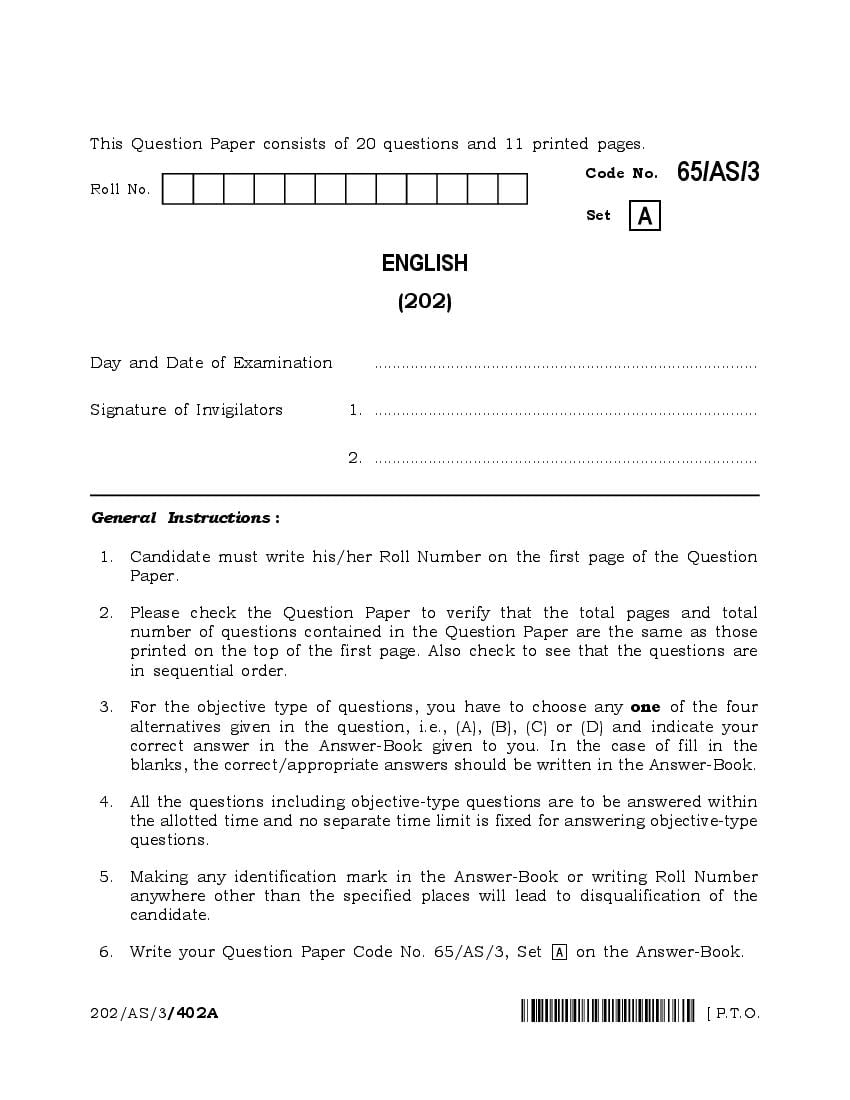
Code No. 65/AS/3
u
Roll No.
Set
ENGLISH
(202)
Day and Date of Examination .....................................................................................
Signature of Invigilators 1. .....................................................................................
2. .....................................................................................
General Instructions :
1. Candidate must write his/her Roll Number on the first page of the Question
Paper.
2. Please check the Question Paper to verify that the total pages and total
number of questions contained in the Question Paper are the same as those
printed on the top of the first page. Also check to see that the questions are
in sequential order.
3. For the objective type of questions, you have to choose any one of the four
alternatives given in the question, i.e., (A), (B), (C) or (D) and indicate your
correct answer in the Answer-Book given to you. In the case of fill in the
blanks, the correct/appropriate answers should be written in the Answer-Book.
4. All the questions including objective-type questions are to be answered within
the allotted time and no separate time limit is fixed for answering objective-type
questions.
5. Making any identification mark in the Answer-Book or writing Roll Number
anywhere other than the specified places will lead to disqualification of the
candidate.
6. Write your Question Paper Code No. 65/AS/3, Set u on the Answer-Book.
202/AS/3/402A [ P.T.O.
Page 2
(202)
Time : 3 Hours ] [ Maximum Marks : 100
Note : (i) This Question Paper has four Sections, ‘A’, ‘B’, ‘C’ and ‘D’.
(ii) All the questions are compulsory including those where internal choice
is given.
(iii) All answers have to be written in the answer script provided.
SECTION–A
( Reading )
( Marks : 15 )
1. Read the passage given below carefully and answer the questions that
follow : 8
1. No one knows exactly how old the pyramids are. A thousand years
before Christ, they were already old and mysterious. The Great
Pyramid at Giza has been attributed to King Cheops of the fourth
dynasty (about 2900 BC).
2. The pyramids are tombs. The ancient Egyptian kings believed that
their future lives depended upon the perfect preservation of their
bodies. The dead were therefore embalmed and the mummies were
hidden below the level of the ground in the interior of these great
masses of stone. Even the inner passages are blocked and concealed
from possible robbers. Food and other necessities were put in the
tombs for the kings to eat in their future lives.
3. The building of such a tremendous structure was a marvellous
engineering feat. It is said that it took 100000 men working for twenty
years to build the Great Pyramid! Each block of stone is 7 metres
high. Some are 5·5 metres wide. Let’s see if we can trace the story of
the building of this particular pyramid.
202/AS/3/402A 2
Page 3
brought by boat from quarries across the Nile and from the South.
This could be done for only three months each spring when the Nile
was flooded. So it took twenty years and some 500000 trips to bring
all the stones needed! Boats unloaded at a landing space connected
to the site of the pyramid by a stone road. The blocks, weighing about
2 tonnes each, were then pulled up the road on sledges by gangs of
men. Stone blocks pulled up the road were laid out in neat rows and
then pulled to the site by the gangs of men. The number of blocks in
the Great Pyramid have been established at 2300000.
5. As the pyramid rose, a huge ramp was built to get the materials to
higher levels. Gangs of men pulled the blocks up the ramp. Each layer
of the pyramid was made of blocks of limestone set side-by-side.
Mortar was used to slide the stones, rather than to cement them
together. Blocks in the centre were rough, but those on the outside
were cut more carefully. The final surface was made of very smooth
limestone with almost invisible joints. The pyramid has three inside
chambers with connecting passages.
(a) Fill in the blanks/Answer the following briefly : 5
(i) The ancient Egyptian kings used to build _____. 1
(ii) Food and other necessities were put in the tombs in anticipation
that they would _____. 1
(iii) The Great Pyramid at Giza is an example of marvellous
engineering feat because _____. 1
(iv) When were the blocks of limestone and granite used in building
the Great Pyramid brought and why? 2
(b) Find a word in the passage that means the following : 1
(i) huge (Para 3)
(ii) a slope joining two levels (Para 5)
(c) Fill in the blanks with one word only : 2
The pyramids are ( i)structures in which the dead bodies of the
ancient Egyptian kings were (ii) . The Great Pyramid at Giza is an
(iii) in itself. It is built of the blocks of (iv) and granite.
202/AS/3/402A 3 [ P.T.O.
Page 4
follow : 7
1. There are two main problems which bother educationists in our
country—the problem of religious and moral instruction in a land
which has people of many faiths and the second problem associated
with the fact that a large variety of languages are spoken by the people
here.
2. Children should be trained to love one another, be kind and helpful
to others, be gentle to animals, be observant and think right. It is
important to teach them to read and write, to count and calculate.
Nevertheless, it is equally important to mould their personality in the
right way.
3. In almost all schools, we have boys and girls born in different faiths,
belonging to families that live diverse ways of life and follow different
forms of worship associated with different religions. Schools should
promote an atmosphere of mutual respect, better understanding and
helpful cooperation among all. We must help children understand that
we should remain united. We should teach them to speak and
understand more languages than one, to appreciate and respect the
different religions as we are all similar as human beings. Boys and
girls can be taught national values by promoting facilities for religious
teaching of all communities to help develop a broader outlook.
(a) On the basis of your reading of the above passage, answer the
following questions :
(i) State one problem that bothers our educationists. 1
(ii) As far as studies are concerned, what should the children be
taught? 1
(iii) What kind of atmosphere should be promoted in schools? 1
(iv) In spite of all the differences, how can we teach children to
remain united? 1
(b) Find antonyms of the following words from the passage : 1
(i) Similar (Para 3)
(ii) Criticise (Para 3)
202/AS/3/402A 4
Page 5
(i) Trouble (Para 1)
(ii) Encourage (Para 3)
(iii) Shape (Para 2)
(iv) Collaboration (Para 3)
SECTION–B
( Writing )
( Marks : 25 )
3. Your tenant who lives on the top floor has the habit of playing guitar and
drums loudly at night, which disturb you especially during examination
days. Write a letter to him complaining about it and suggesting some steps
to solve the problem. 7
4. In India animals are often transported in cramped spaces in trucks. This
leads to tormenting of animals and some of them die on the way. Write an
article in about 100 words on ethical treatment of animals. 7
5. You received a call for your elder sister when she was not at home. On the
basis of your conversation, write a message in not more than 50 words
for her. You are Riddhi : 4
Vivek : Hello! Is it 245678?
Riddhi : Yes, may I know who is speaking?
Vivek : This is Vivek. May I speak to Ms. Siddhi?
Riddhi : She is not at home. If you have any message, please give it to
me for her.
Vivek : Yes, please note down. The official meeting will be held at Park
Plaza Hotel in Lucknow, on September 16, 2023.
Riddhi : That means she has to go to Lucknow.
Vivek : Yes, we shall go by Air India, Flight No. AI324. Tell her to
reach the Domestic Airport by 3 : 00 p.m. I shall bring the
tickets.
Riddhi : Okay Sir, I have noted it and I shall convey the same to my
sister as soon as she comes home.
Vivek : Thank you.
202/AS/3/402A 5 [ P.T.O.
Page 6
(a) Laughter is the best medicine
(b) Conservation of biodiversity
(c) Role of youth in nation building
SECTION–C
( Grammar )
( Marks : 30 )
7. Complete the following paragraph by filling in the blanks. For each blank
there are four options. Choose the most appropriate option for each blank.
The first one has been done for you : 1×6=6
A model excellent workmanship, Balasundari Temple is ( i) fusion
of
of India, and Persian School (ii) architecture. A large number of
pilgrims visit (iii) temple each year making it one of the most visited
temple shrines (iv) Himachal Pradesh. One of the many unique aspects
of the temple is that its conventional Poojari (Priest) has to be a Vaishya
or someone (v) the business community. Considering that the
descendents of Ram Das have been main Poojaris (vi) the temple was
built.
Example : (A) on (B) of (C) at (D) for
(i) (A) a (B) some (C) an (D) of
(ii) (A) for (B) from (C) on (D) of
(iii) (A) the (B) a (C) it (D) an
(iv) (A) on (B) at (C) in (D) under
(v) (A) for (B) from (C) between (D) off
(vi) (A) since (B) from (C) than (D) it
8. Fill in the blanks with correct adjectives given in the brackets : 1×6=6
(a) Did you have _____ (enough/few) food?
(b) _____ (Who/Whose) is this pen?
202/AS/3/402A 6
Page 7
(d) I can’t hear you. You must speak _____ (loud/louder).
(e) He is the _____ (little/least) affected of all.
(f) It is raining _____ (quite/quitely) hard.
9. Select the correct form of phrasal verb shown in the bracket along each
sentence and fill in the blank : 1×6=6
(a) The bus was full. We couldn’t _____ (get on/get up).
(b) _____ (Look out/Look up), there’s a car coming.
(c) Are you looking _____ (forwarding to/forward to) the party next week?
(d) It was my first flight. I was nervous as the plane _____ (took of/
took off).
(e) Why did you _____ (run off/run away) from me?
(f) A woman got into the car and _____ (drove off/drove of).
10. Read the sentences carefully and fill in the blanks with appropriate
prepositions given in the box : 1×3=3
at, on, in
(a) They arrived _____ Friday.
(b) I don’t like going out _____ night.
(c) I learnt to drive _____ four weeks.
11. Make one sentence from two. Use the sentence in bracket. Use wherever
needed : 1×3=3
(a) We often go to visit our uncle in Agra.
(It is only 80 miles away.)
(b) Shiva is one of my closest friends.
(I have known him for a very long time.)
(c) Glasgow is the largest city in Scotland.
(My brother lives there.)
202/AS/3/402A 7 [ P.T.O.
Page 8
shown in bracket along each sentence : 1×6=6
(a) Every boy and every girl _____ (has/have) to join school.
(b) She as well as you _____ (is/are) intelligent.
(c) Bread and butter _____ (was/were) his daily diet.
(d) The king with all his ministers _____ (were/was) killed.
(e) Game after game (were/was) _____ played.
(f) The scholar and the poet _____ (are/is) dead.
SECTION–D
( Literature )
( Marks : 30 )
13. Read the extract given below and answer the questions that follow : 1×4=4
Plastic crap can only be turned into a product of lower quality—a plastic
might be cleaned, cut into very very tiny pieces and used to stuff seat
cushions, a mixture of plastic waste can be recycled into plastic ‘timber’
and used to make durable fencing. But a lot of plastic waste still has to
be thrown away. Metals are different. Any car on the road today will
consist, in part, of earlier cars that have been scrapped and recycled into
new steel and other metals.
( New Good Things from Rubbish )
(a) How can plastic be reused?
(b) Why does a lot of plastic have to be thrown away?
(c) How are metals different from plastic?
(d) Find a word from the passage which has the same meaning as a word
given below :
‘Leftover’
202/AS/3/402A 8
Page 9
This kind of sublime forgiveness was not natural to my father. I had
thought that he would be angry, say hard things, and strike his forehead.
But he was so wonderfully peaceful, and I believe this was due to my clean
confession. A clean confession, combined with a promise never to commit
the sin again, is the purest type of repentance. I know that my confession
made my father feel absolutely safe about me, and increased his affection
for me beyond measure.
( Stealing and Atonement )
(a) What ‘sin’ is the author talking about? 1
(b) How did the father react to the author’s confession? 1
(c) According to the narrator, what is the purest type of repentance? 1
(d) Find a word from the passage which has opposite meaning of the
word given below : 1
‘Safe’
15. Read the extract given below and answer the questions that follow : 1×4=4
And I have learned too
to laugh with only my teeth
and shake hands without my heart.
I have also learned to say, ‘Goodbye’,
when I mean ‘Good-riddance’;
to say, ‘Glad to meet you’,
without being glad; and to say ‘It’s been
nice talking to you’, after being bored.
(a) What does the poet mean by the second line ‘‘to laugh with only my
teeth’’ ? 1
(b) Why does the poet learn to say things opposite to what he feels like? 1
(c) Who is the poet? 1
(d) What does ‘good-riddance’ mean here? 1
202/AS/3/402A 9 [ P.T.O.
Page 10
options from those that follow : 1×2=2
(a) Who seek shelter in the trees at night?
( Tall Trees )
(A) Tired travellers
(B) Birds
(C) Very small monkeys
(D) Drops of dew
(b) What kind of words are the poet recommending in the poem,
The Truth ?
(A) Honest and bitter words
(B) Strong words
(C) Sweet, soft and pleasant words
(D) Pacifying words
17. Answer any two of the following questions in one or two sentence(s)
each : 2×2=4
(a) Why and how did the hundred yard race get reduced to a walk?
( Nine Gold Medals )
(b) What habits of Valodya showed that he was quite impulsive?
( My Elder Brother )
(c) What gift did Kezia prepare for her father?
( The Little Girl )
18. Answer any two of the following questions in 30 to 40 words each : 2×2=4
(a) How did the Indian people and Government recognize and know Ustad
Bismillah Khan?
( Ustad Bismillah Khan )
(b) Why wouldn’t the parrot talk?
( The Parrot Who Couldn’t Talk )
(c) Why wouldn’t the teachers let the tiger’s master enter the
Headmaster’s room to fetch the tiger?
( A Tiger Comes to Town—II )
202/AS/3/402A 10
Page 11
(a) Why did grandfather take Raja to the oldman? Do you think the
oldman saved Raja’s life? Give reasons for your answer.
(b) How does Mother Teresa help the poor?
( Caring for Others )
20. Complete the statements given below by choosing from the options that
follow : 1×3=3
(a) Who among the following was not present in Shivaji’s court in the
chapter, The Return of Lion?
(A) Shivaji
(B) Ram Das
(C) Sambhaji
(D) Pandit Rao
(b) Which country fulfills half of its demand for paper by recycling?
( New Good Things from Rubbish )
(A) US
(B) Japan
(C) India
(D) Germany
(c) Pandit Jawaharlal Nehru could not send a gift to his daughter on her
18th birthday because
(A) he had forgotten her date of birth
(B) he was unwell
(C) he did not have money
(D) he was in a prison
( A Birthday Letter )
202/AS/3/402A [V23] 11
Page 12
Code No. 65/AS/3
v
Roll No.
Set
ENGLISH
(202)
Day and Date of Examination .....................................................................................
Signature of Invigilators 1. .....................................................................................
2. .....................................................................................
General Instructions :
1. Candidate must write his/her Roll Number on the first page of the Question
Paper.
2. Please check the Question Paper to verify that the total pages and total
number of questions contained in the Question Paper are the same as those
printed on the top of the first page. Also check to see that the questions are
in sequential order.
3. For the objective type of questions, you have to choose any one of the four
alternatives given in the question, i.e., (A), (B), (C) or (D) and indicate your
correct answer in the Answer-Book given to you. In the case of fill in the
blanks, the correct/appropriate answers should be written in the Answer-Book.
4. All the questions including objective-type questions are to be answered within
the allotted time and no separate time limit is fixed for answering objective-type
questions.
5. Making any identification mark in the Answer-Book or writing Roll Number
anywhere other than the specified places will lead to disqualification of the
candidate.
6. Write your Question Paper Code No. 65/AS/3, Set v on the Answer-Book.
202/AS/3/402B [ P.T.O.
Page 13
(202)
Time : 3 Hours ] [ Maximum Marks : 100
Note : (i) This Question Paper has four Sections, ‘A’, ‘B’, ‘C’ and ‘D’.
(ii) All the questions are compulsory including those where internal choice
is given.
(iii) All answers have to be written in the answer script provided.
SECTION–A
( Reading )
( Marks : 15 )
1. Read the passage given below carefully and answer the questions that
follow : 7
1. There are two main problems which bother educationists in our
country—the problem of religious and moral instruction in a land
which has people of many faiths and the second problem associated
with the fact that a large variety of languages are spoken by the people
here.
2. Children should be trained to love one another, be kind and helpful
to others, be gentle to animals, be observant and think right. It is
important to teach them to read and write, to count and calculate.
Nevertheless, it is equally important to mould their personality in the
right way.
3. In almost all schools, we have boys and girls born in different faiths,
belonging to families that live diverse ways of life and follow different
forms of worship associated with different religions. Schools should
promote an atmosphere of mutual respect, better understanding and
helpful cooperation among all. We must help children understand that
we should remain united. We should teach them to speak and
understand more languages than one, to appreciate and respect the
different religions as we are all similar as human beings. Boys and
girls can be taught national values by promoting facilities for religious
teaching of all communities to help develop a broader outlook.
202/AS/3/402B 2
Page 14
following questions :
(i) State one problem that bothers our educationists. 1
(ii) As far as studies are concerned, what should the children be
taught? 1
(iii) What kind of atmosphere should be promoted in schools? 1
(iv) In spite of all the differences, how can we teach children to
remain united? 1
(b) Find antonyms of the following words from the passage : 1
(i) Similar (Para 3)
(ii) Criticise (Para 3)
(c) Find synonyms of the following words from the passage : ½×4=2
(i) Trouble (Para 1)
(ii) Encourage (Para 3)
(iii) Shape (Para 2)
(iv) Collaboration (Para 3)
2. Read the passage given below carefully and answer the questions that
follow : 8
1. No one knows exactly how old the pyramids are. A thousand years
before Christ, they were already old and mysterious. The Great
Pyramid at Giza has been attributed to King Cheops of the fourth
dynasty (about 2900 BC).
2. The pyramids are tombs. The ancient Egyptian kings believed that
their future lives depended upon the perfect preservation of their
bodies. The dead were therefore embalmed and the mummies were
hidden below the level of the ground in the interior of these great
masses of stone. Even the inner passages are blocked and concealed
from possible robbers. Food and other necessities were put in the
tombs for the kings to eat in their future lives.
202/AS/3/402B 3 [ P.T.O.
Page 15
engineering feat. It is said that it took 100000 men working for twenty
years to build the Great Pyramid! Each block of stone is 7 metres
high. Some are 5·5 metres wide. Let’s see if we can trace the story of
the building of this particular pyramid.
4. The blocks of limestone and granite used in building the pyramid were
brought by boat from quarries across the Nile and from the South.
This could be done for only three months each spring when the Nile
was flooded. So it took twenty years and some 500000 trips to bring
all the stones needed! Boats unloaded at a landing space connected
to the site of the pyramid by a stone road. The blocks, weighing about
2 tonnes each, were then pulled up the road on sledges by gangs of
men. Stone blocks pulled up the road were laid out in neat rows and
then pulled to the site by the gangs of men. The number of blocks in
the Great Pyramid have been established at 2300000.
5. As the pyramid rose, a huge ramp was built to get the materials to
higher levels. Gangs of men pulled the blocks up the ramp. Each layer
of the pyramid was made of blocks of limestone set side-by-side.
Mortar was used to slide the stones, rather than to cement them
together. Blocks in the centre were rough, but those on the outside
were cut more carefully. The final surface was made of very smooth
limestone with almost invisible joints. The pyramid has three inside
chambers with connecting passages.
(a) Fill in the blanks/Answer the following briefly : 5
(i) The ancient Egyptian kings used to build _____. 1
(ii) Food and other necessities were put in the tombs in anticipation
that they would _____. 1
(iii) The Great Pyramid at Giza is an example of marvellous
engineering feat because _____. 1
(iv) When were the blocks of limestone and granite used in building
the Great Pyramid brought and why? 2
202/AS/3/402B 4
Page 16
(i) huge (Para 3)
(ii) a slope joining two levels (Para 5)
(c) Fill in the blanks with one word only : 2
The pyramids are ( i)
structures in which the dead bodies of the
ancient Egyptian kings were (ii) . The Great Pyramid at Giza is an
(iii) in itself. It is built of the blocks of (iv) and granite.
SECTION–B
( Writing )
( Marks : 25 )
3. You are Rishabh Kumar of St. Joseph School, Allahabad. Write a notice to
be put on the school notice board regarding the upcoming sports day
celebration in your school. 4
4. Your class teacher has asked you to prepare a speech to be delivered in
the morning assembly on the topic—‘Value of Discipline’. Write the speech
in about 100 words. 7
5. You have joined your school’s NCC camp for the first time. Your mother
is very apprehensive of your stay but you are enjoying the camp. Write a
letter to her saying that you enjoy camping with others. You are Rani, ABC
School, Agra. 7
6. Write a paragraph in about 100 words on any one of the following : 7
(a) Silence is precious
(b) It’s no use crying over spilt milk
(c) The pleasure of morning walk
202/AS/3/402B 5 [ P.T.O.
Page 17
( Grammar )
( Marks : 30 )
7. Complete the following paragraph by filling in the blanks. For each blank
there are four options. Choose the most appropriate option for each blank.
The first one has been done for you : 1×6=6
The boy’s ball had bounced ( i) on the road and finally fell (ii) the
water. (iii)
boy felt helpless as he could not get the ball back. He
became very sad and trembled (iv) fear and kept (v) looking
helplessly (vi) the ball.
Example : (A) have (B) had (C) has (D) was
(i) (A) of (B) off (C) on (D) at
(ii) (A) into (B) in (C) to (D) at
(iii) (A) A (B) An (C) There (D) The
(iv) (A) without (B) with (C) at (D) on
(v) (A) at (B) and (C) on (D) an
(vi) (A) for (B) on (C) of (D) off
8. Read the following sentences carefully and select the correct form of verb
shown in bracket along each sentence : 1×6=6
(a) Every boy and every girl _____ (has/have) to join school.
(b) She as well as you _____ (is/are) intelligent.
(c) Bread and butter _____ (was/were) his daily diet.
(d) The king with all his ministers _____ (were/was) killed.
(e) Game after game (were/was) _____ played.
(f) The scholar and the poet _____ (are/is) dead.
9. Read the sentences carefully and fill in the blanks with appropriate
prepositions given in the box : 1×3=3
at, on, in
(a) They arrived _____ Friday.
(b) I don’t like going out _____ night.
(c) I learnt to drive _____ four weeks.
202/AS/3/402B 6
Page 18
needed : 1×3=3
(a) We often go to visit our uncle in Agra.
(It is only 80 miles away.)
(b) Shiva is one of my closest friends.
(I have known him for a very long time.)
(c) Glasgow is the largest city in Scotland.
(My brother lives there.)
11. Fill in the blanks with correct adjectives given in the brackets : 1×6=6
(a) Did you have _____ (enough/few) food?
(b) _____ (Who/Whose) is this pen?
(c) His condition is _____ (more worse/worse) than yours.
(d) I can’t hear you. You must speak _____ (loud/louder).
(e) He is the _____ (little/least) affected of all.
(f) It is raining _____ (quite/quitely) hard.
12. Select the correct form of phrasal verb shown in the bracket along each
sentence and fill in the blank : 1×6=6
(a) The bus was full. We couldn’t _____ (get on/get up).
(b) _____ (Look out/Look up), there’s a car coming.
(c) Are you looking _____ (forwarding to/forward to) the party next week?
(d) It was my first flight. I was nervous as the plane _____ (took of/
took off).
(e) Why did you _____ (run off/run away) from me?
(f) A woman got into the car and _____ (drove off/drove of).
202/AS/3/402B 7 [ P.T.O.
Page 19
( Literature )
( Marks : 30 )
13. Answer any two of the following questions in one or two sentence(s)
each : 2×2=4
(a) Why and how did the hundred yard race get reduced to a walk?
( Nine Gold Medals )
(b) What habits of Valodya showed that he was quite impulsive?
( My Elder Brother )
(c) What gift did Kezia prepare for her father?
( The Little Girl )
14. Answer any two of the following questions in 30 to 40 words each : 2×2=4
(a) How did the Indian people and Government recognize and know Ustad
Bismillah Khan?
( Ustad Bismillah Khan )
(b) Why wouldn’t the parrot talk?
( The Parrot Who Couldn’t Talk )
(c) Why wouldn’t the teachers let the tiger’s master enter the
Headmaster’s room to fetch the tiger?
( A Tiger Comes to Town—II )
15. Answer any one of the following questions in about 100 words : 5
(a) Why did grandfather take Raja to the oldman? Do you think the
oldman saved Raja’s life? Give reasons for your answer.
(b) How does Mother Teresa help the poor?
( Caring for Others )
202/AS/3/402B 8
Page 20
follow : 1×3=3
(a) Who among the following was not present in Shivaji’s court in the
chapter, The Return of Lion?
(A) Shivaji
(B) Ram Das
(C) Sambhaji
(D) Pandit Rao
(b) Which country fulfills half of its demand for paper by recycling?
( New Good Things from Rubbish )
(A) US
(B) Japan
(C) India
(D) Germany
(c) Pandit Jawaharlal Nehru could not send a gift to his daughter on her
18th birthday because
(A) he had forgotten her date of birth
(B) he was unwell
(C) he did not have money
(D) he was in a prison
( A Birthday Letter )
17. Read the extract given below and answer the questions that follow : 1×4=4
Plastic crap can only be turned into a product of lower quality—a plastic
might be cleaned, cut into very very tiny pieces and used to stuff seat
cushions, a mixture of plastic waste can be recycled into plastic ‘timber’
and used to make durable fencing. But a lot of plastic waste still has to
be thrown away. Metals are different. Any car on the road today will
consist, in part, of earlier cars that have been scrapped and recycled into
new steel and other metals.
( New Good Things from Rubbish )
(a) How can plastic be reused?
202/AS/3/402B 9 [ P.T.O.
Page 21
(c) How are metals different from plastic?
(d) Find a word from the passage which has the same meaning as a word
given below :
‘Leftover’
18. Read the extract given below and answer the questions that follow : 1×4=4
This kind of sublime forgiveness was not natural to my father. I had
thought that he would be angry, say hard things, and strike his forehead.
But he was so wonderfully peaceful, and I believe this was due to my clean
confession. A clean confession, combined with a promise never to commit
the sin again, is the purest type of repentance. I know that my confession
made my father feel absolutely safe about me, and increased his affection
for me beyond measure.
( Stealing and Atonement )
(a) What ‘sin’ is the author talking about? 1
(b) How did the father react to the author’s confession? 1
(c) According to the narrator, what is the purest type of repentance? 1
(d) Find a word from the passage which has opposite meaning of the
word given below : 1
‘Safe’
19. Read the extract given below and answer the questions that follow : 1×4=4
And I have learned too
to laugh with only my teeth
and shake hands without my heart.
I have also learned to say, ‘Goodbye’,
when I mean ‘Good-riddance’;
to say, ‘Glad to meet you’,
without being glad; and to say ‘It’s been
nice talking to you’, after being bored.
(a) What does the poet mean by the second line ‘‘to laugh with only my
teeth’’ ? 1
202/AS/3/402B 10
Page 22
(c) Who is the poet? 1
(d) What does ‘good-riddance’ mean here? 1
20. Complete the statements given below by choosing the most appropriate
options from those that follow : 1×2=2
(a) Who seek shelter in the trees at night?
( Tall Trees )
(A) Tired travellers
(B) Birds
(C) Very small monkeys
(D) Drops of dew
(b) What kind of words are the poet recommending in the poem,
The Truth ?
(A) Honest and bitter words
(B) Strong words
(C) Sweet, soft and pleasant words
(D) Pacifying words
202/AS/3/402B [V23] 11
Page 23
Code No. 65/AS/3
w
Roll No.
Set
ENGLISH
(202)
Day and Date of Examination .....................................................................................
Signature of Invigilators 1. .....................................................................................
2. .....................................................................................
General Instructions :
1. Candidate must write his/her Roll Number on the first page of the Question
Paper.
2. Please check the Question Paper to verify that the total pages and total
number of questions contained in the Question Paper are the same as those
printed on the top of the first page. Also check to see that the questions are
in sequential order.
3. For the objective type of questions, you have to choose any one of the four
alternatives given in the question, i.e., (A), (B), (C) or (D) and indicate your
correct answer in the Answer-Book given to you. In the case of fill in the
blanks, the correct/appropriate answers should be written in the Answer-Book.
4. All the questions including objective-type questions are to be answered within
the allotted time and no separate time limit is fixed for answering objective-type
questions.
5. Making any identification mark in the Answer-Book or writing Roll Number
anywhere other than the specified places will lead to disqualification of the
candidate.
6. Write your Question Paper Code No. 65/AS/3, Set w on the Answer-Book.
202/AS/3/402C [ P.T.O.
Page 24
(202)
Time : 3 Hours ] [ Maximum Marks : 100
Note : (i) This Question Paper has four Sections, ‘A’, ‘B’, ‘C’ and ‘D’.
(ii) All the questions are compulsory including those where internal choice
is given.
(iii) All answers have to be written in the answer script provided.
SECTION–A
( Reading )
( Marks : 15 )
1. Read the passage given below carefully and answer the questions that
follow : 8
1. No one knows exactly how old the pyramids are. A thousand years
before Christ, they were already old and mysterious. The Great
Pyramid at Giza has been attributed to King Cheops of the fourth
dynasty (about 2900 BC).
2. The pyramids are tombs. The ancient Egyptian kings believed that
their future lives depended upon the perfect preservation of their
bodies. The dead were therefore embalmed and the mummies were
hidden below the level of the ground in the interior of these great
masses of stone. Even the inner passages are blocked and concealed
from possible robbers. Food and other necessities were put in the
tombs for the kings to eat in their future lives.
3. The building of such a tremendous structure was a marvellous
engineering feat. It is said that it took 100000 men working for twenty
years to build the Great Pyramid! Each block of stone is 7 metres
high. Some are 5·5 metres wide. Let’s see if we can trace the story of
the building of this particular pyramid.
202/AS/3/402C 2
Page 25
brought by boat from quarries across the Nile and from the South.
This could be done for only three months each spring when the Nile
was flooded. So it took twenty years and some 500000 trips to bring
all the stones needed! Boats unloaded at a landing space connected
to the site of the pyramid by a stone road. The blocks, weighing about
2 tonnes each, were then pulled up the road on sledges by gangs of
men. Stone blocks pulled up the road were laid out in neat rows and
then pulled to the site by the gangs of men. The number of blocks in
the Great Pyramid have been established at 2300000.
5. As the pyramid rose, a huge ramp was built to get the materials to
higher levels. Gangs of men pulled the blocks up the ramp. Each layer
of the pyramid was made of blocks of limestone set side-by-side.
Mortar was used to slide the stones, rather than to cement them
together. Blocks in the centre were rough, but those on the outside
were cut more carefully. The final surface was made of very smooth
limestone with almost invisible joints. The pyramid has three inside
chambers with connecting passages.
(a) Fill in the blanks/Answer the following briefly : 5
(i) The ancient Egyptian kings used to build _____. 1
(ii) Food and other necessities were put in the tombs in anticipation
that they would _____. 1
(iii) The Great Pyramid at Giza is an example of marvellous
engineering feat because _____. 1
(iv) When were the blocks of limestone and granite used in building
the Great Pyramid brought and why? 2
(b) Find a word in the passage that means the following : 1
(i) huge (Para 3)
(ii) a slope joining two levels (Para 5)
(c) Fill in the blanks with one word only : 2
The pyramids are ( i)
structures in which the dead bodies of the
ancient Egyptian kings were (ii) . The Great Pyramid at Giza is an
(iii) in itself. It is built of the blocks of (iv) and granite.
202/AS/3/402C 3 [ P.T.O.
Page 26
follow : 7
1. There are two main problems which bother educationists in our
country—the problem of religious and moral instruction in a land
which has people of many faiths and the second problem associated
with the fact that a large variety of languages are spoken by the people
here.
2. Children should be trained to love one another, be kind and helpful
to others, be gentle to animals, be observant and think right. It is
important to teach them to read and write, to count and calculate.
Nevertheless, it is equally important to mould their personality in the
right way.
3. In almost all schools, we have boys and girls born in different faiths,
belonging to families that live diverse ways of life and follow different
forms of worship associated with different religions. Schools should
promote an atmosphere of mutual respect, better understanding and
helpful cooperation among all. We must help children understand that
we should remain united. We should teach them to speak and
understand more languages than one, to appreciate and respect the
different religions as we are all similar as human beings. Boys and
girls can be taught national values by promoting facilities for religious
teaching of all communities to help develop a broader outlook.
(a) On the basis of your reading of the above passage, answer the
following questions :
(i) State one problem that bothers our educationists. 1
(ii) As far as studies are concerned, what should the children be
taught? 1
(iii) What kind of atmosphere should be promoted in schools? 1
(iv) In spite of all the differences, how can we teach children to
remain united? 1
202/AS/3/402C 4
Page 27
(i) Similar (Para 3)
(ii) Criticise (Para 3)
(c) Find synonyms of the following words from the passage : ½×4=2
(i) Trouble (Para 1)
(ii) Encourage (Para 3)
(iii) Shape (Para 2)
(iv) Collaboration (Para 3)
SECTION–B
( Writing )
( Marks : 25 )
3. Write a paragraph in about 100 words on any one of the following : 7
(a) The pleasures of reading
(b) The forbidden fruit is always sweetest
(c) A character from a book or a movie
4. The use of mobile phone is becoming very popular even among the
students. These gadgets have proved to be very useful in our day-to-day
life. Write a speech in about 100 words on the topic ‘Mobile Phone : A
Blessing of Science’. 7
5. Write a letter to the Municipal Commissioner of your city complaining
about the broken roads of your locality. You are Amrit, 96, Nehru Road,
Agra. 7
6. Aditya has to go to attend his friend’s birthday party at his home. When
he leaves, his mother is not at home. So he leaves a message for her
stating where he is going, why and when he’ll return. Supposing yourself
to be Aditya, write a message in about 50 words for his mother. 4
202/AS/3/402C 5 [ P.T.O.
Page 28
( Grammar )
( Marks : 30 )
7. Complete the following paragraph by filling in the blanks. For each blank
there are four options. Choose the most appropriate option for each blank.
The first one has been done for you : 1×6=6
It is quite clear from the data collected that ( i) government schools
the students don’t use English language (ii) speaking to others at all.
Only (iii) students (iv) speaking English in government schools
which is below average (v) . Hindi is spoken by a maximum number
(vi) the students.
Example : (A) from (B) in (C) that (D) on
(i) (A) from (B) in (C) at (D) on
(ii) (A) to (B) on (C) for (D) from
(iii) (A) by (B) a few (C) few (D) the few
(iv) (A) is (B) a few (C) are (D) am
(v) (A) by (B) but (C) not (D) from
(vi) (A) at (B) so (C) of (D) on
8. Make one sentence from two. Use the sentence in bracket. Use wherever
needed : 1×3=3
(a) We often go to visit our uncle in Agra.
(It is only 80 miles away.)
(b) Shiva is one of my closest friends.
(I have known him for a very long time.)
(c) Glasgow is the largest city in Scotland.
(My brother lives there.)
9. Read the following sentences carefully and select the correct form of verb
shown in bracket along each sentence : 1×6=6
(a) Every boy and every girl _____ (has/have) to join school.
(b) She as well as you _____ (is/are) intelligent.
202/AS/3/402C 6
Page 29
(d) The king with all his ministers _____ (were/was) killed.
(e) Game after game (were/was) _____ played.
(f) The scholar and the poet _____ (are/is) dead.
10. Read the sentences carefully and fill in the blanks with appropriate
prepositions given in the box : 1×3=3
at, on, in
(a) They arrived _____ Friday.
(b) I don’t like going out _____ night.
(c) I learnt to drive _____ four weeks.
11. Select the correct form of phrasal verb shown in the bracket along each
sentence and fill in the blank : 1×6=6
(a) The bus was full. We couldn’t _____ (get on/get up).
(b) _____ (Look out/Look up), there’s a car coming.
(c) Are you looking _____ (forwarding to/forward to) the party next week?
(d) It was my first flight. I was nervous as the plane _____ (took of/
took off).
(e) Why did you _____ (run off/run away) from me?
(f) A woman got into the car and _____ (drove off/drove of).
12. Fill in the blanks with correct adjectives given in the brackets : 1×6=6
(a) Did you have _____ (enough/few) food?
(b) _____ (Who/Whose) is this pen?
(c) His condition is _____ (more worse/worse) than yours.
(d) I can’t hear you. You must speak _____ (loud/louder).
(e) He is the _____ (little/least) affected of all.
(f) It is raining _____ (quite/quitely) hard.
202/AS/3/402C 7 [ P.T.O.
Page 30
( Literature )
( Marks : 30 )
13. Complete the statements given below by choosing from the options that
follow : 1×3=3
(a) Who among the following was not present in Shivaji’s court in the
chapter, The Return of Lion?
(A) Shivaji
(B) Ram Das
(C) Sambhaji
(D) Pandit Rao
(b) Which country fulfills half of its demand for paper by recycling?
( New Good Things from Rubbish )
(A) US
(B) Japan
(C) India
(D) Germany
(c) Pandit Jawaharlal Nehru could not send a gift to his daughter on her
18th birthday because
(A) he had forgotten her date of birth
(B) he was unwell
(C) he did not have money
(D) he was in a prison
( A Birthday Letter )
202/AS/3/402C 8
Page 31
(a) Why did grandfather take Raja to the oldman? Do you think the
oldman saved Raja’s life? Give reasons for your answer.
(b) How does Mother Teresa help the poor?
( Caring for Others )
15. Answer any two of the following questions in one or two sentence(s)
each : 2×2=4
(a) Why and how did the hundred yard race get reduced to a walk?
( Nine Gold Medals )
(b) What habits of Valodya showed that he was quite impulsive?
( My Elder Brother )
(c) What gift did Kezia prepare for her father?
( The Little Girl )
16. Answer any two of the following questions in 30 to 40 words each : 2×2=4
(a) How did the Indian people and Government recognize and know Ustad
Bismillah Khan?
( Ustad Bismillah Khan )
(b) Why wouldn’t the parrot talk?
( The Parrot Who Couldn’t Talk )
(c) Why wouldn’t the teachers let the tiger’s master enter the
Headmaster’s room to fetch the tiger?
( A Tiger Comes to Town—II )
202/AS/3/402C 9 [ P.T.O.
Page 32
options from those that follow : 1×2=2
(a) Who seek shelter in the trees at night?
( Tall Trees )
(A) Tired travellers
(B) Birds
(C) Very small monkeys
(D) Drops of dew
(b) What kind of words are the poet recommending in the poem,
The Truth ?
(A) Honest and bitter words
(B) Strong words
(C) Sweet, soft and pleasant words
(D) Pacifying words
18. Read the extract given below and answer the questions that follow : 1×4=4
This kind of sublime forgiveness was not natural to my father. I had
thought that he would be angry, say hard things, and strike his forehead.
But he was so wonderfully peaceful, and I believe this was due to my clean
confession. A clean confession, combined with a promise never to commit
the sin again, is the purest type of repentance. I know that my confession
made my father feel absolutely safe about me, and increased his affection
for me beyond measure.
( Stealing and Atonement )
(a) What ‘sin’ is the author talking about? 1
(b) How did the father react to the author’s confession? 1
(c) According to the narrator, what is the purest type of repentance? 1
(d) Find a word from the passage which has opposite meaning of the
word given below : 1
‘Safe’
202/AS/3/402C 10
Page 33
Plastic crap can only be turned into a product of lower quality—a plastic
might be cleaned, cut into very very tiny pieces and used to stuff seat
cushions, a mixture of plastic waste can be recycled into plastic ‘timber’
and used to make durable fencing. But a lot of plastic waste still has to
be thrown away. Metals are different. Any car on the road today will
consist, in part, of earlier cars that have been scrapped and recycled into
new steel and other metals.
( New Good Things from Rubbish )
(a) How can plastic be reused?
(b) Why does a lot of plastic have to be thrown away?
(c) How are metals different from plastic?
(d) Find a word from the passage which has the same meaning as a word
given below :
‘Leftover’
20. Read the extract given below and answer the questions that follow : 1×4=4
And I have learned too
to laugh with only my teeth
and shake hands without my heart.
I have also learned to say, ‘Goodbye’,
when I mean ‘Good-riddance’;
to say, ‘Glad to meet you’,
without being glad; and to say ‘It’s been
nice talking to you’, after being bored.
(a) What does the poet mean by the second line ‘‘to laugh with only my
teeth’’ ? 1
(b) Why does the poet learn to say things opposite to what he feels like? 1
(c) Who is the poet? 1
(d) What does ‘good-riddance’ mean here? 1
202/AS/3/402C [V23] 11
Document Details
| Board / Org | NIOS |
| Exam | National Institute of Open Schooling Class 10 |
| Type | Question Paper |
| Pages | 33 |
| Updated | 22 Jul 2026 |