Page 1
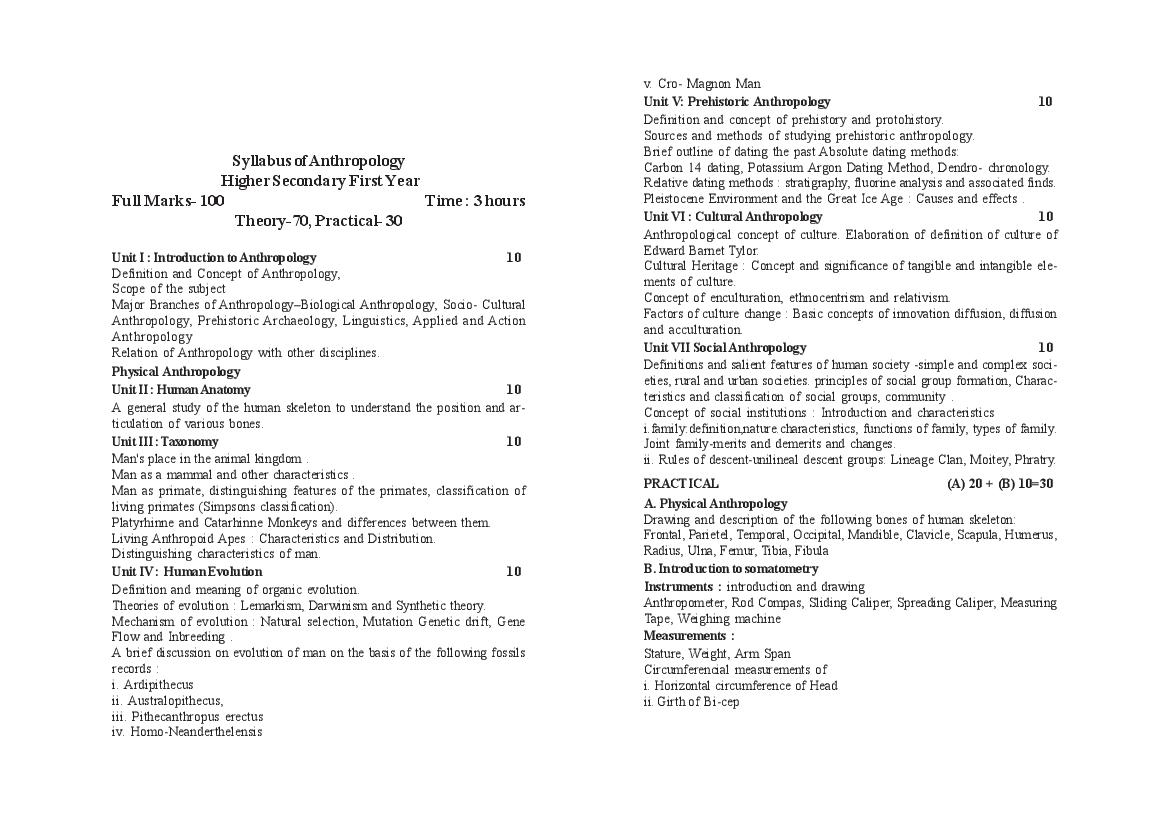
v. Cro- Magnon Man Unit V: Prehistoric Anthropology 10 Definition and concept of prehistory and protohistory. Sources and methods of studying prehistoric anthropology. Brief outline of dating the past Absolute dating methods: Syllabus of Anthropology Carbon 14 dating, Potassium Argon Dating Method, Dendro- chronology. Higher Secondary First Year Relative dating methods : stratigraphy, fluorine analysis and associated finds. Full Marks- 100 Time : 3 hours Pleistocene Environment and the Great Ice Age : Causes and effects . Theory-70, Practical- 30 Unit VI : Cultural Anthropology 10 Anthropological concept of culture. Elaboration of definition of culture of Edward Barnet Tylor. Unit I : Introduction to Anthropology 10 Cultural Heritage : Concept and significance of tangible and intangible ele- Definition and Concept of Anthropology, ments of culture. Scope of the subject Concept of enculturation, ethnocentrism and relativism. Major Branches of Anthropology–Biological Anthropology, Socio- Cultural Factors of culture change : Basic concepts of innovation diffusion, diffusion Anthropology, Prehistoric Archaeology, Linguistics, Applied and Action and acculturation. Anthropology Relation of Anthropology with other disciplines. Unit VII Social Anthropology 10 Definitions and salient features of human society -simple and complex soci- Physical Anthropology eties, rural and urban societies. principles of social group formation, Charac- Unit II : Human Anatomy 10 teristics and classification of social groups, community . A general study of the human skeleton to understand the position and ar- Concept of social institutions : Introduction and characteristics ticulation of various bones. i.family:definition,nature.characteristics, functions of family, types of family. Unit III : Taxonomy 10 Joint family-merits and demerits and changes. Man's place in the animal kingdom . ii. Rules of descent-unilineal descent groups: Lineage Clan, Moitey, Phratry. Man as a mammal and other characteristics . PRACTICAL (A) 20 + (B) 10=30 Man as primate, distinguishing features of the primates, classification of living primates (Simpsons classification). A. Physical Anthropology Platyrhinne and Catarhinne Monkeys and differences between them. Drawing and description of the following bones of human skeleton: Living Anthropoid Apes : Characteristics and Distribution. Frontal, Parietel, Temporal, Occipital, Mandible, Clavicle, Scapula, Humerus, Distinguishing characteristics of man. Radius, Ulna, Femur, Tibia, Fibula Unit IV : Human Evolution 10 B. Introduction to somatometry Definition and meaning of organic evolution. Instruments : introduction and drawing Theories of evolution : Lemarkism, Darwinism and Synthetic theory. Anthropometer, Rod Compas, Sliding Caliper, Spreading Caliper, Measuring Mechanism of evolution : Natural selection, Mutation Genetic drift, Gene Tape, Weighing machine Flow and Inbreeding . Measurements : A brief discussion on evolution of man on the basis of the following fossils Stature, Weight, Arm Span records : Circumferencial measurements of i. Ardipithecus i. Horizontal circumference of Head ii. Australopithecus, ii. Girth of Bi-cep iii. Pithecanthropus erectus iv. Homo-Neanderthelensis