NIOS Class 10 Question Paper 2023 Indian Culture & Heritage
Finished viewing? Save it for later —
Download NIOS Class 10 Question Paper 2023 Indian Culture & Heritage (PDF · 24 pages)About NIOS Class 10 Question Paper 2023 Indian Culture & Heritage
NIOS Class 10 Question Paper 2023 Indian Culture & Heritage is available here for free download. Published by NIOS for National Institute of Open Schooling Class 10, this question paper can be viewed online or downloaded as a PDF (24 pages). Candidates preparing for National Institute of Open Schooling Class 10 can use NIOS Class 10 Question Paper 2023 Indian Culture & Heritage to understand the exam pattern, the type of questions asked, and the overall difficulty level.
Frequently Asked Questions
How can I download NIOS Class 10 Question Paper 2023 Indian Culture & Heritage?
Open this page and click the Download button to save NIOS Class 10 Question Paper 2023 Indian Culture & Heritage as a PDF. It is completely free on AglaSem Docs.
Is NIOS Class 10 Question Paper 2023 Indian Culture & Heritage free to download?
Yes. NIOS Class 10 Question Paper 2023 Indian Culture & Heritage can be viewed online and downloaded as a PDF free of cost on AglaSem Docs.
How many pages does NIOS Class 10 Question Paper 2023 Indian Culture & Heritage have?
NIOS Class 10 Question Paper 2023 Indian Culture & Heritage contains 24 pages, which you can read online or download together as a single PDF.
Where can I find more National Institute of Open Schooling Class 10 study material?
You can find more National Institute of Open Schooling Class 10 question papers, sample papers, syllabus, and answer keys on AglaSem Docs.
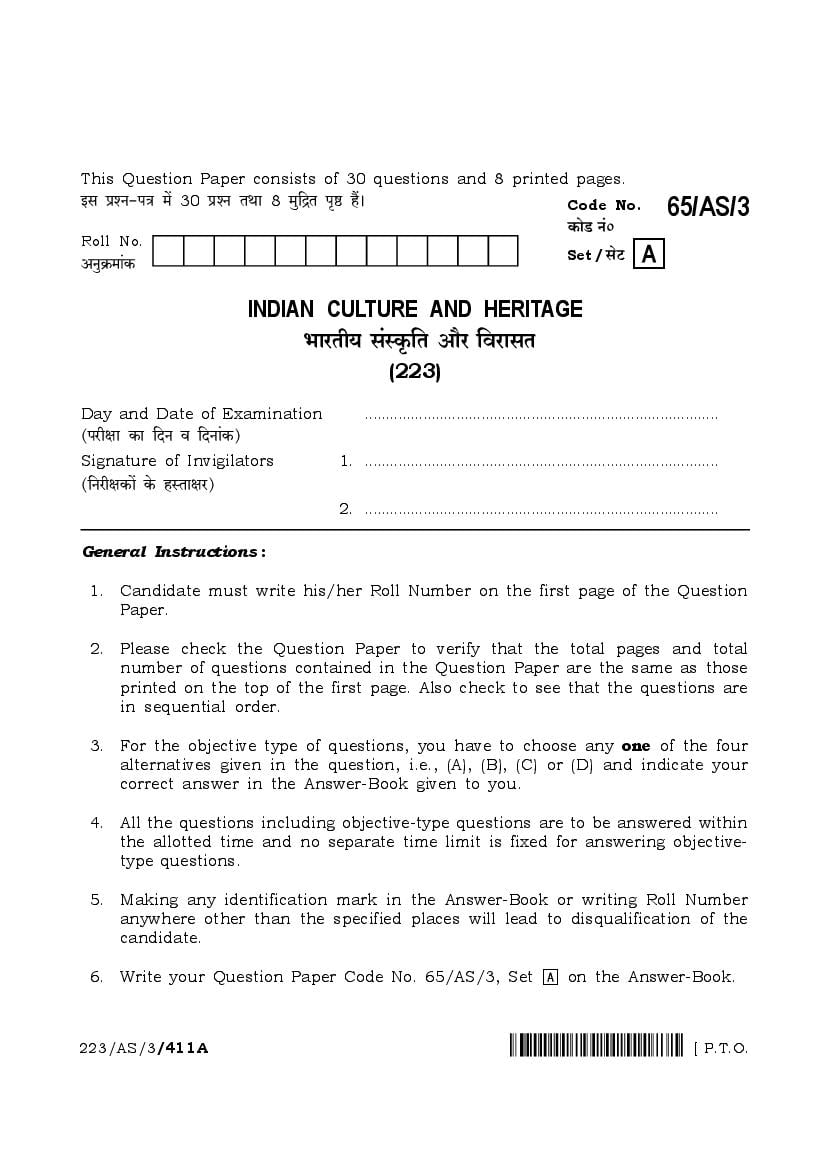
NIOS Class 10 Question Paper 2023 Indian Culture & Heritage – Text
Read the full text of this question paper below — useful to quickly search, copy and reference the content online without downloading the PDF.
📄 View text version (24 pages)
Page 1
Bg àíZ-nÌ ‘| 30 àíZ VWm 8 ‘w{ÐV n¥ð> h¢& Code No. 65/AS/3
u
H$moS> Z§0
Roll No.
Set / goQ>
AZwH«$‘m§H$
INDIAN CULTURE AND HERITAGE
^maVr¶ g§ñH¥${V Am¡a {damgV
(223)
Day and Date of Examination .....................................................................................
(narjm H$m {XZ d {XZm§H$)
Signature of Invigilators 1. .....................................................................................
({ZarjH$m| Ho$ hñVmja)
2. .....................................................................................
General Instructions :
1. Candidate must write his/her Roll Number on the first page of the Question
Paper.
2. Please check the Question Paper to verify that the total pages and total
number of questions contained in the Question Paper are the same as those
printed on the top of the first page. Also check to see that the questions are
in sequential order.
3. For the objective type of questions, you have to choose any one of the four
alternatives given in the question, i.e., (A), (B), (C) or (D) and indicate your
correct answer in the Answer-Book given to you.
4. All the questions including objective-type questions are to be answered within
the allotted time and no separate time limit is fixed for answering objective-
type questions.
5. Making any identification mark in the Answer-Book or writing Roll Number
anywhere other than the specified places will lead to disqualification of the
candidate.
6. Write your Question Paper Code No. 65/AS/3, Set u on the Answer-Book.
223/AS/3/411A [ P.T.O.
Page 2
wish, you can answer in any one of the languages listed below :
English, Hindi, Urdu, Punjabi, Bengali, Tamil, Malayalam, Kannada,
Telugu, Marathi, Odia, Gujarati, Konkani, Manipuri, Assamese, Nepali,
Kashmiri, Sanskrit and Sindhi.
You are required to indicate the language you have chosen to answer in
the box provided in the Answer-Book.
(b) If you choose to write the answer in the language other than Hindi and
English, the responsibility for any errors/mistakes in understanding the
questions will be yours only.
gm‘mݶ AZwXoe …
1. narjmWu àíZ-nÌ Ho$ nhbo n¥ð> na AnZm AZwH«$‘m§H$ Adí¶ {bI|&
2. H¥$n¶m àíZ-nÌ H$mo Om±M b| {H$ àíZ-nÌ Ho$ Hw$b n¥ð>m| VWm àíZm| H$s CVZr hr g§»¶m h¡ {OVZr àW‘ n¥ð> Ho$ g~go
D$na N>nr h¡& Bg ~mV H$s Om±M ^r H$a b| {H$ àíZ H«${‘H$ ê$n ‘| h¢&
3. dñVw{Zð> àíZm| _o§ AmnH$mo Mma {dH$ënm| (A), (B), (C) VWm (D) _| go H$moB© EH$ CÎma MwZZm h¡ VWm Xr JB©
CÎma-nwpñVH$m _| ghr CÎma {bIZm h¡&
4. dñVw{Zð> àíZm| Ho$ gmW-gmW g^r àíZm| Ho$ CÎma {ZYm©[aV Ad{Y Ho$ ^rVa hr XoZo h¢Ÿ& dñVw{Zð> àíZm| Ho$ {bE AbJ go
g_` Zht {X`m OmEJmŸ&
5. CÎma-nwpñVH$m ‘| nhMmZ-{M• ~ZmZo AWdm {Z{X©ï> ñWmZm| Ho$ A{V[aº$ H$ht ^r AZwH«$‘m§H$ {bIZo na narjmWu H$mo
A¶mo½¶ R>ham¶m OmEJm&
6. AnZr CÎma-nwpñVH$m na àíZ-nÌ H$m H$moS> Z§0 65/AS/3, goQ u {bI|&
7. (H$) n«íZ-nÌ Ho$db A§J«oOr/{hÝXr ‘| h¡& {’$a ^r, ¶{X Amn Mmh| Vmo ZrMo Xr JB© {H$gr EH$ ^mfm ‘| CÎma Xo
gH$Vo h¢ …
A§J«oOr, {hÝXr, CXÿ©, n§Om~r, ~§Jbm, V{‘b, ‘b¶mb‘, H$Þ‹S>, VobwJy, ‘amR>r, C{‹S>¶m, JwOamVr, H$m|H$Ur,
‘{Unwar, Ag{‘¶m, Zonmbr, H$í‘rar, g§ñH¥$V Am¡a {gÝYr&
H¥$n¶m CÎma-nwpñVH$m ‘| {XE JE ~m°³g ‘| {bI| {H$ Amn {H$g ^mfm ‘| CÎma {bI aho h¢&
(I) ¶{X Amn {hÝXr Ed§ A§J«oOr Ho$ A{V[aº$ {H$gr Aݶ ^mfm ‘| CÎma {bIVo h¢, Vmo àíZm| H$mo g‘PZo ‘| hmoZo dmbr
Ìw{Q>¶m|/Jb{V¶m| H$s {Oå‘oXmar Ho$db AmnH$s hmoJr&
223/AS/3/411A 2
Page 3
^maVr¶ g§ñH¥${V Am¡a {damgV
(223)
Time : 3 Hours ] [ Maximum Marks : 100
g‘¶ … 3 KÊQ>o ] [ nyUmªH$ … 100
Note : (i) Attempt all questions.
(ii) Marks allotted to each question are indicated against it.
(iii) Question Nos. 1 to 8 are multiple choice questions. Answer to these
questions are to be given in Answer-Book provided to you. No separate
time is allotted for attempting these questions.
(iv) Question Nos. 9 to 16 are to be answered in about 25 words each.
(v) Question Nos. 17 to 25 are to be answered in about 40–50 words each.
(vi) Question Nos. 26 to 30 are to be answered in about 150–200 words each.
{ZX}e … (i) g^r àíZm| Ho$ CÎma Xr{OE &
(ii) à˶oH$ àíZ Ho$ A§H$ CgHo$ gm‘Zo Xem©E JE h¢&
(iii) àíZ g§»¶m 1 go 8 VH$ dñVw{Zð> àíZ {XE JE h¢& BgH$m CÎma AnZr CÎma-nwpñVH$m ‘| {b{IE& dñVw{Zð>
àíZm| Ho$ {bE AbJ go g‘¶ Zht {X¶m J¶m h¡&
(iv) àíZ g§»¶m 9 go 16 VH$ Ho$ à˶oH$ àíZ H$m CÎma bJ^J 25 eãXm| ‘| {b{IE&
(v) àíZ g§»¶m 17 go 25 VH$ Ho$ à˶oH$ àíZ H$m CÎma bJ^J 40–50 eãXm| ‘| {b{IE&
(vi) àíZ g§»¶m 26 go 30 VH$ Ho$ à˶oH$ àíZ H$m CÎma bJ^J 150–200 eãXm| ‘| {b{IE&
1. In Lahore Session of the Indian National Congress, it was decided to
celebrate 26th January, 1930 as
(A) Republic Day (B) Independence Day
(C) Liberation Day (D) Resolution Day 1
^maVr¶ amï´>r¶ H$m±Jg«o Ho$ bmhm¡a A{YdoeZ ‘|, 26 OZdar, 1930 H$mo {H$g ê$n ‘| ‘ZmE OmZo H$m {ZU©¶
{b¶m J¶m?
(A) JUV§Ì {Xdg (B) ñdV§ÌVm {Xdg
(C) ‘w{º$ {Xdg (D) g§H$ën {Xdg
2. Singer Lal Devi was probably the first one to perform in
(A) Dogri language (B) Kashmiri language
(C) Marathi language (D) Punjabi language 1
223/AS/3/411A 3 [ P.T.O.
Page 4
(A) S>moJar ^mfm (B) H$í‘rar ^mfm
(C) ‘amR>r ^mfm (D) n§Om~r ^mfm
3. Heer authored by Waris Shah is
(A) most important Punjabi love story (B) most popular devotional song
(C) the part of annals of Rajasthan (D) celebrated Persian poetry 1
dm[ag emh Ûmam {b{IV "hra' h¡
(A) ~hþV ‘hÎdnyU© n§Om~r ào‘ H$hmZr (B) ~hþV bmoH${ච^{º$ JrV
(C) amOñWmZ Ho$ EoZëg H$m ^mJ (D) ‘ehÿa ’$magr H${dVm
4. Srinivasa Ramanujan was a great
(A) physicist (B) industrialist
(C) space scientist (D) mathematician 1
lr{Zdmg am‘mZwOZ EH$ ‘hmZ
(A) ^m¡{VH$-{dkmZr Wo (B) CÚmoJn{V Wo
(C) A§V[aj d¡km{ZH$ Wo (D) J{UVk Wo
5. ‘Regulation of Perfume Office’ of Akbar finds its mention in
(A) Badshah Nama (B) Tuzuk-i-Akbari
(C) Ain-i-Akbari (D) Alamgir Nama 1
223/AS/3/411A 4
Page 5
(A) ~mXemhZm‘m (B) VwOwHo$ AH$~ar
(C) AmBZo AH$~ar (D) Amb‘JraZm‘m
6. In which year was the First National Education Policy formulated? 1
(A) 1949 (B) 1968
(C) 1986 (D) 2005
àW‘ amï´>r¶ {ejm Zr{V H$m gyÌrH$aU {H$g df© {H$¶m J¶m?
(A) 1949 (B) 1968
(C) 1986 (D) 2005
7. ‘Andaman and Nicobar’ belongs to which of the physical divisions of India?
(A) Mountain range (B) Islands
(C) Plain (D) Plateau 1
‘A§S>‘mZ Am¡a {ZH$mo~ma’ ^maV Ho$ {H$g ^m¡{VH$ {d^mJ go g§~§{YV h¡?
(A) nd©Vr¶ joÌ (B) Ûrn g‘yh
(C) ‘¡XmZ (D) nR>ma
8. The Right to Education Act, 2009 provides education for all children
between which age group? 1
(A) 3–10 years (B) 6–14 years
(C) 6–18 years (D) 7–20 years
223/AS/3/411A 5 [ P.T.O.
Page 6
{ejm nmZo H$m A{YH$ma h¡?
(A) 3–10 df© (B) 6–14 df©
(C) 6–18 df© (D) 7–20 df©
9. Mention any two features of the national cultural style of Gandhian era.
Explain. 2
Jm±Yr ¶wJ H$s amï´>r¶ gm§ñH¥${VH$ e¡br H$s {H$Ýht Xmo {deofVmAm| H$m C„oI H$s{OE& ì¶m»¶m H$s{OE&
10. Who established Harijan Sevak Sangh? What was its aim? 2
h[aOZ godH$ g§K H$s ñWmnZm {H$gZo H$s? BgH$m ³¶m CÔoí¶ Wm?
11. Explain any two features of Sama Veda. 2
"gm‘doX' H$s {H$Ýhr§ Xmo {deofVmAm| H$s ì¶m»¶m H$s{OE&
12. Explain the contribution of William Carey to Indian languages. 2
^maVr¶ ^mfmAm§o H$mo "{d{b¶‘ H¡$ar' Ho$ ¶moJXmZ H$s ì¶m»¶m H$s{OE&
13. Mention any two main agricultural produces of Tamil Nadu in the
Medieval period. 2
‘ܶH$mb ‘| V{‘bZmSw> Ho$ {H$Ýht Xmo ‘w»¶ H¥${f CËnmXm| H$m C„oI H$s{OE&
14. Explain the contents of Musalajati-Darashikohi. Who wrote it? 2
"‘wgbOm{V-Xmam{eH$mohr' H$s {df¶-dñVw H$s ì¶m»¶m H$s{OE& ¶h {H$gZo {bIr?
223/AS/3/411A 6
Page 7
^maV ‘| ~mb-CËnr‹S>Z H$s g‘ñ¶m na MMm© H$s{OE&
16. ‘‘Smoking is number one killer of the world.’’ Explain. 2
""Yy‘«nmZ {díd ‘| ‘¥Ë¶w H$m EH$ Zå~a ‘maH$ h¡&'' ì¶m»¶m H$s{OE&
17. Analyse the role of the Home Rule Movement in the Indian Freedom
Struggle. 4
^maVr¶ amï´>r¶ g§J«m‘ ‘§o "hmo‘ ê$b AmÝXmobZ' H$s ^y{‘H$m H$m {díbofU H$s{OE&
18. Evaluate Jatakas as non-canonical literature. 4
"OmVH$' H$m ‘yë¶m§H$Z EH$ gm‘mݶ CnXoemË‘H$ gm{h˶ Ho$ ê$n ‘| H$s{OE&
19. Explain the religious reforms among Sikhs during 19th and 20th centuries. 4
19dt VWm 20dt eVmpãX¶m| Ho$ Xm¡amZ {gIm| ‘| Ym{‘©H$ gwYma Am§XmobZm| H$s ì¶m»¶m H$s{OE&
20. Describe any four famous structures and buildings of Kolkata. 4
H$mobH$mVm H$s {H$Ýht Mma à{gÕ B‘maVm| VWm ñ‘maH$m| H$m dU©Z H$s{OE&
21. Explain the contents of Sushruta Samhita. 4
"gwlwV g§{hVm' H$s {df¶-dñVw H$s ì¶m»¶m H$s{OE&
22. Examine the role of Britishers in the field of education during 18th
and 19th centuries in India. 4
^maV ‘| 18dt Am¡a 19dt eVmpãX¶m| Ho$ Xm¡amZ {ejm Ho$ joÌ ‘| A§J«oµOmo§ Ûmam {H$E JE à¶mgmo§ na MMm©
H$s{OE&
223/AS/3/411A 7 [ P.T.O.
Page 8
àmMrZ ^maV ‘| {ejm Ho$ CÔoí¶m| H$m dU©Z H$s{OE&
24. Describe any four characteristics of a ‘tribe’. 4
{H$gr "OZOm{V' H$s {H$Ýhr§ Mma {deofVmAm| H$m dU©Z H$s{OE&
25. State cultural relations between India and Indonesia. 4
^maV VWm B§S>moZo{e¶m Ho$ ‘ܶ gm§ñH¥${VH$ g§~§Ym§o H$m C„oI H$s{OE&
26. Examine the correlationship between ‘culture’ and ‘civilization’. 8
"g§ñH¥${V' Am¡a "gä¶Vm' Ho$ ~rM Ho$ gh-g§~§Y H$s naI H$s{OE&
27. Explain the reasons for the popularity of the Bhakti Movement during
Medieval period. 8
‘ܶH$mb Ho$ Xm¡amZ "^{º$ Am§XmobZ' H$s bmoH${à¶Vm Ho$ H$maUm| H$s ì¶m»¶m H$s{OE&
28. Describe ‘Nyaya’ and ‘Mimamsa’ systems of Indian philosophy. 8
^maVr¶ Xe©Z Ho$ "ݶm¶' VWm "‘r‘m§gm' Xe©Zm| H$m dU©Z H$s{OE&
29. Explain the history of ‘Delhi’ from ancient to modern period. 8
àmMrZ go AmYw{ZH$ H$mb Ho$ "{X„r' Ho$ B{Vhmg H$s ì¶m»¶m H$s{OE&
30. Describe the cultural relations between India and Sri Lanka. 8
^maV VWm lrb§H$m Ho$ ‘ܶ gm§ñH¥${VH$ g§~§Ym| H$m dU©Z H$s{OE&
223/AS/3/411A [V23] 8
Page 9
Bg àíZ-nÌ ‘| 30 àíZ VWm 8 ‘w{ÐV n¥ð> h¢& Code No. 65/AS/3
v
H$moS> Z§0
Roll No.
Set / goQ>
AZwH«$‘m§H$
INDIAN CULTURE AND HERITAGE
^maVr¶ g§ñH¥${V Am¡a {damgV
(223)
Day and Date of Examination .....................................................................................
(narjm H$m {XZ d {XZm§H$)
Signature of Invigilators 1. .....................................................................................
({ZarjH$m| Ho$ hñVmja)
2. .....................................................................................
General Instructions :
1. Candidate must write his/her Roll Number on the first page of the Question
Paper.
2. Please check the Question Paper to verify that the total pages and total
number of questions contained in the Question Paper are the same as those
printed on the top of the first page. Also check to see that the questions are
in sequential order.
3. For the objective type of questions, you have to choose any one of the four
alternatives given in the question, i.e., (A), (B), (C) or (D) and indicate your
correct answer in the Answer-Book given to you.
4. All the questions including objective-type questions are to be answered within
the allotted time and no separate time limit is fixed for answering objective-
type questions.
5. Making any identification mark in the Answer-Book or writing Roll Number
anywhere other than the specified places will lead to disqualification of the
candidate.
6. Write your Question Paper Code No. 65/AS/3, Set v on the Answer-Book.
223/AS/3/411B [ P.T.O.
Page 10
wish, you can answer in any one of the languages listed below :
English, Hindi, Urdu, Punjabi, Bengali, Tamil, Malayalam, Kannada,
Telugu, Marathi, Odia, Gujarati, Konkani, Manipuri, Assamese, Nepali,
Kashmiri, Sanskrit and Sindhi.
You are required to indicate the language you have chosen to answer in
the box provided in the Answer-Book.
(b) If you choose to write the answer in the language other than Hindi and
English, the responsibility for any errors/mistakes in understanding the
questions will be yours only.
gm‘mݶ AZwXoe …
1. narjmWu àíZ-nÌ Ho$ nhbo n¥ð> na AnZm AZwH«$‘m§H$ Adí¶ {bI|&
2. H¥$n¶m àíZ-nÌ H$mo Om±M b| {H$ àíZ-nÌ Ho$ Hw$b n¥ð>m| VWm àíZm| H$s CVZr hr g§»¶m h¡ {OVZr àW‘ n¥ð> Ho$ g~go
D$na N>nr h¡& Bg ~mV H$s Om±M ^r H$a b| {H$ àíZ H«${‘H$ ê$n ‘| h¢&
3. dñVw{Zð> àíZm| _o§ AmnH$mo Mma {dH$ënm| (A), (B), (C) VWm (D) _| go H$moB© EH$ CÎma MwZZm h¡ VWm Xr JB©
CÎma-nwpñVH$m _| ghr CÎma {bIZm h¡Ÿ&
4. dñVw{Zð> àíZm| Ho$ gmW-gmW g^r àíZm| Ho$ CÎma {ZYm©[aV Ad{Y Ho$ ^rVa hr XoZo h¢Ÿ& dñVw{Zð> àíZm| Ho$ {bE AbJ go
g_` Zht {X`m OmEJmŸ&
5. CÎma-nwpñVH$m ‘| nhMmZ-{M• ~ZmZo AWdm {Z{X©ï> ñWmZm| Ho$ A{V[aº$ H$ht ^r AZwH«$‘m§H$ {bIZo na narjmWu H$mo
A¶mo½¶ R>ham¶m OmEJm&
6. AnZr CÎma-nwpñVH$m na àíZ-nÌ H$m H$moS> Z§0 65/AS/3, goQ v {bI|&
7. (H$) n«íZ-nÌ Ho$db A§J«oOr/{hÝXr ‘| h¡& {’$a ^r, ¶{X Amn Mmh| Vmo ZrMo Xr JB© {H$gr EH$ ^mfm ‘| CÎma Xo
gH$Vo h¢ …
A§J«oOr, {hÝXr, CXÿ©, n§Om~r, ~§Jbm, V{‘b, ‘b¶mb‘, H$Þ‹S>, VobwJy, ‘amR>r, C{‹S>¶m, JwOamVr, H$m|H$Ur,
‘{Unwar, Ag{‘¶m, Zonmbr, H$í‘rar, g§ñH¥$V Am¡a {gÝYr&
H¥$n¶m CÎma-nwpñVH$m ‘| {XE JE ~m°³g ‘| {bI| {H$ Amn {H$g ^mfm ‘| CÎma {bI aho h¢&
(I) ¶{X Amn {hÝXr Ed§ A§J«oOr Ho$ A{V[aº$ {H$gr Aݶ ^mfm ‘| CÎma {bIVo h¢, Vmo àíZm| H$mo g‘PZo ‘| hmoZo dmbr
Ìw{Q>¶m|/Jb{V¶m| H$s {Oå‘oXmar Ho$db AmnH$s hmoJr&
223/AS/3/411B 2
Page 11
^maVr¶ g§ñH¥${V Am¡a {damgV
(223)
Time : 3 Hours ] [ Maximum Marks : 100
g‘¶ … 3 KÊQ>o ] [ nyUmªH$ … 100
Note : (i) Attempt all questions.
(ii) Marks allotted to each question are indicated against it.
(iii) Question Nos. 1 to 8 are multiple choice questions. Answer to these
questions are to be given in Answer-Book provided to you. No separate
time is allotted for attempting these questions.
(iv) Question Nos. 9 to 16 are to be answered in about 25 words each.
(v) Question Nos. 17 to 25 are to be answered in about 40–50 words each.
(vi) Question Nos. 26 to 30 are to be answered in about 150–200 words each.
{ZX}e … (i) g^r àíZm| Ho$ CÎma Xr{OE &
(ii) à˶oH$ àíZ Ho$ A§H$ CgHo$ gm‘Zo Xem©E JE h¢ &
(iii) àíZ g§»¶m 1 go 8 VH$ dñVw{Zð> àíZ {XE JE h¢& BgH$m CÎma AnZr CÎma-nwpñVH$m ‘| {b{IE& dñVw{Zð>
àíZm| Ho$ {bE AbJ go g‘¶ Zht {X¶m J¶m h¡&
(iv) àíZ g§»¶m 9 go 16 VH$ Ho$ à˶oH$ àíZ H$m CÎma bJ^J 25 eãXm| ‘| {b{IE&
(v) àíZ g§»¶m 17 go 25 VH$ Ho$ à˶oH$ àíZ H$m CÎma bJ^J 40–50 eãXm| ‘| {b{IE&
(vi) àíZ g§»¶m 26 go 30 VH$ Ho$ à˶oH$ àíZ H$m CÎma bJ^J 150–200 eãXm| ‘| {b{IE&
1. Srinivasa Ramanujan was a great
(A) physicist (B) industrialist
(C) space scientist (D) mathematician 1
lr{Zdmg am‘mZwOZ EH$ ‘hmZ
(A) ^m¡{VH$-{dkmZr Wo (B) CÚmoJn{V Wo
(C) A§V[aj d¡km{ZH$ Wo (D) J{UVk Wo
223/AS/3/411B 3 [ P.T.O.
Page 12
(A) Badshah Nama (B) Tuzuk-i-Akbari
(C) Ain-i-Akbari (D) Alamgir Nama 1
AH$~a Ho$ "BÌ H$m¶m©b¶' Ho$ {Z¶‘m| H$m dU©Z {H$g‘| {‘bVm h¡?
(A) ~mXemhZm‘m (B) VwOwHo$ AH$~ar
(C) AmBZo AH$~ar (D) Amb‘JraZm‘m
3. In which year was the First National Education Policy formulated? 1
(A) 1949 (B) 1968
(C) 1986 (D) 2005
àW‘ amï´>r¶ {ejm Zr{V H$m gyÌrH$aU {H$g df© {H$¶m J¶m?
(A) 1949 (B) 1968
(C) 1986 (D) 2005
4. ‘Andaman and Nicobar’ belongs to which of the physical division of India?
(A) Mountain range (B) Islands
(C) Plain (D) Plateau 1
‘A§S>‘mZ Am¡a {ZH$mo~ma’ ^maV Ho$ {H$g ^m¡{VH$ {d^mJ go g§~§{YV h¡?
(A) nd©Vr¶ joÌ (B) Ûrn g‘yh
(C) ‘¡XmZ (D) nR>ma
5. The Right to Education Act, 2009 provides education for all children
between which age group? 1
(A) 3–10 years (B) 6–14 years
(C) 6–18 years (D) 7–20 years
223/AS/3/411B 4
Page 13
{ejm nmZo H$m A{YH$ma h¡?
(A) 3–10 df© (B) 6–14 df©
(C) 6–18 df© (D) 7–20 df©
6. In which year was the Civil Disobedience Movement launched? 1
(A) 1930 (B) 1932
(C) 1934 (D) 1935
{H$g df© ‘| "g{dZ¶ Adkm AmÝXmobZ' H$s ewéAmV hþB©?
(A) 1930 (B) 1932
(C) 1934 (D) 1935
7. Singer Lal Devi was probably the first one to perform in
(A) Dogri language (B) Kashmiri language
(C) Marathi language (D) Punjabi language 1
H$d{¶Ìr bmbXodr g§^dV… nhbr Wr, {OgZo _____ ‘| Jm¶Z {H$¶m&
(A) S>moJar ^mfm (B) H$í‘rar ^mfm
(C) ‘amR>r ^mfm (D) n§Om~r ^mfm
8. Heer authored by Waris Shah is
(A) most important Punjabi love story (B) most popular devotional song
(C) the part of annals of Rajasthan (D) celebrated Persian poetry 1
dm[ag emh Ûmam {b{IV "hra' h¡
(A) ~hþV ‘hÎdnyU© n§Om~r ào‘ H$hmZr (B) ~hþV bmoH${ච^{º$ JrV
(C) amOñWmZ Ho$ EoZëg H$m ^mJ (D) ‘ehÿa ’$magr H${dVm
223/AS/3/411B 5 [ P.T.O.
Page 14
period. 2
‘ܶH$mb ‘| Ho$ab Ho$ {H$Ýht Xmo ‘w»¶ H¥${f CËnmXmo| H$m C„oI H$s{OE&
10. Explain the content of Tuhfat al-Muminin. 2
"Vwh’$V-Cb-‘w‘r{ZZ' H$s {df¶-dñVw H$s ì¶m»¶m H$s{OE&
11. Discuss the problem of child abuse in India. 2
^maV ‘| ~mb-CËnr‹S>Z H$s g‘ñ¶m na MMm© H$s{OE&
12. ‘‘Smoking is number one killer of the world.’’ Explain. 2
""Yy‘«nmZ {díd ‘| ‘¥Ë¶w H$m EH$ Zå~a ‘maH$ h¡&'' ì¶m»¶m H$s{OE&
13. Mention any two features of the national cultural style of Gandhian era.
Explain. 2
Jm±Yr ¶wJ H$s amï´>r¶ gm§ñH¥${VH$ e¡br H$s {H$Ýht Xmo {deofVmAm| H$m C„oI H$s{OE& ì¶m»¶m H$s{OE&
14. Who established Harijan Sevak Sangh? What was its aim? 2
h[aOZ godH$ g§K H$s ñWmnZm {H$gZo H$s? BgH$m ³¶m CÔoí¶ Wm?
15. Explain any two features of Sama Veda. 2
"gm‘doX' H$s {H$Ýhr§ Xmo {deofVmAm| H$s ì¶m»¶m H$s{OE&
16. Explain the contribution of William Carey to Indian languages. 2
^maVr¶ ^mfmAm§o H$mo "{d{b¶‘ H¡$ar' Ho$ ¶moJXmZ H$s ì¶m»¶m H$s{OE&
223/AS/3/411B 6
Page 15
"gwlwV g§{hVm' H$s {df¶-dñVw H$s ì¶m»¶m H$s{OE&
18. Examine the role of Britishers in the field of education during 18th
and 19th centuries in India. 4
^maV ‘| 18dt Am¡a 19dt eVmpãX¶m| Ho$ Xm¡amZ {ejm Ho$ joÌ ‘| A§J«oµOmo§ Ûmam {H$E JE à¶mgmo§ na MMm©
H$s{OE&
19. Describe the aims of education in the Ancient India. 4
àmMrZ ^maV ‘| {ejm Ho$ CÔoí¶m| H$m dU©Z H$s{OE&
20. Describe any four characteristics of a ‘tribe’. 4
{H$gr "OZOm{V' H$s {H$Ýhr§ Mma {deofVmAm| H$m dU©Z H$s{OE&
21. State cultural relations between India and Indonesia. 4
^maV VWm B§S>moZo{e¶m Ho$ ‘ܶ gm§ñH¥${VH$ g§~§Ym§o H$m C„oI H$s{OE&
22. Analyse the role of the Home Rule Movement in the Indian Freedom
Struggle. 4
^maVr¶ amï´>r¶ g§J«m‘ ‘§o "hmo‘ ê$b AmÝXmobZ' H$s ^y{‘H$m H$m {díbofU H$s{OE&
23. Evaluate Jatakas as non-canonical literature. 4
"OmVH$' H$m ‘yë¶m§H$Z EH$ gm‘mݶ CnXoemË‘H$ gm{h˶ Ho$ ê$n ‘| H$s{OE&
24. Explain the religious reforms among Sikhs during 19th and 20th centuries. 4
19dt VWm 20dt eVmpãX¶m| Ho$ Xm¡amZ {gIm| ‘| Ym{‘©H$ gwYma Am§XmobZm| H$s ì¶m»¶m H$s{OE&
223/AS/3/411B 7 [ P.T.O.
Page 16
‘wå~B© H$s {H$Ýht Mma gwà{gÕ B‘maVm| VWm ñ‘maH$mo§ H$m dU©Z H$s{OE&
26. Describe ‘Nyaya’ and ‘Mimamsa’ systems of Indian philosophy. 8
^maVr¶ Xe©Z Ho$ "ݶm¶' VWm "‘r‘m§gm' Xe©Zm| H$m dU©Z H$s{OE&
27. Mention any four architects and their famous works in India. 8
^maV ‘| {H$Ýht Mma dmñVwH$mam| VWm CZHo$ à{gÕ H$m¶m] H$m C„oI H$s{OE&
28. Describe the cultural relations between India and Sri Lanka. 8
^maV VWm lrb§H$m Ho$ ‘ܶ gm§ñH¥${VH$ g§~§Ym| H$m dU©Z H$s{OE&
29. Examine the correlationship between ‘culture’ and ‘civilization’. 8
"g§ñH¥${V' Am¡a "gä¶Vm' Ho$ ~rM Ho$ gh-g§~§Y H$s naI H$s{OE&
30. Analyse the development of ‘folk arts’ during the Mughal period. 8
‘wJb H$mb Ho$ Xm¡amZ "bmoH$H$bmAm|' Ho$ {dH$mg H$m {díbofU H$s{OE&
223/AS/3/411B [V23] 8
Page 17
Bg àíZ-nÌ ‘| 30 àíZ VWm 8 ‘w{ÐV n¥ð> h¢& Code No. 65/AS/3
w
H$moS> Z§0
Roll No.
Set / goQ>
AZwH«$‘m§H$
INDIAN CULTURE AND HERITAGE
^maVr¶ g§ñH¥${V Am¡a {damgV
(223)
Day and Date of Examination .....................................................................................
(narjm H$m {XZ d {XZm§H$)
Signature of Invigilators 1. .....................................................................................
({ZarjH$m| Ho$ hñVmja)
2. .....................................................................................
General Instructions :
1. Candidate must write his/her Roll Number on the first page of the Question
Paper.
2. Please check the Question Paper to verify that the total pages and total
number of questions contained in the Question Paper are the same as those
printed on the top of the first page. Also check to see that the questions are
in sequential order.
3. For the objective type of questions, you have to choose any one of the four
alternatives given in the question, i.e., (A), (B), (C) or (D) and indicate your
correct answer in the Answer-Book given to you.
4. All the questions including objective-type questions are to be answered within
the allotted time and no separate time limit is fixed for answering objective-
type questions.
5. Making any identification mark in the Answer-Book or writing Roll Number
anywhere other than the specified places will lead to disqualification of the
candidate.
6. Write your Question Paper Code No. 65/AS/3, Set w on the Answer-Book.
223/AS/3/411C [ P.T.O.
Page 18
wish, you can answer in any one of the languages listed below :
English, Hindi, Urdu, Punjabi, Bengali, Tamil, Malayalam, Kannada,
Telugu, Marathi, Odia, Gujarati, Konkani, Manipuri, Assamese, Nepali,
Kashmiri, Sanskrit and Sindhi.
You are required to indicate the language you have chosen to answer in
the box provided in the Answer-Book.
(b) If you choose to write the answer in the language other than Hindi and
English, the responsibility for any errors/mistakes in understanding the
questions will be yours only.
gm‘mݶ AZwXoe …
1. narjmWu àíZ-nÌ Ho$ nhbo n¥ð> na AnZm AZwH«$‘m§H$ Adí¶ {bI|&
2. H¥$n¶m àíZ-nÌ H$mo Om±M b| {H$ àíZ-nÌ Ho$ Hw$b n¥ð>m| VWm àíZm| H$s CVZr hr g§»¶m h¡ {OVZr àW‘ n¥ð> Ho$ g~go
D$na N>nr h¡& Bg ~mV H$s Om±M ^r H$a b| {H$ àíZ H«${‘H$ ê$n ‘| h¢&
3. dñVw{Zð> àíZm| _o§ AmnH$mo Mma {dH$ënm| (A), (B), (C) VWm (D) _| go H$moB© EH$ CÎma MwZZm h¡ VWm Xr JB©
CÎma-nwpñVH$m _| ghr CÎma {bIZm h¡Ÿ&
4. dñVw{Zð> àíZm| Ho$ gmW-gmW g^r àíZm| Ho$ CÎma {ZYm©[aV Ad{Y Ho$ ^rVa hr XoZo h¢Ÿ& dñVw{Zð> àíZm| Ho$ {bE AbJ go
g_` Zht {X`m OmEJmŸ&
5. CÎma-nwpñVH$m ‘| nhMmZ-{M• ~ZmZo AWdm {Z{X©ï> ñWmZm| Ho$ A{V[aº$ H$ht ^r AZwH«$‘m§H$ {bIZo na narjmWu H$mo
A¶mo½¶ R>ham¶m OmEJm&
6. AnZr CÎma-nwpñVH$m na àíZ-nÌ H$m H$moS> Z§0 65/AS/3, goQ w {bI|&
7. (H$) n«íZ-nÌ Ho$db A§J«oOr/{hÝXr ‘| h¡& {’$a ^r, ¶{X Amn Mmh| Vmo ZrMo Xr JB© {H$gr EH$ ^mfm ‘| CÎma Xo
gH$Vo h¢ …
A§J«oOr, {hÝXr, CXÿ©, n§Om~r, ~§Jbm, V{‘b, ‘b¶mb‘, H$Þ‹S>, VobwJy, ‘amR>r, C{‹S>¶m, JwOamVr, H$m|H$Ur,
‘{Unwar, Ag{‘¶m, Zonmbr, H$í‘rar, g§ñH¥$V Am¡a {gÝYr&
H¥$n¶m CÎma-nwpñVH$m ‘| {XE JE ~m°³g ‘| {bI| {H$ Amn {H$g ^mfm ‘| CÎma {bI aho h¢&
(I) ¶{X Amn {hÝXr Ed§ A§J«oOr Ho$ A{V[aº$ {H$gr Aݶ ^mfm ‘| CÎma {bIVo h¢, Vmo àíZm| H$mo g‘PZo ‘| hmoZo dmbr
Ìw{Q>¶m|/Jb{V¶m| H$s {Oå‘oXmar Ho$db AmnH$s hmoJr&
223/AS/3/411C 2
Page 19
^maVr¶ g§ñH¥${V Am¡a {damgV
(223)
Time : 3 Hours ] [ Maximum Marks : 100
g‘¶ … 3 KÊQ>o ] [ nyUmªH$ … 100
Note : (i) Attempt all questions.
(ii) Marks allotted to each question are indicated against it.
(iii) Question Nos. 1 to 8 are multiple choice questions. Answer to these
questions are to be given in Answer-Book provided to you. No separate
time is allotted for attempting these questions.
(iv) Question Nos. 9 to 16 are to be answered in about 25 words each.
(v) Question Nos. 17 to 25 are to be answered in about 40–50 words each.
(vi) Question Nos. 26 to 30 are to be answered in about 150–200 words each.
{ZX}e … (i) g^r àíZm| Ho$ CÎma Xr{OE &
(ii) à˶oH$ àíZ Ho$ A§H$ CgHo$ gm‘Zo Xem©E JE h¢ &
(iii) àíZ g§»¶m 1 go 8 VH$ dñVw{Zð> àíZ {XE JE h¢& BgH$m CÎma AnZr CÎma-nwpñVH$m ‘| {b{IE& dñVw{Zð>
àíZm| Ho$ {bE AbJ go g‘¶ Zht {X¶m J¶m h¡&
(iv) àíZ g§»¶m 9 go 16 VH$ Ho$ à˶oH$ àíZ H$m CÎma bJ^J 25 eãXm| ‘| {b{IE&
(v) àíZ g§»¶m 17 go 25 VH$ Ho$ à˶oH$ àíZ H$m CÎma bJ^J 40–50 eãXm| ‘| {b{IE&
(vi) àíZ g§»¶m 26 go 30 VH$ Ho$ à˶oH$ àíZ H$m CÎma bJ^J 150–200 eãXm| ‘| {b{IE&
1. The Right to Education Act, 2009 provides education for all children
between which age group? 1
(A) 3–10 years (B) 6–14 years
(C) 6–18 years (D) 7–20 years
{ejm H$m$ A{YH$ma A{Y{Z¶‘, 2009 Ho$ AZwgma, ~ƒm| H$s {H$g Am¶w-gr‘m Ho$ g^r ~ƒm| Ho$ {bE
{ejm nmZo H$m A{YH$ma h¡?
(A) 3–10 df© (B) 6–14 df©
(C) 6–18 df© (D) 7–20 df©
223/AS/3/411C 3 [ P.T.O.
Page 20
(A) Mountain range (B) Islands
(C) Plain (D) Plateau 1
‘A§S>‘mZ Am¡a {ZH$mo~ma’ ^maV Ho$ {H$g ^m¡{VH$ {d^mJ go g§~§{YV h¡?
(A) nd©Vr¶ joÌ (B) Ûrn g‘yh
(C) ‘¡XmZ (D) nR>ma
3. ‘Regulation of Perfume Office’ of Akbar finds its mention in
(A) Badshah Nama (B) Tuzuk-i-Akbari
(C) Ain-i-Akbari (D) Alamgir Nama 1
AH$~a Ho$ "BÌ H$m¶m©b¶' Ho$ {Z¶‘m| H$m dU©Z {H$g‘| {‘bVm h¡?
(A) ~mXemhZm‘m (B) VwOwHo$ AH$~ar
(C) AmBZo AH$~ar (D) Amb‘JraZm‘m
4. Singer Lal Devi was probably the first one to perform in
(A) Dogri language (B) Kashmiri language
(C) Marathi language (D) Punjabi language 1
H$d{¶Ìr bmbXodr g§^dV… nhbr Wr, {OgZo _____ ‘| Jm¶Z {H$¶m&
(A) S>moJar ^mfm (B) H$í‘rar ^mfm
(C) ‘amR>r ^mfm (D) n§Om~r ^mfm
223/AS/3/411C 4
Page 21
(A) 13th April, 1919 (B) 6th April, 1930
(C) 13th April, 1930 (D) 6th April, 1934
Jm±YrOr Zo S>m§S>r ‘mM© H$~ ewê$ {H$¶m?
(A) 13 Aà¡b, 1919 (B) 6 Aà¡b, 1930
(C) 13 Aà¡b, 1930 (D) 6 Aà¡b, 1934
6. Heer authored by Waris Shah is
(A) most important Punjabi love story (B) most popular devotional song
(C) the part of annals of Rajasthan (D) celebrated Persian poetry 1
dm[ag emh Ûmam {b{IV "hra' h¡
(A) ~hþV ‘hÎdnyU© n§Om~r ào‘ H$hmZr (B) ~hþV bmoH${ච^{º$ JrV
(C) amOñWmZ Ho$ EoZëg H$m ^mJ (D) ‘ehÿa ’$magr H${dVm
7. In which year was the First National Education Policy formulated? 1
(A) 1949 (B) 1968
(C) 1986 (D) 2005
àW‘ amï´>r¶ {ejm Zr{V H$m gyÌrH$aU {H$g df© {H$¶m J¶m?
(A) 1949 (B) 1968
(C) 1986 (D) 2005
223/AS/3/411C 5 [ P.T.O.
Page 22
(A) physicist (B) industrialist
(C) space scientist (D) mathematician 1
lr{Zdmg am‘mZwOZ EH$ ‘hmZ
(A) ^m¡{VH$-{dkmZr Wo (B) CÚmoJn{V Wo
(C) A§V[aj d¡km{ZH$ Wo (D) J{UVk Wo
9. ‘‘Smoking is number one killer of the world.’’ Explain. 2
""Yy‘«nmZ {díd ‘| ‘¥Ë¶w H$m EH$ Zå~a ‘maH$ h¡&'' ì¶m»¶m H$s{OE&
10. Discuss the problem of child abuse in India. 2
^maV ‘| ~mb-CËnr‹S>Z H$s g‘ñ¶m na MMm© H$s{OE&
11. Explain the contribution of William Carey to Indian languages. 2
^maVr¶ ^mfmAm§o H$mo "{d{b¶‘ H¡$ar' Ho$ ¶moJXmZ H$s ì¶m»¶m H$s{OE&
12. Mention any two features of the national cultural style of Gandhian era.
Explain. 2
Jm±Yr ¶wJ H$s amï´>r¶ gm§ñH¥${VH$ e¡br H$s {H$Ýht Xmo {deofVmAm| H$m C„oI H$s{OE& ì¶m»¶m H$s{OE&
13. Who established Harijan Sevak Sangh? What was its aim? 2
h[aOZ godH$ g§K H$s ñWmnZm {H$gZo H$s? BgH$m ³¶m CÔoí¶ Wm?
14. Explain any two features of Sama Veda. 2
"gm‘doX' H$s {H$Ýhr§ Xmo {deofVmAm| H$s ì¶m»¶m H$s{OE&
15. Explain the contents of Sharangadhara Samhita. 2
"em“©Ya g§{hVm' H$s {df¶-dñVw H$s ì¶m»¶m H$s{OE&
223/AS/3/411C 6
Page 23
Medieval period. 2
‘ܶH$mb ‘| ‘mbdm VWm {~hma Ho$ {H$Ýht Xmo ‘w»¶ H¥${f CËnmXm| H$m C„oI H$s{OE&
17. State cultural relations between India and Indonesia. 4
^maV VWm B§S>moZo{e¶m Ho$ ‘ܶ gm§ñH¥${VH$ g§~§Ym§o H$m C„oI H$s{OE&
18. Describe any four characteristics of a ‘tribe’. 4
{H$gr "OZOm{V' H$s {H$Ýhr§ Mma {deofVmAm| H$m dU©Z H$s{OE&
19. Examine the role of Britishers in the field of education during 18th
and 19th centuries in India. 4
^maV ‘| 18dt Am¡a 19dt eVmpãX¶m| Ho$ Xm¡amZ {ejm Ho$ joÌ ‘| A§J«oµOmo§ Ûmam {H$E JE à¶mgmo§ na MMm©
H$s{OE&
20. Explain the contents of Sushruta Samhita. 4
"gwlwV g§{hVm' H$s {df¶-dñVw H$s ì¶m»¶m H$s{OE&
21. Analyse the role of the Home Rule Movement in the Indian Freedom
Struggle. 4
^maVr¶ amï´>r¶ g§J«m‘ ‘§o "hmo‘ ê$b AmÝXmobZ' H$s ^y{‘H$m H$m {díbofU H$s{OE&
22. Evaluate Jatakas as non-canonical literature. 4
"OmVH$' H$m ‘yë¶m§H$Z EH$ gm‘mݶ CnXoemË‘H$ gm{h˶ Ho$ ê$n ‘| H$s{OE&
23. Explain the religious reforms among Sikhs during 19th and 20th centuries. 4
19dt VWm 20dt eVmpãX¶m| Ho$ Xm¡amZ {gIm| ‘| Ym{‘©H$ gwYma Am§XmobZm| H$s ì¶m»¶m H$s{OE&
223/AS/3/411C 7 [ P.T.O.
Page 24
MoÞB© H$s {H$Ýht Mma gwà{gÕ B‘maVm| VWm g§aMZmAm| H$m dU©Z H$s{OE&
25. Describe the aims of education in the Ancient India. 4
àmMrZ ^maV ‘| {ejm Ho$ CÔoí¶m| H$m dU©Z H$s{OE&
26. Describe the cultural relations between India and Sri Lanka. 8
^maV VWm lrb§H$m Ho$ ‘ܶ gm§ñH¥${VH$ g§~§Ym| H$m dU©Z H$s{OE&
27. Describe ‘Nyaya’ and ‘Mimamsa’ systems of Indian philosophy. 8
^maVr¶ Xe©Z Ho$ "ݶm¶' VWm "‘r‘m§gm' Xe©Zm| H$m dU©Z H$s{OE&
28. Examine the correlationship between ‘culture’ and ‘civilization’. 8
"g§ñH¥${V' Am¡a "gä¶Vm' Ho$ ~rM Ho$ gh-g§~§Y H$s naI H$s{OE&
29. Who brought Christianity in India? Analyse its development till to date. 8
^maV ‘| B©gmB© Y‘© H$m¡Z boH$a AmE? AmO VH$ BgHo$ {dH$mg H$m {díbofU H$s{OE&
30. Mention any four monuments of Delhi Sultanate. Describe their
uniqueness. 8
{X„r gëVZV emgZ Ho$ {H$Ýht Mma ñ‘maH$m§o H$m C„oI H$s{OE& BZH$s AZyR>r AdñWm H$m dU©Z H$s{OE&
223/AS/3/411C [V23] 8
Document Details
| Board / Org | NIOS |
| Exam | National Institute of Open Schooling Class 10 |
| Type | Question Paper |
| Pages | 24 |
| Updated | 22 Jul 2026 |