TN TRB Polytechnic Lecturer 2019-2020 Syllabus for Textile Technology
Finished viewing? Save it for later —
Download TN TRB Polytechnic Lecturer 2019-2020 Syllabus for Textile Technology (PDF · 4 pages)About TN TRB Polytechnic Lecturer 2019-2020 Syllabus for Textile Technology
TN TRB Polytechnic Lecturer 2019-2020 Syllabus for Textile Technology is available here for free download. Published by Default for Govt Jobs Exams, this syllabus can be viewed online or downloaded as a PDF (4 pages). Candidates preparing for Govt Jobs Exams can use TN TRB Polytechnic Lecturer 2019-2020 Syllabus for Textile Technology to understand the exam pattern, the type of questions asked, and the overall difficulty level.
Frequently Asked Questions
How can I download TN TRB Polytechnic Lecturer 2019-2020 Syllabus for Textile Technology?
Open this page and click the Download button to save TN TRB Polytechnic Lecturer 2019-2020 Syllabus for Textile Technology as a PDF. It is completely free on AglaSem Docs.
Is TN TRB Polytechnic Lecturer 2019-2020 Syllabus for Textile Technology free to download?
Yes. TN TRB Polytechnic Lecturer 2019-2020 Syllabus for Textile Technology can be viewed online and downloaded as a PDF free of cost on AglaSem Docs.
How many pages does TN TRB Polytechnic Lecturer 2019-2020 Syllabus for Textile Technology have?
TN TRB Polytechnic Lecturer 2019-2020 Syllabus for Textile Technology contains 4 pages, which you can read online or download together as a single PDF.
Where can I find more Govt Jobs Exams study material?
You can find more Govt Jobs Exams question papers, sample papers, syllabus, and answer keys on AglaSem Docs.
TN TRB Polytechnic Lecturer 2019-2020 Syllabus for Textile Technology – Text
Read the full text of this syllabus below — useful to quickly search, copy and reference the content online without downloading the PDF.
📄 View text version (4 pages)
Page 1
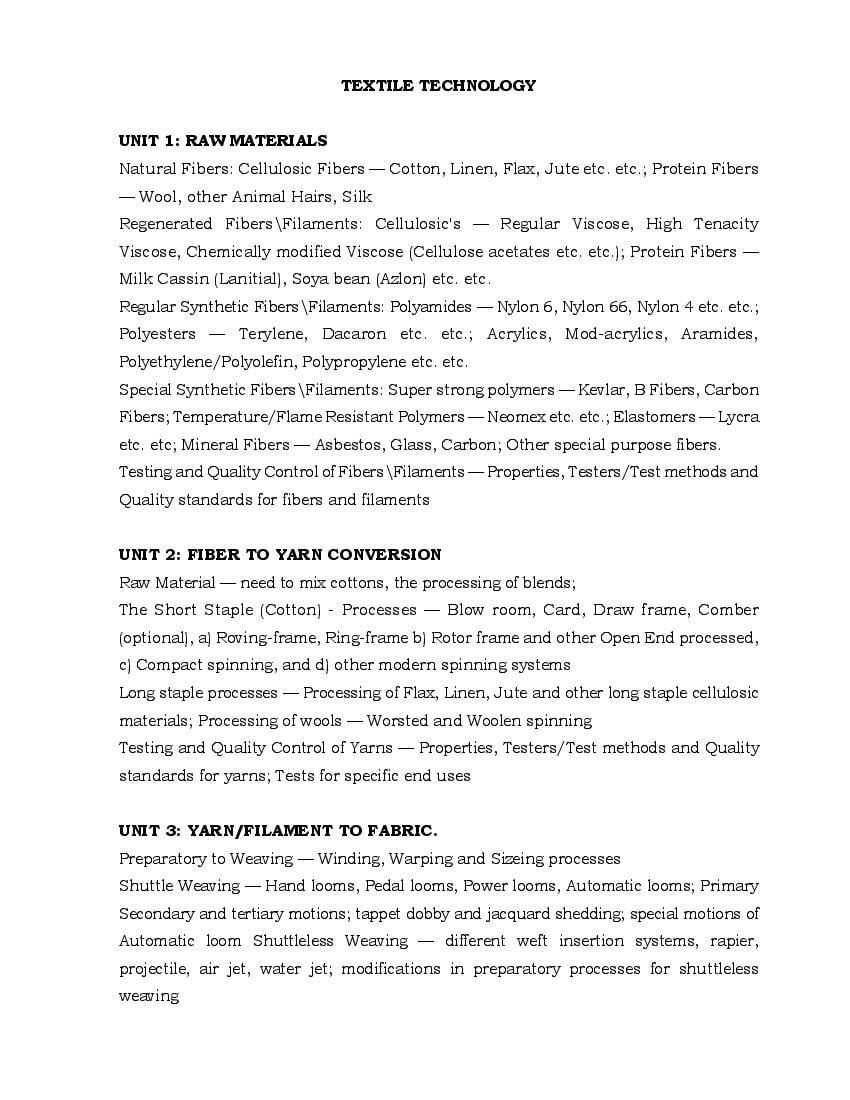
UNIT 1: RAW MATERIALS
Natural Fibers: Cellulosic Fibers — Cotton, Linen, Flax, Jute etc. etc.; Protein Fibers
— Wool, other Animal Hairs, Silk
Regenerated Fibers\Filaments: Cellulosic's — Regular Viscose, High Tenacity
Viscose, Chemically modified Viscose (Cellulose acetates etc. etc.); Protein Fibers —
Milk Cassin (Lanitial), Soya bean (Azlon) etc. etc.
Regular Synthetic Fibers\Filaments: Polyamides — Nylon 6, Nylon 66, Nylon 4 etc. etc.;
Polyesters — Terylene, Dacaron etc. etc.; Acrylics, Mod-acrylics, Aramides,
Polyethylene/Polyolefin, Polypropylene etc. etc.
Special Synthetic Fibers\Filaments: Super strong polymers — Kevlar, B Fibers, Carbon
Fibers; Temperature/Flame Resistant Polymers — Neomex etc. etc.; Elastomers — Lycra
etc. etc; Mineral Fibers — Asbestos, Glass, Carbon; Other special purpose fibers.
Testing and Quality Control of Fibers\Filaments — Properties, Testers/Test methods and
Quality standards for fibers and filaments
UNIT 2: FIBER TO YARN CONVERSION
Raw Material — need to mix cottons, the processing of blends;
The Short Staple (Cotton) - Processes — Blow room, Card, Draw frame, Comber
(optional), a) Roving-frame, Ring-frame b) Rotor frame and other Open End processed,
c) Compact spinning, and d) other modern spinning systems
Long staple processes — Processing of Flax, Linen, Jute and other long staple cellulosic
materials; Processing of wools — Worsted and Woolen spinning
Testing and Quality Control of Yarns — Properties, Testers/Test methods and Quality
standards for yarns; Tests for specific end uses
UNIT 3: YARN/FILAMENT TO FABRIC.
Preparatory to Weaving — Winding, Warping and Sizeing processes
Shuttle Weaving — Hand looms, Pedal looms, Power looms, Automatic looms; Primary
Secondary and tertiary motions; tappet dobby and jacquard shedding; special motions of
Automatic loom Shuttleless Weaving — different weft insertion systems, rapier,
projectile, air jet, water jet; modifications in preparatory processes for shuttleless
weaving
Page 2
Theory and Practice, Testing of knitted fabrics — properties-test methods, end uses of
knitted fabrics
Non Woven Fabric Preparation — different methods of producing non-woven fabrics,
Properties of non-woven fabrics, Testing of non-woven fabrics, end uses of nonwoven
fabrics
Testing and Quality Control of Fabrics — Properties, Testers/Test methods and Quality
standards for gray fabrics; Tests for specific end uses.
UNIT 4: WET PROCESSING
Desizeing — different methods
Scouring — processes for cotton wool and silk (ceresin removal)
Mercerising (fabrics with cotton only) — Slack and taut processes
Bleaching — Different bleaching agents and processes
Dyeing — Classes of dyes, linking dye classes to different fibers, dyeing processes
Printing — Manual — Stamp and Flat screen processes; Automatic — engraved roller
and screen roller systems, digital printing
Testing and Quality Control of Wet processing — Process Parameters and Properties,
Testers/Test methods and Quality standards for processes and finished fabrics;
Tests for specific end uses
UNIT 5: MANUFACTURE OF FILAMENT YARNS
Pre spinning Processes — Preparation of Polymer/Dope, Dope dyeing
Spinning Systems — Linking yarn types and spinning processes; Wet spinning, Melt
spinning, dry spinning — processes and parameters; Multistage (POY) process
Post Spinning Processes — Different types of texturistion, stress relaxation.
UNIT 6: MATHEMATICS AND COMPUTATION IN TEXTILES
Statistical description of test data — measures of central tendency and dispersion;
Objective tests of significance like "t", "F", Chi square and the Analysis of Variance;
Tests for analysis of subjective data; Correlation and Regression; Multivariate
statistical tools.
Fiber Calculations — Use of Linear programming (on k, u, s, m & f) to optimize cotton
mixing, draft calculations and settings
Page 3
charts; Fabric Calculations — Sizeing calculations; Computation of fabric
parameters from test results; computation of production figures.
Wet Processing Computation — Numerical color systems; Calculation of color recipes
(CIE method) and the adjustment of color recipes from trial dyeing; Computation of
material/Liquor ratios for multiple solutions.
UNIT 7: MECHANICS OF TEXTILE MACHINERY
Machinery calculations — Power storage and utilization calculations for textile
machines; Gear and Draft calculations for textile spinning machines; Statics and
kinetics of various sub systems of spinning preparatory and weaving machinery;
Balancing of rotating machine components; Cam design.
UNIT 8: TEXTILE PHYSICS
Bulk Properties of Textile materials — Length, breath and width / diameter, density,
moisture regain, thermal properties, electro-magnetic properties, tensile properties,
bending and buckling modulus, frictional behavior, torsion properties, abrasion
resistance and optical properties
Fine Structure — The theory of the structure of fibers at the crystal lattice level (fringed
micelle theory), amorphous and crystalline regions, degree of order, and orientation etc.
etc.; Explanation of bulk properties in terms of the fine structure properties and chemical
properties.
UNIT 9: TEXTILE CHEMISTRY
Chemistry of the structure of polymers — The chemistry of polymer forming
monomers; The polymerization process; Chemical properties of polymers and what
is required to have fiber forming capabilities Chemistry of the structure of dyes
— theory of chromophore groups, dye structure and affinity to fibrous materials
Chemistry of the dyeing process — Different types of dyeing processes; Physical and
chemical affinity, monderants etc etc; Molecular reasons for different types of affinity
between polymer and dye; Kinetics of dyeing, effects of temperature, Material/Liquor
ratio and time; retarding and accelerating agents
Page 4
Finance — Starting a new Textile Unit, Existing Unit - Raw material Purchase and
Inventory, New Machine Procurement, Power Costs Mill design — Design and
construction of spinning and weaving mills, Populating a new Mill - Balancing of
machinery calculations, Selection and purchase of Machinery Product Planning —
The Textile market, salability of different product, development and implementation of
yarn and fabric Production Plans Balancing of Machine Numbers — Machine/Staff
allocation to products
Textile costing — Cost estimation of different products, calculation of selling prices,
Estimation of marketability of products The Front Office — Management — Human
resources, hiring, salaries & benefits, promotion plans; Payroll data and disbursement,
Inventory control, Financial Records and analysis, Marketing.
Document Details
| Board / Org | Default |
| Exam | Govt Jobs Exams |
| Type | Syllabus |
| Pages | 4 |
| Updated | 15 Jul 2026 |