AHSEC 1st Year Syllabus Economic Geography
Finished viewing? Save it for later —
Download AHSEC 1st Year Syllabus Economic Geography (PDF · 3 pages)About AHSEC 1st Year Syllabus Economic Geography
AHSEC 1st Year Syllabus Economic Geography is available here for free download. Published by Assam Board for Class 11, this syllabus can be viewed online or downloaded as a PDF (3 pages). Candidates preparing for Class 11 can use AHSEC 1st Year Syllabus Economic Geography to understand the exam pattern, the type of questions asked, and the overall difficulty level.
Frequently Asked Questions
How can I download AHSEC 1st Year Syllabus Economic Geography?
Open this page and click the Download button to save AHSEC 1st Year Syllabus Economic Geography as a PDF. It is completely free on AglaSem Docs.
Is AHSEC 1st Year Syllabus Economic Geography free to download?
Yes. AHSEC 1st Year Syllabus Economic Geography can be viewed online and downloaded as a PDF free of cost on AglaSem Docs.
How many pages does AHSEC 1st Year Syllabus Economic Geography have?
AHSEC 1st Year Syllabus Economic Geography contains 3 pages, which you can read online or download together as a single PDF.
Where can I find more Class 11 study material?
You can find more Class 11 question papers, sample papers, syllabus, and answer keys on AglaSem Docs.
AHSEC 1st Year Syllabus Economic Geography – Text
Read the full text of this syllabus below — useful to quickly search, copy and reference the content online without downloading the PDF.
📄 View text version (3 pages)
Page 1
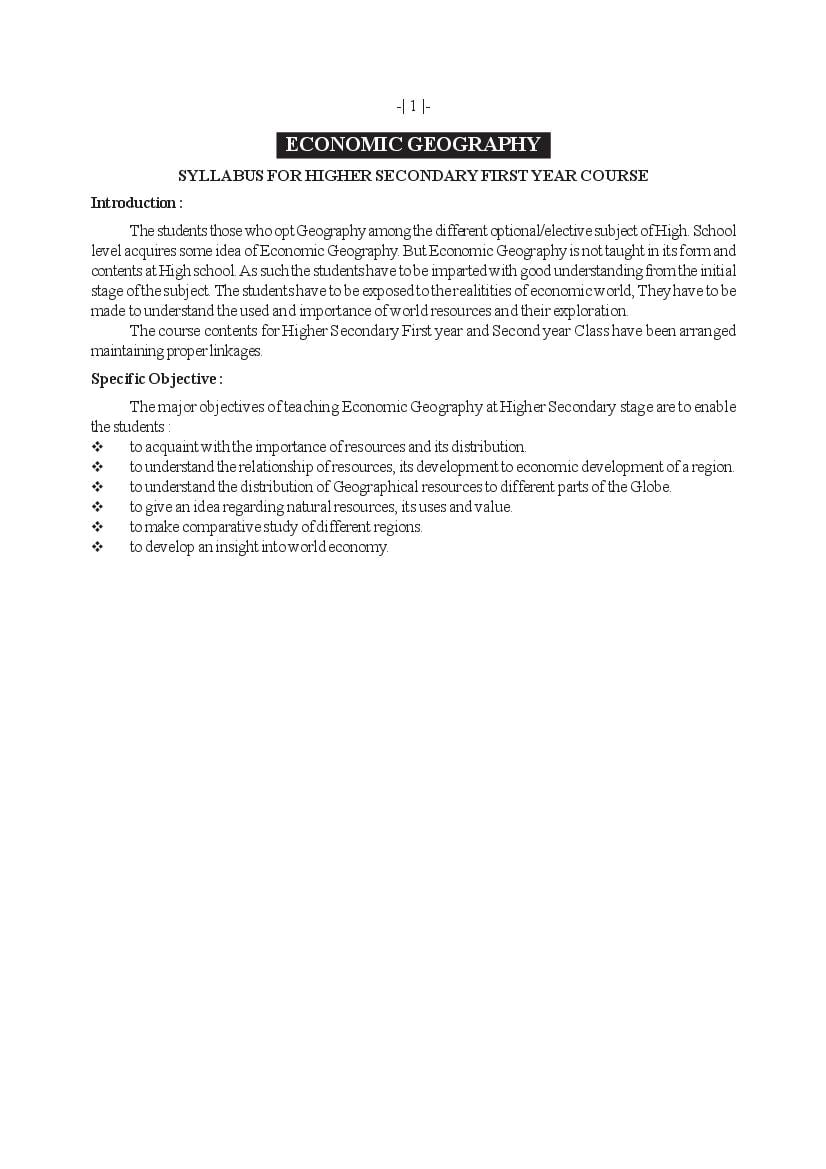
Introduction :
The students those who opt Geography among the different optional/elective subject of High. School
level acquires some idea of Economic Geography. But Economic Geography is not taught in its form and
contents at High school. As such the students have to be imparted with good understanding from the initial
stage of the subject. The students have to be exposed to the realitities of economic world, They have to be
made to understand the used and importance of world resources and their exploration.
The course contents for Higher Secondary First year and Second year Class have been arranged
maintaining proper linkages.
Specific Objective :
The major objectives of teaching Economic Geography at Higher Secondary stage are to enable
the students :
to acquaint with the importance of resources and its distribution.
to understand the relationship of resources, its development to economic development of a region.
to understand the distribution of Geographical resources to different parts of the Globe.
to give an idea regarding natural resources, its uses and value.
to make comparative study of different regions.
to develop an insight into world economy.
Page 2
One Paper Time : Three hours Marks : 100
Unitwise Distribution of Marks & Periods :
Unit Topics Marks Periods
Unit-1 Introduction 15 25
Unit-2 Principal types of World Climate 05 10
Unit-3 Resources 15 25
Unit-4 Agriculture 15 25
Unit-5 Minerals 10 20
Unit-6 Energy Resource 10 20
Unit-7 Manufacturing Industries 15 25
Unit-8 Trade and Transport 07 15
Unit-9 Port, Harbour and Hinterland 08 15
Total : 100 180
Unitwise Distribution of Course contents:
Unit-1 : Introduction : Marks : 15
Definition, nature, scope, importance and methodology of Economic Geography, Primary needs of
Man. Occupation of Man - primary, secondary and tertiary. Enyironment : physical and cultural,
Man's activities under different euvironrnental conditions.
Unit-2 : Principal types of World Climate : Marks : 05
Characteristics of equatorial, Monsoon and Mediterranean types of climate.
Unlt-3 : Resource : Marks : 15
(i) Human : A brief outline on the distribution and density of population.
Man-land ratio, Population density zones of the world. Population and economic development,
Concept of optimum population, over population and under population.
(ii) Forest : Equatorial : Temperate and Sub polar forests and their utilities. Tropical and Temperate
Grass land of the world. Dairying, sheep rearing and cattle rearing in different grassland regions of
the world.
Unit-4 : Agriculture : Types and Methods : Marks : 15
(i) Food crops : Rice and Wheat - geographical conditions for cultivation, production and international
trade.
(ii) Commercial crops : Tea, Coffee, Rubber. Sugarcane, Cotton and Jute-geographical conditions
for cultivation, production and international trade.
Page 3
Unit-5 : Minerals : Marks : 10
Iron ore, Aluminium and Mica-producing exporting and importing Countries of the world.
Unit-6 : Energy Resource : Marks : 10
Coal, Natural gas, Petroleum, Nuclear power and Hydro power- World Distribution and production.
Concept of Non-conventional energy.
Unit-7 : Manufacturing Industries : Marks : 15
Localization factors and Conditions for development of Iron and Steel, Cotton textile, Pulp and
Paper
Unit-8 : Trade and Transport : Marks : 07
Barter and sale- internal and external trade, bases of international trade, balance of trade, favourable
and unfavourable balances, balance of payments, terms of trade. Importance of transport- modes
of transport and their relative advantage and disadvantages, The Suez canal, the North Atlantic sea
route.
Unit-9 : Ports, Harbour and Hinterland : Marks : 08
Ports, Harbour and Hinterlans, conditions for development of a good sea port, Entreport, Free
port.
Document Details
| Board / Org | Assam Board |
| Exam | Class 11 |
| Type | Syllabus |
| Pages | 3 |
| Updated | 30 Apr 2026 |