AHSEC 1st Year Syllabus 2022 Economics
Finished viewing? Save it for later —
Download AHSEC 1st Year Syllabus 2022 Economics (PDF · 4 pages)About AHSEC 1st Year Syllabus 2022 Economics
AHSEC 1st Year Syllabus 2022 Economics is available here for free download. Published by Assam Board for Class 11, this syllabus can be viewed online or downloaded as a PDF (4 pages). Candidates preparing for Class 11 can use AHSEC 1st Year Syllabus 2022 Economics to understand the exam pattern, the type of questions asked, and the overall difficulty level.
Frequently Asked Questions
How can I download AHSEC 1st Year Syllabus 2022 Economics?
Open this page and click the Download button to save AHSEC 1st Year Syllabus 2022 Economics as a PDF. It is completely free on AglaSem Docs.
Is AHSEC 1st Year Syllabus 2022 Economics free to download?
Yes. AHSEC 1st Year Syllabus 2022 Economics can be viewed online and downloaded as a PDF free of cost on AglaSem Docs.
How many pages does AHSEC 1st Year Syllabus 2022 Economics have?
AHSEC 1st Year Syllabus 2022 Economics contains 4 pages, which you can read online or download together as a single PDF.
Where can I find more Class 11 study material?
You can find more Class 11 question papers, sample papers, syllabus, and answer keys on AglaSem Docs.
AHSEC 1st Year Syllabus 2022 Economics – Text
Read the full text of this syllabus below — useful to quickly search, copy and reference the content online without downloading the PDF.
📄 View text version (4 pages)
Page 1
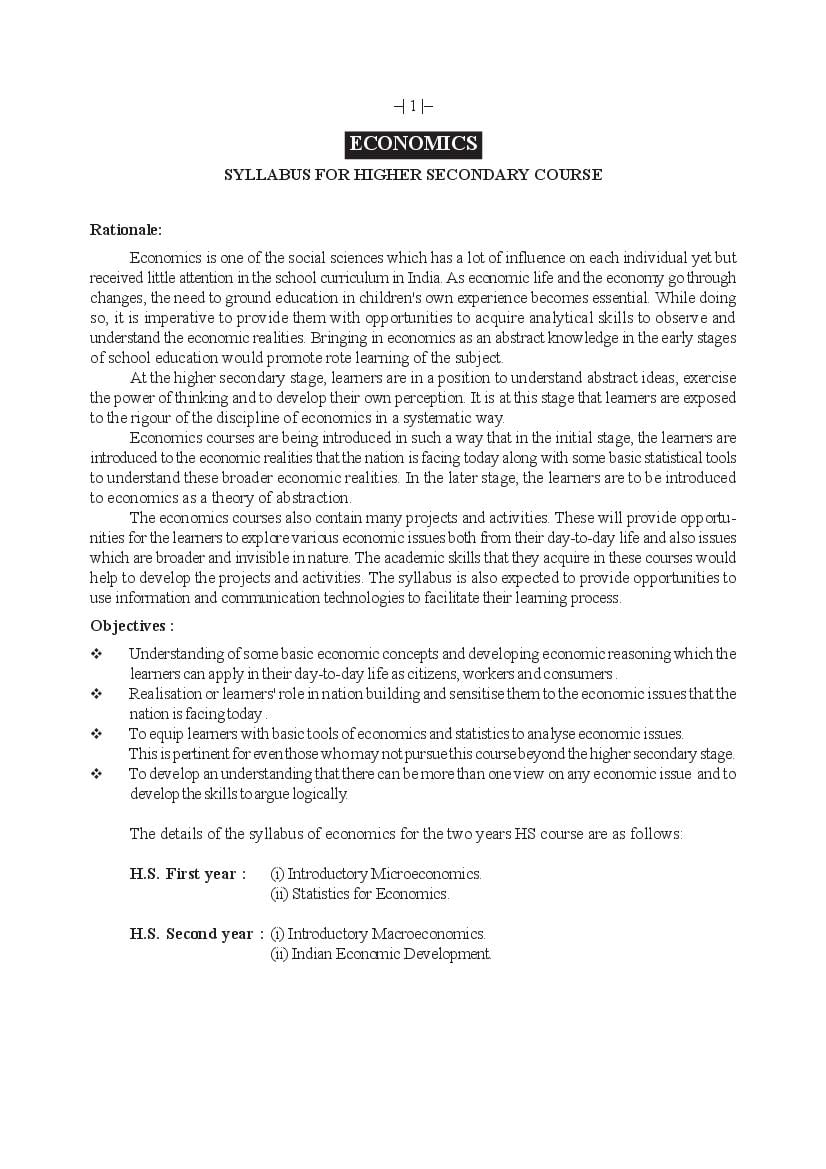
SYLLABUS FOR HIGHER SECONDARY COURSE
Rationale:
Economics is one of the social sciences which has a lot of influence on each individual yet but
received little attention in the school curriculum in India. As economic life and the economy go through
changes, the need to ground education in children's own experience becomes essential. While doing
so, it is imperative to provide them with opportunities to acquire analytical skills to observe and
understand the economic realities. Bringing in economics as an abstract knowledge in the early stages
of school education would promote rote learning of the subject.
At the higher secondary stage, learners are in a position to understand abstract ideas, exercise
the power of thinking and to develop their own perception. It is at this stage that learners are exposed
to the rigour of the discipline of economics in a systematic way.
Economics courses are being introduced in such a way that in the initial stage, the learners are
introduced to the economic realities that the nation is facing today along with some basic statistical tools
to understand these broader economic realities. In the later stage, the learners are to be introduced
to economics as a theory of abstraction.
The economics courses also contain many projects and activities. These will provide opportu-
nities for the learners to explore various economic issues both from their day-to-day life and also issues
which are broader and invisible in nature. The academic skills that they acquire in these courses would
help to develop the projects and activities. The syllabus is also expected to provide opportunities to
use information and communication technologies to facilitate their learning process.
Objectives :
Understanding of some basic economic concepts and developing economic reasoning which the
learners can apply in their day-to-day life as citizens, workers and consumers .
Realisation or learners' role in nation building and sensitise them to the economic issues that the
nation is facing today .
To equip learners with basic tools of economics and statistics to analyse economic issues.
This is pertinent for even those who may not pursue this course beyond the higher secondary stage.
To develop an understanding that there can be more than one view on any economic issue and to
develop the skills to argue logically.
The details of the syllabus of economics for the two years HS course are as follows:
H.S. First year : (i) Introductory Microeconomics.
(ii) Statistics for Economics.
H.S. Second year : (i) Introductory Macroeconomics.
(ii) Indian Economic Development.
Page 2
SYLLABUS FOR HIGHER SECONDARY FIRST YEAR COURSE
One Paper Time : Three hours Marks : 100
Unitwise Distribution of Marks & Periods :
Unit Topics Marks Periods
Part-A Introductory Microeconomics :
Unit-I Introduction 04 08
Unit-II Consumers Equilibrium and Demand 13 25
Unit-III Producer Behaviour and Supply 15 30
Unit-IV Forms of Market and Price Determination 10 20
Unit -V Simple Applications of Tools of Demand & Supply 08 12
Part-B Statics For Economics
Unit-VI Introduction 05 08
Unit-VII Collection, Organization & Presentation of Data 15 22
Unit-VIII Statistical Tools & Interpretation 30 55
Total : 100 180
Unitwise Distribution of Course Contents:
Part A : Introductory Microeconomics
This course introduces the learner to economics as a science of abstraction and reasoning. It
introduces some basic concepts and tools to understand economic issues of an individual or a firm and
how decisions are taken in variety of markets. It also intends to provide exposure to the learners on
how choices are more and how a variety of statistical tools are used to optimally allocate the resources.
Unit-I : Introduction : Marks : 04
What is microeconomics?
Central Problems of an economy, Production possibility curve and opportunity cost.
Unit-II : Consumers Equilibrium and Demand : Marks : 13
Consumer’s Equilibrium : Meaning and attainment of equilibrium through Utility Approach :
One and two commodity cases.
Demand : Concept of deman, Determination of demand, Demand schedule, Demand curve,
Market demand, Movement along and shifts in demand curve, Price elasticity of demand,
Measurement of price elasticity of demand– percentage, Total expenditure and geometric
methods.
Unit-III : Producer Behaviour and Supply : Marks : 15
Production funciton : Returns to factor and returns to scale.
Supply : Market supply, Determinants of suply, Supply schedule, Supply curve, Movement
Page 3
along and shifts in supply curve, Price elasticity of supply, Measurement of price elasticity of
supply- percentage and geometric methods.
Cost and Revenue : Concept of cost, Short run cost curve (fixed and variable cost, total,
average and marginal cost); concept of revenue – total, average adn marginal revenue and
their relatinship, Producer’s equilibrium – with the help of MC and MR.
Unit-IV : Forms of Market and Price Determination : Marks : 10
Forms of market – perfet competition, monopoly, monopolistic competition – their meaning
and features.
Price determination under perfect competition – equilibrium price, effects of shifts in demand
and supply.
Unit-V : Simple applications of Tools of Demand and Supply Curves : Marks : 08
Change in cost conditions and its impact on the form’s and market supply.
Geometric method to determine the elasticity of supply.
Effects of taxation : Per unit tax, Lump Sum Tax, Price ceiling and price floor.
Part B : Statistics for Economics
In this course, the learners are expected to acquire skills in collection, organisation of quantitative
and qualitative information pertainign to various, but simple, economic aspects systematicaly. It also
intends to provide some basic statistical tools to analyse and interpret any ecoomic information and
draw appropriate inerences. In this process, the learners are also expected to unvedrstand the behaviour
of various econoic data.
Unit-VI : Introduction : Marks : 05
Definition, nature and scope of economics.
Meaning and scope of statistics, importance of statistics in Economics.
Unit-VII : Collection and Organisation of Data : Marks : 15
Collection of data : Sources of data – Primary and Seocndary, Methods of collecting data.
Some important sources of secondary data : Census of India and National Sample Survey
Organisation.
Organisation of data : Meaning and types of variables; frequency distribution.
Presentation of data : Tabular and diagrammatic presentation of data :
(i) Geometric forms (bar diagrams and pie diagrams)
(ii) Frequency diagrams (histogram, polygon and ogive) and
(iii) Arithmetic line – Graphs (time series graph)
Unit-VIII : Statistical Tools and Interpretation : Marks : 30
Measures of Centra Tendency – mean (simple and weighted), median and mode.
Measures of Dispersion – absolute dispersion (range, quartile deviation, mean deviation and
standard deviation);
Relative dispersion (co-efficient of quartile deviation, co-efficent of mean deviaiton and co-
efficient of variation); Lorenz Curve : Meaning and its applicaiton.
Page 4
Correlation – meaning, scatter diagram, Measures of correlation – Karl Pearson’s Method
(Two variables ungrouped data) and Spearman’s rank correlation.
Introduction to Index Numbers : meaning, types – wholesale price index, consumer price
index of industrial production, uses of index numbers; Inflation and index numbers (For all the
numerical problems and solutions, the appropriate economic interpretation may be attempted.
This means that students need to solve the problems and provide interpretations for the
results derived)
Prescribed textbooks : 1. Microeconomics, Published by NCERT
2. Statistics for Economics, Published by NCERT
1. ¬ı…ø©Ü¬ı±√œ ’Ô«ø¬ı:±Ú ¬Ûø1‰¬˚˛, Published by AHSEC
2. ’Ô«ÚœøÓ¬1 ¬ı±À¬ı ¬Ûø1¸—‡…±, Published by AHSEC
[Note : The textbooks are available in Bangla Medium also]
Document Details
| Board / Org | Assam Board |
| Exam | Class 11 |
| Type | Syllabus |
| Pages | 4 |
| Updated | 30 Apr 2026 |