NIOS Class 10 Question Paper 2023 Psychology
Finished viewing? Save it for later —
Download NIOS Class 10 Question Paper 2023 Psychology (PDF · 24 pages)About NIOS Class 10 Question Paper 2023 Psychology
NIOS Class 10 Question Paper 2023 Psychology is available here for free download. Published by NIOS for National Institute of Open Schooling Class 10, this question paper can be viewed online or downloaded as a PDF (24 pages). Candidates preparing for National Institute of Open Schooling Class 10 can use NIOS Class 10 Question Paper 2023 Psychology to understand the exam pattern, the type of questions asked, and the overall difficulty level.
Frequently Asked Questions
How can I download NIOS Class 10 Question Paper 2023 Psychology?
Open this page and click the Download button to save NIOS Class 10 Question Paper 2023 Psychology as a PDF. It is completely free on AglaSem Docs.
Is NIOS Class 10 Question Paper 2023 Psychology free to download?
Yes. NIOS Class 10 Question Paper 2023 Psychology can be viewed online and downloaded as a PDF free of cost on AglaSem Docs.
How many pages does NIOS Class 10 Question Paper 2023 Psychology have?
NIOS Class 10 Question Paper 2023 Psychology contains 24 pages, which you can read online or download together as a single PDF.
Where can I find more National Institute of Open Schooling Class 10 study material?
You can find more National Institute of Open Schooling Class 10 question papers, sample papers, syllabus, and answer keys on AglaSem Docs.
NIOS Class 10 Question Paper 2023 Psychology – Text
Read the full text of this question paper below — useful to quickly search, copy and reference the content online without downloading the PDF.
📄 View text version (24 pages)
Page 1
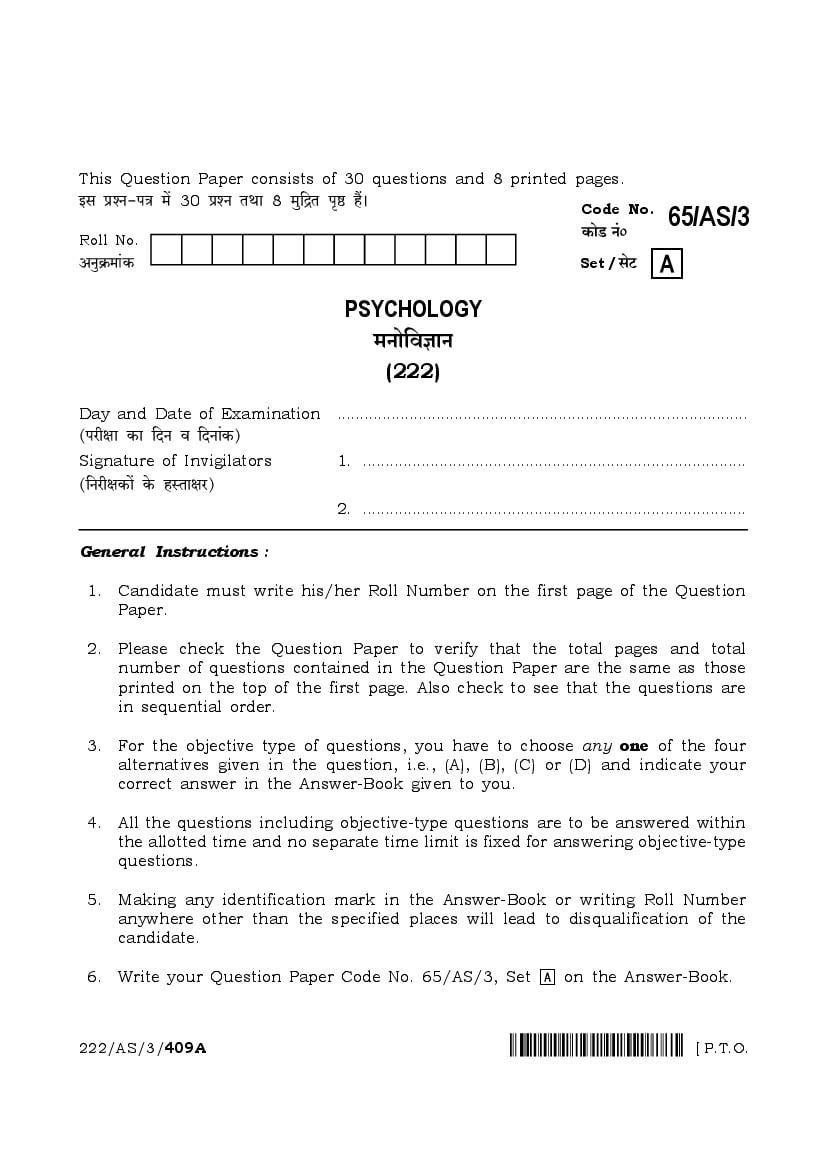
Bg àíZ-nÌ ‘| 30 àíZ VWm 8 ‘w{ÐV n¥ð> h¢& Code No.
H$moS> Z§0
65/AS/3
u
Roll No.
AZwH«$‘m§H$ Set / goQ>
PSYCHOLOGY
‘Zmo{dkmZ
(222)
Day and Date of Examination ...........................................................................................
(narjm H$m {XZ d {XZm§H$)
Signature of Invigilators 1. .....................................................................................
({ZarjH$m| Ho$ hñVmja)
2. .....................................................................................
General Instructions :
1. Candidate must write his/her Roll Number on the first page of the Question
Paper.
2. Please check the Question Paper to verify that the total pages and total
number of questions contained in the Question Paper are the same as those
printed on the top of the first page. Also check to see that the questions are
in sequential order.
3. For the objective type of questions, you have to choose any one of the four
alternatives given in the question, i.e., (A), (B), (C) or (D) and indicate your
correct answer in the Answer-Book given to you.
4. All the questions including objective-type questions are to be answered within
the allotted time and no separate time limit is fixed for answering objective-type
questions.
5. Making any identification mark in the Answer-Book or writing Roll Number
anywhere other than the specified places will lead to disqualification of the
candidate.
6. Write your Question Paper Code No. 65/AS/3, Set u on the Answer-Book.
222/AS/3/409A [ P.T.O.
Page 2
wish, you can answer in any one of the languages listed below :
English, Hindi, Urdu, Punjabi, Bengali, Tamil, Malayalam, Kannada,
Telugu, Marathi, Odia, Gujarati, Konkani, Manipuri, Assamese, Nepali,
Kashmiri, Sanskrit and Sindhi.
You are required to indicate the language you have chosen to answer in
the box provided in the Answer-Book.
(b) If you choose to write the answer in the language other than Hindi and
English, the responsibility for any errors/mistakes in understanding the
questions will be yours only.
gm‘mݶ AZwXoe …
1. narjmWu àíZ-nÌ Ho$ nhbo n¥ð> na AnZm AZwH«$‘m§H$ Adí¶ {bI|&
2. H¥$n¶m àíZ-nÌ H$mo Om±M b| {H$ àíZ-nÌ Ho$ Hw$b n¥ð>m| VWm àíZm| H$s CVZr hr g§»¶m h¡ {OVZr àW‘ n¥ð> Ho$ g~go
D$na N>nr h¡& Bg ~mV H$s Om±M ^r H$a b| {H$ àíZ H«${‘H$ ê$n ‘| h¢&
3. dñVw{Zð> àíZm| _o§ AmnH$mo Mma {dH$ënm| (A), (B), (C) VWm (D) _| go H$moB© EH$ CÎma MwZZm h¡ VWm Xr JB©
CÎma-nwpñVH$m _| Amn ghr CÎma {bI|Ÿ&
4. dñVw{Zð> àíZm| Ho$ gmW-gmW g^r àíZm| Ho$ CÎma {ZYm©[aV Ad{Y Ho$ ^rVa hr XoZo h¢Ÿ& dñVw{Zð> àíZm| Ho$ {bE AbJ
go g_` Zht {X`m OmEJmŸ&
5. CÎma-nwpñVH$m ‘| nhMmZ-{M• ~ZmZo AWdm {Z{X©ï> ñWmZm| Ho$ A{V[aº$ H$ht ^r AZwH«$‘m§H$ {bIZo na narjmWu H$mo
A¶mo½¶ R>ham¶m Om¶oJm&
6. AnZr CÎma-nwpñVH$m na àíZ-nÌ H$m H$moS> Z§0 65/AS/3, goQ u, {bI|&
7. (H$) n«íZ-nÌ Ho$db {hÝXr/A§J«oOr ‘| h¡& {’$a ^r, ¶{X Amn Mmh| Vmo ZrMo Xr JB© {H$gr EH$ ^mfm ‘| CÎma Xo
gH$Vo h¢ …
A§J«oOr, {hÝXr, CXÿ©, n§Om~r, ~§Jbm, V{‘b, ‘b¶mb‘, H$Þ‹S>, VobwJy, ‘amR>r, C{‹S>¶m, JwOamVr, H$m|H$Ur,
‘{Unwar, Ag{‘¶m, Zonmbr, H$í‘rar, g§ñH¥$V Am¡a {gÝYr&
H¥$n¶m CÎma-nwpñVH$m ‘| {XE JE ~m°³g ‘| {bI| {H$ Amn {H$g ^mfm ‘| CÎma {bI aho h¢&
(I) ¶{X Amn {hÝXr Ed§ A§J«oOr Ho$ A{V[aº$ {H$gr Aݶ ^mfm ‘| CÎma {bIVo h¢, Vmo àíZm| H$mo g‘PZo ‘| hmoZo dmbr
Ìw{Q>¶m|/Jb{V¶m| H$s {Oå‘oXmar Ho$db AmnH$s hmoJr&
222/AS/3/409A 2
Page 3
‘Zmo{dkmZ
(222)
Time : 3 Hours ] [ Maximum Marks : 100
g‘¶ … 3 KÊQ>o ] [ nyUmªH$ … 100
Note : (i) All questions are compulsory.
(ii) Marks for each question are indicated against it.
(iii) Question Nos. 1 to 6 are very short answer questions carrying 1 mark
each. Answer these questions as required.
(iv) Question Nos. 7 to 12 are short answer questions type I carrying
2 marks each. Answer to these questions should not exceed 25 words
each.
(v) Question Nos. 13 to 25 are short answer questions type II carrying
4 marks each. Answer to these questions should not exceed 80
words each.
(vi) Question Nos. 26 to 30 are long answer questions carrying 6 marks
each. Answer to these questions should not exceed 150 words each.
{ZX}e … (i) g^r àíZ A{Zdm¶© h¡§&
(ii) à˶oH$ àíZ Ho$ A§H$ CgHo$ gm‘Zo {XE JE h¢&
(iii) àíZ g§»¶m 1 go 6 A{V bKw-CÎmar¶ àíZ h¢, {OZ‘| go à˶oH$ 1 A§H$ H$m h¡& BZHo$ CÎma
Amdí¶H$VmZwgma Xr{OE&
(iv) àíZ g§»¶m 7 go 12 bKw-CÎmar¶ àíZ àH$ma I h¢, {OZ‘| go à˶oH$ 2 A§H$ H$m h¡& BZ‘|
go à˶oH$ àíZ H$m CÎma 25 eãXm| go A{YH$ H$m Zht hmoZm Mm{hE&
(v) àíZ g§»¶m 13 go 25 bKw-CÎmar¶ àíZ àH$ma II h¢, {OZ‘| go à˶oH$ 4 A§H$ H$m h¡& BZ‘|
go à˶oH$ àíZ H$m CÎma 80 eãXm| go A{YH$ H$m Zht hmoZm Mm{hE&
(vi) àíZ g§»¶m 26 go 30 XrK©-CÎmar¶ àíZ h¢, {OZ‘| go à˶oH$ 6 A§H$ H$m h¡& BZ‘| go à˶oH$
àíZ H$m CÎma 150 eãXm| go A{YH$ H$m Zht hmoZm Mm{hE&
222/AS/3/409A 3 [ P.T.O.
Page 4
reproductive maturity is called
(A) childhood
(B) adulthood
(C) adolescence
(D) old age 1
OrdZ H$s {Og Ad{Y ‘| hmoZo dmbo emar[aH$ n[adV©Z ¶m¡Z n[an¹$Vm H$s Amoa g§Ho$V H$aVo h¢, Cgo H$hm
OmVm h¡
(A) ~më¶mdñWm
(B) àm¡‹T>mdñWm
(C) {H$emoamdñWm
(D) d¥ÕmdñWm
2. The category of disorder, in which the person is unable to recall important
personal information after stressful episode, is termed as
(A) multiple personality disorder
(B) depersonalization
(C) dissociative fugue
(D) dissociative amnesia 1
‘Zmo{dH$ma H$m EH$ dJ©, {Og‘| ì¶{º$ Am‘Vm¡a na {H$gr VZmdnyU© KQ>Zm Ho$ ~mX ‘hÎdnyU© ì¶{º$JV
gyMZm H$mo ¶mX H$aZo ‘| Ag‘W© hmo OmVm h¡, H$hbmVm h¡
(A) ~hþ-ì¶{º$Ëd {dH$ma
(B) ì¶{º$Ëd-bmon {dH$ma
(C) {dKQ>Zerb nhMmZ
(D) {dKQ>Zerb ñ‘¥{Vbmon
3. Which of the following tests uses ambiguous, vague and unstructured
stimuli such as pictures, inkblots, drawings and incomplete sentences? 1
(A) Verbal test
(B) Non-verbal test
(C) Projective test
(D) Objective test
222/AS/3/409A 4
Page 5
H$o$ Yã~o, aoIm{MÌ VWm AnyU© dm³¶m| H$m Cn¶moJ {H$¶m OmVm h¡?
(A) empãXH$ narjU
(B) AempãXH$ narjU
(C) àjonr narjU
(D) dñVw{Zð> narjU
4. Out of the following, which leadership style uses rewards and threats to
enforce the orders? 1
(A) Authoritarian
(B) Paternalistic
(C) Consultative
(D) Participative
AmXoem| H$mo bmJy H$aZo Ho$ {bE nwañH$ma Am¡a ^¶ XmoZm| H$m Cn¶moJ {ZåZ{b{IV ‘| go {H$g ZoV¥Ëd-
e¡br ‘| {H$¶m OmVm h¡?
(A) gÎmmdmXr
(B) {nV¥gwb^
(C) ‘§ÌUmË‘H$
(D) gh^mJr
5. ‘Working memory’ is often used synonymously with
(A) sensory memory
(B) short-term memory
(C) long-term memory
(D) meta memory 1
"H$m¶©H$mar ñ‘¥{V' H$m Cn¶moJ àm¶… {H$gHo$ n¶m©¶dmMr Ho$ ê$n ‘| {H$¶m OmVm h¡?
(A) g§doXr ñ‘¥{V
(B) AënH$m{bH$ ñ‘¥{V
(C) XrK©H$m{bH$ ñ‘¥{V
(D) ‘oQ>m ñ‘¥{V
222/AS/3/409A 5 [ P.T.O.
Page 6
(A) counterfactual thinking
(B) positive bias
(C) negative bias
(D) thought suppression 1
O~ h‘ Hw$N> àH$aUm| Ho$ g§~§Y ‘| ñd¶§ H$mo qMVZ go amoH$Vo h¢, h‘ em{‘b hmoVo h¢
(A) AdmñV{dH$ qMVZ ‘|
(B) gH$mamË‘H$ njnmV ‘|
(C) ZH$mamË‘H$ njnmV ‘|
(D) {dMma X‘Z ‘|
7. What is psychological assessment? 2
‘Zmod¡km[ZH$ ‘yë¶m§H$Z ³¶m h¡?
8. What are the possible characteristics of a creative person? 2
EH$ gO©ZmË‘H$ ì¶{º$ H$s g§^m{dV {deofVmE± ³¶m h¢?
9. What do you understand by the term ‘health’? 2
‘ ñdmñ϶’ eãX go Amn ³¶m g‘PVo h¢?
10. Explain how psychological interventions are helpful for a deprived
person. 2
ñnï> H$s{OE {H$ ‘Zmod¡km{ZH$ hñVjon {H$g àH$ma EH$ d§{MV ì¶{º$ Ho$ {bE ghm¶H$ hmoVo h¢&
11. Explain the term ‘self-actualization’. 2
"AmË‘-¶WmWuH$aU' eãX H$s ì¶m»¶m H$s{OE&
12. Describe the concepts of ‘motives’ and ‘needs’. 2
"A{^àoaH$m|' Am¡a "Amdí¶H$VmAm|' Ho$ g§à˶¶m| H$m dU©Z H$s{OE&
222/AS/3/409A 6
Page 7
training. 4
{ejU ñWmZmÝVaU ³¶m h¡? BgHo$ ‘hÎd H$s ì¶m»¶m H$s{OE&
14. Describe ‘cohesiveness’ and ‘conformity’ with the help of examples. 4
"g§JVVm' Ed§ "gh‘{V' H$m CXmhaUm| H$s ghm¶Vm go dU©Z H$s{OE&
15. What do you understand by intelligence? Describe various types of
intelligence tests. 4
~w{Õ go Amn ³¶m g‘PVo h¢? {d{^Þ àH$ma Ho$ ~w{Õ narjUm| H$m dU©Z H$s{OE&
16. Discuss ‘greenhouse effect’. 4
‘J«rZhmCg à^md’ H$s ì¶m»¶m H$s{OE&
17. Describe the various physical changes that occur during adulthood and
old age. 4
àm¡‹T>mdñWm Ed§ d¥ÕmdñWm ‘| hmoZo dmbo {d{^Þ emar[aH$ n[adV©Zmo| H$m dU©Z H$s{OE&
18. Explain how biological approach studies the psychological processes. 4
ñnï> H$s{OE {H$ O¡{dH$ CnmJ‘, ‘Zmod¡km{ZH$ à{H«$¶mAm| H$m Aܶ¶Z {H$g àH$ma H$aVm h¡&
19. Identify and explain the key elements of communication. 4
g§àofU Ho$ ‘w»¶ VÎdm| H$s nhMmZ Ed§ ì¶m»¶m H$s{OE&
20. Describe the major symptoms of schizophrenia. 4
‘Zmo{dXbVm Ho$ à‘wI bjUm| H$m dU©Z H$s{OE&
21. “Yoga contributes to self-development.” Explain this statement. 4
‘‘¶moJ AmË‘-{dH$mg ‘| ghm¶H$ h¡&’’ Bg H$WZ H$s nw{ï> H$s{OE&
22. Describe the major domains of development. 4
{dH$mg Ho$ à‘wI joÌm| H$s MMm© H$s{OE&
222/AS/3/409A 7 [ P.T.O.
Page 8
‘‘mZ{gH$ Am¶w’ Am¡a ‘~w{Õ bpãY’ Ho$ g§à˶¶m| H$s ì¶m»¶m H$s{OE&
24. Discuss the various functions of attitude. Illustrate your answer with the
help of examples. 4
A{^d¥{Îm Ho$ {d{^Þ H$m¶m] H$s ì¶m»¶m H$s{OE& AnZo CÎma H$mo CXmhaUm| H$s ghm¶Vm go g‘PmBE&
25. Describe the following fields of psychology along with their applications : 4
(a) Clinical and Counselling Psychology
(b) Organizational Psychology
‘Zmo{dkmZ Ho$ {ZåZ{b{IV joÌm| H$m CZHo$ AZwà¶moJm| Ho$ gmW dU©Z H$s{OE :
(H$) Z¡Xm{ZH$ Am¡a nam‘e© ‘Zmo{dkmZ
(I) g§JR>ZmË‘H$ ‘Zmo{dkmZ
26. Describe the major socio-emotional development in middle childhood. 6
‘ܶ ~më¶mdñWm ‘| hmoZo dmbo à‘wI gm‘m{OH$-g§doJmË‘H$ {dH$mg H$m dU©Z H$s{OE&
27. What is happiness? Discuss the different ways to achieve happiness and
well-being. 6
àgÞVm ³¶m h¡? àgÞVm Am¡a H$ë¶mU H$mo àmá H$aZo Ho$ {d{^Þ Cnm¶m| H$s MMm© H$s{OE&
28. What steps should be followed to make a good career choice? Explain. 6
EH$ AÀN>m H$[a¶a {dH$ën MwZZo Ho$ {bE H$m¡Z-go H$X‘ CR>mZo Mm{hE? ì¶m»¶m H$s{OE&
29. What are the two main aspects of yoga? Explain the various types of
yoga. 6
¶moJ Ho$ H$m¡Z-go Xmo ‘w»¶ nhby h¢? ¶moJ Ho$ {d{^Þ àH$mamo§ H$s ì¶m»¶m H$s{OE&
30. Explain the concept of perception. Describe the various applications of
perception in everyday life. 6
à˶jrH$aU Ho$ g§à˶¶ H$s ì¶m»¶m H$s{OE& X¡{ZH$ OrdZ ‘| à˶jrH$aU Ho$ {d{^Þ AZwà¶moJmo§ H$m dU©Z
H$s{OE&
222/AS/3/409A [V23] 8
Page 9
Bg àíZ-nÌ ‘| 30 àíZ VWm 8 ‘w{ÐV n¥ð> h¢& Code No.
H$moS> Z§0
65/AS/3
v
Roll No.
AZwH«$‘m§H$ Set / goQ>
PSYCHOLOGY
‘Zmo{dkmZ
(222)
Day and Date of Examination ...........................................................................................
(narjm H$m {XZ d {XZm§H$)
Signature of Invigilators 1. .....................................................................................
({ZarjH$m| Ho$ hñVmja)
2. .....................................................................................
General Instructions :
1. Candidate must write his/her Roll Number on the first page of the Question
Paper.
2. Please check the Question Paper to verify that the total pages and total
number of questions contained in the Question Paper are the same as those
printed on the top of the first page. Also check to see that the questions are
in sequential order.
3. For the objective type of questions, you have to choose any one of the four
alternatives given in the question, i.e., (A), (B), (C) or (D) and indicate your
correct answer in the Answer-Book given to you.
4. All the questions including objective-type questions are to be answered within
the allotted time and no separate time limit is fixed for answering objective-type
questions.
5. Making any identification mark in the Answer-Book or writing Roll Number
anywhere other than the specified places will lead to disqualification of the
candidate.
6. Write your Question Paper Code No. 65/AS/3, Set v on the Answer-Book.
222/AS/3/409B [ P.T.O.
Page 10
wish, you can answer in any one of the languages listed below :
English, Hindi, Urdu, Punjabi, Bengali, Tamil, Malayalam, Kannada,
Telugu, Marathi, Odia, Gujarati, Konkani, Manipuri, Assamese, Nepali,
Kashmiri, Sanskrit and Sindhi.
You are required to indicate the language you have chosen to answer in
the box provided in the Answer-Book.
(b) If you choose to write the answer in the language other than Hindi and
English, the responsibility for any errors/mistakes in understanding the
questions will be yours only.
gm‘mݶ AZwXoe …
1. narjmWu àíZ-nÌ Ho$ nhbo n¥ð> na AnZm AZwH«$‘m§H$ Adí¶ {bI|&
2. H¥$n¶m àíZ-nÌ H$mo Om±M b| {H$ àíZ-nÌ Ho$ Hw$b n¥ð>m| VWm àíZm| H$s CVZr hr g§»¶m h¡ {OVZr àW‘ n¥ð> Ho$ g~go
D$na N>nr h¡& Bg ~mV H$s Om±M ^r H$a b| {H$ àíZ H«${‘H$ ê$n ‘| h¢&
3. dñVw{Zð> àíZm| _o§ AmnH$mo Mma {dH$ënm| (A), (B), (C) VWm (D) _| go H$moB© EH$ CÎma MwZZm h¡ VWm Xr JB©
CÎma-nwpñVH$m _| Amn ghr CÎma {bI|Ÿ&
4. dñVw{Zð> àíZm| Ho$ gmW-gmW g^r àíZm| Ho$ CÎma {ZYm©[aV Ad{Y Ho$ ^rVa hr XoZo h¢Ÿ& dñVw{Zð> àíZm| Ho$ {bE AbJ
go g_` Zht {X`m OmEJmŸ&
5. CÎma-nwpñVH$m ‘| nhMmZ-{M• ~ZmZo AWdm {Z{X©ï> ñWmZm| Ho$ A{V[aº$ H$ht ^r AZwH«$‘m§H$ {bIZo na narjmWu H$mo
A¶mo½¶ R>ham¶m Om¶oJm&
6. AnZr CÎma-nwpñVH$m na àíZ-nÌ H$m H$moS> Z§0 65/AS/3, goQ v, {bI|&
7. (H$) n«íZ-nÌ Ho$db {hÝXr/A§J«oOr ‘| h¡& {’$a ^r, ¶{X Amn Mmh| Vmo ZrMo Xr JB© {H$gr EH$ ^mfm ‘| CÎma Xo
gH$Vo h¢ …
A§J«oOr, {hÝXr, CXÿ©, n§Om~r, ~§Jbm, V{‘b, ‘b¶mb‘, H$Þ‹S>, VobwJy, ‘amR>r, C{‹S>¶m, JwOamVr, H$m|H$Ur,
‘{Unwar, Ag{‘¶m, Zonmbr, H$í‘rar, g§ñH¥$V Am¡a {gÝYr&
H¥$n¶m CÎma-nwpñVH$m ‘| {XE JE ~m°³g ‘| {bI| {H$ Amn {H$g ^mfm ‘| CÎma {bI aho h¢&
(I) ¶{X Amn {hÝXr Ed§ A§J«oOr Ho$ A{V[aº$ {H$gr Aݶ ^mfm ‘| CÎma {bIVo h¢, Vmo àíZm| H$mo g‘PZo ‘| hmoZo dmbr
Ìw{Q>¶m|/Jb{V¶m| H$s {Oå‘oXmar Ho$db AmnH$s hmoJr&
222/AS/3/409B 2
Page 11
‘Zmo{dkmZ
(222)
Time : 3 Hours ] [ Maximum Marks : 100
g‘¶ … 3 KÊQ>o ] [ nyUmªH$ … 100
Note : (i) All questions are compulsory.
(ii) Marks for each question are indicated against it.
(iii) Question Nos. 1 to 6 are very short answer questions carrying 1 mark
each. Answer these questions as required.
(iv) Question Nos. 7 to 12 are short answer questions type I carrying
2 marks each. Answer to these questions should not exceed 25 words
each.
(v) Question Nos. 13 to 25 are short answer questions type II carrying
4 marks each. Answer to these questions should not exceed 80
words each.
(vi) Question Nos. 26 to 30 are long answer questions carrying 6 marks
each. Answer to these questions should not exceed 150 words each.
{ZX}e … (i) g^r àíZ A{Zdm¶© h¡§&
(ii) à˶oH$ àíZ Ho$ A§H$ CgHo$ gm‘Zo {XE JE h¢&
(iii) àíZ g§»¶m 1 go 6 A{V bKw-CÎmar¶ àíZ h¢, {OZ‘| go à˶oH$ 1 A§H$ H$m h¡& BZHo$ CÎma
Amdí¶H$VmZwgma Xr{OE&
(iv) àíZ g§»¶m 7 go 12 bKw-CÎmar¶ àíZ àH$ma I h¢, {OZ‘| go à˶oH$ 2 A§H$ H$m h¡& BZ‘|
go à˶oH$ àíZ H$m CÎma 25 eãXm| go A{YH$ H$m Zht hmoZm Mm{hE&
(v) àíZ g§»¶m 13 go 25 bKw-CÎmar¶ àíZ àH$ma II h¢, {OZ‘| go à˶oH$ 4 A§H$ H$m h¡& BZ‘|
go à˶oH$ àíZ H$m CÎma 80 eãXm| go A{YH$ H$m Zht hmoZm Mm{hE&
(vi) àíZ g§»¶m 26 go 30 XrK©-CÎmar¶ àíZ h¢, {OZ‘| go à˶oH$ 6 A§H$ H$m h¡& BZ‘| go à˶oH$
àíZ H$m CÎma 150 eãXm| go A{YH$ H$m Zht hmoZm Mm{hE&
222/AS/3/409B 3 [ P.T.O.
Page 12
(A) selecting and preparing for an occupation
(B) achieving socially responsible behaviour
(C) achieving emotional independence
(D) All of the above 1
{H$emam| Ho$ {dH$mgmË‘H$ H$m¶m] ‘| gpå‘{bV h¡
(A) ì¶dgm¶ H$m M¶Z Am¡a V¡¶mar H$aZm
(B) gm‘m{OH$ ê$n go CÎmaXm¶r ì¶dhma àmá H$aZm
(C) g§doJmË‘H$ ñdV§ÌVm àmá H$aZm
(D) Cnamoº$ g^r
2. Out of the following, which leadership style uses rewards and threats to
enforce the orders? 1
(A) Authoritarian
(B) Paternalistic
(C) Consultative
(D) Participative
AmXoem| H$mo bmJy H$aZo Ho$ {bE nwañH$ma Am¡a ^¶ XmoZm| H$m Cn¶moJ {ZåZ{b{IV ‘| go {H$g ZoV¥Ëd-
e¡br ‘| {H$¶m OmVm h¡?
(A) gÎmmdmXr
(B) {nV¥gwb^
(C) ‘§ÌUmË‘H$
(D) gh^mJr
3. Which of the following methods of data collection studies the effect of one
variable on another variable by manipulating one and controlling other
variables? 1
(A) Observation
(B) Experimentation
(C) Case study
(D) Survey
222/AS/3/409B 4
Page 13
H$a, Xÿgao Ma na BgHo$ à^md H$m Aܶ¶Z H$aVr h¡?
(A) AdbmoH$Z
(B) àm¶mo{JH$
(C) ì¶{º$ Aܶ¶Z
(D) gd}jU
4. The category of disorder, in which the person is unable to recall important
personal information after stressful episode, is termed as
(A) multiple personality disorder
(B) depersonalization
(C) dissociative fugue
(D) dissociative amnesia 1
‘Zmo{dH$ma H$m EH$ dJ©, {Og‘| ì¶{º$ Am‘Vm¡a na {H$gr VZmdnyU© KQ>Zm Ho$ ~mX ‘hÎdnyU© ì¶{º$JV
gyMZm H$mo ¶mX H$aZo ‘| Ag‘W© hmo OmVm h¡, H$hbmVm h¡
(A) ~hþ-ì¶{º$Ëd {dH$ma
(B) ì¶{º$Ëd-bmon {dH$ma
(C) {dKQ>Zerb nhMmZ
(D) {dKQ>Zerb ñ‘¥{Vbmon
5. Which memory system allows us to remember factual information making
it possible to learn different subjects? 1
(A) Sensory memory
(B) Short-term memory
(C) Long-term memory
(D) Working memory
H$m¡Z-gr ñ‘¥{V àUmbr h‘| CZ V϶mË‘H$ gyMZmAm| H$mo ¶mX aIZo H$s AZw‘{V XoVr h¡, {OZHo$ H$maU
{d{^Þ {df¶m| H$mo grIZm g§^d hmoVm h¡?
(A) g§doXr ñ‘¥{V
(B) AënH$m{bH$ ñ‘¥{V
(C) XrK©H$m{bH$ ñ‘¥{V
(D) H$m¶©H$mar ñ‘¥{V
222/AS/3/409B 5 [ P.T.O.
Page 14
(A) counterfactual thinking
(B) positive bias
(C) negative bias
(D) thought suppression 1
O~ h‘ Hw$N> àH$aUm| Ho$ g§~§Y ‘| ñd¶§ H$mo qMVZ go amoH$Vo h¢, h‘ em{‘b hmoVo h¢
(A) AdmñV{dH$ qMVZ ‘|
(B) gH$mamË‘H$ njnmV ‘|
(C) ZH$mamË‘H$ njnmV ‘|
(D) {dMma X‘Z ‘|
7. Differentiate between ‘aptitude’ and ‘achievement’. 2
‘A{^j‘Vm’ Am¡a ‘CnbpãY’ Ho$ A§Va H$mo ñnï> H$s{OE&
8. What is creativity? 2
‘gO©ZmË‘H$Vm’ ³¶m h¡?
9. Describe the concepts of ‘motives’ and ‘needs’. 2
"A{^àoaH$m|' Am¡a "Amdí¶H$VmAm|' Ho$ g§à˶¶m| H$m dU©Z H$s{OE&
10. Explain the term ‘self-actualization’. 2
"AmË‘-¶WmWuH$aU' eãX H$s ì¶m»¶m H$s{OE&
11. Explain how psychological interventions are helpful for a deprived
person. 2
ñnï> H$s{OE {H$ ‘Zmod¡km{ZH$ hñVjon {H$g àH$ma EH$ d§{MV ì¶{º$ Ho$ {bE ghm¶H$ hmoVo h¢&
12. What do you understand by the term ‘health’? 2
‘ ñdmñ϶’ eãX go Amn ³¶m g‘PVo h¢?
222/AS/3/409B 6
Page 15
conditioning. 4
nwZ~©bZ Ho$ ‘w»¶ àH$ma ³¶m h¢? {H«$¶màgyV AZw~ÝYZ ‘| CZH$s ^y{‘H$m H$mo g‘PmBE&
14. Describe the following fields of psychology along with their applications : 4
(a) Clinical and Counselling Psychology
(b) Organizational Psychology
‘Zmo{dkmZ Ho$ {ZåZ{b{IV joÌm| H$m CZHo$ AZwà¶moJm| Ho$ gmW dU©Z H$s{OE :
(H$) Z¡Xm{ZH$ Am¡a nam‘e© ‘Zmo{dkmZ
(I) g§JR>ZmË‘H$ ‘Zmo{dkmZ
15. Explain the nature of individual differences. 4
d¡¶{º$H$ {^ÞVmAm| H$s àH¥${V H$s ì¶m»¶m H$s{OE&
16. Discuss the various functions of attitude. Illustrate your answer with the
help of examples. 4
A{^d¥{Îm Ho$ {d{^Þ H$m¶m] H$s ì¶m»¶m H$s{OE& AnZo CÎma H$mo CXmhaUm| H$s ghm¶Vm go g‘PmBE&
17. Explain the concepts of ‘mental age’ and ‘intelligence quotient’. 4
‘‘mZ{gH$ Am¶w’ Am¡a ‘~w{Õ bpãY’ Ho$ g§à˶¶m| H$s ì¶m»¶m H$s{OE&
18. “Yoga contributes to self-development.” Explain this statement. 4
‘‘¶moJ AmË‘-{dH$mg ‘| ghm¶H$ h¡&’’ Bg H$WZ H$s nw{ï> H$s{OE&
19. Describe the major symptoms of schizophrenia. 4
‘Zmo{dXbVm Ho$ à‘wI bjUm| H$m dU©Z H$s{OE&
20. Identify and explain the key elements of communication. 4
g§àofU Ho$ ‘w»¶ VÎdm| H$s nhMmZ Ed§ ì¶m»¶m H$s{OE&
21. Explain how biological approach studies the psychological processes. 4
ñnï> H$s{OE {H$ O¡{dH$ CnmJ‘, ‘Zmod¡km{ZH$ à{H«$¶mAm| H$m Aܶ¶Z {H$g àH$ma H$aVm h¡&
222/AS/3/409B 7 [ P.T.O.
Page 16
important.” Justify this statement. 4
‘‘{dH$mg Ho$ {gÕm§Vmo§ Am¡a {ZYm©aH$m| H$s g‘P ‘hÎdnyU© h¡&’’ Bg H$WZ H$s nw{ï> H$s{OE&
23. Describe the various physical changes that occur during adulthood and
old age. 4
àm¡‹T>mdñWm Ed§ d¥ÕmdñWm ‘| hmoZo dmbo {d{^Þ emar[aH$ n[adV©Zmo| H$m dU©Z H$s{OE&
24. Discuss ‘greenhouse effect’. 4
‘J«rZhmCg à^md’ H$s ì¶m»¶m H$s{OE&
25. Describe ‘cohesiveness’ and ‘conformity’ with the help of examples. 4
"g§JVVm' Ed§ "gh‘{V' H$m CXmhaUm| H$s ghm¶Vm go dU©Z H$s{OE&
26. Describe the main features of physical and motor development in middle
childhood. 6
‘ܶ ~më¶mdñWm ‘| hmoZo dmbo à‘wI emar[aH$ Ed§ J{VH$ {dH$mg H$s ‘w»¶ {deofVmAm| H$m dU©Z H$s{OE&
27. Explain the concept of perception. Describe the various applications of
perception in everyday life. 6
à˶jrH$aU Ho$ g§à˶¶ H$s ì¶m»¶m H$s{OE& X¡{ZH$ OrdZ ‘| à˶jrH$aU Ho$ {d{^Þ AZwà¶moJmo§ H$m dU©Z
H$s{OE&
28. What are the two main aspects of yoga? Explain the various types of
yoga. 6
¶moJ Ho$ H$m¡Z-go Xmo ‘w»¶ nhby h¢? ¶moJ Ho$ {d{^Þ àH$mamo§ H$s ì¶m»¶m H$s{OE&
29. What steps should be followed to make a good career choice? Explain. 6
EH$ AÀN>m H$[a¶a {dH$ën MwZZo Ho$ {bE H$m¡Z-go H$X‘ CR>mZo Mm{hE? ì¶m»¶m H$s{OE&
30. What is happiness? Discuss the different ways to achieve happiness and
well-being. 6
àgÞVm ³¶m h¡? àgÞVm Am¡a H$ë¶mU H$mo àmá H$aZo Ho$ {d{^Þ Cnm¶m| H$s MMm© H$s{OE&
222/AS/3/409B [V23] 8
Page 17
Bg àíZ-nÌ ‘| 30 àíZ VWm 8 ‘w{ÐV n¥ð> h¢& Code No.
H$moS> Z§0
65/AS/3
w
Roll No.
AZwH«$‘m§H$ Set / goQ>
PSYCHOLOGY
‘Zmo{dkmZ
(222)
Day and Date of Examination ...........................................................................................
(narjm H$m {XZ d {XZm§H$)
Signature of Invigilators 1. .....................................................................................
({ZarjH$m| Ho$ hñVmja)
2. .....................................................................................
General Instructions :
1. Candidate must write his/her Roll Number on the first page of the Question
Paper.
2. Please check the Question Paper to verify that the total pages and total
number of questions contained in the Question Paper are the same as those
printed on the top of the first page. Also check to see that the questions are
in sequential order.
3. For the objective type of questions, you have to choose any one of the four
alternatives given in the question, i.e., (A), (B), (C) or (D) and indicate your
correct answer in the Answer-Book given to you.
4. All the questions including objective-type questions are to be answered within
the allotted time and no separate time limit is fixed for answering objective-type
questions.
5. Making any identification mark in the Answer-Book or writing Roll Number
anywhere other than the specified places will lead to disqualification of the
candidate.
6. Write your Question Paper Code No. 65/AS/3, Set w on the Answer-Book.
222/AS/3/409C [ P.T.O.
Page 18
wish, you can answer in any one of the languages listed below :
English, Hindi, Urdu, Punjabi, Bengali, Tamil, Malayalam, Kannada,
Telugu, Marathi, Odia, Gujarati, Konkani, Manipuri, Assamese, Nepali,
Kashmiri, Sanskrit and Sindhi.
You are required to indicate the language you have chosen to answer in
the box provided in the Answer-Book.
(b) If you choose to write the answer in the language other than Hindi and
English, the responsibility for any errors/mistakes in understanding the
questions will be yours only.
gm‘mݶ AZwXoe …
1. narjmWu àíZ-nÌ Ho$ nhbo n¥ð> na AnZm AZwH«$‘m§H$ Adí¶ {bI|&
2. H¥$n¶m àíZ-nÌ H$mo Om±M b| {H$ àíZ-nÌ Ho$ Hw$b n¥ð>m| VWm àíZm| H$s CVZr hr g§»¶m h¡ {OVZr àW‘ n¥ð> Ho$ g~go
D$na N>nr h¡& Bg ~mV H$s Om±M ^r H$a b| {H$ àíZ H«${‘H$ ê$n ‘| h¢&
3. dñVw{Zð> àíZm| _o§ AmnH$mo Mma {dH$ënm| (A), (B), (C) VWm (D) _| go H$moB© EH$ CÎma MwZZm h¡ VWm Xr JB©
CÎma-nwpñVH$m _| Amn ghr CÎma {bI|Ÿ&
4. dñVw{Zð> àíZm| Ho$ gmW-gmW g^r àíZm| Ho$ CÎma {ZYm©[aV Ad{Y Ho$ ^rVa hr XoZo h¢Ÿ& dñVw{Zð> àíZm| Ho$ {bE AbJ
go g_` Zht {X`m OmEJmŸ&
5. CÎma-nwpñVH$m ‘| nhMmZ-{M• ~ZmZo AWdm {Z{X©ï> ñWmZm| Ho$ A{V[aº$ H$ht ^r AZwH«$‘m§H$ {bIZo na narjmWu H$mo
A¶mo½¶ R>ham¶m Om¶oJm&
6. AnZr CÎma-nwpñVH$m na àíZ-nÌ H$m H$moS> Z§0 65/AS/3, goQ w, {bI|&
7. (H$) n«íZ-nÌ Ho$db {hÝXr/A§J«oOr ‘| h¡& {’$a ^r, ¶{X Amn Mmh| Vmo ZrMo Xr JB© {H$gr EH$ ^mfm ‘| CÎma Xo
gH$Vo h¢ …
A§J«oOr, {hÝXr, CXÿ©, n§Om~r, ~§Jbm, V{‘b, ‘b¶mb‘, H$Þ‹S>, VobwJy, ‘amR>r, C{‹S>¶m, JwOamVr, H$m|H$Ur,
‘{Unwar, Ag{‘¶m, Zonmbr, H$í‘rar, g§ñH¥$V Am¡a {gÝYr&
H¥$n¶m CÎma-nwpñVH$m ‘| {XE JE ~m°³g ‘| {bI| {H$ Amn {H$g ^mfm ‘| CÎma {bI aho h¢&
(I) ¶{X Amn {hÝXr Ed§ A§J«oOr Ho$ A{V[aº$ {H$gr Aݶ ^mfm ‘| CÎma {bIVo h¢, Vmo àíZm| H$mo g‘PZo ‘| hmoZo dmbr
Ìw{Q>¶m|/Jb{V¶m| H$s {Oå‘oXmar Ho$db AmnH$s hmoJr&
222/AS/3/409C 2
Page 19
‘Zmo{dkmZ
(222)
Time : 3 Hours ] [ Maximum Marks : 100
g‘¶ … 3 KÊQ>o ] [ nyUmªH$ … 100
Note : (i) All questions are compulsory.
(ii) Marks for each question are indicated against it.
(iii) Question Nos. 1 to 6 are very short answer questions carrying 1 mark
each. Answer these questions as required.
(iv) Question Nos. 7 to 12 are short answer questions type I carrying
2 marks each. Answer to these questions should not exceed 25 words
each.
(v) Question Nos. 13 to 25 are short answer questions type II carrying
4 marks each. Answer to these questions should not exceed 80
words each.
(vi) Question Nos. 26 to 30 are long answer questions carrying 6 marks
each. Answer to these questions should not exceed 150 words each.
{ZX}e … (i) g^r àíZ A{Zdm¶© h¡§&
(ii) à˶oH$ àíZ Ho$ A§H$ CgHo$ gm‘Zo {XE JE h¢&
(iii) àíZ g§»¶m 1 go 6 A{V bKw-CÎmar¶ àíZ h¢, {OZ‘| go à˶oH$ 1 A§H$ H$m h¡& BZHo$ CÎma
Amdí¶H$VmZwgma Xr{OE&
(iv) àíZ g§»¶m 7 go 12 bKw-CÎmar¶ àíZ àH$ma I h¢, {OZ‘| go à˶oH$ 2 A§H$ H$m h¡& BZ‘|
go à˶oH$ àíZ H$m CÎma 25 eãXm| go A{YH$ H$m Zht hmoZm Mm{hE&
(v) àíZ g§»¶m 13 go 25 bKw-CÎmar¶ àíZ àH$ma II h¢, {OZ‘| go à˶oH$ 4 A§H$ H$m h¡& BZ‘|
go à˶oH$ àíZ H$m CÎma 80 eãXm| go A{YH$ H$m Zht hmoZm Mm{hE&
(vi) àíZ g§»¶m 26 go 30 XrK©-CÎmar¶ àíZ h¢, {OZ‘| go à˶oH$ 6 A§H$ H$m h¡& BZ‘| go à˶oH$
àíZ H$m CÎma 150 eãXm| go A{YH$ H$m Zht hmoZm Mm{hE&
222/AS/3/409C 3 [ P.T.O.
Page 20
(A) estrogen
(B) progesterone
(C) testosterone
(D) All of the above 1
nwéf hm‘m}Z h¡
(A) EñQ´>moOZ
(B) àmoOoñQ>oamoZ
(C) Q>oñQ>moñQ>oamoZ
(D) Cnamoº$ g^r
2. When we prevent ourselves about thinking of certain topics, we engage in
(A) counterfactual thinking
(B) positive bias
(C) negative bias
(D) thought suppression 1
O~ h‘ Hw$N> àH$aUm| Ho$ g§~§Y ‘| ñd¶§ H$mo qMVZ go amoH$Vo h¢, h‘ em{‘b hmoVo h¢
(A) AdmñV{dH$ qMVZ ‘|
(B) gH$mamË‘H$ njnmV ‘|
(C) ZH$mamË‘H$ njnmV ‘|
(D) {dMma X‘Z ‘|
3. Which of the following methods of data collection studies about the person
in terms of his/her experiences, relationships and interaction with others
across the different contexts of life? 1
(A) Observation
(B) Experimentation
(C) Survey
(D) Case study
222/AS/3/409C 4
Page 21
AZw^dm|, g§~§Ym| Am¡a nmañn[aH$ A§V…{H«$¶m H$m Aܶ¶Z H$aVr h¡?
(A) AdbmoH$Z
(B) àm¶mo{JH$
(C) gd}jU
(D) ì¶{º$ Aܶ¶Z
4. Out of the following, which leadership style uses rewards and threats to
enforce the orders? 1
(A) Authoritarian
(B) Paternalistic
(C) Consultative
(D) Participative
AmXoem| H$mo bmJy H$aZo Ho$ {bE nwañH$ma Am¡a ^¶ XmoZm| H$m Cn¶moJ {ZåZ{b{IV ‘| go {H$g ZoV¥Ëd e¡br
‘| {H$¶m OmVm h¡?
(A) gÎmmdmXr
(B) {nV¥gwb^
(C) ‘§ÌUmË‘H$
(D) gh^mJr
5. The process in which we match the stimulus, present in front of us with
our memory context, is called
(A) repression
(B) recognition
(C) relearning
(D) recall 1
{Og à{H«$¶m ‘| h‘ gm‘Zo CnpñWV CÔrnH$ H$m {‘bmZ AnZr ñ‘¥{V H$s gyMZm go H$aVo h¢, dh h¡
(A) X‘Z
(B) nhMmZZm
(C) nwZ…grIZm
(D) nwZ…ñ‘aU
222/AS/3/409C 5 [ P.T.O.
Page 22
personal information after stressful episode, is termed as
(A) multiple personality disorder
(B) depersonalization
(C) dissociative fugue
(D) dissociative amnesia 1
‘Zmo{dH$ma H$m EH$ dJ©, {Og‘| ì¶{º$ Am‘Vm¡a na {H$gr VZmdnyU© KQ>Zm Ho$ ~mX ‘hÎdnyU© ì¶{º$JV
gyMZm H$mo ¶mX H$aZo ‘| Ag‘W© hmo OmVm h¡, H$hbmVm h¡
(A) ~hþ-ì¶{º$Ëd {dH$ma
(B) ì¶{º$Ëd-bmon {dH$ma
(C) {dKQ>Zerb nhMmZ
(D) {dKQ>Zerb ñ‘¥{Vbmon
7. Explain any two skills that an interviewer should possess. 2
{H$Ýht Xmo {deof H$m¡ebm| H$s ì¶m»¶m H$s{OE, Omo {H$gr gmjmËH$maH$Vm© Ho$ nmg hmoZo Mm{hE&
8. Discuss the concept of decision-making. 2
{ZU©¶ boZo H$s g§H$ënZm H$s MMm© H$s{OE&
9. Explain the term ‘self-actualization’. 2
"AmË‘-¶WmWuH$aU' eãX H$s ì¶m»¶m H$s{OE&
10. Explain how psychological interventions are helpful for a deprived
person. 2
ñnï> H$s{OE {H$ ‘Zmod¡km{ZH$ hñVjon {H$g àH$ma EH$ d§{MV ì¶{º$ Ho$ {bE ghm¶H$ hmoVo h¢?
11. What do you understand by the term ‘health’? 2
‘ ñdmñ϶’ eãX go Amn ³¶m g‘PVo h¢?
12. Describe the concepts of ‘motives’ and ‘needs’. 2
"A{^àoaH$m|' Am¡a "Amdí¶H$VmAm|' Ho$ g§à˶¶m| H$m dU©Z H$s{OE&
222/AS/3/409C 6
Page 23
emór¶ AZw~§YZ H$s à{H«$¶m H$m dU©Z H$s{OE&
14. Explain the concepts of ‘mental age’ and ‘intelligence quotient’. 4
‘‘mZ{gH$ Am¶w’ Am¡a ‘~w{Õ bpãY’ Ho$ g§à˶¶m| H$s ì¶m»¶m H$s{OE&
15. Explain situational or observational measures of personality. 4
ì¶{º$Ëd ‘mnZ H$s n[apñW{V ¶m AdbmoH$Z ‘mnH$m| go Amn ³¶m g‘PVo h¢?
16. Describe the following fields of psychology along with their applications : 4
(a) Clinical and Counselling Psychology
(b) Organizational Psychology
‘Zmo{dkmZ Ho$ {ZåZ{b{IV joÌm| H$m CZHo$ AZwà¶moJm| Ho$ gmW dU©Z H$s{OE :
(H$) Z¡Xm{ZH$ Am¡a nam‘e© ‘Zmo{dkmZ
(I) g§JR>ZmË‘H$ ‘Zmo{dkmZ
17. Discuss the various functions of attitude. Illustrate your answer with the
help of examples. 4
A{^d¥{Îm Ho$ {d{^Þ H$m¶m] H$s ì¶m»¶m H$s{OE& AnZo CÎma H$mo CXmhaUm| H$s ghm¶Vm go g‘PmBE&
18. Discuss ‘greenhouse effect’. 4
‘J«rZhmCg à^md’ H$s ì¶m»¶m H$s{OE&
19. Describe the various physical changes that occur during adulthood and
old age. 4
àm¡‹T>mdñWm Ed§ d¥ÕmdñWm ‘| hmoZo dmbo {d{^Þ emar[aH$ n[adV©Zmo| H$m dU©Z H$s{OE&
20. Explain how biological approach studies the psychological processes. 4
ñnï> H$s{OE {H$ O¡{dH$ CnmJ‘, ‘Zmod¡km{ZH$ à{H«$¶mAm| H$m Aܶ¶Z {H$g àH$ma H$aVm h¡&
21. Identify and explain the key elements of communication. 4
g§àofU Ho$ ‘w»¶ VÎdm| H$s nhMmZ Ed§ ì¶m»¶m H$s{OE&
222/AS/3/409C 7 [ P.T.O.
Page 24
‘OrZmoQ>mBn’ Am¡a ‘’$sZmoQ>mBn’ nXm| Ho$ ‘ܶ A§Va H$mo ñnï> H$s{OE&
23. Describe the major symptoms of schizophrenia. 4
‘Zmo{dXbVm Ho$ à‘wI bjUm| H$m dU©Z H$s{OE&
24. “Yoga contributes to self-development.” Explain this statement. 4
‘‘¶moJ AmË‘-{dH$mg ‘| ghm¶H$ h¡&’’ Bg H$WZ H$s nw{ï> H$s{OE&
25. Describe ‘cohesiveness’ and ‘conformity’ with the help of examples. 4
"g§JVVm' Ed§ "gh‘{V' H$m CXmhaUm| H$s ghm¶Vm go dU©Z H$s{OE&
26. Discuss how cultural factors influence the process of socialization
in childhood. 6
MMm© H$s{OE {H$ ~më¶mdñWm ‘| g‘mOrH$aU H$s à{H«$¶m ‘| gm§ñH¥${VH$ H$maH$ H¡$go à^md S>mbVo h¢&
27. What steps should be followed to make a good career choice? Explain. 6
EH$ AÀN>m H$[a¶a {dH$ën MwZZo Ho$ {bE H$m¡Z-go H$X‘ CR>mZo Mm{hE? ì¶m»¶m H$s{OE&
28. What is happiness? Discuss the different ways to achieve happiness and
well-being. 6
àgÞVm ³¶m h¡? àgÞVm Am¡a H$ë¶mU H$mo àmá H$aZo Ho$ {d{^Þ Cnm¶m| H$s MMm© H$s{OE&
29. Explain the concept of perception. Describe the various applications of
perception in everyday life. 6
à˶jrH$aU Ho$ g§à˶¶ H$s ì¶m»¶m H$s{OE& X¡{ZH$ OrdZ ‘| à˶jrH$aU Ho$ {d{^Þ AZwà¶moJmo§ H$m dU©Z
H$s{OE&
30. What are the two main aspects of yoga? Explain the various types of
yoga. 6
¶moJ Ho$ H$m¡Z-go Xmo ‘w»¶ nhby h¢? ¶moJ Ho$ {d{^Þ àH$mamo§ H$s ì¶m»¶m H$s{OE&
222/AS/3/409C [V23] 8
Document Details
| Board / Org | NIOS |
| Exam | National Institute of Open Schooling Class 10 |
| Type | Question Paper |
| Pages | 24 |
| Updated | 22 Jul 2026 |